Table of Contents
- The Twilight of a Papacy: December 4, 1334
- The Setting: Avignon and the Papal Court in the 14th Century
- Origins of Pope John XXII: From Cahors to the Vatican
- The Rise to Power: Election Amidst Turmoil
- Religious and Political Challenges Under John XXII
- His Theological Controversies: The Beatific Vision Debate
- Relations with Monarchs: The French Crown and the Empire
- The Papacy’s Time in Avignon: Context and Significance
- The Illness and Decline of Pope John XXII
- The Death of a Pope: December 4, 1334
- The Atmosphere in Avignon on That Fateful Day
- Immediate Reactions: Cardinals, Clergy, and the People
- The Conclave: Choosing a Successor in a Fraught Era
- Political Consequences of John XXII’s Death
- John XXII’s Legacy: Theology, Politics, and Urban Transformation
- The Death’s Impact on the Avignon Papacy’s Longevity
- Cultural Memories and Historical Interpretations
- Conclusion: The End of an Era and a Papal Persona
- FAQs on Pope John XXII and His Death
- External Resource
- Internal Link
1. The Twilight of a Papacy: December 4, 1334
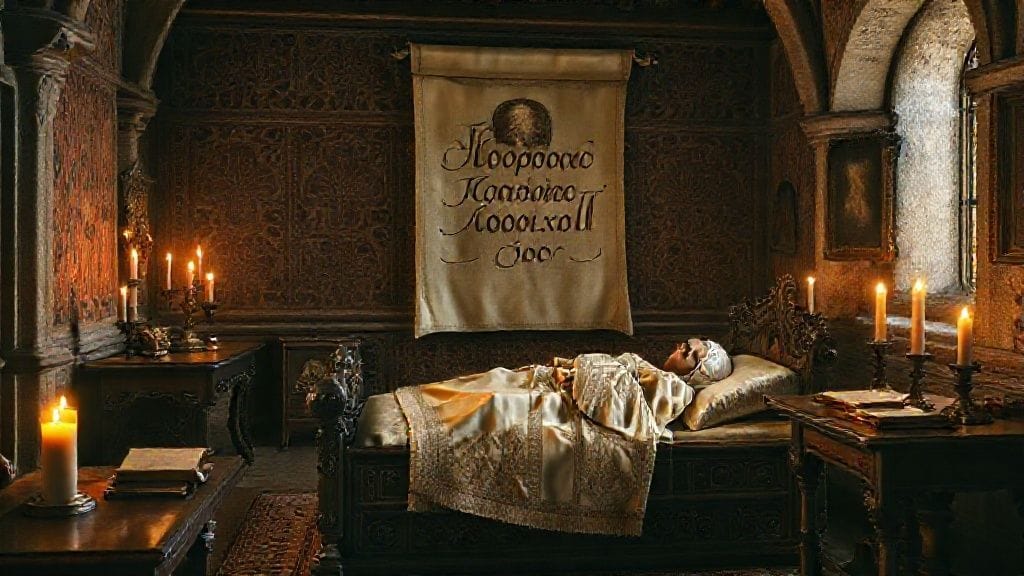
The pale winter light filtered through the stained glass of the papal chambers in Avignon, casting multicolored shadows on the stone floor. The once vigorous figure of Pope John XXII now lay still, a frail testament to decades of spiritual and temporal trials. His breath came slow, each inhalation a whispered farewell. Outside, the quiet murmur of the city mixed with the solemn prayers of cardinals who stood vigil. It was December 4, 1334 — a day that would mark the end of a turbulent and transformative papacy, setting the stage for profound shifts in European Christendom.
John XXII’s death closed a chapter not only on his contentious pontificate but also on a period marked by theological debates, political machinations, and the increasing estrangement of the papacy from Rome. The walls of the Palais des Papes, austere and resolute, seemed to mourn with the city as France’s political reach entwined inexorably with the spiritual heart of Europe. This was a moment heavy with emotion and portent, a death that echoed far beyond Avignon’s ancient stone.
2. The Setting: Avignon and the Papal Court in the 14th Century
To understand the magnitude of Pope John XXII’s passing, one must first grasp the peculiar nature of the Avignon Papacy. For almost four decades, the papal seat had been settled far from Rome’s ruins, nestled instead amidst the vineyards and sun-dappled hills of southeastern France. Avignon was not Rome; it was a papacy in exile, a city whose identity became inseparable from its pontiffs.
The papal court was both fortress and palace, a symbol of spiritual authority entangled in the politics of the French crown. Ever since Pope Clement V had moved the Curia in 1309, papal politics played out under the watchful eye of French kings, intertwining ecclesiastical fate with burgeoning national monarchies. When John XXII ascended the throne in 1316, he inherited not only a complex religious office but also a geopolitical chessboard bristling with tension.
3. Origins of Pope John XXII: From Cahors to the Vatican
Born Jacques Duèze in the modest town of Cahors, in the Quercy region of southern France, John XXII’s journey was emblematic of the medieval Church’s social mobility. Educated in theology and canon law, Duèze rose through the ecclesiastical ranks distinguished by intellect and political acumen. His early career saw him serve as bishop and cardinal, roles that forged his reputation as a shrewd administrator and a cautious conservative.
His French identity and cultivated ties with the royal court became assets in the fractious environment of the early 14th century. Yet Duèze’s ascent was not merely political; he was also a man deeply invested in the spiritual mission of the Church, even as it wrestled with internal schisms and external threats.
4. The Rise to Power: Election Amidst Turmoil
The death of Pope John XXII’s predecessor, Pope Benedict XI, in 1304 sparked a prolonged and contested conclave. Against a backdrop of tensions between Italian and French cardinals, and between secular rulers vying for papal influence, Duèze eventually secured the tiara in 1316.
His election was a compromise, reflecting divisions within the College of Cardinals, but also heralding an era where French influence would become paramount. John XXII’s papacy began under the shadow of conflict — with challenges both within the Church and against emergent secular forces threatening the medieval European order.
5. Religious and Political Challenges Under John XXII
John XXII faced a series of daunting problems: disputes with the Holy Roman Emperor Louis IV over imperial coronations, conflicts with the Franciscan friars over the nature of poverty and apostolic life, and rising calls for reform within the Church hierarchy.
His determination to consolidate papal power led him to strengthen the Curia’s bureaucracy and extend the Church’s fiscal reach through taxation and indulgences. This often bred resentment among both clerics and laity. Yet John was astute enough to read the shifting political landscape, balancing forceful assertions of authority with diplomatic engagements.
6. His Theological Controversies: The Beatific Vision Debate
Among the most enduring legacies of John XXII was his shockingly complex theological position on the "Beatific Vision" — the immediate vision of God by the souls of the righteous after death. Contrary to prevailing beliefs, John argued that the souls of the saved did not enjoy this vision until the Last Judgment.
This caused uproar among theologians and believers alike, casting a shadow of uncertainty over the afterlife, and challenging the faith of millions. His teachings were fiercely disputed, leading to tensions that lasted well beyond his pontificate.
7. Relations with Monarchs: The French Crown and the Empire
John XXII’s close ties with the French monarchy were both a strength and weakness. King Philip VI saw in the pope a useful ally to legitimize his ambitions, notably during the early years of the Hundred Years’ War.
Conversely, John’s fierce conflicts with Louis IV of Bavaria, Holy Roman Emperor, underscored the era’s struggle between spiritual and temporal powers. By refusing to recognize imperial authority and denying Louis’s coronation, John asserted papal supremacy but also deepened political fault lines in Europe.
8. The Papacy’s Time in Avignon: Context and Significance
The Avignon Papacy was often derided as the “Babylonian Captivity” of the Church. Yet under John XXII, Avignon became a vibrant seat of power, where architectural projects thrived, the arts blossomed, and administrative systems were refined.
The city’s transformation, including the expansion of the Palais des Papes, marked a new chapter in papal history — one where the spiritual mission of the Church was inseparable from its worldly dominion.
9. The Illness and Decline of Pope John XXII
The latter years of John XXII’s pontificate were increasingly marked by frailty and incapacitation. Historical accounts suggest he suffered from a wasting illness, possibly cancer or a debilitating infection, which gradually weakened his once-indomitable presence.
Despite his physical decline, he remained intellectually engaged and politically influential until his final days. The perplexing combination of personal vulnerability and imperial authority made his closing chapter both tragic and fascinating.
10. The Death of a Pope: December 4, 1334
When the final moment came on that cold December day, it was met with both quiet sorrow and tension. The papal chamber was alive with whispered prayers and the shuffling footsteps of the closest clerics, yet each heart knew the implications. The death of John XXII was not merely a spiritual loss; it was a pivotal event reverberating through the complex lattice of medieval Christendom.
His passing marked the end of an eighteen-year reign characterized by ambition, controversy, and transformation — a potent symbol of the Church’s shifting identity.
11. The Atmosphere in Avignon on That Fateful Day
Outside the stone ramparts, Avignon’s citizens felt the pall of uncertainty. Markets slowed, church bells tolled softly, and word spread through crowded streets. The city, so deeply entwined with its papal masters, braced for change.
Family groups huddled by hearths, sons whispered to fathers about the future, and the clergy prepared for the slow funeral rites that would usher their pontiff to rest.
12. Immediate Reactions: Cardinals, Clergy, and the People
Within the Curia, the cardinals moved swiftly to secure order. Their faces masked anxiety — the papal vacancy always sparked a delicate game of alliances and intrigues. Some mourned deeply; others weighed the prospects of influence.
The wider clergy issued prayers and masses, while common folk looked for signs and omens, interpreting the event within the tapestry of their faith and fears.
13. The Conclave: Choosing a Successor in a Fraught Era
John XXII’s death triggered a conclave fraught with factionalism. The cardinals, split by regional loyalties and theological leanings, faced the challenge of preserving papal unity amidst increasing secular pressures.
The process would take months, highlighting the fragile balance between spiritual authority and political machinations that defined the Avignon Papacy.
14. Political Consequences of John XXII’s Death
John XXII’s demise emboldened rival factions across Europe. Monarchs recalibrated alliances, while the Holy Roman Empire saw an opportunity to challenge papal supremacy.
Within the Church, conservative and reformist elements jockeyed for influence, setting the stage for future turmoil and the eventual fracturing of western Christendom.
15. John XXII’s Legacy: Theology, Politics, and Urban Transformation
While his death closed a personal chapter, John’s influence endured. His administrative reforms shaped the Curia for generations, and his theological debates lingered in scholastic discourse.
Avignon, transformed by his patronage, remained a testament to his vision — both a sanctuary and a symbol of papal authority removed from Rome’s traditional heart.
16. The Death’s Impact on the Avignon Papacy’s Longevity
Far from heralding immediate decline, John XXII’s death paradoxically reinforced the Avignon Papacy’s grip on power. His successor would build on his legacy, extending the papal exile for decades.
Yet the seeds of dissent planted during his reign would gradually erode the Church’s unity, culminating in schisms and conflicts that reshaped Christianity.
17. Cultural Memories and Historical Interpretations
Historians have long debated John XXII’s pontificate — painting him variously as a despotic autocrat, a visionary reformer, or a conflicted man of faith.
His death remains a poignant moment for scholars and storytellers, a fulcrum illustrating the tensions between earthly power and spiritual mission in medieval Europe.
Conclusion
The death of Pope John XXII on December 4, 1334, was more than the passing of a single man; it was the closing of a complex and often contentious epoch in Church history. As twilight settled over Avignon, it illuminated the profound challenges faced by a papacy caught between tradition and transformation, faith and politics, exile and authority.
John XXII’s enduring legacy is a portrait of paradox — a pontiff who wielded immense power yet grappled with profound theological uncertainty; who shaped the Church’s administrative future and yet presided over growing estrangement from Rome. His death was a somber reminder that even institutions as grand as the papacy hinge on fragile human lives.
The world of the 14th century, restless and fractured, would soon face wars, schisms, and reforms — but the echoes of John XXII’s reign and demise resonated through these upheavals, forever marking the history of medieval Europe.
FAQs
Q1: What were the main causes leading to Pope John XXII’s death?
While precise medical records are lacking, chronic illness such as cancer or infection likely contributed to his decline in health over his final years.
Q2: How did the Avignon Papacy differ from the traditional papal seat in Rome?
The Avignon Papacy (1309–1377) was marked by the papacy’s relocation to southeastern France, creating a period where the Church was viewed as influenced heavily by French politics rather than operating from Rome.
Q3: What controversies defined John XXII’s pontificate?
He was embroiled in political conflicts with the Holy Roman Empire and France, theological disputes like the Beatific Vision, and tensions with religious orders such as the Franciscans.
Q4: Who succeeded John XXII, and how was his death pivotal to the conclave?
Benedict XII succeeded him. John XXII's death opened a conclave filled with factionalism, making the election a significant political event.
Q5: In what ways did John XXII impact the city of Avignon?
He expanded the Palais des Papes and enhanced the administrative apparatus, embedding Avignon’s identity as a papal city.
Q6: How has John XXII’s death been interpreted by historians?
Opinions vary: some see him as authoritarian, others as a reformer or pragmatic leader, reflecting his complex legacy.
Q7: Did John XXII’s death affect the later Avignon Papacy or the Western Schism?
His reign set precedents that prolonged papal exile and contributed to tensions leading to the Western Schism.
Q8: How was the papal death ritual observed in the 14th century?
It involved vigil prayers, funeral masses, and a conclave to elect the successor, all replete with political and spiritual significance.

