Table of Contents
- A Winter Evening in Rome: When the Longest Reign Reached Its Final Hour
- From Senigallia to the Vatican: The Making of Giovanni Maria Mastai-Ferretti
- A Liberal Hope on the Throne of Peter: The Early Years of Pius IX
- Revolution, Exile, and Return: The Shattering of Papal Liberalism
- The Pope Who Refused to Yield: Pius IX and the Loss of the Papal States
- Syllabus of Errors and the Hardening of a Papal Age
- The First Vatican Council and the Triumph of Papal Infallibility
- A Prisoner in His Own Palace: Life in the Vatican After 1870
- Faithful Crowds and Bitter Enemies: The Polarized World Around Pius IX
- The Pope’s Failing Health: A Long Descent Toward February 1878
- The Night pope pius ix dies: Inside the Apostolic Palace
- Rome Reacts at Dawn: Bells, Banners, and Silent Streets
- A City of Two Governments: Italian Authorities and the Vatican in Mourning
- The Body of the Pontiff: Ritual, Preservation, and Veneration
- Diplomats, Devotees, and Detractors: An International Farewell
- The Conclave of 1878 and the Election of Leo XIII
- The Long Shadow of a Long Pontificate: Political and Social Consequences
- From Controversy to Beatification: Remembering Pius IX
- Conclusion
- FAQs
- External Resource
- Internal Link
Article Summary: On a cold February evening in 1878, as Rome adjusted to its new role as capital of a united Italy, pope pius ix dies within the walls of the Apostolic Palace, ending the longest pontificate in history. His death closes not only a life but an entire era, marked by revolutions, the collapse of the Papal States, and the rise of modern nation-states. The article traces his journey from provincial nobleman Giovanni Maria Mastai-Ferretti to embattled pontiff who called Vatican I and defined Papal Infallibility. Through scenes of exile, political intrigues, and religious devotion, we witness how he turned from a symbol of liberal hope into a banner of intransigent Catholic resistance. When pope pius ix dies, Rome becomes a stage on which monarchs, revolutionaries, and humble pilgrims all respond in their own ways. The narrative explores how his passing reshaped Church politics, Italian national identity, and global Catholicism. It also follows the immediate transition to Leo XIII and the long, sometimes painful struggle over the memory of this controversial pope. In doing so, it shows why the moment pope pius ix dies still reverberates through religious and political history.
A Winter Evening in Rome: When the Longest Reign Reached Its Final Hour
On the evening of February 7, 1878, a damp chill lay over Rome. The city, no longer the sleepy ecclesiastical capital of the Papal States but the proud heart of a newly unified Kingdom of Italy, inhaled the cold air of modernity and uncertainty. Within the thick, ancient walls of the Apostolic Palace, a very different kind of chill was settling in: the slow, unmistakable stillness that signals the end of a life. This was the night pope pius ix dies, and with him, a world that had resisted dying for over three decades finally began to loosen its grip on history.
The lamps in the Vatican corridors burned low, their golden light swallowed by dark tapestries and marble shadows. Outside, the city’s gaslights flickered on the streets around the Tiber, reflecting on the cold water like trembling stars. In the papal apartment, cardinals, doctors, and attendants moved with the careful slowness of those who know that any sound, any misstep, might be the last thing a dying man hears. Giovanni Maria Mastai-Ferretti, Pope Pius IX, the man who had worn the tiara since 1846, lay weak and swollen, his breathing labored, his once commanding voice reduced to a rasp of prayer and pain.
For many Romans, the news had been anticipated for weeks. Tales of the pope’s failing health had traveled through the city’s cafés, sacristies, and barracks. Some spoke of him with affection, recalling the early days of his pontificate, when he had been hailed as a liberal reformer and liberator of political prisoners. Others spoke of him with rancor, remembering his hard stance against Italian unification and the Syllabus of Errors, which denounced modern liberties and secular ideologies. But that night, most people fell silent. The city understood that when pope pius ix dies, he will carry with him the last living claim of the papacy to temporal sovereignty over central Italy, a claim already battered by cannons and treaties.
In a nearby room, a small group of prelates whispered in Latin and Italian, glancing nervously at the heavy door that separated them from their dying pontiff. They were already thinking of what must follow: the ritual procedures, the novendiali mourning, the conclave. The Church had rules for everything, even the death of the man who embodied it. Yet behind the procedures lurked something rules could not capture—a sense that this particular death would mark the end of an age in which popes not only preached and blessed but ruled land, collected taxes, and commanded soldiers.
It is astonishing, isn’t it? In 1846, Pius IX had come to the throne at a moment when nationalism was still a dream; by 1878, Italy existed as a single kingdom with Rome as its capital, and the pope had been reduced, in his own words, to a “prisoner in the Vatican.” To understand the emotions swirling in those corridors as pope pius ix dies, we must go back to the beginning—back before the Syllabus, before the revolutions, before Porta Pia—to a young boy in a provincial town on the Adriatic coast, whose epileptic fits and fragile health seemed to destine him for anything but the burdens he would one day carry.
From Senigallia to the Vatican: The Making of Giovanni Maria Mastai-Ferretti
Giovanni Maria Mastai-Ferretti was born on May 13, 1792, in Senigallia, a modest town in the Papal States facing the Adriatic Sea. The French Revolution had already shattered the old European order, but its echoes were only slowly reaching the shores of the Papal territories. The Mastai-Ferretti family belonged to the minor nobility—comfortable, respected, but hardly powerful. His parents, Count Girolamo Mastai-Ferretti and Caterina Solazzi, could scarcely have imagined that the sickly child in their arms would one day rule the Church longer than almost any man before him.
From an early age, Giovanni struggled with health, particularly epileptic seizures that threatened both his education and his future. In a world where physical frailty could mean exclusion from certain paths, he bore the quiet stigma of his condition. The boy, however, possessed a sensitive intelligence and a contemplative nature. Educated initially in the Piarist College in Volterra and later in Rome, he absorbed both the devotional Catholic tradition of the Papal States and the unsettling ideas drifting in from revolutionary France and the Napoleonic conquests.
The Napoleonic occupation of the Papal States during Giovanni’s youth left a deep imprint on his imagination. He witnessed firsthand how armies and treaties could sweep away centuries-old structures of power. The pope, once an unquestioned temporal ruler, was humiliated and exiled. Churches were turned into barracks; religious orders were suppressed. The young Mastai-Ferretti saw how fragile the Church’s political foundation could be, even as he clung to its spiritual solidity. This early lesson in vulnerability would later feed both his instinct for reform and his resolve never to surrender what he believed was divinely entrusted authority.
Despite his health issues, Giovanni pursued the priesthood, overcoming repeated obstacles. One bishop is said to have hesitated to ordain him because of his epilepsy; yet the young man’s perseverance and evident piety prevailed. He was finally ordained a priest in 1819. His early ministry included service at the Tata Giovanni Institute for poor children in Rome and a diplomatic mission to Chile and Peru—an eye-opening journey that exposed him to the realities of a post-colonial world and a global Church.
That mission to Latin America, from 1823 to 1825, would haunt and inspire him. Traveling by ship across the Atlantic, he endured storms, illness, and the jarring sight of faith and politics pulling in opposite directions on a new continent. The Cradle of the Church, Europe, might have been in crisis, but in the Americas, Catholicism was wrestling with fledgling republics, changing allegiances, and anticlerical movements. When he returned to Rome, Mastai-Ferretti had seen enough to know that the Church would have to learn to navigate modern political waters without losing its soul.
In 1827, Pope Leo XII appointed him Archbishop of Spoleto. His episcopal motto, “Crux de Cruce” (the cross from the cross), hinted at his understanding that suffering and contradictions were woven into the fabric of Christian leadership. As bishop, and later as Archbishop of Imola, he showed a capacity for mild reforms and a concern for pastoral care. Unlike some of his more aristocratic counterparts, he was known to move among his priests and people with a certain directness, even a simplicity that would later make him beloved in the early days of his papacy.
By the early 1840s, Giovanni Maria Mastai-Ferretti had built a reputation as a moderate, pastoral, somewhat open-minded prelate—orthodox in doctrine, but not rigid in manner. When Pope Gregory XVI, an intransigent conservative, died in 1846, Europe was approaching a volcanic moment. Across the continent, secret societies and revolutionary circles plotted constitutional reforms, national unity, or outright revolution. In that context, the cardinals gathering in Rome for conclave were under immense pressure to find a man who could calm the winds without being crushed by them. They turned, eventually, to the fifty-four-year-old Archbishop of Imola.
A Liberal Hope on the Throne of Peter: The Early Years of Pius IX
When Giovanni Maria Mastai-Ferretti was elected pope on June 16, 1846, most of Rome did not yet know his name. But the city learned it quickly. Taking the name Pius IX—linking himself to Pius VIII, but with very different undertones—he stepped onto the balcony of St. Peter’s to impart his first blessing, and the assembled crowd saw not a dour old conservative but a relatively young, approachable figure, whose large, expressive eyes and warm demeanor gave him an air of unexpected accessibility.
In the first months of his pontificate, Pius IX astonished Europe. He introduced moderate reforms in the Papal States: a civic guard, a limited amnesty for political prisoners, and the establishment of a consultative council of laymen. He improved infrastructure, supported railroads, and opened cautious dialogues with elements of the movement for Italian reform. Liberal newspapers in Italy and beyond hailed him as the “liberal pope.” Some even dreamed he might lead the cause of Italian unification in a confederation of states under papal guidance.
Behind the scenes, however, Pius IX was walking a tightrope. He believed deeply in the spiritual mission of the papacy, yet he also knew that the old ways of governing the Papal States—through rigid censorship, police surveillance, and absolute monarchy—were unsustainable. His reforms were genuine, but they had clear limits. He would not sanction secret societies like the Carbonari, nor would he tolerate open attacks on Church doctrine. Still, in 1847, when he allowed a civic guard to be formed and a constitution to be drafted, many Italians felt that a new dawn had begun.
Foreign observers were struck by the transformation. The French writer Alexis de Tocqueville noted in his correspondence how Europe watched the “new pope” with fascination, wondering whether a reformed papacy could play a constructive role in a liberal age. Pilgrims flocked to Rome to see this extraordinary figure who, dressed in white, seemed to blend ancient authority with hints of modern sensibility. It was as if history had found a compromise, a way for the old throne of Peter to sit comfortably in a changing world.
But this was only the beginning, and the currents swelling under the surface were far stronger than any one man, even a pope, could control. The same crowds that cheered him would, within two years, demand that he bless a war against Catholic Austria, and condemn him when he refused. The Pius IX who opened prisons would soon be accused of building invisible ones: doctrinal condemnations, tightened discipline, and an unyielding refusal to let the Church be swallowed by nationalism.
In early 1848, Europe exploded. Paris, Vienna, Berlin, Milan, Venice—each city became a chapter in the revolution that would be remembered simply as “’48.” In Rome, too, popular pressure surged toward a breaking point. Liberals and radicals wanted the pope to lead Italy’s struggle for independence and unity. Pius IX felt sympathy for Italian suffering under foreign rule, but he recoiled from the idea of the pope as a secular nationalist leader. His conscience told him that he could not declare war on Catholic Austria without betraying the universal mission of his office.
In April 1848, he refused to bless a war of aggression against Austria. The reaction was immediate and furious. The man who had been hailed as a liberal hero became, almost overnight, a disappointment, even a traitor, in the eyes of many radicals. The fragile bridge between the papacy and modern liberal nationalism cracked—and soon it would collapse entirely, setting the stage for the turmoil that would define the rest of his pontificate and make the night when pope pius ix dies a symbol of that great, unresolved conflict.
Revolution, Exile, and Return: The Shattering of Papal Liberalism
The year 1848 was a crucible for Pius IX. What had begun as cautious reform turned into a storm of expectation and rage. On November 15, 1848, the assassination of his prime minister, Count Pellegrino Rossi, by a nationalist assassin outside the Palazzo della Cancelleria, sent shockwaves through the papal court. Rossi’s blood on the Roman stones was both a warning and a verdict: the moderate path was failing.
Within days, the situation spiraled. Demonstrators gathered before the Quirinal Palace, demanding a democratic government and war against Austria. Pius IX, shaken and fearing for his life, withdrew into the depths of palatial isolation. As pressures mounted, he made a decision that would haunt him and his image for decades. On the night of November 24–25, disguised and under cover of darkness, the pope fled Rome. Escorted by loyalists, he made his way to Gaeta, a fortress town in the Kingdom of the Two Sicilies.
In his absence, Rome declared itself a Republic. Giuseppe Mazzini, the revolutionary patriot, became one of its triumvirs. The Roman Republic tried to enact liberal reforms and separate Church and state, but it existed precariously under the guns of European powers. Pius IX, in exile, watched as a city that had been his capital attempted to redefine itself without him. The papal dream of guiding modern change was replaced by a nightmare of revolutionary secularism on his very doorstep.
By July 1849, French troops under General Oudinot crushed the Roman Republic and restored papal authority. Pius IX returned to Rome, but it was not the same Rome, and he was not the same pope. The experience of exile and the betrayal he felt at the hands of Italian nationalists convinced him that concessions to modern liberalism were a path to ruin. He would later call 1848 “the greatest disaster of the age.” The man who had once embodied liberal hope now began to build a bastion of Catholic resistance to the modern world.
This turn was not merely personal; it was institutional and doctrinal. The Church’s fear of revolution—reinforced by the specter of anticlerical violence in 1848 and beyond—nourished a theology that saw modern political liberalism, secularism, and nationalism as existential threats. Pius IX became the face and voice of that position. When he knelt before the tomb of the Apostle Peter after his return, he was not only a restored ruler; he was a beleaguered fortress commander, determined to hold out at all costs.
The bitterness of that period shaped the emotional tone of his later life. Even as he joked with visitors and displayed a common touch, he never forgot that Romans had cheered his departure and welcomed a republic in his place. As the years went on, the hope that had greeted his election faded into the hardened certainty of a man convinced that compromise could only end in catastrophe. That conviction would shape his response to the Italian unification movement, the creation of the Kingdom of Italy, and, eventually, the loss of the Papal States—a series of blows that made the moment when pope pius ix dies not just the death of a man but the symbolic burial of a political order.
The Pope Who Refused to Yield: Pius IX and the Loss of the Papal States
The 1850s and 1860s were years of mounting pressure. As nationalist forces under leaders like Count Camillo di Cavour, Giuseppe Garibaldi, and King Victor Emmanuel II advanced the cause of Italian unification, the Papal States became an anomaly—an island of clerical rule in a rising sea of constitutional monarchies and national parliaments. The pope’s territories stretched from the Tyrrhenian Sea to the Adriatic, but they were increasingly encircled by the modern Italian state in the making.
Pius IX responded with a blend of spiritual confidence and political rigidity. He shored up the papal administration, strengthened relations with conservative Catholic monarchies, and relied heavily on foreign troops—French, Austrian, and others—to protect his temporal domains. Yet every year seemed to erode the ground under his feet. In 1860, following battles like Castelfidardo, most of the Papal States fell to the forces of the Kingdom of Sardinia, soon to become the Kingdom of Italy. The pope retained control only of Rome and a small surrounding territory, safeguarded largely by a French garrison.
To many Italians, this was progress, the inevitable completion of the Risorgimento. To Pius IX, it was usurpation—a sacrilege against the temporal authority he believed God Himself had placed in the hands of the popes. He became, increasingly, a symbol of resistance. Pilgrims came to Rome and saw a sovereign surrounded by enemy lands, clinging to the few last vestiges of his ancestral domain. Catholic newspapers across Europe portrayed him as a martyr of modern politics, while liberal journalists painted him as a stubborn relic refusing to recognize the future.
The decisive blow came in 1870. When the Franco-Prussian War broke out, Napoleon III withdrew his troops from Rome, leaving the city exposed. The Italian government, under Victor Emmanuel II, saw its opportunity. In September 1870, Italian forces marched on Rome. On September 20, after a brief cannonade, they breached the Aurelian Walls at Porta Pia. The pope’s small army could not withstand a modern national army backed by popular sentiment. Rome fell, and by October, a plebiscite confirmed its annexation to the Kingdom of Italy.
Pius IX retreated behind the walls of the Vatican, refusing to recognize the legitimacy of Italian rule over his former capital. In an act both symbolic and deeply personal, he declared himself a “prisoner” in the Vatican. For the rest of his life, he would refuse to leave the tiny papal enclave. Audiences continued, petitions were heard, encyclicals were written—but the days of the pope riding in public processions through streets that were legally his had ended. The world around him called it defeat; he called it fidelity.
The bitterness of that loss seeped into every corner of his last years. He railed against the “usurpation” and refused to accept financial arrangements like the Italian Law of Guarantees, which sought to regulate the status of the papacy within the new kingdom. To admit such terms, he felt, would be to concede that the pope’s temporal power was negotiable. He preferred isolation to compromise. As a result, when pope pius ix dies in 1878, he leaves behind a papacy that is territorially shrunken but morally, in the eyes of many believers, purified—stripped of worldly trappings and transformed into a spiritual bastion set against an encroaching secular world.
Syllabus of Errors and the Hardening of a Papal Age
Pius IX’s political losses were accompanied by a fierce campaign to assert doctrinal control. Nowhere is this more evident than in the 1864 “Syllabus of Errors,” a document that, even today, still symbolizes the antagonism between the nineteenth-century papacy and modern secular thought. Issued alongside the encyclical Quanta Cura, the Syllabus listed eighty propositions condemned by the pope, ranging from religious indifferentism and rationalism to the notion that the pope should reconcile himself with progress, liberalism, and modern civilization.
To liberal Catholics and secular intellectuals, the Syllabus confirmed their worst fears: the papacy had planted itself firmly against the spirit of the age. To conservative Catholics, however, it was a clarion call, an unambiguous stand against the erosion of faith in the name of “progress.” Newspapers, pamphlets, and sermons across Europe debated its meaning. Some statesmen wondered whether the papacy, under Pius IX, would ever again find common ground with constitutional governments. As the historian Owen Chadwick later observed, Pius IX “refused to see the nineteenth century as anything but a plague,” though his personal demeanor often remained charming and even playful.
Behind the Syllabus lay the trauma of 1848 and the loss of the Papal States, as well as the pope’s deep conviction that truth could not be subject to a vote or a bargain. He saw himself as the guardian of a deposit of faith threatened by a flood of new philosophies and political ideologies. His language was not diplomatic; it was prophetic, even apocalyptic. If liberalism meant that all religions should be equal before the law, he feared it would lead to the marginalization and eventual extinction of Catholicism in public life. Therefore, he drew a hard line.
In Rome, the Syllabus became part of a broader project of Catholic renewal—devotional revivals, Marian piety, Eucharistic adoration, and a reaffirmation of papal authority. In 1854, Pius IX had already defined the dogma of the Immaculate Conception of the Virgin Mary, declaring that she had been conceived without original sin. This act, taken by many as an expression of his confidence in papal teaching authority, prefigured a more sweeping doctrinal development that would arrive a decade and a half later at the First Vatican Council.
These doctrinal moves were not isolated from politics. In his view, a world that rejected papal authority in temporal matters must at least be confronted with the undiminished spiritual and doctrinal supremacy of Peter’s successor. Consequently, by the time pope pius ix dies, the image of the papacy had been transformed: if earlier popes were seen as sovereigns among sovereigns, negotiating treaties and territory, Pius IX’s legacy pushed his successors toward being moral and doctrinal beacons, often standing apart from the state rather than alongside it.
The First Vatican Council and the Triumph of Papal Infallibility
If one moment in Pius IX’s pontificate symbolized this new understanding of the papacy, it was the First Vatican Council (Vatican I), convened in 1869. Bishops from across the Catholic world gathered in Rome to discuss the challenges of modernity and the structure of authority within the Church. Among the most contentious issues on the agenda was the question of papal infallibility—whether, and under what conditions, the pope could speak without error in matters of faith and morals.
For Pius IX, the doctrine of infallibility was not an exercise in self-glorification but an essential clarification in an age of doubt. He believed that, amid the storms of revolution and secularization, the faithful needed a rock that could not be moved by changing political currents or intellectual fashions. By defining the pope’s capacity to teach infallibly, the Church would affirm that divine truth did not depend on parliamentary votes or newspaper editorials.
Not all bishops agreed. Some, particularly from Germany, Austria, and France, feared that a strong definition would alienate governments and encourage the perception of the Church as a rigid autocracy. They sought a more nuanced expression of papal authority, one that preserved the role of bishops and tradition. Debates in the council hall—beneath the soaring dome of St. Peter’s—were heated, emotional, and, at times, dramatic. Eyewitnesses described tears, impassioned speeches, and intense lobbying.
Nevertheless, on July 18, 1870, the council adopted the constitution Pastor Aeternus, proclaiming that when the pope speaks ex cathedra—from the chair of Peter—on matters of faith and morals, intending to bind the whole Church, he is preserved from error by the Holy Spirit. Many of the minority bishops left Rome before the final vote, but the decision stood. The doctrine of papal infallibility became law, and Pius IX, the man who had suffered humiliation and exile, now presided over a papacy whose spiritual authority had never been more clearly defined.
Ironically, only two months later, the thunder of cannons at Porta Pia interrupted the council, which was suspended and never formally closed until the twentieth century. The Council that crowned papal spiritual authority coincided almost exactly with the collapse of papal temporal power. This paradox would define how later generations remembered Pius IX. When pope pius ix dies eight years later, obituaries and eulogies would constantly return to this tension: a pope who lost his land but strengthened his throne, who became, in the words of one contemporary Catholic writer, “poorer in kingdoms, richer in souls.”
A Prisoner in His Own Palace: Life in the Vatican After 1870
After the fall of Rome to Italian troops in 1870, Pius IX withdrew behind the Leonine Walls and embarked on what would be the final chapter of his life: the era of the “prisoner pope.” He refused to step outside the tiny Vatican enclave or to acknowledge the authority of the Italian state over Rome. Officially, he considered himself deprived illegally of his sovereignty; unofficially, he used the situation to dramatize the Church’s conflict with a secularizing world.
Daily life in the Vatican during these years acquired a strange, almost theatrical quality. On one hand, it was a palace—a labyrinth of frescoed halls, chapels, and glittering reception rooms. On the other, it was a self-imposed cage. Protocol changed: public ceremonies like the great Corpus Christi processions through Rome’s streets were replaced by more contained liturgies within the basilica of St. Peter’s. The pope’s world grew inward even as the world outside expanded with railways, telegraphs, and parliamentary debates.
Pius IX aged visibly in this period. He suffered from arthritis and other ailments that limited his mobility, yet he continued to receive visitors. Many left accounts of a man whose personal charm and humor survived the bitterness of politics. He made jokes at his own expense, teased children, and spoke with warmth about the Church’s future, even while lamenting what he saw as the sins of the times. One French pilgrim recalled that the pope, after blessing her, remarked with a twinkle, “They say I am a prisoner. If so, I have many kind jailers.”
The Vatican itself became a symbol of resistance. Pilgrims streamed into Rome to show solidarity with the “imprisoned” pontiff. They filled St. Peter’s Square, knelt before the bronze statue of Peter, and lined up for audiences in which they sought indulgences, graces, and moral guidance. Money flowed in, too, as Catholics worldwide contributed to the “Peter’s Pence,” a collection designed to support the pope in his supposed exile. The more the Italian state tried to portray the pope as a respected but essentially private religious figure, the more Catholics rallied around him as a global spiritual monarch.
This curious mixture of isolation and internationalization laid the groundwork for the modern papacy. Pius IX’s retreat behind the walls sharpened the contrast between Church and state, focus and dispersion. It made the Vatican into something new: not the center of a territorial empire, but the nerve center of a worldwide religious community. By the time pope pius ix dies, this reimagined role was already taking shape, though no one could yet foresee how—under successors like Leo XIII and Pius XI—it would evolve into a diplomatic and moral power with influence far beyond its tiny territorial footprint.
Faithful Crowds and Bitter Enemies: The Polarized World Around Pius IX
The latter years of Pius IX’s pontificate unfolded against a backdrop of intense polarization. For devout Catholics, especially those alarmed by growing secularism, anticlerical legislation, and cultural shifts, he became a beloved father figure. They cherished his firmness, his Marian spirituality, his defense of Catholic rights in an often-hostile world. In countries like France, Austria, Spain, and Ireland, ultramontane movements arose—Catholics who looked “beyond the mountains” to Rome as their ultimate authority, even against their own national churches or governments.
On the other side, many liberals and secular thinkers saw Pius IX as the personification of everything they opposed. To them, he was the pope who condemned freedom of the press, opposed the separation of Church and state, and refused to accept the legitimacy of modern democracies. Satirical cartoons in European newspapers depicted him as a medieval monarch clinging to his tiara while the modern world marched past. He was lampooned as the “Pope-King,” an anachronism surrounded by incense and bayonets.
Yet behind the caricatures lay a more complex reality. Pius IX’s policies were uncompromising, but his personal interactions often softened the edges. He wept when told of Catholics persecuted under hostile governments. He blessed objects brought by peasants who had walked for days to see him. He listened patiently to religious sisters and missionaries describing their work in far-off lands. The same man who signed the Syllabus could also be found pressing rosaries into the hands of trembling pilgrims, whispering words of consolation.
This dual image—iron pope and gentle father—ensured that his death would be experienced not only as a political milestone but as a deeply personal loss by millions. When pope pius ix dies, the tears shed in dark village churches were not for a controversial encyclical or a lost piece of territory; they were for the “Holy Father” whom many had never seen but felt they knew. At the same time, in government chambers and editorial offices, his passing would be met with calculation and, in some cases, relief. Perhaps a new pope, they hoped, would be more flexible, more willing to negotiate, more attuned to the realities of the nineteenth century.
The Pope’s Failing Health: A Long Descent Toward February 1878
By the mid-1870s, age and illness were catching up with Pius IX. He was over eighty, weighed down by decades of tension, and plagued by rheumatism, gout, and other chronic conditions. His legs swelled painfully; climbing stairs became difficult; long ceremonial liturgies demanded ever greater effort. Doctors visited regularly, prescribing rest and treatments that offered only temporary relief.
Still, he clung to his duties with stubborn perseverance. “I must work while it is still day,” he reportedly told an aide, echoing the Gospel. Audiences continued, though shorter. He sat more frequently, walked less, leaned on canes and attendants. Observers noticed that his face, once animated and expressive, sometimes slid into an expression of exhausted weariness when he thought no one was watching.
Rumors about his health circulated through Rome and beyond. Each winter, people wondered if he would survive the cold and damp that seeped into the Vatican’s ancient stone. In 1877, his condition worsened significantly. Swelling in his legs and feet made even short walks agonizing. Breathing became more labored. His doctors, recognizing that they could not halt the decline, focused on alleviating pain. Within the palace, a sense of watchful waiting settled like dust on the corridors.
Yet he refused to yield entirely to infirmity. On feast days, he appeared at the window overlooking St. Peter’s Square to bless the crowd, even if only briefly. His voice was weaker, his gestures smaller, but the symbolic act mattered. Many in the square knew they were seeing him for the last time. Devotional magazines of the period published engravings of the “aged pontiff,” white-haired, stooped, yet still clad in glittering pontifical robes, as if the vestments could support what the failing body no longer could.
By early 1878, it was clear that the end was near. The pope’s attendants maintained a strict protocol of discretion, but cardinals and diplomats understood the gravity of the situation. Some rushed to Rome, fearing they might miss the last days. Others waited for official word before making travel plans. As Pius IX’s strength ebbed, the weight of his long pontificate pressed on the minds of those around him: the man who had seen 1848, who had defined the Immaculate Conception, who had presided over Vatican I, who had seen Rome fall, was now slowly exiting the stage.
The Night pope pius ix dies: Inside the Apostolic Palace
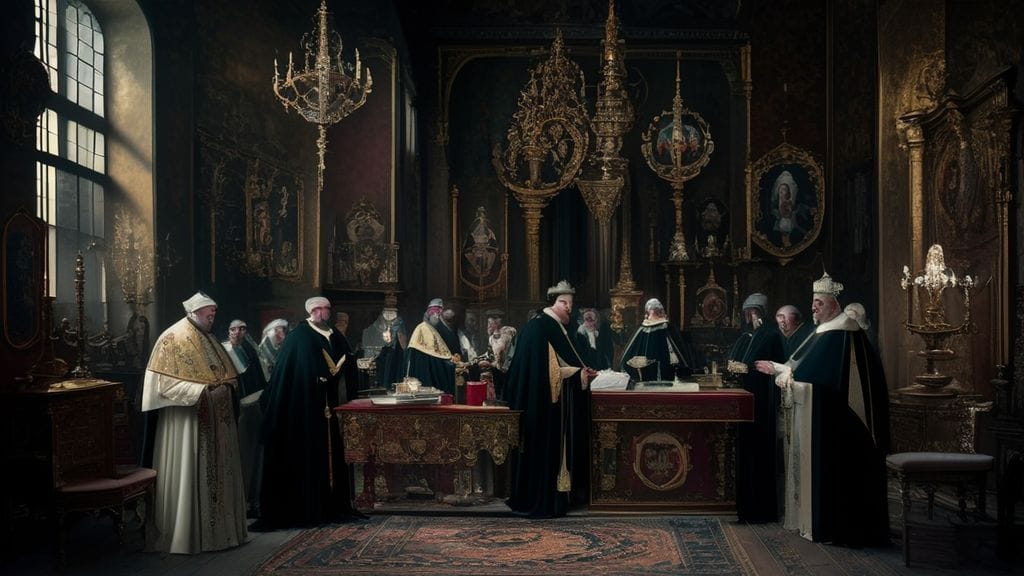
The evening of February 7, 1878, descended slowly over Rome, the sky above the dome of St. Peter’s turning from gray to indigo. Inside the Apostolic Palace, the lamps had already been lit. Curtains muffled the outside world, as if the very architecture was conspiring to create a space apart from time. In the pope’s chamber, the atmosphere thickened with incense, candle smoke, and the quiet murmur of prayer.
Pius IX lay in his bed, propped up by pillows, his once-robust frame now reduced by disease and age. A crucifix rested within his sight. Nearby, a small table held a candle, a glass of water, and a few personal objects—a rosary, perhaps, a small statue, letters from loved ones and far-off friends. Physicians stood at a respectful distance, ready but essentially powerless. Those present understood that modern medicine could not do what faith, hope, and ritual had been summoned to accomplish: to ease a soul from this life to the next.
Cardinals entered in small groups, kneeling briefly at the bedside before withdrawing to a corner to recite their prayers. Some wept openly. Others kept their composure, already thinking of the conclave to come. The ceremonial order for the death of a pope was clear, but the human heart is not so easily regimented. Memories flooded their minds: the young, hopeful Pius of the 1840s; the exiled pope of Gaeta; the defiant sovereign of the 1850s and 1860s; the “prisoner of the Vatican” of recent years. Now, all those faces resolved into one pale, tired visage, the mouth moving silently in prayer.
A confessor administered the last rites—the Anointing of the Sick and the Apostolic Blessing in articulo mortis. Those in the room answered the prayers in low voices, Latin phrases blending with faint sobs. A few attendants noted the exact times, as required: the beginning of the rite, its conclusion, the waxing and waning of the pontiff’s breathing. In such moments, the Church’s insistence on precision and ceremony became a way of holding grief at bay.
As the night wore on, the pope’s breathing grew more shallow. Witnesses later recalled that he squeezed a crucifix or rosary in his hand, the final gesture of a life steeped in devotion. Outside, in the Vatican courtyards, Swiss Guards and other attendants waited in tense silence, their breath visible in the cold air. Beyond the walls, a few Romans lingered in the streets, staring up at the dark windows, aware by rumor or intuition that something momentous was happening inside.
Then, at a certain hour—sources give slightly varying times, but all agree it was late—the breathing stopped. A physician approached the bed, listened, checked for a pulse. After a brief, solemn pause, he nodded. pope pius ix dies, and with that simple, unadorned fact, one of history’s longest and most turbulent pontificates came to an end. Those present knelt. Some kissed the ring that would soon be destroyed, as tradition required. A few whispered, “Requiescat in pace.”
Almost immediately, the machinery of ritual began to whir into motion. A chamberlain would soon perform the ancient ceremony of calling the pope by his baptismal name three times, gently striking his forehead with a small silver hammer—a symbolic act confirming death. The fisherman’s ring would be broken to prevent any further use in sealing documents. The death would be announced discreetly within the palace, then to the ambassadors and, finally, to the world. Yet, for a brief interval that night, there was only stillness, candlelight, and the overwhelming realization that an era had ceased to breathe.
Rome Reacts at Dawn: Bells, Banners, and Silent Streets
When the news spread through Rome on the morning of February 8, the city awakened to a strange calm. The pope had died in the night, and though many had expected it, the reality still landed like a stone in the basin of public consciousness, sending ripples in all directions. Church bells began to toll a slow, measured knell, their sound rolling over tiled roofs and narrow alleyways, across the Tiber, and up into the newly built districts of the Italian capital.
In the older quarters near the Vatican, people made the sign of the cross instinctively when they heard the bells. Some hurried to nearby churches, where priests, already informed, had begun to set black draperies or prepare special Masses for the dead pontiff. In poorer neighborhoods, women murmured prayers at their windowsills, while children, half-understanding, asked why the bells sounded so differently that morning.
Yet Rome was no longer simply a papal city; it was the capital of a kingdom. The Italian government received the news with formal sobriety. Flags on public buildings were lowered to half-mast—a gesture of respect that also acknowledged the delicate balance the state sought to maintain: honoring a religious leader whose temporal claims it had rejected. In government offices, ministers and clerks discussed what this might mean for Italy’s relationship with the Holy See. Some hoped that a new pope might accept the Law of Guarantees and recognize the status quo. Others warned that the College of Cardinals was unlikely to reverse Pius IX’s hard line overnight.
Newspapers rushed to print special editions. In Rome and other Italian cities, editorials sketched his life in broad strokes, some critical, some surprisingly sympathetic. Conservative Catholic papers in other countries, such as France and Spain, published black-framed front pages, lauding him as “Pius the Great” or the “Martyr of the Papacy.” More liberal presses emphasized his opposition to modern liberties but acknowledged the dramatic sweep of his pontificate. One French journalist wrote that “with the death of Pius IX, the nineteenth century loses one of its most obstinate adversaries and, paradoxically, one of its most characteristic figures.”
In the streets around St. Peter’s, a different scene unfolded. Pilgrims who happened to be in Rome—or who had rushed there upon hearing of his declining health—crowded the square, kneeling, weeping, praying. Some clutched small portraits of the pope; others pressed rosaries to their lips. The massive façade of St. Peter’s, draped in the beginnings of mourning decor, loomed above them, a stone witness to the passing of a man who had done so much to define, and defy, the tumult of his age.
As the hours passed, the city settled into a rhythm of ordinary life inflected with extraordinary awareness. Shops opened. Carriages rattled over cobblestones. Cafés served coffee and wine, their tables full of whispered speculation about the next conclave. Yet over everything hung the knowledge that the man who had called himself a prisoner of this city had, at last, been released—not by politics, but by death.
A City of Two Governments: Italian Authorities and the Vatican in Mourning
The death of Pius IX immediately tested the fragile coexistence of the Kingdom of Italy and the Vatican. On one side of the Tiber stood the Quirinal Palace, now the residence of King Victor Emmanuel II and symbol of secular authority. On the other side rose the Vatican, seat of a spiritual power that refused to recognize the state’s sovereignty over Rome. The pope’s passing required both entities to perform a delicate dance—each acknowledging the other’s existence without yielding ground on principle.
The Italian government issued formal condolences, recognizing Pius IX as a religious figure of great historical significance. At the same time, it quietly ensured that public order in Rome would be maintained during the period of mourning and the upcoming conclave. Troops were discreetly stationed, and police monitored potential flashpoints where radical anticlerical groups might attempt to disrupt religious ceremonies. The government had no desire to provoke international Catholic outrage by appearing to disrespect the dead pontiff.
Within the Vatican, the College of Cardinals took control. The Camerlengo, responsible for managing the temporal goods of the Church during the interregnum, oversaw the immediate steps: sealing the papal apartments, accounting for possessions, notifying the diplomatic corps accredited to the Holy See. Black draperies and silver candlesticks appeared in ceremonial halls. The pope’s body, prepared for public viewing, would soon become the focal point of the city’s overlapping loyalties and resentments.
Diplomats from Catholic countries, such as Austria, Spain, and France, paid their respects with a mixture of protocol and genuine emotion. They had dealt with Pius IX and his Secretariat of State through years of revolution, war, and ideological conflict. Now they stood in black frock coats, bowing before a bier where the small, aged man who had once been a major player in European politics lay motionless, robed in white and red. Their reports back to their governments, later sifted by historians, captured the sense of passage—of something indefinable slipping from the world.
Yet the gap between the Italian state and the papacy remained unbridged. The Law of Guarantees, offered in 1871 to delineate the pope’s rights within Italy, had been rejected by Pius IX. With his death, some in Rome’s political salons wondered if the coming conclave might elect a more conciliatory figure. The mood oscillated between respect for a departed adversary and calculation about the opportunities that a new reign might bring. In this way, even in death, Pius IX continued to exert a gravitational pull on the politics around him.
The Body of the Pontiff: Ritual, Preservation, and Veneration
The Church’s rituals for the death of a pope are both practical and symbolic, weaving together the need to honor the deceased, prepare for the future, and instruct the faithful. Pius IX’s body, after being certified dead, was washed and clothed in papal vestments: white cassock, red shoes, and the rich liturgical garments befitting a pontiff. His face, lined by age and illness, was smoothed as well as possible, and his hands, bearing the marks of a lifetime of blessing, were gently folded.
The body was placed in the Sala del Trono or another suitable hall within the Apostolic Palace, where officials and dignitaries could pay their respects in a controlled setting. Candles burned around the bier, their flames mirrored in the polished marble floors and gilded frames of papal portraits that seemed to watch over their successor in death. Later, the body would be transferred to St. Peter’s Basilica for public viewing, allowing the broader Catholic world, represented by the pilgrims already in Rome, to take part in the farewell.
Embalming practices of the time, though less sophisticated than modern methods, were employed to preserve the body for the prolonged period of mourning and ceremonies. Accounts mention that, as with other popes, Pius IX’s internal organs were removed and placed in special urns, often deposited in designated chapels. This was both a practical and a devotional act, reflecting a theology that saw the human body—especially that of a pontiff—as a temple of the Holy Spirit even in death.
Once in St. Peter’s, the pope’s body lay in state on a raised catafalque, surrounded by a sea of candles and flanked by Swiss Guards in full ceremonial dress. The faithful approached in a long, somber procession. Some knelt briefly, others remained longer, praying the rosary or simply gazing in silence. Tears stained rough peasant hands as well as the lace gloves of aristocratic ladies. For many, seeing the lifeless body made the abstraction of history tangible. This was the man whose image had hung in their homes, whose encyclicals had been read from their pulpits, now as still as the marble saints above him.
The solemnity of the occasion did not erase controversy. Some Romans grumbled that the man who had resisted Italy’s birth as a united nation received too grand a send-off. Yet even critics found it difficult to deny the theatrical power of the scene: the vast basilica, the echo of Gregorian chant, the endless line of mourners. The Catholic liturgy of death, with its black vestments, incense, and ancient Latin prayers, seemed to gather not only Pius IX’s life but the whole drama of nineteenth-century Catholicism into a single, unforgettable tableau.
Diplomats, Devotees, and Detractors: An International Farewell
As news of Pius IX’s death spread across Europe and the wider world, reactions poured in from every quarter of the Catholic universe and beyond. Catholic monarchs sent messages of condolence and ordered prayers of suffrage in their chapels. Bishops across continents instructed their clergy to celebrate Masses for the repose of his soul. Even in lands where Catholicism was a minority, such as parts of Germany or the United States, churches tolled their bells and draped their sanctuaries in mourning.
In Paris, Viennese salons, and Madrid’s court circles, conversations turning on art or politics shifted to the question of what would come after Pius IX. Would the next pope be another intransigent opponent of liberalism, or a diplomat more inclined to compromise? The French writer and statesman Charles de Montalembert, who had struggled with the tensions between Catholic faith and liberal politics, had once warned that “the papacy must not confound its eternal mission with the accidents of temporal power.” Pius IX’s death revived such debates with new urgency.
Among ordinary Catholics, however, the tone was more pastoral than political. Missionaries in Africa and Asia offered Masses in remote chapels. Irish peasants gathered in thatched churches, praying for the pope who had, in their eyes, stood against British oppression. In Latin America, where Pius IX had sent bishops and supported local churches, his passing was remembered in homilies that linked Rome’s struggles to their own fights against anticlerical regimes. In a poignant twist, some of the very republics Pius IX had once regarded with suspicion now mourned him as a symbol of Catholic perseverance.
Detractors did not remain silent. Liberal newspapers in countries like Italy and Germany published sharper critiques, highlighting his resistance to freedom of conscience and his opposition to national unification movements. Some caricatures reappeared, less vicious now, as if death had dulled their edge. Historians themselves would remain divided: one twentieth-century scholar noted that Pius IX’s reign saw “the high tide of papal opposition to modernity,” while another conceded that his spiritual reforms gave the Church new resilience in an age of change.
In Rome itself, the convergence of so many perspectives created an almost palpable tension. Diplomatic receptions, liturgical ceremonies, and whispered conversations in cloisters wove together an international farewell unlike any other. Those who filed past his bier in St. Peter’s did so with different thoughts: gratitude, resentment, curiosity, reverence. Yet all were drawn to the same place, under the same dome, to acknowledge that a figure who had loomed so large over their century was now a still, silent presence, awaiting burial and judgment.
The Conclave of 1878 and the Election of Leo XIII
The death of a pope always ushers in a period known as the sede vacante—the empty seat. After the novendiali, the nine days of official mourning and Masses for the deceased pontiff, the College of Cardinals prepared to enter conclave to elect his successor. In 1878, this meant not only choosing a new spiritual leader but determining, in some measure, how the papacy would face the challenges Pius IX had left unresolved.
The cardinals gathered in Rome represented a wide range of nationalities and perspectives, though nearly all had been shaped by Pius IX’s long reign. Some were considered “ultramontanes,” strongly committed to the line he had taken on doctrine and politics. Others, while fully orthodox, were more inclined toward diplomatic engagement with the modern world. The question was not whether to uphold Vatican I’s teaching on papal infallibility—that was fixed—but how to exercise papal authority in a Europe increasingly dominated by nation-states and secular ideologies.
As the conclave began, speculation ran rampant outside the Vatican walls. The Italian government watched nervously, hoping for a pope less hostile to the kingdom. Catholic believers worldwide prayed that the Holy Spirit would guide the choice. Inside the Sistine Chapel, ballots were cast and burned, their smoke drifting from the chapel’s chimney in a familiar signal to the waiting crowds. Black smoke indicated no decision; white smoke would proclaim, to the delight or anxiety of those below, that a new pope had been elected.
After relatively few ballots, the cardinals chose Cardinal Gioacchino Vincenzo Pecci, the Archbishop of Perugia, who took the name Leo XIII. Pecci was known for his diplomatic skill, intellectual breadth, and somewhat more conciliatory temperament. His election signaled not a rejection of Pius IX’s doctrinal legacy, but a shift in tone and strategy. Whereas Pius IX had often confronted the modern world head-on, Leo XIII would seek more often to engage it—through encyclicals like Rerum Novarum, which addressed social questions, and through careful diplomacy.
The very fact that conclave could proceed smoothly, under the eyes of a secular Italian government that exercised police authority over the streets but not over the Church’s internal process, illustrated the new reality. The papacy would no longer command armies or govern vast territories. Instead, it would exercise a different kind of influence, one that Leo XIII would bring into clearer focus. But this evolution was only possible because of the groundwork—some would say the scorched earth—left behind by Pius IX. When pope pius ix dies, he passes on both a problem and a possibility; Leo XIII would inherit both.
The Long Shadow of a Long Pontificate: Political and Social Consequences
Pius IX’s pontificate remains one of the most consequential in the history of the Church, not only for its length but for the depth of the transformations it oversaw—or resisted. Politically, his reign marked the final end of the Papal States, a territorial entity that had existed in various forms for over a millennium. With his death, the debate about whether the pope should wield temporal power in the classic sense was effectively over, even if the formal settlement—through the Lateran Treaties—would not come until 1929.
Socially, his era saw the solidification of a new Catholic identity, often called “ultramontane,” in which loyalty to Rome, and to the pope personally, took on unprecedented intensity. Devotional practices multiplied: pilgrimages to Rome, the spread of papal images, the expansion of confraternities dedicated to the Sacred Heart or Mary. In many countries, especially those with anticlerical governments, Catholics rallied around the beleaguered pope as a symbol of resistance. This dynamic, as historians such as John W. O’Malley have argued, helped re-knit the Church into a kind of spiritual international, offsetting the fragmentation caused by nation-states.
Yet the costs were real. Pius IX’s confrontational stance toward liberalism and secularism contributed to harsh church–state conflicts in countries like Germany (the Kulturkampf) and France, where anticlerical laws targeted religious congregations, education, and Church property. Critics argued that the Syllabus and similar documents made peaceful coexistence between Catholicism and modern democratic societies more difficult, even as time would eventually prove that accommodation was possible under later popes.
For Italy, the consequences were particularly profound. The refusal of Pius IX to recognize the Kingdom of Italy’s legitimacy over Rome created the so-called “Roman Question,” a festering dispute that divided Italian Catholics and the state for decades. Many devout Catholics felt torn between their religious loyalty to a pope who denounced the new order and their civic duties to a nation that claimed their allegiance. Political participation by Catholics was often discouraged or condemned, leaving a vacuum that would influence Italian politics well into the twentieth century.
On the other hand, the spiritual strengthening of the papacy under Pius IX laid the groundwork for its later moral influence. The definition of the Immaculate Conception, the convening of Vatican I, and the clarification of papal infallibility all contributed to a renewed sense of doctrinal clarity. As one historian observed, “The papacy lost the Papal States but gained the Church.” When pope pius ix dies, that paradox crystallizes: the man whose stubbornness had cost the Church its earthly kingdom also gave it a sharpened sense of spiritual mission in a rapidly changing world.
From Controversy to Beatification: Remembering Pius IX
The memory of Pius IX has never been simple. To some, he remains a hero of Catholic orthodoxy, a pope who stood firm against the storms of revolution and secularization. To others, he is a symbol of intransigence, a man whose rejection of liberalism and nationalism made necessary adjustments more painful than they needed to be. The debates over his legacy did not end with his funeral; they continued, and even intensified, in the decades that followed.
In the early twentieth century, as popes like Benedict XV and Pius XI navigated new political landscapes, Pius IX’s name reappeared in discussions about how the Church should engage—or resist—modern states. Some saw in him a model of unwavering principle; others pointed to Leo XIII and later popes as examples of a more flexible, dialogical approach. The memory of 1848, the Syllabus, and the “prisoner of the Vatican” became touchstones in arguments about what it meant to be faithfully Catholic in a pluralistic world.
Within the Church, devotion to Pius IX grew among certain circles. Stories of his personal piety, miracles attributed to his intercession, and his suffering for the Church circulated widely. Movements arose to promote his cause for sainthood. Yet his beatification process faced opposition, not only from secular critics but from Catholics who worried that canonizing such a controversial figure might be misunderstood as canonizing every policy he had ever endorsed.
Nevertheless, the Church moved forward. In 2000, more than a century after pope pius ix dies, Pope John Paul II beatified him, recognizing his virtues and personal sanctity. The decision sparked protests in some quarters, particularly among Jews who recalled Pius IX’s role in the Mortara case—the abduction of a Jewish child secretly baptized by a servant and raised as a Catholic, which Pius IX had staunchly defended. This tragic episode, often cited by scholars such as David Kertzer, remains one of the darkest stains on his legacy and complicates any attempt to see him solely as a heroic figure.
Today, historians and believers alike approach Pius IX with a mixture of respect, criticism, and fascination. His life is a lens through which we can see the nineteenth century’s great struggles: faith and reason, Church and state, tradition and modernity. The night when pope pius ix dies in the Apostolic Palace is, in that sense, not just a biographical endpoint, but a symbolic moment when one version of Catholicism’s relationship with the world passed away, making room for another, still unfolding in our time.
Conclusion
On that winter night in 1878, as the lamps flickered in the Apostolic Palace and Pius IX’s breathing slowed to silence, more than a single life came to an end. The death of pope pius ix dies in both a literal and a symbolic sense marked the close of an era in which the papacy had attempted, and ultimately failed, to hold onto its ancient temporal kingdom amid the rise of nation-states and secular ideologies. Yet it also marked the birth of a new kind of papal authority—less territorial, more spiritual; less rooted in fortresses and armies, more in doctrine, devotion, and global networks of believers.
From his youth in Senigallia to his exile in Gaeta and his self-imposed imprisonment in the Vatican, Pius IX embodied the contradictions of his age. He began as a liberal hope and ended as a bastion of resistance. He condemned modern errors and yet, by losing his states, inadvertently freed the papacy to become the conscience of a world no longer organized around confessional empires. The shockwaves of his choices—political, doctrinal, and pastoral—reverberated through Italy’s unification, Europe’s culture wars, and the inner life of Catholicism itself.
The Rome that awoke to tolling bells on February 8, 1878, was a city of contested sovereignties and overlapping loyalties, a place where black-draped basilicas stood within sight of parliamentary chambers. In that tension, the modern papacy was forged. The conclave that elected Leo XIII did not erase Pius IX’s legacy; it reinterpreted it, channeling his insistence on papal primacy into new forms of engagement with the modern world. The “prisoner of the Vatican” thus became, paradoxically, the architect of a freer, more globally resonant papal role.
Remembering Pius IX today means acknowledging the sufferings he endured, the mistakes he made, and the courage with which he defended what he believed to be the truth. It also means seeing his story as a chapter—crucial, conflicted, incomplete—in the ongoing dialogue between faith and history. The night when pope pius ix dies may lie far behind us, but the questions his life posed—about power and conscience, change and continuity, God and the modern world—are still very much alive.
FAQs
- When did Pius IX die?
Pius IX died on the evening of February 7, 1878, in the Apostolic Palace in Vatican City, after a prolonged period of declining health. - Why is Pius IX considered such an important pope?
He reigned for over 31 years, the longest verified pontificate in history, during which he witnessed and shaped key events such as the 1848 revolutions, the loss of the Papal States, the Italian unification, the proclamation of the dogma of the Immaculate Conception, and the First Vatican Council’s definition of papal infallibility. - What does it mean that he called himself a “prisoner in the Vatican”?
After Italian troops captured Rome in 1870 and annexed it to the Kingdom of Italy, Pius IX refused to recognize the new political order or leave the Vatican. He described himself as a “prisoner” to protest what he saw as the illegitimate seizure of the Papal States and to dramatize the Church’s conflict with the secular state. - How did the death of Pius IX affect the relationship between the Church and the Italian state?
His death did not immediately resolve the “Roman Question,” but it opened the door for his successor, Leo XIII, to adopt a more diplomatic approach. Over time, this helped pave the way for eventual agreements like the Lateran Treaties of 1929, which formally recognized Vatican City as an independent state. - What was the Syllabus of Errors, and why did it matter?
The Syllabus of Errors, issued by Pius IX in 1864, was a list of condemned propositions associated with modern liberalism, rationalism, and secularism. It mattered because it symbolized the papacy’s strong opposition to many aspects of nineteenth-century political and intellectual life, shaping church–state conflicts for decades. - Did Pius IX really define papal infallibility?
Yes. Under his leadership, the First Vatican Council (1869–1870) promulgated Pastor Aeternus, which defined the doctrine of papal infallibility when the pope speaks ex cathedra on matters of faith and morals. This dramatically clarified the pope’s teaching authority in the Catholic Church. - How did Catholics around the world react to his death?
Reactions were mixed but intense. Many Catholics mourned him deeply, seeing him as a steadfast defender of the faith, and offered Masses and prayers across Europe, the Americas, and beyond. Others, including liberal Catholics and secular observers, viewed his death as the end of a particularly confrontational chapter in Church history and hoped for a more conciliatory successor. - Has Pius IX been recognized as a saint?
He has not been canonized as a saint, but he was beatified by Pope John Paul II in 2000, which means the Church recognizes his heroic virtues and permits public veneration of him in certain contexts. His beatification remains controversial due to aspects of his pontificate, such as the Mortara case.
External Resource
Internal Link
Other Resources
- Encyclopaedia Britannica – general search for the exact subject
- Google Scholar – academic search for the exact subject
- Internet Archive – digital library search for the exact subject

