Table of Contents
- When the Potsdam Conference Opens: A World Pauses on the Edge of Peace
- From Yalta to Ruins: The Road That Led to Potsdam
- A City of Ashes: Potsdam and Berlin in the Summer of 1945
- The Villa in the Park: Cecilienhof as a Stage for History
- Three Leaders, Three Visions: Truman, Churchill, Attlee, and Stalin
- When the Doors Close: How the Potsdam Conference Opens Behind the Scenes
- Germany’s Fate on the Table: Borders, Zones, and Punishment
- The Polish Question and the Shifting Map of Europe
- Population Transfers and Silent Tragedies in the Shadow of Diplomacy
- Secrets in Truman’s Pocket: The Atomic Bomb and the Changing Balance
- Japan, Surrender, and the Potsdam Declaration
- The Birth Pains of the Cold War: Cooperation Frays at Cecilienhof
- Voices from the Margins: Interpreters, Aides, and Ordinary Germans
- The Potsdam Agreement: Words on Paper, Burdens on Millions
- From Conference Tables to Divided Continents: Long-Term Consequences
- Historians, Memories, and the Myths of Potsdam
- Conclusion
- FAQs
- External Resource
- Internal Link
Article Summary: In July 1945, as the potsdam conference opens in a battered corner of Germany, the victors of the Second World War gather to decide the fate of a broken continent and a shaken world. Over the following weeks, from the gardens of Cecilienhof Palace, they redraw borders, dismantle empires, and quietly usher in a new age of tension. The article follows the conference chronologically, from the ruined streets outside to the whispered conversations inside, tracing how hopes for lasting cooperation slowly tangled with fear and mistrust. It shows how Germany’s future, the Polish borders, mass expulsions, and the coming use of the atomic bomb all intersected around the discussion tables. As the potsdam conference opens, personal anxieties, political calculations, and ideological rivalries collide in every sentence spoken by Truman, Churchill, Attlee, and Stalin. Yet behind the grand decisions, millions of ordinary people—displaced families, defeated soldiers, and starving civilians—wait to learn how their lives will be reshaped. By the time the conference ends, the world has stepped from a hot war into a cold one, guided by documents stamped and signed in that quiet villa. Through narrative detail and reflective analysis, this article follows how the moment when the potsdam conference opens became one of the most decisive turning points of the twentieth century.
When the Potsdam Conference Opens: A World Pauses on the Edge of Peace
On the morning of 17 July 1945, the air over Potsdam was heavy with the dust of ruined cities and the damp sweetness of summer rain. Cars bearing the flags of three victorious powers rolled through streets lined with shattered houses, past families still sifting through rubble for pieces of their former lives. It was here, in this uneasy calm after six years of global war, that the potsdam conference opens and the world held its breath. Inside the wooded park of Cecilienhof Palace, far from the stench of burned-out cellars and makeshift graves, soldiers checked passes and patrols shifted nervously. The guns had fallen mostly silent, but peace had not yet learned how to speak.
When the potsdam conference opens, it is more than a diplomatic ritual; it is a moment when the victors must become architects. They arrive not just to celebrate survival but to define what “aftermath” will mean. Joseph Stalin, leader of a Soviet Union that has bled by the tens of millions, comes seeking security and compensation. Harry S. Truman, new president of the United States and still wearing the weight of his unexpected office, comes searching for order and a way to bring his soldiers home. Winston Churchill, the bulldog of Britain, limps in with an empire exhausted and uncertain of its future, and within days he will be replaced mid-conference by Clement Attlee, a quiet man with radically different domestic dreams.
Outside the palace grounds, old women carry buckets of water past Red Army sentries. Children watch convoys of foreign vehicles in muted fascination, half frightened, half curious. Inside, polished tables gleam, maps are unrolled, and interpreters sharpen their pencils. The potsdam conference opens in a peculiar twilight: the war in Europe is over; the war in Asia still burns. The horrors of the Holocaust are only beginning to be fully understood. The outlines of a new world order can just be seen, like the bones of a city exposed under the rubble. Yet no one in those first hours can know how closely this meeting will bind the end of one era to the birth of another.
As the delegations take their first seats, cameras click and newsreel operators capture staged smiles. But once the public show is over and the doors close, the atmosphere thickens. Every word now carries hidden freight: fear of renewed conflict, suspicion of future betrayal, hope for collaboration that might not survive the month. The potsdam conference opens with a single, inescapable question pressing against every windowpane of Cecilienhof: what kind of peace do the victors owe to the defeated—and to each other?
From Yalta to Ruins: The Road That Led to Potsdam
Potsdam was not born in a vacuum. It was the latest stop along a dark, winding road that had already passed through Casablanca, Tehran, and Yalta. By early 1945, the so-called “Big Three”—Roosevelt, Churchill, and Stalin—had stood together on Crimean soil, promising both the destruction of Nazism and the creation of a better, more stable world. At Yalta in February, while the Red Army advanced relentlessly toward Berlin and Allied troops struggled through the winter in the West, key outlines had already been drawn: zones of occupation in Germany, spheres of influence in Eastern Europe, and the fragile foundations of the United Nations.
Yet the world changed dramatically in the five months between Yalta and the moment the potsdam conference opens. Franklin D. Roosevelt, the seasoned American leader who had juggled alliance tensions for years, died suddenly in April, leaving Truman—a man barely briefed on the deepest wartime secrets—to inherit a global conflict. As Truman himself later admitted, he felt as though the moon, the stars, and all the planets had fallen on him at once. In the same period, Allied and Soviet armies finally crushed the Nazi regime, discovering not only concentration camps like Buchenwald and Dachau but the industrialized magnitude of genocide.
At the same time, Stalin’s armies occupied much of Eastern and Central Europe. As Soviet flags were planted in Warsaw, Budapest, Prague, and Vienna, Western observers saw more than liberation; they saw the possibility of a new kind of domination. Governments-in-exile and resistance movements found themselves pushed aside by Communist parties that had the backing of Moscow and the leverage of tanks in the streets. The promises of “free and unfettered elections,” so confidently endorsed at Yalta, already sounded thinner by July.
The Western Allies were hardly innocent. Strategic bombings had turned cities like Dresden, Hamburg, and Cologne into vast fields of broken stone and charred bodies. In the Pacific, American advances came at terrible cost, and debates about how to end the war with Japan grew increasingly desperate. In secret laboratories from Los Alamos to Oak Ridge, physicists were racing toward a weapon they believed might make all previous warfare obsolete. Truman would not fully grasp the meaning of their work until just before the potsdam conference opens, when he was informed that the first atomic test had succeeded.
So by the time leaders converged on Cecilienhof, they carried not only victories but burdens, doubts, and unfinished promises. At Yalta, they had spoken of unity against a common enemy. In Potsdam, that enemy was dead, and with his death the glue of the alliance had begun to dissolve. In its place remained overlapping anxieties: Soviet fears of another invasion from the West, American fears of Communist expansion, British fears of imperial decline. Potsdam was supposed to turn wartime cooperation into peacetime collaboration. Instead, it would expose how fragile that cooperation had always been.
A City of Ashes: Potsdam and Berlin in the Summer of 1945
Potsdam itself was wounded when the conference convened. Once a graceful Prussian residence town filled with palaces, parks, and Baroque façades, it now wore the scars of air raids and street fighting. Its neighbor Berlin, only a short drive away, was even more devastated—an apocalyptic landscape where entire districts lay in heaps, and thousands lived in basements and cellars like moles in the earth. When the potsdam conference opens, delegates pass through streets where the smell of smoke has soaked into stone and wood, where posters announcing food rations and curfews flutter against half-collapsed walls.
For ordinary Germans, July 1945 was an uneasy, hungry, humiliating month. Nazi banners had vanished nearly overnight, replaced by improvised white flags and the symbols of occupying armies. Many men were dead or in prisoner-of-war camps; many women carried the double burden of trauma and survival. Children wandered, shoeless, in search of discarded cigarette butts they could trade for bread. The idea that a group of foreign leaders would gather nearby to determine the future of their land was both abstract and immediate. They did not know the term “geopolitics,” but they experienced its consequences every time a soldier checked their papers or requisitioned their bicycle.
Allied soldiers, too, were marked by the war. Many had seen the liberation of camps and the liberation of cities that did not feel liberated at all. Some resented what they saw as generous treatment of Germans after so much Allied sacrifice; others pitied civilians picking through rubble for coal and potatoes. Soviet troops, in particular, carried the memory of burned villages and massacred families on the eastern front. Their presence in and around Potsdam reminded everyone that the Soviet Union had paid an extraordinary price—over twenty million dead—for its place at the negotiating table.
Despite the misery around it, Cecilienhof seemed almost disconnected from the city beyond its walls. Built before the war for Crown Prince Wilhelm, its mock-Tudor architecture, red brick, and timber beams felt like something out of an English country dream, now commandeered for a harsh modern reality. The contrast was almost theatrical: inside, polished floors and carefully arranged flowerbeds; outside, cratered roads and shattered lives. That distance—between the suffering city and the manicured conference venue—was more than physical. It was symbolic of a broader gap between those who made decisions and those who would have to live with them.
Yet even within that controlled space, the world’s chaos could not be entirely kept out. Staff reported shortages of supplies, unpredictable electricity, and the constant, nagging sense that, despite the outward calm, Europe was still trembling. At night, when the meetings ended and the leaders retired, one could imagine the murmurs of thousands of displaced people drifting like ghosts through the treetops, a reminder that history’s grand bargains are always underwritten by human pain.
The Villa in the Park: Cecilienhof as a Stage for History
Cecilienhof Palace, nestled in the New Garden of Potsdam, became the unlikely theatre where the future of continents would be scripted. Completed in 1917 and designed in a neo-Tudor style, it was meant as a royal family home, not a crucible of world politics. Its multiple courtyards, steep gables, and ivy-covered brick walls evoked an older, calmer Europe—the very Europe that the First World War had shattered and the Second had nearly obliterated. Now, with the potsdam conference opens moment, this domestic space transformed into a fortified nerve center of global decision-making.
The Soviets, who controlled the surrounding area, oversaw much of the logistical preparation. They hung flags, arranged meeting rooms, and, in a gesture heavy with symbolism, laid out a large flowerbed in the central courtyard in the shape of the red Soviet star. Soviet security personnel guarded the gates and watched every movement. The presence of Red Army soldiers inside what had once been a Prussian royal residence carried a clear message: the old order was gone, and Moscow was now a dominant power in Central Europe.
Inside, rooms were converted into conference halls and offices, fitted with long tables, row upon row of chairs, and simultaneous interpretation systems. Maps of Germany and Europe were mounted on easels, showing jagged front lines, occupation zones, and newly proposed borders. Cables snaked along the floors as radio and telegraph equipment hummed tirelessly, linking Potsdam to Washington, London, Moscow, and beyond. Typists clattered at all hours, producing draft communiqués, memoranda, and aide-mémoire that would later become citations in countless books on postwar diplomacy.
The building itself shaped the human choreography of the conference. Narrow corridors funneled leaders and aides into accidental meetings. A chance encounter on a staircase could lead to a clarification, a promise, or a carefully worded threat. The courtyard became an informal stage, where delegates could be photographed in orchestrated camaraderie—Truman and Stalin smiling stiffly, Churchill in his familiar bow tie—before disappearing back inside to haggle over reparations and frontiers. The contrast between public posture and private negotiation was never greater than when the potsdam conference opens its daily sessions with ceremonial handshakes, only to slide quickly into tense exchanges behind closed doors.
Even small details of Cecilienhof found their way into the memories of those who were there. Some remembered the squeak of certain floorboards that betrayed late-night movements, or the aroma of Soviet cigarettes that lingered in every room. Others recalled watching the evening light fade through leaded glass windows while debates dragged on over Germany’s industrial capacity. These sensory fragments remind us that epochal decisions are not made in abstraction but in specific, tangible places—under particular rafters, at particular tables, with coffee that grows cold while maps curl at the edges.
Three Leaders, Three Visions: Truman, Churchill, Attlee, and Stalin
When the potsdam conference opens, it brings together personalities as complex and contrasting as the nations they represent. Joseph Stalin arrived as the unchallenged ruler of the Soviet Union, a figure both feared and admired. His country had survived invasion, endured sieges like Leningrad, and emerged victorious at Stalingrad and Kursk. Stalin had seen Russian cities burned and rebuilt; he trusted very little and forgave almost nothing. To him, security meant physical control of territory, friendly governments on his borders, and the dismantling of Germany’s ability to ever again strike eastward.
Harry S. Truman, by contrast, was still relatively unknown on the global stage. A former haberdasher from Missouri, he had served as a senator and briefly as vice president, mostly outside Roosevelt’s inner circle. Yet now he held the presidency of a nation that had become an industrial and military giant. In private, Truman could be frank and earthy; in public, he worked to project firmness and resolve. He approached Potsdam aware that many Europeans viewed the United States as a temporary presence, but he also carried something no one else there had—a secret about a new weapon that would soon shatter not only cities but the very assumptions of diplomacy.
Winston Churchill’s presence at the start of Potsdam encapsulated both continuity and change. He had been the indomitable voice of resistance during Britain’s darkest hours, the man whose speeches had steadied a nation under bombardment. But by July 1945, a general election was underway in Britain, and his position was not secure. Churchill arrived at Cecilienhof carrying both the weight of wartime leadership and the uncertainty of peacetime politics. He hoped to preserve British influence, maintain the empire, and prevent Soviet dominance in Europe. His style—witty, eloquent, sometimes bombastic—clashed sharply with Stalin’s silence and Truman’s plain-spokenness.
Then, midway through the conference, came a twist none of the planners had anticipated: Churchill’s party lost the election. On 26 July, he quietly departed Potsdam, replaced by Clement Attlee, leader of the Labour Party. Attlee was almost the anti-Churchill—reserved, modest, and deeply focused on domestic reform, from creating a welfare state to nationalizing key industries. He had to step abruptly from the heat of British politics into the even fiercer heat of global diplomacy. For a time, the Soviet leader could claim, not entirely incorrectly, that he was the only one at the table whose position was politically unshakable.
These different backgrounds and priorities meant that when the potsdam conference opens each session, there are in fact several parallel conversations taking place. Truman seeks a peace that will allow American troops to withdraw but not abandon Europe; he wants cooperation but is suspicious of Soviet intentions. Churchill, then Attlee, want to keep Britain relevant despite the country’s exhaustion and economic crisis. Stalin wants recognition of his sacrifices and de facto control over Eastern Europe. All three powers publicly pledge to work together for a just peace, yet each carries a private checklist of goals they will not sacrifice, even for the sake of unity.
The human dimension of these leaders emerges in their offstage behavior. Truman takes walks in the garden, conferring with his advisers and sometimes testing out jokes he might use to ease tension. Churchill, early on, drinks whisky late into the night and dictates memoranda from his bed. Stalin keeps his thoughts close, letting others speak more and then cutting in with a quiet but decisive phrase. Around them swirl foreign ministers—Byrnes, Bevin, Molotov—and military chiefs, each with their own calculations. But it is the chemistry among the Big Three that will determine whether this fragile moment of convergence becomes a platform for long-term cooperation or merely the last cordial photograph before the Cold War’s frost sets in.
When the Doors Close: How the Potsdam Conference Opens Behind the Scenes
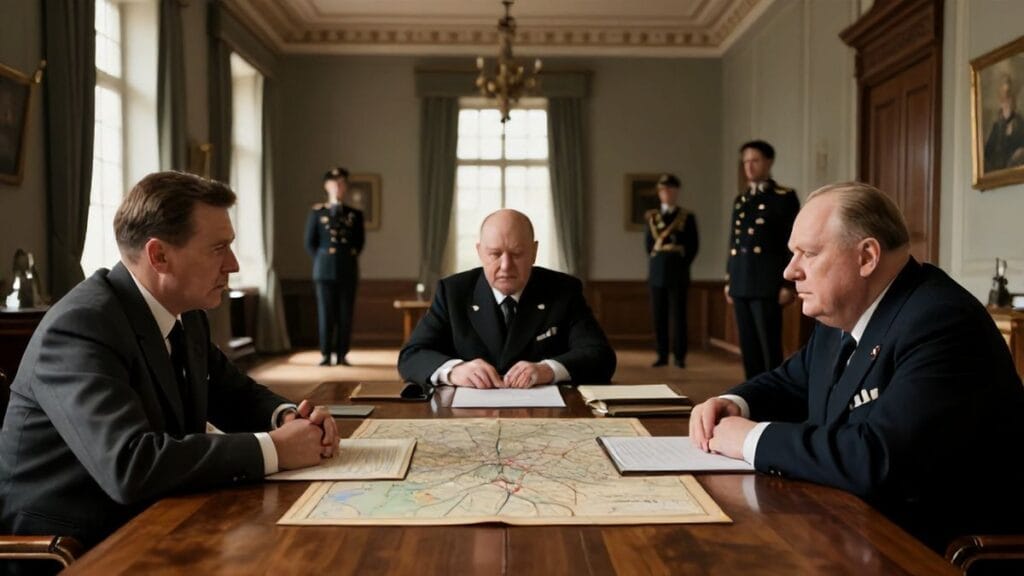
The public spectacle of the potsdam conference opens with cameras and carefully staged arrivals; the real work begins once the doors close and the interpreters take their seats. Delegations file into the main conference room—Americans on one side, Soviets on another, British opposite—and the atmosphere shifts from ceremonial to charged. Notepads are opened, pens poised, translators ready to shuttle meanings between English and Russian. A large table dominates the room, cluttered with papers, ashtrays, and glasses of water, a battlefield of words rather than weapons.
The first sessions are devoted to setting the agenda and reaffirming shared goals: the complete demilitarization and denazification of Germany, the punishment of war criminals, the establishment of a stable postwar order. There is, at least outwardly, a spirit of continuity with earlier conferences. Yet within hours, subtler tensions surface. How harshly should Germany be treated? How far will Soviet influence in Eastern Europe be allowed to extend? Who will control the key levers of European industry, from coal mines in the Ruhr to factories along the Elbe?
The procedure is painstaking. Delegates deliver prepared statements; translators interpret; then comes the real negotiation—questions, objections, and amendments. Stalin listens more than he speaks, often letting his foreign minister, Vyacheslav Molotov, handle the technical disputes. Truman, learning as he goes, relies heavily on Secretary of State James F. Byrnes, whose experience and ambition make him both an asset and a wildcard. Churchill, and later Attlee, bring with them foreign secretaries Anthony Eden (briefly) and then Ernest Bevin, who must navigate between Anglo-American partnership and British national interests.
Evenings after the main sessions bring a different kind of conversation. Dinners and receptions offer opportunities for informal diplomacy. A remark tossed out over a glass of wine might soften a hard line the next morning; a joke poorly timed might deepen distrust. Truman attempts, at times, to use casual conversation as leverage, hinting at American industrial strength or at the United Nations as a path to collective security. Stalin remains cautious, refusing to reveal more than necessary. The sense that vast, invisible forces are at work—that the future of ideologies, alliances, and entire regions might pivot on the phrasing of a single sentence—is palpable.
From the perspective of aides and observers, the way the potsdam conference opens each day has a rhythm almost like theater. Curtains pull back; actors take their marks; lines are delivered, sometimes off script. Yet beneath the performance lies a very real contest for power, influence, and security. As historian Melvyn P. Leffler later observed, the wartime alliance was always “a marriage of convenience,” and in Potsdam, that marriage is clearly headed for a difficult separation. Every draft communique, every compromise clause, bears the marks of bargaining that is as hard-nosed as anything that occurred on the battlefield.
Germany’s Fate on the Table: Borders, Zones, and Punishment
Above all else, Germany dominates the agenda. The nation that had plunged Europe into catastrophe twice within a generation now lay prostrate, its cities ruined, its regime dismantled, its leaders either dead or awaiting trial. When the potsdam conference opens substantive negotiations, one question looms over all the others: what should be done with Germany?
The Allies had already agreed at Yalta to divide Germany into four occupation zones—American, British, Soviet, and French—each administered by the respective power but governed by a central Allied Control Council. In practice, this arrangement masked deep differences of intent. The Soviet Union, having suffered the brunt of German aggression, favored heavy reparations and a weak, disarmed Germany that could never again threaten its borders. The United States and Britain, while committed to demilitarization and denazification, were increasingly wary of policies that might create fertile ground for extremism, as the harsh terms of the Treaty of Versailles had arguably done after World War I.
At Potsdam, these conflicting memories and fears took concrete form. How much industrial equipment should be dismantled and shipped east as reparations? Should Germany remain a single economic entity despite its political division into zones? How could Nazis be removed from positions of authority without paralyzing a whole society that had been steeped in Nazi institutions for over a decade? The final Potsdam Agreement stipulated that German industry would be controlled and partly dismantled, that Nazi organizations would be dissolved, and that education, the judiciary, and the press would be purged of Nazi influence.
Another agonizing topic was the prosecution of major war criminals. The Allies agreed to put the highest-ranking surviving Nazi leaders on public trial, not only to punish specific crimes but to set a legal and moral precedent. Plans for what would become the Nuremberg Trials crystallized in the discussions. The idea that an international tribunal could hold individuals responsible for crimes against peace and humanity was revolutionary. It represented an attempt to move beyond victors’ justice toward a codified international law, even if the implementation would remain deeply imperfect.
Germany’s territorial future was also shaped in these rooms. While the exact western borders remained contested, the general outline of a smaller Germany was clear. However, debates on its eastern frontier were entangled with broader questions about Poland and Soviet influence in Central Europe, issues that would consume many hours and sharpen many disagreements. In the end, Germany at Potsdam was condemned to a long period of occupation, reconstruction, and surveillance, its sovereignty suspended in the name of both security and reform.
For ordinary Germans, the results were felt in ration cards, travel restrictions, political vetting, and the steady presence of foreign soldiers in their streets. The lofty language of the Potsdam Agreement filtered down into mundane realities: rebuilding a bombed-out bridge allowed only if it did not serve as a strategic threat; reopening a local newspaper only after its editors were cleared of Nazi involvement. As always, grand strategy translated into small, intimate changes—who could teach in schools, who could work in government offices, who could even move freely between town and countryside.
The Polish Question and the Shifting Map of Europe
If Germany’s fate was the most urgent problem at Potsdam, Poland’s fate was its most emotionally charged. The story was bitterly ironic: the Second World War had begun with the invasion of Poland in 1939, ostensibly triggering British and French declarations of war in its defense. Yet by the summer of 1945, as the potsdam conference opens, it is clear that Poland will not emerge as the fully independent nation many had once imagined. Instead, it is at the center of a tug-of-war between Soviet security concerns and Western commitments to self-determination.
During the war, two rival Polish political entities had emerged: the government-in-exile in London, recognized by the West, and a Communist-dominated committee established in Lublin, backed by the Soviet Union. The Red Army’s presence on Polish soil gave Stalin decisive leverage. At Yalta, the Big Three had agreed to reorganize the Lublin-based authorities into a broader “Government of National Unity” and to hold free elections. But by July, Western leaders were increasingly skeptical. Reports filtering out of Poland suggested intimidation, censorship, and the suppression of non-Communist parties.
At the same time, Poland’s borders were being dramatically reshaped. In the east, the Soviet Union retained lands seized under the 1939 Nazi-Soviet Pact, including much of prewar eastern Poland, incorporating them into Soviet republics such as Ukraine and Belarus. In compensation, Poland was to be “moved west,” gaining formerly German territories up to the Oder–Neisse line. This meant that millions of Germans would be expelled from regions like Silesia, Pomerania, and parts of East Prussia, their homes and farms handed over to Poles resettled from the east or returning from wartime exile.
The negotiations at Potsdam over these borders were heated. British and American representatives worried about mass expulsions, fearing chaos and humanitarian disaster. Stalin, in turn, insisted that the new frontiers were essential for Poland’s security and, by extension, the Soviet Union’s. The final communique did not definitively fix Poland’s western border but placed the territories east of the Oder–Neisse under Polish administration, pending a final peace settlement. In practice, that “temporary” arrangement became permanent, but the ambiguity left room for frustration and revisionist dreams on both sides.
Behind the maps and lines lay human dislocation on a vast scale. Villages that had spoken German for centuries suddenly found themselves “Polish.” Street signs changed overnight; new authorities took over town halls. Poles flooded in from the east, often carrying little more than what they could fit on a cart, to claim houses whose previous occupants had fled or been forced out. For those affected, the decisions taken in the hushed rooms at Cecilienhof were not abstract diplomacy; they were the difference between staying in the only home they had ever known and being loaded into an overcrowded train headed toward an uncertain future.
In later decades, historians and political leaders would revisit the Potsdam decisions on Poland again and again. Some argued that the Western powers had effectively abandoned Poland to Soviet control, betraying the spirit of earlier promises. Others insisted that, given the realities of Soviet occupation, the choices were tragically constrained. Either way, the Polish question at Potsdam revealed a central truth: even as the conference proclaimed a commitment to freedom and democratic reconstruction, it simultaneously ratified a de facto division of Europe into spheres of influence.
Population Transfers and Silent Tragedies in the Shadow of Diplomacy
One of the most haunting legacies of Potsdam lay in a few seemingly bureaucratic paragraphs about population transfers. The conference did not invent the expulsions of Germans from Eastern and Central Europe—those had already begun spontaneously and often violently in the immediate wake of Nazi defeat. But when the potsdam conference opens its discussions on this matter, it faces a grim reality: millions are already on the move, or soon will be, and something must be said about their fate.
The final Potsdam Agreement stated that the transfer of German populations from countries like Poland, Czechoslovakia, and Hungary to Germany should be carried out in an “orderly and humane” manner. The language sounded reassuring, smoothed by diplomacy. But nothing about uprooting entire communities, often under the watchful eyes of soldiers, could ever truly be orderly or humane. Trains crammed with families and their belongings rolled westward; columns of refugees trudged along roads, suffering hunger, disease, and abuse. Estimates vary, but historians suggest that between 12 and 14 million ethnic Germans were expelled or fled from Eastern Europe in those years, and hundreds of thousands died in the process.
These expulsions were driven by rage and fear. Many local populations had endured brutal occupation by the Nazi regime, including massacres, forced labor, and systematic attempts at Germanization. To them, the presence of German minorities after the war felt like a lingering threat, a living reminder of oppression. New or restored governments in Warsaw, Prague, and elsewhere saw the removal of these minorities as a way to solidify their own authority and reduce the risk of future irredentist claims. The Allied leaders at Potsdam, grappling with the scale of destruction and the urgency of stabilization, reluctantly assented.
What was largely missing from the negotiations was the voice of the individuals who would be marched from their homes. In the minutes of meetings and the carefully drafted communiqués, they appear, if at all, as numbers—“populations,” “minorities,” “refugees.” The human stories—of a farmer who must abandon land tilled by his family for generations, of a mother who loses a child along the way, of communities that vanish overnight—cloud the margins of official history like a faint watermark, visible only if one looks closely. Yet these stories are as much a product of the potsdam conference opens decisions as any border drawn on a map.
In later years, some participants would look back uneasily at this aspect of Potsdam. They had hoped to prevent further bloodshed, to channel chaotic expulsions into regulated movements. Instead, in many places, violence and misery continued, merely draped in a thin veil of international approval. It is one of the cruel paradoxes of the conference: an event hailed for ending a war also formalized, however unintentionally, new rounds of suffering for millions who had never sat at the table where their lives were decided.
Secrets in Truman’s Pocket: The Atomic Bomb and the Changing Balance
Perhaps the most fateful undercurrent at Potsdam was something that did not appear clearly in the official agenda at all: the emergence of the atomic bomb. On 16 July 1945, just a day before the potsdam conference opens, the first successful test of a nuclear device—codenamed Trinity—took place in the New Mexico desert. The explosion lit the sky with a blinding flash and carved a new axis into the history of warfare and diplomacy. News of the test reached Truman in Potsdam, and it transformed not only his personal sense of power but the entire dynamic of the conference.
Truman had only been fully briefed on the Manhattan Project after becoming president. The weapon he now knew the United States possessed was unlike anything seen before—capable of obliterating entire cities in a single blast. In his diary, he noted that the bomb might give him a “hammer” over his adversaries, and many historians have argued that its existence emboldened his stance toward the Soviet Union at Potsdam. As historian Gar Alperovitz controversially suggested, the bomb was not only a means to end the war with Japan but also a diplomatic lever in the emerging rivalry with Moscow.
During the conference, Truman informed Stalin in a deliberately vague and casual manner that the United States had developed a new, unusually powerful weapon. To Truman’s surprise, Stalin reacted calmly, almost indifferently, simply expressing the hope that it would be put to good use against Japan. Truman interpreted this as a sign that Stalin did not grasp the bomb’s significance. In reality, thanks to an extensive Soviet espionage network, Stalin was already aware of the Manhattan Project and had begun his own nuclear program. His composure at Potsdam was as much performance as Truman’s cryptic disclosure.
The presence of the atomic bomb in Truman’s mind influenced discussions about Japan’s surrender. It made some American officials more inclined to demand unconditional surrender and to resist any compromise that might allow Japan to keep its emperor or avoid occupation. At the same time, the bomb’s existence cast a long shadow over Soviet-American relations. If the United States possessed such a weapon, how long until the Soviet Union did as well? And once both had it, what would become of traditional military balances and diplomatic bargaining?
The bomb also posed an ethical challenge. Many at the time saw it as a terrible but necessary tool to end the war swiftly and save lives that would be lost in an invasion of Japan. Others, even then, worried about targeting cities, about radiation, about the precedent being set. Yet these moral debates remained largely in the background at Potsdam. The conference was not a forum for philosophical contemplation; it was a place where concrete decisions had to be made, fast. Still, when we look back, it is impossible not to sense the irony: as the leaders talked of disarmament, demilitarization, and lasting peace, the age of nuclear terror had already begun to dawn outside the walls of Cecilienhof.
Japan, Surrender, and the Potsdam Declaration
While ruined Germany surrounded the conference, another war still raged half a world away. The Pacific conflict against Japan showed no clear sign of imminent surrender in July 1945. Japanese forces fought fiercely on islands like Okinawa, and American planners anticipated devastating casualties in any invasion of the Japanese home islands. It was in this context that the potsdam conference opens a crucial discussion about how to end the war in Asia and what terms to offer Japan.
The result was the Potsdam Declaration, issued on 26 July 1945 by the United States, the United Kingdom, and China (the Soviet Union, still bound by its neutrality pact with Japan, did not initially sign). The declaration called for Japan’s unconditional surrender and laid out terms for its disarmament, occupation, and political transformation. It promised that Japan would not be “enslaved as a race or destroyed as a nation,” but insisted that “stern justice shall be meted out to all war criminals.” It also demanded the elimination of all obstacles to the revival and strengthening of democratic tendencies among the Japanese people.
One of the most contentious issues was the fate of the Japanese emperor, Hirohito. For many Japanese, the emperor was not merely a political figure but a sacred symbol. Some in the American leadership believed that insisting on his removal could make surrender far less likely; others saw any concession as a betrayal of the demand for complete accountability. The Potsdam Declaration was deliberately ambiguous on this point, stating that the authority of the emperor and the Japanese government would be subject to the Supreme Commander of the Allied Powers but not explicitly calling for Hirohito’s removal. This ambiguity would later allow a compromise in which the emperor remained as a constitutional monarch under occupation.
Japan initially rejected the declaration, interpreting it—partly due to translation issues and domestic political constraints—as a demand for humiliating capitulation. The word “mokusatsu,” used in a Japanese government statement, was translated as “ignore” or “treat with silent contempt,” reinforcing American perceptions of defiance. In the weeks that followed, the bomb tested in New Mexico would be dropped on Hiroshima and Nagasaki, and the Soviet Union would enter the war against Japan, collectively pushing Tokyo toward surrender.
From the vantage point of Potsdam, however, none of this was yet foreordained. The participants could not know precisely how the declaration would be received or how quickly events would accelerate. They were trying to construct a framework that could bring the war to an end while laying the groundwork for a peaceful, democratic Japan aligned—if possible—with the emerging postwar order. The Potsdam Declaration became, in effect, the bridge between two terrifying eras: the age of total war and the age of nuclear deterrence.
The Birth Pains of the Cold War: Cooperation Frays at Cecilienhof
In the official photographs from Potsdam, the leaders still sit close, still smile, still sign documents together. But beneath the surface, the alliance is unraveling. The seeds of the Cold War, sown in earlier conferences and on distant battlefields, find fertile ground in the discussions that unfold day after day. When the potsdam conference opens, there is still talk of “the Grand Alliance.” By the time it ends, that phrase already sounds nostalgic.
The fault lines are clear. The Soviet Union seeks recognition of its sphere of influence in Eastern Europe, arguing that friendly—or at least non-hostile—governments on its western border are essential after the trauma of repeated invasions. The United States and Britain, while having accepted much of this in practice, still cling to the language of free elections and self-determination. Each side accuses the other, implicitly or explicitly, of hypocrisy: the West points to Soviet interference in Poland and Romania; the Soviets point to Western support for regimes and movements that serve their own interests.
Economic issues deepen the rift. Stalin wants significant reparations from Germany, especially from the industrial Ruhr, as compensation for the unimaginable devastation inflicted on Soviet territory. The Americans and British worry that excessive reparations will prevent German recovery and, worse, push Germans toward radicalism or dependency on the Soviet Union. These conflicting aims turn technical negotiations over coal quotas, steel output, and machinery shipments into proxy battles over the very shape of Europe’s future.
Even in matters where agreement is reached on paper, mutual suspicion persists. The plan for an Allied Control Council to govern Germany as a single economic unit, despite divided zones, requires a level of trust and coordination that is already eroding. Agreements on demilitarization and denazification are interpreted differently on each side of the emerging line between East and West. What one side sees as legitimate security measures, the other sees as ideological consolidation.
In hindsight, many historians view Potsdam as the moment when the wartime coalition fully ceded to a peacetime rivalry. As the American diplomat George F. Kennan would later write in his famous “Long Telegram,” Soviet policy was rooted in “a cautious, persistent pressure” to expand influence, while American policy increasingly centered on containment. Though that assessment came months after the conference, its logic was already visible at Cecilienhof. The two systems—capitalist democracy and state socialism—could cooperate against a common enemy, but without that enemy, their underlying tensions resurfaced with renewed vigor.
Yet it is important to remember that the people in those rooms did not experience history with the clarity we now have. They were tired, conscious of domestic pressures, and haunted by fresh memories of total war. They hoped, in many cases sincerely, to avoid another catastrophe. The tragedy of Potsdam is not that its participants wanted conflict but that, within the constraints and fears of their moment, the choices they made nudged the world toward four decades of division.
Voices from the Margins: Interpreters, Aides, and Ordinary Germans
Official histories of Potsdam often focus on leaders and foreign ministers, but the conference was also experienced by hundreds of lesser-known figures whose perspectives add texture to the story. Interpreters, secretaries, drivers, cooks, guards—each moved through the same corridors, heard fragments of the same conversations, and carried impressions that would never find their way into communiqués.
Interpreters in particular stood at the crossroads of language and power. Their task was not simply to translate words but to carry tone, nuance, and sometimes deliberate ambiguity across linguistic divides. A slight shift in phrasing could soften a threat, sharpen a demand, or cloud a commitment. Some later remembered the tension of rendering Stalin’s sparse, often elliptical comments into English, or Truman’s plain speech into Russian. When the potsdam conference opens its sessions each day, these interpreters know that what they say, sentence by sentence, can tilt the emotional balance of the room.
For aides and junior diplomats, Potsdam was both a grueling workload and an education in realpolitik. They drafted position papers at three in the morning, scrambled to incorporate last-minute changes demanded by their leaders, and rushed between offices with armfuls of documents. Many kept diaries, later mined by historians for glimpses of the human drama behind the formal proceedings. One American staffer might note the exhaustion etched on Truman’s face after a particularly hard meeting; a Soviet stenographer might quietly observe Molotov’s poker-like discipline even under pressure.
Meanwhile, outside the cordon of Cecilienhof, ordinary Germans tried to rebuild their lives in the shadow of great decisions. Some worked as cooks, cleaners, or gardeners at the palace, careful to remain discreet, aware that a misplaced word could bring punishment. Others bartered with Allied soldiers—an extra ration of chocolate or cigarettes exchanged for a family heirloom or a hastily sewn shirt. For them, the question of what was happening inside the conference rooms was less pressing than how to find tonight’s meal or tomorrow’s safe place to sleep.
One can imagine a German mother walking her child along the Havel River, pointing vaguely toward the palace and saying, “They are deciding what comes next.” The child, too young to grasp the meaning of “occupation” or “zones,” understands only that strangers in uniforms speak foreign languages and that the world feels uncertain. These muted observations remind us that history moves on multiple levels at once: the grand narratives of states and systems, and the intimate, fragile narratives of individuals who endure them.
The Potsdam Agreement: Words on Paper, Burdens on Millions
By early August, the conference edged toward conclusion. After weeks of negotiation, drafts, revisions, and last-minute bargaining, the leaders and their foreign ministers shaped the Potsdam Agreement—an imperfect, sometimes ambiguous document that nonetheless became one of the key charters of the postwar order. When the potsdam conference opens, much of this text is unwritten; by the time it closes, those words will begin to ripple outward across continents.
The agreement covered a wide range of issues. In Germany, it laid down the “four Ds”: demilitarization, denazification, democratization, and decentralization. It specified the structure of Allied control, the dismantling of German military and industrial capability, and the prosecution of war criminals. It reaffirmed the principle that Germany would be treated as a single economic unit despite its division into zones, at least in theory. It defined reparations, allowing the Soviet Union to take a significant share from its own zone and, in a complex arrangement, from Western zones as well.
On territorial matters, the agreement sanctioned the transfer of some regions from German to Polish and Soviet control, while deferring final decisions on borders until a future peace treaty. It recognized the provisional government in Poland, despite Western misgivings about its democratic credentials. It endorsed the intention to move German populations out of Poland, Czechoslovakia, and Hungary, as mentioned earlier, in what it called an “orderly and humane” fashion—a phrase that history would test harshly.
The document also addressed broader principles: the rebuilding of Europe, the role of the Allied leaders in supporting democratic institutions, and the commitment to disarmament—as far as conventional weapons were concerned. It gestured toward a world in which international cooperation, hopefully embodied by the United Nations, would prevent future conflicts of such devastating scale.
And yet, for all its scope, the Potsdam Agreement was as much a snapshot of a fleeting moment as it was a blueprint for the future. It reflected the balance of power and the mindset of leaders in mid-1945—exhausted, wary, constrained by domestic politics, and shaped by fresh memories of war. Some clauses were models of clarity; others were riddled with loopholes and vague wording that allowed conflicting interpretations. Those ambiguities later fueled disputes over everything from reparations to political freedoms in occupied territories.
The true impact of the Potsdam Agreement must be measured not only in diplomatic terms but in human consequences. For a German family in Dresden, it meant years of rationing, political scrutiny, and gradual reconstruction under foreign oversight. For a Polish family in Wrocław (formerly Breslau), it meant moving into a house that had belonged to Germans and learning to see a new map as natural. For a Soviet family in Smolensk, it meant the bitter comfort of knowing that their losses had at least forced concessions from the West and a buffer zone around their homeland. Words typed on thin paper at Cecilienhof became, for millions, the boundaries of what their future could be.
From Conference Tables to Divided Continents: Long-Term Consequences
The Potsdam Conference did not single-handedly create the Cold War, but it set into motion and codified many of the dynamics that would define it. When the potsdam conference opens, the lines between ally and rival are still blurred; within just a few years, those lines will harden into borders of barbed wire and concrete. The division of Germany into occupation zones, intended initially as a temporary measure, evolves into the creation of two separate states: the Federal Republic of Germany (West Germany) and the German Democratic Republic (East Germany). Berlin itself is split, ultimately leading to the Berlin Blockade and, later, the Berlin Wall.
Eastern Europe, meanwhile, follows a trajectory shaped deeply by the decisions and silences of Potsdam. In countries like Poland, Hungary, Czechoslovakia, Romania, and Bulgaria, Communist parties gradually consolidate power, often backed by Soviet pressure and security services. Elections are held but manipulated; opposition figures are marginalized, arrested, or forced into exile. The Western powers protest but do little to change the course of events on the ground, constrained by war-weariness, the limits of their influence in Soviet-occupied areas, and their own strategic priorities elsewhere.
The Western response crystallizes into the policy of containment, articulated in various forms by officials like Kennan and implemented through measures such as the Truman Doctrine and the Marshall Plan. Economic aid flows to Western Europe, helping to rebuild shattered economies and strengthening non-Communist governments. NATO forms in 1949 as a collective security pact. In turn, the Soviet Union responds with the creation of the Warsaw Pact, and Europe becomes a continent divided militarily, ideologically, and psychologically.
The shadow of the atomic bomb, first flickering at Potsdam, grows darker by the year. The Soviet Union detonates its own nuclear device in 1949, ending the brief American monopoly. An arms race ensues, with both sides stockpiling weapons capable of annihilating humanity many times over. Diplomacy in this new era becomes a high-stakes balance of deterrence and fear. The same logic that once pushed leaders to negotiate at Cecilienhof now pushes them to manage crises from Berlin to Cuba without triggering global catastrophe.
Yet not all consequences of Potsdam are grim. The conference, for all its flaws, did help ensure that Germany would be rebuilt as a democratic state in the West and—within a very different framework—in the East. It contributed to a long, painful, but ultimately successful process of European recovery in the Western half of the continent. It produced, through the Potsdam Declaration, a framework for transforming Japan into a pacifist, democratic, economically vibrant nation. These outcomes, messy and contested though they were, stand as partial vindications of the idea that victors can build more than just punishment into their peace.
Still, the grand lines drawn and endorsed when the potsdam conference opens and closes cast shadows far beyond Europe. They influenced decolonization, as European powers weakened by war struggled to hold onto empires from India to Africa. They shaped the ideological battlegrounds of the later twentieth century, from Korea and Vietnam to Latin America and the Middle East. At every turn, the question lingered: could the lessons of 1945—about total war, about mass murder, about the fragility of diplomacy—prevent new catastrophes? The answer, as the decades unfolded, remained painfully mixed.
Historians, Memories, and the Myths of Potsdam
In the years since 1945, the Potsdam Conference has been examined, praised, condemned, and mythologized. It sits alongside Versailles and Yalta as one of the great diplomatic gatherings of modern history, a moment when leaders tried to write the script for a world they only partially understood. As the potsdam conference opens in the pages of history books, it often appears tidy, its causes and consequences neatly arranged. The real event was anything but.
Historians have debated whether the Western powers “lost” Eastern Europe at Potsdam or whether they ever truly had the power to “save” it. Some, like the early Cold War historian Herbert Feis, emphasized Soviet aggression and ideological ambition, portraying Potsdam as a stage on which Stalin pursued expansion under the guise of security. Others, in a revisionist wave in the 1960s and 1970s, argued that American economic and strategic aims were equally assertive, that the United States sought to shape a world open to its markets and influence, and that Soviet actions were partly reactive to Western pressure. More recent scholarship tends to reject simple villain/hero narratives, instead highlighting a tragic interplay of fear, ideology, and limited options.
Memories of Potsdam also differ across national lines. In Russia and other parts of the former Soviet Union, the conference is sometimes remembered as a moment when Soviet sacrifices were finally acknowledged, when a devastated nation claimed its rightful place as a global power. In Germany, it is often recalled as the beginning of a long tutelage under foreign authority, but also as the starting point for a process of reckoning with Nazi crimes. In Poland and other Eastern European countries, memories can be bitter, as the conference symbolizes broken promises and the start of a new, unwanted dependence.
Personal testimonies add nuance to these national narratives. A British diplomat might remember a fleeting sense of camaraderie over shared cigarettes, even as he worried about Soviet intentions. An American officer might recall both the pride of representing a victorious nation and the discomfort of witnessing hunger in conquered cities. A Soviet official might remember the satisfaction of seeing the Red Army’s triumph acknowledged, while privately mourning family members lost at the front.
Popular culture has also left its mark on how we imagine Potsdam. Documentary films show black-and-white footage of motorcades, handshakes, and signing ceremonies, often with dramatic narration that simplifies complex debates into clear-cut triumphs or failures. Textbooks condense weeks of negotiation into a handful of bullet points. Yet behind every summary lies the messy reality of people improvising in conditions of uncertainty.
In the end, perhaps the most honest way to remember Potsdam is to see it as both necessary and inadequate—as an earnest, flawed attempt to impose order on chaos. The conference could not erase the ideological divide that had grown throughout the 1930s and 1940s. It could not heal the wounds of genocide or fully prevent new injustices. But it did, for better or worse, provide a structure within which the postwar world took shape. For historians, the moment when the potsdam conference opens remains a rich, unsettling case study in the limits of human foresight and the power of human decisions.
Conclusion
When we reconstruct the days of July and August 1945, it is tempting to see inevitability everywhere, to imagine that once the potsdam conference opens, the Cold War, the divided Germany, the nuclear arms race, and the reshaped map of Europe all followed as if on rails. Reality was more fragile. In the corridors and conference rooms of Cecilienhof, exhausted leaders and their advisers grappled with impossible choices, constrained by fear, ideology, and the burdens of fresh catastrophe. They hoped to avoid another world war, to punish aggression without sowing the seeds of new extremism, to rebuild shattered societies without losing control of them.
Their successes and failures are deeply intertwined. Germany’s transformation into a stable democracy in the West and its eventual reunification suggest that some of the decisions taken at Potsdam, however harsh in the short term, enabled long-term recovery. Japan’s postwar trajectory from militarist empire to peaceful economic power gives weight to the vision embedded in the Potsdam Declaration. Yet the suffering endured by millions during population transfers, the stifling of political freedoms in Eastern Europe, and the descent into decades of nuclear-armed rivalry attest to the tragic costs and blind spots of the same process.
The image of the palace at Cecilienhof—its Tudor-style gables framed by summer trees, its flowerbed in the shape of a Soviet star—captures the paradox of the moment. An old-world setting hosted the birth of a new world order, one that would be more tightly interconnected and more perilous than anything that had come before. The men who met there could not foresee the Berlin Wall, the Cuban Missile Crisis, or the eventual peaceful revolutions of 1989, but they sensed that they were balancing on the hinge of history.
To study Potsdam is to accept that peace settlements are rarely pure triumphs of justice or reason. They are compromises struck under pressure, written in the ink of recent bloodshed and limited imagination. The phrase “when the potsdam conference opens” should not conjure a tidy diplomatic tableau but rather a nervous, uncertain pause in which the future was still malleable. In that pause, flawed human beings made choices that have defined the contours of our world to this day. Understanding their moment—its hopes, its fears, its moral ambiguities—helps us face our own with a little more humility and, perhaps, a little more resolve.
FAQs
- What was the main purpose of the Potsdam Conference?
The Potsdam Conference was convened to decide how to administer defeated Germany, to finalize aspects of the postwar order in Europe, and to coordinate Allied policy toward Japan. When the potsdam conference opens in July 1945, its central aims include demilitarizing and denazifying Germany, determining its borders and reparations, and addressing broader security issues after the collapse of the Nazi regime. - Who were the main leaders at the Potsdam Conference?
The principal participants were Joseph Stalin of the Soviet Union, Harry S. Truman of the United States, and, initially, Winston Churchill of the United Kingdom. Partway through the conference, Churchill was replaced by Clement Attlee after Labour’s victory in the British general election. Each leader brought distinct priorities and fears, which shaped how the negotiations unfolded. - Where did the conference take place and why was Potsdam chosen?
The conference took place at Cecilienhof Palace in Potsdam, near Berlin, in the Soviet-occupied zone of Germany. Potsdam was chosen largely because Berlin and its immediate surroundings were already under Allied control, and the Soviets, as the occupying power in that area, could provide a secure venue. Despite the city’s war damage, Cecilienhof offered a self-contained site that could be tightly guarded and adapted for diplomatic use. - How did the atomic bomb influence the Potsdam Conference?
The successful test of the first atomic bomb occurred one day before the potsdam conference opens, and the news reached President Truman during the meetings. This new weapon altered the strategic balance, giving the United States an unprecedented military advantage. It influenced Truman’s confidence in negotiations with Stalin and played a key role in shaping Allied demands for Japan’s unconditional surrender, eventually referenced in the context of the Potsdam Declaration. - What decisions about Germany were made at Potsdam?
The Allies agreed on the “four Ds” for Germany: demilitarization, denazification, democratization, and decentralization. They confirmed the division of Germany into occupation zones, established an Allied Control Council for joint administration, and outlined reparations to be taken from each power’s zone. The conference also endorsed dismantling parts of German industry and approved the prosecution of major war criminals, paving the way for the Nuremberg Trials. - How did the Potsdam Conference affect Poland and its borders?
Potsdam effectively endorsed a major westward shift of Poland’s borders. The Soviet Union retained former eastern Polish territories, while Poland received German lands to the west, up to the Oder–Neisse line, though final confirmation was deferred. This decision led to massive population transfers: millions of Germans were expelled from the newly Polish territories, and many Poles were resettled from the east. - Did the Potsdam Conference start the Cold War?
The Cold War did not have a single starting point, but Potsdam is widely seen as a critical turning moment. The conference exposed deep disagreements over Eastern Europe, reparations, and political freedoms, and it took place just as the United States gained a nuclear monopoly. While the alliance against Nazi Germany still existed in name, the mistrust and divergent goals evident at Potsdam quickly evolved into the open rivalry that defined the Cold War. - What was the Potsdam Declaration?
The Potsdam Declaration was a statement issued by the United States, the United Kingdom, and China on 26 July 1945, calling for Japan’s unconditional surrender. It outlined terms for disarmament, occupation, and political reform in Japan, promising no destruction of the Japanese nation but insisting on the prosecution of war criminals and the removal of militarist influence. Japan’s initial rejection of this declaration preceded the use of atomic bombs on Hiroshima and Nagasaki. - How did the population transfers decided at Potsdam impact civilians?
The conference acknowledged and effectively sanctioned the transfer of German populations from Poland, Czechoslovakia, and Hungary, stating they should occur in an “orderly and humane” way. In reality, the expulsions were often chaotic and brutal, involving forced marches, overcrowded trains, disease, and violence. Millions were uprooted from homes where their families had lived for generations, and hundreds of thousands died during the process. - What is the legacy of the Potsdam Conference today?
The legacy of Potsdam includes the political division of Germany, the consolidation of spheres of influence in Europe, and the framework for postwar reconstruction and justice. Its decisions helped shape the map of modern Europe and contributed to both the onset of the Cold War and the eventual emergence of stable democratic states in the West. The conference is remembered as a moment of both hope and missed opportunity, where efforts to secure peace also laid foundations for decades of tension.
External Resource
Internal Link
Other Resources
- Encyclopaedia Britannica – general search for the exact subject
- Google Scholar – academic search for the exact subject
- Internet Archive – digital library search for the exact subject