Table of Contents
- The Dawn of October 14, 1806: Foreboding Clouds Over Prussia
- Prussian Military Pride on the Eve of Battle
- The French Grande Armée: Napoleon’s War Machine in Motion
- Tensions in the Holy Roman Empire: Political Stakes and Alliances
- Strategic Movements Before Jena and Auerstedt
- The Battle of Jena: Clash of Titans in Morning Mist
- Auerstedt Engaged: Marshal Davout's Unexpected Heroism
- Chaos and Command: Prussian Leadership Under Fire
- The Collapse of the Prussian Lines: Turning Points and Decisive Moments
- The Aftermath on the Battlefield: Casualties, Captures, and Disorder
- Napoleon’s Pursuit: From Victory to Occupation
- The Shattering of Prussian Military Tradition
- Political Reverberations Across Europe: Allies and Adversaries React
- Reforms Born from Defeat: Prussia’s Military and Social Renaissance
- Cultural and Psychological Impact on Prussia’s Nationhood
- The Battle’s Place in the Napoleonic Wars: Larger Implications
- Echoes Through History: How Jena–Auerstedt Shaped Modern Europe
- Lessons in Leadership and Strategy: What Generals Learned
- Memorials and Memory: Commemorating Jena and Auerstedt
- Conclusion: The Lasting Legacy of October 14, 1806
- FAQs
- External Resource
- Internal Link
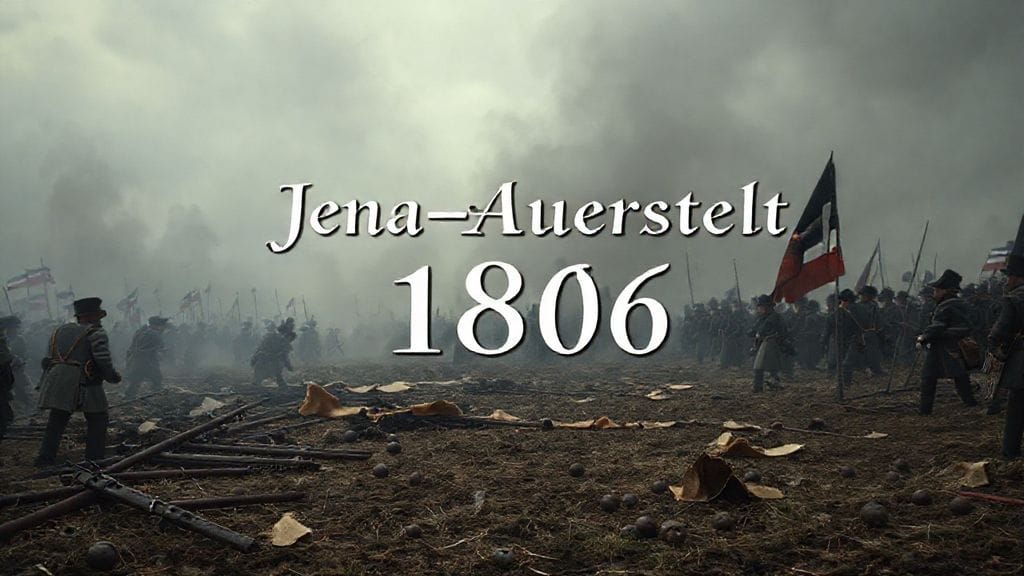
The heavy morning fog hung low above the rolling hills of central Germany, shrouding the fields near the twin towns of Jena and Auerstedt in an eerie silence. The air was thick with anticipation and dread. From the Prussian ranks, confident trumpets blared intermittent calls to muster and courage, while the distant thunder of French drums reverberated ominously across the landscape. On October 14, 1806, two colossal armies—Prussia’s proud and ancient forces and Napoleon Bonaparte’s ruthlessly efficient Grande Armée—were about to collide in battles that would shatter centuries-old military orthodoxies and redraw the map of Europe. The sun rose on a day that would mark not only the defeat of a kingdom but the beginning of a profound transformation that echoed well beyond the battlefield.
The Dawn of October 14, 1806: Foreboding Clouds Over Prussia
October 14, 1806, dawned cool and gray in the duchy of Saxony, where the twin battles of Jena and Auerstedt would soon explode in violence and strategic genius. The autumn sun struggled to penetrate a mist that seemed to predict the uncertainty of what was to come. Thousands of soldiers, clad in the traditional blue and white of the Prussian army, held fast amid whispered prayers and last-minute preparations. They embodied centuries of military discipline and aristocratic pride—traits they believed would lead them to victory against the French.
Yet far away, a different kind of confidence electrified the French camps. Under Napoleon’s inspiring leadership, the Grande Armée had been drilled into a maneuver machine, blending rapid movement with fresh tactical ideas. The contrast between the two forces—one steeped in rigid hierarchy and tradition, the other a dynamic expression of revolutionary fervor and innovation—would prove decisive. But that morning, neither side could be certain who would claim the day.
Prussian Military Pride on the Eve of Battle
At the heart of the Prussian stance was a deep-seated belief in the invincibility of their armies. Prussia’s military heritage stretched back to Frederick the Great, whose reforms and battlefield acumen had established the kingdom as a European power to reckon with. By 1806, the Prussian officer corps was a well-established elite: aristocrats who prized conventional tactics, linear formations, and rigid discipline.
The army’s commanders—King Frederick William III, the Duke of Brunswick, Prince Hohenlohe, and the aging Field Marshal Charles William Ferdinand—stood confident that their forces could withstand and crush Napoleon’s advances. It was a confidence bolstered by the army’s size—over 150,000 men—and traditional war ethos, but one marred by outdated training and slow decision-making.
“The Prussian army carries the weight of history, but the burden can sometimes be a shackle,” later observers would suggest. That day would prove the chain had snapped.
The French Grande Armée: Napoleon’s War Machine in Motion
In stark contrast, the French Grande Armée presented a radically different approach to warfare. Napoleon Bonaparte’s meteoric rise from Corsican artillery officer to Emperor had been fueled by an ability to innovate tactically and operationally. By 1806, his forces were characterized by speed, flexibility, and the integration of infantry, cavalry, and artillery.
Napoleon’s strategy hinged on swift marches, envelopments, and the principle of concentrating forces at decisive points—“masses of men at the critical spot,” as one of his marshals put it. Every soldier was part of a grand symphony of movement directed by Napoleon’s singular strategic vision.
In the weeks before October 14, the French army had maneuvered relentlessly, aiming to catch the fragmented Prussian forces off balance. The French planned to strike not simply to defeat, but to annihilate the enemy formations in one blow.
Tensions in the Holy Roman Empire: Political Stakes and Alliances
The battles of Jena and Auerstedt did not occur in a vacuum; instead, they were the violent culmination of complex political and ideological struggles. The Holy Roman Empire, disintegrating and vulnerable, found itself increasingly under French pressure. Many German principalities were torn between traditional allegiances and the seductive ideas of nationalism and liberal reforms seeded by the French Revolution.
Prussia, eager to assert itself as the protector of German lands and reliant on old monarchical traditions, was incensed by French dominance. The Kingdom had joined the Fourth Coalition against Napoleon along with Britain, Russia, and others, aiming to curtail French expansion.
Yet within Prussia itself, conservative forces resisted adapting to changing warfare and politics, a division that would undermine their effectiveness.
Strategic Movements Before Jena and Auerstedt
As autumn set in, the Prussian army deployed in two main bodies separated by several kilometers—an arrangement that would prove catastrophic. Marshal Louis-Nicolas Davout’s III Corps of the French army edged unexpectedly toward Auerstedt, while Napoleon himself confronted Prince Hohenlohe near Jena.
The Prussian plan hoped to use their superior numbers to engage and envelop the French, but their divided formations and slow communication doomed coordination. The French cavalry’s aggressive screens and use of reconnaissance continuously fed Napoleon information, allowing him to strike precisely where weaknesses appeared.
This misalignment—between confident Prussian commanders and alert French tacticians—set like slow tinder awaiting a spark.
The Battle of Jena: Clash of Titans in Morning Mist
Near the town of Jena, the battle erupted in the morning hours. Napoleon personally directed columns of infantry and artillery in wave after wave of attack. The French advanced rapidly, using artillery barrages to soften Prussian positions and cavalry charges to shatter lines.
Despite sometimes valiant resistance, the Prussian army’s rigidity showed. Orders were delayed and misunderstood, units became fragmented, and commanders like Prince Hohenlohe found themselves overwhelmed. The Prussian front gave way, and panic rippled through the ranks.
Napoleon, ever the master of timing, unleashed reserves precisely when the Prussian line faltered, turning a hard-fought standoff into a rout. “At Jena, the spirit of the past fell like autumn leaves before the storm,” a French officer later reflected.
Auerstedt Engaged: Marshal Davout's Unexpected Heroism
While the spotlight shone on Jena, it was Marshal Davout who faced the brunt of the Prussian threat near Auerstedt with a fraction of the opposition’s numbers—around 27,000 French troops against more than 60,000 Prussians led by the formidable Duke of Brunswick.
What could have been a disaster became a stunning testament to discipline and leadership. Despite being outnumbered, Davout held formation, executing expertly coordinated volleys and defensive maneuvers. The Duke of Brunswick’s death early in the battle contributed to confusion among Prussian officers.
Davout’s forces steadily repelled attacks and launched counter-assaults that eventually forced the Prussians into full retreat. Historians consider Auerstedt the glory of Davout’s career—a moment when the fabled Grande Armée proved its mettle.
Chaos and Command: Prussian Leadership Under Fire
The twin defeats exposed severe deficiencies in Prussia’s command structure. Fragmented communication, an overly complex chain of command, and an entrenched aristocratic officer class ill-prepared for rapid tactical shifts turned the day into a nightmare of missed opportunities.
The death of Field Marshal Brunswick, pierced by a cannonball early in the fight, was both a psychological and strategic blow. Frederick William III’s presence on the battlefield failed to inspire cohesion as units scattered under pressure.
This command paralysis contrasted sharply with Napoleon’s direct control and adaptive tactics, demonstrating a shift from traditional warlord leadership to centralized, flexible command.
The Collapse of the Prussian Lines: Turning Points and Decisive Moments
By midday, the Prussian lines had fragmented into isolated pockets. Retreats became disorganized breaks, and French pursuit forces seized the initiative. One after another, regiments collapsed under relentless pressure.
The capture of thousands of prisoners and the fall of strategic positions around Jena signaled the final stages of defeat. The French were not merely winning a battle; they had shattered the essence of Prussian military power in central Europe.
It was a humiliation of magnitude few could have anticipated, a trauma seared into the national psyche for decades.
The Aftermath on the Battlefield: Casualties, Captures, and Disorder
Estimates indicate that the Prussians lost over 25,000 men—killed, wounded, or captured—while the French suffered around 9,000 casualties. The battlefield was littered with the dead and dying beneath autumn skies, where the cries of the wounded mixed with the muffled orders of officers still attempting to salvage scattered units.
Captured equipment, colors, and standards—symbols of Prussian honor—fell into French hands. The psychological impact was profound, with soldiers across Europe stunned at how quickly what was considered an impregnable army collapsed.
Napoleon’s Pursuit: From Victory to Occupation
Victory was not the end but the beginning. Napoleon wasted no time pressing his advantage, pursuing the broken Prussians relentlessly into the heart of their kingdom. Berlin would fall within weeks, the Electorate of Saxony swiftly annexed, and the old order disintegrated.
The swift and brutal occupation forced the Prussian monarchy to the negotiating table, culminating in the humiliating Treaty of Tilsit in 1807. Napoleon’s grasp on Europe tightened, positioning France as the continent’s unrivaled power.
The Shattering of Prussian Military Tradition
Jena–Auerstedt revealed the fatal weaknesses of Prussia’s military model. Clinging to outdated doctrines, rigid formations, and aristocratic privilege, the army had failed to adapt to the demands of modern warfare. The battle became a symbol of obsolescence, sparking national soul-searching.
Military thinkers saw the need for change. In the wake of defeat, Prussia would embark upon profound reforms that transformed conscription, officer training, and command structures—heralding a new era in military science.
Political Reverberations Across Europe: Allies and Adversaries React
The results at Jena–Auerstedt sent shockwaves through Europe’s courts and battlefields. Allies of Prussia, like Russia and Austria, reconsidered their strategies; smaller German states began to look warily at Napoleon. Meanwhile, Britain remained the determined opposition but recognized the need for new coalitions.
At home, Napoleon’s victory emboldened his ambitions. The map of Germanic Europe would soon be redrawn with satellite states loyal to France in place of the old Holy Roman Empire.
Reforms Born from Defeat: Prussia’s Military and Social Renaissance
In the years following 1806, reformers led by figures such as Gerhard von Scharnhorst and August von Gneisenau revolutionized Prussian military doctrine. Universal conscription replaced reliance on aristocratic cadres, and meritocracy gained the upper hand in officer selection.
Their efforts seeded the eventual resurgence of Prussia on the Napoleonic battlegrounds in 1813-1815 and laid foundations for modern German militarism.
Cultural and Psychological Impact on Prussia’s Nationhood
Beyond immediate politics, the defeat fostered a deep cultural reckoning. Poets, philosophers, and thinkers pondered the demise of old orders and the necessity of renewal. Prussia’s mourning turned into a resolute nationalism that permeated society.
“The spirit of Jena calls us to rebuild, not merely our army, but our very identity,” wrote a contemporary observer. This sense of rebirth would shape Prussia and German identity for generations.
The Battle’s Place in the Napoleonic Wars: Larger Implications
Jena–Auerstedt stands as a pivotal turning point in the Napoleonic wars. It destroyed one of Europe’s premier armies in a single day and secured France’s dominance on the continent.
However, it was a double-edged sword. The occupation of Prussia drained French resources and unleashed nationalist resistances that would contribute to Napoleon’s eventual downfall. In this way, the battle represents both the zenith and the beginning of the imperial unraveling.
Echoes Through History: How Jena–Auerstedt Shaped Modern Europe
The reverberations of that October day were felt for centuries. Jena–Auerstedt not only shaped military practices but catalyzed German unification movements and altered notions of citizenship and statehood.
Historians see the battle as the crucible in which old feudal armies gave way to modern national militaries—marking a fundamental shift in European history.
Lessons in Leadership and Strategy: What Generals Learned
Napoleon’s triumph at Jena–Auerstedt teaches enduring lessons in leadership: the importance of adaptability, speed, and centralized command.
Meanwhile, the Prussian failure underscores dangers of complacency, resistance to change, and poor coordination. The battle remains a classic study in contrasts for military minds worldwide.
Memorials and Memory: Commemorating Jena and Auerstedt
Today, monuments and museums near Jena and Auerstedt keep alive the memory of those who fought and died. The battlefield is a site of pilgrimage for historians and descendants alike—reminding us of war’s human costs and the profound forces shaping nations.
Conclusion
The defeat of Prussia at the twin battles of Jena and Auerstedt on October 14, 1806, was more than a military catastrophe—it was a historical crucible that forced a nation to confront its deepest flaws and forge a new path. In the smoke and carnage of that day, the old world yielded to new strategic paradigms, political realities, and cultural identities. The echoes of those battles resonate still, reminding us that history is never static but a living story of resilience, adaptation, and transformation.
FAQs
Q1: Why was the Prussian army defeated so decisively at Jena and Auerstedt?
A1: The Prussian army suffered from outdated tactics, rigid command structures, poor communication, and an inability to adapt to Napoleon’s rapid maneuvers and centralized control, leading to fragmentation and collapse under pressure.
Q2: Who were the key commanders in the battles of Jena and Auerstedt?
A2: On the Prussian side: King Frederick William III, Duke of Brunswick (killed early at Auerstedt), Prince Hohenlohe, and Field Marshal Charles William Ferdinand. On the French side: Emperor Napoleon Bonaparte and Marshal Louis-Nicolas Davout, who distinguished himself at Auerstedt.
Q3: What triggered the conflict between Prussia and Napoleon leading to these battles?
A3: Growing rivalry over dominance in Central Europe, the collapse of the Holy Roman Empire, and the formation of the Fourth Coalition against French expansionism precipitated the clash.
Q4: How did the defeat impact Prussia politically and militarily?
A4: It led to significant military reforms including universal conscription, merit-based officer promotion, and organizational modernization, as well as political realignments under French occupation.
Q5: What was Napoleon’s immediate strategic gain after the battle?
A5: He secured control over much of Central Germany, captured Berlin, and weakened the Fourth Coalition, allowing him to consolidate power further in Europe.
Q6: How did the battles influence European warfare?
A6: They highlighted the effectiveness of operational maneuver warfare, centralized command, and combined arms tactics—principles that became central to modern military doctrine.
Q7: Is there any lasting cultural or symbolic meaning attached to the battles?
A7: Yes, in Germany, the battles symbolize both national humiliation and subsequent renewal, inspiring a legacy of reform and unity that contributed to German nationalism.
Q8: Are there memorials or museums related to Jena and Auerstedt today?
A8: Yes, both battlefields have memorials, museums, and preserved sites that commemorate the events and educate the public about the historic significance and human stories involved.