Table of Contents
- A Frontier on the Edge of Empire
- From Roman Noble to Provincial Power: The Rise of Varus
- Germania Before the Governor: Lands Beyond the Limes
- An Imperial Decision: Appointing Varus to Germania
- The Burden of Office: publius quinctilius varus governor in a Restless Land
- Forging Rule Across the Rhine: Laws, Taxes, and Roman Order
- Tribes, Chieftains, and Ambassadors: Diplomacy in the Dark Forests
- Arminius Enters the Stage: Ally, Auxiliary, and Hidden Rival
- The Shape of Everyday Life in Roman Germania
- Warning Signs at the Frontier: Rumors, Raids, and Miscalculations
- Into the Woods: Varus Leads His Legions East
- The Teutoburg Trap: Three Days that Shook the Empire
- The Death of a Governor and the Shock in Rome
- Augustus’s Lament: “Varus, Give Me Back My Legions!”
- Blame, Memory, and the Making of a Scapegoat
- Germania After Varus: Retreat, Fortification, and the Frozen Frontier
- From Governor to Cautionary Tale: Varus in Ancient Sources
- Modern Interpretations: Strategy, Hubris, and the Edge of Empire
- Echoes Through Time: National Myths and the Forest of Teutoburg
- Conclusion
- FAQs
- External Resource
- Internal Link
Article Summary: When Publius Quinctilius Varus was appointed governor of Germania, he stepped onto a frontier that was more promise than possession, a landscape where Roman roads met trackless forests and imperial law collided with tribal custom. This article follows publius quinctilius varus governor of the Rhine frontier from his aristocratic beginnings through the fateful decisions that culminated in the disaster of the Teutoburg Forest. It traces the political logic behind his appointment, the fragile alliances he inherited, and the ambitious Roman project to transform Germania into a stable province. Yet behind the carefully staged rituals of Roman authority, we witness tensions simmering among the Germanic chieftains and the subtle rise of Arminius, the supposed ally who would engineer Rome’s nightmare. Through narrative reconstruction and historical analysis, we explore how Varus governed, how he misread the land and its people, and how one governor’s miscalculation reshaped imperial strategy for generations. The story does not end with his death; it continues in the corridors of power in Rome, in the anguished cry of Augustus, and in the centuries-long memory that turned a failed campaign into legend. By following publius quinctilius varus governor in life, death, and remembrance, we see how a single provincial appointment could alter the map of Europe.
A Frontier on the Edge of Empire
The Rhine frontier at the turn of the 1st century CE was less a line on a map than a breathing, shifting zone of contact. On its western bank, stone, tile, and Latin inscriptions proclaimed the presence of Rome: legionary camps, bustling canabae where traders hawked oil and wine, and colonial settlements rising from land that had been forcibly pacified. On the eastern bank, beyond the glinting current, stretched the world the Romans named Germania—dense forests, bogs that swallowed men and horses, mist-shrouded hills dotted with wooden halls, and miles of land where Rome’s eagles had only recently begun to appear.
This was not yet the hardened boundary that later centuries would call the limes. Under Augustus, the Rhine was intended as a staging ground, not a barrier. The grand design envisioned the rivers Rhine and Elbe as the eastern frame of a new Roman province, a Germania pacified, taxed, and ruled like Gaul. Years of campaigning by Drusus and Tiberius had pushed Roman influence far inland, winning over some tribes, crushing others, and planting the seeds of Roman infrastructure in a soil that resisted every plow of foreign rule. Forts, temporary but ambitious, sprouted along the Lippe and the Weser; Roman officers learned tribal names, rivalries, and passageways through the forests.
Into this fragile project, beaten into shape at great human cost, the empire would soon insert a single man with immense authority. When Publius Quinctilius Varus was chosen to be governor of Germania, the appointment was more than a change of personnel. It represented a shift from conquest to consolidation, from the clash of open battle to the quiet imposition of law and taxation. But this was only the beginning; the Roman project in Germania, and Varus’s fateful role within it, would turn a distant frontier into the stage of one of antiquity’s most consequential tragedies.
From Roman Noble to Provincial Power: The Rise of Varus
Publius Quinctilius Varus was not born a man of the frontier. He emerged instead from the polished, competitive world of the Roman aristocracy, a scion of an old senatorial family whose name had rung in the Senate long before Augustus ushered in the Principate. He was no rough-hewn soldier rising through the ranks, but a product of Rome’s political machine—a man who knew how to wait in the shadow of more powerful figures and how to prove himself a reliable cog in the machinery of imperial governance.
By the time Augustus considered him for command in Germania, Varus had held the consulship in 13 BCE—a prestigious peak in a senatorial career—and had already governed difficult provinces. Most notoriously, he had been sent to Syria, where, according to ancient sources like Velleius Paterculus, he dealt ruthlessly with local dissent and squeezed the land for taxes. Paterculus, an admirer of the imperial system, wrote of him with a mix of respect and censure: Varus, he alleged, entered a rich province poor and left it rich, with the implication that not all of the wealth flowed back to Rome. The historian Cassius Dio, writing later, would stress his “indolence” and “inexperience” in warfare, but such criticisms may have been sharpened by hindsight and catastrophe.
At court, Varus was connected by marriage and friendship to the imperial family. His first wife was a daughter of Agrippa, Augustus’s brilliant general and trusted right hand. After her death, he married Claudia Pulchra, a grand-niece of Augustus. These alliances signaled trust: only a man welcome in the inner orbit would be entrusted with sensitive provincial posts. Yet this intimacy with power also meant that his successes and failures would be measured not only against Roman expectations but against the standards of the emperor himself.
The career of publius quinctilius varus governor and magistrate shows a man who, in the eyes of Augustus, seemed ideally suited to handle the transition of a turbulent region into a tranquil revenue-producing province. He had a reputation for legal acumen, familiarity with provincial administration, and a willingness to impose Roman order with a firm hand. What he did not have, arguably, was the instinct for frontier command that had animated men like Drusus, nor the wary, patient caution that Tiberius had displayed in Germania. Yet in the quiet offices of Rome, the need for a “civil” governor now appeared greater than the need for a conquering general. That misreading of the frontier’s true condition would prove fatal.
Germania Before the Governor: Lands Beyond the Limes
Long before publius quinctilius varus governor of Germania crossed the Rhine, the region the Romans labeled Germania was a mosaic of peoples whose lives followed rhythms very different from the Roman calendar. Archaeological traces and later written testimony suggest scattered villages of timber and thatch, herds of cattle grazing on semi-cleared land, and a society in which kinship and warrior honor mattered more than legal codes engraved in bronze. The Romans divided the tribes into names—Cherusci, Bructeri, Marsi, Chatti—but on the ground, identities were fluid, alliances shifting, and leadership often contested.
Drusus, stepson of Augustus, had made the name Germania famous in Rome with his daring campaigns across the Rhine in the 10s BCE. He had marched as far as the Elbe, building forts and bridges, clashing with tribal warriors, and leaving behind altars and trophies that told their own triumphalist story. His brother Tiberius, more methodical, had followed, preferring diplomacy and the manipulation of tribal rivalries to simple devastation. Together, they had forged a web of treaties and hostages that tied a number of chieftains, willingly or not, to Rome’s orbit.
But these campaigns, while impressive, had not produced a pacified province like Gaul. Tribal leaders accepted Roman gifts, subsidies, and Roman backing against rivals—but many did so with an eye to their own advantage, not out of any loyalty to a distant emperor. Roman military roads cut into the landscape, yet beyond their edges, the forest still belonged to those who knew its paths. Roman standards might gleam above a fort one year and vanish the next as garrisons were reassigned or withdrawn.
The Germanic peoples did not constitute a single political unit. Some tribes, such as the Ubii, had already settled on the Roman side of the Rhine and embraced a client status, their towns blossoming into Romanized centers like Ara Ubiorum (later Cologne). Others, like the Cherusci, occupied lands between the Weser and the Elbe and found themselves increasingly courted or coerced by Roman governors seeking reliable intermediaries. It is astonishing, isn’t it, that Rome imagined such a complex tapestry could be swiftly rewoven into a single provincial garment?
By the time Varus received his mandate, the empire’s strategists believed they had laid sufficient groundwork. Auxiliary troops recruited from Germania served under Roman standards; Roman envoys knew the names and rivalries of leading chiefs; a growing stream of merchants carried Mediterranean goods into the interior. From the Palatine Hill, Germania appeared ready—almost—for the next step: the formal subordination of its peoples under Roman provincial administration. That Augustus chose a man like Varus to preside over this transformation reveals much about how secure he thought the situation had become.
An Imperial Decision: Appointing Varus to Germania
The decision to appoint Varus to Germania was likely taken in the quiet deliberations of Augustus and his senior advisors, far from the mud and mist of the frontier. The emperor, by now aging and cautious, had spent decades expanding, stabilizing, and pruning the empire’s borders. Germania was both an opportunity and an unresolved problem. Its subjugation would secure Italy and Gaul from eastern raids and bring new land and manpower under Roman control. Yet its wildness and the tenacity of its tribes remained an unpleasant reminder that, even under Augustus, some lands were not easily tamed.
By about 7 CE—corresponding roughly to the moment indicated in our event, “Publius Quinctilius Varus appointed governor of Germania, Germania | 7”—Augustus was ready to move from military conquest toward civil organization. He needed a man who could erect the framework of provincial governance: courts, tax registers, judicial circuits, linked chains of authority from local chieftains up to the imperial center. To the emperor, publius quinctilius varus governor of Syria and veteran of the consulship seemed well suited. He was not the arrowhead of conquest; he was the hand that would smooth the newly pierced wound into a scar.
Ancient sources offer few direct details about the formalities of Varus’s appointment, but the structure of Roman administration helps us reconstruct it. Varus would have been given imperium over the region, the authority to command troops, administer justice, and conclude treaties. His task, however, was framed as consolidation rather than further conquest. The legions stationed in Germania—three full legions, with their auxiliaries and camp followers, something like 20,000 men in total—were now instruments of security and deterrence, not tools of grand new offensives.
Behind the decision lay a gamble. Augustus calculated that the tribal world east of the Rhine had been sufficiently broken in by years of Roman interventions that it would not require a military genius to hold. Instead, it needed a firm, orderly, and experienced administrator to solidify the gains. In this vision, Varus’s earlier record in Syria—his rigorous, some would say harsh, enforcement of Roman law and taxes—was not a blemish but a qualification. A people only half-won over, the emperor reasoned, would need to feel the unbending presence of Rome.
Yet behind the celebrations that may have accompanied the ceremony of appointment—the congratulatory visits, the formal prayers, the quiet satisfaction of Varus’s family—there lurked uncertainties. Not all generals viewed Germania as pacified; not all envoys returning from the frontier told tales of gratitude and willing submission. But in the political atmosphere of Augustus’s later years, raising doubts about the princeps’ grand designs may not have been wise. Varus accepted the command, perhaps with pride, perhaps with some trepidation. He was to carry Rome’s law into the shadowy woods beyond the Rhine. What he did not know was that the woods were already watching him.
The Burden of Office: publius quinctilius varus governor in a Restless Land
When publius quinctilius varus governor of Germania arrived on the frontier, he stepped into a role that combined the authority of a general, the sternness of a judge, and the ambition of an empire attempting to reshape a landscape and its people. The Rhine crossings where his entourage moved eastward were lines of transition not only for his person but for the entire region. Behind him lay provinces accustomed to Roman law; before him lay a territory that had known Roman swords but not yet Roman statutes.
As governor, Varus’s power radiated outward from the legionary bases, especially the great camps at Vetera and Mogontiacum on the Rhine and the forward positions in the interior. His authority traveled in the form of marching columns, scribes with wax tablets, centurions bearing orders, and interpreters struggling to render Latin legal formulas intelligible to tribal assemblies. The office of publius quinctilius varus governor was not an abstract concept; it was experienced by those under his rule as a new, often bewildering set of demands on their labor, loyalty, and honor.
Varus was charged with overseeing not just soldiers but people—tens of thousands of Germanic inhabitants whose customs he likely only partially understood. To them, the Roman governor was at once a distant figure and an intrusive presence: distant because he dwelt in fortified camps and traveled with an entourage; intrusive because his decisions now touched inheritance disputes, blood feuds, and land allocations that had previously been regulated by elders and warbands. The imposition of Roman-style courts meant that personal grievances and conflicts between clans could now be dragged before a foreign judge whose power flowed from across the sea.
In the Roman view, this was civilization advancing. But for the tribes, especially their would-be leaders, it cut both ways. Some chieftains saw in Varus an ally whose backing could validate their ascendancy over rivals; others saw a threat to the fragile autonomy that still distinguished their status from that of subjects in conquered provinces. The burden of office for Varus, then, lay not only in his responsibility to Augustus but in the necessity of balancing the hard face of Roman might with the delicate art of dealing with proud, armed communities unused to the idea of a governor at all.
publius quinctilius varus governor thus became a figure of paradox: he was meant to embody the calm of a settled province in a place that was not yet provincial; he was tasked with enforcing laws that many did not recognize as legitimate; he was protected by legions whose presence both secured and poisoned his relations with the local elites. In this tension between Roman expectations and Germanic realities, the seeds of disaster were already sown.
Forging Rule Across the Rhine: Laws, Taxes, and Roman Order
The most visible sign that Rome intended to transform Germania from a military theater into a true province came in the administrative measures Varus began to implement. Taxes, legal proceedings, censuses—these dry instruments of empire were, in their own way, as revolutionary as any legionary column. In Gaul, similar policies had eventually woven former enemies into the imperial fabric; in Germania, they would pull threads that were not yet securely anchored.
Varus convened tribal assemblies and, according to later accounts, insisted that lawsuits and disputes be brought before his court. Where once compensation for injury or death might be negotiated between clans, with oaths sworn over feasts and sacrificial animals, now Roman formulas and the presence of stern scribes intervened. To Roman eyes, this meant justice no longer left to whim or vendetta. To the Germanic sense of honor, it could seem like the humiliation of being judged by a foreigner in a tongue that many did not speak.
Taxation was even more explosive. The Roman fiscal system did not yet blanket Germania as it did provinces like Asia or Egypt, but Varus appears to have made decisive steps in that direction. Whether in coin, in cattle, or in labor, the extraction of resources signaled a new reality: Rome no longer simply demanded military support and submission; it now claimed a right to harvest the fruits of the land. Velleius Paterculus, who was present on the frontier, later wrote with damning brevity that Varus treated the newly annexed Germania as if it were a province that had long been submissive, imposing “harsh exactions of tribute” and acting with “supreme haughtiness.”
In practice, these measures likely unfolded unevenly. Some tribes closer to the Rhine or more bound to Rome by earlier treaties might experience the new burdens as extensions of existing obligations. Others, further inland and less habituated to Roman demands, would feel them as a sudden tightening of the imperial grip. The legal and fiscal reforms of publius quinctilius varus governor thus had a patchwork effect: in some places, they stabilized Roman authority; in others, they stirred resentment and fear.
It is easy, in hindsight, to say that Varus moved too fast. But from his perspective, lingering half-measures risked leaving Germania in permanent limbo, never fully secure, always at risk of slipping back into open rebellion. Augustus expected results: lists of taxpayers, reports of settled disputes, the slow but measurable conversion of a wild frontier into a manageable province. Under the pressure of such expectations, Varus continued to extend Roman order further into territory that had not yet had time to forget the shock of conquest.
Tribes, Chieftains, and Ambassadors: Diplomacy in the Dark Forests
No governor could rule Germania by decrees alone. The reality on the ground forced Varus into constant negotiations with the patchwork of tribal leaders whose assent—or at least acquiescence—he needed. These men were not passive recipients of Roman will. They calculated, bargained, and, at times, deceived.
Varus’s court was thus a revolving door of envoys: tattooed warriors bearing gifts, interpreters slipping between languages, Roman officers accustomed to reading both gestures and silences. Some came to renew treaties secured under Drusus and Tiberius; others sought Roman support in local power struggles. Each time publius quinctilius varus governor received a delegation, he had to judge the balance between intimidation and favor. A chief too tightly bound to Rome might lose prestige among his warriors; a chief too aloof might drift toward rebellion.
Friendships—real or feigned—formed across cultural divides. Feasting together, exchanging hostages, sharing hunts or reviews of troops, Roman officials and Germanic leaders sought common ground. Yet even in shared cups of wine, there was asymmetry. To the Romans, these rituals affirmed client-patron relationships in which the emperor sat at the apex. To the tribes, they might confirm alliances between near-equals who pursued their own interests.
Over time, Varus came to rely heavily on certain chieftains as intermediaries. Among the Cherusci, one such figure was Segestes, a nobleman who, according to Tacitus, remained loyal to Rome even when most of his people turned away. Another was Segimerus, and, significantly, Segimerus’s son: a young, charismatic warrior named Arminius. These relationships looked solid enough on the surface. They were reinforced by Roman honors, by positions in auxiliary commands, and by the exchange of pledges.
Yet behind the facade of friendship, there were fault lines. Some chieftains resented the increasing formalization of Roman demands; others feared that taxes and courts would erode their authority. Old rivalries, long simmering between tribes, could be inflamed by the perception that Rome favored one side over another. The forest whispered, and not all that was said reached Varus’s ears. The governor, surrounded by Roman advisors and a handful of trusted Germanic allies, navigated an ocean of half-seen currents. He believed he was steering toward stable provincial rule. In truth, he was being drawn slowly, inexorably, toward a hidden reef.
Arminius Enters the Stage: Ally, Auxiliary, and Hidden Rival
Arminius, the man who would undo Varus, did not stride onto the scene as an obvious enemy. He appeared first as a collaborator, an officer in Roman service, a product of the very system that publius quinctilius varus governor was trying to expand. Born into the Cheruscan elite, Arminius had, in his youth, been sent to Rome—either as a hostage to guarantee his father Segimerus’s loyalty or as a participant in the customary education of allied nobles. There he absorbed Roman tactics, language, and political culture.
Cassius Dio and Tacitus, writing later, portray Arminius as both intelligent and fiercely ambitious. He commanded auxiliary cavalry in the Roman army and earned Roman citizenship and the rank of equestrian, marks of distinction for a provincial leader. On campaign, he would have ridden under the same eagles as Roman officers, learned their methods of marching, reconnaissance, and encampment, and observed the strengths and vulnerabilities of their military system. Arminius, in other words, knew how Rome thought about war.
When he returned to Germania, Arminius did so as a man of two worlds. To his fellow Cherusci and neighboring tribes, he brought tales of Rome’s wealth and glory, but also of its arrogance and appetite. To Roman officials, he presented himself as a loyal intermediary, a native leader who could translate Roman commands into local obedience. Varus, needing such figures to extend his authority, appears to have trusted Arminius deeply. He is described as frequenting the governor’s entourage, offering counsel, and sharing intelligence about tribal sentiments.
Yet beneath this veneer of trust, Arminius nurtured a very different vision. He watched as Varus’s courts overrode local customs, as taxes bit into the livelihoods of his people, as the Roman military presence seemed less like an alliance and more like an occupation. To a proud warrior raised in a culture that valued freedom from foreign domination, Roman “civilization” looked like a gilded cage. The skills Rome had given him—its military doctrines, its strategic mindset—could now, he realized, be turned against it.
Somewhere in these years of Varus’s governorship, Arminius began to weave a conspiracy. He spoke in secret to other chieftains, invoking not just resentment but the possibility of coordinated action. The tribes of Germania had rarely acted in concert; their rivalries were a gift to Roman divide-and-rule. Arminius sought to reverse that equation: to turn fractured discontent into unified resistance. The success of his plan would depend on one crucial factor—whether Varus could be lulled into a sense of such security that he would risk moving his legions deep into hostile terrain, far from their fortified camps.
The Shape of Everyday Life in Roman Germania
While diplomacy and conspiracy played out in halls and camps, ordinary life on the frontier followed its own rhythms. To understand the impact of publius quinctilius varus governor on Germania, one must look beyond the circles of elites and consider the soldiers, settlers, traders, and villagers whose days were transformed by Rome’s presence.
In the legionary camps, life was regimented: drills at dawn, maintenance of weapons and fortifications, inspections by centurions whose vine-staffs enforced discipline with bruising clarity. Soldiers came from across the empire—Italians, Gauls, Spaniards, even other Germanic recruits serving far from home. They shared cramped barracks, gambled with knucklebones, wrote letters back to families, and swapped rumors about promotions or transfers. Some had already spent years in Germania, watching the forest line across the river and wondering if this hard, damp land would ever feel like a province worth dying for.
Just outside the camps, unplanned settlements known as canabae clung to the walls like barnacles. Here lived merchants who supplied the legions with wine, olive oil, spices, and cloth; craftsmen who repaired armor and built wagons; prostitutes; innkeepers; and the unofficial families of soldiers who, despite bans on marriage for serving legionaries, often formed lasting relationships with local women. Latin mingled with Celtic and Germanic dialects; amphorae and wooden buckets moved in and out of improvised taverns. For these people, Varus’s laws and taxes mattered most in how they affected trade and security.
Further east, in the territory of the tribes, daily life was still largely organized around agriculture, herding, and seasonal warfare. Roman presence brought changes: coinage circulated more widely; imported goods such as Roman pottery and glass became prestige items; some young men sought service in the auxiliaries as a path to wealth and status. But for many, the most tangible sign of the governor’s authority was the demand to appear in his courts or to contribute to new burdens of tribute.
Imagine a Cheruscan farmer summoned to a legal assembly overseen by Varus. He stands in a crowd, listening as interpreters render the governor’s pronouncements. The Latin phrases, the formal process, the rows of armed Roman soldiers—all reshape his sense of who holds power in his world. Whether he leaves convinced of Roman justice or humiliated by submission depends on a thousand subtle factors: how fairly his case is heard, whether his chieftain stands visibly by his side, whether Roman scribes show impatience or respect. In these small encounters, the grand project of provincialization either sinks roots or provokes resistance.
Thus, the tenure of publius quinctilius varus governor was experienced not only in the reports sent back to Rome but in the quiet anxieties of villagers, the ambitions of merchants, and the grudging acceptance—or bitter resentment—of those forced to bend their customs to foreign rule.
Warning Signs at the Frontier: Rumors, Raids, and Miscalculations
Even as Varus’s administration seemed to consolidate Roman authority, there were signs that all was not well. Raids flared intermittently along the frontier, small-scale but troubling. Some Roman patrols reported unexplained disappearances; outlying allied communities muttered about unrest inland. Yet Varus, shaped by his previous experiences in Syria and reassured by the formal loyalty of key chieftains, appears to have interpreted these disturbances as manageable, the inevitable friction of a land adjusting to new rulers.
There were, too, personal warnings. Segestes, the pro-Roman Cheruscan noble, is said by Tacitus to have approached Varus with grave concerns about Arminius, even naming him as the architect of a coming rebellion. Segestes urged the governor to arrest Arminius and the other suspected leaders preemptively. But Varus, perhaps unable to imagine such treachery in a man he considered a trusted ally, dismissed the counsel as motivated by jealousy or internal rivalries. To shatter his network of native leaders based on unproven accusations would, he may have thought, destabilize the very order he was trying to build.
Here, the dual identity of publius quinctilius varus governor and Roman aristocrat may have worked against him. Accustomed to a world in which personal standing and patronage relationships carried great weight, he mistook the surface forms of alliance—shared meals, exchanged honors, visible obedience—for deeper loyalty. He measured Arminius by the standards of a Romanized auxiliary officer and overlooked the possibility that beneath the Roman armor beat a heart committed to his own people’s independence.
Roman intelligence networks, never perfect, were also stretched thin. Scouts could not be everywhere; interpreters sometimes shaded translations in ways that suited their own patrons. The vastness of the forest and the labyrinth of tribal politics made it easy for conspirators to meet unseen. When reports of gatherings and secret councils did filter in, they were likely dismissed as ordinary jockeying among chieftains—nothing that three legions could not contain.
In this atmosphere, late in the campaigning season of 9 CE, came the spark: news—whether true or fabricated—of an uprising among tribes supposedly under Rome’s sway in the interior. Arminius and other leaders urged Varus to respond decisively, to move his forces before the unrest spread. It was presented as an opportunity to demonstrate Roman resolve and to remind wavering communities of the might that backed the governor’s pronouncements. Varus, convinced that he commanded not only legions but the loyalty of his Germanic allies, agreed. He would march east, into the heart of Germania.
Into the Woods: Varus Leads His Legions East
As summer waned and autumn loomed in 9 CE, Varus set his legions in motion. Three legions—traditionally identified as XVII, XVIII, and XIX—along with auxiliary cohorts and cavalry, began their march from their summer quarters toward the region of the supposed revolt. It was not a lightning strike by a lean, mobile force, but the lumbering advance of a column burdened with baggage, camp followers, and the apparatus of a provincial governor on the move.
Arminius, riding alongside, reinforced the impression of safety. He knew the land, he assured Varus; he could guide the army along the best routes to reach the restless tribes quickly. To a governor who had come to depend on this Cheruscan intermediary, such assurances must have sounded not only plausible but necessary. The column progressed along forest tracks and muddy paths, stretched out over miles—a long, vulnerable serpent of men, animals, and wagons.
The decision to move so heavily encumbered, and apparently without fully securing the flanks or detailed reconnaissance of the route ahead, reveals much about Varus’s mindset. He did not believe he was entering a hostile land in the sense that an enemy core territory would be; he believed he was passing through a region formally under Roman dominion, troubled by localized unrest at most. In such a scenario, bringing along administrative staff and baggage made sense. A decisive show of force, followed by legal settlements and perhaps the taking of new hostages, would reaffirm order.
But this was only the beginning of his miscalculations. When Arminius and his fellow conspirators asked leave to ride ahead and gather additional allied contingents, Varus granted it. To him, this was merely his trusted Germanic officer fulfilling his role. He failed to imagine that Arminius would instead use the time and freedom of movement to finalize preparations for an ambush. Meanwhile, another supposed ally, Segestes, again tried to warn Varus—this time even detaining Arminius in his own hall and urging the governor to take him into custody. Varus, astonishingly, ordered Arminius released and dismissed Segestes’s fears.
So the legions pressed deeper into the forested hills of what modern historians identify as the Teutoburg region, moving away from their fortified bases, away from the swift reinforcement lines along the Rhine. The sky darkened with gathering clouds; autumn rains turned the ground to sludge. Roman discipline remained, but cohesion frayed as the column wound through narrow defiles and marshy clearings. The forest closed in around them, a living wall of trunks and undergrowth. Somewhere out there, unseen, men who knew every path and vantage point were taking up their positions.
The Teutoburg Trap: Three Days that Shook the Empire
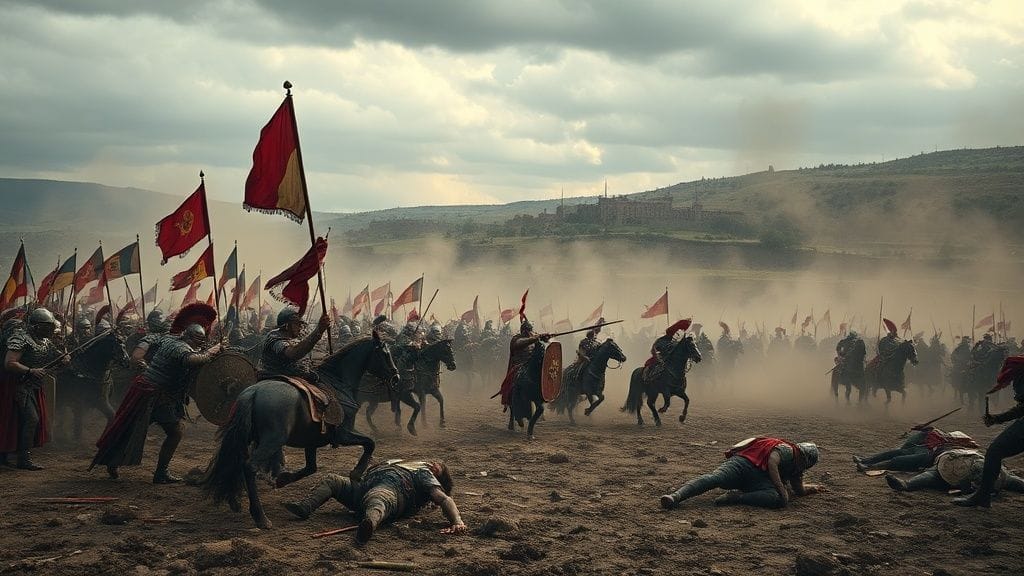
The ambush, when it came, was not a single blow but a sustained, harrowing series of assaults that unfolded over several days. Ancient accounts, especially those of Cassius Dio, paint a picture of chaos and terror under a curtain of rain and leaves. As the Roman column snaked through a constricted stretch of forest, Germanic warriors burst from the trees and high ground, hurling spears and javelins into the thick of the marching troops.
Initially, the legions tried to form up in their usual defensive posture, but the terrain made classic Roman tactics almost impossible. The ground was uneven, sodden; the forest allowed no broad deployment. Units were cut off from one another; signals were hard to see or hear amid the din and the storm. Wagons toppled or stuck fast; horses panicked; mules bolted. The long line of march became a string of isolated knots, each trying desperately to fend off attackers appearing and disappearing like ghosts among the trees.
Varus, as governor and commander, faced a nightmare with no clear solution. Some sources suggest he attempted to establish a fortified camp for the night, ordering his men to build defenses as best they could with wet timber and earth. The next day, he tried to break out, aiming to reach more open country. But Arminius and his confederates had chosen the ground well. Each attempted movement drew the Romans into new kill zones where slopes and thickets favored the lighter-armed Germanic warriors. Roman shields were heavy with water; armor chafed and fatigued exhausted men; missile fire continued relentlessly.
On the second and third days, the pressure intensified. Supplies dwindled; wounded men slowed the march; discipline faltered. Some auxiliary contingents, perhaps those with weaker ties to Rome, may have broken or fled. Germanic fighters, emboldened by early successes, pressed closer, attacking not only from a distance but in brutal close-quarters combat. Individual acts of valor punctuated the slaughter—centurions rallying cohorts, standard-bearers dying to protect their eagles—but the overall momentum moved in one direction only: downward, into annihilation.
The killing ground later associated with Kalkriese, where modern excavations have unearthed coins bearing Varus’s name, fragments of armor, and gruesome evidence of battlefield devastation, may preserve traces of this final phase. There, constrained between a bog and an artificial earthwork, segments of the Roman forces were encircled and cut to pieces. No orderly retreat, no negotiated surrender, no heroic last stand capable of altering the outcome—only the disintegration of three legions under relentless assault, their formations shattered, their standards captured.
As the situation became irretrievable, Varus confronted the ultimate decision of a Roman commander facing catastrophic defeat. According to Cassius Dio, he chose suicide rather than capture, falling on his sword to avoid the humiliation and potential political exploitation that would follow if he were taken alive. Some of his senior officers followed his example; others fell fighting. publ ius quinctilius varus governor of Germania died not in a marble hall in Rome but in the mud of a forest he had never fully understood, surrounded by the wreckage of the imperial project he had been sent to complete.
The Death of a Governor and the Shock in Rome
The immediate aftermath in Germania was a landscape of horror. Survivors were few. Some, badly wounded, were captured and enslaved or sacrificed to Germanic gods; others managed to slip through the forests and bogs to stagger back toward Roman lines. The captured eagles of the XVII, XVIII, and XIX legions became trophies paraded among the triumphant tribes, potent symbols of Rome’s vulnerability. The bodies of the dead, according to later Roman accounts, were left unburied or subjected to ritual mutilations that underscored the depth of Germanic hatred for their oppressors.
News of the disaster traveled slowly, carried by terrified refugees and intercepted messengers. When the scale of the catastrophe became clear—three legions annihilated, their governor dead, the eastern frontier aflame—it landed in Rome like a thunderclap. Augustus, nearing the end of his long reign, had weathered conspiracies, wars, and personal losses, but the destruction in the Teutoburg Forest struck him with particular force. The dream of a pacified Germania, of an empire bounded by the Elbe, crumbled overnight.
The Senate, when informed, must have been stunned. These were not auxiliary units or allied contingents lost in some distant desert; these were full Roman legions, mainstays of imperial power, their disappearance leaving a gaping hole in the military strength of the Rhine front. Panic spread. Would the victorious tribes now cross the Rhine and pour into Gaul? Were Italy and the heartland at risk? Rumors exaggerated the danger, but the fear they generated was genuine.
In the imperial household, the loss was both public and personal. Publius Quinctilius Varus had been not only a governor but a man tied by marriage and friendship to the wider Julio-Claudian network. His failure shamed that network; his death tore at its fabric. People who had once greeted Varus proudly as a former consul now spoke of him in hushed tones as the man whose name had become intertwined with disaster.
And yet, even in the shock, the machinery of response began to grind into motion. Troops were shifted; commanders recalled or reassigned. Tiberius, the capable and moody stepson of Augustus, prepared to travel once more to the Rhine. The empire had been wounded, but it was far from helpless. Still, a line had been crossed. Never again would Rome regard the lands east of the Rhine with quite the same easy confidence. The forest had spoken, and its answer to the imperial project of publius quinctilius varus governor of Germania was a resounding, bloody no.
Augustus’s Lament: “Varus, Give Me Back My Legions!”
Few moments from this period have been so often repeated as the anecdote of Augustus wandering his palace, his hair uncombed, crying out, “Quinctili Vare, legiones redde!”—“Quinctilius Varus, give me back my legions!” Suetonius, in his Life of Augustus, preserves this dramatic scene, and though it may be embellished, it conveys the emotional impact the disaster had on the aging emperor. The cry was not only for Varus, but for the legions themselves, those proud formations that had been the backbone of his power.
Augustus had spent a lifetime turning a fractious republic into a stable imperial system, using military strength judiciously to secure borders and maintain internal order. The loss in Germania felt like a personal failure of judgment. He had chosen Varus; he had approved the strategy of turning conquest into provincial administration; he had believed Germania was ready. Now, faced with reports of mass slaughter and the capture of the standards, he confronted, perhaps for the first time, the limits of his imperial vision.
In the months that followed, Augustus took visible steps to reassert control. He ordered increased religious observances, seeking the favor of the gods in a time of crisis. Recruiting for new legions began, drawing on Rome’s citizen body and allied communities. He also reportedly forbade the commemoration of the lost legions’ numbers in later formations, an eerie silence in the military record that kept the memory of their destruction alive by absence. The XVII, XVIII, and XIX would never be re-raised.
His lament, “Varus, give me back my legions,” was more than grief; it was recognition that a key assumption of his long reign had collapsed. The idea that Rome could steadily expand along every frontier, converting enemies into subjects and wild lands into provinces, could no longer be maintained uncritically. Germania, once envisioned as a new Gaul, would instead become a frontier to be contained, not a prize to be absorbed.
For Augustus personally, the disaster darkened his final years. He had outlived many heirs and allies; now he had outlived one of his governors and the men under his command. The imperial system would endure, but the cost had been brutal. In the corridors of power, Varus’s name became a warning, his fate a specter that would haunt every future discussion of risky campaigns into unconquered lands.
Blame, Memory, and the Making of a Scapegoat
In the wake of catastrophe, blame becomes a currency of its own. Publius Quinctilius Varus, who had once been lauded for his service, now found his memory put on trial in the court of Roman opinion. Ancient historians, writing with the clarity and cruelty of hindsight, often painted him as the architect of his own downfall—reckless, arrogant, blind to warning signs. Velleius Paterculus, a contemporary but also a partisan of Tiberius, condemned Varus’s administrative harshness and his failure to appreciate the dangerous volatility of Germania.
Cassius Dio, writing in the 3rd century, sharpened this picture further. He criticized Varus’s military incompetence, his excessive reliance on Arminius, and his decision to march encumbered into difficult terrain. “He had not the slightest suspicion of their hostile purpose,” Dio wrote, “but believed that they were friendly.” In Dio’s hands, publius quinctilius varus governor of Germania becomes almost a tragic fool, a man who trusted when he should have doubted, who imposed formal rule where he should have proceeded cautiously.
Yet it would be simplistic to place all responsibility on Varus alone. The very fact of his appointment, the instructions he was given, and the broader strategic framework designed by Augustus and his advisors shaped his decisions. The imperial court had decided that Germania was ready for provincial treatment; Varus merely acted in accordance with that assessment. The pressure to demonstrate progress—to deliver to Rome a functioning province rather than a perpetual war zone—must have weighed heavily on him.
Moreover, the brilliance of Arminius’s deception complicates the narrative of Varus as merely incompetent. The young Cheruscan had mastered Roman ways precisely so that he could exploit them. His understanding of how men like Varus thought allowed him to craft a trap that played on the governor’s expectations of loyalty and order. The conspiracy that led to Teutoburg was not an inevitable eruption of Germanic rage; it was a calculated, coordinated effort that took advantage of structural weaknesses in Rome’s frontier system.
Still, Roman culture had a habit of personalizing failures, turning complex systemic misjudgments into the stories of individual flaws. Varus, dead and unable to defend himself, became the focus of that tendency. Over time, his name became synonymous with disaster, much as “Cannae” evoked Hannibal’s great victory over Rome. In the popular memory of the empire, Varianus clades—the Varian disaster—stood as a cautionary tale: about trusting the wrong allies, about overconfidence in newly subdued regions, about the thin line between provincial rule and open revolt.
Germania After Varus: Retreat, Fortification, and the Frozen Frontier
The immediate strategic response to the Varian disaster was not collapse but counteraction. Tiberius, already a seasoned commander in Germania, was dispatched once more to the Rhine. He moved quickly to stabilize the frontier, reinforcing garrisons, reassuring allied tribes, and demonstrating that Rome, though wounded, could still strike back. The fear that Germanic warriors would surge across the Rhine into Gaul did not materialize; Arminius and his confederates were more focused on consolidating their newfound freedom than on launching a full-scale westward invasion.
Yet the long-term effect of the disaster was a profound reorientation of Roman policy. Augustus and, after him, Tiberius came to view the Rhine and Danube not as staging grounds for relentless expansion, but as more or less permanent borders. Occasional punitive expeditions would still cross into Germania, seeking to recover lost eagles or punish particularly troublesome tribes, but the grand design of turning the region into a full province like Gaul was quietly shelved.
This shift manifested physically in the strengthening of fortifications along the western bank of the Rhine. Camps became more permanent; civilian settlements on the Roman side grew in size and complexity. Over the decades, a fortified frontier—later generations would call it the limes Germanicus—took shape, a line of walls, towers, and roads that separated the heavily Romanized west from the more loosely controlled lands to the east.
For the Germanic tribes, the retreat of Roman ambitions created a different set of dynamics. Some groups remained allied to Rome, benefiting from trade and subsidies; others drifted away or pursued their own regional rivalries. The absence of direct Roman rule allowed Germanic societies to develop with less external interference than, say, the Celtic peoples of Gaul. This autonomy would, centuries later, play a role in the formation of medieval European kingdoms in these regions.
Thus, the failure of publius quinctilius varus governor to secure Germania as a province had consequences far beyond his lifetime. By freezing the frontier along the Rhine, Rome unintentionally preserved a cultural and political divide that would help shape the later maps of Europe. A counterfactual history in which Varus succeeded and Germania became Romanized like Gaul would likely look very different indeed.
From Governor to Cautionary Tale: Varus in Ancient Sources
Our understanding of Varus, his appointment, and his downfall comes predominantly from Roman sources written after the fact, each colored by its author’s context and agenda. Velleius Paterculus, a former officer under Tiberius, offers a relatively contemporary perspective. He acknowledges Varus’s noble birth and high offices but criticizes his conduct in Germania as marked by a complacent assumption that the province was already fully subdued. Velleius’s loyalty to Tiberius may have motivated him to distance his patron from the disaster by emphasizing Varus’s personal failings.
Cassius Dio, writing in Greek more than two centuries later, crafts a dramatic narrative, rich with speeches and psychological interpretation. He underscores Varus’s gullibility and Arminius’s cunning, using their story to illustrate the dangers facing any empire that grows careless on its borders. Dio’s account of Varus’s suicide, of the desperate attempts of the legions to break free, and of Augustus’s anguished reaction has shaped much of modern popular understanding of the event.
Tacitus, whose focus lies more on later conflicts between Rome and the Germanic peoples, treats Varus mainly as a precursor to the themes that dominate his Annals: the complexities of rule over proud, warlike tribes, and the recurring pattern of Roman arrogance meeting unexpected resistance. He reserves particular sympathy for Segestes, the loyalist who tried to warn Varus, and for the later Roman general Germanicus, who, under Tiberius’s reign, led expeditions to recover the lost standards and honor the fallen.
None of these sources is neutral. Each, in its own way, uses the figure of publius quinctilius varus governor of Germania as a rhetorical device: a moral example of hubris punished, a foil to highlight the virtues of other commanders, a symbol of the moment when Rome’s expansion met a hard limit. Modern historians, aware of these biases, attempt to reconstruct a more nuanced portrait, recognizing Varus as a capable administrator thrust into a frontier role for which his talents and assumptions were poorly matched.
Still, the power of the ancient narratives endures. It is through them that Varus’s name has survived at all. Without their tales of disaster, he would be just another governor listed in prosopographical handbooks, a footnote in the vast bureaucracy of empire. Instead, he stands, alongside figures like Crassus at Carrhae, as a reminder that even Rome, in all its might, was vulnerable to misjudgment and the cunning of its foes.
Modern Interpretations: Strategy, Hubris, and the Edge of Empire
Modern scholarship, drawing on archaeology, landscape studies, and a critical reading of the texts, has added new layers to our understanding of Varus and his governorship. Excavations at Kalkriese and elsewhere have unearthed battlefield remains—weapon fragments, coins, personal items—that corroborate the scale and nature of the disaster. Among these finds are coins minted under Varus’s authority, tangible traces of publius quinctilius varus governor of Germania moving through the land he sought to administer.
Historians now debate not only Varus’s personal competence but the broader strategic logic of Rome’s Germanian policy. Some argue that Augustus’s vision of pushing the frontier to the Elbe was fundamentally flawed, underestimating the difficulty of maintaining long supply lines and pacifying a sparsely urbanized, tribally fragmented region. In this view, Varus was the unlucky executor of an overambitious plan, sacrificed to imperial hubris.
Others suggest that the plan itself was sound in principle but fatally undermined by specific errors: an overreliance on auxiliary leaders like Arminius, insufficient intelligence gathering, and a provincial administration that moved too quickly to impose taxes and legal structures. The lesson, in this reading, is not that Rome should never have attempted to provincialize Germania, but that it did so with a dangerous mixture of haste and complacency.
There is also growing appreciation for the agency and sophistication of the Germanic side. Arminius is no longer seen merely as a barbarian chieftain who got lucky, but as a politically astute leader who exploited his Roman training to orchestrate a calculated uprising. His ability to coordinate multiple tribes, time the ambush, and anticipate Roman reactions speaks to a level of strategic thinking that earlier generations of scholars too readily dismissed.
In military studies, the Varian disaster serves as a case study in the hazards of operating in hostile, poorly mapped terrain; the importance of logistics and reconnaissance; and the psychological dimension of coalition warfare. Modern analyses ask hard questions: Why did Varus ignore Segestes’s warnings? Why did he choose the route he did? Could a different governor, more attuned to frontier warfare, have avoided the trap—or was some form of major conflict inevitable once Rome attempted to tighten its grip?
Ultimately, the consensus remains that Varus was neither a monster nor a martyr, neither uniquely incompetent nor blameless. He was, rather, a Roman aristocratic administrator who, placed in the wrong context and given the wrong assumptions, made decisions that magnified structural weaknesses into catastrophe.
Echoes Through Time: National Myths and the Forest of Teutoburg
Long after the Roman Empire itself had fallen, the story of Varus and Arminius continued to resonate, reshaped by the needs and imaginations of later ages. In Late Antiquity and the early Middle Ages, the memory of the disaster blurred, but the notion of a wild Germania that had once defied Rome persisted. Medieval chroniclers, drawing on fragmentary classical texts, occasionally referenced the battle as an emblem of the northern peoples’ stubborn independence.
It was in the early modern and modern periods, however, that the Varian disaster took on new ideological weight. In the 19th century, as German national consciousness developed in the shadow of fractured principalities and foreign domination, Arminius—renamed “Hermann” in the vernacular—was recast as a founding hero of the German nation. The Teutoburg Forest became not just a site of Roman defeat, but the symbolic birthplace of a people.
Monuments such as the Hermannsdenkmal, a towering statue erected in the 19th century near Detmold, physically inscribed this myth into the landscape. In the shadow of its raised sword, Varus’s name appears as that of the vanquished oppressor, while Arminius/Hermann stands as a defiant liberator. Nationalist historians and poets contrasted the supposed decadence and arrogance of Rome—embodied in publius quinctilius varus governor—with the rugged virtue and freedom-loving spirit of the Germanic tribes.
Such interpretations, of course, tell us as much about 19th-century Europe as they do about the 1st century CE. They selectively emphasized certain aspects of the ancient accounts, ignoring, for example, the internal divisions among the Germanic peoples and the many tribes that cooperated, willingly or not, with Rome. But their endurance shows the enduring symbolic power of the Varian disaster as a narrative of resistance against an overbearing empire.
In the 20th century, this symbolism was at times co-opted for darker purposes, fueling extremist ideologies that sought historical validation in the imagined purity and martial glory of the “ancient Germans.” In response, more critical scholarship sought to disentangle history from myth, to see Varus and Arminius not as archetypes of decadent empire and noble barbarian, but as complex figures operating in a messy, contingent world.
Today, visitors to the sites associated with the battle encounter museums that present both the archaeological reality and the centuries of reinterpretation that followed. Panels and exhibits show not only coins minted under Varus and the remnants of Roman armor, but also 19th-century paintings, Romantic poems, and propaganda posters. In this layered landscape, the story of publius quinctilius varus governor of Germania continues to evolve, inviting each generation to confront how it uses the past to think about power, identity, and resistance.
Conclusion
The appointment of Publius Quinctilius Varus as governor of Germania was, in its own time, an administrative decision among many: another step in the steady advance of Roman provincial governance. Yet its consequences were anything but routine. Charged with transforming a frontier of forts and shifting alliances into a stable province, publius quinctilius varus governor brought to the task the tools he knew best—law courts, tax assessments, the confident rituals of Roman sovereignty. In the hills and forests beyond the Rhine, those tools met a reality they could not easily reshape.
Varus misread the depth of Germanic resentment and overestimated the solidity of Rome’s alliances. Trusting in Arminius and others, he marched his legions into a trap that would annihilate thousands, shatter imperial assumptions, and etch his name into history as a byword for disaster. Yet the story is larger than his personal misjudgment. It exposes the fragility of empires that believe their power self-validating, the dangers of imposing order too quickly on societies only half subdued, and the capacity of local actors to turn the strengths of a dominating power against itself.
The aftermath reshaped Rome’s strategic horizon. The dream of an Elbe frontier gave way to the pragmatism of fortified borders along the Rhine. The lands east of that river would retain, to a significant extent, their own developmental path, with profound consequences for later European history. In ancient texts, in archaeological trenches at Kalkriese, in the shadow of the Hermannsdenkmal, and in the ongoing work of historians, the figure of Varus remains a focal point where questions of hubris, resistance, and memory converge.
To follow the arc from Varus’s appointment to his death, from the hopeful language of provincialization to the anguished cry of Augustus, is to watch an empire confront its limits. It is to see how the office of a single governor can concentrate the ambitions and blind spots of an entire system, and how the decisions made in distant palaces reverberate among forests, villages, and battlefields far from their origin. The story of Publius Quinctilius Varus, appointed governor of Germania, thus endures not merely as a tale of defeat, but as a lens through which to examine the perennial tensions between power and prudence at the edges of empire.
FAQs
- Who was Publius Quinctilius Varus before becoming governor of Germania?
He was a Roman senator from an old aristocratic family, a former consul (13 BCE), and an experienced provincial administrator who had previously governed Syria. His career and family connections, including ties to the imperial household through marriage, convinced Augustus that he was suited to turn Germania from a military theater into a functioning province. - Why did Augustus appoint Varus to Germania instead of a frontier general like Tiberius?
By around 7 CE, Augustus believed that Germania was largely pacified thanks to earlier campaigns by Drusus and Tiberius. He therefore wanted not another conquering general but a firm civil governor to impose law, taxes, and administrative order. Varus’s reputation as a strict, capable administrator seemed to fit that need, though it proved ill-suited to the volatile frontier reality. - What exactly was Varus’s role and authority in Germania?
As governor, Varus held imperium over the region: he commanded the legions stationed there, administered justice, presided over legal assemblies, collected or organized tribute, and managed relations with local tribal leaders. In effect, he was the emperor’s representative on the frontier, responsible for turning a patchwork of alliances and occupied zones into a coherent Roman province. - How did Arminius manage to deceive Varus?
Arminius had served in the Roman army, gained citizenship and equestrian rank, and presented himself as a loyal auxiliary commander. Varus relied on him as a native intermediary and guide. Using this trust, Arminius fed Varus information about a supposed uprising inland and persuaded him to march his legions into difficult terrain, all while secretly coordinating a coalition of tribes to ambush the Roman column. - What happened to Varus’s legions in the Teutoburg Forest?
Over the course of several days in 9 CE, three legions (XVII, XVIII, XIX) and their auxiliaries were attacked repeatedly in the forests and marshes of what is now northwestern Germany. Hampered by terrain, weather, and surprise, they were unable to form effective battle lines. The forces were gradually encircled and destroyed; their standards were captured, and Varus, seeing the situation as hopeless, took his own life to avoid capture. - How did Rome respond to the defeat?
Rome reacted with shock but also with swift measures. Augustus intensified recruitment, reinforced the Rhine frontier, and sent Tiberius to stabilize the situation. In the longer term, subsequent emperors chose not to pursue the full annexation of Germania east of the Rhine. Instead, they fortified the river as a more permanent boundary and limited their operations across it mainly to punitive expeditions. - Why is the Varian disaster considered so important in Roman history?
The destruction of Varus’s army marked the end of serious Roman efforts to make Germania a full province extending to the Elbe. Strategically, it prompted a more defensive approach to the northern frontier. Symbolically, it exposed the vulnerability of Rome’s seemingly unstoppable expansion and became a powerful example of how overconfidence and misreading local conditions could lead to empire-shaking defeat. - How do we know about Varus and the battle today?
Most of our information comes from Roman historians such as Velleius Paterculus, Cassius Dio, Suetonius, and Tacitus, who wrote about Varus’s governorship, the ambush, and its aftermath. Their accounts are complemented by archaeological finds, especially at sites like Kalkriese, where coins, weapon fragments, and human remains corroborate a large Roman military disaster dating to Varus’s time. - Did the defeat in Germania permanently weaken the Roman Empire?
It did not fatally weaken Rome, which recovered militarily and continued to be a dominant power for centuries. However, it did permanently alter Roman strategic thinking about northern expansion and contributed to fixing the Rhine as a long-term frontier. In that sense, it shaped the geographical contours of the empire and indirectly the later history of Europe. - How has Varus’s legacy been viewed over time?
In antiquity, Varus was often portrayed as a cautionary example of overconfidence and poor frontier judgment. In later centuries, especially in 19th-century Germany, Arminius was celebrated as a national hero and Varus as the archetypal foreign oppressor defeated in the Teutoburg Forest. Modern historians tend to see Varus more soberly—as a competent but miscast administrator whose tenure on a precarious frontier exposed the limits of Roman power.
External Resource
Internal Link
Other Resources
- Encyclopaedia Britannica – general search for the exact subject
- Google Scholar – academic search for the exact subject
- Internet Archive – digital library search for the exact subject