Table of Contents
- The Last Breath of the First Emperor
- Shaqiu in Hebei: The Enigmatic Setting
- Qin Shi Huang: The Man Who United China
- The Emperor’s Obsession with Immortality
- The Political Landscape of Qin’s Final Years
- The Fateful Journey to Shaqiu
- Death in a Moving Palace: The Imperial Demise
- Secrets Wrapped in Silence: Official Records vs. Rumors
- The Hidden Mausoleum and the Terracotta Army
- Power Vacuum: The Aftermath of Qin Shi Huang’s Death
- The Struggle for Succession and the Fall of Qin
- A Legacy Preserved and Distorted Over Millennia
- Shaqiu Today: From Obscurity to Archaeological Interest
- The Myth and Reality of the First Emperor’s Death
- Reflections on Mortality and Power in Ancient China
- Conclusion: The End of an Era, The Birth of Legend
- FAQs: Understanding Qin Shi Huang’s Death and Its Impact
- External Resource
- Internal Link
The Last Breath of the First Emperor
In the sweltering heat of a summer day in 210 BCE, somewhere near the town of Shaqiu in what is now Hebei province, the powerful and fearsome figure who had unified warring states into the first empire of China took his last breath. Qin Shi Huang — the First Emperor — died not in the comforts of his grand capital but aboard a grandiose, mobile palace, a peripatetic vessel packed with treasures, guards, and advisors, en route on a quest to evade death itself. This final scene, shrouded in mystery and intrigue, marks not only the end of a life but the beginning of a legend that has fascinated historians and storytellers for over two millennia.
The death of Qin Shi Huang is unlike the peaceful passing expected of a ruler who wielded absolute power. Instead, it reveals a man gripped by fear, obsessed by immortality, moving restlessly across his realm like a ghost fleeing its shadow. Far from the pomp and ceremony befitting a sovereign, this demise was cloaked in secrecy, shadowed by intrigue and political manoeuvres that would change the course of Chinese history forever.
Shaqiu in Hebei: The Enigmatic Setting
Shaqiu, today a relatively obscure site, comes alive in the annals of history as the improbable stage of the empire’s final act. Located in Hebei province, north of the Qin heartland, Shaqiu was not a capital, nor a major city, but a waypoint on the First Emperor’s relentless journey. Historians debate the significance of this locale; some suggest it was a tactical resting point, others that it was a psychological trap — a liminal space where the Emperor might confront his mortality away from prying eyes.
This was a region dotted with natural beauty — rugged hills and meandering rivers — yet no landscape could soften the grim realities that awaited Qin Shi Huang there. It was here that the great conqueror, who once demanded terror and obedience, succumbed to the fragility of human life. Shaqiu thus stands as a symbol of the transience of power, a poignant backdrop for the fall of a colossal figure.
Qin Shi Huang: The Man Who United China
To understand the gravity of this death, one must grasp the staggering achievements of Qin Shi Huang. Born Ying Zheng in 259 BCE, he ascended as king of Qin at a young age and embarked on an ambitious mission to end centuries of internecine warfare. By 221 BCE, through a blend of ruthless military campaigns, political centralization, and innovative governance, he declared himself Huangdi — the First Emperor of a unified China.
His reign heralded monumental reforms: standardizing weights and measures, unifying the script, and constructing infrastructure like roads, canals, and the early Great Wall. Yet his methods were often brutal — burning books, suppressing dissent, and imposing harsh laws. He was a paradoxical figure — visionary yet tyrant, builder yet destroyer, creator of one empire and catalyst of fragmentation after his demise.
The Emperor’s Obsession with Immortality
From early in his reign, Qin Shi Huang was haunted by the specter of death. The emperor’s quest for immortality is legendary. He dispatched alchemists and explorers to find elixirs, commanded expeditions to mythical islands, and surrounded himself with mystics and physicians promising eternal life.
This obsession drove many state policies and rituals; it was the backdrop for his restless travelling, designed to avoid astrologically ill-fated locations or perceived omens. His fear of mortality was no mere private anxiety but a state affair, reflecting the emperor’s belief that his personal survival was inseparable from the empire's continuation.
The Political Landscape of Qin’s Final Years
By the time of his death, Qin Shi Huang’s empire was vast but brittle. The tightly wound machinery of central authority required the constant presence of the emperor. His sudden moving court sowed instability, while antagonisms brewed beneath the surface—among ministers, generals, and royal family members.
Provincial commanders, once loyal, grew restless; the vast bureaucratic apparatus risked disintegration without a strong hand. Although the Qin state survived decades, its final years were marked by paranoia and insecurity, shadows foreshadowing its imminent unraveling.
The Fateful Journey to Shaqiu
In late summer of 210 BCE, the emperor embarked on an arduous trip northward. The reasons remain partly speculative: perhaps to consult certain sacred sites, avoid dangerous omens in the capital, or oversee border defenses against nomadic tribes. The caravan was massive — horse-drawn carts laden with precious artifacts, guards in shining armor, a retinue of servants and advisors following in anxious silence.
Yet the journey was more than a state expedition; it was also the emperor’s flight from death’s impending embrace. Tales suggest he was visibly ill, yet driven by desperation — a man battling fate along dusty roads and through quiet villages. Shaqiu became a temporary haven or tomb; no one outside the inner circle knew how close the end was.
Death in a Moving Palace: The Imperial Demise
Qin Shi Huang died aboard his mobile palace, an unprecedented and chilling detail. A sovereign who transformed landscapes met his death not in his grand halls but while constantly on the move. His death was reportedly kept secret for days to avoid disorder and enable a controlled succession.
Historical records are sparse, but Chinese chroniclers like Sima Qian reveal a blend of fact and legend: the emperor died suddenly, the body concealed secretively, his passing manipulated by court officials eager to secure power. This covert demise starkly contrasts with the public spectacle that characterized much of his reign.
Secrets Wrapped in Silence: Official Records vs. Rumors
The emperor’s death remains veiled in conflicting accounts. Official histories tend to underplay the chaos preceding the event, while folklore and later narratives speculate wildly—from assassination theories to mystical curses.
Was it natural illness, poison, or divine retribution? The truth likely lies buried with the emperor himself, obscured by deliberate silencing. This silence over the exact details shapes the continuing allure of Qin Shi Huang: a man whose life and death eluded complete understanding.
The Hidden Mausoleum and the Terracotta Army
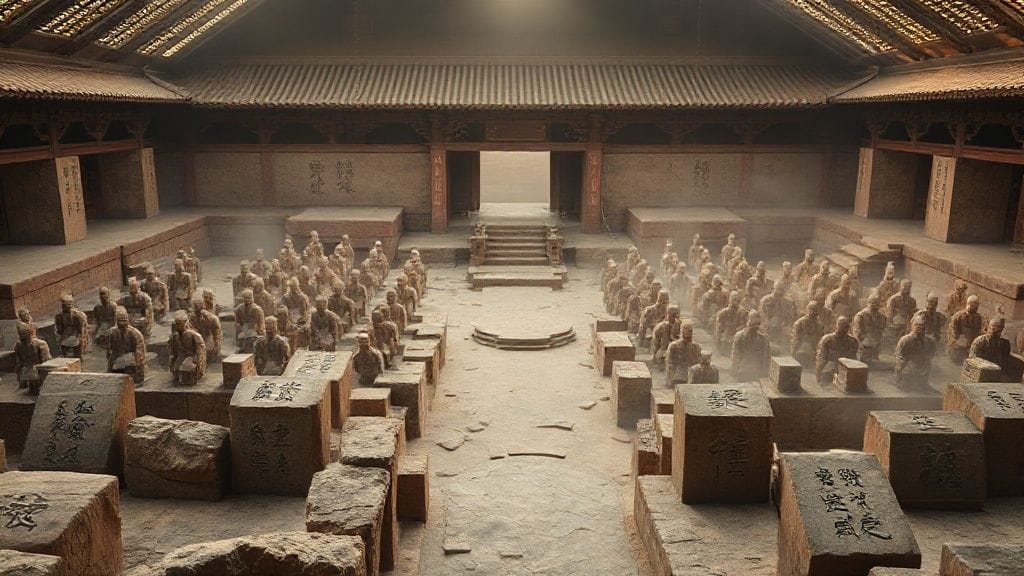
After his death, Qin Shi Huang was entombed in a monumental mausoleum near modern Xi’an, featuring the famous Terracotta Army — thousands of life-sized clay soldiers guarding his eternal rest. This burial complex embodies his quest for immortality, an attempt to project power into the afterlife.
The mausoleum’s design incorporates rivers of mercury and elaborate traps, reflecting ancient beliefs in the soul’s posthumous journeys and a desire to guard the emperor forever. Yet it also represents the paradox of Qin Shi Huang’s reign — grandeur bound by an obsession with death.
Power Vacuum: The Aftermath of Qin Shi Huang’s Death
The emperor’s death unleashed a dangerous power vacuum. His designated heir was bypassed by scheming ministers, and intrigue spiraled rapidly. The new emperor, under the influence of corrupt courtiers, lacked his predecessor’s resolve.
Discontent simmered among the nobility and populace, many oppressed by Qin’s harsh laws. The fragile empire, constructed on fear and military might, began to fracture, its foundations shaken by premature death and political betrayal.
The Struggle for Succession and the Fall of Qin
Within months, rebellion engulfed the former empire. The Qin dynasty, despite its achievements, collapsed spectacularly by 206 BCE. Uprisings led by figures like Liu Bang and Xiang Yu reshaped China’s political landscape.
This rapid downfall illustrates the vital role of Qin Shi Huang’s strong leadership; once removed, the edifice built over decades crumbled swiftly. The death at Shaqiu was the catalyst for chaos — a reminder that empires, no matter how vast, hinge on the fragile lives of their rulers.
A Legacy Preserved and Distorted Over Millennia
Qin Shi Huang’s historical legacy is complex. Seen as a founder of Chinese unity and a visionary reformer, he is also remembered as a ruthless tyrant. His death marks a narrative fulcrum where admiration intersects with fear and myth.
The confusion and mystery surrounding his final moments amplify his symbolic status—an immortal in death as in life. His story survived centuries through official histories, folklore, and endless reinterpretations, making him one of history’s most fascinating and enigmatic characters.
Shaqiu Today: From Obscurity to Archaeological Interest
Modern archaeology has unearthed some remnants around Shaqiu, though far less spectacular than the mausoleum near Xi’an. Yet scholars remain interested in this site because of its historical connection to the First Emperor’s final days.
The region invites reflection on Emperor Qin’s mortal journey, a stark counterpoint to the grandeur of his legacy. Shaqiu symbolizes the humanity behind the imperial mask, a geographic footnote that echoes monumental historical change.
The Myth and Reality of the First Emperor’s Death
Over two millennia, Qin Shi Huang’s death has spawned myths blending fact and fiction — from tales of magical elixirs to conspiracies of court intrigue. Modern historians strive to strip away legend to reveal probable truths rooted in political reality and biological fate.
This ongoing dialogue between myth and history enriches our understanding of ancient China, highlighting how death, power, and memory intertwine to shape historical narratives.
Reflections on Mortality and Power in Ancient China
Qin Shi Huang’s last days underscore timeless human concerns: our fragility in the face of death, the quest for legacy, and the burdens of absolute power. His story invites empathy and awe as it reveals a ruler driven by fear and hope, ambition and vulnerability.
The Emperor’s death is not simply a historical event but a meditation on mortality itself, reflecting ancient Chinese philosophies and continuing to resonate across time.
Conclusion: The End of an Era, The Birth of Legend
The death of Qin Shi Huang at Shaqiu marked the closing of a transformative chapter in Chinese history, yet it also ignited a narrative that would endure across centuries. From a restless journey in a mobile palace to the silent depths of a sealed tomb, his final moments embody the paradox of a man who sought eternity but met death like any other mortal.
In death as in life, Qin Shi Huang commands fascination — a testament to the enduring human drama at the heart of history. His story teaches us about the price of power, the mystery of death, and the fragile threads that hold empires together.
FAQs
1. Why did Qin Shi Huang travel to Shaqiu before his death?
The exact reasons remain uncertain, but scholars suggest it was part of his quest for immortality, consulting sacred sites or avoiding ominous astrological signs in the capital. Shaqiu was likely a strategic rest stop on this pilgrimage of desperation.
2. How did Qin Shi Huang die?
Historical records indicate he died suddenly while on the journey, possibly from natural causes exacerbated by stress and age. Some theories propose poisoning or illness, but no definitive evidence exists.
3. What was the political impact of his death?
His death triggered a succession crisis and destabilized the Qin dynasty, leading to rapid collapse and rebellion. Without his leadership, the tightly controlled empire fractured.
4. What is known about the mausoleum of Qin Shi Huang?
Located near Xi’an, it is a vast complex guarded by the famous Terracotta Army, symbolizing his desire for protection in the afterlife. The tomb remains largely unexcavated, preserving many mysteries.
5. How do modern historians view Qin Shi Huang?
He is seen as a complex figure—both a unifier and a tyrant—whose reforms shaped China profoundly but whose harsh rule sowed seeds of discontent.
6. What role does Shaqiu play in understanding Qin Shi Huang’s death?
Shaqiu is the last known location during the emperor’s final journey, providing critical geographical context and a focus for archaeological and historical research.
7. How has the story of Qin Shi Huang’s death influenced Chinese culture?
His death contributes to his mythos, inspiring stories, art, and philosophical reflections on mortality, power, and legacy throughout Chinese history.
8. Why was the emperor’s death kept secret for some time?
Secrecy was maintained to prevent political chaos and allow time for a controlled succession, reflecting the fragile stability of the Qin regime.