Table of Contents
- A New Dawn over the Ganges: The Proclamation That Changed India
- The Tumultuous Prelude: From Sepoy Mutiny to Imperial Crisis
- Behind the Throne: British Political Shifts in Mid-19th Century
- The Fall of the East India Company: End of an Era
- November 1, 1858: The Queen’s Proclamation Unveiled in Allahabad
- Words and Weight: Analyzing the Text of the Proclamation
- A Promise of Peace: British Assurances to Indian Princes and Peoples
- Imperial Architecture: From Company Rule to the British Crown
- The Immediate Aftermath: Reactions in India’s Royal Courts and Streets
- Voices in the Shadows: Indian Perspectives and Resistance Movements
- Religious Undertones: Balancing Hindu, Muslim, and Christian Interests
- Administrative Overhauls: The Birth of the Viceroy and New Governance
- Military Reforms and the Legacy of the 1857 Uprising
- Cultural Resonance: The Proclamation in Literature and Public Memory
- The Global Dimension: Britain’s Empire and the Indian Pivot
- The Economic Impact: From Mercantile Monopoly to Crown Investment
- Seeds of Nationalism: How the Proclamation Ignited Future Movements
- Queen Victoria’s Image and Imperial Legitimacy
- The British Press and Public Opinion Back Home
- Long-Term Legacy: India’s Journey towards Independence
- Reflection: Crown Rule’s Paradox of Control and Concession
- Revisiting the Proclamation Today: Memory, Myth, and Scholarship
A New Dawn over the Ganges: The Proclamation That Changed India
The morning sun had barely risen over the sacred river Ganges on that crisp November day in 1858, yet in the city of Allahabad, a fresh chapter of history was quietly inscribed in imperial ink. From the halls of power, across the great subcontinent, reached a message not merely administrative but deeply symbolic — a formal declaration by Queen Victoria herself, marking the official transfer of India’s governance from the faltering East India Company to the British Crown. The air was crisp but heavy with anticipation, shadowed by memories of rebellion and bloodshed only a year prior. For millions of Indians, the proclamation was more than words: it was the dawn of a new era that promised peace yet layered uncertainty.
This proclamation did not emerge out of thin air; it was the crescendo of decades of dominance, exploitation, conflict, and uneasy coexistence. It sought to establish a new order, one which would recast the very relationship between Britain and India — an empire within an empire. The question then lingered—would this royal decree heal the wounds of the uprising, or deepen the fissures that would one day fuel the fires of independence? To truly understand November 1, 1858, and the scope of the Queen’s proclamation, we must delve into the tangled web of events that led up to this fulcrum of history.
The Tumultuous Prelude: From Sepoy Mutiny to Imperial Crisis
The year 1857 is forever etched into Indian and British collective memory as the year of a great upheaval—the Sepoy Mutiny, the First War of Indian Independence, or the Indian Rebellion of 1857, depending on whose narrative you embrace. It began with the military revolt of Indian soldiers, or sepoys, against British officers, fueled by grievances both immediate and deep-rooted: disrespect of Indian religious practices, dissatisfaction with pay and conditions, and a pervasive mistrust of the Company’s intentions.
The rebellion swiftly morphed from a military mutiny into a widespread uprising engulfing major cities like Delhi, Kanpur, Lucknow, and Jhansi. For nearly two years, India plunged into chaos and brutal conflict, shaking the foundations of British rule. The East India Company, a commercial behemoth turned de facto ruler, was overwhelmed by the scale of resistance and brutality. Both sides endured atrocities that left scars impossible to erase.
The British response was equally fierce, marked by campaigns to recapture key centers and exact retribution. This bloody struggle exposed not just the vulnerabilities of Company rule but the contradictions inherent in their system: a commercial entity struggling to maintain imperial order. It became painfully clear to British politicians in London that a new form of governance was necessary. The Company was no longer fit to govern a land as vast and strategically vital as India.
Behind the Throne: British Political Shifts in Mid-19th Century
The fallout from the rebellion triggered seismic shifts within British political circles. The debate was no longer whether Britain should control India, but how. The crisis coincided with rising Victorian ideals of responsibility and moral governance, wrapped tightly in imperial pride and the ambitions of a global empire. Parliament, reflecting the sentiments of public opinion and statesmen like Lord Palmerston and Lord Canning, pressed for direct Crown intervention.
Behind these decisions loomed Queen Victoria herself—an emblematic monarch whose personal image came to symbolize the unity and supremacy of the British Empire. Though the proclamation was drafted under her name by ministers, it was Victoria’s assent and royal authority that would recast the imperial relationship. This shift entailed not merely administrative reorganization but a profound ideological transformation: the British Crown would espouse a paternalistic and protective role, styling itself as guardian over the diverse peoples of India.
The Fall of the East India Company: End of an Era
On August 2, 1858, the British Parliament passed the Government of India Act, effectively dissolving the East India Company, ending two centuries of mercantile rule. It prohibited the Company from any further involvement in governance, replacing it with direct royal administration. This legislative act marked the death knell of private empire and the birth of formal colonial rule.
The Company’s end was dramatic but also symbolic—its legacy both vast in territorial acquisition and fraught with exploitative practices. It had been the vector of British influence, yet its inadequacy during the crisis made a revival impossible. The Crown’s direct rule was meant to bring order, stability, and a new legitimacy after the chaos.
November 1, 1858: The Queen’s Proclamation Unveiled in Allahabad
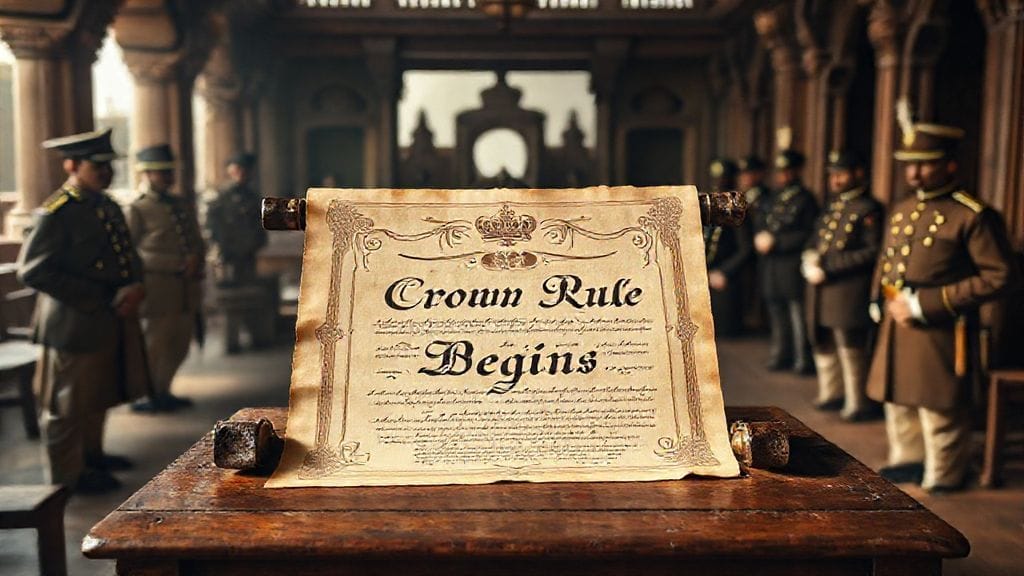
All hail the dawn of November 1, 1858—etched in history as the day the royal proclamation was read out loud in the citadel of Allahabad, an ancient city placed strategically at the trijunction of India’s great rivers. This city, symbolic in its confluence of cultures and political significance, was chosen deliberately as the grand stage for the announcement. British officials, Indian princes, nobles, and local dignitaries gathered to witness the formal declaration.
The grand ceremony was more than routine—it was designed to embody the transition of power. For the Indian elites, the proclamation was a public assurance by the Crown that their traditional privileges and rights would be preserved. For the British, it was a demonstration of renewed imperial resolve.
The text of the proclamation was read aloud in English and translated for Indian ears, its measured tone masking the undercurrents of control that lay beneath royal promises of justice and benevolence.
Words and Weight: Analyzing the Text of the Proclamation
The proclamation itself is a masterclass in imperial rhetoric, carefully balancing authority with benevolence. It assured the peoples of India that their “religions, rights, and privileges” would be respected and that “peace and good government” would be restored. The Queen promised to “maintain the principles of justice and protect the rights of all classes”—a clear counterpoint to the arbitrary rule attributed to the Company.
Yet beneath this layered language lay firm control: the Crown claimed sovereign authority “for the good and welfare of the people.” It signified a paternalistic empire, legitimized by the monarch’s grace rather than a commercial charter. The proclamation was also a strategic olive branch to Indian princes, many of whom had sided with or against the rebellion and whose loyalty was crucial to maintaining peace.
In these words, the British sought to rewrite their image from exploiters to protectors, creating a narrative that would justify and sustain imperial rule for decades.
A Promise of Peace: British Assurances to Indian Princes and Peoples
The proclamation took care to emphasize that Indian rulers and aristocrats would retain their estates and privileges if they accepted the Crown’s suzerainty. This was a deliberate strategy to stabilize governance by co-opting traditional elites who wielded local influence. Many princes, warily watching the chaos of the past years, welcomed the assurances as a lifeline for their survival.
For common people, the promise of peace resonated deeply, especially as the rebellion had devastated farms, towns, and livelihoods. The British pledged to protect their “property and lives,” attempting to court goodwill and legitimacy.
Yet this peace was not one of equality but of ordered hierarchy, where British supremacy would reign undisputed. The proclamation’s promises were carefully circumscribed to preserve imperial interests under the guise of protection.
Imperial Architecture: From Company Rule to the British Crown
Transitioning governance from a commercial enterprise to the Crown altered India’s political architecture fundamentally. The Governor-General became the Viceroy, embodying the monarch’s authority on the ground. This consolidation symbolized the direct imperial control over civil administration, the military, and diplomacy.
The proclamation empowered this new governance structure to wield flags of law, sovereignty, and justice, reshaping India’s bureaucratic landscape. The Crown also initiated reforms to centralize authority, streamlining administration and legal frameworks, seeking to prevent a recurrence of rebellion through better control.
This architecture formed the foundation for British India’s “Raj” period, which would last until 1947.
The Immediate Aftermath: Reactions in India’s Royal Courts and Streets
Reactions to the proclamation were as diverse as India itself. Royal courts issued cautiously worded statements pledging allegiance to the Crown, balancing gratitude and guarded hope. Some rulers felt relief that their autonomy was acknowledged; others feared gradual erosion of power.
Among the populace, responses ranged from hopeful acceptance to skepticism and quiet resentment. Many Indians pondered whether this new rule would bring justice or enforce stricter control.
British officials worked swiftly to stabilize administration, but beneath this official calm, the memory of the rebellion and its causes simmered dangerously. It was clear to all that the proclamation was not a full end but a new beginning.
Voices in the Shadows: Indian Perspectives and Resistance Movements
The proclamation did not erase the wounds of rebellion. In rural villages and urban quarters, whispered discontent persisted. Some viewed the Crown’s promises as hollow—merely a new mask for continued domination.
Indian intellectuals and emerging leaders began reflecting on what self-rule might mean. This period saw silent seeds of nationalism, though organized independence movements were decades away.
Resistance took subtle forms—cultural preservation, covert criticism, and grassroots discontent. For many, the proclamation was a reminder: the struggle for dignity and autonomy had only just begun.
Religious Undertones: Balancing Hindu, Muslim, and Christian Interests
The rebellion had demonstrated fault lines of religious tension, especially concerning caste, faith, and missionary activity. The proclamation carefully stressed respect for all “faiths and customs,” aiming to mollify fears of forced conversion or religious imposition.
This was a delicate diplomatic gesture: British officials sought to distance Crown rule from the perceived religious insensitivity of the East India Company, notably regarding the introduction of rifle cartridges rumored to be greased with animal fat forbidden by religious law.
Balancing these religious dynamics was critical to preserving peace and legitimacy under the new regime.
Administrative Overhauls: The Birth of the Viceroy and New Governance
The proclamation signaled the creation of the Viceroyalty of India, a singular position representing the monarch’s will. This office centralized authority like never before.
The administration was expanded and professionalized. New civil services, staffed increasingly by British officials trained for colonial governance, were introduced. The legal system was overhauled to incorporate British common law principles more firmly, though refracting them through the prism of Indian customs.
This bureaucratic transformation sought to ensure efficiency, loyalty, and control.
Military Reforms and the Legacy of the 1857 Uprising
The rebellion revealed deep vulnerabilities in how Indian troops were recruited and managed. Following the proclamation, the British Indian Army underwent major reforms: increasing European troop presence, restructuring regiments, and fostering loyalty through better pay and conditions.
Security became paramount, aiming to prevent another uprising by controlling the composition and command of military units.
Yet these reforms also sowed seeds of discontent that would later influence nationalist movements within and beyond the army ranks.
Cultural Resonance: The Proclamation in Literature and Public Memory
The Queen’s proclamation entered Indian and British cultural consciousness. British poets, historians, and officials lauded it as a milestone of empire, imbuing it with narrative of triumph and benevolence.
In India, it inspired a complex legacy. Some viewed it as a betrayal of local autonomy, others as a pragmatic acceptance. Writers and thinkers grappled with the evolving meaning of British rule, setting the stage for future debates on identity and autonomy.
Public memory preserved November 1 as both a symbol of control and a moment pregnant with possibility.
The Global Dimension: Britain’s Empire and the Indian Pivot
The transformation of India’s governance resonated far beyond its borders. Britain, asserting Crown rule over India, reaffirmed its place as a leading imperial power amidst competition with France, Russia, and other colonial empires.
India’s vast resources and strategic location made it the jewel of the British Empire. The proclamation underscored this significance, heralding intensified economic and military integration of India into global imperial networks.
This had repercussions for colonial policy worldwide, as other territories looked to India’s fate as precedent.
The Economic Impact: From Mercantile Monopoly to Crown Investment
The new regime brought shifts to India’s economy. The end of the East India Company freed the Crown to implement more direct economic policies. Investments flowed into infrastructure—railways, telegraphs, roads—increasing integration but also entrenching British commercial interests.
Traditional Indian industries faced disruptions, and land revenue systems like the Permanent Settlement continued under Crown auspices, often disadvantaging peasants.
Economic control tightened, ensuring India remained a vital asset within the empire’s global trade matrix.
Seeds of Nationalism: How the Proclamation Ignited Future Movements
Though the proclamation sought peace and stability, it unwittingly planted the seeds of Indian nationalism. The recognition of distinct Indian identities, religions, and rights encouraged early political consciousness.
As education spread and Indian elites gained access to British political ideas, critiques of colonial rule deepened.
The year 1858 can thus be seen as both an end and a beginning: ending Company rule but opening the path toward the struggles for freedom that would shape the subcontinent’s 20th-century destiny.
Queen Victoria’s Image and Imperial Legitimacy
Queen Victoria emerged as the symbolic mother of the Indian empire, her image carefully cultivated by British authorities. She would later be given the title “Empress of India” in 1876, cementing the personal union between monarchy and colony.
This personal touch blurred political lines, embedding imperial control within the affective realm of royalty and loyalty.
The proclamation was an early step in this image making, highlighting monarchy as a unifying and legitimizing force across continents.
The British Press and Public Opinion Back Home
Reports of the proclamation sparked wide coverage in Britain’s burgeoning press. Newspapers praised the new policy as enlightened and necessary, a reaffirmation of Britain’s “civilizing mission.”
Public opinion was largely supportive, though debates lingered around costs and ethics of empire.
The articulation of Crown rule was also a propaganda tool, shaping British perceptions of India’s place within an expanding global empire.
Long-Term Legacy: India’s Journey towards Independence
The proclamation’s effects endured well beyond its immediate context. It established structures that would govern India for another 90 years.
Yet the tensions it contained—between promise and control, protection and domination—continued to influence the complex evolution of British India. These contradictions fueled future demands for self-rule, leaving a contested legacy.
Looking back, the proclamation can be seen as a pivot point—a moment when the colonial relationship was renegotiated in ways that shaped modern India’s political trajectory.
Reflection: Crown Rule’s Paradox of Control and Concession
The Queen’s proclamation was both a gesture of empire’s compassion and an assertion of its supremacy. It promised respect and welfare while cementing an unequal relationship.
History invites us to reflect on this paradox: how imperial power sought legitimacy through promises it could rarely fulfill fully. The proclamation was at once an olive branch and a scepter—a symbol of hope and domination intertwined.
This ambiguity defines much of colonial history and echoes in contemporary debates on legacy and memory.
Revisiting the Proclamation Today: Memory, Myth, and Scholarship
Modern historians continue to analyze the proclamation’s text and context with fresh eyes, uncovering layers of meaning and contestation.
In India, it remains a subject of debate—seen alternately as a prelude to colonial repression or a milestone in the complex process of nation-building.
The proclamation invites ongoing critical engagement, reminding us that history is never settled but always open to new interpretations.
Conclusion
The Queen’s Proclamation of November 1, 1858, stands as a monumental moment, weaving together threads of conquest, crisis, and cautious reconciliation across one of history’s most complex empires. It marked the formal end of commercial colonialism and the birth of Crown rule—a change that promised peace but imposed new structures of control whose consequences would reverberate for generations.
What makes this event particularly poignant is its human dimension: the hopes and fears of Indian princes, the trauma of rebellion, the cautious optimism of everyday people yearning for stability, and the imperial designers crafting an empire’s future from afar. The proclamation illustrates how power and language mingle—words of respect and justice cloaked in a framework of dominance.
It set into motion a century of transformation that would ultimately culminate in India’s quest for independence, a journey shaped both by the Crown’s promises and its limitations. Studying this proclamation invites us to reflect on the enduring complexities of colonial legacies and the resonant human stories beneath grand historical designs.
We stand today not merely as observers of the past but as participants in the dialogue that history opens—reminded that every empire, no matter how vast, balances precariously between control and concession.
FAQs
1. Why was the Queen’s Proclamation of 1858 necessary?
The proclamation was necessary to formalize the transfer of power from the East India Company to the British Crown after the 1857 rebellion exposed the Company’s inability to govern effectively and maintain order.
2. What promises did the proclamation make to Indian princes and people?
It promised to respect Indian religions, customs, and rights, to maintain peace and justice, and to protect the privileges of Indian princes who accepted British sovereignty.
3. How did the proclamation change the governance of India?
It ended Company rule, introduced direct Crown administration, created the position of Viceroy to represent the monarch, and centralized political and military control.
4. How did Indians react to the proclamation?
Reactions varied: many princes welcomed the assurances, common people had mixed feelings—hope for peace but skepticism about British intentions—and some groups maintained covert resistance.
5. What were the military reforms following the proclamation?
The British restructured the Indian Army to increase European presence, reorganized regiments, and improved pay to foster loyalty and prevent future mutinies.
6. How did the proclamation influence Indian nationalism?
While it was meant to pacify India, it also laid the groundwork for political consciousness by recognizing Indian identities and rights, inspiring future nationalist movements.
7. Did the proclamation affect religious relations in India?
Yes. It emphasized respect for all faiths to reduce religious tensions that contributed to the 1857 rebellion and to counter fears of missionary aggression.
8. What is the long-term legacy of the proclamation?
It marked the start of direct British rule for nearly a century, influencing India’s political, social, and economic life and shaping the path toward independence.