Table of Contents
- The Roar Before the Storm: Setting the Stage for Raung’s Awakening
- The Geographic and Cultural Heart of East Java
- Volcanoes and Villages: A History of Coexistence
- The Early Signs: Monitoring an Unquiet Giant
- February 2015: The First Plumes of Smoke
- The Eruption Unfolds: Chaos from the Crater
- Impact on Aviation and the Regional Economy
- The Human Toll: Displacement and Daily Struggles
- Local Responses: Community and Government in the Face of Disaster
- International Attention: Aid, Media, and Scientific Interest
- The Environmental Aftermath: Ash, Rain, and Ecological Shifts
- Cultural Narratives and Folklore Rekindled
- Scientific Insights: Volcano Monitoring in a Modern Era
- The Psychological Weight of Living on a Volcano
- Lessons Learned: Emergency Preparedness and Resilience
- Raung’s Legacy in Indonesian Volcanology
- Conclusion: From Destruction to Renewal
- FAQs: Understanding the Raung Eruption
- External Resource
- Internal Link
The Roar Before the Storm: Setting the Stage for Raung’s Awakening
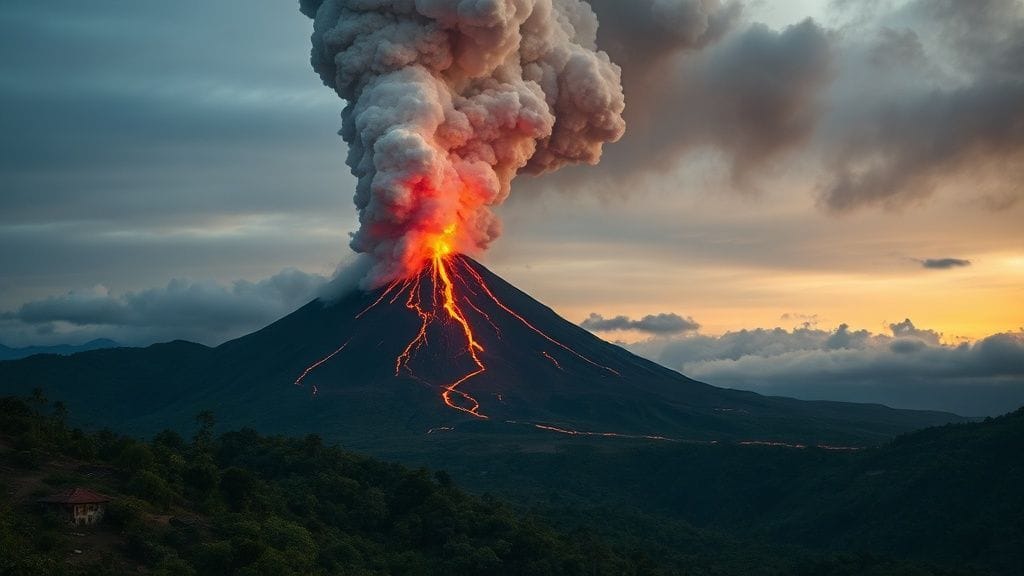
In the humid air just outside Banyuwangi, East Java, the evening sky darkened not with the coming night but with the heavy, ominous plume rising from Mount Raung. The year was 2015, and what began as a distant murmur soon erupted into a dramatic spectacle of nature’s fury. People on the slopes and surrounding villages gazed upward — a blend of awe, fear, and resignation washing over their faces. For this volcano, which towered over the landscape like a sleeping giant, was stirring to life once again.
Raung’s eruption that year was no mere footnote in the annals of Indonesian volcanism. It was a powerful reminder of the geological forces churning beneath the archipelago — forces that shaped not only landscapes, but lives, economies, and the very soul of a region. This story is one of anticipation, upheaval, resilience, and ultimately, the profound relationship between humans and the restless Earth beneath them.
The Geographic and Cultural Heart of East Java
East Java, a province famed for its rich soils, sprawling tea plantations, and vibrant culture, holds an intriguing relationship with its volcanoes. Mount Raung stands tall here, nearly 3,300 meters high, dominating the skyline with its caldera and active crater. Neighboring settlements rely heavily on agriculture, fishing, and increasingly, tourism drawn by the rich natural beauty and spiritual significance of the region.
The area surrounding Raung is a tapestry of human activity and volcanic presence, rooted in centuries of coexistence. Villages nestle in valleys and on hillsides, where people have adapted their lives to the soil’s fertility — a gift of volcanic activity — but also to the looming threat of eruption. For many locals, Raung is not only a geographical landmark; it is woven into folklore, religion, and daily rituals, sometimes revered, sometimes feared.
Volcanoes and Villages: A History of Coexistence
For centuries, Raung has been active intermittently, erupting with considerable violence. Historical records, though sparse, describe eruptions in the 17th and 18th centuries that reshaped the environment and challenged local communities. These eruptions, sometimes deadly, helped forge the resilient spirit of the inhabitants, who learned to interpret the volcano’s warning signs.
In the modern era, Indonesian volcanologists have meticulously tracked Raung’s activity. Yet monitoring has always been challenging — remote locations, limited access, and the unpredictable nature of volcanic behavior complicate efforts to forecast eruptions accurately. Time and again, communities have been caught off guard, highlighting the tenuous balance between human ambition and natural hazard.
The Early Signs: Monitoring an Unquiet Giant
As 2015 began, subtle tremors beneath Raung hinted at disturbances within. Seismographs recorded increasing activity, and thermal cameras detected rising heat levels near the summit. Yet to the casual observer, Raung appeared placid — a deceptive calm that often precedes volcanic fury.
Scientists at the Center for Volcanology and Geological Hazard Mitigation in Indonesia closely monitored these changes. Satellite imagery revealed expanding ash clouds and sulfur dioxide emissions that signaled magma movement underground. Local authorities started organizing briefings and planning evacuation protocols, aware that the volcano’s awakening could impact thousands.
February 2015: The First Plumes of Smoke
On the morning of February 12, a dark cloud erupted from Raung’s crater, marking the beginning of a cycle of explosive activity. Ash shot kilometers into the sky, spreading a gray shroud over the landscape, turning day into twilight. Flights were delayed or diverted as the ash threatened airports as far as Bali and Surabaya.
Villagers scrambled to protect their homes and livestock, donning masks against the choking ashfall. Schools and markets closed as authorities declared alert levels, triggering widespread caution. Despite the precautions, the eruption’s scale and intensity caught some off guard, revealing vulnerabilities in communication and preparedness.
The Eruption Unfolds: Chaos from the Crater
Over the subsequent weeks, Raung unleashed multiple eruptions — strombolian bursts of lava and ash clouds that continuously reshaped the environment. The volcano’s fire plays illuminated night skies, fireworks of molten rock and hot gases that were as beautiful as they were terrifying.
Lava flows threatened forested areas, while ash contaminated water sources and smothered crops. The rhythmic tremors rattled homes, vibrations felt as much emotionally as physically. At times, the volcano seemed to roar directly at the people, a primal sound signifying its ancient power.
Impact on Aviation and the Regional Economy
Indonesia’s skies, saturated with volcanic ash, experienced major disruptions. The ash, infamous for damaging aircraft engines, led to widespread flight cancellations and rerouting. Delays affected not just passengers but also the cargo and tourism industries vital to East Java and neighboring regions.
Farmers watched helplessly as ash smothered fields, jeopardizing harvests of coffee, tea, and rice — the economic backbone of many local communities. Fishermen found the waters murkier, affecting fish behavior and catch yields. The eruption’s economic tidal wave rippled far beyond immediate physical damage.
The Human Toll: Displacement and Daily Struggles
The most pressing impact was on the people who lived in Raung’s shadow. Over 20,000 were displaced as authorities enforced evacuations in high-risk zones. Temporary shelters filled quickly, often lacking adequate facilities or resources. Dust-covered faces, tired eyes, and the humbling patience of waiting defined everyday life.
Reports of respiratory illnesses rose as ash inhalation became a persistent risk, particularly for children and the elderly. Local health workers stretched thin, delivering care amid logistical hurdles. Yet amidst hardship, the strength of community surfaced — neighbors supported one another, and volunteer groups organized food, masks, and information.
Local Responses: Community and Government in the Face of Disaster
The Indonesian government, working alongside local administrations, mounted a multi-layered response. Disaster mitigation agencies increased ground patrols, improved early warning systems, and coordinated evacuations. Social media played an emerging role, disseminating real-time updates that warned and reassured.
Religious leaders held ceremonies invoking protection, blending cultural traditions with crisis management. Volunteers formed networks distributing aid and comforting evacuees. The eruption tested the state’s readiness, exposing gaps in infrastructure but also remarkable capacities for solidarity.
International Attention: Aid, Media, and Scientific Interest
News of Raung’s eruption spread globally, catching the eye of international aid organizations and scientific communities. Monitoring equipment and expert teams from abroad offered assistance, eager to study this eruption’s patterns.
Media coverage brought images of ash-suffocated towns and resilient faces into living rooms worldwide, sparking empathy and prompting donations. Yet these narratives often underestimated the deep-rooted experience of living amid volcanic activity — a lived reality rather than just a headline.
The Environmental Aftermath: Ash, Rain, and Ecological Shifts
Environmental consequences extended beyond the ash clouds. Heavy rains following the eruption mixed with loose volcanic material, provoking dangerous lahars—mudflows that swept through river valleys, damaging infrastructure and natural habitats.
Flora and fauna faced immediate threats, but scientific observations suggested long-term ecological transformations. Nutrient-rich ash could stimulate soil fertility over time, yet initial devastation posed serious challenges for biodiversity and conservation efforts.
Cultural Narratives and Folklore Rekindled
The eruption rekindled ancient stories and spiritual beliefs surrounding Raung. Elders recounted legends warning of the volcano’s wrath while explaining its gifts — the fertility of the land and its role as a guardian spirit.
These narratives provided comfort and meaning amid trauma, reinforcing identity and offering frameworks for resilience. Rituals, offerings, and prayers became acts of reclaiming agency and communal strength, bridging past and present.
Scientific Insights: Volcano Monitoring in a Modern Era
The 2015 eruption served as a pivotal case study for Indonesian volcanology. Advances in satellite technology, seismic networks, and gas sensing enabled scientists to better understand eruption precursors and dynamics.
However, it also highlighted the struggle to translate data into timely, clear public warnings. The challenge remained to enhance predictive models while fostering trust and awareness among vulnerable populations.
The Psychological Weight of Living on a Volcano
Beyond physical destruction, the eruption exerted profound psychological effects. Anxiety, uncertainty, and disruption of everyday life layered upon communities accustomed to unpredictability.
Interviews with evacuees and local officials reveal a complex emotional landscape — fear mingled with resignation, hope sparked by community solidarity. This human dimension underscores the necessity of integrating mental health support into disaster response frameworks.
Lessons Learned: Emergency Preparedness and Resilience
Raung’s 2015 eruption prompted reflection across Indonesia’s disaster management sectors. Authorities implemented improved early warning systems, evacuation planning, and community education.
Local knowledge and traditional practices were increasingly recognized as valuable complements to scientific data. The eruption became a catalyst for strengthening resilience, building infrastructure, and fostering collaboration between state agencies and citizens.
Raung’s Legacy in Indonesian Volcanology
Today, Raung stands as a vital emblem of Indonesia’s volcanic landscape — a living laboratory for understanding natural hazards and human adaptation. The eruption of 2015 reminded all that volcanic peaks are never truly silent; instead, they narrate stories of creation, destruction, and endurance.
In scientific circles and local communities alike, Raung’s eruption marks a chapter of learning and continuity, inspiring deeper respect for the volatile Earth we inhabit.
Conclusion: From Destruction to Renewal
The 2015 eruption of Mount Raung was a dramatic upheaval but also a story of resilience. Nature’s power humbled communities, halted economies, and painted skies with ash — yet from this destruction arose renewal.
The people of East Java, intertwined with their volcanic landscape, demonstrated courage, solidarity, and hope. Their narratives remind us that disasters are not just endings but transitions — moments calling forth our capacity to adapt, rebuild, and coexist with the immense forces that shape our world.
Raung’s roar was a warning, a spectacle, and ultimately, an invitation to live consciously beneath the shadow of earth’s restless heart.
FAQs: Understanding the Raung Eruption
Q1: What triggered the 2015 eruption of Mount Raung?
A: The eruption was caused by the movement of magma beneath the volcano, leading to increased seismic activity, gas emissions, and pressure buildup until the volcanic crater explosively released ash and lava.
Q2: How did the eruption affect local communities?
A: Thousands were displaced due to ashfall and evacuation zones; health issues such as respiratory problems increased, and agriculture and fishing industries suffered significant damage.
Q3: What measures were taken to mitigate the eruption’s impact?
A: The government implemented evacuation orders, established emergency shelters, increased monitoring and warnings, and coordinated distribution of masks and aid.
Q4: Why is volcanic ash hazardous to aviation?
A: Volcanic ash can damage aircraft engines by melting and clogging mechanical parts, impair visibility, and cause instrument failure, leading to flight cancellations and rerouting.
Q5: How did the eruption influence scientific research?
A: It provided valuable data on eruption precursors, ash dispersal, and volcano monitoring technology, encouraging improvements in early warning systems and disaster preparedness.
Q6: What cultural significance does Mount Raung hold?
A: It is a symbol in local folklore and spiritual practice, revered as a powerful natural force that shapes the land and community identity.
Q7: What were the environmental consequences of the eruption?
A: Short-term damage included ashfall and lahars affecting habitats and water systems; long-term effects include soil enrichment and ecological shifts.
Q8: How do locals psychologically manage living near an active volcano?
A: Through community support, religious practices, acceptance of risk, and integrating traditional knowledge with modern preparedness strategies.

