Table of Contents
- A City Shrouded in Autumn Mist: Amsterdam, October 1669
- The Final Days of a Master: Rembrandt’s Last Moments
- The Dutch Republic in the Golden Age: A Tapestry of Prosperity and Paradox
- Rembrandt’s Early Triumphs and Turmoil: The Rise of a Prodigy
- The Artist and His City: An Intimate, Complicated Relationship
- The Shadow of Debt: Financial Hardships Amidst Fame
- House in Jodenbreestraat: The Last Studio, The Final Sanctuary
- The Artistic Legacy in Crisis: Changing Tastes and the Battle for Relevance
- October 4, 1669: The Day the Curtain Fell
- Mourning in the Shadows: The Funeral and Public Reception
- From Obscurity to Reverence: Posthumous Reputation Through Centuries
- Rembrandt’s Influence on Dutch Identity and Global Art
- The Theft, the Restoration, the Rediscovery: Rembrandt Reborn
- The Human Behind the Legend: Private Life and Enduring Emotional Resonance
- Final Brushstrokes: How Death Marked a Transition in Dutch Art History
- Rembrandt in the Dutch Golden Age: A Mirror to Society’s Triumphs and Struggles
- The Weight of Mortality in Rembrandt’s Late Works
- The Silent Legacy of Amsterdam’s Narrow Streets
- Legacy Reflected: Modern Appreciation and Museology
- Why Rembrandt’s Death Still Matters Today
1. A City Shrouded in Autumn Mist: Amsterdam, October 1669
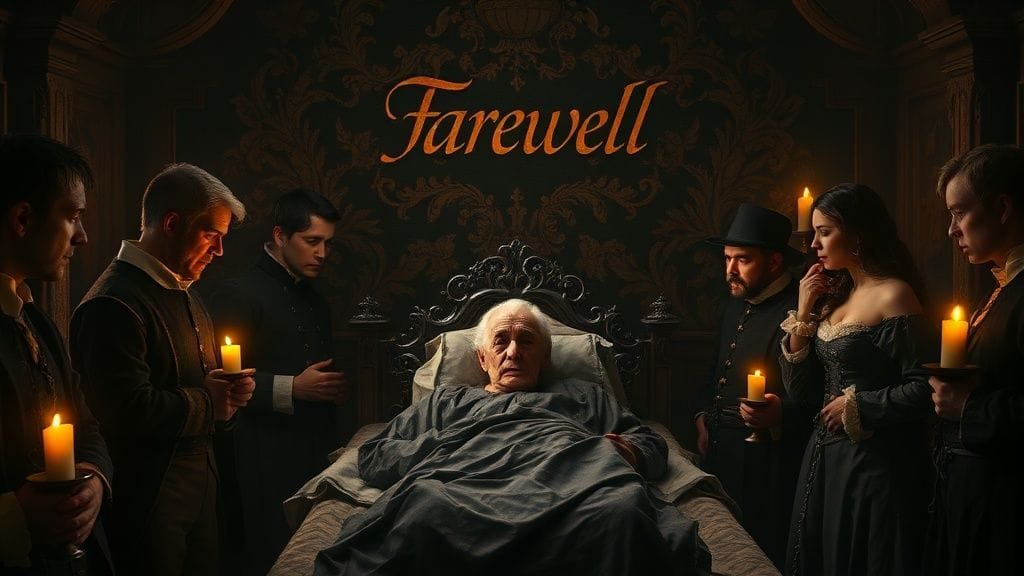
The damp chill of early October 1669 had settled over Amsterdam like a ghostly veil. Narrow alleys were slick with rain, and the golden light that once bathed the city now seemed filtered, muted. Autumn leaves swirled along the cobblestones, whispering of an end—not just to the season but to an era. In a modest house on Jodenbreestraat, within the thrumming heart of the Dutch Republic, Rembrandt Harmenszoon van Rijn’s breath grew shallow.
In those final hours, history held its breath. A figure whose strokes had painted the soul of a nation was poised to depart from a world he had so vividly captured on canvas. The air was thick with a mix of silent awe and quiet sorrow. The city, already renowned for its bustling commerce and robust cultural life, stood on the cusp of losing one of its most complex, troubled, and remarkable sons.
2. The Final Days of a Master: Rembrandt’s Last Moments
The life of Rembrandt had not been one of uninterrupted glory. His final days were marked by relative obscurity and financial ruin—a tragic contrast to the exuberance of his earlier fame. On the verge of his sixtieth birthday, frail and weighed down by illness and debt, Rembrandt’s genius persevered, though his society’s gaze often turned elsewhere.
Legend holds that even on his deathbed, Rembrandt’s mind lingered obsessively on the play of light and shadow, the eternal dance between dark and illumination that fueled his art. Impressionistic accounts tell of his wife Saskia’s memory haunting his thoughts, and the looming presence of his son Titus, who would soon face the void left behind.
Yet, in those last breaths, Rembrandt was still the artist interwoven with human frailty and profound insight. His death was not merely the halt of a life but the closing of a grand chapter in Dutch cultural history.
3. The Dutch Republic in the Golden Age: A Tapestry of Prosperity and Paradox
To fully grasp the significance of Rembrandt’s death, one must first understand the context in which he lived—a period now remembered as the Dutch Golden Age. The 17th century saw the United Provinces of the Netherlands rise as an economic and cultural powerhouse. Amsterdam was its vibrant cronicle: a nexus of trade, innovation, and artistic experimentation.
Yet this prosperity coexisted uneasily with social tensions, religious disputes, and the ever-present specter of mortality. The Protestant ethic shaped public life, while mercantilism fueled expansion. In this mosaic, Rembrandt’s art emerged—both a product and a commentary of his time.
Unwavering in his commitment to depicting the human condition, he defied norms. Where many celebrated idyllic landscapes or idealized portraits, Rembrandt found beauty in realism—the imperfections, the shadows, the depth beneath surface appearances.
4. Rembrandt’s Early Triumphs and Turmoil: The Rise of a Prodigy
Born in Leiden in 1606, Rembrandt’s ascent was meteoric. His early works were marked by an extraordinary command of chiaroscuro and an emerging ability to infuse biblical and mythological subjects with palpable emotion and drama. Through the 1630s and 1640s, his reputation bloomed like a tulip in spring.
Yet greatness was shadowed by misfortune. Personal losses—his beloved wife Saskia died young, his children were ravaged by illness—and increasing financial troubles loomed ominously. Despite this, Rembrandt’s studio at its height attracted innumerable pupils and patrons.
His prolific output ranged from grand historical canvases to quiet, introspective self-portraits. The man who had once been the darling of Amsterdam’s elite began to face changed tastes and rival artists eager to carve their own place in the ever-competitive art scene.
5. The Artist and His City: An Intimate, Complicated Relationship
Amsterdam was both cradle and crucible for Rembrandt. This city, buzzing with merchants, scholars, and political actors, offered opportunity and audience but also harsh judgment. His personal eccentricities and riveting independence sometimes alienated potential allies.
Rembrandt’s affinity for the marginalized—portraying beggars, Jews, and the downtrodden—mirrored the city’s contradictions. Despite a thriving Jewish quarter and relative tolerance, religious divides and social stratifications remained stark.
In the Jodenbreestraat quarter where he lived, the pulse of Amsterdam’s cultural diversity beat visibly. The city’s canals reflected light and shadow not only on water but in the myriad human dramas played out on its streets.
6. The Shadow of Debt: Financial Hardships Amidst Fame
Although Rembrandt’s artistic reputation was formidable, his financial acumen—or lack thereof—proved his undoing. By the early 1650s, debts accumulated. Luxuries once afforded became burdens; a beloved home on Jodenbreestraat was eventually seized by creditors.
Court records from the period reveal haggling over possessions, painful sales of prized works, even legal battles. These fiscal crises never eclipsed his artistic flourishing but darkened his later years with uncertainty.
This stark dichotomy—artistic genius colliding with personal misfortune—adds a tragic human dimension to the narrative of his life’s end.
7. House in Jodenbreestraat: The Last Studio, The Final Sanctuary
The house on Jodenbreestraat, though modest by contemporary standards, had been Rembrandt’s haven. Within its walls hung the fruits of decades: sketches, pigments, brushes, canvases scarred by repeated trials.
Here, isolated from the grandeur he once enjoyed, the artist grappled with new realities, continuing to paint despite ever-diminishing prospects. The worn wooden floorboards bore the weight not only of his body but also of his history—hopes fulfilled and dreams deferred.
This space was where Rembrandt met death, not with silence, but with the residual hum of creation still alive in his hands.
8. The Artistic Legacy in Crisis: Changing Tastes and the Battle for Relevance
By the time Rembrandt passed on October 4, 1669, the art world was shifting. The exquisite detachment of the French Baroque and the delicate elegance of Dutch contemporaries challenged the intense, often somber authenticity of his style.
Patrons sought lighter, more decorative works. Rembrandt’s raw emotional power was occasionally deemed old-fashioned or too introspective for the rising bourgeoisie’s tastes.
Yet precisely in this dissonance lay the seeds of his enduring greatness. His ability to strip away artifice brought human vulnerability into stark relief—a trait rediscovered and celebrated centuries later.
9. October 4, 1669: The Day the Curtain Fell
On that gray autumn day, as the bells tolled softly over Amsterdam’s rooftops, Rembrandt breathed his last. Few witnessed the event; it was a quiet passing rather than a grand finale.
Contemporaries recorded in diaries that the city barely paused, distracted by its own affairs. The great master died without fortune or fanfare—a stark contrast to the luminescence of his canvases.
Nonetheless, this moment marked the end not just of a life but of an epoch in Dutch art. Though humble and somber, this death was the closing stroke on an unparalleled creative life.
10. Mourning in the Shadows: The Funeral and Public Reception
Rembrandt was buried in a common grave in the Westerkerk’s cemetery, reflective of his diminished finances but not his significance. The absence of pomp did not prevent his few close friends and disciples from honoring his memory quietly.
Public reaction was subdued but tinged with respect, tinged with regret. The city's newspapers noted the passing, placing him among “those few whose genius illuminated our times.”
Still, for many, Rembrandt’s full measure was yet to be grasped—a truth that time would affirm with increasing clarity.
11. From Obscurity to Reverence: Posthumous Reputation Through Centuries
After his death, Rembrandt’s reputation ebbed and flowed. During the 18th and 19th centuries, his works were alternately revered and misunderstood. It took the Romantic movement to rekindle interest in his emotional depth.
Collectors like Sir Joshua Reynolds and scholars reignited passion for his art, restoring him to his rightful place in the pantheon of great painters. Museums gradually assembled collections, allowing broader public access.
Today, he is not only a Dutch hero but a symbol of artistic integrity and human vulnerability worldwide.
12. Rembrandt’s Influence on Dutch Identity and Global Art
Rembrandt’s death heralded the consolidation of the Dutch Golden Age as a defining cultural moment. His ability to merge personal introspection with universal themes shaped Dutch self-perception.
Beyond the Netherlands, his impact rippled through European and eventually global art history. His innovations in light, texture, and psychological realism set foundations for modern portraiture and narrative painting.
His work continues to inspire artists, historians, and audiences who seek truth beyond surface beauty.
13. The Theft, the Restoration, the Rediscovery: Rembrandt Reborn
Centuries after his death, Rembrandt’s works have undergone trials reflective of their enduring allure. Theft, forgery, misattribution, and restoration efforts have swirled around his oeuvre.
At times, artworks were lost in fires or wars; at others, new pieces attributed to him ignited scholarly debates. Each rediscovery reignited interest, reaffirming the master’s unmatched status.
Modern technology, from infrared imaging to chemical analysis, has brought new insights into his creative techniques, offering intimate glimpses into his genius.
14. The Human Behind the Legend: Private Life and Enduring Emotional Resonance
Behind the fame, Rembrandt was a man marked by tragedy and resilience. He loved deeply and lost repeatedly: his wife Saskia, beloved son Titus, cherished pupils and patrons.
Letters, diaries, and records reveal his humor, frustrations, dreams, and devout spirituality. These elements humanize the legend, knitting a texture of relatable emotion beneath the grandeur of his historical stature.
In every brushstroke lingers that fragile humanity—a connective thread across centuries.
15. Final Brushstrokes: How Death Marked a Transition in Dutch Art History
Rembrandt’s death symbolized an inflection point in art history. The robust confidence of early Dutch painting gave way to styles emphasizing decorum and idealization.
Yet his influence remained a lodestar, encouraging future generations to pursue authenticity and soulfulness. The transition signaled by his death was less an end than a transformation—a testament to the endurance of disruptive genius.
16. Rembrandt in the Dutch Golden Age: A Mirror to Society’s Triumphs and Struggles
Rembrandt’s art functioned as a mirror reflecting the contradictions of Dutch society during its Golden Age—wealth and poverty, tolerance and persecution, faith and doubt.
His empathetic portrayals of ordinary and marginalized figures illuminated societal undercurrents often ignored. In this way, his death left a vacuum in Dutch cultural introspection, a silence felt by citizens attuned to their own city’s layered realities.
17. The Weight of Mortality in Rembrandt’s Late Works
In the twilight of his career, Rembrandt’s paintings took on a somber meditation on death and time. Self-portraits revealed not just aging flesh but deep psychological journeys.
Works like “The Three Crosses” or “Jacob Wrestling with the Angel” wrestled with spiritual and existential themes, foreshadowing his own mortality.
These paintings, suffused with shadows yet pulsing with light, stand as haunting preludes to his passing.
18. The Silent Legacy of Amsterdam’s Narrow Streets
While Rembrandt’s physical presence vanished, the narrow streets and canals of Amsterdam continued to echo with his legacy. The city’s architecture and cultural fabric bear subtle traces of his life and work.
Tourists and scholars tread the same paths, imagining the master at work amid the daily tumult of 17th-century urban life.
His death was not the extinguishing of a flame but the passing of a torch carried forward by the city itself.
19. Legacy Reflected: Modern Appreciation and Museology
Today, Rembrandt is among the most studied and beloved figures in art history. Institutions such as the Rijksmuseum in Amsterdam and the Rembrandt House Museum tell his story with reverence and depth.
Exhibitions, research, and popular culture ensure his ongoing resonance. The study of his technique enriches not only historical knowledge but contemporary artistic practice.
Rembrandt’s death did not close a chapter—it opened an endless dialogue across generations.
20. Why Rembrandt’s Death Still Matters Today
Rembrandt’s passing was more than a biographical footnote; it signaled the closure of an exceptional life that transformed the art world’s approach to humanity and light.
His death invites reflection on the nature of genius, the frailty of human fortune, and the enduring power of creativity. The emotions stirred by his life and career remain profoundly relevant in an age hungry for authenticity and emotional truth.
In a modern world rife with spectacle, Rembrandt’s death reminds us that true art pierces beneath surface illusions to reveal the timeless human soul.
Conclusion
Rembrandt’s death in Amsterdam on October 4, 1669, was a moment at once quiet and monumental—a silent waltz of shadow meeting light for the last time. It marked the conclusion of a life defined by extraordinary talent, human vulnerability, and unyielding pursuit of truth through paint and canvas. His passing echoed through the narrow streets of the bustling Dutch Republic, touching hearts both then and now.
Though the city scarcely paused that autumn day, history would prove far kinder. Rembrandt’s legacy, forged amid joy and sorrow, poverty and triumph, remains a beacon illuminating the complexities of existence. His death did not dim the brilliance he cast upon the world; rather, it signaled the beginning of an eternal dialogue between past and present, artist and audience, shadow and light.
In the end, Rembrandt’s life and death teach us that art is the language through which humanity confronts mortality, celebrates spirit, and finds immortal resonance.
FAQs
Q1: What were the main causes leading to Rembrandt’s financial difficulties before his death?
A1: Rembrandt’s financial troubles stemmed from a combination of extravagant spending, poor financial management, and the loss of many patrons as artistic tastes changed. His costly lifestyle, coupled with economic downturns and legal disputes, led to the forced sale of his house and assets, severely impacting his final years.
Q2: How did Rembrandt’s art reflect the societal conditions of the Dutch Golden Age?
A2: His work mirrored society’s contrasts—wealth alongside poverty, religious devotion amidst skepticism, tolerance and exclusion. By portraying marginalized figures and unidealized human emotions, Rembrandt captured the complexity of a society undergoing swift economic and cultural change.
Q3: What was the immediate public reaction to Rembrandt’s death in Amsterdam?
A3: The public reaction was relatively muted at the time, largely because Rembrandt had fallen out of favor and was no longer wealthy or well-connected. His burial was modest, but within artistic and scholarly circles, his death was recognized as significant, although his full posthumous acclaim came much later.
Q4: In what ways has Rembrandt’s legacy influenced modern art?
A4: Rembrandt’s techniques in lighting, texture, and psychological depth have influenced countless artists across centuries. His focus on emotional realism and human vulnerability prefigured modern artistic movements and continues to inspire contemporary portraiture and narrative art.
Q5: How did Rembrandt’s death impact the Dutch art scene?
A5: His death marked a symbolic end to a period of intense innovation in Dutch painting. Although others continued to develop new styles, Rembrandt’s unique blend of emotional intensity and realism set a high watermark that the art world remembered and built upon.
Q6: Where was Rembrandt buried, and why was it significant?
A6: He was buried in a common grave in the Westerkerk’s cemetery in Amsterdam, reflecting his impoverished state at death. This modest burial contrasted with his earlier fame but underscored the often transient nature of worldly success.
Q7: What are some of the most poignant themes in Rembrandt’s late works before his death?
A7: His late paintings frequently explored mortality, spirituality, suffering, and redemption. These themes are conveyed through somber tones, intense contrasts of light and dark, and deeply introspective self-portraits that reveal his confrontation with aging and death.
Q8: Why does Rembrandt’s death still captivate historians and art lovers today?
A8: His death symbolizes the intersection of human vulnerability and artistic genius, encapsulating a story of personal struggle, cultural brilliance, and enduring influence. It resonates as a universal narrative about creativity’s role in confronting life’s fragility and transcending it through art.