Table of Contents
- The Dawn of a New Era: Proclamation of the Republic
- The Twilight of an Empire: The Ottoman Decline and World War I
- Mustafa Kemal Atatürk: The Architect of Modern Turkey
- The Turkish War of Independence: A Nation’s Struggle for Sovereignty
- The Treaty of Sèvres and the Seeds of Resistance
- Ankara as the Heartbeat of Revolution
- October 29, 1923: A Historic Day in Ankara
- The Ceremony That Shaped a Nation
- The Symbolism in Atatürk’s Words and Actions
- The New Republic’s Ideals: Secularism, Nationalism, Modernity
- Early Reforms: Education, Law, and Women’s Rights
- The Shift from Sultanate to Republic: Political and Social Challenges
- International Reactions and the Global Context
- The Abolition of the Caliphate: Balancing Tradition and Progress
- Economic Foundations of the New Republic
- The Role of the Military in the Republic’s Formation
- Cultural Renaissance and Language Reform
- Challenges and Opposition in the Early Years
- The Legacy of October 29, 1923 in Modern Turkey
- Republic Day Today: Celebrations and National Memory
- Conclusion: The Republic’s Enduring Spirit
- FAQs about the Proclamation of the Republic of Turkey
- External Resource
- Internal Link
On a brisk autumn morning of October 29, 1923, Ankara was alive with anticipation and a quiet, electrifying hope. The air was thick with the collective breath of a nation poised on the edge of transformation. From the dust of war and dissolution of an empire emerged something remarkably new—a republic conceived not in the halls of power inherited but born from struggle and vision. As Mustafa Kemal, later known as Atatürk, stepped before the gathered crowd and declared the Republic of Turkey, a chapter closed on centuries of imperial rule and another opened in the history of a resilient people. The proclamation was more than a political statement; it was an audacious declaration of identity, sovereignty, and hope. But this moment—glorious and jubilant—was also hard-won, layered with sacrifice, ideological battles, and the steadfast belief in a future that saw Turkey not as a relic of the past, but as a beacon for the modern age.
The Dawn of a New Era: Proclamation of the Republic
The Republic of Turkey was officially proclaimed on October 29, 1923, marking a definitive rupture from the Ottoman past and the birth of a modern nation-state under the leadership of Mustafa Kemal Atatürk. This proclamation symbolized the culmination of a revolutionary journey fueled by a desire to forge a secular, democratic, and united Turkey. Ankara, once a modest provincial town, had become the political heartbeat of this fervent movement, symbolizing both geographic and ideological repositioning away from the decaying Ottoman capital of Istanbul.
The Twilight of an Empire: The Ottoman Decline and World War I
To understand the gravity of the proclamation, one must rewind to the waning days of the Ottoman Empire. Once a sprawling empire stretching across three continents, the Ottoman world had steadily diminished by the early 20th century. Internally fractured and externally pressured by European powers eager to carve its territories, the empire's entry into World War I on the side of the Central Powers proved catastrophic. The eventual defeat led to occupation, partition plans, and deep humiliation—most fiercely felt in Anatolia by its Turkish inhabitants.
Mustafa Kemal Atatürk: The Architect of Modern Turkey
Among the many figures of this era, one man rose above all others—Mustafa Kemal. A decorated military officer with a reputation as a resolute strategist and eloquent leader, Mustafa Kemal galvanized nationalist sentiments with unwavering determination. Rejecting the capitulation and fragmentation imposed by external forces and the Ottoman elite’s weakness, he forged a movement committed to independence and reform. His vision was clear: a secular republic that could stand proudly among modern nations.
The Turkish War of Independence: A Nation’s Struggle for Sovereignty
The Treaty of Sèvres, signed in 1920, sought to dismember the Ottoman remnants, ceding vast territories to Greece, France, Britain, and even Armenia. This treaty was the spark that ignited the Turkish War of Independence— a conflict fought on multiple fronts by irregular fighters and disciplined troops under Mustafa Kemal’s leadership. Through a series of daring battles against foreign invaders and domestic royalists, the Turkish forces reclaimed their land and authority, culminating in international recognition under the subsequent Treaty of Lausanne.
The Treaty of Sèvres and the Seeds of Resistance
More than a diplomatic text, the Treaty of Sèvres represented a death sentence to Turkish sovereignty. By parceling out Anatolian territory and setting conditions that threatened the nation’s identity and cohesion, it galvanized a broad resistance. It was a moment when nationalism transcended class and faction, uniting residents into a collective will to defend their homeland and destiny—a context critical to the republic’s eventual proclamation.
Ankara as the Heartbeat of Revolution
While Istanbul remained the imperial capital, it was Ankara that emerged as the epicenter of the nationalist movement. Its strategic location in the interior of Anatolia made it ideal for organizing the resistance. In uncertain times, Ankara transformed from a provincial backwater to the nation's political and symbolic core—a testament to a new political order rising from the ashes of empire.
October 29, 1923: A Historic Day in Ankara
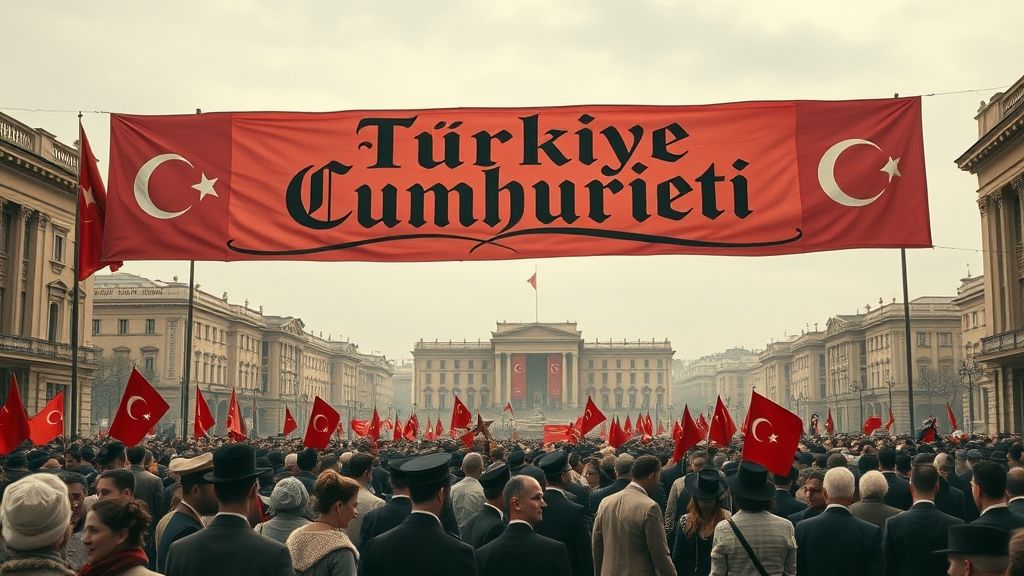
On October 29, 1923, hundreds gathered in Ankara’s new parliament building. The ceremony brimmed with solemnity and a fierce pride that had been forged in the crucible of war and political upheaval. When Mustafa Kemal stood to announce the birth of the Republic of Turkey and his election as the first president, the moment’s gravity spread far beyond the room—it reverberated across Anatolia, signaling a rebirth.
The Ceremony That Shaped a Nation
The proclamation ceremony was suffused with symbolism. Atatürk’s speech centered on sovereignty belonging indelibly to the nation, not to sultans or foreign powers. His words emphasized unity, progress, and the upliftment of Turkish society. The republic was not merely a change in governance; it was a promise of equality and modernization. To many, the event was a deeply emotional affirmation that their sacrifices had not been in vain.
The Symbolism in Atatürk’s Words and Actions
Atatürk’s disclaimers of monarchy and theocracy resonated powerfully against the background of centuries-old Ottoman rule intertwined with Islamic institutions. He asserted a break from this past to embrace secular laws and national unity. His leadership style blended military decisiveness with a visionary resolve to secularize and democratize the Turkish state—a vision engraved in his speeches that day.
The New Republic’s Ideals: Secularism, Nationalism, Modernity
The freshly formed Republic of Turkey pledged itself to a set of ideals grounded in secularism, nationalism, and modernity. Secularism was to disentangle the governance of state from religious authority; nationalism sought a unified Turkish identity transcending ethnic and sectarian divides, while modernity emphasized industrialization, education reform, and civil liberties. These ideologies would steer the country's trajectory in profound ways.
Early Reforms: Education, Law, and Women’s Rights
Immediately following the proclamation, sweeping reforms aimed at transforming Turkish society took root. Arabic script was replaced with a Latin alphabet, education secularized, and legal codes restructured along European lines. Women’s suffrage, dress reforms, and the promotion of science signaled a social revolution that expanded rights and broke many traditional norms embedded in Ottoman culture.
The Shift from Sultanate to Republic: Political and Social Challenges
The transition from centuries of sultanic rule to a republican model was far from seamless. The abolition of the sultanate and later the caliphate stirred opposition among conservative and religious factions. Yet Atatürk’s skillful political maneuvering and firm resolve ensured these changes were cemented, signaling a rapid transformation of Turkish political culture.
International Reactions and the Global Context
Globally, the proclamation signaled Turkey’s emergence as a sovereign, modern-state actor. Western governments watched cautiously but ultimately respected the outcomes of the nationalist movement embodied by Atatürk. The Republic’s formation also inspired anti-colonial and nationalist movements elsewhere, underscoring its global resonance amid the tangled aftermath of the Great War.
The Abolition of the Caliphate: Balancing Tradition and Progress
One of the most controversial moves following the proclamation was the abolition of the Ottoman caliphate in 1924—an institution recognized by Muslims worldwide. The decision was necessary to solidify secularism but came at the cost of profound religious backlash. It highlighted the delicate balancing act Atatürk and his government undertook: reform without fracturing the societal foundations.
Economic Foundations of the New Republic
Economically, the republic grappled with immense challenges: war devastation, impoverished rural areas, and lack of industrial infrastructure. Yet plans to modernize agriculture, encourage industrial growth, and reduce foreign dependence laid the groundwork for Turkey’s economic sovereignty, anchoring the republic’s long-term viability.
The Role of the Military in the Republic’s Formation
The Turkish military was not only instrumental on the battlefield during the War of Independence but also remained a guardian of the republic’s principles in its early decades. Their loyalty to Atatürk and commitment to secular nationalism cemented the army’s unique role as both defender and architect of the new state.
Cultural Renaissance and Language Reform
Cultural renaissance was a hallmark of the new republic. The language reform—shifting to the Latin alphabet—was radical, making literacy more accessible and fostering national unity. Literature, arts, and education flourished under state patronage, which aimed to craft a Turkish identity distinct from Ottoman and Islamic legacies.
Challenges and Opposition in the Early Years
Despite notable successes, the early republic faced pockets of resistance from monarchists, religious conservatives, and ethnic minorities unsettled by homogenizing policies. Political dissent was sometimes met with repression, revealing the tensions between nation-building and pluralism.
The Legacy of October 29, 1923 in Modern Turkey
Nearly a century later, the republic’s founding day remains a cornerstone of Turkish national identity, enshrined in public holidays, education, and civic rituals. The ideals and contradictions born on that October morning continue to shape Turkey’s evolving political and social landscape.
Republic Day Today: Celebrations and National Memory
Republic Day is celebrated with parades, ceremonies, and reflections across Turkey. It is a day not only to honor Atatürk’s legacy but also to engage with the ongoing project of the republic—a complex blend of pride, reflection, and national aspiration.
Conclusion
October 29, 1923, was no mere historic footnote. It was the triumphant birth cry of a nation reclaiming its fate amidst the ruins of empire and war. The proclamation of the Republic of Turkey signaled a profound break with the past and a daring embrace of a secular, modern future. Mustafa Kemal Atatürk’s vision—fraught with challenges, opposition, and sacrifices—unfolded into a transformative project that redefined what it meant to be Turkish. To look back on that day is to witness the indomitable spirit of a people who chose hope and sovereignty over decline and submission. It’s a story of resilience, courage, and the audacity to dream anew—an enduring testament to the human capacity for reinvention.
FAQs
Q1: What were the main causes that led to the proclamation of the Republic of Turkey?
The collapse of the Ottoman Empire after World War I, the harsh terms of the Treaty of Sèvres, and the nationalist push led by Mustafa Kemal to defend sovereignty and modernize the nation were key causes.
Q2: Who was Mustafa Kemal Atatürk and why is he central to this event?
Atatürk was a military leader and visionary politician who led the Turkish War of Independence and founded the Republic, implementing radical reforms to modernize Turkey.
Q3: How did the proclamation affect the Ottoman monarchy?
The proclamation formally abolished the sultanate, ending centuries of Ottoman monarchy and dismantling imperial institutions.
Q4: What were the immediate reforms following the proclamation?
Reforms included secularizing education and law, adopting the Latin alphabet, improving women's rights, and promoting industrialization.
Q5: How did other countries react to the formation of the Turkish Republic?
While initially cautious, most countries eventually recognized the republic as a sovereign state, marking Turkey’s emergence on the global stage.
Q6: Why was Ankara chosen as the capital instead of Istanbul?
Ankara was strategically safer in the interior, symbolized the new nationalist movement, and represented a break from the Ottoman past centered around Istanbul.
Q7: What is the significance of October 29th in Turkey today?
It is celebrated as Republic Day, a national holiday that honors Turkey’s foundation, national identity, and republican values.
Q8: How did the abolition of the caliphate impact Turkey and the wider Muslim world?
It reinforced Turkey’s secular state but caused backlash and discontent among Muslims globally who saw the caliphate as a central religious authority.