Table of Contents
- Dawn over Tehran: The Coronation of Reza Shah
- Persia on the Brink: The Twilight of Qajar Rule
- Reza Khan: The Rise of a Soldier to Power
- The Fall of the Qajars: Political Chaos and Foreign Intrigue
- The Making of a Monarch: From Prime Minister to Shah
- April 25, 1926: The Day of the Crown
- The Crown and Its Meaning: Symbolism and Legitimacy
- The Ceremony Unfolds: A Nation Witnesses Its New Shah
- Modernization Drive: The Early Ambitions of Reza Shah
- Nationalism Reborn: Crafting a New Iranian Identity
- Women, Education, and the State: Social Reforms Begin
- The Military and Centralization: Reza Shah’s Iron Grip
- Diplomacy and the World: Balancing Britain, Russia, and the West
- Public Sentiment: Hopes, Fears, and Resistance
- The Shah’s Legacy: Foundations of Modern Iran
- Shadows Cast: Authoritarianism and Repression
- The Road to Pahlavi Dynasty Consolidation
- Economic Transformation: Infrastructure and Industry
- Cultural Renaissance: Reviving Persian Pride
- Reza Shah in Global Context: Between Tradition and Modernity
- The Aftermath: How the 1926 Coronation Changed Iran Forever
- Remembering Reza Shah: Historical Debates and Memory
- Conclusion: The King Who Would Remake Iran
- FAQs: Understanding Reza Shah’s Coronation and Iran’s Transformation
- External Resource
- Internal Link
Dawn over Tehran: The Coronation of Reza Shah
April 25th, 1926, dawned with an air of profound expectancy over Tehran. The city, nestled against the backdrop of the snowy Alborz Mountains, shimmered with an unusual brightness — not merely from the morning sun but from the flickering hope and trepidation that stirred among its people. Reza Khan, the man who had seized power only a few years earlier amidst Persia’s unsteady tides, was about to be crowned Shah of Iran. This was no ordinary day. It was the birth of a new dynasty, a tangible break from centuries of dynastic decline, foreign interference, and internal disarray.
As crowds gathered near the grand Golestan Palace, the heartbeat of the ancient capital, whispers of transformation filled the narrow bazaars and opulent mansions alike. Foreign emissaries, religious clerics, military officers, and curious citizens alike awaited the moment when a military leader, once just a mere soldier, would don the crown—signaling not only royal ascension but the onset of a sweeping national rebirth.
Persia on the Brink: The Twilight of Qajar Rule
To grasp the full significance of Reza Shah’s coronation, one must first navigate the turbulent waters that engulfed Persia at the dawn of the 20th century. The Qajar dynasty, which had ruled for over a century, was in evident decline. Corruption plagued the court, local governors wielded unchecked power, and the central government was feeble and fragmented. The once-great Persian Empire struggled to maintain its sovereignty amid the growing ambitions of British and Russian empires, each carving spheres of influence across Persian soil.
The Constitutional Revolution of 1906, hailed at its inception as a beacon of reform and democratic aspirations, had ultimately failed to stabilize the nation. It left a fractured parliament, frail institutions, and power struggles that would crescendo into civil unrest. The global upheaval of World War I further devastated Persia, despite its declared neutrality. Allied and Central powers’ occupations and skirmishes turned Persian villages and towns into battlefields. The nation's economic and social fabric began to unravel.
Reza Khan: The Rise of a Soldier to Power
In the shadow of chaos emerged a figure who would redefine Persian history — Reza Khan. Born in 1878 in a modest village near the Caspian Sea, Reza’s journey from soldier to sovereign was extraordinary. His ascent began in the military, where his leadership during the tumultuous years following World War I marked him as a determined and capable officer.
Through a daring coup in 1921, known as the 1921 Persian coup d’état, Reza Khan, then a colonel, seized Tehran’s reins by force, dismantling weak premiers and political rivals. His vision for Iran was not merely survival but revitalization. He forcefully worked to centralize power in Tehran, restore order, and erase the influence of tribal warlords and foreign agents.
The Fall of the Qajars: Political Chaos and Foreign Intrigue
The last Qajar Shah, Ahmad Shah, had little control over his fracturing kingdom. His indecisiveness and exile left a power vacuum filled by competing factions — clerics backing conservative interests, nationalists pushing reform agendas, and foreign diplomats manipulating local leaders.
When Reza Khan became Prime Minister in 1923, the dynasty’s days were numbered. Through political maneuvering and military backing, he rendered the Qajars irrelevant. His consolidation of power worried Britain and the Soviet Union, which maintained economic and strategic interests in Iran, but his nationalist rhetoric won the hearts of many Iranians eager to reclaim sovereignty from imperial influences.
The Making of a Monarch: From Prime Minister to Shah
A crucial moment came in 1925 when the Majlis (parliament) formally deposed the Qajar dynasty. Parliament offered Reza Khan the crown, symbolizing a new era. After careful deliberations, Reza accepted the throne, eager to legitimize his rule through royal tradition while implementing modernizing reforms inspired by the Western world.
Naming his dynasty "Pahlavi," which evoked ancient Persian heritage, Reza Shah positioned himself as the bridge between Iran’s glorious past and ambitious future. The coronation would cement this new legitimacy, turning a military strongman into a king.
April 25, 1926: The Day of the Crown
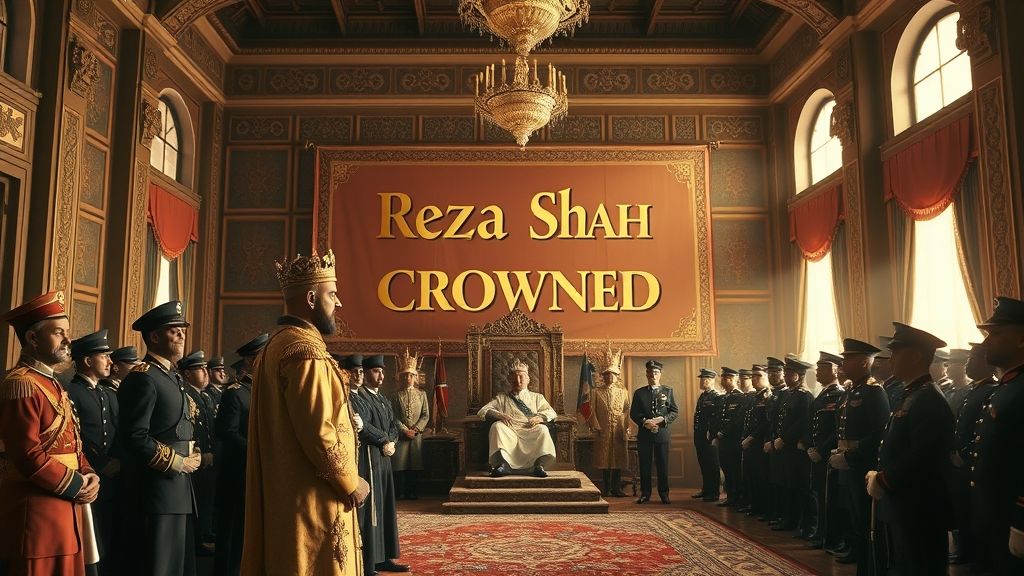
On the morning of April 25, 1926, the red carpet was laid across the Golestan Palace’s marble floors. Foreign dignitaries and local elites converged under vast Persian carpets and glittering chandeliers, while outside, thousands of Tehranis lined the streets in hopes of glimpsing their new monarch.
The ceremony was carefully scripted to evoke both tradition and progress. Clerics performed prayers, and ancient Persian symbols adorned the throne room, yet Reza Shah entered in Western military uniform. The crown itself was bespoke, blending Persian motifs with European regalia styles. With the crown placed upon his head by key religious and state figures, Reza Shah was officially crowned—and a new chapter of Iranian history began.
The Crown and Its Meaning: Symbolism and Legitimacy
The crown symbolized more than royal authority; it represented the fragile yet potent union of Persia’s imperial heritage and Reza Shah’s vision of restoration. The Pahlavi crown blended Sassanian designs with modern aesthetics, reflecting a conscious effort to link Iran’s ancient past with its modern destiny.
This symbolism was critical for gaining the public’s allegiance. In a country where tradition ran deep, legitimacy derived from historical continuity mattered profoundly. Reza Shah’s coronation was rehearsed not simply as a proclamation of power but as a cultural renaissance.
The Ceremony Unfolds: A Nation Witnesses Its New Shah
Reza Shah’s procession rivaled those of medieval kings. Mounted troops paraded the streets of Tehran, bands played anthems inspired by Persia’s historical legacies, and religious leaders blessed the proceedings, signaling clerical acquiescence, however cautious.
Public reaction was mixed yet largely hopeful. Merchants debated the promises of stability; intellectuals speculated on Persia’s future; rural farmers wondered how a distant crown would affect their daily lives. But the overwhelming sentiment was one of anticipation — hope that the “iron shah” would forge a strong Iran.
Modernization Drive: The Early Ambitions of Reza Shah
Having worn the crown, Reza Shah moved swiftly. His modernization projects were ambitious and sweeping: railroads connecting the country, creation of a national army, secular education reforms, and infrastructure development aimed at pulling the country out of feudal stagnation.
He sought to emancipate Iran from foreign tutelage and internal disorder through state-driven nationalism and modernization. Schools, factories, and roads sprouted in cities and hinterlands alike, reshaping the physical and social landscape of Iran.
Nationalism Reborn: Crafting a New Iranian Identity
Reza Shah’s reign coincided with a powerful nationalist awakening. He sought to rekindle pride not only in Iranian sovereignty but in Persian culture itself. The use of the Persian language was promoted rigorously, and various tribal languages were suppressed to unify the nation under a cohesive identity.
He banned the use of “Persia” in foreign relations, insisting Western countries refer to the nation as “Iran,” emphasizing Aryan and pre-Islamic roots. This was both a political and cultural statement—a rebuke of colonial influence and a revival of an indigenous national pride.
Women, Education, and the State: Social Reforms Begin
One of the most striking aspects of Reza Shah’s rule was his approach to women and education. He mandated public education for girls, outlawed the veil in public spaces, and encouraged female participation in public life as symbols of Iran’s modernization.
Though these measures would generate deep controversy among religious conservatives and rural communities, they signaled a break with Iran’s ancien régime and a bold commitment to social transformation.
The Military and Centralization: Reza Shah’s Iron Grip
Reza Shah’s military background shaped his style of governance. He centralized power ruthlessly, dissolving tribal autonomy and bringing all armed forces under state control. This curtailed centuries-old power structures and rebellions but also solidified authoritarian control.
The military was not only a tool of defense but an engine for nation-building, extending state authority into previously untamed regions. Yet, this iron grip left little space for political pluralism or dissent.
Diplomacy and the World: Balancing Britain, Russia, and the West
Internationally, Reza Shah navigated a delicate balance. Britain, with its interests in oil and India, and the Soviet Union, pressing from the north, both eyed Iran warily. Reza Shah’s nationalist rhetoric and military modernization raised alarms, but he deftly maintained diplomatic relationships to avoid foreign domination.
Increasingly, he engaged with Western countries to import technology, military equipment, and advisers who could assist in developing a self-sufficient Iran.
Public Sentiment: Hopes, Fears, and Resistance
While many Iranians welcomed the promise of stability and modernization, not all were enthusiastic. Religious leaders feared the Shah’s secular reforms; tribal leaders felt marginalized. The populace was divided between excitement for progress and anxiety over rapid change.
Small rebellions persisted in remote areas; political opposition was often suppressed brutally. Yet, for many townsfolk and urban middle classes, the new Shah was a symbol of national revival after generations of hardship.
The Shah’s Legacy: Foundations of Modern Iran
The 1926 coronation was more than a ceremonial act — it was the foundation stone of modern Iran. Under Reza Shah’s rule, the country saw transformations in infrastructure, education, governance, and national identity that profoundly influenced its 20th-century trajectory.
His reign laid the groundwork for Iran’s emergence onto the international stage as a modern nation-state, even if the cost was authoritarianism and social tension.
Shadows Cast: Authoritarianism and Repression
Yet the crown’s luster concealed shadows. Reza Shah’s rule was marked by strict censorship, political imprisonments, and the curtailment of civil liberties. Dissent was met with force; opponents were exiled or silenced.
This authoritarianism would seed future unrest but also reflect the complexities of modernization in a multicultural, multiethnic country struggling for unity and independence.
The Road to Pahlavi Dynasty Consolidation
Post-coronation, Reza Shah worked relentlessly to consolidate the Pahlavi dynasty’s control, replacing the fragmented Qajar monarchy with a centralized monarchy that wielded near-absolute power. He appointed loyalists to key posts, enforced symbolic acts of loyalty, and projected the monarchy as the embodiment of national unity.
This consolidation provided political stability but also underscored the fragile legitimacy of the new dynasty dependent on force.
Economic Transformation: Infrastructure and Industry
Reza Shah’s reign catalyzed Iran’s economic modernization. Roads, railways—most famously the Trans-Iranian Railway—factories, and oil industry developments transformed the economy. Agriculture was mechanized; trade routes expanded.
These projects aimed to reduce foreign dependence and integrate Iran’s diverse regions into a cohesive economic whole, fostering urbanization and social change.
Cultural Renaissance: Reviving Persian Pride
The Shah’s vision extended to cultural revival. He sponsored archaeological digs, restored ancient monuments, promoted Persian arts, and commissioned architecture inspired by Iran’s imperial past.
This cultural renaissance blended nationalism and state propaganda, fostering a sense of pride but also controlling historical narratives.
Reza Shah in Global Context: Between Tradition and Modernity
In the global arena, Reza Shah was emblematic of the early 20th-century “modernizing autocrat,” seeking to lift his nation into the modern world while rooted in tradition. His reign paralleled contemporaries in Turkey, Egypt, and elsewhere who pursued similar nationalist-modernizing projects.
His Iran was a battleground between past and future, East and West, religion and secularism.
The Aftermath: How the 1926 Coronation Changed Iran Forever
The coronation crystallized a new political order, paving the way for reforms and authoritarian rule that would influence Iran well into the mid-20th century. It ended centuries of dynastic decline and foreign manipulation but laid the seeds of centralized power struggles and resistance.
The Pahlavi dynasty would last until 1979, with Reza Shah’s son extending and complicating his ambitions. The 1926 coronation remains a pivotal moment marking Iran’s complex journey toward modern nationhood.
Remembering Reza Shah: Historical Debates and Memory
History remembers Reza Shah ambiguously — as a nationalist modernizer and an authoritarian ruler. Some laud his efforts to build a strong, independent Iran; others critique his heavy-handed repression and disregard for democratic freedoms.
In Iranian memory, his legacy is contested, reflecting the ongoing tensions between tradition and modernization. Monuments to his reign exist alongside critical academic reassessments.
Conclusion
Reza Shah’s coronation was not simply the crowning of a new king but the enthronement of a new era for Iran—a nation reborn from the ashes of imperial decay, foreign interference, and internal fragmentation. The ceremony resonated as a dramatic assertion of Iranian sovereignty and modern ambition, setting into motion forces that would reshape the country’s political, social, and cultural life.
Yet beneath the grandeur lay the contradictions of nation-building: progress shadowed by authoritarian control, hope tempered by repression, tradition reinterpreted through the prism of modern nationalism. Reza Shah’s reign embodies the bittersweet complexities of forging modernity amidst a turbulent world. His crown symbolized not just power, but possibility—an Iran stretching between its ancient past and uncertain future.
FAQs
Q1: Why was the coronation of Reza Shah in 1926 so significant for Iran?
A1: It marked the end of the Qajar dynasty and the establishment of the Pahlavi dynasty, symbolizing a new era of centralized power and modernization for Iran after decades of internal chaos and foreign interference.
Q2: How did Reza Khan rise to power before becoming Shah?
A2: Reza Khan, a military officer, led a coup in 1921 and gradually consolidated power as Prime Minister before being offered the crown by parliament in 1925.
Q3: What were the main reforms introduced by Reza Shah after his coronation?
A3: Major reforms included modernization of infrastructure, centralization of government and military, expansion of education (including for women), prohibition of the veil, and promotion of nationalism.
Q4: How did foreign powers react to Reza Shah’s rise?
A4: Britain and the Soviet Union were cautious and suspicious due to their strategic interests in Iran, but Reza Shah skillfully balanced diplomatic relations to maintain sovereignty.
Q5: What was the symbolism behind the Pahlavi crown during the coronation?
A5: The crown blended ancient Persian motifs with modern elements to symbolize a connection between Iran’s imperial heritage and its future modernization.
Q6: How did public opinion in Iran vary regarding Reza Shah’s reign?
A6: Public opinion was mixed—urban middle classes often supported modernization and stability, while rural populations and clerics sometimes resisted his secular and authoritarian policies.
Q7: Did Reza Shah’s rule lead to lasting changes in Iranian society?
A7: Yes, his policies laid the foundations for modern infrastructure, education, and national identity, though his authoritarianism also created tensions that would influence Iran's future.
Q8: How is Reza Shah viewed in Iranian historical memory today?
A8: He remains a controversial figure—credited with modernization and national sovereignty, yet criticized for repression and autocracy.