Table of Contents
- The Quiet Dawn Before the Storm: Salisbury on November 10, 1965
- Rhodesia's Unilateral Declaration: An Unprecedented Break
- The Roots of Rebellion: Colonial Legacy and Rising Tensions
- Ian Smith: The Man Who Dared to Defy the Empire
- The Federal Break-up and the Road to Isolation
- The Political Climate in Rhodesia: White Supremacy and the Fear of Majority Rule
- From Salisbury to London: The Tug of War Between Rhodesia and Britain
- November 11, 1965: The Day Rhodesia Declared Itself Independent
- Immediate Reactions: Jubilation, Outrage, and Global Uncertainty
- The International Backlash: Sanctions, Condemnations, and Diplomatic Isolation
- Black Rhodesians’ Plight: Voices Silenced Amidst Political Turmoil
- The Liberation Movements Rise: ZANU, ZAPU, and the Path to Guerrilla Warfare
- Britain’s Dilemma: Legal Ambiguities and Political Hesitation
- The United Nations Steps In: Debates, Resolutions, and Ineffectiveness
- Economic Survival Under Sanctions: Rhodesia’s Paradox of Prosperity and Crumbling Ethics
- The Role of South Africa and Portugal: Regional Allies in a Global Cold War
- The War Within: Escalation to the Bush War and Its Human Cost
- From UDI to Majority Rule: The Long and Painful Road to Zimbabwe
- Legacy and Memory: How the 1965 Declaration Shaped Southern Africa
- Reflecting on Defiance: The Unilateral Declaration in Historical Perspective
From the glaring sun rising over the shimmering buildings of Salisbury to the hushed expectancy in its grand hotels, November 10, 1965, carried a tension that was both electric and heavy. The streets held a wary calm, as if the city itself awaited an upheaval that would shake colonial Africa to its core. By midnight, this calm shattered with the words that reverberated through the halls of power and echoed across the world: Rhodesia had declared unilateral independence. What followed was a saga that would span decades—of rebellion, repression, hope, and despair—etched deeply into the fabric of a nation's soul.
The Rhodesian Unilateral Declaration of Independence (UDI) was no mere political statement. It was a manifestation of a desperate clinging to control by an entrenched minority, a dramatic gamble by a government convinced that the tide of history could be stemmed. This bold and defiant act threw the British Empire into disarray, exposed the fragilities of colonial governance, and ignited a century-old struggle for identity, power, and justice.
But to fully grasp the magnitude of that night in Salisbury, we must first immerse ourselves in the complex web of history and human ambitions that led to that fateful moment.
The Quiet Dawn Before the Storm: Salisbury on November 10, 1965
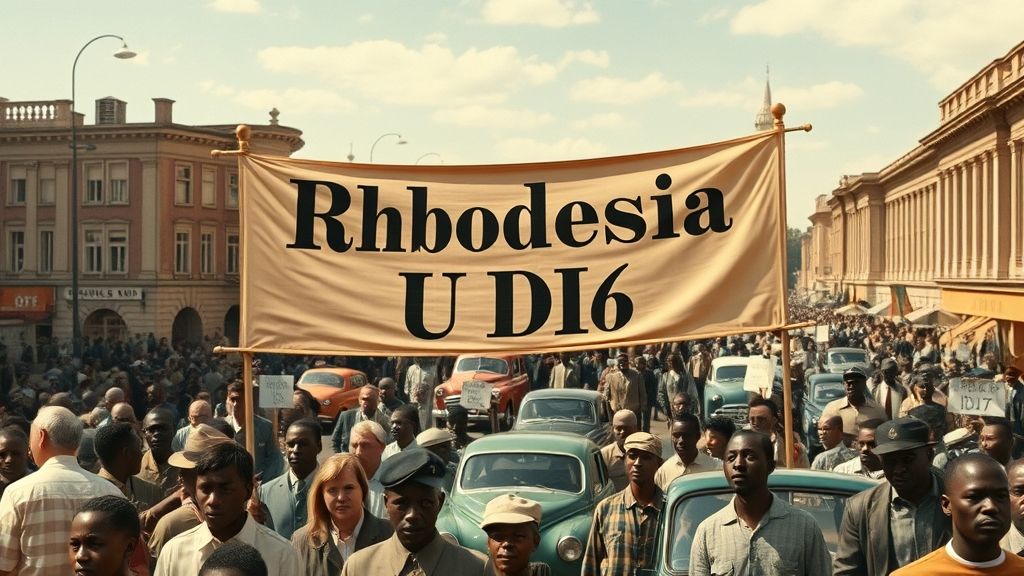
Salisbury in 1965 was a city of contradictions. Designed along the lines of British colonial towns, its orderly streets, manicured gardens, and imposing government buildings carried the veneer of civility. Yet beneath this surface simmered racial divides as stark as the African sun. Predominantly white in administration and power but surrounded by a vast African majority denied representation, the city bore the anxiety of impending change.
As dusk fell on November 10, whispers ran through the cafés and clubs frequented by the white elite. Rumors of a bold move—one that might sever ties with Mother England—passed from mouth to mouth. For many, it was a daring claim to sovereignty; for others, a dangerous plunge into uncertain waters. The air was thick with anticipation, and across the city, the machinery of government prepared for a moment that would define Rhodesia’s destiny.
Rhodesia's Unilateral Declaration: An Unprecedented Break
At precisely 23:30 on the night of November 11th, 1965, Ian Smith, Prime Minister of Rhodesia, stood at the podium in Parliament House to deliver words that ignited shock waves around the globe:
“We, the Government of Rhodesia, do hereby declare that from this day forward, Rhodesia shall be an independent sovereign State.”
These words constituted a Unilateral Declaration of Independence (UDI), an act made without British consent and condemned by the United Kingdom as illegal. The move was revolutionary and unprecedented: a self-governing British colony severing ties autonomously, claiming full sovereignty while rejecting Westminster’s authority.
The reasoning Smith put forth was a refusal to surrender political power to the black majority under terms dictated by London. Rhodesia’s white minority leadership declared that they would chart their own course—one that preserved their political and racial privileges.
The Roots of Rebellion: Colonial Legacy and Rising Tensions
To understand this dramatic rupture, one must turn back decades to the colonial legacy forged in Southern Africa. The region that became Rhodesia—named after Cecil Rhodes, imperialist and mining magnate—had been a British territory marked by racial hierarchy, economic exploitation, and settler dominance.
By mid-20th century, Rhodesia was a self-governing colony dominated by a white minority that controlled land, wealth, and political power. The African majority, deprived of land and political voice under strict segregation, increasingly demanded rights and recognition in the face of global decolonization.
The British Empire, grappling with its own waning influence after World War II, sought to transition its colonies towards majority rule, following patterns seen in Ghana (1957) and Kenya (1963). Rhodesia’s white leaders, however, feared that majority rule would jeopardize their privileges and livelihoods.
This fundamental clash set the stage for mounting tensions leading up to 1965.
Ian Smith: The Man Who Dared to Defy the Empire
Ian Smith, Rhodesia's Prime Minister since 1964, emerged as the pivotal figure in this drama. A farmer-turned-politician, Smith was charismatic, resilient, and resolutely committed to preserving white minority rule.
His rhetoric emphasized African “unpreparedness” for governance and the purported threat that majority rule posed to law and order. To many of his followers, he was a protector of civilization; to critics, a reactionary clinging to colonial oppression.
Smith’s leadership style was marked by defiance and pragmatism. When London insisted that Rhodesia accept black majority rule before independence, Smith refused, calculating that UDI was the only path to maintain control.
The Federal Break-up and the Road to Isolation
The breaking point emerged after the collapse of the Federation of Rhodesia and Nyasaland in 1963, which had brought together Southern Rhodesia, Northern Rhodesia, and Nyasaland. With the newly independent neighboring nations pushing towards black majority rule, Rhodesia found itself increasingly isolated.
Attempts to negotiate with Britain to secure independence while maintaining white supremacy failed, leading to a deadlock. The British government under Harold Wilson demanded a transition to majority rule, while Rhodesian leaders insisted on self-determination.
Faced with what it perceived as an ultimatum, the Rhodesian government chose rebellion over concession.
The Political Climate in Rhodesia: White Supremacy and the Fear of Majority Rule
The white Rhodesian government, representing just 5% of the population, kept tight political control through laws limiting voting rights and land ownership. The black majority, denied basic rights, was growing restless, inspired by the winds of independence sweeping Africa.
Fear of communist influence in African liberation movements, lingering Cold War anxieties, and deep-seated racial prejudices hardened white resolve. The preservation of a segregated social order became a question of survival.
The UDI was thus a desperate bid to safeguard this fragile status quo.
From Salisbury to London: The Tug of War Between Rhodesia and Britain
When Rhodesia declared independence, Britain viewed the act as rebellious and illegal. London immediately refused to recognize the proclamation and demanded the restoration of lawful authority.
The stage was set for a diplomatic standoff. Britain imposed economic sanctions and cut off formal communications, urging the country to abandon its defiance. Rhodesia, undeterred, prepared to face isolation.
This tug of war would extend beyond parliamentary battles into the international arena.
November 11, 1965: The Day Rhodesia Declared Itself Independent
The night of November 11, 1965, was electric. Smith’s speech echoed through Parliament, punctuated by applause from white legislators and stunned silences from African representatives.
Flags were raised, official declarations signed, and newspapers printed the headlines: “Rhodesia Independent at Last.” For white Rhodesians, the moment was one of pride and relief. For many black inhabitants, it heralded a continuation of oppression.
The act was bold, dramatic, and dangerous.
Immediate Reactions: Jubilation, Outrage, and Global Uncertainty
Within Rhodesia, the white population largely celebrated the move as a victory for self-determination. Black Rhodesians, barred from political participation, saw their hopes dashed.
Internationally, reactions ranged from condemnation to cautious bewilderment. Britain denounced the declaration as illegal; the United Nations called for sanctions; neighboring African countries decried the act as neo-colonialism.
The Cold War context heightened concern that Rhodesia’s defiance might destabilize the region.
The International Backlash: Sanctions, Condemnations, and Diplomatic Isolation
The United Nations Security Council swiftly imposed economic sanctions designed to cripple Rhodesia’s economy. International trade partners severed ties, and the country became a pariah on the world stage.
Despite these measures, sanctions were only partially effective. Rhodesia developed ingenious methods to bypass restrictions, assisted by neighboring South Africa and Portugal.
Still, the isolation intensified internal pressures and foreshadowed a prolonged conflict.
Black Rhodesians’ Plight: Voices Silenced Amidst Political Turmoil
For the black majority, the UDI deepened disenfranchisement. Restricted from political channels, many turned to organized resistance.
The voices that poured into exile and clandestine meetings outside Rhodesia represented a growing determination to fight for liberation by all means necessary.
Human rights abuses and repression compounded grievances, setting the stage for violent conflict.
The Liberation Movements Rise: ZANU, ZAPU, and the Path to Guerrilla Warfare
The Unilateral Declaration galvanized African nationalist parties. The Zimbabwe African National Union (ZANU) led by Robert Mugabe and the Zimbabwe African People’s Union (ZAPU) under Joshua Nkomo intensified efforts to mobilize guerrilla warfare.
Armed struggle erupted in earnest during the 1970s, known as the Rhodesian Bush War or Second Chimurenga.
The UDI, intended to prevent African rule, paradoxically accelerated the liberation fight.
Britain’s Dilemma: Legal Ambiguities and Political Hesitation
Britain faced a complex dilemma. As the former colonial power, it sought to uphold legality and promote majority rule but hesitated over military intervention.
Legal actions ensued; officials ceased to recognize Rhodesian legitimacy, yet direct confrontation was avoided to limit conflict.
This restraint, coupled with international pressure, framed Britain as a cautious but determined actor.
The United Nations Steps In: Debates, Resolutions, and Ineffectiveness
The United Nations condemned Rhodesia’s UDI repeatedly, passing several resolutions demanding withdrawal and urging sanctions.
Yet the effectiveness of these measures was limited by loopholes and non-compliance by various states.
The symbolic weight of the UN played a role in delegitimizing the regime but could not force its hand.
Economic Survival Under Sanctions: Rhodesia’s Paradox of Prosperity and Crumbling Ethics
Despite sanctions, Rhodesia’s economy initially proved resilient, buoyed by agriculture, mining, and assistance from sympathetic neighbors.
Yet the cost was high: increased militarization, censorship, and international isolation undermined long-term prosperity.
Ethical compromises and economic hardships heralded that this defiance was fragile.
The Role of South Africa and Portugal: Regional Allies in a Global Cold War
Regional dynamics shaped Rhodesia’s fate. Apartheid South Africa, itself internationally shunned, provided vital economic and military support.
Portugal’s control of Mozambique allowed clandestine supply routes.
These alliances underscored how the broader Cold War and anti-communist sentiments influenced policies in southern Africa.
The War Within: Escalation to the Bush War and Its Human Cost
The Rhodesian Bush War escalated brutality on all sides. Guerrilla fighters faced ruthless counter-insurgency; civilians endured forced relocations and human rights abuses.
Over a decade, tens of thousands died, and the social fabric frayed. The UDI's legacy became inseparable from this human tragedy.
From UDI to Majority Rule: The Long and Painful Road to Zimbabwe
The stalemate finally broke in 1979 with the Lancaster House Agreement, paving the way for recognized independence as Zimbabwe in 1980.
The moment marked the delayed triumph of majority rule, but also the beginning of new challenges in nation-building.
The UDI era remained a defining chapter in Zimbabwe’s complex history.
Legacy and Memory: How the 1965 Declaration Shaped Southern Africa
The Rhodesian UDI left a powerful imprint on postcolonial Africa. It challenged colonial authority but also entrenched divisions and sowed long conflicts.
The declaration is remembered variably as defiance, rebellion, or oppression—dependent on perspectives.
Its lasting impact continues to spark debate about sovereignty, race, and justice.
Reflecting on Defiance: The Unilateral Declaration in Historical Perspective
Looking back, Rhodesia’s Unilateral Declaration of Independence embodies tensions of an era: decolonization clash, minority fears, and the birth pangs of new nations.
At its core, the event raises profound questions about identity, power, and the price societies pay in moments of upheaval.
The story of November 11, 1965, remains a testament to courage and tragedy entwined in the march of history.
Conclusion
The Rhodesian Unilateral Declaration of Independence was more than a political stunt; it was a watershed moment revealing the deep fractures of a society grappling with change. The defiance of 1965 was both a cry of desperation from a privileged minority and a catalyst for a long, painful liberation struggle. It exposed the inadequacies of colonial formulas and underscored humanity's enduring quest for freedom and equality.
In the shadow of that night in Salisbury, history unfolded with all its contradictions—hope and violence, bravery and cruelty, loss and renewal. The echoes of the Declaration still resonate today, inviting us to reflect on the dangers of exclusion and the power of determination.
The story of Rhodesia’s UDI is a compelling reminder that the pursuit of sovereignty must be intertwined with justice and dignity for all.
FAQs
Q1: What was the Unilateral Declaration of Independence (UDI) in Rhodesia?
A1: The UDI was a declaration made by Rhodesia’s white minority government on November 11, 1965, proclaiming independence from Britain without the British government's consent, aiming to preserve white minority rule.
Q2: Why did Rhodesia's government declare independence unilaterally?
A2: Rhodesia’s government, led by Ian Smith, declared independence unilaterally because Britain insisted on transitioning to black majority rule before granting independence, which the white minority opposed fiercely.
Q3: What were the immediate international reactions to the UDI?
A3: The UDI was widely condemned as illegal. Britain refused recognition, and the United Nations imposed economic sanctions. Many African countries denounced the act as perpetuating colonial oppression.
Q4: How did the UDI impact the black majority population in Rhodesia?
A4: The UDI deepened political disenfranchisement and repression of the black majority, accelerating the rise of nationalist movements and armed resistance against white minority rule.
Q5: How did Rhodesia manage to survive economically despite international sanctions?
A5: Rhodesia circumvented sanctions through trade with neighboring countries like South Africa and Portugal, internal agricultural production, and informal networks, although sanctions hampered growth.
Q6: What role did the Rhodesian Bush War play after the UDI?
A6: The Bush War was a guerrilla conflict fought by African liberation movements against the Rhodesian government, fueled directly by the tensions caused by the UDI and the imposed minority rule.
Q7: When did Rhodesia finally gain recognized independence and under what conditions?
A7: Rhodesia became the recognized independent nation of Zimbabwe in 1980, following the Lancaster House Agreement, which mandated black majority rule and free elections.
Q8: How is the UDI remembered in modern Zimbabwe and internationally?
A8: The UDI is remembered as a symbol of colonial-era defiance and minority oppression internationally, while in Zimbabwe it is often recalled as a painful period whose end led to liberation.