Table of Contents
- A Kingdom on the Brink: England in the Late 15th Century
- The House of York and the House of Lancaster: A Nation Divided
- The Rise of Richard III: From Duke to King
- The Shadow of the Princes in the Tower
- The Lancastrian Hope: Henry Tudor’s Claim
- The Gathering Storm: Political Intrigue and Unrest
- The March to Bosworth Field: Armies on the Move
- August 22, 1485: Dawn Breaking on Bosworth Field
- The Clash of Titans: The Battle Unfolds
- The Final Moments of a King: Richard III’s Last Charge
- The Death of Richard III: Immediate Aftermath
- Henry Tudor Crowned King: The Birth of the Tudor Dynasty
- The Battle’s Ripple Effects: England’s Political Landscape Transformed
- The Legend and Legacy of Richard III: From Tyrant to Tragic Hero
- Archaeology and Rediscovery: Richard III in Modern Times
- The Bosworth Battlefield Today: Memory and Myth
- Literature and Arts: Shakespeare’s Richard III and Beyond
- The Role of Bosworth in the Wars of the Roses Narrative
- Historical Debates: Was Richard III a Villain or a Victim?
- A Nation Reforged: England after Bosworth
- Conclusion
- FAQs
- External Resource
- Internal Link
1. A Kingdom on the Brink: England in the Late 15th Century
The hot August sun struggled to pierce the murky Midlands sky on that fateful morning of August 22, 1485. The air was thick with tension, the scent of earth mingled with the metallic tang of anticipation and dread. Across a sprawling field near Market Bosworth, two armies faced each other—each bearing not only weapons but the weight of a nation’s fractured soul. History was about to be carved, not in lofty halls or quiet chambers, but in the brutal chaos of blood and steel. This was the final game of a deadly chess match that had haunted England for decades: the Battle of Bosworth Field.
2. The House of York and the House of Lancaster: A Nation Divided
England of the late 15th century was a land torn between two rival dynasties—the House of York and the House of Lancaster. Rooted in a tangled genealogy that traced back to Edward III, the War of the Roses was not just a series of clashes but a deep civil conflict born from competing claims to the throne. Each side bore the symbol of a rose—the white rose of York, the red rose of Lancaster—emblems of a country sundered by rebellion, ambition, and bloodshed.
For nearly 30 years, different kings had risen and fallen, lords switched allegiance with dangerous fluidity, and the throne itself seemed to shift like sand underfoot. England’s nobility and common folk alike bore the brunt of this disarray, their lives uprooted and their lands ravaged.
3. The Rise of Richard III: From Duke to King
Born in 1452, Richard Plantagenet had always lived under the shadow of power and conflict. As the younger brother of King Edward IV, Richard was a stalwart Yorkist, skilled in arms and political maneuvering. His title, Duke of Gloucester, marked him as a formidable lord in the north, a guardian of Yorkist interests during the turbulent 1460s and 1470s.
The sudden death of Edward IV in 1483 thrust Richard into the spotlight. His path to the throne was swift and shrouded in controversy; declared Lord Protector for his young nephew Edward V, Richard quickly declared the boy illegitimate and seized the crown for himself. Crowned as Richard III, his reign promised order but soon spiraled into tyranny and suspicion.
4. The Shadow of the Princes in the Tower
Arguably the darkest cloud over Richard III’s rule was the fate of the two young princes, Edward V and his brother Richard of Shrewsbury. Locked away in the Tower of London, they vanished without a trace, and centuries of rumor have suggested that Richard, desperate to secure his throne, may have orchestrated their deaths.
This mystery wound itself into the collective memory and darkened Richard’s legacy, painting him as the archetypal usurper and villain—a narrative deeply propagated by political enemies and immortalized by William Shakespeare’s haunting portrait.
5. The Lancastrian Hope: Henry Tudor’s Claim
Meanwhile, across the Channel in Brittany, a young scion of the Lancastrian line awaited his moment. Henry Tudor, the Earl of Richmond, was a figure of hope for those tired of Yorkist rule. Though his claim was tenuous—through his mother’s Lancastrian blood and distant relation to the royal family—Henry had the advantage of support from disaffected nobles and a kingdom hungry for stability.
He crossed into Wales with a small but determined force, resolved to strike at the heart of Richard’s reign and change England’s destiny forever.
6. The Gathering Storm: Political Intrigue and Unrest
Leading up to Bosworth, England simmered with conspiracies, betrayals, and shifting alliances. Richard’s grip on power was weakening, his once-loyal nobles restless or openly defecting. Among them was Lord Stanley, a man whose allegiance would prove decisive.
The chessboard was set, with spies and provocateurs moving pieces beneath the surface. The common people, weary of war and hoping for peace, could only watch as noble ambitions spelled more bloodshed.
7. The March to Bosworth Field: Armies on the Move
Henry Tudor’s landing in England in August 1485 was a calculated risk. His force was outnumbered but bolstered by a mix of loyalists and opportunists. Richard, confident but cautious, marched south from York to confront this challenge.
The two armies converged near Market Bosworth over days of tense prep—campfires flickering, scouts skimming the countryside, commanders weighing their moves. The battle would be swift but decisive.
8. August 22, 1485: Dawn Breaking on Bosworth Field
The morning was cool with an uneasy stillness, as though the land itself held its breath. Soldiers, noble and common, steeling themselves for the conflict to come, looked toward the horizon expecting glory, survival, or end.
Richard rode at the head of his men, a king in full armor and determination, while Henry eyed the field with a mix of hope and dread. History awaited, and neither side knew they were on the cusp of ending an era.
9. The Clash of Titans: The Battle Unfolds
Bosworth was not a prolonged affair; it was brutal, chaotic, and decisive. Swords clashed, arrows darkened the sky, and the cries of men echoed across the fields. The initial exchanges saw fierce resistance by Richard’s forces, but the tide shifted when Lord Stanley’s forces hesitated, looking to the winds of change.
In moments, the battlefield’s balance tipped. Richard charged with desperate courage, a king willing to stake all on a single blow. But the tide of fate was against him.
10. The Final Moments of a King: Richard III’s Last Charge
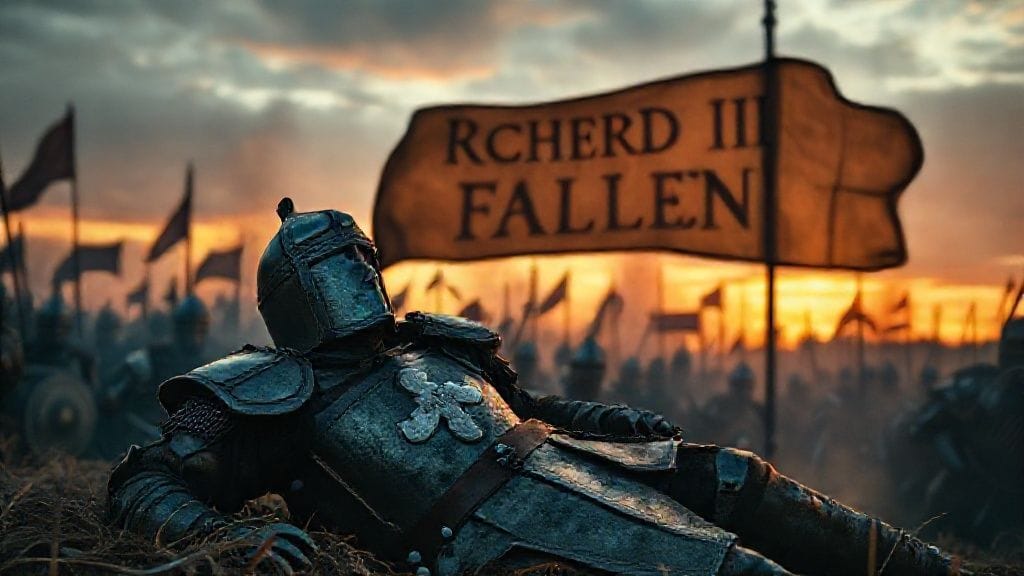
According to chroniclers, Richard led a fearless charge directly toward Henry Tudor, seeking to end the battle swiftly by striking down his rival. His horse was killed under him; armored and surrounded, the king fought valiantly to the death.
Richard III fell that day, slain in the fields he had hoped to command, his crown lost beneath the weight of rebellion and history’s judgment.
11. The Death of Richard III: Immediate Aftermath
Richard’s death sent shockwaves through the kingdom. His body was stripped, reportedly displayed as a warning. Yet, for all the cruelty of that fate, his demise brought a fragile peace.
Henry Tudor’s coronation swiftly followed, signaling a new era—one with promise, but shadowed by the costs of war and contested legitimacy.
12. Henry Tudor Crowned King: The Birth of the Tudor Dynasty
Henry VII’s ascent was not just a personal triumph; it marked the beginning of the Tudor dynasty, which would shape England for the next century. By marrying Elizabeth of York, Henry united the two roses, symbolizing the end of the Wars of the Roses.
However, peace was tentative, hard won, and would require ruthless politics and careful diplomacy to maintain.
13. The Battle’s Ripple Effects: England’s Political Landscape Transformed
Bosworth altered England’s political fabric irreversibly. The old nobility was weakened and reorganized under Tudor rule. The monarchy emerged stronger but more centralized, foreshadowing the shifts that would lead England into Renaissance splendor and later religious upheaval.
The battle marked a definitive end to medieval factionalism but also the beginning of new power struggles.
14. The Legend and Legacy of Richard III: From Tyrant to Tragic Hero
For centuries, Richard’s reputation swayed between villain and martyr. Shakespeare’s portrayal cast him as a deformed, scheming tyrant, but modern historians and findings invite more nuanced interpretations.
His legacy is a compelling study of how history, politics, and myth merge, revealing the sometimes blurry line between truth and propaganda.
15. Archaeology and Rediscovery: Richard III in Modern Times
In 2012, an extraordinary archaeological discovery unearthed Richard’s skeletal remains beneath a parking lot in Leicester. The findings offered fresh insights into his injury, health, and final moments, renewing public fascination.
This discovery reignited debates about his character and the battle’s true story, bringing history vividly to life for a new generation.
16. The Bosworth Battlefield Today: Memory and Myth
The site of Bosworth is both a memorial and a pilgrimage for history enthusiasts. Marked by a battlefield visitor center and commemorative monuments, it invites reflection on the cost of power and the cyclical nature of history.
Yet the myths still linger amid the fields—echoes of clashing swords and fallen kings.
17. Literature and Arts: Shakespeare’s Richard III and Beyond
Richard III’s story has captivated poets, playwrights, and filmmakers for centuries. Shakespeare immortalized him in his chilling historical drama, influencing popular imagination.
Beyond the bard, artists and historians continue to re-interpret Richard’s life and death, each retelling reshaping his image anew.
18. The Role of Bosworth in the Wars of the Roses Narrative
The battle represents the final and most decisive chapter of the Wars of the Roses, symbolizing resolution but also a new beginning. It encapsulates themes of ambition, betrayal, loyalty, and fate—themes echoing through English history.
Understanding Bosworth is thus essential to grasping the medieval conflict’s significance.
19. Historical Debates: Was Richard III a Villain or a Victim?
Scholars remain divided on Richard’s true nature. Was he a ruthless usurper responsible for regicide and fratricide? Or a scapegoat victimized by Tudor propaganda?
These debates illustrate the complexity of interpreting history, where evidence, bias, and narrative intertwine.
20. A Nation Reforged: England after Bosworth
England emerged from Bosworth tentative but gradually strengthened. The Tudor reign heralded reforms in governance, law, and international standing—transforming a battered realm into a rising European power.
The battle was thus both an end and a beginning—a blood-stained pivot on the road to modernity.
Conclusion
The Battle of Bosworth Field was more than just a clash of swords or a changing of monarchs. It was the dramatic conclusion of decades of conflict, a brutal reckoning that reshaped England’s future in profound ways. Richard III’s fall, emblematic of lost hope and contested power, invites us to reflect on the merciless tides of history and the human lives caught in the storm.
Yet from that bloody August day rose a new dynasty—a nation slowly but irreversibly forges itself anew, navigating the fragile path between chaos and order. Bosworth reminds us how history is not merely dates and documents but the deeply human story of ambition, loyalty, loss, and the enduring quest for justice.
FAQs
Q1: What caused the Battle of Bosworth Field?
The battle was the climax of the Wars of the Roses, a civil war rooted in dynastic claims between the houses of York and Lancaster. Richard III's contested claim and political turmoil led Henry Tudor to challenge for the throne.
Q2: Who was Richard III beyond the battle?
Richard III was the last Plantagenet king of England, whose brief reign was marked by controversy, including the mysterious disappearance of his nephews, the Princes in the Tower.
Q3: How did Henry Tudor win the battle despite being outnumbered?
Henry’s victory depended on strategic alliances, notably the crucial support and delayed intervention of Lord Stanley, whose forces turned the tide against Richard’s army at a decisive moment.
Q4: What was the significance of Richard III’s death?
Richard’s death ended the reign of the Plantagenets and ushered in the Tudor dynasty, beginning a transformative period in English history.
Q5: How has Richard III’s reputation evolved?
For centuries, Richard was vilified, largely due to Tudor historiography and Shakespeare’s play. Modern archaeological evidence and scholarship have fostered a more complex understanding of his character.
Q6: What did the discovery of Richard III’s remains reveal?
The 2012 discovery provided physical evidence of his injuries during battle, confirmed his burial site, and reinvigorated public and academic interest in his life and death.
Q7: How is the Bosworth battlefield commemorated today?
The battlefield is marked with monuments and a visitor center, serving as a site of education and remembrance for visitors interested in this pivotal event.
Q8: Why is the Battle of Bosworth Field important in English history?
It symbolizes the end of medieval civil strife and the beginning of a centralized Tudor monarchy, laying the groundwork for England’s rise as a major European power.

