Table of Contents
- The Dawn of a New Alliance: The Birth of the Swiss Waldstätten
- A Turbulent Europe at the End of the 13th Century
- Uri, Schwyz, and Unterwalden: The Heartlands of Resistance
- The Pressure from Habsburg Ambitions
- The Pact of 1291: Forging an Unbreakable Bond
- Ancient Oaths and Modern Myth: The Founding Legend
- The First Steps towards Autonomy: Local Governance and Law
- Economic Roots: Trade, Mountains, and Self-Sufficiency
- The Role of Geography: Mountains as Sanctuary and Fortress
- Communal Identity: From Villages to Confederation
- External Reactions: Nobles and Monarchs Watch Closely
- Conflicts and Skirmishes: Testing the Alliance’s Strength
- The Influence of the Church and Religious Legitimacy
- Oral Traditions and Chronicles: The Making of Swiss Identity
- The Waldstätten’s Legacy: Foundations of Modern Switzerland
- How the Alliance Shaped European Political Dynamics
- The Symbolism of the Alliance in Swiss National Memory
- The Myths, Realities, and Historical Debates around 1291
- Conclusion: The Enduring Spirit of Uri, Schwyz, and Unterwalden
- FAQs: Understanding the Swiss Waldstätten Alliance
- External Resource
- Internal Link
The Dawn of a New Alliance: The Birth of the Swiss Waldstätten
The cold mountain air of late summer in 1291 carried with it whispers of change. In the shadow of Alpine peaks, three humble valleys—Uri, Schwyz, and Unterwalden—found themselves at a crossroads. Bound by ancient ties of kinship, geography, and shared destiny, these communities faced an existential threat from the expanding Habsburg dynasty. What emerged then was more than a pact; it was the crucible of a new political reality that defied centuries of feudal domination. This was the nascent spark of what would come to be known as the Swiss Waldstätten Alliance—the precursors to Switzerland’s legendary confederation.
In the valley village of Schwyz, farmers and hunters gathered under the solemn oaks. It was here, amid the murmurs of cautious hope and fierce determination, that the first stones of Swiss independence were laid. Yet this alliance was not born overnight nor without struggle. Behind the simple oath taken on that fateful day lay millennia of tension, resilience, and aspiration.
A Turbulent Europe at the End of the 13th Century
To understand 1291, one must first paint the broader canvas of late 13th-century Europe. The continent was a jigsaw of competing feudal realms, burgeoning monarchies, and ambitious dynasties. The Holy Roman Empire, a sprawling and loosely held entity, exerted often indirect influence over its myriad territories. Here, among the Alpine passes, the tug of imperial ambition intertwined with the rugged localisms of mountain life.
The Habsburgs, ascending in influence and power, harbored designs on the rich alpine territories. Their aim was to consolidate control over critical trade routes and fertile lands. But the mountain communities—ruggedly independent and fiercely protective of their customs—were proving resistant to external domination. Uri, Schwyz, and Unterwalden, despite their modest size, had forged a reputation for formidable endurance.
Uri, Schwyz, and Unterwalden: The Heartlands of Resistance
Each of these three valley communities had distinct histories, but they shared the common traits of stubborn self-sufficiency and a deep connection to their surroundings. Uri, with its access to the strategic Gotthard Pass, was a gateway between north and south Europe. Schwyz, expansive and fertile, was the agricultural heart where traditions of communal landholding thrived. Unterwalden, itself split into Obwalden and Nidwalden, balanced pastoral life with emerging crafts and local markets.
The people were not mere peasants clinging to survival; they were skilled in alpine warfare, famously adept at defending their homelands against raiders or knights unfamiliar with mountain combat. Their assemblies—Landsgemeinden—provided early examples of participatory governance as villages gathered to debate matters of law and collective interest, laying the social framework for their independence.
The Pressure from Habsburg Ambitions
For the Habsburg family, rising as one of the preeminent houses within the empire, controlling these valleys was both a strategic and symbolic prize. The Gotthard Pass was a lynchpin of European commerce—control meant influence over the flow of goods, armies, and ideas. Moreover, bringing these communities under direct lordly rule would extend the dynasty’s prestige and revenues.
By the late 1280s, evidence shows increased attempts by Habsburg officials to impose taxes, assert legal authority, and demand military service. For the mountain folk, already wary of distant overlords, this signaled a threat to centuries-old freedoms. It sparked a sense of urgency; to confront this, they needed unity more than ever.
The Pact of 1291: Forging an Unbreakable Bond
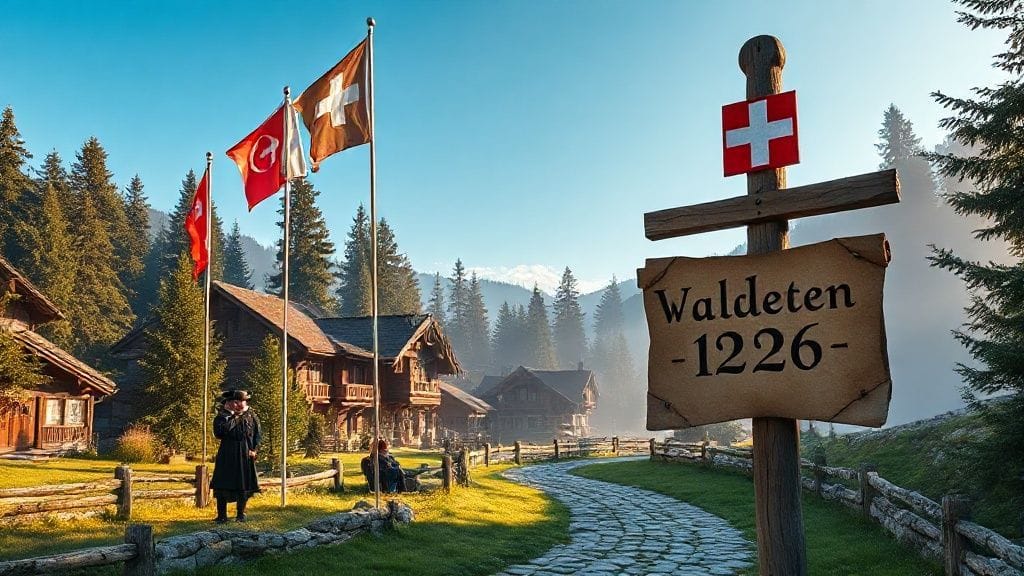
Legend states that on August 1, 1291, representatives from Uri, Schwyz, and Unterwalden met at the chapel of St. Michael near the Rütli meadow along Lake Lucerne. What transpired was a solemn pact, where each pledged mutual assistance “in all future dangers.” This compact was both a defensive alliance and a commitment to uphold shared rights and liberties.
The act was revolutionary in its simple yet profound assertion: the authority of the collective community would surpass individual lords or distant emperors. Written in the famous Federal Charter of 1291 (the Bundesbrief), it enshrined principles that would reverberate through centuries—mutual aid, respect for local laws, and defense against external aggression.
Ancient Oaths and Modern Myth: The Founding Legend
The Rütli Oath has become enshrined in Swiss collective memory, immortalized by poets and historians alike. It symbolizes not just political alliance but the birth of Swiss identity itself. Yet historians debate the mythic aspects versus documentary facts. While the Federal Charter exists, some evidence suggests the alliance may have presented an evolution of pre-existing feudal arrangements rather than a sudden rupture.
Nonetheless, the myth carries immense emotional power—an image of humble men standing beneath towering pines, united in defiance against empire and oppression. It tells a story of human courage, community, and the desire for self-rule, inspiring millions even today.
The First Steps towards Autonomy: Local Governance and Law
The pact of 1291 formed more than a military alliance; it laid groundwork for shared legal frameworks. Each community retained significant autonomy, but agreements were made for common defense and dispute resolution.
The Landsgemeinde, a form of popular assembly, allowed adult male citizens to participate in decision-making. The concept was remarkably democratic for its time, emphasizing consensus and collective responsibility. Such structures fostered a political culture deeply rooted in communal participation, setting the stage for the later expansion of the Swiss Confederacy.
Economic Roots: Trade, Mountains, and Self-Sufficiency
Life in the Waldstätten was shaped by the rugged terrain, but also by an intricate network of trade. The Gotthard Pass connected northern and southern Europe, funneling commerce from Italy to the Rhine valley.
The communities leveraged their geographic position, trading salt, cheese, timber, and iron. Self-sufficiency was tempered by openness to commerce. This economic vitality strengthened their independence—it wasn’t mere survival but a thriving alpine economy.
The Role of Geography: Mountains as Sanctuary and Fortress
The dramatic Alpine topography shaped the very character of the Waldstätten communities. Steep slopes, narrow valleys, and high passes made these lands difficult to conquer or control. Mountains functioned both as natural fortresses and as barriers to external armies unfamiliar with the terrain.
This geography fostered a culture of resilience, adaptability, and fierce territoriality. Mountain paths became lifelines, and knowledge of the terrain was a source of military advantage. But it was also a psychological foundation—knowing that the land itself was a guardian of freedom.
Communal Identity: From Villages to Confederation
By forging the 1291 alliance, Uri, Schwyz, and Unterwalden transcended isolated village life. A shared identity developed, one that proudly celebrated local autonomy while embracing collective security.
This confederation planted the seeds for the expansion of similar pacts in other regions, culminating in the Swiss Confederacy that by the 14th and 15th centuries would include further cantons. The Waldstätten communities saw themselves not just as subjects but as members of a political project rooted in mutual respect and shared destiny.
External Reactions: Nobles and Monarchs Watch Closely
The formation of the alliance did not go unnoticed. Regional lords and imperial authorities viewed the pact with a mix of suspicion and concern. Though small in scale, the Waldstätten alliance embodied a challenge to feudal hierarchies.
Over subsequent decades, tensions simmered—sometimes erupting into skirmishes or disputes over jurisdiction. Yet the persistence and unity of the Waldstätten gradually deterred aggressive encroachments, illustrating the power of collective will over individual might.
Conflicts and Skirmishes: Testing the Alliance’s Strength
The early 14th century brought intermittent conflicts that tested the solidity of the alliance. In 1308 and thereafter, forces loyal to the Habsburgs attempted to suppress the growing independence of these mountain communities.
One of the most famous confrontations, the Battle of Morgarten in 1315, which involved an expanded confederation including Lucerne, was a spectacular Swiss victory. This battle validated the alliance’s military strategies and forged the narrative of Swiss invincibility and unity.
The Influence of the Church and Religious Legitimacy
The Church held significant sway over European politics, and the Waldstätten were no exception. Yet the alpine communities carefully navigated their religious affiliations, maintaining loyalty to the Church while preserving local privileges.
Religious ceremonies and oaths imbued the alliances with a sacred character. The chapel of St. Michael, for instance, was more than a meeting place—it symbolized divine witness to the pact, lending spiritual legitimacy to political autonomy.
Oral Traditions and Chronicles: The Making of Swiss Identity
Much of what we know about the early alliances comes through a blend of chronicles, legends, and oral transmissions. Figures like Aegidius Tschudi in the 16th century parlayed these traditions into a coherent national narrative.
The oral culture celebrated heroes, recounted daring escapes, and emphasized collective identity forged in mountains and mist. These stories wove the Waldstätten’s experience into the broader tapestry of Swiss exceptionalism.
The Waldstätten’s Legacy: Foundations of Modern Switzerland
The 1291 alliance was not a mere historical footnote—it laid the groundwork for the modern Swiss Confederation. The political innovation, based on mutual aid, local autonomy, and federative principles, enabled successive expansion and adaptation.
Switzerland’s unique political experimentation in direct democracy and confederalism traces its lineage to these Alpine beginnings. The Waldstätten’s courage and vision still resonate in Swiss governance and national self-understanding.
How the Alliance Shaped European Political Dynamics
The alliance demonstrated an early form of resistance to feudal centralization. Its success inspired other regions and foreshadowed the emergence of nation-states founded on consent rather than hereditary rule.
Moreover, the Swiss model complicated the strategies of great powers, proving that mountain communities could leverage geography and unity to carve political space. The reverberations of 1291 echoed throughout European diplomacy and conflict.
The Symbolism of the Alliance in Swiss National Memory
Today, August 1 is celebrated as Swiss National Day, commemorating the Rütli Pact and the alliance of Uri, Schwyz, and Unterwalden. The event is woven into civic rituals, education, and literature as a symbol of freedom, solidarity, and resilience.
This collective memory fuels national pride and cohesion, reminding Swiss citizens of the roots of their independence and democratic values. It’s a story telling of humble origins and grand ideals.
The Myths, Realities, and Historical Debates around 1291
Despite the powerful narratives, historians have long debated the exact nature of the 1291 pact. Was it truly a revolutionary founding act, or one chapter in a longer process of gradual autonomy?
The scarcity of contemporary documents, the layering of legends, and political uses of history complicate the picture. Yet the enduring symbol transcends simple fact or fiction. It represents a foundational moment in the Swiss spirit.
Conclusion: The Enduring Spirit of Uri, Schwyz, and Unterwalden
The rise of the Swiss Waldstätten alliance in 1291 is a story of courage amidst looming threats, of humble communities rising to define their own fate. It teaches us about the power of unity and the yearning for freedom against overwhelming odds.
From mountain villages to a modern federal state, the echoes of Uri, Schwyz, and Unterwalden remind us that history is not simply the tale of kings and battles—it is the story of people, their bonds, and the ideals they dare to uphold. As the Alpine winds continue to sweep across these valleys, so too does the legacy of 1291 inspire generations to believe in the power of collective resolve.
FAQs
Q1: What triggered the formation of the Swiss Waldstätten alliance in 1291?
A: The immediate trigger was pressure from the Habsburg dynasty’s attempts to assert control over the alpine territories, threatening the communities’ traditional freedoms and autonomy.
Q2: Who were the key actors involved in the 1291 pact?
A: Representatives from the three mountain communities—Uri, Schwyz, and Unterwalden—played the central role, along with local elders and communal assemblies shaping the terms.
Q3: How reliable is the legend of the Rütli Oath?
A: While the Rütli Oath is a powerful symbol immortalized in literature and tradition, historians see it as a mythologized version of historical events, with the Federal Charter of 1291 representing the documented alliance.
Q4: What role did geography play in the alliance’s success?
A: The rugged Alpine terrain provided natural defense, fostering a culture adapted to mountain warfare and making external conquest difficult, thereby supporting autonomy.
Q5: How did the alliance influence the development of Swiss political systems?
A: The alliance introduced principles of mutual aid, federalism, and participatory governance (Landsgemeinde), laying the foundation for Switzerland’s unique democratic and confederal systems.
Q6: What was the international reaction to the alliance at the time?
A: Neighboring nobles and the Holy Roman Empire viewed the alliance with suspicion, with occasional military attempts to challenge it, though these largely failed.
Q7: How is the 1291 alliance commemorated in modern Switzerland?
A: August 1 is celebrated as Swiss National Day, honoring the founding pact with ceremonies, public speeches, and cultural events reflecting Swiss values of freedom and unity.
Q8: What is the broader significance of the Waldstätten alliance for European history?
A: It represents one of the earliest successful resistances to feudal domination, illustrating how small communities could assert sovereignty through unity and local governance.