Table of Contents
- Gathering Storms before the Crown at Scone
- A Kingdom in Chains: Scotland on the Eve of 1306
- The Making of Robert Bruce: Lineage, Ambition, and Conflict
- Murder in the Church: The Killing of John Comyn at Greyfriars
- From Fugitive to Pretender: Robert Bruce’s Desperate Gamble
- Scone Abbey Prepares: Clergy, Nobles, and the Risk of Treason
- The Morning of 25 March 1306: Rituals, Omens, and Tension
- Robert the Bruce Crowned King of Scots: The Ceremony at Scone
- The Missing Stone of Destiny and the Improvised Regalia
- Voices in the Hall: Supporters, Doubters, and Silent Hostility
- Edward I’s Wrath: Punishment, Propaganda, and War Without Mercy
- Exile, Defeat, and Survival: The Dark Years After Scone
- From Crown to Victory: Bannockburn and the Fulfillment of 1306
- The People’s War: How Ordinary Scots Lived Bruce’s Kingship
- Myth, Memory, and Legend: How 1306 Shaped Scottish Identity
- Historians Debate: Usurper, Murderer, Patriot, King
- Long Echoes: 1306 in Modern Politics and Culture
- Conclusion
- FAQs
- External Resource
- Internal Link
Article Summary: On 25 March 1306, at Scone Abbey, robert the bruce crowned king of scots stepped into a role that seemed, at that moment, more like a death sentence than a triumph. This article traces the turbulent road that led to that day, from Scotland’s subjugation under Edward I of England to the bitter rivalries among the Scottish nobility. It follows Robert Bruce through the shocking murder of John Comyn, the hastily arranged coronation at Scone, and the brutal consequences unleashed by an enraged English crown. From there, we move through Bruce’s early defeats and exile, to his gradual resurgence and ultimate victory at Bannockburn, showing how the fragile claim of 1306 hardened into recognized sovereignty. Along the way, the narrative explores how common people, nobles, and clergy experienced this violent reordering of power, and how the memory of robert the bruce crowned king of scots has been transformed over centuries into legend. The article also examines conflicting historical interpretations, asking whether Bruce should be remembered as a ruthless opportunist or as a visionary patriot. In the end, it argues that the coronation at Scone was less an ending than the beginning of a long, uncertain struggle that would redefine the idea of a Scottish nation. Yet behind the pageantry of that single spring day lay raw fear, soaring hope, and a kingdom balanced precariously between annihilation and rebirth.
Gathering Storms before the Crown at Scone
On a cold March morning in 1306, the small community of Scone—long the ritual heart of Scottish kingship—stirred with a quiet, anxious energy. The air carried the sharp edge of late winter, a chill that seeped through the cloisters of Scone Abbey and the rough wooden halls that clustered nearby. Messengers had come riding hard across muddy roads, bearing news whispered with equal parts awe and dread: Robert Bruce, Earl of Carrick, intended to be crowned king. To some, the idea seemed audacious; to others, suicidal. Yet, as preparations began within the abbey’s worn stone walls, a powerful truth settled over Scone like the mist rising from the River Tay—Scotland stood on the brink of either rebirth or ruin.
By the time robert the bruce crowned king of scots at Scone Abbey, his land had endured nearly two decades of humiliation, war, and divided loyalty. To understand why a hastily arranged coronation in a kingdom without a recognized monarch mattered so profoundly, we must move backward—into the years when Scotland’s throne lay vacant, when powerful lords schemed, and when an English king styled himself “Lord Paramount of Scotland.” The coronation at Scone did not spring fully formed from Bruce’s ambition alone; it was the visible crest of a wave that had been building through years of dynastic disputes, broken promises, and violent resistance. And yet, this was only the beginning.
The story of 25 March 1306 is not simply the tale of a crown placed on a claimant’s head. It is the story of a kingdom wrestling with the meaning of loyalty and sovereignty, of nobles gambling everything on a single man’s claim, and of common people whose lives would be shattered or reshaped by decisions made far above their station. It is astonishing, isn’t it, how an event that took only a few ritual hours could alter the course of centuries? To see it clearly, we must first look at the landscape of loss and submission that framed Bruce’s choice.
A Kingdom in Chains: Scotland on the Eve of 1306
When Edward I of England—“Longshanks,” the Hammer of the Scots—looked north in the late thirteenth century, he saw not a sovereign realm, but a richer, weaker neighbor ripe for domination. The crisis began with a simple but deadly problem: in 1286, King Alexander III of Scotland died suddenly after being thrown from his horse during a stormy night ride. His only direct heir was his granddaughter, the infant Margaret, the “Maid of Norway.” Before she could take the throne, she too died in 1290. A kingdom that had known relative stability under Alexander suddenly found itself thrust into an era of profound uncertainty.
Thirteen claimants came forward to press their rights to the Scottish crown. Among them were two leading figures: John Balliol and Robert Bruce the Competitor, grandfather of the future king. Unable to settle the dispute internally without risking civil war, the Scottish guardians invited Edward I to arbitrate. It was a fateful decision. Edward demanded recognition as overlord of Scotland before agreeing to judge the matter. Desperate to avoid chaos, the Scots reluctantly complied. In 1292, Edward chose John Balliol as king—perhaps seeing in him a pliant figure he could control.
Balliol’s kingship quickly became a hollow one. Edward dragged him to English parliaments, humiliated him with public demands, and forced him to accept English legal supremacy over Scottish courts. Many Scots, including the Bruce family, simmered with resentment. When a Franco-Scottish alliance pushed Balliol into resisting Edward in 1295, the English king responded with full military force. In 1296, he invaded, sacked Berwick in a massacre still remembered for its brutality, and crushed Scottish forces at Dunbar. Balliol was stripped of his royal insignia—mockingly nicknamed “Toom Tabard,” the Empty Coat—and imprisoned. The Stone of Destiny, the ancient symbol of Scottish kingship that traditionally lay at Scone, was seized and carried to Westminster.
From that point, Scotland was no longer treated as a sovereign kingdom but as a conquered land. English garrisons appeared in key castles; English law and taxation extended north of the Tweed. Resistance flickered nonetheless, most famously under William Wallace, whose spectacular victory at Stirling Bridge in 1297 briefly stunned Edward’s regime. But Wallace’s defeat at Falkirk in 1298 and his eventual execution in London in 1305 sent a chilling message: open defiance would be met with ruthless vengeance. As 1306 approached, Scotland was a realm scarred by war, peppered with English fortresses, and led by nobles who had sworn oaths of fealty to Edward—sometimes more than once. It was into this fractured, fearful, but still smoldering landscape that Robert Bruce stepped.
The Making of Robert Bruce: Lineage, Ambition, and Conflict
Robert Bruce was not born an outsider to power. He came into the world around 1274 as the son of Robert Bruce, Lord of Annandale (often called the Competitor’s son), and Marjorie, Countess of Carrick. Through his father’s side, he was a direct descendant of David I of Scotland, giving him a respectable, if contested, claim to the throne. Through his mother, he inherited the earldom of Carrick, bringing him lands, income, and influence in southwest Scotland. Educated in the culture of war and lordship, Bruce grew up with the knowledge that his family believed they had been unjustly passed over when Edward I favored John Balliol.
The Bruces and the Balliols formed two great poles of dynastic rivalry. Though both were of Norman origin, both deeply integrated into Scottish aristocracy, Bruce’s branch had been loyal supporters of previous monarchs and had cultivated their own power base in the west. When Balliol fell, Bruce’s prospects seemed to brighten. Yet Bruce’s path was anything but straightforward. He swore oaths to Edward I, like many other Scottish nobles, and served in England’s campaigns. At moments he appeared to accommodate English power—even as he quietly nurtured his own ambitions.
This duality—pragmatic accommodation balanced against burning aspiration—would come to define Bruce’s reputation. Some chroniclers, especially English ones, later painted him as untrustworthy, a man who shifted allegiances to suit convenience. Others, particularly Scottish writers of the later fourteenth century such as John Barbour in The Bruce, depicted him as a hero playing a long, dangerous game for his nation’s freedom. The truth likely lies somewhere between: Bruce was a lord navigating an impossibly treacherous political landscape, where one wrong step might mean ruin for his house.
By the opening years of the fourteenth century, Robert Bruce had grown into a hardened, calculating nobleman in his early thirties. He had seen the consequences of both submission and rebellion. He knew that merely serving as one more lord under Edward’s overlordship would never satisfy either his personal ambition or his family’s sense of rightful claim. At the same time, he understood that openly seizing the throne would mark him for death if he failed. It is this volatile mixture of calculation and daring that set the stage for the violent decision he made in February 1306—a decision that would make the coronation at Scone not merely controversial, but explosive.
Murder in the Church: The Killing of John Comyn at Greyfriars
In February 1306, Robert Bruce rode to Dumfries in southwest Scotland to meet another of the kingdom’s powerful men: John “the Red” Comyn, Lord of Badenoch and nephew of the deposed King John Balliol. Comyn, whose family dominated northern Scotland and controlled key royal offices, was both a rival claimant and a central pillar of any resistance to English rule. Their meeting took place in the Greyfriars Church, a Franciscan house in Dumfries—ostensibly a place of peace, under the protection of holy sanctuary.
What exactly transpired between them remains the subject of debate, but most accounts agree on the essential horror of what followed. According to one version, Bruce and Comyn had earlier discussed a pact: Comyn would support Bruce’s claim to the throne in exchange for lands, or Bruce would back Comyn’s claim. When word of this negotiation reached Edward I, Comyn allegedly betrayed Bruce, revealing his aims. Meeting in the church, Bruce may have confronted him with this betrayal. Voices rose. Accusations flew. At some point, Bruce drew a dagger and stabbed Comyn in front of the high altar.
Stunned, Bruce staggered from the church, telling his companions what had happened. One, often named as Sir Roger de Kirkpatrick, reputedly replied, “I’ll mak siccar”—“I will make sure”—and returned to deliver the final blows to Comyn. Whether that precise phrase was ever spoken or not, the deed was done: one of Scotland’s most powerful nobles lay dead in a place of sanctuary, slain by another leading magnate. Bruce had crossed a line from which there was no turning back. He had not only committed murder, but sacrilege, in a house of God. In the eyes of Edward I and many Scottish lords loyal to the Comyn-Balliol cause, he had revealed himself as a criminal and usurper.
The killing of Comyn was the match that ignited Bruce’s desperate race toward kingship. He had foreclosed the option of quiet submission; he had turned not just England, but a large portion of Scottish nobility, into sworn enemies. As one later chronicler summarized with grim brevity, Bruce “leapt from the altar to the throne, and from the throne to the gallows—if he had his deserts.” Yet for Bruce, there was now only one plausible path to survival: to move so quickly, and to claim such legitimacy, that enough of Scotland would rally to him before his enemies could crush him. Within weeks, perhaps days, the idea was clear: he must be crowned King of Scots, and only Scone would do.
From Fugitive to Pretender: Robert Bruce’s Desperate Gamble
In the immediate aftermath of Comyn’s murder, Robert Bruce became, in effect, a fugitive noble with a price on his head. Edward I’s reaction, once the news reached him, was predictable: condemnation, fury, and the preparation of punitive campaigns. Comyn’s kin and allies within Scotland also clamored for revenge. Yet Bruce did not flee abroad. Instead, he began to move through his own lands and those of sympathetic lords, gathering whatever support he could for a sudden, unprecedented bid for the throne.
The timing was perilous but calculated. England’s king was old and preoccupied with wider continental affairs; the English garrisons in Scotland were strong, but the land remained restive. Many Scottish nobles had sworn oaths reluctantly and might be tempted to support a strong, decisive challenger—especially one with a credible claim of royal blood. Meanwhile, the idea of an anointed, crowned king might prove more rallying than that of a simple rebel lord. In medieval political theology, kingship possessed a mystical as well as practical authority; to be “King of Scots” was to stand, at least in theory, as the embodiment of the kingdom’s rights.
Bruce’s gamble, then, was to transform himself rapidly from outlaw into monarch. He had already taken one irrevocable step with Comyn’s death. The next would be to draw on the deep traditions of Scottish coronation at Scone, even though some of those traditions—most painfully the Stone of Destiny—had been torn away by Edward I a decade earlier. The very lack of formal symbols would make the act more daring, more fragile, but perhaps also more poignant. In a sense, Bruce was trying to reconnect an occupied, fragmented land with its interrupted lineage of kings.
It is precisely here that the phrase “robert the bruce crowned king of scots” takes on its full historical weight. He was not simply putting on a crown; he was staking his life, family, and followers on the belief that enough Scots longed for a free, native kingship to stand with him against the wrath of the mightiest monarch in western Europe. And he was doing so in the knowledge that defeat would mean a traitor’s execution not only for himself, but possibly for anyone who dared to call him king.
Scone Abbey Prepares: Clergy, Nobles, and the Risk of Treason
Scone Abbey, near the ancient royal hill of Moot Hill, had long been the setting where Scottish kings were inaugurated. Traditionally, they were seated upon the Stone of Destiny, a block of sandstone placed in a wooden chair that symbolically tied each new monarch to centuries of Gaelic and Pictish rule. By 1306, that stone was gone, seized and taken to Westminster Abbey to be embedded beneath Edward’s coronation throne. Its absence loomed large in the minds of clergy and nobles who converged on Scone for Bruce’s proposed coronation.
For the churchmen of Scone and the bishops and abbots who might participate, the stakes were terrifyingly high. To anoint and crown Bruce was to declare openly that Scotland remained a kingdom, independent of English lordship, and that the man now publicly branded a murderer of Comyn was its rightful king. English retribution would likely be brutal; priests and abbots might face imprisonment, execution, or the destruction of their houses. Yet some clerics, convinced that no Christian people should be left perpetually under foreign domination, saw in Bruce’s act a chance to restore the dignity of a free Scottish church closely allied with a free Scottish crown.
Nobles faced similar calculations. Those who chose to attend and support the ceremony were consciously aligning themselves with Bruce’s rebellion and cutting ties with Edward’s “peace.” Families already deeply wounded by war—such as the MacDougalls and parts of the Comyn network—saw no reason to legitimize their enemy; they absented themselves, or worse, prepared to fight him. But others, including members of the Bruce affinity, smaller lords chafing under English rule, and some magnates who saw no future in endless submission, came to Scone knowing full well that they might soon pay with their lives.
The chronicler Walter Bower, writing in the fifteenth century, later described the lords and clergy who attended Bruce’s coronation as men and women “inflamed with zeal for the liberty of their people.” Whether that language is slightly idealized or not, one fact is beyond doubt: participation was a statement. Those who entered Scone Abbey in March 1306 were stepping across a legal and moral line, turning their backs on oaths to Edward I and embracing a new, dangerous allegiance. In that collective decision, as much as in the act of placing a crown on Bruce’s head, lay the true revolutionary power of what occurred.
The Morning of 25 March 1306: Rituals, Omens, and Tension
The morning of 25 March 1306—Feast of the Annunciation, a day associated with divine beginnings—must have dawned with a strange mixture of solemnity and dread at Scone. The abbey bells would have sounded, calling canons to prayer, their voices echoing Latin chants beneath high, vaulted ceilings still dark from the early hour. Yet outside, the stir of horses, armor, and hurried servants reminded everyone that this was no ordinary holy day. A king was about to be made, or at least declared.
Those who gathered must have wondered at the omens. There was no Stone of Destiny. There was no uncontested consensus among the realm’s great families. There was no foreign recognition, and worse, the most immediate foreign power—England—regarded the act as outright rebellion. Still, medieval people were adept at finding meaning in the calendar and in ritual itself. That Bruce’s coronation fell on a major Marian feast day could be read as a sign that God and the Virgin might favor a new beginning for Scotland. A priest could remind them of Israel choosing a king under God’s guidance, even in dark times.
Inside the abbey, robed clergy prepared holy oils, relics, and the liturgical texts used for coronations. The absence of the traditional regalia forced improvisation. A circlet or coronet might substitute for the old royal crown, perhaps borrowed from Bruce’s own household treasures or crafted in haste by a loyal goldsmith. A sword could be drawn from his armory and declared the sign of just rule and defense of the realm. These substitutions did not negate the legitimacy of the rite; in some ways they underscored the impression of a kingdom striving to rebuild itself from fragments.
Among those in attendance, thoughts must have turned to the likely response from the south. Many would have heard stories of Edward’s brutal treatment of captured rebels: disembowelment, quartering, heads displayed on spikes. William Wallace’s fate the previous year at Smithfield in London—hung, drawn, and quartered—would still have burned in their memory. They knew that by calling Bruce “king” today, they might be condemning themselves to similar deaths tomorrow. And yet they stayed. Such is the tension that hummed in the air as the hours moved steadily toward the moment when robert the bruce crowned king of scots would step forward to claim his fate.
Robert the Bruce Crowned King of Scots: The Ceremony at Scone
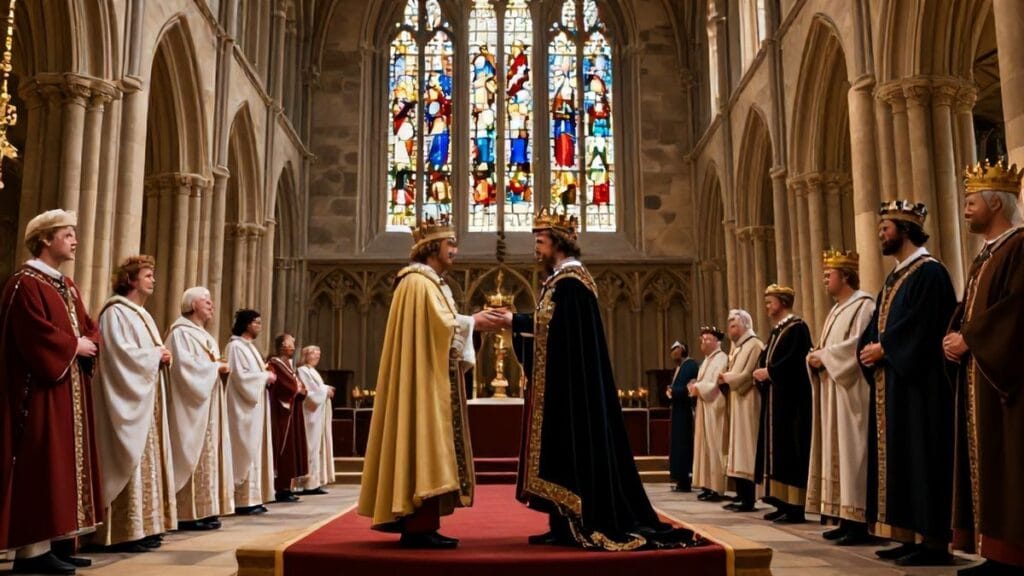
At last, the time came. Robert Bruce, dressed in finery befitting a great noble but not yet a king, processed toward the place of coronation within Scone Abbey. The exact wording of the ceremony has not survived in full, but its general pattern would have followed recognized medieval forms. The candidate was presented to those assembled, the question posed—did they accept this man as their rightful king?—and the answer, in that charged hall, was yes.
The chronic tradition holds that it was Isabella, Countess of Buchan, who played a crucial and symbolic role. A Comyn by birth but married into another great family, she claimed the hereditary right of her kin to place the crown upon the king’s head—an echo of earlier Gaelic traditions. In defying her own family’s political line to appear at Scone in support of Bruce, she gave the moment a powerful resonance. As the circlet or crown touched Bruce’s head, she helped bind him not only to Norman-Scots aristocratic custom but also to older, regional memories of kingship that reached back before the Normans ever came.
Holy oil was likely applied to Bruce’s head or breast, marking him as an anointed monarch under God’s protection. A bishop or abbot would have spoken words committing him to the defense of the church, the doing of justice, and the traditional rights of his people. Swords and scepters, however improvised, were placed in his hands. To those present, the legal and sacramental transformation was profound: Robert Bruce was no longer simply a powerful lord who had slain a rival. From that moment, in their eyes, robert the bruce crowned king of scots became the living symbol of Scotland’s claim to be a kingdom in its own right.
Voices would have risen in acclamation—“Long live the king!”—echoing from the stone walls. Outside, heralds might proclaim the news to waiting retainers, who repeated it farther afield. The ceremonial atmosphere, though shadowed by danger, must have carried its own palpable excitement. For the first time since John Balliol’s forced abdication a decade earlier, Scotland had a king chosen not by Edward’s arbitration, but by its own lords and clergy within its own sacred space.
Yet behind the celebrations, an awareness lingered that this act had not magically restored the lost Stone of Destiny or erased the English garrisons garrisoned in castles across the land. Scone that day was both a sanctuary and a stage, but it was also a target. Some present might have wondered how long Bruce’s kingship would survive once English armies marched north. Still, in the fragile logic of medieval legitimacy, the deed had been done: robert the bruce crowned king of scots on 25 March 1306 was, in the language of that age, now God’s anointed in Scotland, and to resist him was to resist not merely a man, but an office imbued with spiritual and historical authority.
The Missing Stone of Destiny and the Improvised Regalia
One of the most haunting details of Bruce’s coronation is what was not there. The Stone of Destiny—symbol of continuity from ancient kings—rested hundreds of miles to the south in Westminster Abbey, beneath the coronation chair of English monarchs. Edward I had taken it not just as war booty, but as a statement: the line of Scottish kings was broken and subsumed. For Bruce to be crowned at Scone without that stone was to confront the physical absence of a nation’s history.
So the coronation relied on memory and substitution. Chronicles hint that a wooden platform or chair may have been used in place of the old ceremonial arrangement. The regalia—crown, sword, scepter—had either been lost, seized, or hidden; what Bruce wore and held may have belonged to his own household or been donated by supporters. These makeshift symbols did not escape contemporary observers. English chroniclers later sneered at the pretensions of a “king” crowned without his proper stone and regalia, as if mocking the emptiness of his claim.
Yet scarcity can sometimes sharpen meaning. In the eyes of his supporters, the absence of the Stone of Destiny could be read as evidence of England’s injustice, not Bruce’s illegitimacy. The very act of proceeding anyway—of declaring robert the bruce crowned king of scots even while the traditional instruments of that crown lay captive in a foreign shrine—spoke of defiance and faith. In a sense, Bruce and those around him chose to believe that kingship resided not in stone or metal, but in the will of the community and the sanction of God.
Later Scottish tradition would retroactively wrap this moment in a kind of romantic austerity: a kingdom stripped to its essence, a king crowned in adversity rather than splendor. Historians like G.W.S. Barrow have noted that the coronation’s “poverty of regalia” did not prevent it from being accepted by much of the realm as valid and binding. The lack, in other words, did not define the act’s failure, but underscored the harsh political reality in which Scottish sovereignty had to be reimagined.
Voices in the Hall: Supporters, Doubters, and Silent Hostility
Within Scone Abbey and its environs, the coronation did not erase opposition; it merely declared a side. For the men and women present, attitudes toward Bruce ranged from fervent belief to wary calculation. Some saw him as the only viable alternative to endless English domination, a strong arm with royal blood who could unite the realm’s factions around a single standard. Others were there because they feared being left on the losing side or hoped to secure royal favor if Bruce succeeded.
The absence of others spoke loudly. Many powerful nobles allied with the Comyns, the Balliols, or simply with Edward I stayed away. Their lands and retinues would not answer Bruce’s summons. Some may have watched developments from their strongholds, waiting to see whether this hastily made king would endure long enough to justify risking their own positions. Among ordinary folk—peasants, town-dwellers, wandering beggars—the coronation probably arrived as rumor rather than spectacle: “There is a new king, a Bruce, crowned at Scone.” For people whose lives were measured by harvests and rents, the immediate impact might have seemed distant. But they knew well that kingship, old or new, tended to bring war.
Within the hall, a different kind of silence would have weighed on the air. The murder of John Comyn only weeks before was no secret. Some in attendance may have had friendship or kinship ties to the slain lord; others might have quietly wondered what it meant for a man who had shed blood in a church to now receive anointing in another. Was this true penance and redemption, or the cold triumph of a ruthless pragmatist? Medieval mentalities could hold these contradictions together: a king could be simultaneously sinner and instrument of divine providence.
Yet once the formal words were spoken, there was little space left for public doubt. To question the newly crowned king too openly was to risk being seen as a traitor by his faction. Those who maintained their reservations would bide their time, nursing grievances, waiting for a moment to strike—often in alliance with England. The hall at Scone thus contained not only the birth of a new monarchy, but the seeds of future civil strife. The coronation, for all its solemn ritual, did not unify Scotland overnight; it fixed a line that would divide it in blood for years to come.
Edward I’s Wrath: Punishment, Propaganda, and War Without Mercy
When word reached Edward I that robert the bruce crowned king of scots at Scone, his reaction combined outrage, grim satisfaction at a pretext for war, and a fierce determination to crush what he saw as a treacherous rebellion. To Edward, Bruce was not a rightful monarch but a vassal who had murdered a fellow noble within a church and then dared to usurp the rights of a king deposed under English authority. This was not merely disobedience; it was sacrilegious, seditious treason.
Edward’s response was swift and brutal. Orders went out for a major campaign into Scotland under trusted commanders. English propaganda portrayed Bruce as a criminal and Scotland’s resistance as illegitimate. The fate of those who supported him was to serve as an example to others. Captured allies of Bruce, especially members of his family, were executed with theatrical cruelty. Some were hanged and disemboweled, their body parts displayed in different towns. Female relatives were imprisoned in harsh confinement; the famous Countess of Buchan, who had placed the crown on Bruce’s head, was reportedly locked in an outdoor cage at Berwick or another stronghold, exposed to public view as a living warning.
The English king also made a point of desecrating the very idea of a Scottish kingship independent of his own authority. By rewarding those Scottish nobles who remained loyal to him with lands and offices stripped from Bruce’s supporters, he sought to show that real power and patronage flowed only from the English crown. Chronicler accounts from the English side revel in depictions of Bruce’s early defeats as proof that God did not favor his cause, that his coronation at Scone was a hollow charade in the face of English might.
Yet Edward’s hard line had a paradoxical effect. The savagery of his reprisals, as at earlier moments in the wars of independence, deepened hatred among many Scots, pushing some undecided nobles toward Bruce’s camp out of anger or sheer desperation. Even people who distrusted Bruce personally could not fail to notice that those who resisted English dominion, whatever their internal rivalries, were treated alike as rebels to be terrorized rather than subjects to be reconciled. In this crucible of fear and rage, the legitimacy of robert the bruce crowned king of scots slowly began to sink deeper roots, not in the halls of abbeys but in the hardened hearts of a people long pushed too far.
Exile, Defeat, and Survival: The Dark Years After Scone
In purely military terms, the years immediately following Bruce’s coronation were catastrophic for his cause. Within months, he suffered defeats at Methven and Dalry. Many of his closest supporters were killed or captured. Several of his brothers met brutal ends at English hands. His wife, Elizabeth de Burgh, and other female relatives were seized and imprisoned. The newly crowned king of Scots found himself a hunted man, reduced to leading a small band of loyal followers from one hiding place to another.
Legend places Bruce during this period on remote islands off the west coast or hidden in the heather and caves of the Highlands, nursing wounds and watching the kingdom slip through his fingers. It is in this context that the famous, if possibly apocryphal, story of Bruce and the spider emerges: the king, in despair, observes a spider tirelessly attempting—and failing—to cast its web from one beam to another, until at last it succeeds. Inspired, Bruce resolves to try once more to reclaim his kingdom. Whether or not this tale is literally true, it captures the mood of a man whose coronation had given him a title but not the power to enforce it.
For the average Scot, these dark years meant renewed instability. English campaigns, punitive raids, and sporadic fighting among rival lords devastated the countryside. Crops were trampled under marching armies; villages burned; churches looted. Loyalties were double-edged. To aid Bruce openly was to risk English retribution; to serve Edward might invite retribution if Bruce should eventually prevail. Many tried to hedge, offering minimal support to whichever side currently dominated their region, praying merely to survive.
And yet, Bruce’s survival—physical and political—through this bleak period was itself remarkable. Lesser men might have fled permanently to foreign courts, living out their days as exiles debating lost causes. Bruce instead used this time to reassess, to build networks in Gaelic-speaking regions in the west and north, and to recalibrate his military strategy. He abandoned the idea that he could simply field armies in open battle against English forces and their allied Scottish magnates. Instead, he began to wage a war of mobility, using small, hardened bands who knew the terrain intimately. The crown he had received at Scone became not a prize resting on secure brows, but a burden he had to earn again and again, skirmish by skirmish, winter by harsh winter.
From Crown to Victory: Bannockburn and the Fulfillment of 1306
From around 1307 onward, the tide began, slowly, to turn. Edward I died that year, and though his successor, Edward II, inherited his father’s armies, he did not inherit his ferocious focus or strategic skill. Bruce exploited the transition ruthlessly, striking at English garrisons, retaking castles, and ordering many of them dismantled so they could not easily be reoccupied. His reputation as a commander grew; his followers, once a desperate band, swelled into a formidable national army drawn from many regions of Scotland.
By 1314, the long gamble begun when robert the bruce crowned king of scots at Scone was approaching a decisive test. The English king, under pressure to reassert his authority and relieve the besieged garrison at Stirling Castle, led a large army north. Bruce, now experienced and hardened, chose his ground carefully near the Bannock burn, a stream crossing marshy terrain that would favor his tactics and negate some of the English advantages in heavy cavalry.
The Battle of Bannockburn, fought over two days in June 1314, has been recounted endlessly, but its significance in relation to the coronation at Scone cannot be overstated. On the first day, Bruce himself famously met the English knight Henry de Bohun in single combat, splitting his skull with an axe after deftly sidestepping a lance charge—an episode that later storytellers seized upon as a symbol of Scottish courage and kingly prowess. On the second day, disciplined Scottish schiltrons—dense pike formations—pushed back the English knights, while English forces found themselves trapped between the advancing Scots, the marshy ground, and their own panicking ranks.
When the English army finally broke, many were killed fleeing across the Bannock or cut down by pursuing Scots. Edward II barely escaped. In the aftermath, Bruce stood not only as an anointed king in ritual terms, but as a victor whose martial success gave practical weight to his claim. The memory of Scone, of a fragile coronation under the shadow of the Stone’s absence, now seemed like the first note in a crescendo that had reached its thunderous peak at Bannockburn.
Peace and formal recognition did not come overnight—indeed, it was not until the Treaty of Edinburgh-Northampton in 1328 that England officially acknowledged Bruce as King of Scots. But for many contemporaries, Bannockburn functioned as the true confirmation of what had been proclaimed at Scone: that Scotland, though battered, was a kingdom, and that Robert was its rightful ruler. The journey from that dim abbey in 1306 to the sun-drenched fields of 1314 reveals kingship in the Middle Ages as a process, not a single event, woven from ritual, bloodshed, and the slow, often terrible work of convincing a people to believe.
The People’s War: How Ordinary Scots Lived Bruce’s Kingship
It is tempting to tell this story purely through the lens of kings, nobles, and battles, but the meaning of robert the bruce crowned king of scots cannot be fully grasped without considering those who never stood in Scone Abbey or on the field of Bannockburn. For peasants bound to the soil, tenants of monasteries, and burghers in small towns, Bruce’s kingship was experienced not as a philosophical principle but as a changing pattern of rents, taxes, and dangers.
During the years of struggle, many rural communities found themselves caught between foraging armies and punitive raids. A village that offered shelter or supplies to Bruce’s men might be burned by an English garrison seeking to teach a lesson. Conversely, a community that aided the English could be targeted later by Bruce’s adherents as collaborators. Famine and disease, already regular companions in medieval life, flourished in the wake of such disruptions. Chroniclers speak of years when “the poor ate roots and grass, and died like beasts in the fields,” though such accounts may be colored by rhetorical exaggeration.
Yet common people were not simply passive victims. Local traditions suggest that some communities deliberately misled English patrols, hid Bruce’s men in outbuildings or caves, or supplied them with food at night. Others may have done the same for English troops, driven by fear more than loyalty. Over time, as Bruce’s position strengthened, aligning with him became not only safer but also a source of pride. The idea of fighting “for King Robert” could resonate in villages where men had brothers or sons in his ranks, where the stories of earlier heroes like Wallace still circulated.
Economically, Bruce’s eventual success brought slow stabilization. Confiscated lands from those who had opposed him were redistributed to loyal followers, creating a new aristocratic order whose fortunes were tied to the Bruce dynasty. For tenants on those lands, the immediate lord changed, but so did expectations of service and protection. In charters and legal documents, Bruce portrayed himself as a restorer of rightful order, promising the kind of stable governance that had been shattered since Alexander III’s death. Whether he delivered on all of these promises is debatable, but the image of a king who had shared hardship with his people, who had known defeat and hunger, proved a powerful one.
Myth, Memory, and Legend: How 1306 Shaped Scottish Identity
Over the centuries that followed, the scene at Scone in 1306 was transformed from a risky political act into the cornerstone of a national myth. Poets like John Barbour in the fourteenth century and later writers in the nineteenth-century romantic tradition elevated Robert the Bruce into an almost larger-than-life figure. The coronation, the hardships, the spider in the cave, the triumph at Bannockburn—all fused into a story about perseverance, freedom, and the indomitable character of the Scottish people.
In these retellings, the rough edges of history were smoothed away. Bruce’s early oaths to Edward I, his role in the murder of Comyn, the internal civil conflicts with other Scottish families—all tended to be minimized or recast as necessary evils on the road to liberation. The coronation at Scone appeared less as a contested, dangerous gamble and more as an almost inevitable, righteous step in the unfolding of a nation’s destiny. Schoolbooks, ballads, and monuments helped fix this version of events in the popular imagination.
Such myth-making had real political uses. During the later struggles over the Union of the Crowns in 1603 and the Acts of Union in 1707, the figure of Bruce and the memory of an independent medieval kingship provided a symbolic contrast to the reality of shared monarchy and parliamentary union with England. In the nineteenth and twentieth centuries, as modern nationalism emerged, robert the bruce crowned king of scots at Scone took on fresh significance. Artists depicted the scene with dramatic lighting and solemn faces; historians debated the exact layout and participants, while activists and writers invoked it as proof that Scotland had once stood as a fully independent state with its own sacred rituals of sovereignty.
In this way, the coronation became not just a moment in medieval ecclesiastical history, but a touchstone for later generations grappling with questions of identity, autonomy, and memory. It shows how a single event, rooted in the politics of its own age, can be reinterpreted over and over to meet the needs and dreams of those who come after. The ghosts of Scone’s abbey, long since destroyed in the Reformation, still walk in the pages of literature, in the debates of parliaments, and in the quiet pride of families who trace their stories back to the wars of independence.
Historians Debate: Usurper, Murderer, Patriot, King
Modern historians approach Robert Bruce and his coronation with a mixture of admiration and skepticism. They sift chronicles, charters, and diplomatic correspondence, aware that every source carries its own biases. English chroniclers like the Lanercost writer saw Bruce as a villain, emphasizing his role in Comyn’s murder and portraying his rule as founded on treachery. Later Scottish writers, by contrast, tended to sanctify him. The historian Michael Brown, for instance, has drawn attention to Bruce’s careful construction of his public image, while others, such as G.W.S. Barrow, have highlighted his abilities as a statesman and military leader.
On one side of the debate stands the view of Bruce as an opportunist: a man who shifted loyalties, killed a rival in a church, and seized a damaged crown primarily to satisfy dynastic ambition. From this perspective, the coronation at Scone appears as a bold but self-serving move in the cutthroat world of medieval aristocratic politics, differing in degree but not in kind from similar acts across Europe. The suffering that followed—the wars, executions, famines—might then be laid, at least partly, at his feet.
On the other side stands a more sympathetic interpretation: Bruce as a flawed but ultimately visionary leader who recognized that Scotland’s survival as a separate realm required decisive action. Here, the killing of Comyn, while morally troubling, is framed as the removal of a rival whose faction might have accepted permanent subordination to England. In this telling, the coronation at Scone becomes a necessary rallying point, the moment when Scotland’s elites, or at least a critical portion of them, chose to stake their futures on native kingship rather than foreign overlordship.
Most nuanced scholarly work now acknowledges elements of both. Bruce was ambitious and ruthless, but also capable of inspiring loyalty and of making hard strategic decisions that ultimately did secure Scottish independence for a time. The phrase robert the bruce crowned king of scots thus encapsulates both the bloodstained pragmatist and the enduring symbol of resistance. The historian’s task is not to pick a side in a moral drama, but to understand how a man like Bruce navigated the structures and expectations of his age—and how those actions resonated far beyond his own lifetime.
Long Echoes: 1306 in Modern Politics and Culture
Even today, the coronation at Scone in 1306 reverberates in Scottish political and cultural life. In debates about devolution, independence referendums, and the constitutional position of Scotland within the United Kingdom, references to Bruce and his era often surface. Politicians and commentators, whether cautiously or with theatrical flair, evoke the wars of independence as a foundational moment when Scotland asserted the right to govern itself.
In popular culture, films, novels, and television dramas reinterpret Bruce’s story for new audiences. Some focus on Bannockburn and battlefield heroism; others delve into the intrigue of noble families and the personal struggles of a man forced to carry the weight of a crown won in such contentious circumstances. Tourist sites connected, however tenuously, to Bruce’s life—castles he besieged, caves he’s rumored to have hidden in, the grounds where Scone Abbey once stood—draw visitors eager to stand where history unfolded.
Academic historians sometimes wince at the simplifications these portrayals entail, but they also recognize that the very persistence of interest in robert the bruce crowned king of scots speaks to something enduring in the human imagination: a fascination with the moment when an individual dares to claim authority in the face of overwhelming opposition. The fact that Bruce’s coronation was followed by years of hardship rather than instant glory only deepens its resonance. It shows that nationhood, however defined, is rarely born in clean, unambiguous acts; it emerges from messy, contested, and often violent processes in which symbols, like crowns placed on anxious brows in shadowed abbeys, play a crucial part.
If we walk today across the quiet lawns where Scone Abbey once stood, little remains of the physical setting of that March day in 1306. The stone walls are gone; the sounds of chanting clerics and armored nobles have long since faded. Yet the idea born there—the conviction that Scotland could choose its own king, in its own place, by its own rites—still flickers in political speeches, folk songs, and family stories. The coronation was not an endpoint, but a touchstone, one that each generation revisits, questions, and reimagines in the light of its own struggles.
Conclusion
On 25 March 1306, in the austere, echoing spaces of Scone Abbey, robert the bruce crowned king of scots stepped into a role that would test every fiber of his being. The coronation was born from bloodshed and desperation, shadowed by the absence of the Stone of Destiny and the threat of English vengeance. It did not instantly unite Scotland, nor did it guarantee victory. Instead, it marked the beginning of a long, uncertain journey in which ritual, warfare, diplomacy, and sheer endurance slowly transformed a contested claimant into a recognized monarch.
By tracing the road to Scone—from dynastic crisis and English conquest through Comyn’s murder, improvised ceremony, crushing defeats, and eventual triumph at Bannockburn—we see how kingship in medieval Scotland emerged from a complex interplay of lineage, faith, and force. We also glimpse how ordinary people lived through these convulsions, suffering in their wake but also, at times, sustaining them. Over centuries, memory recast Bruce from a hard-edged political actor into a near-mythic figure, his coronation elevated as a symbol of national resilience and the desire for self-rule.
Yet, stripped of legend, the scene at Scone remains intensely human: anxious nobles weighing their futures, clergy risking their lives for a vision of a free church and kingdom, a man accepting a crown that might just as easily serve as a noose. It is this tension—between glory and peril, ideal and compromise—that gives the event its enduring power. In the end, the coronation of Robert the Bruce reminds us that the shaping of nations is rarely clean, never simple, and always, in some measure, an act of faith in an uncertain future.
FAQs
- Why was Robert the Bruce crowned at Scone Abbey specifically?
Scone Abbey had long been the traditional site of Scottish coronations, closely associated with the Stone of Destiny and the inauguration of earlier kings. By choosing Scone, Bruce anchored his claim in the deepest available symbols of Scottish sovereignty, even though the Stone had been removed by Edward I and much of the old regalia was missing. - How soon after John Comyn’s murder was Robert the Bruce crowned king?
John Comyn was killed in February 1306, and Bruce was crowned at Scone on 25 March 1306, likely just a few weeks later. The haste reflected Bruce’s need to transform himself rapidly from outlaw to anointed monarch before his enemies could fully organize against him. - Did the absence of the Stone of Destiny invalidate Bruce’s coronation?
No. While the Stone of Destiny was a powerful traditional symbol, legitimacy in medieval kingship rested on a combination of lineage, consent of leading nobles and clergy, and proper religious rites. Contemporary Scottish supporters accepted Bruce’s coronation as valid despite the stone’s absence, though English writers mocked it as incomplete. - Was Robert the Bruce universally supported in Scotland after his coronation?
Far from it. Many influential families, especially those aligned with the Comyn and Balliol factions or closely tied to Edward I, opposed him. Bruce’s early reign was marked by civil conflict as well as war with England, and it took years of campaigning before his authority was widely accepted across the kingdom. - How did Robert the Bruce eventually secure recognition of his kingship?
Bruce combined persistent military campaigns, culminating in the victory at Bannockburn in 1314, with diplomatic efforts and institution-building at home. Formal English recognition came with the Treaty of Edinburgh-Northampton in 1328, which acknowledged him as King of Scots and affirmed Scotland’s independence. - Did the Church support Robert the Bruce’s coronation?
Some clergy strongly supported Bruce, seeing in him a defender of a free Scottish church, while others hesitated or opposed him, especially in light of Comyn’s murder in a church. Over time, however, papal and ecclesiastical recognition gradually shifted in his favor, particularly as his political position stabilized. - What happened to those who helped crown Robert the Bruce?
Many paid a heavy price. Edward I targeted Bruce’s supporters with harsh punishments. The Countess of Buchan, who ceremonially placed the crown on his head, was famously imprisoned in a cage. Others were executed, imprisoned, or stripped of lands before Bruce’s fortunes improved. - How reliable are the stories, like the spider in the cave, connected to Bruce?
Stories such as Bruce and the spider are likely later legends rather than eyewitness accounts, shaped by oral tradition and later literary works. While they may not be factual in a strict sense, they capture how later generations understood Bruce’s perseverance and have become part of his enduring myth.
External Resource
Internal Link
Other Resources
- Encyclopaedia Britannica – general search for the exact subject
- Google Scholar – academic search for the exact subject
- Internet Archive – digital library search for the exact subject

