Table of Contents
- A Silent Witness to Time: The Waning Days of Roger Bacon
- The Medieval World in Turmoil: England and Oxford in the Late 13th Century
- The Making of a Scholar: Roger Bacon’s Early Life and Intellectual Pursuits
- Roger Bacon’s Revolutionary Ideas: Science on the Brink of Change
- The Shadow of Authority: Church and Academia in the 1200s
- Oxford, 1292: A City of Learning and Unrest
- The Final Years: Bacon’s Confinement and Intellectual Struggles
- The Last Breath: Roger Bacon’s Death in Oxford
- The Immediate Aftermath: Mourning a Visionary
- The Legacy in Ink: How Bacon’s Works Endured and Influenced Future Generations
- Alchemy and Optics: The Practical Genius Left Behind
- Science and Superstition: The Thin Line in Medieval Scholarship
- The Church’s Grip on Knowledge: Persecution and Protection
- Chronicles and Anecdotes: Contemporary Accounts of Bacon’s Life and Death
- Rediscovering Bacon: The Renaissance and Beyond
- The Modern Image: Roger Bacon in Popular Culture and Historiography
- The Wider Influence: Bacon’s Role in the Scientific Revolution
- Footprints in Today’s Science: Bacon’s Methods and Ideas Revisited
- Oxford’s Memory: Commemorations and Monuments
- Conclusion: The End of an Era, the Dawn of Innovation
- FAQs: Roger Bacon’s Life, Death, and Legacy
- External Resource
- Internal Link
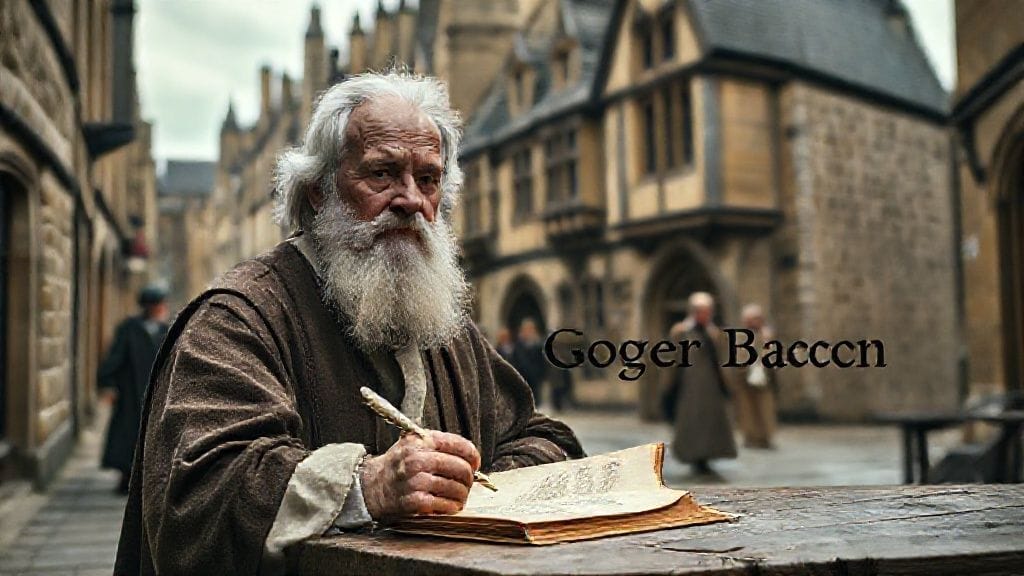
In the gray dawn of a cold February morning in 1292, the cloistered streets of Oxford whispered subdued farewells to a man whose mind stretched far beyond his own century. Roger Bacon, a figure both revered and feared, lay dying in a modest chamber within the venerable walls of the University. Outside, the city stirred with the footsteps of scholars and clerics, oblivious to the passing of an intellectual titan who had challenged the very foundations of medieval thought. It was the end of a life marked by relentless curiosity, frustration with authority, and an unyielding quest for knowledge—a quest that would echo through time.
A Silent Witness to Time: The Waning Days of Roger Bacon
The final days of Roger Bacon remain shrouded in the nuances of medieval obscurity. The 13th century was an era where men of science often peered into shadows wrought by superstition and ecclesiastical authority. Yet, in this crucible of conflict, Bacon’s spirit soared. As he lay on his deathbed, the atmosphere was thick with the weight of unspoken battles—between tradition and innovation, faith and reason, power and knowledge.
Few knew the full extent of the intellectual legacy that would survive him. His experiments on optics, his proposals for empirical methods, and his belief in direct observation as the path to truth seeded ideas that would one day blossom beyond medieval walls, planting the roots for a transformation that only future centuries would fully grasp.
The Medieval World in Turmoil: England and Oxford in the Late 13th Century
To understand Roger Bacon’s last moments, one must step back into the broader panorama of 13th-century England. England’s political landscape was marked by tension under King Edward I’s rule, a monarch focused on law, order, and military campaigns in Wales and Scotland. Meanwhile, Oxford was emerging as a hub of intellectual ferment, its university founded barely decades earlier already attracting inquisitive minds from across Europe.
But this was also a world dominated by the Church’s authority. The Catholic Church’s control over education and thought was immense, dictating what could be studied, discussed, and published. The institution viewed challenges to its dogma as threats not only to faith but to social order itself. This environment framed Bacon's experience—both his achievements and his ups and downs.
The Making of a Scholar: Roger Bacon’s Early Life and Intellectual Pursuits
Born around 1219, little is known of Roger Bacon’s formative years. His surge into academia brought him first to Oxford, then to the University of Paris, where he mastered the traditional scholastic curriculum. Yet, Bacon was never content with purely theoretical knowledge. His insatiable curiosity pushed him into physics, astronomy, alchemy, and languages, making him a polymath before the term was coined.
By the mid-13th century, Bacon was gaining a reputation as a forward thinker. He argued forcefully for strengthening empirical observation alongside classical learning from Aristotle and the Bible. This approach was controversial; it nudged against educational orthodoxy and stirred suspicion among faculty and Church authorities.
Roger Bacon’s Revolutionary Ideas: Science on the Brink of Change
Bacon’s intellectual contributions were staggering. He foresaw advances that stretched centuries ahead—a mechanical flying machine, telescopes, magnifying glasses, and even gunpowder. He emphasized mathematics as a necessary tool to understand the universe, insisting that knowledge must be interwoven with experimentation.
Nevertheless, to his contemporaries, some of his ideas bordered on heresy or folly. His fascination with alchemy and cryptic writings on controlling nature’s secrets invited scrutiny. Bacon’s life became a balancing act—pushing the edges of medieval science while trying to avoid the wrath of those who saw his methods as dangerous or impious.
The Shadow of Authority: Church and Academia in the 1200s
The 13th century was an age when knowledge was both a treasure and a tool of power. The Church’s monopoly over education meant that scholars like Bacon had to navigate carefully. His attempts to reform academic methods and criticize the superficial teaching of Latin grammar and Aristotelian philosophy triggered backlash.
Historical accounts suggest Bacon was even imprisoned for a period—whether by Church officials or University authorities remains a topic of debate. This punishment underscored the tensions between revolutionary ideas and institutional control. For Bacon, intellectual freedom was a cause worth personal sacrifice.
Oxford, 1292: A City of Learning and Unrest
By the time of his death, Oxford was a bustling intellectual center with its labyrinthine colleges and cloisters. But beneath the veneer of scholastic achievement simmered political and religious pressures. The university itself had experienced various conflicts, including violent outbreaks between town inhabitants and students, known as the "town and gown" strife. These conflicts illustrated the struggles within a society balancing progress and tradition.
In this vibrant yet conflicted environment, Roger Bacon’s death was not a public event. It passed quietly, like a candle’s flame flickering out in a draft, unnoticed by the masses but deeply felt by those who understood the gravity of losing such a mind.
The Final Years: Bacon’s Confinement and Intellectual Struggles
The scholarly records offer scant information on Bacon’s last years, but historians agree that they were marked by isolation. His unorthodox methods and ideas alienated many. There is evidence that Bacon spent time confined—possibly detained by Church authorities—preventing him from publishing or teaching adequately.
During this period, Bacon authored some of his most important works in optics and scientific methodology. These texts reveal a man still vibrant in mind, wrestling with ideas that would later lay the groundwork for the scientific method.
The Last Breath: Roger Bacon’s Death in Oxford
When Roger Bacon passed away in 1292, the chroniclers of Oxford recorded his death without fanfare. No state funerals, no grand memorials—only the whispered acknowledgment of a scholar’s passing. Perhaps this silence was fitting. Bacon’s life had often been lived at the margins, between acceptance and suspicion.
Yet, his death symbolized more than an individual’s end. It was the closing of a chapter on medieval thought rigidly chained to dogmatism. Bacon’s legacy was the seed of intellectual revolution—one that would break free in the Renaissance.
The Immediate Aftermath: Mourning a Visionary
In a world where fame was fleeting and ideas often condemned, Bacon’s death did not immediately trigger widespread recognition. Nevertheless, within academic circles, his name carried weight. His disciples preserved his manuscripts, copying and disseminating his ideas.
Despite the Church’s ambivalence, many later scholars looked back on Bacon as an archetype of the scientist-scholar, an emblem of courage and inquiry amid oppression.
The Legacy in Ink: How Bacon’s Works Endured and Influenced Future Generations
Roger Bacon’s writings survived centuries, carried on fragile parchment through the upheavals of history. His treatises on optics influenced pioneers like Johannes Kepler and Galileo Galilei, while his insistence on observation foreshadowed the later empirical methods that transformed science.
Beyond optics, Bacon’s interdisciplinary approach inspired the Renaissance polymaths who bridged gaps between philosophy, mathematics, and experimentation—hallmarks of modern scientific inquiry.
Alchemy and Optics: The Practical Genius Left Behind
Two of Bacon’s contributions stand out vividly: his studies in optics and his interest in alchemy. In optics, Bacon analyzed the properties of light and lenses, articulating principles that would underpin the invention of spectacles and later telescopes.
In alchemy, though shrouded in mystery and often misunderstood, Bacon sought to understand the transformation of substances—a precursor to chemistry. His practical experiments and notes extended the boundaries of medieval science beyond theory to practice.
Science and Superstition: The Thin Line in Medieval Scholarship
Roger Bacon’s life straddled a precarious boundary. At a time when magic, superstition, and religion intertwined with early science, his work was occasionally mistaken for heresy or sorcery. The medieval mindset was primed to conflate unexplained phenomena with divine or diabolical forces.
Bacon's work illuminated the struggle to separate rational investigation from superstition—a tension that characterized much of pre-modern science.
The Church’s Grip on Knowledge: Persecution and Protection
The paradox of Bacon’s era was that the Church both preserved knowledge and stifled innovation. Universities were Church institutions, and scholarly work required ecclesiastical approval. This duality meant that pioneering minds like Bacon’s had to negotiate their place carefully.
Histories hint that his confinement was a consequence of crossing these boundaries. Nonetheless, the Church’s preservation of classical texts also offered Bacon his foundational corpus, creating a paradoxical relationship of dependence and resistance.
Chronicles and Anecdotes: Contemporary Accounts of Bacon’s Life and Death
Medieval chroniclers like William of Nottingham spoke of Bacon’s deep knowledge and peculiar personality—an outsider within orthodox circles. Anecdotes recall a figure deeply engaged in secret experiments, sometimes cloaked in mystery, other times frank in criticizing scholastic laziness.
These stories persisted orally before being codified, painting a vivid portrait of a man both revered and isolated.
Rediscovering Bacon: The Renaissance and Beyond
The Renaissance, with its revival of classical learning and humanistic inquiry, rediscovered Bacon’s manuscripts. Scholars recognized in his work the nascent scientific spirit. His writings were translated, printed, and debated, igniting inspiration.
Later thinkers positioned Bacon as a forefather of empirical science—transforming a once-marginalized figure into a celebrated pioneer.
The Modern Image: Roger Bacon in Popular Culture and Historiography
In modern times, Roger Bacon has become a symbol—sometimes mythologized—as an early “scientist” ahead of his era. His life features in historical novels, films, and academic discourse. This image is both a tribute and a lens into how history adapts figures to cultural narratives.
Yet beyond myth, historians strive to balance admiration with critical understanding of his context and limitations.
The Wider Influence: Bacon’s Role in the Scientific Revolution
While Bacon did not witness the scientific revolution, his insistence on experimentation and mathematics prefigured its emergence. He challenged medieval scholasticism and sought a method based on facts and critical analysis.
These attributes link Bacon to the lineage of figures like Francis Bacon (no relation), Galileo, and Newton—architects of the modern scientific worldview.
Footprints in Today’s Science: Bacon’s Methods and Ideas Revisited
Today, Bacon’s work is studied not only for historical interest but also as a philosophical milestone in science methodology. His promotion of empirical observation and induction precedes methods now foundational in research and discovery.
Reflecting on Bacon’s legacy reminds us that scientific progress is often the gradual triumph of curiosity over constraint.
Oxford’s Memory: Commemorations and Monuments
Oxford itself honors Roger Bacon’s memory modestly but meaningfully. Plaques and references in academic circles herald his contributions. The university’s ongoing role as a global center of knowledge is part of the living heritage he helped shape.
Visitors walking through Oxford’s ancient quads can almost hear echoes of Bacon’s restless mind moving through shadowed corridors centuries ago.
Conclusion
Roger Bacon’s death in 1292 marked the passing of a complex and courageous intellect whose life was a testament to the unyielding human thirst for understanding. In the face of dogma, suspicion, and confinement, he dared to dream beyond his time—foreseeing tools and methods that centuries later would revolutionize science and society.
His story reminds us that innovation often arises from tension and struggle, that progress is not linear but layered with conflict. Bacon’s legacy is not only in his ideas but in the enduring spirit of inquiry and resilience that he embodied. As night descends on medieval Oxford and dawn breaks over modern science, his life shines as a beacon for all seekers of truth.
FAQs
1. Who was Roger Bacon, and why is he significant?
Roger Bacon was a 13th-century English philosopher and scientist known for advocating empirical methods and pioneering studies in optics. He is significant for laying early foundations of the scientific method.
2. What were the main challenges Bacon faced in his lifetime?
Bacon struggled against the ecclesiastical and academic authorities that often viewed his ideas as threatening or heretical. He was reportedly imprisoned and faced isolation due to his unorthodox methods.
3. What contributions did Roger Bacon make to science?
He contributed notably to optics, the study of light and lenses, promoted mathematics for scientific inquiry, and stressed observation and experimentation.
4. How did the Church influence Bacon’s work and life?
The Church controlled education and censored intellectual exploration in medieval Europe, leading to tension as Bacon’s ideas sometimes contradicted orthodox teachings.
5. What is known about Bacon’s death and final years?
Bacon died in Oxford in 1292, likely in relative obscurity. His final years were marked by confinement and limited freedom to publish or teach.
6. How has Roger Bacon’s legacy evolved over time?
Initially overlooked, Bacon’s work was rediscovered during the Renaissance and later celebrated as an early proponent of scientific inquiry, influencing later scholars and scientists.
7. Did Bacon directly contribute to the Scientific Revolution?
While he predated the Scientific Revolution by centuries, his emphasis on experimentation and mathematics anticipated key elements of that movement.
8. How is Roger Bacon remembered in Oxford today?
Though his death was humble, Oxford acknowledges him with commemorations and honors him as a pioneering scholar in the university’s rich history.