Table of Contents
- The Dawn of a New Era: Rome, February 9, 1849
- Seeds of Revolution: Italy in the Mid-19th Century
- The Roman Question: Papal Rule and Catholic Authority
- The Spark Ignites: The 1848 Revolutions Across Europe
- Rome in Turmoil: The Fall of Papal Temporal Power
- Giuseppe Mazzini: The Soul of the Roman Republic
- The Flight of Pope Pius IX: A Pope in Exile
- The Birth of the Roman Republic: February 9, 1849
- Governing the Republic: Ideals and Realpolitik
- Social Reforms and Radical Experiments in Rome
- The Role of Garibaldi: Soldier of Liberty
- International Reactions: Allies and Enemies Abroad
- The French Intervention: Crush of the Republic
- Siege and Resistance: Rome Under Fire
- The Fall of the Roman Republic: July 1849
- Aftermath and Return of the Pope
- The Roman Republic’s Legacy in Italian Unification
- Voices from the Republic: Letters, Speeches, and Dreams
- Lessons of the 1849 Republic for Modern Democracy
- Conclusion: The Eternal Fire of Rome’s Republican Dream
- FAQs: Understanding the Roman Republic of 1849
- External Resource: Wikipedia Link
- Internal Link: Visit History Sphere
The Dawn of a New Era: Rome, February 9, 1849
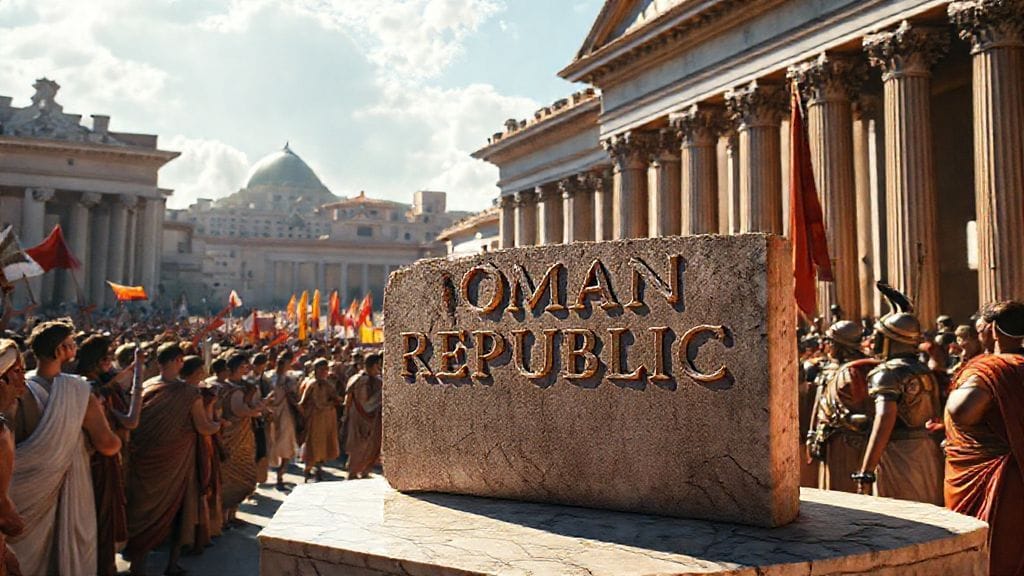
In the chill of winter, amid the ancient stones and winding alleys of Rome, a momentous rupture shattered centuries of tradition. On February 9, 1849, the Eternal City awoke not as the heart of Papal dominion but as the cradle of a fledgling republic. The echoes of trumpets and murmurs of crowds mingled with the frosty air, as citizens gathered in the Piazza del Popolo, their eyes bright with hope, fear, and the ferment of change. They were part of a grand experiment, a gamble on liberty against the weight of centuries’ old theocracy. The red, white, and green banner fluttered—a symbol of unity and a prelude to a dream of an Italy reborn. But beneath the triumphant facade, the shadows of violence, ideological strife, and looming foreign powers gathered like a storm.
Seeds of Revolution: Italy in the Mid-19th Century
Italy in 1849 was a mosaic of fragmented states: kingdoms, duchies, and papal territories stitched together by language and culture but divided politically. The Risorgimento—the "resurgence"—had been simmering for decades, fueled by a burgeoning sense of nationalism and the spread of liberal ideas. The populace, especially the burgeoning middle classes and intellectuals, hungered for constitutional rights, representation, and an end to foreign domination, notably Austrian rule in the north.
Yet the Papal States, under Pope Pius IX, remained a bastion of conservative theocracy. Society was rigidly structured; the Church controlled not only spiritual life but also political authority in Rome and central Italy. However, even Pius IX had initially shown a liberal bent early in his tenure, granting reforms that kindled hopes among reformists. The reality was more complex—a slow oscillation between reform and repression that left a restless population yearning for more profound change.
The Roman Question: Papal Rule and Catholic Authority
The Papal States were unique in Europe: temporal power wielded directly by the head of the Catholic Church. The Pope ruled not only as a spiritual leader but as a monarch with armies, laws, and subjects. This fusion engendered deep contradictions. The Church preached spiritual compassion but enforced rigid political control. The Church’s temporal authority was seen by many Italian patriots as an impediment to national unification and democratic progress.
Religious fervor deeply permeated Roman life, yet throughout the 1840s, anti-clerical sentiment grew, chiefly among intellectuals, liberals, and revolutionaries. Some saw the papacy’s temporal power as an anachronism, a relic to be dismantled if Italy was to become one nation united by modern ideals rather than divisive allegiances to princes and prelates.
The Spark Ignites: The 1848 Revolutions Across Europe
The year 1848 is etched into history as “the Springtime of Nations”—a thunderous wave of revolts and uprisings shook Europe from Paris to Vienna, from Berlin to Budapest. Protesters demanded constitutions, civil liberties, and national self-determination. Italy was no exception. Milan and Venice rose against Austrian occupiers; other cities clamored for reform.
Rome became a crucible of conflicting forces. The Pope, initially sympathetic, faltered under pressure from conservatives and reactionaries. A series of violent clashes erupted in the city, pitting radical republicans against papal forces and conservative militias. The tension was palpable, a city on the brink of transformation.
Rome in Turmoil: The Fall of Papal Temporal Power
The violence escalated, culminating in the assassination of the Minister of the Interior, Pellegrino Rossi, in November 1848. This event marked a turning point. Pope Pius IX fled Rome disguised as a simple priest and sought refuge in the Kingdom of Naples. His flight created a vacuum of authority — and an opportunity.
In the Pope’s absence, a revolutionary assembly convened, determined to fill the power void. After days of fervent debate, a radical decision was made—to abolish papal temporal rule and proclaim a Roman Republic, one that would serve as a beacon for all Italian patriots.
Giuseppe Mazzini: The Soul of the Roman Republic
Central to the story of the Roman Republic is Giuseppe Mazzini, the visionary philosopher, and activist who had spent years advocating for a unified, democratic Italy. Driven by principle and fiery idealism, Mazzini saw in Rome not just a city but the symbolic heart of a new republic.
Mazzini’s ideas were radical for the time: republican democracy based on universal suffrage, secular education, freedom of the press, and the separation of church and state. He was not a mere dreamer but a man of action committed to translating ideals into governance.
When the Republic was declared, he was elected one of its triumvirs—alongside Aurelio Saffi and Carlo Armellini—and took a leading role in guiding this fragile new order. His charisma and sheer determination infused the Republic with an urgent sense of purpose.
The Flight of Pope Pius IX: A Pope in Exile
Pope Pius IX’s departure did not end his influence. From Gaeta and later France, he called upon Catholic monarchs to restore his temporal authority and crush the secular republicans. His cry found a willing listener in Napoleon III of France, who feared the spread of republicanism as much as the loss of Catholic sway.
The papal flight added a complex religious dimension to what was essentially a political crisis. The Church’s supporters in Europe—monarchical regimes and conservative forces—saw the Roman Republic as a heretical rebel government and a threat to their own stability.
The Birth of the Roman Republic: February 9, 1849
On a cold yet electrifying February day, Rome’s citizens gathered for the historic proclamation of the Roman Republic. The ancient city, once the seat of imperial power and now the center of papal authority, symbolically turned its back on the past.
The declaration was a radical act, ending centuries of papal rule. It created a civilian government committed to democracy, secularism, and national unity. For many, this was more than politics; it was the emergence of a new identity, the birth of an Italy that could break its chains.
Governing the Republic: Ideals and Realpolitik
Setting up a government from scratch in the heart of revolutionary tension was far from simple. Mazzini and his colleagues navigated a difficult course. They introduced a constitution defining civic rights, abolished censorship, enacted social reforms, and attempted to establish a secular legal system.
Yet, realities proved harsh. The Republic faced shortages, internal dissent, and political factions ranging from moderate liberals to radical democrats and socialists. Questions about property rights, the Church's role, and the army’s composition often drove bitter debate.
Despite challenges, the Republic embodied the hopes of its citizens, who participated actively in its defense and administration. The streets of Rome buzzed with political discussions and vibrant public engagement—a clear break from the Papal States' authoritarian legacy.
Social Reforms and Radical Experiments in Rome
The Roman Republic enacted landmark reforms that shook the foundations of Roman society. The sale of Church lands funded public welfare programs; elder care, schools, and even early workers’ rights came to the fore.
Education was universalized and secularized—an affront to Church control. Women, though excluded from formal politics, found new spaces in civic life and social initiatives.
However, the Republic’s reforms were a double-edged sword. Traditional power structures were threatened, creating fierce opposition from conservatives, clergy, and landowners—setting the stage for internal strife.
The Role of Garibaldi: Soldier of Liberty
No story of the Roman Republic is complete without Giuseppe Garibaldi, the legendary Italian general and nationalist. Garibaldi’s charisma and military prowess made him the Republic's stalwart defender.
Known for his red shirt and relentless energy, Garibaldi led volunteer forces against the French invasion and internal insurrections. His commitment to republican ideals was matched by his tactical brilliance, earning him admiration even among enemies.
Garibaldi’s courage in defense of the Republic became emblematic of the struggle for Italian freedom—a narrative still celebrated today.
International Reactions: Allies and Enemies Abroad
While the Roman Republic inspired many liberals and revolutionaries across Europe, it equally alarmed conservative powers. Austria, keen on crushing Italian nationalism, tightened control over Northern Italy. France, under Napoleon III, framed its intervention as the defense of the Church but also acted to assert French influence.
Britain remained cautiously neutral, advocating diplomacy over war but wary of upsetting the European balance.
This complex web of international relations turned Rome into a geopolitical chessboard—where the Republic was a fragile pawn amid titanic forces.
The French Intervention: Crush of the Republic
In April 1849, French troops landed near Rome, beginning a siege that would test the Republic’s endurance. Framed as liberators of the Pope and protectors of Catholicism, the French forces were well-equipped and disciplined, vastly outmatching the Republic’s volunteers.
Despite fierce urban warfare and spirited resistance led by Garibaldi and others, the French steadily tightened their grip on the city. The siege became a symbol of David versus Goliath—idealism confronting imperial power.
Siege and Resistance: Rome Under Fire
For months, the walls of Rome echoed with the sounds of cannon fire and musket volleys. Citizens fought courageously, young and old, men and women, united by a shared dream.
Yet hardships mounted—food shortages, disease, and fatigue gnawed at defenders and civilians alike. The winter of 1849 was cruel, and the city’s ancient stones bore witness to fierce street battles and tragic losses.
Garibaldi’s legend grew, but even he admitted the odds were grim.
The Fall of the Roman Republic: July 1849
After months of resistance, the Republic finally succumbed in early July 1849. French forces entered the city, restoring papal rule amidst both jubilation by loyalists and despair among republicans.
Many leaders fled into exile; others were imprisoned or executed. The dream of a Roman Republic seemed shattered, yet its spirit would persist underground and in the hearts of many.
Aftermath and Return of the Pope
Pope Pius IX returned triumphantly but faced a changed Rome. The papacy tightened control with the support of foreign troops, yet the seeds of change had been sown.
The papal states became a symbol of reaction in the face of growing Italian unification movements. Tensions simmered, setting the stage for future conflicts that would eventually dismantle papal temporal power.
The Roman Republic’s Legacy in Italian Unification
Though short-lived, the Roman Republic left an indelible mark on Italy’s path to unification. It injected republican ideals into the national consciousness and demonstrated both the possibility and the cost of revolution.
The efforts of Mazzini, Garibaldi, and their comrades inspired new generations, keeping alive the dream of a democratic, united Italy—a dream realized a decade later in 1861.
Voices from the Republic: Letters, Speeches, and Dreams
Letters from republican deputies, speeches by Mazzini, and eyewitness accounts reveal the human dimension of this volatile epoch. People spoke of hope, fear, sacrifice, and an unyielding belief in liberty.
One letter from a Roman mother to her son on the front lines captures this poignantly: “We fight not just for Rome or Italy, but for the dawn of freedom itself. Whatever fate awaits us, tell the world we dared to dream.”
Lessons of the 1849 Republic for Modern Democracy
The Roman Republic stands as a stark reminder of the challenges revolutions face: balancing idealism with pragmatism, confronting foreign intervention, and navigating internal divisions.
Its history teaches us about the resilience of democratic aspirations amid adversity, about the power of ideas to transcend time, and about the enduring human quest for justice and self-rule.
Conclusion
The proclamation of the Roman Republic in 1849 was more than a political upheaval—it was a seismic rupture in the narrative of Italy and Europe. For a brief moment, Rome dared to break free from the ancient chains of theocratic monarchy and assert the principles of democracy, secularism, and national unity.
Though crushed by external might and internal fractures, the Republic’s fiery legacy did not die. It lived on in the hearts of patriots, seeded future revolutions, and carved a path toward modern Italy.
In the cold winter of 1849, amidst cannon smoke and bloodied cobblestones, the people of Rome chose to dream boldly. Their courage echoes still as a testament to the eternal flame of liberty.
FAQs
1. What were the main causes leading to the proclamation of the Roman Republic in 1849?
The immediate cause was the flight of Pope Pius IX following violent uprisings and assassination in Rome. More broadly, the rise of nationalist and liberal radicalism amid European revolutions of 1848, dissatisfaction with papal theocratic rule, and the Risorgimento movement fueled the Republic’s birth.
2. Who was Giuseppe Mazzini and what role did he play in the Roman Republic?
Mazzini was a leading Italian patriot and republican theorist, advocating for a united and democratic Italy. He became a triumvir of the Roman Republic, steering its government and infusing its vision with his ideals of liberty, secularism, and national unity.
3. Why did Pope Pius IX flee Rome, and where did he go?
Facing violent unrest and assassination threats, Pope Pius IX fled in November 1848 to the Kingdom of Naples, seeking safety and support to eventually restore his temporal power.
4. How did the international community react to the Roman Republic?
Conservative European powers, notably France and Austria, opposed the Republic fearing the spread of republicanism. France intervened militarily on behalf of the Pope. Britain remained largely neutral but wary of disturbance to the balance of power.
5. What role did Giuseppe Garibaldi have in defending the Roman Republic?
Garibaldi was the Republic’s military leader, organizing volunteer militias and leading the defense during the French siege. His courage and tactical skill became legendary.
6. What were some key social reforms enacted by the Roman Republic?
The Republic implemented secular education, abolished censorship, provided for public welfare using funds from Church land sales, and advocated early workers' rights—radical for their time.
7. How long did the Roman Republic last?
The Roman Republic lasted approximately five months, from its proclamation on February 9, 1849, until its fall to French forces in early July 1849.
8. What is the historical legacy of the Roman Republic of 1849?
Though short-lived, the Roman Republic profoundly influenced the Italian unification movement, symbolizing the fight for democracy and national unity. It inspired future generations and remains a powerful emblem of resistance against tyranny.