Table of Contents
- Britain on the Edge of Empire: Setting the Stage for 446
- From Roman Province to Abandoned Frontier
- The Long Shadow of the Legions’ Departure
- Barbarian Winds: Saxon, Pictish, and Irish Threats
- The Making of a Plea: Who Spoke the Groans of the Britons?
- Aetius, “Twice Consul”: The Man Who Might Have Saved Britain
- A Letter Across a Dying Empire
- “The Groans of the Britons”: Reconstructing the Famous Cry for Help
- Life Under Siege: Ordinary People in Extraordinary Times
- Faith Amid Ruins: Bishops, Monasteries, and the Spiritual Crisis
- Politics in the Vacuum: Tyrants, Warlords, and Romano-British Elites
- Why No Help Came: Rome’s Own Battle for Survival
- From Plea to Catastrophe: Saxon Federates and the Turn to War
- Memory, Legend, and the Birth of Arthurian Echoes
- Archaeology of Desperation: Tracing the Crisis in the Soil
- Historians, Sources, and the Problem of a Single Cry
- Long-Term Consequences: From Roman Britain to Anglo-Saxon England
- Conclusion
- FAQs
- External Resource
- Internal Link
Article Summary: In the mid-fifth century, a desperate appeal known as the groans of the britons was sent from a collapsing Romano-British society to the powerful Roman general Aetius, begging for aid against encroaching enemies. This article follows the story of that plea, from the fading days of Roman rule to the political vacuum that left Britain exposed to Picts, Irish raiders, and Saxon mercenaries. It reconstructs the world of 446: a land of fractured authority, anxious bishops, embattled peasants, and aristocrats caught between old Roman identities and new brutal realities. Through narrative and analysis, it explores why the groans of the britons went unanswered and how this silence shaped the birth of early medieval Britain. The article also examines how later writers, notably Gildas and Bede, remembered and reshaped the episode to explain catastrophe and moral decline. Drawing on archaeology, textual fragments, and modern scholarship, it shows how a single cry for help became a turning point between Roman civility and post-Roman fragmentation. By the end, the groans of the britons emerge not only as a political document but as a haunting symbol of an entire society on the brink of transformation.
Britain on the Edge of Empire: Setting the Stage for 446
The story of the Romano-British appeal in 446 begins not with ink and parchment, but with the slow cracking of an imperial world. For almost four centuries, Britain had been a distant but integral limb of the Roman Empire, a wind-battered island at the northwestern edge of a vast Mediterranean system. Cities like Londinium and Verulamium boasted stone walls, bustling markets, and bathhouses full of steam and gossip. Latin inscriptions recorded civic duties and proud dedications. Along Hadrian’s Wall, the northern frontier bristled with forts and watchtowers, guarding the province from the peoples the Romans casually called “barbarians.”
Yet beneath the polished veneer of Romanitas, tensions had long been building. Supply routes across the Channel grew more precarious as pirates stalked the seas. Tax collectors, once a symbol of ordered governance, became to many Britons the sharp edge of imperial greed. By the early fifth century, coins grew scarcer, villas were abandoned or fortified, and the old structures that held together this outlying society began to fail. In this landscape of uncertainty, the groans of the Britons were first born, not yet written in words, but heard in fearful whispers, in hurried repairs to crumbling town walls, in the anxious prayers of parents who feared the next raid from across the sea.
This was a Britain in transition, still clinging to its Roman identity yet increasingly forced to improvise without the reassuring presence of the imperial machine. Governors came and went, or vanished altogether. Local magnates filled the vacuum, raising private militias and asserting authority over collapsing civitates. The legions that once marched in disciplined ranks had largely gone; their absence was like a missing heartbeat in the body of the province. By 446, when the famous plea to Aetius was sent, Britain was no longer a fully Roman province, but it was not yet the patchwork of Anglo-Saxon kingdoms that would later define the island. It was a liminal place, poised on the edge of eras, suspended between memory and fear. And into this uncertainty would be poured the most desperate words a people can utter: a collective cry for help.
From Roman Province to Abandoned Frontier
To understand the emotional weight of the 446 appeal, we must walk back through the decades that preceded it. In the late fourth century, the Empire was already groaning under its own internal pressures: civil wars, economic strains, and a complex dance of diplomacy and conflict with powerful neighbors like the Goths. Britain, though distant, felt each tremor. In 367, the so-called “Barbarian Conspiracy” hit the island—Picts from the north, Scots (Irish raiders) from across the sea, and Saxons from the North Sea coast converged in a coordinated assault. Roman officials panicked, forts were overrun, and it took the swift intervention of Count Theodosius to restore order. For a time, it seemed that Roman authority had reasserted itself, but the episode left a scar: a proof that the frontier was more fragile than anyone wanted to admit.
By the early 400s, the empire’s priorities shifted ever more urgently toward the continent. Strongmen like Stilicho had to shuffle limited troops between crises: Visigoths in Italy, Vandals crossing the Rhine, internal usurpers vying for the purple. Britain became a tempting power base for ambitious generals. In 406 and the years after, a succession of soldier-emperors rose from the island—Marcus, Gratian, and finally Constantine III—each proclaimed by restless troops who saw opportunity in chaos. These usurpers marched their forces to Gaul, leaving Britain dangerously under-defended. It was a plundering of men and resources from which the province never truly recovered.
Then came the moment later remembered as the end: around 410, the emperor Honorius, beleaguered in Italy, supposedly told the cities of Britain to “look to their own defense.” The line comes to us from the historian Zosimus, and scholars still argue about its precise context. Yet whether it was a formal renunciation or a desperate deflection, the meaning was clear on the island: Rome would not send help. No great armies would sail from the continent to reinforce the frontiers. Provincial councils could petition; bishops could pray; aristocrats could scrape together militias—but the golden age of imperial protection was over. In later generations, this abandonment crystallized into a feeling of betrayal. When the groans of the Britons were finally written to Aetius decades later, they carried the weight of this earlier dismissal, a haunting echo of Honorius’s cold instruction.
The Long Shadow of the Legions’ Departure
The withdrawal of the Roman legions was not an overnight event; it was a long, painful unravelling. At first, life in many towns likely continued with a veneer of normality. Magistrates held local councils, taxes were still collected, and markets opened as usual—though perhaps with fewer exotic goods and more talk of bandits. Yet under the surface, something vital had changed: the monopoly of organized, state-sanctioned violence had evaporated. Where once centurions and governors enforced a discernible hierarchy of power, now local warlords, ambitious landowners, and even peasant bands could wield force more freely.
As military infrastructure withered, urban life began to fragment. Archaeological evidence tells the story in the language of debris and silence: coins become rarer in the early fifth century; fine imported tableware dwindles; some villas show signs of hurried fortification or partial abandonment. In several towns, public buildings were repurposed as workshops or even as makeshift housing. The old civic pride of the Roman city thinned into something more pragmatic and survival-oriented. Behind these material traces lie human experiences: council members wondering whether their decisions had any weight now that Rome had turned away, merchants calculating whether trade across the Channel was still worth the risk, parents listening for strange sounds beyond the town walls at night.
The long shadow of the legions’ departure also settled over the frontier zones. Along Hadrian’s Wall, some forts were reoccupied in ad hoc fashion, perhaps by local militias or remnants of former units. Others fell into decay. The great linear barrier, once a symbol of Rome’s enduring authority, became a ragged line in the landscape, more psychological than practical. For communities in the north and west, especially, the sense of being on the edge of something dangerous intensified. The groans of the Britons, when finally articulated in a letter, were the culmination of decades of these anxieties and improvisations, a recognition that local efforts could no longer counter the scale or frequency of the threats pressing in on all sides.
Barbarian Winds: Saxon, Pictish, and Irish Threats
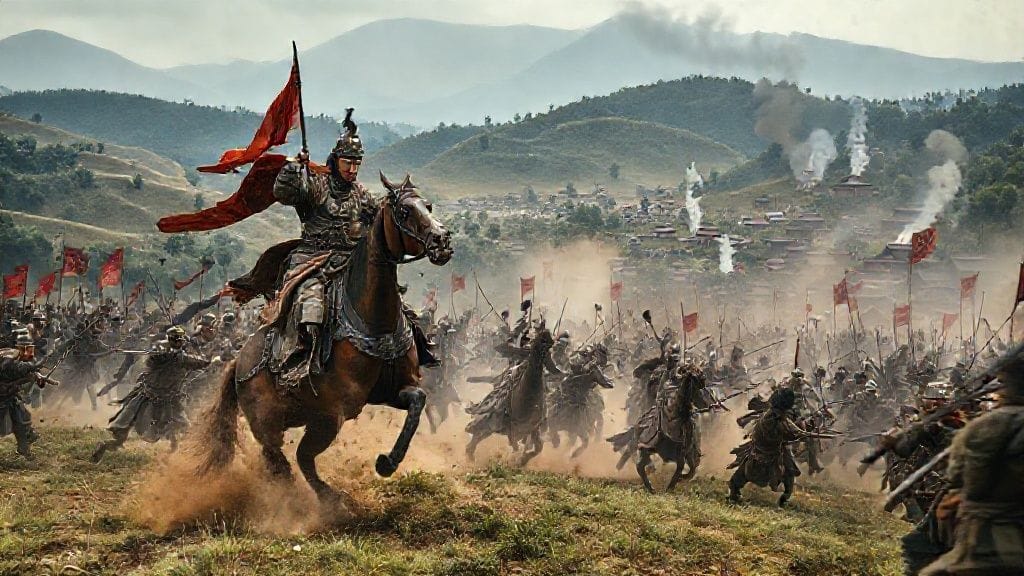
By the 440s, the Britons lived in a world encircled by enemies—or so it felt to those who penned the famous appeal. To the north, beyond the remnants of Hadrian’s Wall, Pictish groups sent raiding parties southward, testing the weakening defenses. Their incursions were not mere isolated cattle raids; they were sustained pressures that eroded stability in the northern provinces, driving refugees and fear before them. To the west, across the Irish Sea, Scotti and other Irish raiders targeted the rich but exposed coasts of western Britain. They carried off slaves, burned isolated settlements, and sometimes established their own power bases on British soil.
From the east came another, increasingly formidable force: the Saxons, along with other Germanic groups such as Angles and Jutes. Initially, they appeared primarily as pirates, skimming along river mouths and estuaries, striking where defenses were weakest. Their shallow-draft ships allowed them to dart in and out of creeks and inlets, leaving charred village remains and shattered communities behind. Over time, these raids evolved into more structured forms of pressure. Some groups settled seasonally, trading or extorting protection money; others forged agreements with local British leaders, offering their swords as mercenaries in exchange for land, loot, or political leverage.
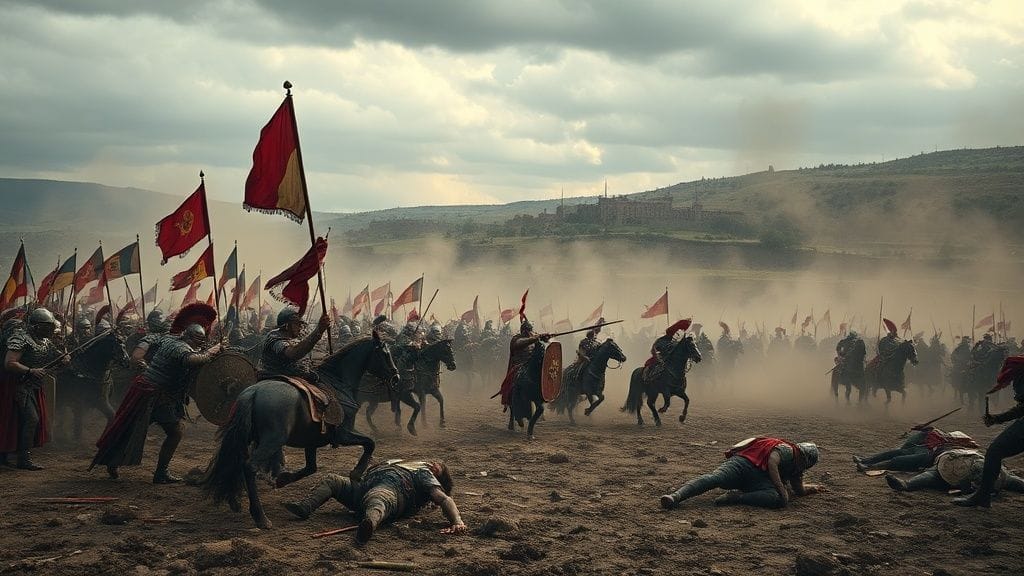
The cumulative effect on the Romano-British psyche was profound. Every coastline became suspect, every mist rising from the sea could conceal hostile sails. The countryside near the shore, once a patchwork of prosperous farms and villas, became a zone of fear. It’s in this context that the words remembered by the sixth-century writer Gildas echo with such force: “The barbarians drive us to the sea, the sea drives us back to the barbarians; between them we are either killed or drowned.” Whether or not these were the exact groans of the Britons sent to Aetius, they capture an emotional truth: the sense of entrapment, of having no escape route left. Surrounded by what seemed like unending waves of “barbarian” assaults, the Romano-British elites looked desperately across the Channel to the one figure who still embodied the military might of a world they understood—Flavius Aetius.
The Making of a Plea: Who Spoke the Groans of the Britons?
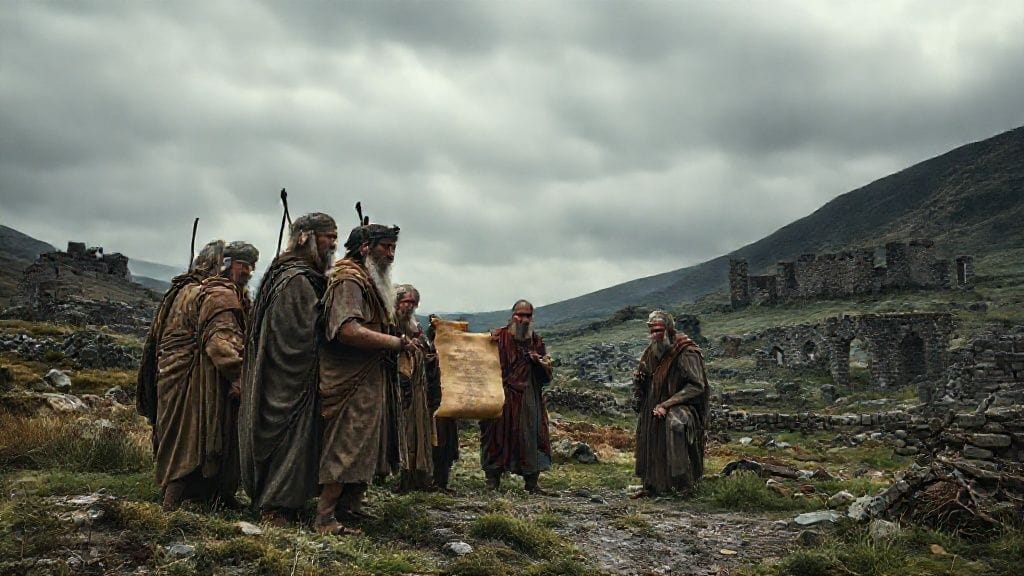
The letter of 446 was not a spontaneous cry from a single throat; it was a constructed voice, shaped by politics, rhetoric, and the urgency of a frightened elite. Who, then, actually authored the groans of the Britons? We do not have the original text, only later recollections by Gildas, writing almost a century later, and then Bede, who drew on Gildas in the eighth century. Both portray the appeal as a last-ditch attempt by British leaders to secure Roman assistance. But behind their stylized Latin and moralizing tone, we can glimpse the probable authors: bishops, former civil officials, and landowning aristocrats who still saw themselves as heirs to Roman civilization.
These men—almost certainly men—would have been educated in the rhetorical traditions of the Empire. They knew how to frame suffering so it demanded attention, how to wrap desperation in the formalities of a petition. The phrase “groans of the Britons” (Gemitus Britannorum) is itself a kind of literary flourish, echoing scriptural language and imperial petition formulas. It suggests a collective cry, but in practice it was likely drafted by a small committee in a provincial council or episcopal gathering. Somewhere, perhaps in a half-decaying basilica or the hall of a fortified villa, they met to decide: do we once more throw ourselves at the mercy of a distant Roman power that has already turned its back on us?
They would have debated wording. How much shame could they bear to admit? How starkly should they describe the ravages of the Saxons and other enemies? Too little, and Aetius might ignore them. Too much, and they risked presenting Britain as a lost cause. The final letter, as remembered, strikes a chilling balance: “The barbarians drive us to the sea…” Here is pathos without surrender, victimhood without complete self-abasement. Their groans of the Britons were designed to move a hardened general across the sea, to stir Roman honor and self-interest. After all, saving Britain was not just a humanitarian act; it could still be framed as restoring an imperial frontier, reasserting order on a familiar map. That, at least, is what the letter’s authors must have hoped as they sealed their message and entrusted it to the dangerous sea-lanes that separated them from Gaul.
Aetius, “Twice Consul”: The Man Who Might Have Saved Britain
When the plea arrived, it was addressed to one of the last great figures of the Western Roman Empire: Flavius Aetius, often called “the last of the Romans.” By 446, Aetius had carved out a towering position amidst the ruin of imperial authority. Born into a family of military officials, he had spent part of his youth as a hostage among the Huns, learning their language and tactics. That intimate knowledge later became his greatest political weapon. In the tumultuous 430s and 440s, he rose through the ranks to become magister militum, the empire’s senior general, the de facto ruler behind the nominal emperor Valentinian III.
Aetius’s world was one of ceaseless crisis management. Visigoths pressed in from southwestern Gaul; Burgundians and Franks maneuvered for territory; Vandals, under the formidable Geiseric, dominated North Africa and threatened Italy’s grain supply with their navy. The Huns themselves, under Attila, were an ever-present specter, allies one day, existential threat the next. Aetius kept this chaotic chessboard in precarious balance through a mix of battlefield skill, ruthless politics, and carefully calibrated alliances. In 446, he would have been fully occupied with the defense of Gaul and the internal politics of a court that both relied on him and feared his power.
To such a man, the groans of the Britons would have been one cry among many. Aetius knew Britain—at least as a place on imperial maps and in older administrative records—but for him, it was a distant frontier that had already half slipped from Roman control. Sending troops there would mean diverting forces from theaters he considered vital, like Gaul and Italy. If Aetius did indeed read the letter, he may have felt a flicker of nostalgia for a more intact empire, perhaps even a sense of obligation. But strategic calculus was unforgiving. As the historian J. N. L. Myres observed in one modern study, “Britain by Aetius’ day was no longer a pivot of policy; it was a liability on the farthest margin of concern.” The man who might have saved Britain, or at least postponed its transformation, had larger fires to fight—and enemies considerably closer to his own doorstep.
A Letter Across a Dying Empire
Imagine the journey of that letter. Somewhere in Britain—perhaps in a stronghold still clinging to Roman administrative norms—a scribe dips his pen into ink and carefully traces elegant Latin characters onto parchment. The words are measured, but behind them lies panic. Once the text is approved by the local council or episcopal gathering, it is rolled, sealed, and entrusted to couriers. They set out toward the coast, riding along roads that Romans had laid centuries before. Some of those roads are now cracked and overgrown; milestones tilt in abandoned stretches; roadside mansiones, once lively rest houses, stand half deserted.
At the shore, the couriers must find a captain willing to brave the crossing. The Channel is not a mere inconvenience—it is a zone of risk. Saxon raiders prowl these waters, and storms can blow up without warning. The ship that carries the groans of the Britons may also be carrying wool, hides, or even desperate migrants seeking safety on the continent. As it sets sail, it moves through a maritime landscape altered by decades of insecurity. Lighthouses, once maintained by imperial funds, may now be dark. Coastal watch posts, if they still function, are manned by local forces with limited coordination.
Upon landing in Gaul, the letter enters another troubled world. Roman administration there is still stronger than in Britain, but it, too, is fraying. The couriers must navigate a patchwork of Roman-held territories, semi-independent barbarian settlements, and zones of active warfare. Reaching Aetius or his representatives requires not just persistence but also the favor of local officials and commanders who might otherwise ignore provincial pleas. By the time the letter arrives at the general’s headquarters—perhaps in northern Gaul, where he spent much of his career—the ink on its surface could already be smudged by salt air and handling. Its words, however, remain sharp: a distillation of years of fear, a final bet on the residual power of Roman solidarity. But this was only the beginning of the letter’s true journey, which would not end with a military expedition, but with silence—and, later, with the bitter pen of Gildas.
“The Groans of the Britons”: Reconstructing the Famous Cry for Help
The exact wording of the groans of the Britons has not survived, but its remembered essence comes to us through the sixth-century cleric Gildas in his work De Excidio et Conquestu Britanniae (“On the Ruin and Conquest of Britain”). He recounts that the Britons sent a desperate appeal to “Agitius, thrice consul”—almost certainly Aetius—declaring in summary: “The barbarians drive us to the sea, the sea drives us back to the barbarians; between them we are either killed or drowned.” It is a line that sounds almost theatrical in its symmetry, yet therein lies its power. It compresses geography, politics, and human fear into a single image: a trapped people, pinned between invaders and the unforgiving sea.
Modern historians debate how literally we should take Gildas’s account. Some argue that he is paraphrasing, shaping the letter to fit his own moralistic narrative about sin and divine punishment; others suggest that he may preserve at least a kernel of the original phrasing. Either way, the phrase “groans of the Britons” has come to stand in for the appeal itself, a shorthand for a whole cascade of suffering. It appears multiple times in modern scholarship precisely because it captures not only an event but an atmosphere. When we speak of the groans of the Britons today, we are invoking both a historical petition and a broader emotional climate: the cry of a society that feels abandoned by its protectors and encircled by relentless threats.
It’s astonishing, isn’t it, how a single sentence can bear so much interpretive weight? Scholars mine it for clues about the scale of barbarian incursions, the organization of British leadership, and the persistence of Roman identities in a world already slipping into the early Middle Ages. Some see in it evidence that British elites still imagined themselves part of a Roman orbit, appealing not to a neighboring king but to a Roman general whose legitimacy derived from imperial structures. Others note its resemblance to biblical lamentation, suggesting that Christian bishops may have played a central role in drafting it. One modern historian, Michael Kulikowski, has pointed out that the very act of writing such an appeal in Latin, and sending it in formal diplomatic fashion, indicates a high degree of continuity with late Roman political culture, even on the very eve of its disintegration in Britain.
Life Under Siege: Ordinary People in Extraordinary Times
While letters and chronicles preserve the voices of elites, the groans of the Britons were also the unrecorded sobs and curses of countless ordinary people living through the crisis. On small farms inland from the vulnerable coasts, families listened for distant shouts that might signal raiders. Some built stockades around their homes; others took to sleeping in wooded hideouts during times of heightened threat. Children grew up learning not the proud myths of Rome’s conquests, but practical lore about when to flee, what food to store, how to hide valuables from plunderers.
In towns, those who remained behind the walls carried a different burden. Urban life had always been a marker of Roman identity: streets laid in geometric patterns, forums where officials spoke, temples and churches punctuating the skyline. Now, that urban fabric was fraying. Local councils faced impossible decisions about taxation, defense, and charity. How do you maintain public baths or repair bridges when your tax base is eroding and your young men are needed for ad hoc militias? The morale of townspeople must have oscillated wildly between defiant solidarity and a crippling sense of abandonment. Markets might still operate, but every unfamiliar face carried the scent of potential threat; every rumor from the countryside could send shivers through the crowd.
Women, in particular, bore a heavy share of the unseen suffering. Raids were not just about theft and killing; they produced widows, orphans, and captives. Irish raiders carried away boys and girls to lives of slavery across the sea—a fate later immortalized in the story of Saint Patrick, himself a Romano-British youth taken into captivity in Ireland in the early fifth century. Others were left to keep farms running in the absence of husbands and fathers. Churches and monasteries, where they existed, became both sanctuaries and targets, offering solace but not always safety. When we repeat the phrase groans of the Britons, we must remember these lives too: the unnamed majority whose anguish never made it into the elegant Latin of surviving texts.
Faith Amid Ruins: Bishops, Monasteries, and the Spiritual Crisis
Christianity had taken root deeply in Roman Britain by the fourth century. Councils of British bishops attended gatherings on the continent; inscriptions and church remains attest to a vibrant, if regionally varied, Christian culture. By the time of the 446 appeal, bishops were among the most educated and influential figures left in many communities. They presided over liturgies that framed current disasters in biblical terms: plagues of barbarians as punishments for sin, the withdrawal of Roman power as a divine test, the groans of the Britons as a kind of collective penitential psalm.
In their sermons, some might have urged repentance more than resistance, seeing in the chaos a fulfillment of scriptural warnings about pride and moral decay. Others likely took a more pragmatic approach, using church networks to coordinate relief, mediate disputes between local warlords, or negotiate with raiders. Monasteries, still in relatively early stages of development in Britain, played roles as both spiritual retreats and logistical hubs. Their storehouses, scriptoria, and fields needed protection—but they also could provide refuge to displaced populations, at least for a time.
This religious dimension is crucial to understanding how the crisis was remembered. Gildas, writing about a century later, framed the entire history of late Roman and post-Roman Britain as a morality tale. In his telling, the groans of the Britons were not just a political petition; they were a belated confession of sin, followed by an even greater fall into wickedness once the immediate threat was temporarily checked. His narrative is harsh, often bitter, depicting British leaders as corrupt, foolish, and spiritually blind. While modern historians treat Gildas with caution, his work preserves the sense of spiritual anguish that accompanied political collapse. The loss of Roman order was not only a matter of soldiers and taxes; it also felt, to many, like a loss of divine favor, a withdrawal of providential protection that left the island exposed not just to barbarians, but to existential doubt.
Politics in the Vacuum: Tyrants, Warlords, and Romano-British Elites
Power abhors a vacuum, and in the decades leading up to 446, Britain’s political landscape became increasingly fragmented. Without a clear imperial chain of command, local leaders stepped forward—or were pushed—to take up authority. Some bore Roman titles, perhaps even claimed to act as “kings” or “tyrants” in a quasi-imperial mode. Others were simply strongmen whose power rested on access to armed followers and control over fertile land or strategic sites. These figures often emerged from existing Romano-British aristocracies, owners of large estates who converted economic clout into military and political dominance.
Conflicts among these elites further weakened the island’s ability to respond collectively to external threats. Instead of uniting against Picts, Irish raiders, or Saxons, rival leaders sometimes used foreign warriors as tools in internal power struggles. Later tradition, preserved via Gildas and Bede, suggests that British rulers invited Saxon mercenaries, led by chieftains like Hengist and Horsa, to serve as federate troops against northern enemies. Whether or not the details are accurate, the pattern is familiar from elsewhere in the late Roman world: barbarian groups settled as allies (foederati), paid in land or rations, expected to defend a region but often pursuing their own interests.
In such a climate, the decision to send the groans of the Britons to Aetius can be seen as a rare moment of attempted unity. Enough leaders, at least in some core territories, agreed that an external savior was necessary. Yet even this act contained an implicit confession of failure: they could not resolve their internal divisions, could not muster sufficient local force, and could not build a stable political order on their own. The letter to Aetius was therefore both a diplomatic document and a mirror, in which the fractures of British society were faintly visible between the polished lines of formal Latin. It was a last appeal to an imperial principle of order that was already dissolving elsewhere.
Why No Help Came: Rome’s Own Battle for Survival
When modern readers encounter the story of the groans of the Britons, a natural reaction is moral outrage: how could Rome, which had ruled Britain for centuries, simply ignore such a desperate plea? The answer lies not in a single act of callousness, but in the brutal arithmetic of imperial decline. By the mid-440s, the Western Empire was fighting for its own survival on multiple fronts. North Africa, the breadbasket of Rome, had fallen to the Vandals; the Visigoths were entrenched in southwestern Gaul; Burgundians and Franks carved out their own spheres of influence. The imperial tax base was shrinking, armies were increasingly made up of federate troops with questionable loyalty, and internal court intrigues constantly threatened to topple leading figures like Aetius.
In this context, Britain looked less like a partner and more like a distant, expensive problem. Sending a substantial force there would have meant stripping troops from Gaul or Italy, inviting disaster closer to the imperial heart. Even if Aetius felt personal sympathy for the Britons or nostalgia for the days when Britain was a reliable province, his strategic calculations would have been relentless. The empire could not be everywhere at once. Some territories, hard as it was to admit, had to be sacrificed if others were to be held. Britain was on the far side of a dangerous sea, offering little economic return compared to its cost in soldiers and ships.
Moreover, the very fact that the Britons had to frame their appeal in such desperate terms may have undermined their case. A land so overrun by enemies might be judged a lost cause, beyond reasonable rescue. If Aetius did respond at all, it left no trace in surviving records. Silence, rather than a neat conclusion, is what history hands us. The groans of the Britons echo in that silence, a plea that disappears into the noise of a dying empire’s final struggles. Within just a few decades, Aetius himself would fall—assassinated in 454 by the very emperor he had served—and Rome’s ability to project organized military power would shrivel further. In a grim sense, Britain’s fate was a preview of Rome’s own.
From Plea to Catastrophe: Saxon Federates and the Turn to War
The failure of the 446 appeal did not end British attempts to manage their crisis; it forced them onto a more dangerous path. Deprived of imperial support, British rulers intensified their reliance on Saxon and other Germanic federates. In theory, this system offered a solution: hire fierce, sea-hardened warriors to protect coasts and frontiers, pay them in land or supplies, and keep them under the loose oversight of Romanized elites. In practice, it planted the seeds of a new order that would eventually eclipse Romano-British authority altogether.
Gildas describes, in bitter tones, how these federates turned from allies to oppressors when their “stipends” were reduced or withheld. They demanded more land, more resources, more political leverage. When their demands were not met—or when ambitious warlords on both sides saw opportunity in conflict—violence erupted on a new scale. Settlements burned, not only under the assault of external raiders, but in civil wars that blurred the line between barbarian and Briton. Some British leaders fought ferociously, achieving local victories that later rumor would inflate into legendary battles. Others fled westward or northward, seeking refuge in less ravaged regions or even across the sea.
From these convulsions emerged the earliest foundations of what would become Anglo-Saxon England. Saxon and Angle leaders carved out footholds along the eastern and southeastern coasts, establishing power bases that would, over the next century and a half, expand into recognizable kingdoms: Kent, Sussex, Wessex, East Anglia, and beyond. For Romano-British society, this process felt like catastrophe: the loss of lands, the erosion of Latin literacy in many regions, the collapse of old civic structures. Yet it was not instantaneous. For decades, mixed communities persisted, cultural exchange occurred, and some Romano-British elites may even have accommodated themselves to new Germanic overlords. Nevertheless, when we trace the line back to 446, we can see how the unanswered groans of the Britons accelerate this trajectory from crisis management to transformational conflict.
Memory, Legend, and the Birth of Arthurian Echoes
Out of the smoke and trauma of the fifth century arose not only ruins, but stories. As generations passed, the raw memories of raids, battles, and appeals to distant generals were reshaped into legend. Local victories by Romano-British leaders against Saxon forces, whatever their exact details, formed the kernel of later tales about a heroic warlord who held back the tide of barbarian conquest: Arthur. Historically, the figure is contested—some scholars see him as a composite, others doubt his existence entirely. But culturally, he came to embody the last glimmer of resistance after events like the groans of the Britons had gone unanswered.
In Welsh and later Latin sources, the memory of a time when Britain was once Roman, Christian, and united under a valiant defender persists like a haunting refrain. It is no coincidence that many Arthurian stories are suffused with a sense of loss: Camelot’s glory destined to fade, the Round Table destined to break. This is the emotional legacy of the fifth century’s crises. The despair embedded in the appeals to Aetius, the sense of betrayal when help did not come, the fragmenting of the island into warring kingdoms—all of these currents flow into later literature, even when the specific names and dates are forgotten.
In this way, the groans of the Britons live on not only in сух historical chronicles, but in the imaginative fabric of medieval Britain and beyond. Every retelling of the fall of Camelot, every lament for a once-unified kingdom now lost, carries an echo of that earlier lament sent across the sea. The transformation of trauma into legend may have offered some consolation: where history was unbearable, story could transmute defeat into tragic nobility. Yet even in legend, the shadow of abandonment remains. Arthur, like Aetius, cannot ultimately save Britain from its destiny of fragmentation.
Archaeology of Desperation: Tracing the Crisis in the Soil
Because textual sources for fifth-century Britain are so sparse, archaeologists have played a crucial role in reconstructing the world behind the groans of the Britons. In fields, beneath modern towns, and along ancient roads, they have found material evidence that speaks in its own quiet register. Abandoned villas tell of elite families who could no longer maintain grand rural residences; some show signs of hasty fortification, as if owners tried to turn refined country homes into makeshift fortresses. Urban excavations reveal layers of burning and hurried repair in certain towns, while others show gradual decay rather than sudden destruction.
In eastern Britain especially, the archaeological record begins to show a shift in material culture during and after the mid-fifth century: the appearance of Germanic-style pottery, brooches, weaponry, and burial practices. Grubenhäuser (sunken-featured buildings), characteristic of early Anglo-Saxon settlements, start to dot the landscape, sometimes near or even atop former Roman sites. Cemetery evidence reveals changing fashions in dress and grave goods, indicating new identities taking root. Yet, intriguingly, there are also signs of continuity: some sites show a blending of Roman and Germanic styles, suggesting that the transition was not a simple replacement but a complex, regionally varied process.
Even in seemingly small finds, the crisis leaves its imprint. Hoards of coins and valuables buried in the early fifth century, never recovered by their owners, hint at moments of sudden flight or anticipated danger. Defensive ditches and hilltop enclosures, often modified from older Iron Age fortifications, testify to communities seeking high, defensible ground once more. Through these traces, the groans of the Britons become tangible—not only words in a late antique letter, but patterns of disrupted lives inscribed in earth and stone. As one modern archaeologist observed in reference to this period, “The landscape itself becomes a document of fear and adaptation.”
Historians, Sources, and the Problem of a Single Cry
For all its evocative power, the story of the groans of the Britons rests on fragile foundations. Our main narrative source, Gildas, wrote roughly a century after the events he describes. His purpose was not to produce a neutral chronicle, but to deliver a fiery sermon condemning the sins of his contemporaries by recounting the disasters of the past. Bede, writing in the eighth century, drew heavily on Gildas and reframed the narrative from an Anglo-Saxon Christian perspective. No official imperial record of the 446 appeal survives, nor any British document contemporary with the letter itself.
This paucity of sources has led historians into lively debate. Some question whether the letter to Aetius occurred precisely as Gildas reports, or whether he compressed several appeals into one symbolic episode. Others ask how representative the groans of the Britons were of the entire island: was it only certain regions, perhaps in the east, that sent the plea, while more remote or resilient areas charted their own course? The lack of corroborating continental testimony is striking, though not decisive; after all, many provincial events in this chaotic era went unrecorded by official scribes preoccupied with nearer threats.
Yet despite these uncertainties, most scholars agree that some form of desperate appeal did reach Aetius, anchored in a real context of escalating barbarian pressure and internal instability. The episode has become a focal point not only because of what it tells us about 446, but because it encapsulates the broader dynamics of late Roman collapse. As historian Peter Heather notes in one of his studies, the groans of the Britons serve as “a synecdoche for the whole experience of peripheral provinces abandoned by a center that could no longer sustain them.” The very dominance of this one story in our accounts of late Roman Britain is itself a reminder of how much has been lost, how many other cries—written, spoken, or merely thought—have vanished from the record.
Long-Term Consequences: From Roman Britain to Anglo-Saxon England
When we step back from the immediate drama of 446 and the unheeded letter, a longer arc comes into view. In the centuries that followed, the contours of Britain changed so profoundly that the island which had once petitioned Aetius became almost unrecognizable. Latin, once the language of administration and high culture, receded. In the east and south, Germanic dialects took root and evolved into Old English. Roman civic life dissolved into a mosaic of kingdoms—Kent, Northumbria, Mercia, Wessex—each with its own power struggles and alliances. Christian institutions, though battered, persisted and eventually helped to shape new identities, both in the surviving Brittonic-speaking regions and among the converted Anglo-Saxons.
The groans of the Britons thus stand near the hinge of British history. They mark one of the last moments when Romano-British elites could still imagine salvation coming in the form of Roman legions sailing over the horizon. After their plea was ignored, the psychological break deepened. Future solutions would be local, not imperial; alliances would be forged with nearby warlords, not distant generals. Over time, memories of Roman rule would fade into legends of a golden age, sometimes idealized, sometimes demonized, but always distant. The very people who had once cried out for Roman aid would be remembered by their descendants as half-legendary ancestors, their language transformed into Welsh, Cornish, Breton.
And yet, in a paradoxical way, the legacy of Rome endured through the very processes that followed its political withdrawal. The new Anglo-Saxon polities adopted aspects of Roman Christianity, Roman law, and Roman notions of kingship, transmitted through the church and through contact with the surviving Eastern Roman (Byzantine) world via the papacy. When Bede wrote his Ecclesiastical History of the English People in the eighth century, he used Roman chronology, cited Roman authors, and framed the story of the English church as part of a broader, Latinate Christian civilization. The groans of the Britons belonged to a prehistory that he did not fully share, but the very language in which he remembered them was a legacy of the empire whose aid had failed to arrive.
Conclusion
The episode known as the groans of the Britons is, on one level, a simple story: a desperate letter sent in 446 from a troubled island to a powerful Roman general, asking for military assistance that never came. Yet when examined closely, it unfolds into a rich tapestry of human experiences and historical forces. It illuminates the slow unravelling of Roman authority in Britain, the escalating pressures from Picts, Irish raiders, and Saxons, and the internal fragmentation that left Romano-British society vulnerable. Behind the formal Latin of the appeal stand bishops, aristocrats, soldiers, peasants, slaves, and refugees—all caught in the crosscurrents of a collapsing world.
The groans of the Britons also challenge us to think about the nature of imperial responsibility and abandonment. Aetius’s silence was not just a personal failure or a bureaucratic oversight; it was the audible crack of an overextended system reaching its breaking point. As Rome prioritized closer, more defensible regions, peripheral provinces like Britain slipped from the imperial grasp, their fates relegated to the margins of contemporary attention and later historiography. In the gap between expectation and reality, between the hope of legions and the arrival of Saxon federates, new identities began to gestate: Brittonic kingdoms in the west, Anglo-Saxon realms in the east, and the mythic memory of a once-unified Britain struggling for its life.
Ultimately, the power of this episode lies not in precise dates or names, but in its emotional and symbolic resonance. It speaks of a people who still believed, even in their darkest hour, that words could bridge seas and summon help from distant centers of power. It speaks of how those words—those groans of the Britons—can survive in altered form, echoing through centuries of chronicles, archaeology, and legend. And it reminds us that behind every turning point in history stands a chorus of voices, many lost, some faintly heard, all testifying to the costs of change when old orders die and new worlds are painfully born.
FAQs
- What were the “groans of the Britons”?
The “groans of the Britons” refers to a desperate appeal sent around 446 by Romano-British leaders to the Roman general Flavius Aetius, asking for military help against Picts, Irish raiders, and Saxons. The original text is lost, but a later writer, Gildas, paraphrased it as a lament that the Britons were trapped between the barbarians and the sea, facing death either way. - Who was Aetius, and why did the Britons appeal to him?
Flavius Aetius was the most powerful military commander in the Western Roman Empire in the mid-fifth century, often called “the last of the Romans.” The Britons appealed to him because, in a world where formal imperial authority in Britain had collapsed, he was one of the few remaining figures who might still command the resources to rescue a beleaguered province. - Did Rome send troops to help Britain after the appeal?
There is no evidence that Aetius or the Western Roman government sent significant military aid to Britain in response to the 446 letter. Most historians believe the appeal went effectively unanswered, largely because the empire was overstretched and preoccupied with more urgent threats closer to its core territories. - How do we know about the groans of the Britons if the original letter is lost?
Our knowledge comes mainly from the sixth-century cleric Gildas, who wrote a work called On the Ruin and Conquest of Britain. He summarized and interpreted the appeal as part of a moral narrative about the sins and punishments of his people. The eighth-century historian Bede later repeated and adapted Gildas’s account in his own history. - What role did Saxons play in the crisis described in the letter?
The Saxons and related Germanic groups initially appeared as raiders along Britain’s coasts, then increasingly as hired federate troops employed by Romano-British leaders to defend the island. Over time, tensions grew, and these federates turned into powerful rivals, carving out their own territories and laying the foundations for later Anglo-Saxon kingdoms. - How did ordinary people experience this period of crisis?
Ordinary Britons faced raids, displacement, and economic disruption. Many fled from vulnerable coastal areas, fortified farms or hilltops, or sought refuge in towns and religious centers. Families were separated through slavery and war, livelihoods were destroyed, and traditional patterns of life were upended by insecurity and political fragmentation. - Is there a connection between the groans of the Britons and King Arthur?
Indirectly, yes. The political and military turmoil of the fifth and early sixth centuries, including the failure of Roman aid and subsequent wars with Saxons, formed the backdrop for later stories of a Romano-British war leader who resisted Germanic advances. While the historical existence of Arthur is debated, the legends reflect the same era of struggle that produced the famous plea to Aetius. - What does archaeology tell us about this period in Britain?
Archaeological evidence shows abandoned villas, fortified sites, changing burial practices, and the gradual appearance of Germanic material culture, especially in eastern Britain. These finds support the picture of economic decline, social restructuring, and the emergence of new, mixed communities during and after the mid-fifth century. - Why is the episode significant for understanding the fall of the Western Roman Empire?
The groans of the Britons exemplify how peripheral provinces were gradually abandoned as the empire struggled to defend its core territories. The episode highlights the limits of imperial power, the reliance on barbarian federates, and the transition from Roman provincial structures to localized, post-Roman polities—patterns visible elsewhere in the Western Empire’s collapse. - Did Roman culture completely disappear from Britain after 446?
No. While formal imperial administration and the legions vanished, aspects of Roman culture persisted: Christianity, some legal and social practices, Latin learning in certain regions, and urban traditions in a few surviving centers. Over time, these elements blended with Brittonic and Anglo-Saxon cultures, helping to shape the complex identities of early medieval Britain.
External Resource
Internal Link
Other Resources
- Encyclopaedia Britannica – general search for the exact subject
- Google Scholar – academic search for the exact subject
- Internet Archive – digital library search for the exact subject