Table of Contents
- A Coastline on Edge: Frisia Before the Storm
- From Carolingian Frontier to Viking Target
- Roric of Dorestad: A Viking Between Two Worlds
- Dorestad, Jewel of the North Sea Trade
- The Year 854: A Tide of Violence and Opportunity
- Roric of Dorestad Defends Frisia: The Pact of Necessity
- Shields Along the Marshes: Organizing Frisian Defense
- Barges, Longships, and Tidal Traps: Warfare on the Frisian Waters
- Fear in the Villages, Gold in the Counting Houses
- Bishops, Counts, and Kings: The Politics Behind the Defense
- Between Cross and Hammer: Religion in a Frontier Society
- Roric’s Reputation: Defender or Occupier?
- The Aftermath of 854: A Brief Calm on a Restless Sea
- From Frontier Crisis to North Sea Order
- Memory, Chronicle, and Legend: How Roric Was Remembered
- Why This Forgotten Defense Still Matters Today
- Conclusion
- FAQs
- External Resource
- Internal Link
Article Summary: In the middle of the ninth century, the Frisian coasts of the North Sea were caught between the waning power of the Carolingian Empire and the rising fury of Viking raiders. In 854, a remarkable and paradoxical moment occurred when the Viking warlord Roric of Dorestad, long both a raider and a ruler, turned from plunderer to protector and defended Frisia against other Vikings. This article traces the unstable world that produced such an arrangement, following how roric of dorestade defends frisia became a turning point in the region’s history. Through politics, faith, commerce, and fear, we watch Frisians, Franks, and Norsemen improvise a fragile order along a drowning coastline. The narrative explores daily life under threat, the strategies used to resist seaborne attacks, and the bitter compromises needed to keep trade alive. It also examines how chroniclers wrote about this episode, sometimes with suspicion, sometimes with grudging admiration. By the end, the article shows that this obscure frontier defense illuminates a larger transformation of Europe’s shores from open raiding grounds into defended states.
A Coastline on Edge: Frisia Before the Storm
Long before the year 854 etched itself into the fragile memory of medieval Frisia, the coastline between the mouths of the Rhine, Meuse, and Ems was already a land of risk and opportunity. The Frisians had always lived in a state of poised tension, their villages clinging to earthen mounds above the flood line, their lives tuned to the rhythm of tides and storms. Salt marshes stretched inland, broken by sluggish rivers and treacherous sandbanks; behind them, damp meadows and sparse woodlands sheltered small communities accustomed to rebuilding what the sea repeatedly tried to claim. It was a landscape whose greatest strength—its access to water—was also its deepest vulnerability.
In the early ninth century, this littoral fringe was no backwater, but part of a bustling North Sea world. Merchant ships from Britain, Scandinavia, and the Frankish realms rode the estuaries, bringing furs, slaves, wine, glassware, and cloth to trading centers like Dorestad. To outsiders, Frisia appeared as a ribbon of wealth threaded along the shore, its harbors like gleaming beads held precariously together by custom and royal charters. Yet the very openness that made Frisia rich—its easy access points, its broad waterways, its hospitable inlets—also made it extraordinarily exposed. Any sails on the horizon might belong to welcome traders… or to raiders.
Even before roric of dorestade defends frisia became more than a distant possibility, the people of this region knew that nothing was permanent. Every winter brought the risk of storm surges that could break dikes and drown cattle; every spring promised both new trade and new fear as longships began to move with the ice-free seas. In farmsteads where Latin prayers mingled awkwardly with older, half-remembered pagan charms, families whispered about churches burned on distant coasts and monasteries stripped of their relics. The news traveled as slowly as the river currents, but by the mid-800s, Frisians could no longer pretend that Viking violence was merely someone else’s distant misfortune.
The Carolingian rulers who claimed overlordship of Frisia were far away, usually occupied with their own civil wars, dynastic intrigues, and border conflicts. At court in Aachen or Compiègne, Frisia was a line in a charter, an entry in a tax record, a disputed benefice between counts and bishops. On the ground it was something else entirely: a frontier where royal power arrived mainly in the form of tax demands and occasional armies, not stable protection. So the Frisian coastal communities lived in a perpetual in-between, their fate tied to an empire that often seemed too distant and too divided to care.
This was the world that would soon call on a man like Roric, a wandering Viking leader who had taken root in Frankish lands. It’s astonishing, isn’t it, that a people so shaped by the sea would one day entrust their defense against Vikings to a Viking himself? Yet to understand why roric of dorestade defends frisia in 854 mattered and even made sense, we must first understand how the political fabric of this coast began to fray under the pressure of both internal weakness and external assault.
From Carolingian Frontier to Viking Target
In the first half of the ninth century, the Carolingian Empire stretched from the Atlantic to the Elbe, an impressive patchwork of kingdoms theoretically bound together under the heirs of Charlemagne. Frisia lay at the northern edge of this realm, a vital but vulnerable frontier. Charlemagne himself had claimed the region through campaigns against the Saxons and Frisians, imposing new bishops, monasteries, and counts to anchor his rule. But by 814, when Charlemagne died, the structures he had built began to loosen. His successors divided the empire, fought bitterly with one another, and struggled to project consistent power to the periphery.
The North Sea littoral, and especially Frisia, felt these fractures immediately. Dorestad, the great emporium on the lower Rhine, was a symbol of imperial triumph and economic integration. Yet its success made it a beacon for trouble. With each Carolingian family quarrel, the royal gaze turned inward, leaving places like Dorestad to fend for themselves. After the Treaty of Verdun in 843 divided the empire into three main kingdoms—East, West, and Middle Francia—Frisia became tied to the middle kingdom of Lothar I, and then to his son Lothar II. That middle strip, running from Italy to the North Sea, was rich but stretched thin, more a road between powers than a cohesive state. It was within this fragile political setting that Viking fleets discovered opportunity.
From the 830s onward, Viking attacks had become a grim feature of life in the Frankish world. First they came as seasonal raiders: swift descents on monasteries like Noirmoutier or on river ports unprepared for war. Then they began to overwinter, establishing fortified camps on islands and riverbanks so that they could raid at will. The North Sea became not just a highway of trade but a battlefield. The lower Rhine and its estuaries, with their easy access into the heart of the Frankish realms, attracted special attention. Dorestad, Hedeby, Quentovic—these were the jewels that glinted in the eyes of Scandinavian warbands.
Contemporary annals, like the Annals of Fulda and the Annals of St. Bertin, lamented the inability of Frankish rulers to respond consistently to this new kind of threat. Sometimes they raised armies, fought back, and bought short-lived peace. Other times they negotiated with Viking leaders, granting them land and tribute in exchange for their promise—always fragile—to defend the coast and abstain from further raids. It was a desperate, improvisational politics, one in which rulers who could not expel the Vikings tried instead to harness them.
Frisia, as a frontier zone, was central to this improvisation. Its harbors were staging points; its rivers were invasion routes; its people stood between the raiders and the imperial heartlands. Crowned heads in distant palaces began to see that they might rather have a single, semi-loyal Viking strongman controlling this region than a swarm of independent raiders ravaging it at will. In this context emerged the figure of Roric, a Scandinavian leader who battered Frankish shores and then, astonishingly, became a Frankish vassal.
By the time roric of dorestade defends frisia in 854, the pattern was familiar: the empire made peace not through strength alone, but through accommodation. Yet behind the formal acts of vassalage and land grants lay uneasy questions: Could a man who had once burned churches truly safeguard them? Could a ruler born in the north defend a Christian frontier he had once helped imperil? These were the stakes when the empire turned, out of both pragmatism and necessity, to a Viking lord to stabilize its most exposed northern shore.
Roric of Dorestad: A Viking Between Two Worlds
Roric—often rendered as Rorik or Hrørek in Scandinavian fashion—was not a minor chieftain. He stood within the tangled web of Danish royal politics, a claimant and competitor in the conflicts that shook Scandinavia in the early ninth century. We cannot reconstruct his biography with the precision of a modern dossier, but scattered references in Frankish chronicles suggest a man of ambition, resilience, and considerable military following. He proved himself capable of negotiating not only with kings on the battlefield but with rulers in their halls.
It appears that Roric first emerged in Frankish sources around the 840s, leading raids along the coasts and rivers that so tormented the empire. His fleets, like those of many of his peers, tested defenses and probed for weakness. Each burned port and plundered monastery hammered home a harsh lesson: the Carolingians could not be everywhere at once, and their centralized model of lordship struggled to adapt to quick, amphibious warbands. But Roric was no mere opportunist. He watched, learned, and understood that wealth and power could flow not only from raiding but also from ruling.
Over time, he began to shift from predator to partner. Frankish rulers, desperate to secure their frontiers, offered him a place within the imperial order. He was granted lands—first in what is now the Low Countries, then more firmly in Frisia—on the condition that he recognize the authority of the Frankish king and commit to defend the region against other raiders. There is deep irony in the arrangement: one Viking was made responsible for keeping other Vikings at bay. Yet for Roric, the deal was shrewd. Instead of unreliable spoils acquired at sword’s edge, he gained recognized lordship, stable revenues, and the legitimacy that came from acting as a royal vassal.
This is where Dorestad enters the story not only as a place but as part of Roric’s very identity. Known to the sources as “Roric of Dorestad,” he became inseparable from the region he governed. To Frankish eyes, his new role was clear: he was a buffer, a shield of sorts, translating Viking ferocity into controlled protection. The fact that roric of dorestade defends frisia could be spoken without obvious contradiction captures the strange political alchemy of the time. A man who might once have approached Frisia with a fleet of plunderers now approached it as its appointed guardian.
We do not know with certainty whether Roric embraced Christianity fully or merely tolerated it. Some scholars argue he was baptized, as so many Viking leaders were when it suited their interests. Others remain cautious, noting that the sources emphasize his political status more than his faith. Yet whether he prayed to Christ or to the old gods—or to both, hedging his bets—his rule represented a kind of bridge between worlds. In his hall, Frisian notables, Frankish envoys, and Scandinavian captains might all have met, each speaking their own tongue but bound by the shared grammar of power, profit, and fear.
Roric’s presence in Dorestad also had a psychological dimension. For local merchants and peasants who remembered the terror of raids, seeing a Viking lord in charge could not have been simple. Was he protector, conqueror, or something in between? Did they sleep more easily or less? The chronicles are largely silent on local sentiment, but we can guess at the mixture of relief and unease. A dangerous man had been placed between them and their enemies; but could anyone be sure where his loyalties would lie when the sails of another fleet darkened the horizon?
Dorestad, Jewel of the North Sea Trade
To grasp why Roric’s role mattered so profoundly, we must linger in Dorestad itself, the bustling town whose name he carried. Located near the modern Dutch village of Wijk bij Duurstede, at a strategic bend of the Rhine where various branches met, Dorestad was one of the great commercial hubs of the Carolingian world. Archaeology has revealed long rows of wooden warehouses, wharfs jutting into the water, and traces of imported goods from across Europe. Coin finds show that kings minted large volumes of silver here, stamping their authority into the very currency that moved along the trade routes.
In the early ninth century, Dorestad buzzed with activity. Frisians brought wool, salt, and livestock; traders from the Rhineland pressed wine and glass into the stream of commerce; Scandinavian merchants arrived with furs, walrus ivory, and slaves; English and Irish traders came with linen and fine metalwork. Languages mingled in the air: Old Frisian, Frankish, Old Norse, Latin, perhaps even Celtic tongues. It was a marketplace of goods and information, a place where a rumor born in York might reach Cologne within a few weeks, carried along by barges and pack animals.
The profits were enormous, but so were the dangers. A port so rich could not be ignored by pirates. Dorestad’s defenses were never designed with large-scale Viking warfare in mind. It lay inland enough to feel somewhat insulated from coastal raids, yet close enough to the sea that longships could reach it with surprising speed. As the decades passed and Viking raids intensified, Dorestad increasingly found itself in the crosshairs. Already in the 830s and 840s, the town suffered attacks and disruptions. Trade could not flourish under constant fear; ships stayed away when rumors spoke of fleets in the estuaries.
The Carolingian monarchy recognized this vulnerability. Dorestad was not just any town; it was a financial artery pumping wealth into royal treasuries. To lose it—or even to see its revenues sharply fall—was to weaken the entire regime. When internal conflicts among Charlemagne’s heirs swallowed royal attention, Dorestad paid the price. Counts appointed to defend the region might be loyal but lacked the naval resources and constant presence needed to ward off raiders who could appear and disappear with the tides.
In this context, granting Dorestad and its surrounding territories to Roric was radical but intelligible. Who better to deter Viking fleets than a Viking lord with his own ships and warband? If roric of dorestade defends frisia successfully, then Dorestad might remain a functioning pivot of trade instead of a recurring scene of ash and ruin. The town thus became the setting of a wider experiment: could Viking power, once channeled, become not only less destructive but even protective of Christian commerce?
The answer in 854 seemed, for a time, to be yes. Under Roric’s ward, Dorestad’s wharfs likely regained some of their former hustle, though perhaps always under the shadow of his authority. Merchants may have calculated that paying dues to a Viking count was still better than seeing their warehouses burned. The town, in other words, survived by adapting to a world where the line between raider and ruler had blurred almost beyond recognition.
The Year 854: A Tide of Violence and Opportunity
The mid-850s were not calm years in the Frankish realms. Civil strife among the descendants of Louis the Pious continued to weaken royal authority, and Viking activity showed no sign of ebbing. Fleets raided both the Atlantic and North Sea coasts, pressed up river systems like the Seine, Loire, and Rhine, and sometimes penetrated far inland to strike at rich monasteries and urban centers. In 845, a famous Viking raid had even sacked Paris, prompting dramatic ransoms. By 854, a grim pattern had been set: coastal communities could no longer treat attacks as occasional shocks—they were a constant risk.
Frisia, sitting astride estuaries that led to the imperial interior, was a natural target. The sources are sparse for the exact sequence of raids around 854, but we can reconstruct an atmosphere thick with rumor: shipmasters whispering of new Viking bands gathering in the Danish straits; monks copying charters with one eye on the rising smoke along the horizon; royal envoys riding north with urgent instructions to frontier lords like Roric. Perhaps in Roric’s hall, scouts brought word of fleets sighted off the islands, or of armed gatherings among rival Scandinavian leaders tempted by the riches of the Frisian coast.
For Roric, each such report was a test. He knew the Viking world intimately—its rivalries, its codes of honor, its unpredictable swings between alliance and betrayal. Men he might once have fought beside could now appear as enemies, their longships slicing through the same waters he had promised to defend. To fail in his duty would risk not only his own lands but also the fragile trust of his Frankish overlords. To succeed would mean proving that a man raised in the raiding culture of the north could become the firm bulwark of a Christian frontier.
In 854, that test came into sharp focus. Viking threats against Frisia escalated, and the chroniclers later remembered that Roric “defended Frisia against the Northmen,” a phrase that at once clarifies and mystifies. It implies coordinated action, mobilization, perhaps even pitched battle. Yet it also reflects the chroniclers’ own sense of astonishment at the spectacle of Viking fighting Viking in defense of Christian lands. Roric’s intervention was not a small skirmish; it was an event significant enough to be noticed and recorded in annals that typically reserved their lines for kings and earthquakes.
The moment had a symbolic weight beyond the battlefield. When roric of dorestade defends frisia, he demonstrated that the old simple dichotomy—Viking versus Christian, raider versus victim—no longer captured reality. Power in the 850s North Sea was more fluid than that. Vikings could be mercenaries, allies, rulers, and, when it suited them, protectors of the very communities they had once terrorized. The defense of 854 condensed into a single episode the broader transformation underway along Europe’s northern shores.
Roric of Dorestad Defends Frisia: The Pact of Necessity
The defense of Frisia in 854 did not arise from idealism; it was born of necessity. Roric’s interests and those of his Frisian and Frankish neighbors had become intertwined. If rival Vikings sacked the coast, Dorestad’s trade would falter, revenues would drop, and the Frankish king might well question the value of maintaining Roric’s privileges. Conversely, if Roric could repel the attackers, he would prove his worth both as a warlord and as a political partner. This convergence of motives made action not just desirable, but essential.
The sources give us only the outline, but we can fill it with plausible detail without violating what they tell us. Roric would have called his men to arms—the hardened warriors who formed his household troop, plus local militias obligated by custom and command. From the upland farms came Frisians armed with spears, axes, and whatever armor they could muster; from Roric’s own Scandinavian following came experienced fighters used to shipboard combat. Though they came from different traditions, they had a shared goal: drive off the invading fleet before it could break the coastline’s fragile defenses.
We can imagine messengers riding swiftly along the dike lines and river paths, carrying urgent words to church centers and local chiefs: “The count commands every able man to the estuaries. The Northmen are coming.” Fear sharpened obedience. In churches from which the bells had once tolled only for feasts and funerals, clergy now prayed for deliverance, chanting psalms that likened the sea’s rage to the fury of the enemy. Some chronicler, perhaps years later, would remember those days when roric of dorestade defends frisia as a pivotal stand, though the peasants who trudged to the marshes with their spears might only have thought of their homes and families.
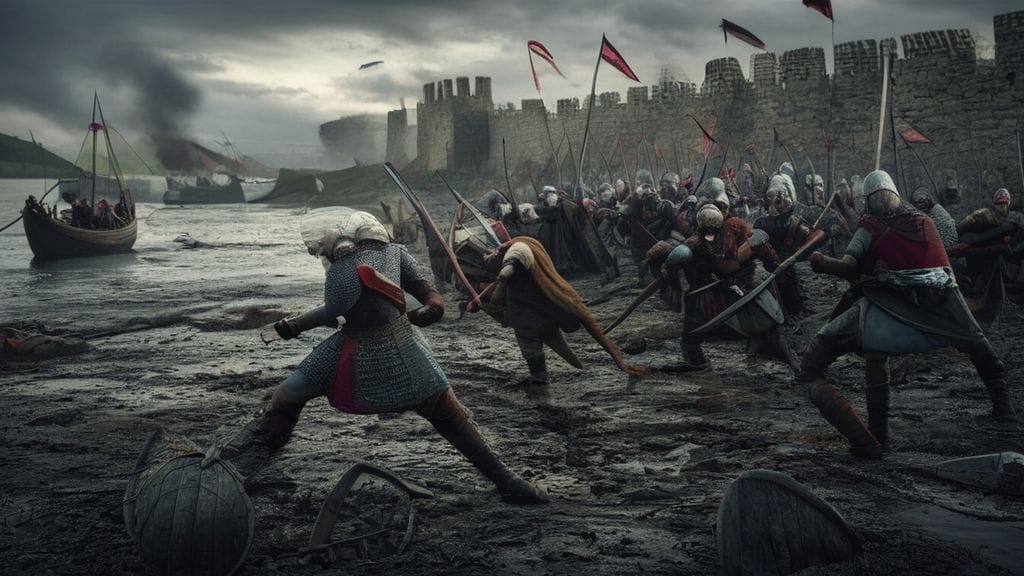
The clash itself almost certainly took place along the water, where narrow channels and sandbanks could be turned to advantage. Roric knew these coasts by then; his scouts would have marked the safest approaches and the most dangerous traps. As the enemy fleet advanced, longships riding light in the tide, Roric’s own vessels may have slid out from concealed inlets, oars creaking, shields glinting along the gunwales. At some signal—an unfurled banner, a blast from a horn—the defenders lunged forward, closing the distance in a sudden spray of foam.
To fight on water was to dance with chaos. Ships grappled together, turning into floating battlefields. Men slipped on wet planks, fell into the chill, dark water in armor that dragged them under. Javelins arced between hulls; arrows rattled on shields; curses in Old Norse mingled with shouted prayers in Latin and Frisian. For those watching from the shoreline—women, children, the elderly—the battle must have felt like a judgment rendered in real time: either the familiar sails of their defender would reappear victorious, or foreign ships would push up the rivers to bring fire and slaughter.
Roric prevailed. Whether through superior numbers, better positioning, or simple luck, he and his allies repelled the attackers. The chronicles tell us that the invaders were driven away from Frisia, their attempt to carve out new plunder thwarted. In the aftermath, wrecked ships may have bobbed in the shallows, and bodies—some in Scandinavian dress, some in Frisian attire—washed ashore together. The sea, indifferent to human allegiance, received them all.
The victory cemented Roric’s role. In a hard, practical sense, roric of dorestade defends frisia meant that the political bargain of granting him authority had worked, at least for that moment. Yet behind the celebrations, questions lingered. Was Roric now too powerful? Had the Carolingians, in saving Frisia from one kind of threat, created another? The pact of necessity had held for a day of battle, but its longer-term implications would unfold slowly, in charter disputes, whispers at court, and future negotiations with other Viking leaders.
Shields Along the Marshes: Organizing Frisian Defense
The defense of 854 was not a single heroic spasm but the visible crest of deeper changes. To make Roric’s stand possible, the defensive organization of Frisia had been gradually reshaped. Where once local communities relied primarily on their own resources, by the mid-ninth century they were increasingly drawn into broader structures of military obligation. The appointment of a powerful frontier lord like Roric was one part of that process; the mobilization of local manpower and resources was another.
Frisian society had long prided itself on a certain autonomy, with free farmers playing a central role in local assemblies and legal traditions. But under the pressure of Viking attacks, these assemblies were forced to confront harsher realities: dike maintenance alone could no longer suffice as the main shared obligation; now there was also the need to build watch-posts, support garrisons, and contribute men to coastal patrols. Villages might have been required to maintain small fleets of river craft, ready to respond to alarms and carry fighters to threatened points along the shore.
Roric, as count and protector, would have stood at the apex of this system, but its real strength lay in those anonymous men who shouldered spears and stood in the mud. They were the ones who patrolled the marshes, who watched the horizon for strange sails, who listened for the distant echo of oars. Their world became one of constant low-level mobilization. Even during times of apparent peace, rumor could turn a fishing boat on the horizon into a feared raiding party until proven otherwise.
This environment reshaped daily life. Men could not wander far from home during the campaigning season without risking being absent when called. Women bore more of the burden of managing farms and households in their absence. Children grew up with stories not only of storms and saints, but also of the day roric of dorestade defends frisia and of the dangers that still lurked beyond the horizon. Churches became both spiritual refuges and logistical hubs, storing provisions that could support defenders or refugees in times of need.
Defensive architecture, too, evolved. While massive stone fortresses were still rare in this marshy land, earthworks grew higher, timber palisades thicker. Some trading sites may have ringed themselves with ditches and ramparts, designed to at least slow attackers long enough for help to arrive. Harbor towns experimented with chains or barriers across river mouths, crude but potentially effective measures to prevent enemy ships from sailing straight into their hearts. All this required coordination, which in turn increased the importance of figures like Roric who could compel cooperation across what had once been fiercely independent communities.
Barges, Longships, and Tidal Traps: Warfare on the Frisian Waters
To modern eyes, it is easy to imagine Viking warfare as a matter of dramatic land battles and burning halls. But in Frisia, the real battlefield was water. Rivers, channels, and tidal flats formed an intricate, shifting labyrinth in which skilled pilots could outmaneuver larger forces. In such a setting, the technical and tactical details of naval warfare mattered immensely.
Viking longships were brilliantly adapted to these conditions. Light, flexible, and shallow-drafted, they could slip over sandbars that would ground heavier vessels. Their crews could haul them over small stretches of land to bypass obstacles or to move between waterways. For many years, this mobility had given raiders a decisive edge, allowing them to appear where they were least expected and vanish where no conventional fleet could follow. But by 854, defenders like Roric had learned—and borrowed—these techniques.
Frisian river barges, while traditionally slower and more focused on cargo, could be modified for war: fitted with more oars, equipped with makeshift shields along the sides, and stocked with javelins and bows. Combined forces of local barges and Roric’s longships created hybrid fleets suited both to holding positions in tricky channels and to launching sudden counterattacks. Tidal knowledge became a weapon: defenders timed their movements to catch attackers at low tide, when unfamiliar sandbanks could trap them, or used the rising water to escape ambushes.
A battle in such waters was as much about navigation as about swordplay. A single misjudged turn could send a ship grounding on a bar, pinned in place while enemies closed in. Commanders like Roric needed not only courage but intimate knowledge of every inlet and shoal. That knowledge was precious, passed down from generations of fishermen and pilots. In relying on Roric, the Frisians and Franks wagered that he had learned their coasts well enough to turn them into an ally.
The defense in 854 must be understood in this technical context. When roric of dorestade defends frisia, he did so not only as a warrior but also as a strategist of waters. His success suggested that the advantage had shifted at least somewhat away from raiders towards those willing to invest in sustained control of the seascape. Nevertheless, every victory was provisional. The sea itself changed—channels shifted, sandbanks moved—forcing defenders to constantly update their knowledge and adapt their methods. Warfare along the Frisian coast was thus a continuous negotiation with nature as well as with human foes.
Fear in the Villages, Gold in the Counting Houses
Wars and raids are often told from the perspective of rulers and warriors, but their most enduring impact is felt in the quiet corners of everyday life. In ninth-century Frisia, peasants, craftsmen, and small traders lived within a tension that the victory of 854 could only partially ease. They were grateful, no doubt, that roric of dorestade defends frisia had not failed, that their homes had not been burned that year. Yet they also knew that the threat remained, just beyond the horizon.
In the villages, fear took practical forms. Families cached small valuables in hidden pits or wooden chests buried under barns; women kept an eye on river paths while tending animals; children grew up alert to the subtle signs of disturbance in the daily pattern of waves and wind. Weddings and baptisms might be scheduled around the seasons least likely to bring raids, as if joy itself had to be carefully timed. The toll of anxiety on body and mind cannot be easily measured, but it must have been immense.
At the same time, the great trading towns carried on their business. In Dorestad’s counting houses, merchants calculated risks and profits with a cold eye. The presence of a strongman like Roric offered a kind of rough insurance. As long as he held the coast, ships dared to sail, warehouses stayed stocked, and coins clinked on wooden tables. Some merchants might even have profited from the chaos, buying goods cheap in panicked markets and selling them dear once security returned. For them, the fact that roric of dorestade defends frisia successfully meant more than safety; it meant the continuation of their commercial world.
The church occupied an ambivalent position between these two spheres. Bishops and abbots owned estates, collected rents, and sometimes traded, aligning their interests with economic stability. But they also carried pastoral responsibility for people traumatized by decades of raids. Sermons likely interpreted the Viking threat as divine punishment for sins—an explanation that tried to impose meaning on senseless violence. After Roric’s victory, clergy may have preached sermons of gratitude, weaving his deeds into a providential narrative: God, they might say, had used even a former enemy to protect his flock.
And yet behind the religious language lay unvarnished calculation. Church leaders knew they needed secular protectors. If the cost of survival was to accept a Viking lord as count, many were ready to pay it. The moral discomfort of such a compromise was easier to live with than the very real prospect of having one’s monastery burned to the ground.
Bishops, Counts, and Kings: The Politics Behind the Defense
The story of 854 is also a story of politics woven through charters, embassies, and quiet negotiations in royal halls. Behind the image of Roric standing on a riverbank, watching his ships engage an enemy fleet, stood kings such as Lothar I and Lothar II, bishops charged with guarding both souls and lands, and rival counts who eyed Roric’s growing power with suspicion. The defense of Frisia was both a military event and a chapter in the ongoing struggle to define authority in a fracturing empire.
For the Carolingian monarchs, alliances with Viking lords were two-edged swords. Roric was valuable precisely because he was dangerous. As long as he remained a loyal vassal, he could hold a crucial frontier and keep trade flowing. But any sign of defection—or even of excessive independence—could transform him from asset to threat. Royal charters granting him lands likely included careful wording about his obligations, his right to hold courts, and his duty to defend the king’s interests. Each legal phrase was both promise and warning.
Churchmen, too, had stakes in this arrangement. Bishops in Utrecht and other sees along the Rhine-Flemish frontier sought protection for their dioceses and monasteries. Some may have initially opposed granting power to a man of Viking origin, fearing for the safety of their churches and relics. Yet once Roric demonstrated his willingness to defend Christian lands, the stance could soften, if only pragmatically. One can imagine a bishop writing to court, cautiously endorsing the policy: “Since roric of dorestade defends frisia with vigor, let us thank God who can turn the hearts of the fierce to the service of peace.”
Local Frankish counts, however, might have seen the matter differently. To them, Roric’s elevation was a threat to their own influence. They had been raised within a system that imagined authority in Frankish hands; to see a foreign warlord occupy the role of count infringed upon both their honor and their expectations of succession. It is not hard to imagine quiet intrigue, letters sent to the king complaining of Roric’s arrogance or hinting that he was not truly trustworthy. In the labyrinth of Carolingian high politics, such murmurs could be as dangerous as any Viking raid.
Thus the victory of 854, while helpful to the king in the short term, may also have intensified long-term tensions. The more effectively Roric defended Frisia, the more indispensable he became—and the more unsettling his presence was to those who preferred a purely Frankish aristocracy. Power, once shared, is not easily reclaimed. The chronicler’s short noting that roric of dorestade defends frisia conceals behind it a whole web of rivalries and reluctant accommodations.
Between Cross and Hammer: Religion in a Frontier Society
Religion in ninth-century Frisia was less a static landscape of beliefs than a dynamic frontier of competing symbols and practices. Officially, the region had been Christian for generations. Charlemagne’s campaigns had imposed baptism, and bishops were installed to shepherd the converted. Yet in the remote villages along the coast, old customs persisted. The sea and storms still inspired a fear that older gods might have once claimed; charms and rituals that predated Christianity likely continued beneath a thin veneer of church teaching.
Into this religious mosaic stepped Roric, a man whose original faith was almost certainly Scandinavian paganism. Whether he formally embraced Christianity, we cannot know for sure, though it would have been politically advantageous for him to at least profess some loyalty to the Christian God. In any case, his presence introduced a new layer of religious complexity. A ruler who might secretly honor Odin and Thor now defended churches dedicated to saints like Willibrord and Boniface, missionaries who themselves had once come north to convert Frisians.
For local priests and monks, this must have posed both a challenge and an opportunity. On one hand, it might have been tempting to present Roric’s military success as evidence of God’s favor—a narrative that could be used to encourage further Christianization among Scandinavian followers. On the other hand, too close an embrace of a Viking lord risked confusing the faithful, who might wonder how firmly the line between Christian and pagan truly stood. Still, necessity overrode scruple. If roric of dorestade defends frisia, then, some clergy judged, perhaps he was an instrument chosen by Providence, however unlikely.
The people, for their part, probably navigated these complexities pragmatically. A farmer whose fields lay within sight of a small wooden church might cross himself in times of storm and yet retain ancestral gestures of appeasement toward the waters. Hearing that a pagan-born warrior had saved their village from pillage, they might adopt a flexible attitude: if the Christian God had allowed this, perhaps even guided it, then maybe the world was larger and stranger than their catechism alone suggested. Frontier societies often breed such religious elasticity, blending formal doctrine with lived necessity.
Meanwhile, Viking followers of Roric who came from the far north would have encountered Christian rituals more intensely than they might have back home. Bells marked time; crosses crowned hillocks; processions moved along dikes. Some would resist, clinging fiercely to their ancestral gods; others might be curious, intrigued, or calculating. Conversion, when it came, was often a matter of alliances and marriages as much as faith. In this way, the defense of 854 was also part of a slow, uneven process by which the religious landscape of the North Sea world shifted, absorbing what had once seemed utterly foreign.
Roric’s Reputation: Defender or Occupier?
History rarely grants frontier lords a simple legacy. Roric was no exception. To the Frankish chroniclers who recorded his deeds, he was a problematic yet useful figure, a man whose loyalty could not be assumed but whose military value could not be denied. They wrote of him with a certain guarded respect, recording that roric of dorestade defends frisia without lavishing excessive praise. Their tone suggests relief rather than admiration: the disaster had been averted, but the instrument of salvation was a reminder of imperial weakness.
Among the Frisians themselves, perceptions likely varied. Some, especially merchants and church figures in Dorestad and other centers, may have seen Roric as a necessary protector. He kept the rivers open, discouraged roving raiders, and brought stability to a region constantly under threat. For these people, Roric’s longships became familiar guardians rather than sources of terror. The fact that he had once been a raider might fade in the face of present security and economic survival.
Others may have resented him deeply. Free farmers forced to provide labor, ships, or provisions for his campaigns could see him as yet another overlord taking from them in the name of distant kings. Old stories of Viking brutality would not vanish overnight. To them, the claim that roric of dorestade defends frisia might ring hollow or ironic: yes, he defended the coast, but he also extracted his due in rents, tolls, and obedience. Occupation and protection are often two sides of the same coin.
Later generations of historians have inherited this ambiguity. Some emphasize Roric as a proto-princely figure, an early example of how Scandinavian power began to settle and institutionalize along the North Sea littoral. Others stress the continuing violence of the Viking age and caution against romanticizing figures like him. They point out that his loyalty to the Frankish realm was always contingent, and that he could as easily have turned against it if circumstances changed.
Still, the fact that his defense of Frisia in 854 is remembered at all suggests that, for a moment, his interests aligned with those of the people he ruled. In that alignment, fragile though it was, lay a glimpse of a future in which former raiders would become counts, dukes, even kings—figures like Rollo in Normandy or the Danish kings of England. Roric’s career anticipated those later developments, standing as an early, unstable version of a pattern that would reshape Europe’s political and cultural map.
The Aftermath of 854: A Brief Calm on a Restless Sea
After the repelled raids of 854, the Frisian coast enjoyed at least a temporary reprieve. Chronicles do not note major disasters immediately following, suggesting that Roric’s stand had bought some measure of peace. Trade likely picked up again; ships that had sought safer harbors might have returned; builders and farmers resumed the seemingly endless tasks of repair and preparation. Yet everyone must have known that the calm could not last forever.
The Viking Age, after all, was not a single wave but a series of surges. Even as roric of dorestade defends frisia effectively in 854, other fleets were active on other coasts, probing for weak points from Ireland to the Iberian Peninsula. News of successes and failures traveled along the same routes as trade. A raiding party turned back in Frisia might decide to try its luck on the Seine; a fleet bloodied in Frankish waters might veer toward England instead. The sea carried danger as impartially as it carried goods.
Within Frisia, the victory likely strengthened Roric’s hand. Success in battle was the currency of legitimacy in this world. For Viking followers, their leader had proven himself once more; for Frisians and Franks, he had demonstrated that the bargain struck with him was not in vain. Yet increased prestige could breed anxiety. Kings wary of powerful vassals might begin to consider how to limit Roric’s influence, perhaps by gradually curbing his rights or balancing him with other lords. The aftershocks of 854 thus played out as much in court politics as on the water.
At a more human level, the memory of the clash would linger. Survivors would revisit the battlefield in their minds during long winter evenings, telling and retelling the story of how the enemy’s ships turned back, how a friend fell, how a son returned home alive. The children who had watched the smoke on the horizon would become adults who knew in their bones that fortune could turn quickly. Even with Roric’s success, they could not assume that their grandchildren would live free of fear.
From Frontier Crisis to North Sea Order
When we look back at 854 from a broader historical vantage point, we see it not as an isolated incident but as part of a transitional era. The ninth century was a long crisis, but embedded within it were the seeds of a new order in the North Sea world. The very fact that roric of dorestade defends frisia as a recognized count under Frankish overlordship shows that the older model of occasional raiding and fluid chieftaincies was beginning to give way to more stable forms of power.
Over the following centuries, this trend would become unmistakable. Scandinavian leaders increasingly sought not only booty but also land, titles, and recognized rulership. In Normandy, Rollo and his successors established a principality that combined Norse vigor with Frankish administrative forms. In England, Danish kings would sit on the throne itself, ruling through a fusion of their own customs with Anglo-Saxon institutions. In the eastern Baltic, Norse adventurers laid the foundations of Kievan Rus’, blending with Slavic populations and Byzantine influences.
Frisia’s experience in the 850s can thus be seen as an early laboratory of this transformation. The experiment was messy, full of half-measures and compromises, but its logic was clear: better to have one powerful, semi-integrated Viking lord defending a region than a swarm of independent raiders endlessly attacking it. The outcome was never guaranteed; the risks were stark. But the success in 854 provided evidence that such arrangements could work, at least under favorable conditions.
Over time, as the Carolingian Empire fragmented further and regional powers rose, the North Sea littoral would see the gradual emergence of more defined polities, with stronger coastal defenses, more regular taxation, and tighter control over trade routes. The Viking Age did not end because the Scandinavians suddenly became less fierce; it ended because both they and their neighbors found more profitable and stable ways to channel power. Roric’s dual role as former raider and present defender epitomizes this shift.
Memory, Chronicle, and Legend: How Roric Was Remembered
Our knowledge of Roric and the events of 854 comes mainly from terse entries in Latin annals, written by monks whose priorities were salvation history and dynastic politics, not full biographies of frontier counts. The Annals of St. Bertin and related texts give us glimpses: acknowledgments that roric of dorestade defends frisia, notes of charters and negotiations, hints at his changing fortunes. They write of him as a marginal yet telling figure in the great drama of the Carolingians’ struggle with the Northmen.
Yet beyond the written record, there must have been oral stories: Frisian tales of the day a Viking lord stood between their homes and the sea; Scandinavian sagas or fragments thereof, now lost, that perhaps mentioned a chieftain who found riches not only in raiding but also in ruling foreign lands. Legend loves paradox, and Roric’s life offered plenty. It is easy to imagine a fireside storyteller describing the moment when men on both sides of a battle spoke the same language and worshiped different gods, or perhaps even the same gods in secret, while flying different banners.
Later medieval traditions in the Low Countries would focus more on saints, local dynasties, and the slow conquest of land from the sea. Figures like Roric faded into the background, overshadowed by more firmly Christian and more fully “local” heroes. Only with the rise of modern historical scholarship, and the careful reading of annals, charters, and archaeological evidence, did he re-emerge as a significant figure in understanding the early medieval North Sea world.
Modern historians debate details—whether we should see Roric primarily as a tool of Carolingian policy or as an independent actor deftly exploiting Frankish weakness—but they generally agree on his importance as a bridge figure. As one twentieth-century historian put it, “Rorik of Dorestad represents the moment when the Viking ceases to be merely a wave upon the shore and begins to carve his name upon the land.” That insight captures why a relatively obscure event like the defense of Frisia in 854 deserves attention: it illuminates a turning point, when patterns of violence and power were quietly being rewritten.
Why This Forgotten Defense Still Matters Today
In a world saturated with grand battles and famous conquests, it might be tempting to dismiss the episode in which roric of dorestade defends frisia as a historical footnote. Yet it speaks directly to themes that continue to resonate: the fragility of frontiers, the uneasy alliances forged in times of crisis, and the ways in which outsiders can become protectors—or be seen as such—without ever fully shedding their foreignness.
Modern coastal regions grappling with piracy, migration, and geopolitical competition might recognize elements of their own dilemmas in ninth-century Frisia. Rulers then, as now, had to decide whether to confront threats purely by force or to make deals with powerful non-state actors, hoping to turn enemies into guardians. The story of Roric shows both the possibilities and perils of such strategies. His successful defense in 854 brought real security, but at the cost of embedding a figure with ambiguous loyalties at the heart of a vulnerable region.
Moreover, the episode reminds us that historical categories—“Viking,” “Christian,” “Frisian,” “Frank”—were never as rigid as later narratives sometimes suggest. Identities were negotiated in practice: through oaths sworn, lands granted, battles fought, and marriages made. A Viking chieftain could become a Christian count; a pagan warrior could defend churches; a coastal villager could fear and rely upon the same man in almost equal measure. Such complexity resists the neat moral dichotomies that often dominate popular retellings of the Viking Age.
Finally, reflecting on 854 challenges us to consider how communities remember and forget. The Frisians who lived under Roric’s rule surely knew that their survival had, at a crucial moment, depended on him. Yet their descendants allowed his name to sink into partial obscurity, overshadowed by other, more convenient stories. In recovering episodes like this, historians do more than fill gaps in a timeline; they restore to view the thorny, improvised nature of the past, in which security was always provisional and heroes were often ambivalent figures.
Conclusion
The defense of Frisia in 854, when Roric of Dorestad stood against his fellow Northmen, was at once a local event and a window onto a wider transformation of the medieval North. Along a vulnerable coastline of marshes and estuaries, where Frisians had long lived with the twin dangers of storm and raid, a new kind of arrangement emerged: a former raider became the region’s shield. In the terse words of the annals, roric of dorestade defends frisia; behind those words lie the mobilization of villages, the maneuvering of fleets, the prayers of monks, the calculations of merchants, and the uneasy acceptance of a Viking as lord.
Politically, the episode revealed both the weakness and adaptability of the Carolingian order. Unable to expel the Vikings outright, Frankish rulers instead tried to harness their power, embedding them in the frontier as counts and protectors. Socially, it drew ordinary Frisians into larger military and economic systems, reshaping daily life around the constant possibility of attack. Religiously, it blurred boundaries, placing churches under the guard of a man whose own faith was, at best, in transition. And culturally, it anticipated the broader shift from a world of seasonal raiders to one of settled principalities and kingdoms along the North Sea.
Today, the marshes have been diked, the estuaries re-engineered, and the fears that haunted ninth-century Frisia feel distant. Yet the underlying questions endure: how do communities on the edge respond to persistent threats? Whom do they trust when traditional protectors fail? How do they live with the consequences of bargains made under duress? By looking closely at this forgotten frontier, we see not merely an anecdote of the Viking Age, but a chapter in the enduring story of how societies balance survival, legitimacy, and memory along the fluid borders where land meets sea.
FAQs
- Who was Roric of Dorestad?
Roric of Dorestad was a ninth-century Viking leader of likely Danish royal background who became a Frankish vassal and count in the Frisian region. Granted authority over key trading centers such as Dorestad, he was tasked with defending the coast and river routes against other Viking raiders, a role he notably fulfilled in 854 when he repelled attacks on Frisia. - What happened in Frisia in 854?
In 854, Viking forces threatened the Frisian coastline and its vital trading hubs. Roric, then acting as count and frontier lord, organized a defense using his own Scandinavian warband and local Frisian contingents. Contemporary annals report that he successfully drove off the attackers, preserving the region from major devastation that year. - Why would a Viking defend Frisia from other Vikings?
By 854, Roric had been integrated into the Carolingian political system as a vassal who held land and authority in return for military service. His economic and political interests were tied to the safety of Dorestad and surrounding territories. Defending Frisia protected his revenues, upheld his agreement with the Frankish king, and strengthened his own prestige among both Frisians and fellow Scandinavians. - How reliable are the sources about Roric and the defense of 854?
The main evidence comes from Latin annals such as the Annals of St. Bertin, which briefly mention Roric’s grants and his actions against other Northmen. These are terse and written from a Frankish clerical perspective, so they do not provide detailed narratives. However, when combined with charters and archaeological findings from places like Dorestad, they give a credible framework for understanding his role. - Was Roric of Dorestad a Christian?
It is not absolutely certain. Many Viking leaders who entered into formal relationships with Christian rulers were baptized, at least nominally, to cement alliances. Some scholars believe Roric likely underwent such a conversion, while others stress that the sources focus more on his political and military functions than on his personal faith. In any case, he operated in a heavily Christian environment and defended Christian communities. - How did Roric’s rule affect ordinary Frisians?
Roric’s presence brought both protection and new obligations. On the positive side, his defenses helped deter raids and allowed trade to continue, which supported local economies. On the negative side, Frisians had to contribute men, ships, and supplies to his military efforts, and accept a foreign-born lord as their count. For many, he embodied both security and subordination. - What made Dorestad so important in this story?
Dorestad was one of the major trading centers of the Carolingian Empire, located on the lower Rhine. Its wealth and strategic position made it a prime target for Viking raiders and a crucial asset for the Frankish kings. Roric’s control of Dorestad and his defense of the surrounding region were key reasons the crown tolerated and supported his unusual position as a Viking count. - Did Roric’s defense end Viking raids in the region?
No, his success in 854 did not end Viking activity in Frisia or the wider Frankish world. It provided a temporary respite and demonstrated that coordinated defense led by a powerful frontier lord could work. However, raids continued in subsequent years, shifting in intensity and location as Viking strategies and political conditions evolved. - How does this episode fit into the broader Viking Age?
Roric’s career illustrates a broader trend in the Viking Age, where Scandinavian leaders moved from seasonal raiding toward more permanent settlement and political integration. Similar patterns occurred in Normandy, England, and eastern Europe. The defense of Frisia in 854 is an early example of a Viking acting as a recognized territorial ruler and protector rather than solely as a raider. - Why is the defense of Frisia in 854 largely unknown today?
The event lacks the dramatic fame of battles like the sack of Paris or the later conquest of England, and the sources describe it only briefly. Over time, local memory shifted toward other heroes and narratives, while Roric remained a somewhat marginal figure in broader European historiography. Only detailed study of the annals and archaeology has restored attention to his pivotal role on the Frisian frontier.
External Resource
Internal Link
Other Resources
- Encyclopaedia Britannica – general search for the exact subject
- Google Scholar – academic search for the exact subject
- Internet Archive – digital library search for the exact subject