Table of Contents
- The Moment of Genius: A Budapest Workshop in 1974
- The Man Behind the Puzzle: Ernő Rubik’s Early Life and Inspirations
- Post-War Hungary: A Backdrop of Innovation and Constraint
- The Birth of the Magic Cube: From Prototype to Patent
- Crafting Complexity: The Ingenious Mechanics of the Rubik's Cube
- Initial Reception: Skepticism and Fascination in Budapest
- Crossing Borders: The Cube’s Journey from Hungary to the World
- The Western Explosion: Rubik's Cube’s Rise in the 1980s Pop Culture
- Speedcubing and the Science of Solving the Cube
- The Cube as Educational Tool: Geometry, Algorithms, and Beyond
- Rubik’s Cube and Cold War Symbolism: East Meets West on a Puzzle
- Economic Impact: Licensing, Manufacturing, and the Puzzle Industry Boom
- Variations and Challenges: From 2×2 to 17×17 and Beyond
- Cultural Imprint: Movies, Art, and the Cube in Popular Imagination
- Lifelong Legacy: Ernő Rubik’s Reflections and Ongoing Influence
- The Cube in the Digital Age: Apps, Virtual Solving, and AI
- The Puzzle’s Philosophical and Psychological Dimensions
- Museums and Collections: Preserving the History of Rubik’s Cube
- Anniversary Celebrations and Global Competitions
- Conclusion: Why the Rubik’s Cube Still Fascinates the World
- FAQs on the Invention and Legacy of the Rubik’s Cube
- External Resource
- Internal Link
The Moment of Genius: A Budapest Workshop in 1974
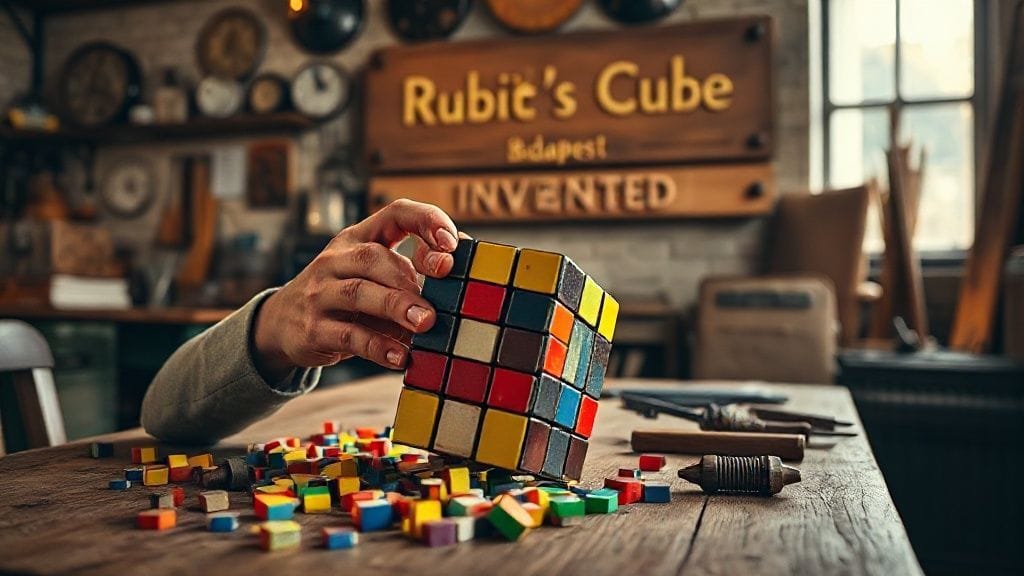
It was a humid summer afternoon in Budapest, 1974. In a modest flat cluttered with wooden models, small tools, and academic papers, Ernő Rubik carefully twisted a curious cube in his hands. Each rotation was slow, deliberate—examining, discovering, challenging. With every twist, the colors blurred and realigned. But this was no ordinary toy or puzzle. It was an invention that would soon captivate millions, challenge the brightest minds, and redefine how we think about complexity and creativity.
As the cube's faceted surfaces clicked into new patterns, Rubik was far from imagining the cultural and intellectual phenomenon that would emerge. Behind those simple movements lay a profound interplay of mathematics, engineering, and art—a mechanical mystery that would become an international icon. The world would come to know this genius as the Rubik’s Cube.
The Man Behind the Puzzle: Ernő Rubik’s Early Life and Inspirations
Born on July 13, 1944, in Budapest amidst the turmoil of war-torn Europe, Ernő Rubik grew up in a household where architecture and design were more than mere professions—they were ways of seeing the world. His father, a furniture designer, and his mother, a poet and journalist, provided an environment pulsating with creativity and discipline.
From an early age, Rubik was fascinated by spatial relationships and three-dimensional structures. His youthful experiments with self-made models and geometric constructions presaged his later work as an architect and university professor. Yet, it was his restless curiosity about how objects move, interlock, and transform that planted the seed for the Magic Cube.
In 1960s Hungary, a country steeped in history yet grappling with Soviet influence and scarce resources, innovation was often a delicate dance between ingenuity and limitation. Rubik’s work mirrored this tension: technical resourcefulness meeting artistic vision.
Post-War Hungary: A Backdrop of Innovation and Constraint
Hungary in the early 1970s was a place of paradoxes. The Iron Curtain constrained intellectual freedom, yet it fostered a unique robustness in scientific and technical education. State-sponsored programs invited innovation but within rigid ideological frameworks.
In this fraught atmosphere, puzzles and games were not merely diversions; they became platforms for intellectual exploration and quietly subversive creativity. Rubik, teaching at the Academy of Applied Arts and Design, understood this dual function implicitly.
His invention emerged not from commercial ambition but from a pedagogical impulse—to help students grasp complex three-dimensional geometry intuitively. This origin story imbued the cube with a sense of playful earnestness, far from the mass-market toy industry.
The Birth of the Magic Cube: From Prototype to Patent
Originally dubbed the "Magic Cube," Rubik’s invention was first a functional teaching tool—designed to demonstrate how parts could move independently yet remain part of a cohesive whole without falling apart. The mechanism was unlike anything seen before—a deceptively simple cube with rotating layers.
The first prototype was painstakingly crafted from wood and plastic segments linked by an intricate, internal pivot system. As Rubik himself described, "I had no idea that I had created a puzzle; I thought it was just a working model of a 3D structure. The challenge was to understand how it moved."
After several months of refinement, Rubik applied for a patent in Hungary in 1975. The state's recognition was cautious but supportive. The cube’s future was uncertain, yet it radiated possibility.
Crafting Complexity: The Ingenious Mechanics of the Rubik’s Cube
What made the Rubik's Cube revolutionary was its internal architecture. Unlike other puzzles with fixed parts, the cube’s pieces moved dynamically on a hidden mechanism beneath the colorful facets. Each of its 26 smaller cubes (or "cubies") rotated around a central core.
This design defied conventional toy manufacturing. It demanded precise engineering—balancing friction, durability, and smooth motion. The brilliance lay in its modularity and symmetry: every face could turn independently without disassembling the cube.
Mathematically, the cube embodies staggering complexity. It has 43 quintillion possible configurations—yet only one correct alignment. This tension between order and chaos invited endless fascination.
Initial Reception: Skepticism and Fascination in Budapest
At first, the Magic Cube was a curiosity within Hungary’s modest design community. Students and colleagues marveled over its mechanical novelty but found it frustratingly difficult to solve.
Rubik himself spent weeks mastering the patterns. The cube was not just a toy but a riddle—one that tested patience and spatial insight.
The state’s utilization of the cube focused on educational settings. Yet, word of this unusual puzzle gradually spread, and visitors to Budapest brought back tales of a "mechanical brain teaser."
Crossing Borders: The Cube’s Journey from Hungary to the World
The real turning point came in the late 1970s when a toy company executive from Ideal Toys, based in the United States, discovered the cube at a toy fair in Nuremberg, Germany. Recognizing its potential, Ideal obtained licensing rights and prepared to launch the product globally.
In 1980, rebranded as the Rubik’s Cube, the puzzle hit Western markets to immediate acclaim. Its timing perfectly aligned with a cultural moment enthusiastic for brainteasers, puzzles, and novel challenges.
Suddenly, a gadget engineered in a Budapest workshop amid Cold War tensions was sweeping the West, symbolizing both universal curiosity and intellectual play.
The Western Explosion: Rubik's Cube’s Rise in the 1980s Pop Culture
The 1980s was the decade of Rubik’s Cube mania. The cube appeared in classrooms, offices, and living rooms worldwide. It became emblematic of a youth culture fascinated by science, mathematics, and the growing possibilities of a digital age.
The puzzle spawned competitions, instruction manuals, and even merchandise—T-shirts, posters, and video games. Its colorful design and mysterious complexity made it almost a cultural totem.
Celebrities, politicians, and scientists openly embraced the cube, further fueling its ascent. Movies and TV shows frequently included references to this iconic cube, reinforcing its presence in collective memory.
Speedcubing and the Science of Solving the Cube
As millions attempted to solve the Rubik’s Cube, a competitive culture arose. Speedcubing, the practice of solving the cube in the shortest time possible, transformed the puzzle from a pastime into a sport.
Early champions began setting records by developing sophisticated algorithms—sequences of moves designed to reduce the cube systematically. This new language of gestures and patterns blurred boundaries between art, sport, and scientific problem-solving.
Today’s world records, broken down to mere seconds, testify to the astounding depth and skill the Rubik’s Cube demands. It is a testament to human dexterity, memory, and calculation.
The Cube as Educational Tool: Geometry, Algorithms, and Beyond
Despite its commercial success, the Rubik’s Cube retained its educational roots. Across the globe, teachers adopted the cube as a practical tool to illustrate concepts of geometry, group theory, combinatorics, and algorithmic thinking.
The tactile experience of the cube complements abstract reasoning. It offers learners a live embodiment of complex mathematics—one that stimulates intuition and curiosity.
Numerous studies have shown how cube-solving can improve spatial skills, concentration, and logical thinking. As such, it became a bridge between play and learning—a rare and precious synergy.
Rubik’s Cube and Cold War Symbolism: East Meets West on a Puzzle
The Rubik’s Cube arrived on the global stage during a tense Cold War era. Manufactured behind the Iron Curtain, it quickly became a symbol of intellectual exchange and cultural connection crossing ideological divides.
In the West, the cube was sometimes caricatured as a quirky product of Eastern engineering. Yet, its universal appeal transcended politics, serving as a quiet reminder that creativity and curiosity knew no borders.
For Hungarians and Eastern Europeans, the cube was a source of pride—a demonstration that innovation was thriving despite political obstacles.
Economic Impact: Licensing, Manufacturing, and the Puzzle Industry Boom
The global success of the Rubik’s Cube revitalized an entire sector of the toy and puzzle industry. Licensing deals, mass production, and international distribution created millions in revenue and jobs.
The cube's success encouraged companies to explore new puzzle designs, variants, and intellectual property. It underscored the economic power of combining mechanical ingenuity with cultural appeal.
Moreover, the Rubik’s Cube contributed to the growth of STEM-related toys and games, anticipating the modern emphasis on educational entertainment.
Variations and Challenges: From 2×2 to 17×17 and Beyond
The original 3×3 cube inspired a whole family of puzzles. Smaller cubes, like the 2×2 “Pocket Cube,” provided accessible entry points for beginners, while larger—and more complex—variants pushed enthusiasts to explore intricate combinations.
Innovators created 4×4, 5×5, and even the colossal 17×17 cubes, each exponentially increasing the challenge. Additional variants incorporated different geometries—pyramids, dodecahedrons, and other polyhedra.
This ecosystem of puzzles illustrates how a single idea can inspire continuous reinvention and global communities of solvers.
Cultural Imprint: Movies, Art, and the Cube in Popular Imagination
Beyond mathematics and play, the Rubik’s Cube has embedded itself in culture. It appears in films as a symbol of genius or complexity, from "The Pursuit of Happyness" to "The Deadpool" movies.
Artists have transformed the cube into canvases, sculptures, and installations. Its colorful facets and cubic geometry invite endless reinterpretations.
Music videos, fashion, and even architecture have drawn inspiration from the cube’s signature pattern, turning it into an icon of intellectual creativity and aesthetic beauty.
Lifelong Legacy: Ernő Rubik’s Reflections and Ongoing Influence
Now well into his eighth decade, Ernő Rubik reflects humbly on his invention: “I created the cube for myself and my students. Never did I imagine it would become a global phenomenon.”
Beyond the fame and fortune, Rubik sees his creation as a testament to human curiosity and the joy of discovery. He continues to engage with educational initiatives, promoting STEM learning worldwide.
His legacy is not only the cube but the inspiration it ignites in each puzzler who dares to twist its facets.
The Cube in the Digital Age: Apps, Virtual Solving, and AI
With the rise of smartphones and computers, the Rubik’s Cube entered a new realm. Digital simulations replicate the cube’s challenges, offering tutorials, competitions, and analytics.
Artificial intelligence algorithms can solve the cube in fractions of a second—astonishing feats that deepen our understanding of problem-solving and machine learning.
Virtual reality and augmented reality have enabled immersive cube experiences, further blurring boundaries between the physical and digital worlds.
The Puzzle’s Philosophical and Psychological Dimensions
Why does the Rubik’s Cube fascinate so deeply? Philosophers and psychologists suggest it embodies the human condition: the struggle to impose order on chaos, the allure of patterns, and the satisfaction of mastery.
It’s a metaphor for life’s puzzles—complex, multifaceted, yet solvable through perseverance and insight. This resonance explains its lasting emotional power.
Its solving process encourages mindfulness, patience, and resilience—qualities as vital in our chaotic modern world as in 1970s Budapest.
Museums and Collections: Preserving the History of Rubik’s Cube
Recognizing its cultural significance, several museums have curated exhibitions dedicated to the cube’s history, from Budapest’s House of Houdini to the National Museum of Mathematics in New York.
Collectors prize early prototypes, rare editions, and signed cubes. These artifacts testify to the puzzle’s place at the crossroads of art, science, and popular culture.
Such preservation efforts ensure that future generations appreciate the cube beyond entertainment—as a milestone in human creativity.
Anniversary Celebrations and Global Competitions
Each milestone anniversary of the Rubik’s Cube sparks worldwide celebrations. International Rubik’s Cube Day, held every July 13th, honors Ernő’s birthday with competitions, workshops, and exhibits.
The World Cube Association organizes official speedcubing contests in dozens of countries, uniting a global community of enthusiasts.
These events celebrate not only competition but camaraderie, exchange, and shared passion—a vibrant testament to the cube’s universal appeal.
Conclusion: Why the Rubik’s Cube Still Fascinates the World
Fifty years after its invention, the Rubik’s Cube remains a shining emblem of human creativity and perseverance. It is more than a toy; it is a challenge to think differently, to embrace complexity, and to find order in seeming chaos.
In a world often fragmented and fast-moving, the cube invites us to slow down, to experiment, and to delight in discovery. Its colorful facets reflect not only patterns of plastic squares but facets of our collective imagination and intellect.
Ernő Rubik’s invention isn’t just a puzzle on a shelf; it’s a continuing story about curiosity, resilience, and the magic hidden in simplicity.
FAQs on the Invention and Legacy of the Rubik’s Cube
Q1: What inspired Ernő Rubik to invent the Rubik’s Cube?
Rubik was motivated by a desire to help his students visualize and understand three-dimensional geometry, creating a mechanical model to explore spatial relationships.
Q2: How did the Rubik’s Cube become popular outside Hungary?
After Ideal Toys licensed the patent in the late 1970s, it was introduced to Western markets in 1980. Its novelty and challenge captured global attention, sparking widespread fascination.
Q3: Why is the Rubik’s Cube mechanically unique?
Unlike traditional puzzles, its internal pivot mechanism allows each face to rotate independently without the cube falling apart, enabling over 43 quintillion possible configurations.
Q4: What impact did the Rubik’s Cube have on education?
It became a tool for teaching mathematical concepts such as algorithms, group theory, and spatial reasoning, improving students’ problem-solving skills worldwide.
Q5: How does the Rubik’s Cube reflect Cold War-era tensions?
Invented behind the Iron Curtain but celebrated worldwide, it symbolized East-West cultural exchange and revealed the universality of intellectual curiosity despite political divides.
Q6: What are some modern developments related to the Rubik’s Cube?
The cube has inspired digital apps, AI solving algorithms, virtual reality experiences, and continues to foster global competition communities like speedcubing.
Q7: How has the Rubik’s Cube influenced popular culture?
It has appeared in films, music, art, fashion, and architecture, serving as a symbol of intellect, creativity, and the joy of puzzles.
Q8: Why does the Rubik’s Cube continue to captivate new generations?
Its combination of simplicity and complexity offers a timeless challenge, encouraging perseverance, creativity, and intellectual growth across cultures and ages.