Table of Contents
- A City of Caliphs on the Eve of Ruin
- Timur the Conqueror and His Vision of Empire
- The Jalayirid Sultanate: A Fragile Power in a Broken World
- Old Wounds: From Hülegü to Timur and the Shadow of 1258
- March toward the Tigris: Timur Sets His Sights on Baghdad
- Siege and Betrayal: How the City’s Walls Were Broken
- The Sack of Baghdad by Timur: A City Given to the Sword
- Pyramids of Skulls: Terror as Strategy and Spectacle
- Survivors, Slaves, and Scattered Scholars
- Faith under Fire: Mosques, Shrines, and the Ulama in the Inferno
- Baghdad’s Ruin and the Reordering of Power in the Middle East
- Memory, Chronicle, and the Making of Timur’s Legend
- From Ashes to Echoes: Baghdad’s Long Road through the Timurid Aftermath
- Comparing Catastrophes: 1258, 1401, and the Fate of an Eternal City
- Conclusion
- FAQs
- External Resource
- Internal Link
Article Summary: This article follows the dramatic story of Baghdad in 1401, when the armies of Timur—known in the West as Tamerlane—descended upon the ancient city and tore it apart. Beginning with the city’s illustrious past as the heart of the Abbasid Caliphate, it traces how centuries of political fragmentation left Baghdad vulnerable on the eve of the sack of baghdad by timur. We follow Timur’s rise, his ruthless military logic, and the weakness of the Jalayirid Sultanate that failed to shield the city. The narrative then plunges into the siege, the fall, and the harrowing days of massacre, enslavement, and deliberate terror, including the infamous pyramids of skulls. Alongside battlefield maneuvers, it explores the human cost: families ripped apart, scholars killed or displaced, mosques damaged, and markets silent. The article examines how the sack of baghdad by timur reshaped regional politics across Iraq, Iran, and beyond, and how chroniclers and later historians transformed the event into a moral and political lesson. It compares this catastrophe with the earlier Mongol sack of 1258, illuminating patterns of destruction and survival in the city’s long history. Ultimately, it argues that the sack of baghdad by timur was not just another episode of medieval violence but a turning point that haunted the memory of Baghdad for centuries, even as the city slowly rebuilt from its ruins.
A City of Caliphs on the Eve of Ruin
By the summer of 1401, Baghdad was a city living in the echo of former greatness. Once the glittering capital of the Abbasid Caliphate, where caliphs commanded armies and poets contended for golden dinars with lines of verse, it now stood weathered and diminished on the banks of the Tigris. The circular city of the early Abbasids had long ago dissolved into sprawling quarters, half-ruined suburbs, and scattered palaces whose marble floors remembered footsteps of rulers now dust. Yet the name “Baghdad” still carried a resonance that stretched from Cairo to Samarkand, from Anatolia to India—a symbol of learning, wealth, and the lost unity of the Islamic world.
The streets remained busy enough. Merchants from Mosul and Isfahan haggled over textiles and spices; boatmen poled their flat-bottomed vessels across the Tigris, crying out for passengers; water-sellers wound through alleyways carrying goatskins; children chased one another around the shadow of leaning minarets. In the book markets, tattered volumes of philosophy and astronomy, copies of al-Ghazali’s theology and Ibn Sina’s medicine, changed hands among scholars and students whose poverty did not extinguish their appetite for knowledge. Baghdad’s scholars no longer dictated the curriculum of the Islamic world, but their voices had not yet fallen silent.
And yet, under this surface of everyday life, there was a constant hum of anxiety. Rumors traveled faster than caravans. From the east had come terrifying news over the previous decade: a warlord named Timur, of Turkic-Mongol origin, had forged a fearsome empire from Transoxiana, his banners flying over Samarkand and beyond. Cities that resisted him—Isfahan, Delhi, Aleppo—were said to have been punished with unspeakable savagery: streets slick with blood, their populations decimated, their ruins decorated with towers of human skulls. In Baghdad’s coffee stalls and caravanserais, people spoke of the sack of Isfahan in hushed tones, voices dropping when they mentioned Timur’s name.
The sack of baghdad by timur had not yet occurred, but it was already anticipated in the fearful imagination of the city’s inhabitants. Old men remembered another disaster, half a century and more before their birth: the Mongol sack of 1258, when Hülegü’s armies toppled the Abbasid caliphate itself and turned Baghdad into a vast graveyard. Their fathers had told them stories—of the Tigris running black with ink from thrown books and red with blood from slaughtered scholars. And now, as whispers grew that Timur’s gaze had shifted toward Iraq, the fear that such a catastrophe could happen again began to gnaw at the city’s heart.
Still, some clung to the belief that Baghdad would be spared. The city was under the rule of the Jalayirid Sultanate, a dynasty that had emerged from the ruins of the Ilkhanate and had managed, through diplomacy and war, to carve out a fragile dominion in Iraq and parts of western Iran. Its ruler in 1401, Sultan Ahmad Jalayir, had survived earlier confrontations with powerful neighbors. Baghdad’s fortifications, though aged, still ringed the city, and its strategic position on the Tigris gave defenders hope that they might endure a siege long enough for help to arrive. Faith, habit, and denial conspired to keep life going as usual. People married and buried, baked bread and recited poetry, even as distant dust on the eastern horizon hinted that a storm was forming.
Timur the Conqueror and His Vision of Empire
To understand why the sack of baghdad by timur unfolded with such devastating force, one must step away from the Tigris and travel in imagination to the broad plains and oasis cities of Central Asia. Timur—known to Persians as Timur-e Lang, “Timur the Lame,” because of an old leg injury—rose from the fractious tribal world of Transoxiana in the mid-fourteenth century. He claimed descent, not directly from Genghis Khan, but from the Mongol imperial tradition; and this semi-mythic connection mattered. The legacy of the Mongol Empire still lingered in the political imagination of Eurasia, and Timur cast himself as the rightful heir, a restorer of order after a century of fragmentation.
By 1401, he had built a realm that stretched from the Syr Darya to the Euphrates, from the steppes of Kazakhstan to the fringes of the Indian subcontinent. His capital at Samarkand glittered with turquoise domes and tiled madrasas, monuments built by artisans and craftsmen dragged from conquered cities. Timur’s empire was not a static state so much as a machine of conquest, constantly in motion. Victory fed his power, and his power demanded new campaigns. The chronicles describe a man of immense physical energy and iron will, whose nights were filled with councils of war and whose days were spent riding at the head of his armies, eyes always scanning the horizon for the next challenge.
His vision of empire fused Mongol notions of universal sovereignty with Islamic rhetoric of jihad and justice. Timur publicly championed Sunni orthodoxy and patronized scholars, jurists, and Sufi sheikhs, but his campaigns frequently devastated Muslim lands as thoroughly as he ravaged non-Muslim kingdoms. For Timur, piety and brutality were not contradictions but tools: religion sanctified his conquests, while terror secured them. The pyramids of skulls he ordered built outside rebellious cities were not merely orgies of cruelty; they were messages in stone and bone, announcing to the world that defiance would be met with annihilation.
Timur’s armies were composed of hardened steppe cavalry, veteran commanders, and contingents from subject peoples compelled into service. They moved with calculated speed, laying siege to cities with siege engines, sappers, and psychological warfare. The fall of a major urban center was sometimes followed by selective mercy—if it had surrendered swiftly. Resistance, however, called forth a ritual of devastation. One chronicler attributes to Timur the chilling policy of assigning each soldier a fixed number of inhabitants to kill, ensuring that slaughter was systematized, not left to chance or passion.
By the late 1390s, having subdued much of Iran and pushed deep into the Caucasus and Anatolia, Timur turned southward. Iraq, with its strategic cities of Baghdad and Mosul and its symbolic weight as the former heart of the caliphate, represented both an opportunity and a challenge. The Jalayirid Sultanate stood in his path, a reminder that the fragmentation of Mongol authority in the region had produced new powers that might, in time, threaten his supremacy. To bring Baghdad under his control would not only yield a key node in regional trade and politics; it would also inscribe his name indelibly into the memory of the Islamic world—as conqueror of the city of the caliphs.
The Jalayirid Sultanate: A Fragile Power in a Broken World
The stage upon which the sack of baghdad by timur would unfold was prepared by decades of political disintegration. When the Ilkhanate, the Mongol-ruled state in Iran and Iraq, collapsed in the mid-fourteenth century, its territories fragmented into competing dynasties, each claiming pieces of the legacy. Among these successors were the Jalayirids, descended from a Mongol tribal elite that had served under earlier Ilkhans. Through a mixture of opportunism, military skill, and alliances, they established their authority over Baghdad and parts of Azerbaijan and western Iran.
By 1401, however, the Jalayirid Sultanate was showing the old scars of constant struggle. Sultan Ahmad Jalayir was a ruler of real political talent but also of fluctuating fortunes. He had contended with rival dynasties such as the Qara Qoyunlu (the “Black Sheep” Turkmen), the Muzaffarids of southern Iran, and other regional warlords. His court in Baghdad maintained the forms of royal culture—poets, chroniclers, artists, and jurists found patronage there—but Ahmad’s grasp on power was never entirely secure. Internal disputes and the ever-present threat from neighbors meant that the sultan’s attention was often fixed on immediate survival rather than long-term fortification or reform.
Militarily, the Jalayirids were no match for the relentless expansion of Timur. They commanded cavalry and infantry forces drawn from Iraqi Arabs, Kurds, Turkmen, and remnants of Mongol-descended elites, but their resources were stretched thin. Baghdad’s walls needed repair; its garrison was not what it had been in earlier centuries. When Timur’s name began to circulate more insistently in the council chambers of Baghdad, some advisors argued for diplomacy, others for alliance with his enemies, still others for trusting in the city’s walls and in God. The result was hesitation—fatal in the face of a conqueror who valued decisive blows.
Politically, Ahmad Jalayir had made a dangerous enemy of Timur years earlier. He had alternately sought Timur’s favor, resisted his expansion, and attempted to navigate the shifting alliances of the region. Such ambiguity invited suspicion. From Timur’s perspective, Ahmad represented a recalcitrant vassal at best, and a rival claimant to regional hegemony at worst. Baghdad, under Ahmad’s rule, was therefore both a prize and an example: to seize it would complete his domination of Iran and Iraq; to destroy it would warn all other rulers who hesitated before his demands.
The ordinary people of Baghdad, for their part, knew little of the intricacies of diplomacy. What they saw were tax increases, levies, and the hurried strengthening of certain walls and bastions. Rumors trickled through: that the sultan had quarreled with Timur; that negotiations had failed; that Timur had vowed to chastise Baghdad as he had chastised other cities. Some hoped that the Mamluks of Egypt, who had clashed with Timur’s interests in Syria, might intervene; others put their trust in the city’s long history of survival. Baghdad, they would say, had endured plague, crusade, Mongol invasion. Surely it would endure this, too.
Old Wounds: From Hülegü to Timur and the Shadow of 1258
To grasp the psychological weight of the sack of baghdad by timur, one must recall that it took place beneath the shadow of another, earlier catastrophe whose memory still haunted the city. In 1258, almost a century and a half before Timur’s arrival, the Mongol prince Hülegü had besieged and captured Baghdad, overthrowing the last Abbasid caliph and effectively ending the institution that had symbolized the unity of the Sunni Muslim world for centuries. That earlier sack was one of the most traumatic events in medieval Islamic history. Chroniclers described bodies piled in streets, libraries burned, canals choked with corpses. Estimates of the dead vary wildly—from hundreds of thousands to over a million—but all agree that the destruction was on a colossal scale.
Baghdad never fully recovered its former political centrality after 1258. The caliphate survived in name only, relocated to Cairo under Mamluk control, while Baghdad itself became a provincial capital in successive empires. Yet the city’s symbolic importance endured. Pilgrims from across the Muslim world still came to visit the tombs of saints and scholars; traders continued to pass through, albeit in smaller numbers; and stories about Baghdad’s golden age remained alive in literature and oral tradition. This tension—between historical greatness and present vulnerability—deepened the city’s sense of itself and sharpened the pain of new disasters.
When news of Timur’s conquests reached Baghdad in the late fourteenth century, people inevitably compared him to Hülegü. Both were seen as heirs of the Mongol tradition of world conquest, both wielded enormous military power, both had already devastated Iranian cities. However, there were crucial differences. Hülegü had been part of a larger imperial system under the Great Khan, while Timur operated as an autonomous warlord, crafting his own mythology as he expanded. Timur’s Islamic posture also complicated perceptions: whereas Hülegü’s army contained significant non-Muslim contingents and had toppled a caliph, Timur presented himself as a champion of Sunni Islam even as he attacked Muslim cities.
Still, the parallels were strong enough that chroniclers later framed the events of 1401 as a second Mongol catastrophe. One historian, writing a generation after the event, commented that “what the Mongols began with their sack under Hülegü, Timur completed with his.” Another, more poetic writer compared the two conquerors to “twin eclipses” that had plunged the city into darkness at different points in its history. Such comparisons were not mere rhetoric; they shaped how Baghdadis understood their own past and their place in a world where empires rose and fell with startling speed.
As Timur’s armies drew nearer, these old stories moved from memory into present fear. Parents told their children to stay close; traders debated whether to move their goods elsewhere while escape was still possible. The city’s scholars, some of whom had written treatises on the Mongol invasions or on divine punishment and repentance, now faced the terrifying possibility that they would become the subjects, rather than the interpreters, of another age-defining catastrophe.
March toward the Tigris: Timur Sets His Sights on Baghdad
The campaign that culminated in the sack of baghdad by timur was part of a broader arc of conquest. In the late 1390s and early 1400s, Timur had subdued the Muzaffarids in central and southern Iran, seized Shiraz and Isfahan, and driven rival powers from the field. Each victory tightened his grip on the Iranian plateau and brought him closer to the fertile but politically fragmented lands of Iraq. Baghdad, perched like a jewel along the Tigris, could no longer be ignored.
Timur’s strategic logic was ruthless but clear. Controlling Baghdad meant securing the essential river routes and caravan roads that linked Iran to Syria and Anatolia, and further to Egypt and the Mediterranean. It meant the ability to project power westward or southward at will. Moreover, Baghdad’s symbolic value as the former seat of the caliphs offered Timur a propaganda prize. To be master of Baghdad was to claim a kind of spiritual as well as temporal supremacy in the Islamic world, especially for a ruler eager to depict himself as the restorer of order after decades of chaos.
Relations between Timur and Sultan Ahmad Jalayir had already deteriorated. Ahmad’s attempts to balance between Timur and other regional powers, including the Qara Qoyunlu, had convinced the conqueror that the Jalayirid ruler was unreliable. Underneath the correspondence and formalities, Timur prepared for war. By the end of 1400, his forces were moving in stages toward Iraq, mopping up resistance and securing supply lines. Towns that submitted quickly were spared the worst, though they paid heavy tribute and saw hostages taken; those that held out were looted and sometimes partially destroyed, sending a clear warning to Baghdad.
Inside the city, preparations were hasty and uneven. The garrison was reinforced; sections of the wall received emergency repairs; food stocks were increased where possible. Yet time and resources were limited, and the sultan faced competing demands from other parts of his realm. Some noble families quietly shifted assets out of Baghdad, sending money and relatives to safer towns. Others, convinced that the city’s religious prestige would protect it, dismissed such moves as cowardice. In mosques and Sufi lodges, prayers were recited for deliverance; sermons urged steadfastness while also calling for repentance, warning that sins and injustices within the city might invite divine punishment in the form of enemy armies.
By early 1401, the dust clouds of Timur’s approaching forces were visible to scouts. Stories from refugees and travelers arriving ahead of the army painted a grim picture. They spoke of cities stripped of inhabitants, of gardens trampled by horses, of captives driven in chains across harsh landscapes. Some described towering mounds of skulls erected outside city gates. Whether every detail was accurate hardly mattered; the fear such tales provoked was real enough. The Jalayirid administration tried to maintain calm, but the tension in the streets was unmistakable. People who could afford to flee began to leave, heading for the countryside or for towns they hoped lay beyond Timur’s immediate reach.
Timur, meanwhile, advanced with calculated precision. He divided his forces into contingents tasked with encircling the city, cutting off routes of escape and lines of supply. Siege engines were prepared; sappers made ready to undermine walls. Negotiations were attempted—by some accounts, Timur offered terms if the city acknowledged his supremacy and opened its gates—but mutual distrust and pride stood in the way. Baghdad, once again, chose to resist.
Siege and Betrayal: How the City’s Walls Were Broken
The siege that preceded the sack of baghdad by timur was, in the chronicles, more briefly described than the horrors that followed, yet its dynamics were crucial. Baghdad’s walls, though aged, still posed a serious obstacle. The Tigris and its canals formed natural barriers along parts of the city, and the defenders—Jalayirid troops, city militias, and perhaps volunteers stirred by sermons—knew the stakes. They were not merely defending a political capital; they were protecting their homes, their families, and the accumulated memory of generations.
Timur’s army invested the city, establishing camps around its perimeter. Archers and siege engines took up positions; watchtowers were erected to observe movements within the walls. The siege began conventionally enough: skirmishes at the gates, probing attacks, attempts to find weak points. Over time, famine and disease, the two silent allies of any besieger, began to creep into Baghdad. Prices for bread and grain climbed; the poor suffered first, selling possessions to survive, then begging or stealing, and finally succumbing to hunger.
Chroniclers disagree on the length of the siege—some suggest several weeks, others more—but they concur that morale within the city gradually cracked. Some commanders urged continued resistance, arguing that Timur would lose interest or be forced to pivot his forces elsewhere. Others, more realistic or more fearful, doubted that any outside power would come to Baghdad’s aid in time. The Mamluks of Egypt were preoccupied; local allies were either weak or already eliminated. What remained was either capitulation or a last-ditch defense likely to end in massacre.
Into this tense atmosphere crept the specter of betrayal. In sieges across history, internal divisions have often proved more fatal than enemy battering rams, and Baghdad in 1401 was no exception. Certain notables, calculating that resistance was doomed and hoping to save their property or lives, may have opened secret channels to Timur’s envoys. There are reports—imperfect and colored by later blame—that informants provided the besiegers with detailed knowledge of the city’s defenses and internal disputes. Gates might have been left poorly guarded at crucial moments; a section of wall already weakened by age and neglect may have been indicated to Timur’s engineers.
At some point, whether through direct assault, undermining of the walls, or a combination of internal treachery and outer pressure, Baghdad’s defenses were breached. A gate fell, or a wall collapsed, and Timur’s troops poured into the city. The transition from siege to sack was swift and brutal. The rules of medieval warfare were clear: a city that resisted and was taken by storm placed itself at the mercy of the conqueror. Plunder, enslavement, and killing were not aberrations but expected consequences.
Yet, as events would prove, the conqueror’s mercy would be in short supply.
The Sack of Baghdad by Timur: A City Given to the Sword
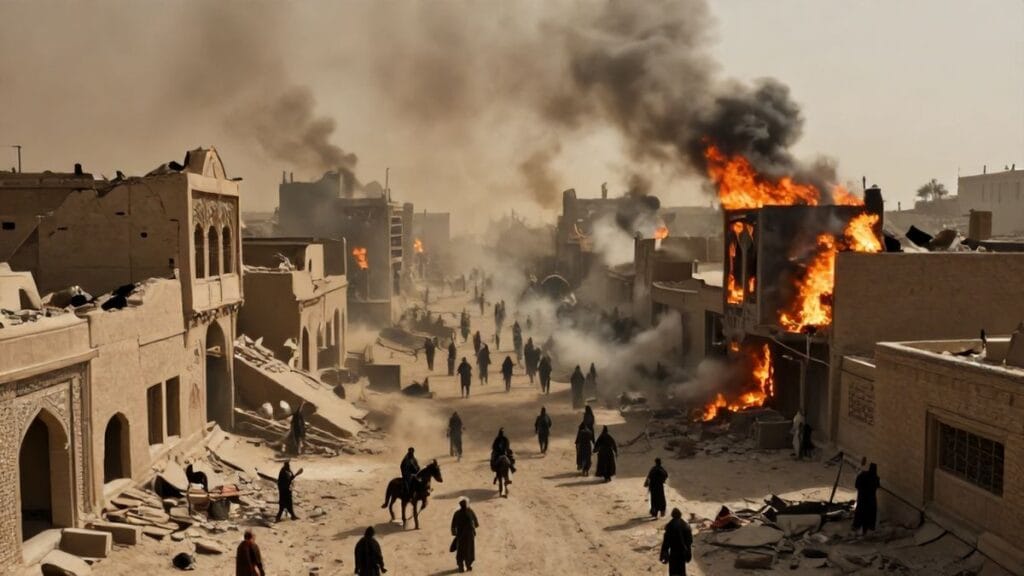
When the walls finally gave way and Timur’s soldiers surged into Baghdad, the city that had once been the luminous heart of the Abbasid world entered one of the darkest chapters in its history. The sack of baghdad by timur, fierce and methodical, unfolded over days that blurred into a continuous nightmare for its inhabitants. Chroniclers speak of the thunder of hooves in narrow streets, the crash of doors kicked in, the cries of those hunted through their own homes.
Every sack is both chaotic and, in its own twisted way, ordered. Timur, experienced in the capture of great cities, did not leave events entirely to chance. As in Isfahan and elsewhere, he reportedly imposed a grim system upon his men, assigning quotas of killing and regulating the distribution of spoils. Each soldier or unit could claim a certain number of captives and goods; each was also responsible for a prescribed number of executions. Whether this was strictly enforced or partially symbolic, it reveals the deliberate nature of the violence that ensued. This was not a spontaneous riot. It was a demonstration.
Houses across Baghdad were ransacked. Wealthy neighborhoods, where craftsmen and officials had built modest palaces with inner courtyards and ornamented halls, drew particular attention. Gold, silver, silks, carpets, carved wood, and precious manuscripts all became targets. In the scramble for plunder, even sacred spaces were not always spared. Though Timur sometimes portrayed himself as a patron of religion, his soldiers knew that mosques and madrasas could conceal valuables. Doors of cedar and teak were broken, chests overturned, libraries opened not for reading but for looting.
Those who resisted were cut down without ceremony. Men attempting to defend their families with kitchen knives or hunting bows were killed where they stood. Some women, facing the prospect of enslavement, reportedly chose death by their own hand. In one chilling story, a scholar’s family burned their own house to avoid capture, leaving only ashes for the conquerors. Children, confused and terrified, clung to the bodies of parents, sometimes spared, often not. The sack of baghdad by timur was, as one later historian wrote, “a storm that spared neither branch nor root.”
Not all killing was indiscriminate, however. Timur was known to select certain groups for preservation: skilled artisans, architects, calligraphers, and craftsmen whose talents could embellish his capital, Samarkand. In Baghdad, as in other conquered cities, teams of soldiers were tasked with identifying and securing such individuals. These unlucky survivors were separated from their families and marched away as living spoils of war. Their fate was different from those left behind, but it was a form of captivity nonetheless, a forced transplantation of the city’s creative lifeblood to serve the glory of a distant ruler.
The sheer scale of the violence is difficult to quantify. Medieval sources habitually give inflated numbers—hundreds of thousands killed, or more—but even adjusted for exaggeration, the loss of life was enormous. Entire quarters of the city were reportedly emptied. The silence that followed the din of battle was not the peaceful hush of a sleeping town but the stunned quiet of streets crowded with corpses, smoke drifting from burned homes, dogs and birds beginning their scavenging.
Pyramids of Skulls: Terror as Strategy and Spectacle
Among the most infamous aspects of the sack of baghdad by timur was the construction of pyramids of skulls outside—or even within—the city. These macabre monuments, which contemporaries described with a mix of horror and grim fascination, were not unique to Baghdad. Timur had employed similar displays after the surrenders or destructions of cities in Iran and Syria. Yet in Baghdad, the city of caliphs and scholars, the symbolism cut deeper.
According to several chroniclers, after the initial spasm of killing and plunder, Timur ordered an organized execution of a large portion of the surviving population. Soldiers rounded up captives from different quarters: men of fighting age, perhaps; in some accounts, even older men and adolescents. They were taken to designated sites where, in a grisly assembly line, they were beheaded. Their heads were then piled into conical towers, carefully arranged so that each skull was visible. One source claims that there were dozens of such pyramids, each composed of hundreds of heads. Whether or not these exact figures are accurate, the intent is undeniable.
This was terror as theater, the violence transformed into a message broadcast across the landscape. Anyone approaching Baghdad in the aftermath would see these ghastly towers and understand the price of defiance. Timur’s reputation, already fearsome, fed on such spectacles. In a world where news traveled by caravan and rumor, images mattered. The skull pyramids were an assertion of power that echoed far beyond the Tigris.
Some modern historians have debated the literal accuracy of these accounts, noting that numbers may have been exaggerated and that the logistics of constructing such large and orderly pyramids would have been challenging. Yet even if we allow for hyperbole, there is no doubt that mass executions occurred and that the association of Timur with skull towers was firmly entrenched in contemporary memory. A later Persian chronicler wrote that “the plains around Baghdad were whitened with bones, as if the earth had grown teeth.” Such vivid imagery, whether strictly factual or not, testifies to the psychological impact of the event.
These acts also reveal Timur’s understanding of politics. By making examples of major cities, he sought to reduce the need for prolonged sieges elsewhere. If rulers and urban elites believed that resistance would lead to annihilation, many might choose to surrender without a fight. In this sense, the sack of baghdad by timur was both a punishment and an investment in future compliance. The cost, of course, was borne by ordinary people whose lives were extinguished or shattered to send a message they had never chosen to convey.
It is astonishing, isn’t it, that such calculated cruelty coexisted with Timur’s patronage of architecture and art? Yet in his worldview, fear and beauty were two sides of the same coin. The skulls of Baghdad and the domes of Samarkand were both monuments to his will.
Survivors, Slaves, and Scattered Scholars
In the wake of the sack of baghdad by timur, survival took many forms, none of them untouched by trauma. For those not killed outright, life became a negotiation with loss and captivity. Some families, having hidden successfully during the worst of the violence, emerged from cellars, wells, or improvised hiding places to find their neighborhoods transformed into charred ruins and empty houses. Others saw loved ones led away in chains, destined for distant markets or for forced labor in the service of Timur’s elites.
The practice of enslaving defeated populations was common across medieval Eurasia, and Timur’s campaigns were no exception. In Baghdad, men, women, and children were selected as spoils. Some were distributed among commanders and soldiers as household servants or concubines; others were marched in columns toward Central Asia. The journey itself killed many: hunger, exhaustion, and disease winnowed the ranks of captives long before they reached Samarkand or other cities of Timur’s realm. Those who survived found themselves uprooted from their language, their customs, and all familiar landmarks of their identity.
Among the targeted groups were artisans and scholars. Timur understood that the splendor of his capital depended on more than brute force; it required the skills of those who could build mosques, palaces, and gardens, and those who could adorn his court with learning and prestige. Chronicles mention that from many conquered cities he ordered the selection of architects, calligraphers, astronomers, and physicians. From Baghdad, too, such a human harvest was taken. These individuals were simultaneously privileged and imprisoned: valued by their captor, yet unable to return home.
The city’s scholarly community suffered grievously. Some learned men were killed in the general slaughter; others were carried off. Libraries—private and institutional—were plundered or burned. The cumulative effect was a dramatic thinning of Baghdad’s intellectual life. A generation later, a chronicler lamented that “the lamps of science that once shone in Baghdad were dimmed, and their light scattered to foreign lands.” Yet even in the midst of ruin, fragments of learning survived. A few scholars hid their books; others memorized crucial works; still others began to write down their experiences, recording for posterity the catastrophe that had befallen their city.
These survivor accounts, though often colored by theology and moral interpretation, provide invaluable glimpses into the human dimension of the event. One anonymous narrative, preserved in later compilations, describes a man wandering through the ruins searching for relatives: “For three days I walked as one drunk, though I had not tasted wine. Each street brought me to another house where I had known a friend, and in each I found only silence and bones.” Another witness, quoted by a fifteenth-century historian, speaks of the captives being sorted: “Like traders counting their wares, they counted our people, separating the young from the old, the strong from the weak. We were not men and women to them, but things.”
Those who remained in Baghdad faced the enormous task of piecing together some semblance of communal life. Markets gradually reopened, though with fewer goods and fewer merchants. Mosques called the faithful to prayer again, their congregations now thinned and grieving. Graves multiplied in cemeteries; informal burial grounds appeared in vacant lots. Survivors shared stories and rumors, stitching together a communal memory that would ensure the sack was never forgotten.
Faith under Fire: Mosques, Shrines, and the Ulama in the Inferno
Religion, always central to Baghdad’s identity, both suffered and adapted in the wake of the sack of baghdad by timur. The city was home not only to Sunni mosques and madrasas but also to important Shi‘i shrines in its environs, as well as to Christian and Jewish communities. The violence, though primarily political and military in its immediate causes, inevitably touched these religious institutions and reshaped their roles.
Many mosques sustained damage during the fighting and looting. Some were stripped of valuable furnishings—carpets, candlesticks, Qur’an stands inlaid with ivory and mother-of-pearl. In a number of cases, manuscripts were burned or scattered. Yet Timur, mindful of his image as a champion of Islam, did not order a systematic destruction of religious buildings as such. Indeed, he sometimes took care to present his actions as a punishment for political defiance rather than as hostility to the faith. After the immediate violence subsided, Friday prayers resumed in surviving congregational mosques, where preachers navigated a delicate balance between mourning, theological reflection, and adaptation to the new reality.
The city’s ulama—the scholars of law and religion—were particularly challenged. Some had been killed; others had fled before or during the assault. Those who remained faced the question of how to interpret what had happened. For many, the language of divine testing and punishment offered a framework. Sermons spoke of sins and injustices that had “invited the scourge” upon Baghdad: corruption among officials, neglect of religious duties, mistreatment of the poor. Such interpretations were not mere resignation; they provided a moral lens through which survivors could make sense of senseless slaughter.
At the same time, the ulama had to negotiate with Timur’s representatives. Religious legitimacy mattered to the conqueror; endorsement from Baghdad’s jurists and preachers could help frame his rule as lawful. Some scholars accepted positions under the new regime, issuing legal opinions that recognized Timur’s authority. Others refused, choosing internal exile, silence, or departure over complicity. The chronicles sometimes praise these latter figures as exemplars of integrity, though they also acknowledge that survival often required compromise.
The city’s Sufi communities played a distinctive role. Sufi lodges, or khanqahs, had long been spaces of spiritual retreat and social support. In the aftermath of the sack, they became refuges for the traumatized. Sufi teachings about the fleetingness of the world, the illusion of stability, and the necessity of trust in God resonated intensely with people who had seen their lives overturned overnight. Miraculous stories circulated: tales of saints who had predicted the disaster, or whose tombs had been mysteriously spared; accounts of individuals saved by reciting particular litanies. Such narratives, while impossible to verify historically, reveal how religious imagination wove the catastrophe into broader patterns of meaning.
Other religious communities—Christians and Jews, for instance—also endured violence and disruption, though their experiences are less well documented. Some churches and synagogues were damaged, some congregants killed or enslaved. Yet historical patterns suggest that, once order was reimposed, these communities too found ways to rebuild under Timur’s loose overlordship or under subsequent rulers who filled the power vacuum. The fabric of Baghdad’s religious pluralism was torn but not entirely destroyed.
Baghdad’s Ruin and the Reordering of Power in the Middle East
The sack of baghdad by timur was not merely a local disaster; it had ripple effects that extended across the political landscape of the Middle East. With Baghdad humbled and the Jalayirid Sultanate shattered, a significant player in the region’s balance of power effectively vanished. Sultan Ahmad Jalayir himself fled, becoming a wandering ruler, briefly recapturing parts of his former domains before ultimately being captured and killed. The old Jalayirid structure in Iraq collapsed into fragments, making room for new forces.
In the immediate aftermath, Timur did not establish a permanent, centralized administration in Baghdad. His empire functioned less as a bureaucratic state and more as a web of overlordship, tributary relationships, and garrisoned strongpoints. Local notables and surviving administrative elites were sometimes restored to positions under the watchful eye of Timurid representatives, tasked with collecting taxes and maintaining basic order. But the city’s autonomy was gone, and its capacity to act as an independent political center had been crippled.
Regionally, rival polities calibrated their strategies in light of Timur’s demonstrated willingness to devastate even prestigious cities. The Mamluk Sultanate in Egypt and Syria, already wary of Timur’s incursions into the Levant, now faced the reality of his influence reaching deep into Iraq. The Qara Qoyunlu and other Turkmen confederations, operating in eastern Anatolia and Iran, maneuvered to fill the spaces he left behind. In the longer term, Baghdad would pass under their sway and later under that of the Safavids and Ottomans, but always as a city whose primacy had been painfully reduced.
Economically, the consequences were stark. Baghdad’s destruction disrupted trade routes along the Tigris and the overland roads that threaded through Iraq. Merchants shifted their caravans to safer paths where possible; some relocated permanently to other cities—Tabriz, Aleppo, Damascus—that, while not immune to war, seemed more stable at that moment. Agricultural production in the surrounding areas also suffered as populations were killed or displaced and irrigation works fell into disrepair. The city that had once orchestrated the flow of goods and knowledge across continents now struggled to meet its own needs.
Yet behind the immediate devastation lay a subtler transformation. The sack symbolized the further decline of the old Iranian–Iraqi heartland of the Islamic world as the primary seat of power. Over the following centuries, political and economic gravity would increasingly shift toward Anatolia, Egypt, and, in due course, the Indian subcontinent and the rising maritime empires of Europe. The Tigris and Euphrates region remained important, but it was no longer the unquestioned axis around which everything else revolved. In this sense, the sack of baghdad by timur was both a late echo of Mongol-era upheavals and an early tremor in a broader reorientation of Eurasian power.
Memory, Chronicle, and the Making of Timur’s Legend
The sack of baghdad by timur did not end when the last fires burned out or when his armies rode away. It continued to live, reshaped and reinterpreted, in the pages of chronicles, in sermons, in poetry, and in the whispered stories of survivors. These layers of memory are crucial, for they show how a historical event becomes a moral lesson, a political argument, or a symbol in subsequent generations’ debates.
Contemporary and near-contemporary chroniclers approached the catastrophe with differing agendas. Some, writing under Timurid patronage, sought to present Timur as a divinely favored conqueror whose harsh actions were justified by the need to restore order. In such narratives, Baghdad’s resistance becomes a kind of rebellion against legitimate authority, and its punishment appears tragic but morally explicable. They emphasize Timur’s subsequent acts of piety—patronage of mosques and scholars in other cities—as a counterbalance to the violence.
Others, more distant from his court or openly critical, painted a darker picture. For them, the sack symbolized the moral degeneration of the age. A Persian historian, writing in the mid-fifteenth century, lamented that “in these times, kings have become wolves and their subjects sheep, and God has loosed upon us a Timur as once He loosed the Mongols, to chasten us for our sins.” Another author described the skull pyramids in Baghdad as “minarets built not to call the faithful to prayer, but to proclaim the arrogance of a tyrant.” Throughout, one senses a struggle to fit unprecedented cruelty into familiar frameworks of divine justice and human agency.
Modern historians must navigate these sources critically. As Beatrice Manz notes in her study of Timur’s empire, narratives about his cruelty and his piety are both often shaped by later political uses, yet their persistent themes of terror and deliberate spectacle cannot be ignored. The sack of baghdad by timur, she and others argue, exemplifies how he combined pragmatic military strategy with psychological warfare that bordered on the theatrical. Meanwhile, scholars like John Woods and Maria Subtelny have shown how Timurid historians crafted a royal image for Timur that downplayed the worst atrocities while emphasizing his role as a patron of culture.
In Baghdad itself, the memory of 1401 intertwined with that of 1258, merging into a collective sense of the city as repeatedly betrayed by the rulers who should protect it and repeatedly abandoned to foreign conquerors. Poets composed elegies for the ruined city, comparing it to a once-beautiful beloved now scarred and abandoned. Preachers invoked the disaster as a cautionary tale: warning rulers against injustice, urging communities to unity and piety lest divine wrath befall them again.
Over centuries, as Baghdad changed hands and slowly rebuilt, the specific details of the sack faded for many, but the idea remained: that even the greatest of cities could be reduced to rubble and bone in a matter of days. This enduring memory has made the sack of baghdad by timur an important reference point not only for medievalists but for modern Iraqis reflecting on more recent traumas, where old and new catastrophes sometimes echo each other in unsettling ways.
From Ashes to Echoes: Baghdad’s Long Road through the Timurid Aftermath
In the wake of the sack of baghdad by timur, the city did not simply vanish, though some contemporaries wrote as if it had. Cities, unlike individual lives, have a stubborn capacity for persistence. Amid ruins, people rebuild, markets reopen, and new rulers lay claim to old walls. Baghdad’s recovery was halting and incomplete, but it was real.
In the years immediately following Timur’s departure, authority in Baghdad wavered. Timurid garrisons or client rulers held nominal power for a time, but the conqueror’s attention soon shifted elsewhere—to campaigns in Anatolia and plans that would ultimately bring him into conflict with the Ottoman sultan Bayezid I. As his armies moved on, local elites, Turkmen confederations like the Qara Qoyunlu, and other claimants vied for control over Iraq. Baghdad changed hands multiple times, each new regime inheriting a city still bearing the scars of 1401.
Reconstruction proceeded unevenly. Key infrastructural elements—bridges, irrigation systems, walls—received attention from successive rulers, who understood that a functioning Baghdad could yield valuable tax revenues and strategic advantages. Some quarters were rebuilt over old foundations; in others, ruins lingered for decades, serving as physical reminders of past violence. Cemeteries expanded where new neighborhoods might have risen. The city’s population, drastically reduced, gradually replenished through natural growth and in-migration from surrounding countryside and other regions destabilized by war.
Culturally, Baghdad never fully regained its earlier position as the unrivaled center of Islamic scholarship, but it did remain a living node in the network of learning. Scholars traveled through, sometimes settling for a few years, sometimes moving on. Madrasas reopened or were newly endowed by ambitious rulers seeking prestige. The memory of the sack infused their work: treatises on law and theology occasionally alluded to the “days of trial” when God had tested the faithful. Sufi orders continued to flourish, offering spiritual solace in a world that seemed, to many, increasingly marked by uncertainty and upheaval.
By the later fifteenth and sixteenth centuries, Baghdad would be drawn into an emerging rivalry between the Safavid Empire of Iran and the Ottoman Empire of Anatolia and southeastern Europe. Both would, at different times, occupy the city and claim to restore its fortunes. Each superimposed new layers of architecture, administration, and religious politics onto a landscape still shaped by the devastation of the Mongol and Timurid eras. In this way, Baghdad’s long aftermath was not just about recovery but about incorporation into new imperial stories that used its past as a backdrop for their own legitimacy.
The echoes of 1401 persisted, nonetheless. Occasional references in chronicles, invocations in sermons during later crises, and the continued circulation of stories about Timur’s cruelty kept the memory alive. It is telling that when early modern and modern observers wrote about Baghdad’s turbulent history, they frequently listed the Mongol sack of 1258 and the Timurid sack of 1401 as twin markers of ruin, anchoring narratives of decline and resilience. The city’s identity was thus shaped as much by what had been destroyed as by what remained.
Comparing Catastrophes: 1258, 1401, and the Fate of an Eternal City
Placed side by side, the Mongol sack of 1258 and the sack of baghdad by timur in 1401 form a grim pair of bookends around a period of profound transformation in the Middle East. Both events involved Central Asian conquerors overrunning the city, both resulted in massive loss of life and destruction of infrastructure, and both left indelible marks on the region’s memory. Yet there were important differences in context and consequence that reveal how Baghdad’s role in the wider world had changed.
In 1258, Baghdad was still the seat of the Abbasid caliphate, a potent, if sometimes more spiritual than political, institution that symbolized unity for the Sunni Muslim world. Hülegü’s conquest thus had a uniquely shattering effect: it was not just a city that fell, but the visible heart of a centuries-old order. The subsequent political vacuum contributed to a major reconfiguration of power, with the Mamluk Sultanate in Cairo stepping into a quasi-caliphal role. Baghdad, under later Mongol and post-Mongol rulers, became a provincial center; its symbolic centrality was diminished even as it remained a significant urban hub.
By 1401, when Timur arrived, the caliphate as a political institution in Baghdad was long gone. The Jalayirid Sultanate ruling the city was one among several regional powers, and while Baghdad still carried immense prestige, it no longer served as the linchpin of a vast empire. The sack of baghdad by timur thus did not topple a universal institution, but it did extinguish a fragile local dynasty and accelerate the decline of Iraq as a primary political cockpit. The broader Islamic world, while horrified, did not realign itself as dramatically in response as it had after 1258.
Another difference lies in how the two events were woven into historical interpretation. Medieval Muslim writers often saw the Mongol invasions, including 1258, as a watershed requiring deep theological reflection. They debated whether such disasters were divine punishment, tests of faith, or the result of human sin and folly. By the time of Timur, these interpretive frameworks were already in place. The sack of 1401 was frequently read through the lens created by 1258: as a repetition or completion of an earlier judgment, an additional chapter in a story whose moral was already known.
Yet, despite these differences, both catastrophes underscored a crucial truth: no city, however illustrious, is immune to the tides of war and empire. Baghdad’s reputation for learning, its religious sanctity, its economic importance—all these could not shield it from the ambitions of distant warlords. At the same time, its repeated resurgence showed another side of urban history: the capacity to endure, adapt, and reinvent, even when the very stones of the city seemed to cry out in lamentation.
For historians today, comparing 1258 and 1401 helps illuminate patterns of continuity and change in the region’s history. Both sacks disrupted local society and knowledge networks, yet knowledge survived through dispersal—scholars fleeing, books carried away, ideas transplanted. In this way, even the most destructive events had paradoxical effects: they broke centers but sometimes spread their contents more widely. The sack of baghdad by timur, like Hülegü’s assault before it, thus belongs not only to the history of violence but also to the history of how cultures endure and transform under pressure.
Conclusion
The sack of baghdad by timur in the summer of 1401 was more than a brutal episode in a violent age; it was a turning point that exposed the fragility of a city whose name had once meant power, learning, and spiritual authority. Under the hooves of Timur’s cavalry and the blades of his soldiers, Baghdad’s houses were plundered, its population decimated, its scholars scattered or slain. Pyramids of skulls rose where once minarets had dominated the skyline, and the Tigris witnessed yet another chapter of human cruelty written upon its banks.
Yet this catastrophe unfolded in a world already transformed by earlier Mongol invasions. The Abbasid caliphate was gone; the Jalayirid Sultanate ruled a fragmented realm; rival dynasties circled like predators around a wounded heartland. In this context, Timur’s assault both continued and accelerated long-term trends: the decline of Iraq’s centrality, the shift of power toward other regions, and the increasing reliance on terror as an instrument of imperial policy. The sack of baghdad by timur thus stands as both culmination and prelude—a late echo of Mongol-era shocks and an early signal of new imperial orders to come.
For the people of Baghdad, the event was not an abstract political development but a personal cataclysm. Families were torn apart, neighborhoods erased, faith tested. And yet, in the ruins, life persisted. Survivors buried their dead, reclaimed spaces, reopened shops, and resumed prayers. Over generations, the city rebuilt, changed rulers, and reentered the currents of regional politics, never again quite what it had been, but never entirely silenced.
In the chronicles and memories that followed, the sack of baghdad by timur became a moral lesson and a warning. Writers invoked it to criticize unjust rulers, to call for piety and reform, or to lament the cycles of violence that seemed to haunt their world. Modern scholars, reading these accounts with critical eyes, have reconstructed a complex picture of conquest, cruelty, and resilience. What emerges is a narrative in which neither destruction nor survival is absolute: both coexist, like overlapping layers of an ancient city’s foundations.
To remember 1401, then, is to confront the capacity of human beings not only to ruin the most extraordinary creations of their own civilization but also to rebuild amid the wreckage. Baghdad’s story reminds us that no center is eternal, no power unassailable—and that memory itself, fragile yet persistent, is one of the few bulwarks we possess against repeating the worst of our past.
FAQs
- What was the sack of Baghdad by Timur?
The sack of Baghdad by Timur refers to the capture and brutal plundering of Baghdad in 1401 by the Central Asian conqueror Timur (Tamerlane). After a siege and breach of the city’s defenses, Timur’s forces carried out widespread killing, looting, and enslavement, reportedly constructing pyramids of skulls from the victims and severely damaging Baghdad’s population, infrastructure, and intellectual life. - Why did Timur attack Baghdad and the Jalayirid Sultanate?
Timur attacked Baghdad primarily to consolidate his control over Iraq and western Iran and to eliminate the Jalayirid Sultanate as a rival regional power. Baghdad’s strategic position on major trade routes and its symbolic status as the former seat of the Abbasid caliphate made it a coveted prize. Sultan Ahmad Jalayir’s unstable relations with Timur—oscillating between resistance and uneasy accommodation—convinced the conqueror that the city had to be subdued decisively. - How many people were killed during the sack?
Exact numbers are impossible to establish, as medieval chroniclers often exaggerated. Some sources claim hundreds of thousands of deaths, which may be inflated. Nonetheless, the consensus among historians is that the loss of life was enormous, amounting to a large portion of Baghdad’s inhabitants. The combination of direct killing, famine, disease, and subsequent displacement produced a demographic collapse from which the city took decades to recover. - What happened to Baghdad after Timur left?
After Timur’s departure, Baghdad passed through a period of political instability. Timurid influence remained for a time, but power soon fragmented among Turkmen confederations such as the Qara Qoyunlu and, later, the Aq Qoyunlu. The city gradually rebuilt parts of its infrastructure and social life, but it never fully regained its earlier status as the unrivaled cultural and political center of the Islamic world. In later centuries, it would be contested between the Safavids and Ottomans. - How did the sack of 1401 compare to the Mongol sack of 1258?
Both events were devastating, involving mass killing and extensive destruction, and both profoundly affected Baghdad’s trajectory. The 1258 sack toppled the Abbasid caliphate and symbolized the end of an era when Baghdad was the central seat of Islamic political authority. By contrast, in 1401 the city was already a diminished capital under the Jalayirids. The sack by Timur further weakened Iraq’s role in regional politics but did not trigger as dramatic a reconfiguration of the wider Islamic world as the earlier Mongol conquest had. - Did Timur specifically target scholars and religious institutions?
Timur did not wage an ideological war against learning or religion per se; in fact, he styled himself as a patron of Sunni Islam and supported scholars and architects in his own domains. However, during the sack of Baghdad, scholars and religious institutions suffered heavily as part of the general violence and looting. Many learned men were killed or enslaved, and libraries and madrasas were damaged or plundered, resulting in a serious blow to Baghdad’s intellectual life. - Are the stories about pyramids of skulls historically reliable?
Accounts of skull pyramids around Baghdad come from multiple medieval sources, some of which may exaggerate numbers and dimensions for rhetorical effect. While historians are cautious about taking every detail literally, the consistency of these reports, and the broader pattern of similar displays in Timur’s other campaigns, make it highly likely that large-scale, staged executions and gruesome displays did occur. The skull pyramids, whether exactly as described or somewhat embellished, are emblematic of Timur’s use of terror as a deliberate political tool. - What primary sources describe the sack of Baghdad by Timur?
The event is discussed in various Persian and Arabic chronicles, including works by historians such as Sharaf al-Din ‘Ali Yazdi, who wrote the Zafarnama (“Book of Victory”) under Timurid patronage, and later writers like Ibn Taghribirdi and others in Mamluk Egypt. These sources differ in perspective—some are sympathetic to Timur, others critical—but together they provide a multifaceted, if sometimes contradictory, picture of the siege, sack, and aftermath. - How did the sack affect Baghdad’s role in Islamic scholarship?
Baghdad had already lost some of its preeminence after the Mongol sack of 1258, but 1401 inflicted another severe blow. Many scholars were killed or displaced, and key institutions suffered damage or decline. While learning did continue in the city, it no longer held the same central, commanding position it had enjoyed in the classical Abbasid era. Intellectual leadership shifted increasingly to other centers such as Cairo, Damascus, Herat, and later Istanbul and Isfahan. - Why is the sack of Baghdad by Timur significant today?
The sack is significant because it highlights the vulnerability of even the most celebrated cities to the dynamics of empire, war, and political fragmentation. It offers insight into how terror can be used as a strategic instrument, how societies remember and interpret catastrophe, and how cultural and intellectual traditions can survive through dispersal and adaptation. For modern readers, the story of 1401 also resonates with more recent episodes of violence in Baghdad, underscoring both the city’s enduring importance and its repeated exposure to the storms of history.
External Resource
Internal Link
Other Resources
- Encyclopaedia Britannica – general search for the exact subject
- Google Scholar – academic search for the exact subject
- Internet Archive – digital library search for the exact subject

