Table of Contents
- On the Eve of Catastrophe: Delhi Before Timur
- Timur’s Path to Power and His Gaze Toward India
- The Road from Samarkand: An Army Marches to the Indus
- Clash at the Frontier: Timur’s First Battles in Hindustan
- Cracks in the Sultanate: Political Decay in Delhi
- The March on Delhi: Fear, Flight, and Failed Diplomacy
- The Battle of 17 December 1398: When the Empire’s Heart Stopped
- The Orchestrated Slaughter: Prisoners, Panic, and Massacre
- Three Days of Horror: The Sack of Delhi by Timur
- Fire, Plunder, and Desecration: The City Unmade
- Voices from the Ruins: Chroniclers, Survivors, and Silence
- Economy in Ashes: Demographic and Commercial Collapse
- Religious Zeal, Political Calculation: Why Timur Struck Delhi
- From Delhi to Samarkand: Spoils, Captives, and Cultural Transfer
- Delhi After the Storm: Power Vacuums and Haunted Streets
- The Long Shadow: How 1398 Shaped the Subcontinent
- Myth, Memory, and Historians: Interpreting Timur’s Invasion
- Echoes of 1398 in Modern India and Central Asia
- Conclusion
- FAQs
- External Resource
- Internal Link
Article Summary: In the winter of 1398, the sack of Delhi by Timur shattered one of the medieval world’s greatest cities and sent shockwaves across Asia. This article follows the rise of Timur from steppe warlord to conqueror and explains why his gaze turned toward the crumbling Delhi Sultanate. It reconstructs the tense weeks before the battle, the clash of 17 December, and the systematic, chilling violence that followed as Delhi was looted, burned, and depopulated. Through narrative detail, contemporary chronicles, and modern historical analysis, it shows how the sack of Delhi by Timur was both a religiously framed “holy war” and a calculated act of imperial theater. The article traces the fates of survivors, the destruction of Delhi’s economy, and the political vacuum that allowed later powers like the Mughals to rise. It also explores how memories of the sack of Delhi by Timur were reshaped over centuries, serving as warnings, propaganda, and symbols of foreign devastation. Finally, it considers how this single week in December 1398 still echoes in modern historical consciousness, and why revisiting the sack of Delhi by Timur helps us understand the fragility of empires and cities alike.
On the Eve of Catastrophe: Delhi Before Timur
On the banks of the Yamuna, in the final decades of the fourteenth century, Delhi still called itself the heart of Hindustan. Its stone ramparts stretched across the earth like a grey serpent, encircling crowded bazaars, palaces weighed down with silk and jade, and mosques whose domes gathered the prayers of tens of thousands. Yet behind the façade of permanence, the city trembled. It is impossible to understand the sack of Delhi by Timur without first stepping into this fragile world, a capital glittering and cracking in the same moment.
For more than a century, the Delhi Sultanate had announced its authority in copper, silver, and stone. Coins bore the names of Turko-Afghan rulers who traced their legitimacy to conquest and to their role as defenders of Islam in a largely non-Muslim land. Friday sermons invoked the sultan after praising God and the Prophet, reaffirming week by week that power flowed from the throne in Delhi. Grandees rode through the streets on dandled horses, elephants lumbered under gilded howdahs, and caravans arrived from Multan, Sind, Bengal, and beyond, their bales filled with indigo, spices, cotton textiles, and warhorses from Central Asia.
Yet the city’s splendor masked a decaying structure. The Tughlaq dynasty that sat on Delhi’s throne in 1398 was the last in a line of rulers who had battled rebels, famine, and mutinous nobles. Muhammad bin Tughlaq, decades earlier, had tried to govern an empire that stretched from the Himalayas to the deep south. His ambitious projects—moving the capital to Daulatabad, issuing token currency, waging widespread campaigns—had strained the empire and eroded trust. His successor, Firoz Shah Tughlaq, restored a semblance of stability, building canals, mosques, and madrasas, but beneath his public works the political order fissured as regional governors tasted autonomy.
By the time of Sultan Nasir-ud-Din Mahmud Tughlaq, nominal ruler in 1398, the Delhi Sultanate’s reach had shrunk. Bengal, Gujarat, the Deccan, and Jaunpur asserted their own sovereignty. Delhi’s treasury was shallow. Even within the capital, factions jostled for control, court intrigues dulled the sultan’s authority, and commanders calculating their odds began to hedge loyalties. From the countryside, stories filtered in of villages overburdened by taxation, of banditry on the roads, and of ordinary peasants caught in the crossfire of noble rivalries.
At the same time, the demographic and cultural life of Delhi remained vibrant. The city was a tapestry woven from many threads: Turkic military elites, Afghan soldiers, Persian-speaking administrators, merchants from Central Asia and the Middle East, local Indian Muslims, Hindu traders, artisans, and laborers from nearby regions. In homes and streets, people spoke not only Persian and Arabic, the languages of court and scholarship, but also evolving varieties of Hindavi and local dialects. Sufi shrines dotted the city’s outskirts, drawing both Muslims and Hindus into a shared devotional culture; the songs of mystic poets wound their way through alleys and across the Yamuna’s broad, sand-swept banks.
Still, there was a tension in the air—a sense that something was coming, though almost no one could have imagined the scale of the catastrophe about to descend. News from the northwest had been unsettling: rumors of a Central Asian warlord whose armies had smashed through kingdoms from Persia to the Caucasus. His name, whispered with dread, was Timur. But to many in Delhi, he was a distant threat, a far-off tempest trapped beyond the mountains and deserts that separated Hindustan from the lands of Transoxiana. The city had seen invaders before and survived. Why should this time be different?
Yet it would be different. In just a few months, the sack of Delhi by Timur would rip through the city like a firestorm, leaving behind a husk of the once-great capital. The merchants counting coins in perfumed shops, the scholars debating law in shady courtyards, the soldiers grumbling over late pay—they were all living, unknowingly, in the last days of an old Delhi.
Timur’s Path to Power and His Gaze Toward India
Timur, known in Western memory as Tamerlane, was born into a world of dust, horses, and shifting alliances. Emerging from the Barlas tribal confederation in the 1330s, somewhere near Kesh (later Shahr-i Sabz) in present-day Uzbekistan, he was neither the son of a reigning monarch nor, strictly speaking, a direct descendant of the great Genghis Khan. But he understood power better than most men of his age, and he understood the value of a story. By marrying into the Chinggisid line and proclaiming himself the “Sword of Islam,” he crafted a legitimizing myth that fused Mongol conquest with Islamic piety.
Through the 1360s and 1370s, Timur outmaneuvered rivals across Transoxiana, turning Samarkand into his capital and his canvas. As he conquered, he built: madrasas, mosques, and caravanserais appeared, funded by spoils taken from defeated cities. He was charismatic, ruthless, and deeply attentive to detail—obsessed with logistics, intelligence, and the choreography of terror. Chroniclers like Sharaf ad-Din Ali Yazdi, writing in the following decades, portrayed him as a man driven by both ambition and a sense of divine mission.
By the 1380s and 1390s, Timur’s armies had hammered Khwarazm, Persia, parts of Iraq, the Caucasus, and sections of Anatolia. Cities that resisted—Isfahan, for instance—paid with rivers of blood. Pyramids of severed heads were left behind as terrible monuments to his passing, deliberate symbols intended to frighten other cities into submission. Merchants, artisans, and scholars, however, were carefully spared and transported to Samarkand and other Central Asian centers, enriching them with the skills and knowledge plundered from west and east.
Having subdued much of the Islamic heartland from Syria to Iran, Timur turned his gaze south-eastward. India was not unknown to him. For centuries, there had been trade and migration between Central Asia and the Indo-Gangetic plain. Sufi saints, merchants, and horse-dealers had long traveled from Samarkand and Bukhara to Lahore and Delhi. The Delhi Sultanate itself had been created and sustained, in large part, by Central Asian and Afghan military elites. Timur thus looked at Delhi with a complex mixture of familiarity and contempt. Here was a land wealthy in elephants, gold, and grain, but ruled—so he claimed—by unworthy men and “heretics” who failed to uphold the purity of Islam.
The immediate pretext came from the Punjab frontier. Local conflicts involving Muslim and Hindu polities, as well as the flight of certain chiefs, were framed by Timur’s propagandists as a struggle between true faith and unbelief, between a just ruler and deviants. It is astonishing, isn’t it, how often invaders find God on their side when the prize is rich enough? In letter after letter, Timur cloaked expansionist greed in the language of jihad, promising to cleanse India of “idolaters” and lax Muslims, even as he meticulously calculated the ransom and tribute that could be extorted.
At the same time, the Delhi Sultanate’s visible weakness acted as an invitation. From his vantage point in Samarkand, Timur could see an empire fracturing under weak sultans and ambitious governors. The sultan in Delhi, he heard, commanded neither unwavering loyalty from his nobles nor fear from his enemies. The roads to the capital seemed guarded more by distance and reputation than by united armies. A bold strike, he reasoned, might both fill his coffers and add a new chapter to his legend.
By the mid-1390s, the decision had ripened in his mind. He would march on Hindustan. This would not be a campaign of settlement—Timur never intended to rule India directly—but a raid on a colossal scale, a blow so savage that the memory of it would echo for centuries. And so the sack of Delhi by Timur was conceived long before Delhi’s residents heard the first reports of his approach. In Samarkand and beyond, preparations began.
The Road from Samarkand: An Army Marches to the Indus
The campaign that would culminate in the sack of Delhi by Timur did not begin with a single trumpet blast but with months of quiet preparation. Messengers galloped through the night carrying orders to distant garrisons. Emirs assembled cavalry units, counted arrows, inspected armor, and secured supplies. The great war machine of Timur was awakening once more, its movements measured and deliberate.
Timur’s forces were a mosaic of peoples: Turko-Mongol horse archers from Transoxiana, Persian infantry, contingents from conquered principalities in Persia and the Caucasus, and auxiliaries drawn from allied tribes. Estimates of their numbers vary, as they always do in medieval warfare, but many historians suggest that perhaps 90,000 to 100,000 fighting men marched at one stage or another along the route to India, not counting camp followers, artisans, and slaves. It was a mobile city, lethal and restless, advancing across steppe and mountain.
The march began in 1398. To reach Hindustan, Timur had to cross the old arteries that had carried conquerors before him: the passes and plains of Afghanistan and the Punjab. He moved through Kabul and Ghazni, places already scarred by earlier conquests, where populations trembled at his banner. Those who submitted were spared the fate of Isfahan or Baghdad; those who resisted were crushed quickly, their heads adding to the grim architecture of fear he carried in his wake.
Timur’s logistical genius showed in the way he organized this massive movement. Units were divided, routes staggered, and supply points pre-arranged. Livestock drove themselves along, walking on the hooves that would eventually carry them into cooking pots. Local rulers who bowed early were allowed to retain some autonomy in exchange for tribute and provisions. In his retinue moved secretaries and chroniclers, men who would later record his deeds and cement his memory as a world conqueror. It was conquest as theater, but also conquest as meticulous administration.
The natural barriers between Central Asia and India swallowed many lesser armies, but Timur advanced like a man who had rehearsed the script. The harsh passes of the Hindu Kush tested his troops with cold and hunger, yet he pushed them forward with relentless determination. He knew that the prize—Delhi—lay beyond the Indus, and he also knew that any sign of weakness could embolden local chiefs to band together against him.
Resistance flared along the way. In some fortresses and towns, defenders believed that the mountains and walls would protect them. Timur replied as he always did: with savage efficiency. A garrison that refused to surrender might be annihilated; its civilian population enslaved or massacred as a warning. But artisans, physicians, and scholars were carefully separated from the doomed. They would later walk in chains to Samarkand, where their skills and intelligence would be co-opted to beautify the very capital whose ruler had destroyed their homes.
As the army moved, stories raced ahead. Travelers, merchants, and fugitives carried fragmented accounts into the Punjab: tales of shimmering banners, disciplined horsemen, and massacres so vast that “the earth itself could scarcely drink so much blood,” as one later chronicler put it. Some accounts grew in the telling; others were hushed to avoid panic. But together they marked the slow tightening of a noose around northern India.
The Delhi Sultanate, in theory, could have met this threat with a coordinated response, mobilizing garrisons from across the north and rallying nobles to the sultan’s banner. In practice, internal divisions, delayed decisions, and fear dulled the empire’s reflexes. Delhi watched and waited, hoping that the storm would break somewhere else.
Clash at the Frontier: Timur’s First Battles in Hindustan
When Timur’s forces reached the Indus and crossed into the Punjab, the invasion was no longer a rumor. It was a fact, hammered into the soil by thousands of hooves. The frontiers of the Delhi Sultanate rattled first. Local rulers, governors, and zamindars suddenly faced a choice no one wants to make: submit to an invader or resist and risk annihilation.
Near the city of Uch and in the regions that now lie along the borderlands of Pakistan and India, initial clashes set the pattern. Some towns threw open their gates, offering hostages and gold. Timur took their wealth, posted his own officers, and moved on, careful not to exhaust his forces before the main confrontation. Others tried to fight. They were met with waves of mounted archers, feigned retreats, and enveloping maneuvers perfected in the Central Asian steppe. The result was almost always the same: confusion, collapse, and a bloody reckoning.
Timur also had to contend with a political landscape crowded with small powers: Hindu Rajput chiefs, Muslim governors semi-independent of Delhi, and local warlords who had long carved out personal fiefdoms in the crumbling northern marches of the Sultanate. To some of these, he presented himself as a liberator from Delhi’s taxes. To others, especially non-Muslim rulers, he offered only the choice between immediate submission and certain destruction. He could be pragmatic when he wished, granting terms to those who yielded quickly. But behind every negotiation loomed the specter of the fate he had inflicted on defiant cities throughout Persia and Iraq.
Among the most notorious early actions of his Indian campaign was the attack on Multan and on the surrounding regions. Fortified towns fell in quick succession, their inhabitants massacred or enslaved. The invasion acquired a dual character: on the one hand, a political and military strike against the authority of the Delhi Sultanate; on the other, a campaign of plunder and religious violence against local populations, many of them Hindu. Timur’s chroniclers emphasize his supposed zeal, describing him as smashing idols and burning temples. Modern historians, however, have been careful to point out that piety and profit moved hand in hand: religious justifications helped motivate his troops and legitimize his rule, but looting and tribute remained central to his strategy.
By the time Timur pushed further into the Punjab, the shockwaves had reached Delhi. Refugees brought stories of entire towns emptied of their men, of families torn apart, of smoke that darkened the horizon for days. The sultan’s court reacted with a mixture of alarm and paralysis. Some advisors urged immediate mobilization, others counseled negotiation. But the clock was ticking, and Timur’s columns were now threading their way along the ancient routes that led toward the heart of the Sultanate.
Cracks in the Sultanate: Political Decay in Delhi
To grasp why the sack of Delhi by Timur unfolded with such horrifying speed, one must peer inside the palace walls of the Tughlaq court in the late fourteenth century. Here, in audience halls streaked with dust and fading glory, the machinery of empire had begun to seize.
Nasir-ud-Din Mahmud Tughlaq, the reigning sultan in 1398, nominally sat at the center of power, but his authority was confined largely to Delhi and its immediate environs. The centrifugal forces pulling the Sultanate apart had long been gathering strength. Successive reigns marked by ambitious reforms gone wrong, costly wars, and factional politics had eroded the legitimacy of the throne. The empire that had once extended deep into the Deccan and Bengal now resembled a frayed cloak—its edges tattered, its seams ready to split.
Power, in practical terms, was divided among powerful amirs and regional allies. In the capital, military commanders and bureaucratic elites cultivated their own networks of clients. Many were more interested in defending their private estates and privileges than the abstract honor of the dynasty. The sultan’s commands, once carried like sacred writ to the provinces, were now often questioned, delayed, or quietly ignored.
Delhi itself bore the scars of earlier traumas. Famine, plague, and rebellions in the preceding decades had depopulated sections of the city. Some suburbs had already fallen into ruin, their houses taken over by weeds and jackals. The sultan’s coffers, drained by years of mismanagement and declining revenues, struggled to pay the standing army. Soldiers muttered about arrears, and desertion was a growing problem. A confident, united regime might have greeted news of Timur with a swift show of force; this weakened court reacted like a man waking from troubled sleep, confused and off-balance.
Religious tensions also troubled the realm. While the Delhi Sultanate ruled over a predominantly non-Muslim population, its elites were overwhelmingly Muslim—Turko-Afghan, Persian, and Central Asian in origin. Over time, a rich tapestry of coexistence had formed: Hindu merchants thrived under Muslim patrons; Sufi saints preached to mixed congregations; local customs seeped into the daily lives of city-dwellers regardless of creed. Yet, from time to time, zealous clerics and hardline administrators attempted to reinforce religious boundaries through discriminatory taxes or punitive measures, sowing resentment. Timur’s propagandists would later exploit this complex landscape, painting Delhi not only as politically weak but as religiously compromised.
In the weeks before the final crisis, debates in the court turned frantic. Should Delhi attempt to buy off Timur with tribute? Could the sultan rally enough men to fight in the open field, as earlier rulers had sometimes done against Mongol incursions? Or was it better to retreat behind the city’s walls and pray that its fortifications could withstand a siege?
Crucially, there was no single, decisive answer. Some nobles, fearful for their personal fortunes, quietly prepared escape routes and refuges in the countryside. Others tried, half-heartedly, to gather troops. The result was a muddled mobilization that would prove disastrously inadequate once Timur reached the plains around the capital. The empire’s internal rot, long in the making, was about to be exposed under the harshest possible light.
The March on Delhi: Fear, Flight, and Failed Diplomacy
As Timur’s forces moved deeper into northern India, a chill spread across the Indo-Gangetic plain. Villages along the routes he favored faced wrenching choices. Some emptied overnight as people fled into forests or toward other cities, carrying whatever they could balance on their backs. Others stayed, resigning themselves to fate, hoping that humble submission might spare their lives.
Timur was now advancing with a precision honed by decades of campaigning. Scouts swept ahead, gathering terrain intelligence and gauging the mood of local populations. His diplomats, too, were busy. Letters were dispatched to rulers near and far, some couched in the language of religious admonition, others threatening absolute destruction should resistance be attempted. One such message to the sultan of Delhi denounced him for his supposed failings as an Islamic ruler and demanded submission. The subtext was unmistakable: accept vassalage and tribute or face annihilation.
In Delhi, the sultan and his advisors hesitated. Diplomacy with Timur offered little guarantee; the conqueror’s record did not suggest mercy toward major capitals that defied him. Yet to yield without a fight was to abandon any pretense of sovereignty. Honor, religion, and the expectations of the city’s populace all pointed towards resistance, even if the odds of success were slim.
Meanwhile, stories from the countryside tightened the knot of fear. Towns that tried to resist fell in days; their garrisons slaughtered, their people taken as slaves or killed outright. Places that surrendered quickly sometimes fared better, but even then, massive levies were imposed. Timber, grain, gold, silver, able-bodied men and women—everything could be turned into fuel for Timur’s war machine.
Some commanders in Delhi recommended a scorched-earth policy along the invasion routes: destroy crops, poison wells, and deny the enemy forage. But such measures would also devastate the very peasants who formed the empire’s tax base and who already suffered under war and displacement. Under pressure, the court stumbled toward a middle path, too shallow to seriously impede an army as disciplined and mobile as Timur’s.
By the time Timur drew near to Delhi, he had already defeated several local forces that tried to stand in his way. Each victory emboldened his soldiers and deepened the despair of his enemies. The roads into the city swarmed with refugees, their presence a constant reminder of the invader’s brutality. For inhabitants of Delhi, the names of nearby towns once familiar only from traders’ gossip—Panipat, for example—suddenly became omens.
It was now painfully clear that the capital would have to fight. And so the fate of the city would be decided not by clever diplomacy or distant maneuvers, but by blood on a winter’s battlefield.
The Battle of 17 December 1398: When the Empire’s Heart Stopped
The sun that rose over the plains near Delhi on 17 December 1398 lit up two very different armies. On one side, Timur’s forces stood in carefully arranged formations, their horses restless but well-fed, their tactics already rehearsed in dozens of earlier battles. On the other side, the Sultanate’s army appeared a patchwork: war elephants armored in steel and leather, diverse contingents of cavalry and infantry drawn in haste from Delhi and its environs, and commanders whose loyalty was more to self-preservation than to coordinated strategy.
Contemporary chroniclers describe the preparations in vivid, almost theatrical detail. Timur placed his finest archers in the vanguard, flanked by cavalry units adept at the classic steppe tactics of feigned retreat and encirclement. Some sources suggest that he had already devised ways to neutralize the terrifying sight of war elephants—a weapon the Delhi Sultanate had long wielded with pride.[1] The elephants, though massive and intimidating, could panic under missile fire or fire itself, turning from assets into unpredictable hazards.
On the Delhi side, the sultan’s commanders pinned their hopes on those elephants and on sheer numbers. If they could punch through Timur’s ranks with a thunderous charge, perhaps they could break his momentum. But the cohesion and discipline of their forces were in question from the outset. The months of fear, late payments, and internal rivalries had not forged a united fighting machine; they had corroded it.
The clash began with the twang of bowstrings. Timur’s horse archers poured arrows into the advancing lines, targeting both the riders and the elephants. Smoke from fires lit to scare or wound the beasts mingled with winter dust, shrouding the battlefield in shifting veils. Under this barrage, some of the elephants faltered, trumpeting in distress. Others charged forward, creating pockets of chaos rather than the clean, crushing line the Delhi commanders had hoped for.
As parts of the Sultanate’s army became disordered, Timur executed the maneuver that had broken so many foes before: a calculated feigned retreat by some units, luring enemy contingents into overextension, followed by enveloping attacks from fresh cavalry wings. Sections of Delhi’s forces, confident that they were pressing an advantage, rode out too far, only to find themselves suddenly surrounded. The realization must have been like ice in the veins.
Within hours, the battle had turned. Resistance clung on in pockets, but discipline dissolved as soldiers saw comrades fall and commanders waver. Some units began to flee toward the city, their flight sowing panic among those still fighting. The sultan himself, faced with the prospect of capture or death, eventually abandoned the field, retreating toward Delhi and then beyond. This decision, understandable on one level, left his army effectively leaderless, its remaining resolve splintered.
By the end of the day, the plains outside Delhi were carpeted with bodies, human and animal. Crows and vultures would feast there for days. The heart of the Sultanate had been pierced. Yet this was only the beginning. The sack of Delhi by Timur, the event that would sear itself into memory, had not yet fully unfolded. The city still stood behind its walls, tens of thousands of lives suspended between hope and dread.
The Orchestrated Slaughter: Prisoners, Panic, and Massacre
After victory on the field, a conqueror faces a decisive moral and strategic choice: how to treat captives and a soon-to-be-subdued population. Timur’s decision in the days immediately surrounding the sack of Delhi by Timur reveals the cold calculus at the core of his rule.
In the wake of earlier battles on the road to Delhi, Timur had accumulated a vast number of prisoners: soldiers, civilians, artisans, and camp followers taken from towns and regions his army had overrun. As his forces pressed closer to the capital, these prisoners posed a problem. If left alive and unguarded near the battlefield, they could become a dangerous liability—potential rebels, saboteurs, or sources of chaos at a critical moment.
Timur’s solution, according to multiple sources, was chilling in its simplicity. Before the decisive confrontation near Delhi, he reportedly ordered the mass execution of tens of thousands of prisoners. Some chroniclers give astonishingly high figures, perhaps inflated, but the scale was nonetheless enormous. Men, women, and even children, marched in chains for weeks, were suddenly led to their deaths. Their throats were cut, their bodies dumped into trenches hastily dug in the soil of northern India.
This act served several purposes. It removed any internal threat, it terrorized both his own soldiers into obedience and local populations into submission, and it projected a clear message: Timur’s mercy could not be assumed; it was given or withheld purely at his discretion. It also foreshadowed what would happen inside Delhi if the city did not yield completely.
Once the sultan’s forces were defeated and Timur’s camp established near Delhi, negotiations and probes began. Some factions within the city, frightened by the overwhelming strength of the invader and disillusioned with their own rulers, may have considered accommodation. But between the collapse of central authority and the deepening panic, the city’s response was fragmented. In Timur’s mind, the script was already written. Delhi would be an example, a spectacle of punishment and pillage unrivaled in the region’s memory.
Timur’s chroniclers later framed the violence that followed as harsh but justified, a divine scourge visited upon a corrupt and insufficiently pious city. Modern scholars, like Sunil Kumar and Irfan Habib in their respective works, have emphasized the calculated nature of the slaughter and plunder: it was about terror and treasure more than theology.[2] Still, for those trapped within Delhi’s walls, the ideological debates of conquerors and historians meant little. All that mattered was survival, and even that now seemed a distant hope.
Three Days of Horror: The Sack of Delhi by Timur
When the gates of Delhi finally opened to Timur’s forces, whether by negotiation, threat, or military penetration, the city did not fall in a single moment; it unraveled over days of carefully unleashed chaos. The sack of Delhi by Timur, often described as lasting for three days, etched itself into collective memory precisely because of the methodical way in which destruction and plunder were organized.
To many residents, the arrival of the conqueror in the city may initially have seemed like the prelude to negotiated submission: an occupation marked by tribute, humiliation, and perhaps some limited violence. But Timur’s reputation had preceded him, and his commanders knew what was expected. Soldiers fanned out through the city’s quarters, their movements not entirely random but guided by information about where wealth, grain, and people were concentrated.
One can try to imagine the sounds. At first, perhaps, a few scattered shouts and the clatter of boots. Then the crash of doors being forced open, the shrieks of women, the terrified cries of children, the bellow of soldiers calling to each other in Turkic and Persian as they tore through streets that had, only days before, hummed with the ordinary business of life. Temples and mosques alike shook as doors were battered, precious metals stripped, and jewelled objects pried from walls and altars.
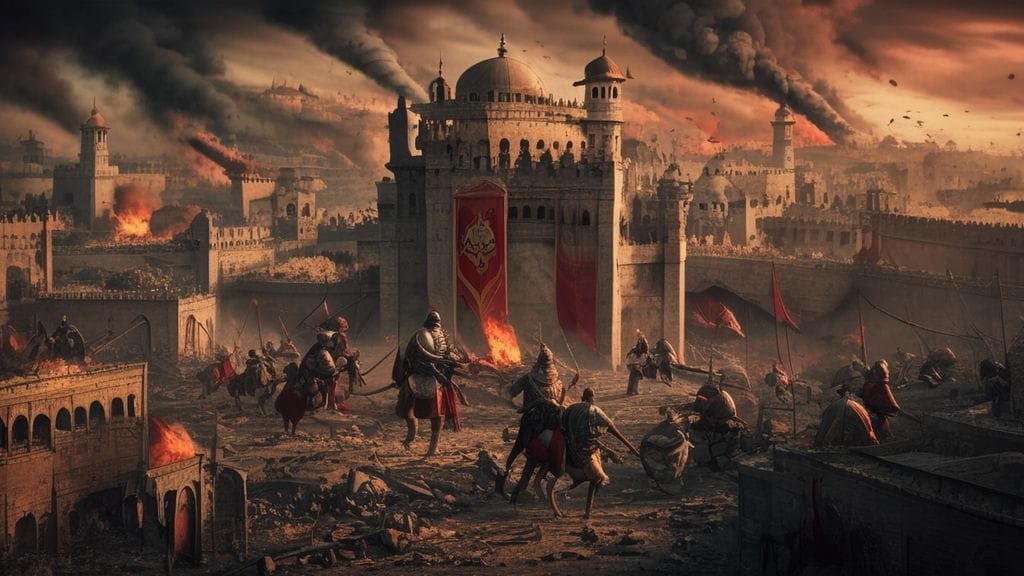
Accounts from the period, though colored by rhetorical exaggeration, are consistent in describing a scene of widespread massacre. Men of fighting age were prime targets for the sword; women and children were dragged away as slaves. Fire followed, both intentional and accidental. Shops were looted, then set alight. Entire neighborhoods burned, the flames whipped by winter winds, their smoke mixing with the smell of blood. The Yamuna reflected the glow of the city’s suffering, its waters seething with the debris of ruined homes.
The sack of Delhi by Timur was not only physical but symbolic. Centers of power and learning—palaces, administrative buildings, and houses of scholars—were stripped of books, instruments, delicate objects, and architectural elements that could be transported. Certain mosques were spared or claimed for prayer by the invaders, serving as markers of a new, if temporary, authority. Other religious structures, particularly Hindu temples but also some shrines and lesser mosques associated with the old regime, were looted or damaged, their wealth appropriated as war booty and their desecration justified in the language of religious purification.
Among the victims were not just elites, but ordinary laborers, artisans, and petty traders whose lives were irrevocably smashed. A potter who had spent decades perfecting his craft might find his kiln smashed and his family taken. A weaver who once supplied fine cloth to the court might watch his loom burned and his sons cut down in the alley. In these countless, unrecorded tragedies, the true human cost of the sack of Delhi by Timur resides.
It is important to stress that this violence was not a chaotic loss of control by Timur’s army. On the contrary, the plunder was systematized. Spoils were gathered into central depots, counted, apportioned according to rank, and prepared for transport back to Central Asia. Slaves were registered and divided, some destined for Samarkand, others for sale in markets along the route. Only after the conqueror and his emirs had taken their share did the lower ranks of soldiers have freer rein to loot what remained.
By the end of those days, Delhi was a haunted city. Streets that had been crowded with carts, animals, and pedestrians now lay strewn with corpses and rubble. Silence, broken only by the sobs of survivors and the crackling of dying fires, descended on a capital that had boasted of its invincibility. The sack of Delhi by Timur had achieved what it intended: the city was broken, its population shattered, its reputation as an imperial center profoundly compromised.
Fire, Plunder, and Desecration: The City Unmade
In the aftermath of the initial onslaught, a second, more insidious phase of the sack of Delhi by Timur unfolded: the systematic unmaking of the city’s infrastructure and social fabric. The first explosions of violence had destroyed lives; the slower grind of plunder and fire destroyed livelihoods.
Markets that once drew traders from distant regions lay in ruin. The great bazaars of Delhi, where saffron from Kashmir, horses from Central Asia, and cotton textiles from across northern India had changed hands, were stripped of goods. Storerooms were emptied. Goldsmiths and jewelers, whether alive or dead, saw their treasures scooped up and melted down. Grain reserves—vital not only for immediate survival but also for stabilizing prices—were seized for the army or burned, signaling looming famine.
Religious sites bore the marks of desecration and reappropriation. Some mosques were used as stables or barracks, others as warehouses for loot. Hindu temples were obvious targets for a conqueror who framed his campaign as a jihad; their idols were smashed, their precious metals removed. Timur’s own chroniclers boasted of this, seeing it as proof of his religious zeal. But even they acknowledged that wealth, not merely piety, drove these acts. In a grimly practical sense, the gods of Delhi were being turned into coin for Samarkand.
Fires consumed entire quarters. Some may have been deliberately set to flush out hiding residents or to destroy properties that could not easily be looted. Others resulted from unattended lamps tipped over in the chaos, from cooking fires that spread through crowded, flammable neighborhoods. Fire, once it leapt from building to building, did not distinguish between the homes of Muslim or Hindu, rich or poor. It was the great equalizer, reducing a century or more of accumulated urban life to ash in a matter of hours.
Infrastructure collapsed. Wells were fouled or damaged, bridges weakened, roads cluttered with debris. The administrative personnel who had kept the machinery of the city running—scribes, tax collectors, judges, and minor officials—were scattered. Some were killed, others fled, and a few attempted, in the shadows, to keep some semblance of order. Yet order without authority and resources is almost impossible. The city’s capacity to feed, police, and govern itself had been gutted.
For those who survived within Delhi’s walls, the following days were a blur of hunger, fear, and disorientation. Families searched desperately for missing members, often finding only bodies. Parents looked into the faces of their children and wondered how they would feed them now that shops were empty and granaries seized. People who had once understood their city as the center of the world suddenly found themselves living in a place that resembled a battlefield more than a capital.
The physical destruction was profound, but the psychological impact may have been even greater. An invisible architecture of trust—the belief that the city, whatever its troubles, would endure—had collapsed. Now, even if the walls still stood in many places, Delhi existed only as a ghost of itself.
Voices from the Ruins: Chroniclers, Survivors, and Silence
The story of the sack of Delhi by Timur reaches us through fractured voices: contemporary chroniclers, later historians, and faint echoes preserved in memory and folklore. Each voice is partial, shaped by its vantage point and purpose. Together, however, they sketch a portrait of catastrophe.
Perhaps the most influential among Timur’s apologists is Sharaf ad-Din Ali Yazdi, who wrote the Zafarnama (“Book of Victory”) in the early fifteenth century. Commissioned by Timur’s descendants, Yazdi’s work presents the conqueror as a near-mythic figure, guided by divine favor. When he describes the Indian campaign, he emphasizes the ruler’s piety, courage, and justice, while downplaying or rationalizing the mass violence. To Yazdi, the sack of Delhi by Timur becomes a necessary chastisement of an errant city, a righteous cleansing drenched in blood but glowing with religious justification.
Other Persian, Arabic, and later Indo-Persian sources offer different details. Some stress the scale of the slaughter, recording numbers that strain credibility precisely because they are meant to convey overwhelming horror. Fluctuating figures—100,000 killed here, 200,000 there—must be read critically. Medieval chroniclers wrote for effect, and numbers were often literary devices rather than precise statistics. Yet even when we discount exaggeration, the pattern they reveal is unmistakable: the violence was immense.
Then there are the silences. The voices of ordinary Delhites—artisans, laborers, women, children—largely vanish into the archives of oblivion. A few anecdotes survive, sometimes embedded in Sufi hagiographies or local histories, of families who fled to shrines for protection or who credited a saint’s intercession with saving them from a soldier’s sword. But in general, the poor and marginalized, who bore the brunt of suffering, left few written records.
Later Indian historians, writing centuries afterward in both Persian and vernacular languages, looked back on 1398 as a moment of rupture. To some, it was divine punishment for the injustices of the Tughlaq rulers. To others, it symbolized the vulnerability of even the mightiest cities to foreign invasion. In Mughal times, the memory of Timur was treated with ambivalence. Babur, founder of the Mughal Empire, proudly traced his lineage to Timur and invoked that heritage as a source of legitimacy. Yet the very dynasty that gloried in its Timurid roots also ruled over the same land once ravaged by its ancestor’s army, and thus had to negotiate the uncomfortable legacy of 1398.
Modern historians, working with surviving chronicles, inscriptions, and material remains, have tried to piece together a more balanced picture. They sift through Yazdi’s praise and hostile Indian accounts alike, triangulating facts where possible. They also remind us that much will never be known: the exact death toll, the precise chain of events in each neighborhood, the individual stories of loss. In these unknowns lies a sobering truth: historical knowledge can illuminate, but it cannot fully resurrect the lives and sensations of those crushed beneath the wheels of empire.
Still, even within the limitations of the sources, the human dimension is undeniable. When we speak of the sack of Delhi by Timur, we are not merely enumerating military maneuvers or political consequences; we are invoking the screams of anonymous victims, the exhaustion of refugees, and the stunned silence that followed the last crackle of dying fires.
Economy in Ashes: Demographic and Commercial Collapse
The immediate spectacle of the sack of Delhi by Timur draws our attention to violence, but the invasion’s long-term impact unfolded more quietly, in the realm of demography and economics. Delhi had been a hub—an entrepôt where goods, people, and capital converged. The sack tore through the delicate networks that sustained this role.
First, the city’s population plummeted. Many died during the assault; many more perished later from injuries, hunger, and disease. Those captured as slaves were marched away, their labor and reproductive potential removed from the region entirely. Others fled into the countryside and surrounding towns, unsure whether it was safer to risk banditry on the road or to remain in a city associated with recent trauma and rumored to be cursed by God.
The loss of population had a cascading effect. Fewer artisans meant fewer goods produced for local use and for trade. Skilled specialists—architects, calligraphers, metalworkers—were particular targets for deportation to Central Asia. Timur, paradoxically, destroyed Delhi in large part to build up Samarkand and other cities under his rule. The human capital that had accumulated in the Indian capital over generations was abruptly redirected northward, enriching the conqueror’s homeland at Delhi’s expense.
Commercially, the city’s markets went into shock. Networks of trust that underpinned credit, long-distance trade, and partnerships were shattered when key players were killed or displaced. Merchants from distant lands, hearing of Delhi’s fate, hesitated to commit caravans to a city that no longer guaranteed security or demand. Regional trade rerouted itself toward other centers—Jaunpur, Gujarat, Bengal, and, in time, the rising sultanates and kingdoms that filled the vacuum left by Delhi’s decline.
Agricultural production in the surrounding regions also suffered. Fields left untended during wartime overgrew with weeds; irrigation networks damaged by neglect or warfare fell into disrepair. Peasants who had fled to escape conscription or looting were slow to return. The Sultanate’s already strained tax system faltered further, as revenues from the devastated capital and its hinterlands dwindled.
In economic terms, the sack of Delhi by Timur accelerated a shift that was already underway: the decentralization of power and prosperity in northern India. Where once Delhi had stood as the almost unchallenged center, now it became just one among several contested nodes of authority. New regional capitals rose in importance, and the dream of a tightly centralized empire ruled from the Yamuna receded, at least for a time.
For ordinary people, these macro-level changes manifested as daily hardship. Food prices spiked when grain supplies were interrupted. Jobs disappeared as workshops closed and construction projects halted. Security deteriorated, with bandits and warlords exploiting the weakened state presence. The trauma of the sack was not an isolated event but the start of a grinding period of instability whose scars lasted for generations.
Religious Zeal, Political Calculation: Why Timur Struck Delhi
Why did Timur turn his armies toward India, and why did he attack Delhi with such ferocity? Historians have long wrestled with these questions, parsing the conqueror’s proclamations and behavior for clues. The answer, as so often in history, lies in the interplay of ideology and interest.
Publicly, Timur framed his Indian campaign as a righteous war. He presented himself as a champion of Islam, punishing both “idolaters” and Muslim rulers who failed, in his view, to enforce proper orthodoxy. The Delhi Sultanate, with its complex religious landscape and its accommodation of non-Muslim subjects, became an easy target for this rhetoric. Timur’s chroniclers emphasize how he destroyed temples and forced conversions, portraying him as a purifying fire sweeping away heresy.
Yet this religious narrative, while not purely cynical, cannot be taken at face value. Timur’s record elsewhere shows a flexibility that undercuts the notion of a single-minded holy warrior. He could ally with certain non-Muslim rulers when it suited his interests and he did not always act against religious “deviance” when doing so might undermine his political or economic gains. His piety was real enough, but it coexisted with a hard-headed sense of strategy.
Delhi, viewed through this strategic lens, offered irresistible temptations. It was a wealthy city, sitting near the crossroads of internal Indian trade and connected to wider commercial circuits that linked it, indirectly, to the Islamic heartlands. The sack of Delhi by Timur promised enormous loot: bullion, precious stones, textiles, horses, and human captives. Additionally, success against such a famed capital would enhance his prestige immensely, reinforcing his image as a world-conquering ruler in the mold of Genghis Khan.
There were also geopolitical considerations. By punishing Delhi, Timur could weaken a potential rival or threat in the east, even if that threat was currently hamstrung by internal decay. He could also raise his standing among neighboring Islamic polities by presenting his campaign as a blow against heterodoxy and laxity. In a world where rulers competed not only for territory but also for moral authority, this mattered.
Ultimately, it is the convergence of these motives—religious zeal, economic greed, and political calculation—that led to the invasion. Timur was not unique in cloaking expansion in piety, but he was unusually effective in turning that cloak into both shield and sword: a shield against criticism, a sword that cut through resistance by sanctifying violence.
The sack of Delhi by Timur thus serves as a chilling example of how men of power can convert abstract ideals into instruments of concrete brutality, persuading themselves and their followers that the spilling of blood is not only permissible but virtuous.
From Delhi to Samarkand: Spoils, Captives, and Cultural Transfer
Once the plunder of Delhi had been gathered and the city cowed, Timur turned to the next phase of his plan: the orderly extraction of its riches and talent. Conquest, for him, was not an end but a means. The true prize lay in what he could carry away to adorn Samarkand and his other Central Asian possessions.
Columns of laden camels and carts began to form. Gold and silver ingots, coins stamped with the names of Delhi’s sultans, jewels pried from palace treasuries, rare textiles, and ceremonial weapons—all were bundled and cataloged. Slaves of all kinds were herded together: artisans, musicians, scribes, scholars, soldiers, and common laborers. Many would never again see the land of their birth. Their world shrank to the dust beneath their feet and the sound of the lash.
Artisans, in particular, were prizes. Timur had long practiced a strategy of selective deportation, using conquered cities as quarries from which to mine human expertise. From Delhi, he took builders, stonemasons, calligraphers, and metalworkers whose skills would later leave their mark on structures far from India. When we admire the intricate tile work and architectural refinement of Timurid-era monuments in Samarkand and Herat, we are also—though often unknowingly—witnessing the afterlife of craftspeople uprooted by violence from places like Delhi.
This flow of people and objects was a form of cultural transfer, albeit one born of brutal coercion. Indian techniques, motifs, and knowledge seeped into the creative milieu of Central Asia, mingling with Persian, Turkic, and Mongol influences. Music, textiles, and perhaps even certain architectural ideas crossed the mountains in the wake of the conqueror’s banners.
Meanwhile, Timur prepared his departure. He had no interest in ruling Delhi directly or attempting to knit India into his empire as a stable province. The sack of Delhi by Timur had been designed as a raid on a colossus, not as the foundation of a new administrative order. With winter advancing and his objectives achieved, he began to withdraw his forces, leaving behind a broken capital and a vacuum of power.
For the captives forced to march with him, each step away from Delhi was a step deeper into exile. Some may have nurtured fragile hopes of escape; others resigned themselves to a new life under Timurid masters. Their stories, for the most part, dissolve into the larger history of Timurid Central Asia, their individual identities subsumed under the category of “Indian artisans” or “Hindustani slaves” in the chronicles. Yet their influence endured, inscribed in stone and story along the Silk Road.
Delhi After the Storm: Power Vacuums and Haunted Streets
When Timur’s army finally moved away from Delhi, the city did not spring back to life. It staggered. The sack of Delhi by Timur had ripped out not only people and property but also the connective tissues of governance and trust that made urban life possible.
The Tughlaq dynasty, already tottering before the invasion, never recovered in any meaningful way. Sultan Nasir-ud-Din Mahmud, who had fled during the crisis, retained only the faintest shadow of authority. In the power vacuum, ambitious nobles and regional strongmen jostled for control. New dynasties would soon arise to claim the legacy of Delhi, among them the Sayyids and later the Lodis, but their grip remained tenuous in the early years. The city, once the commanding center of a subcontinental empire, found itself reduced to a contested prize in a fractured political landscape.
For ordinary residents, politics might have seemed like a distant game. Their more immediate concerns were survival and reconstruction. Families returned cautiously to their old neighborhoods, picking through rubble to salvage whatever remained. Some streets were virtually empty, their former inhabitants dead or dispersed. Wells had to be cleaned and repaired, basic infrastructure rebuilt, markets reestablished at a modest scale.
Yet even as life resumed in halting steps, the specter of December 1398 hung over everything. Every cracked wall and blackened foundation was a reminder of what had happened. The wealthy who survived may have tried to recreate some semblance of their previous lifestyles, but trust in the security of property and status had been deeply shaken. Merchants weighed the risks of investing in a city that had so recently been proven vulnerable to catastrophic assault.
Religious life, too, bore scars. Some shrines and mosques had been desecrated or repurposed during the occupation. Re-sanctifying these spaces required ritual, resources, and, perhaps most importantly, a renewal of communal confidence. Sufi saints and scholars played a role in this process, offering narratives of resilience and divine testing. Yet not all believers found comfort in these explanations. For some, the sack of Delhi by Timur called into question the justice of God or the reliability of rulers who claimed to govern in God’s name.
Over time, Delhi did rebuild, its population slowly refilling its quarters, its markets regaining some vibrancy. But it was a different city—poorer, more cautious, less certain of its destiny. The memory of 1398 lingered as a warning that no fortification, no imperial boast, could guarantee safety against the ambitions of men like Timur.
The Long Shadow: How 1398 Shaped the Subcontinent
The sack of Delhi by Timur was not just a traumatic episode; it was a hinge in the history of the Indian subcontinent. Its repercussions rippled outward for decades, reshaping political geography, patterns of trade, and the psychology of power.
Politically, the weakening of the Delhi Sultanate opened the door for regional powers to expand. In the north and east, the Jaunpur Sultanate rose as a formidable state, drawing strength from territories and populations that might once have looked primarily to Delhi. In the west and south, Gujarat, Malwa, and the Deccan sultanates consolidated their autonomy. The dream of a single, centralized authority over much of northern India did not vanish, but it fractured, becoming one vision among many competing projects.
This fragmentation created both instability and opportunity. On the one hand, constant rivalry among regional states led to frequent warfare, raids, and shifting alliances, all of which imposed hardships on ordinary people. On the other hand, multiple centers of patronage and trade enabled cultural and economic diversification. Cities like Ahmedabad, Jaunpur, and later Agra flourished as alternative hubs, each nurturing distinct architectural styles, literary traditions, and mercantile communities.
The memory of Timur’s raid also affected how later rulers conceived of defense and legitimacy. Fortification strategies evolved, with greater attention paid to regional strongholds and fortified capitals that might resist future invasions from the northwest. Some rulers sought to bolster their religious legitimacy more overtly, presenting themselves as champions of orthodoxy or as patrons of Sufi orders, in part to avoid the charge of impiety that Timur had leveled against Delhi’s sultans.
In the longer run, the weakened state of northern India became a factor in the success of Babur, Timur’s descendant, when he invaded in the early sixteenth century and founded the Mughal Empire. Though over a century had passed since 1398, the political landscape he encountered still bore the imprint of that earlier catastrophe: competing sultanates, fragile alliances, and a Delhi that, while still symbolically important, no longer held unquestioned primacy. Babur’s own writings reference his Timurid heritage with pride, implicitly linking his conquest to the legacy of his formidable ancestor.
Thus, the sack of Delhi by Timur can be seen as part of a chain of events that, paradoxically, helped set the stage for another, more enduring Central Asian dynasty to take root in India. The city would rise again under the Mughals, transformed by new waves of immigrants, artisans, and patrons—but it could never completely erase the memory of the winter when it was forced to its knees.
Myth, Memory, and Historians: Interpreting Timur’s Invasion
Over the centuries, the sack of Delhi by Timur has been told and retold, each generation casting it in new lights. For some, it became a cautionary tale about moral decay and divine punishment; for others, an example of foreign barbarity; for still others, a source of dynastic legitimacy.
In popular memory and folklore, Timur often appears as a figure of almost supernatural cruelty. Stories exaggerate his atrocities to emphasize the terror he inspired. Parents, it is said in some traditions, would invoke his name to frighten disobedient children: behave, or Timur will come for you. These tales, however apocryphal, reflect the deep impression his invasion made on the cultural psyche.
Among Muslim historians writing in India, especially during the Mughal and post-Mughal periods, assessments of Timur were often ambivalent. On the one hand, he was venerated as an ancestor by the Mughals, a lineage that linked Indian emperors to the illustrious conqueror of Iran and Central Asia. On the other hand, his destruction of Delhi raised uncomfortable questions. How could a supposedly just and pious Muslim ruler ravage a major center of Islamic learning and culture?
European colonial historians, writing in the nineteenth and early twentieth centuries, tended to use Timur’s invasion as evidence of an alleged pattern of “oriental despotism” and recurring cycles of brutal conquest in Asian history. They contrasted this, often self-servingly, with their own imperial rule, which they portrayed as more rational, lawful, and progressive. Such narratives downplayed indigenous resilience and agency, reducing complex societies to passive victims in need of Western “civilization.”
Modern scholarship has pushed back against these simplifications. Historians now emphasize the need to read medieval sources critically, recognizing their literary conventions, biases, and political contexts. They stress that while the sack of Delhi by Timur was undeniably horrific, it was not unique in world history—comparable devastations can be found in the annals of many other regions and eras, from Rome’s sacks to the ravages of the Thirty Years’ War.
At the same time, contemporary historians insist on foregrounding the human suffering that older, more triumphalist narratives often glossed over. They ask: what did it mean, concretely, for tens of thousands of people to lose their homes, families, and livelihoods in a matter of days? How did communities rebuild, adapt, or relocate in the decades that followed? These questions draw our attention away from great men and toward the experiences of ordinary women and men swept up in the storms of high politics.
In this way, the historiography of Timur’s invasion has become a kind of mirror, reflecting changing assumptions about power, morality, and the purpose of writing history itself.
Echoes of 1398 in Modern India and Central Asia
Today, more than six centuries after the sack of Delhi by Timur, its echoes can still be heard, though sometimes faintly, in the political discourse and cultural memory of both India and Central Asia. The events of 1398 are no longer at the forefront of public consciousness, yet they surface at charged moments, invoked to make sense of contemporary anxieties.
In India, references to Timur’s invasion occasionally appear in debates about foreign conquest, religious violence, and national identity. Some nationalist narratives emphasize the sack as emblematic of a broader pattern of invasions from the northwest, using it to frame a long, embattled history of the subcontinent. Such invocations often simplify the past, flattening its complexity into a stark binary of invader and victim, Muslim and Hindu, foreign and native. They risk obscuring the multi-layered reality of medieval India, where alliances and enmities frequently cut across religious lines and where rulers like the Tughlaqs and Mughals, though of Central Asian origin, became deeply rooted in the subcontinent’s soil.
In Central Asia, Timur (Amir Temur) has been rehabilitated in recent decades as a national hero, particularly in Uzbekistan. Monuments, museums, and public art celebrate him as a founder of statehood and patron of culture. This modern image tends to highlight his patronage of architecture and scholarship in Samarkand while downplaying or reframing his most brutal campaigns. The destruction of Delhi, if mentioned at all in public commemorations, is often contextualized as part of a broader pattern of medieval warfare, not as an exceptional atrocity.
These divergent memories underscore how history is not only about what happened but about how communities choose to remember and use what happened. For residents of Delhi today, the city’s long history includes many episodes of conquest and reconstruction. The ruins of earlier dynasties coexist with bustling modern neighborhoods and government buildings. The specific trauma of 1398 may be less immediate than the more visible remnants of Mughal, colonial, and postcolonial transformations.
Yet, when historians, writers, or filmmakers explore themes of invasion and resilience, Timur’s campaign still offers a potent symbol. It invites reflection on the fragility of cities, the vulnerability of civilians in war, and the ways in which power can justify almost any act in the name of higher ideals. In an age when urban centers around the world remain targets of violence, the story of Delhi’s sack resonates as more than a distant medieval tragedy; it stands as a warning about what can happen when ambition, ideology, and military might converge without restraint.
Conclusion
The sack of Delhi by Timur in December 1398 was a week of terror that reshaped centuries. What began as a calculated campaign launched from distant Samarkand culminated in the devastation of one of the medieval world’s greatest cities. The story arcs from a decaying Delhi Sultanate and a rising Central Asian conqueror to a battlefield on the city’s outskirts, through three days of orchestrated horror, and into a long, painful aftermath of depopulation, economic collapse, and political fragmentation.
Along the way, we see how ideology and ambition intertwined. Timur justified his invasion as a holy war, but beneath the religious rhetoric lay hard-headed strategic and economic calculations. The sack of Delhi by Timur was as much about treasure and prestige as it was about piety. Its victims were not abstract entities—“the Sultanate,” “the city”—but individual men, women, and children whose lives were shattered in moments of brutal encounter.
The consequences echoed far beyond Delhi’s walls. The weakening of the Delhi Sultanate opened space for new regional powers and, eventually, made possible the rise of another Timurid line in India: the Mughals. Cultural transfers, born of coerced migration and pillage, linked North India to Central Asia in ways both creative and tragic. For historians and citizens alike, the events of 1398 offer a stark reminder of how quickly political decay can invite external predation, and how fragile even the most imposing urban civilizations can be.
To revisit the sack of Delhi by Timur today is not to indulge in morbid fascination but to confront enduring questions about violence, memory, and responsibility. Who tells the story of conquest, and for whose benefit? How do we honor the suffering of those whose names were never recorded? And how might such knowledge shape the choices we make in our own time, in cities that may feel secure but, as Delhi once did, stand always on history’s uncertain ground?
FAQs
- When did Timur sack Delhi?
The sack of Delhi by Timur took place in December 1398, with the decisive battle occurring on 17 December and the most intense phase of looting and massacre unfolding over the following days. - Why did Timur invade the Delhi Sultanate?
Timur invaded for a combination of reasons: to enrich himself and his state through massive plunder, to enhance his prestige by conquering a major capital, to weaken a potentially rival power, and to present himself as a champion of Islam punishing what he portrayed as an impious and disorderly regime. - How many people died during the sack of Delhi by Timur?
Exact numbers are impossible to determine. Medieval chroniclers provide figures ranging from tens of thousands to several hundred thousand, but these are often exaggerated. Modern historians agree that the death toll was enormous, involving large segments of the city’s population and captured prisoners from earlier battles. - What happened to the Delhi Sultanate after Timur’s invasion?
The Delhi Sultanate was severely weakened. The Tughlaq dynasty lost much of its authority, and in the ensuing decades, new dynasties and regional states—such as the Sayyids, Lodis, and sultanates in Jaunpur, Gujarat, and the Deccan—rose to prominence. Delhi remained important but no longer held uncontested sway over northern India. - Did Timur rule India after conquering Delhi?
No. Timur did not attempt to establish a permanent administration in India. After plundering Delhi and extracting wealth and captives, he withdrew his forces back toward Central Asia, leaving behind a devastated city and a power vacuum. - How did the sack of Delhi by Timur affect the economy and society of the region?
The invasion caused massive population loss, disruption of trade networks, destruction of markets and infrastructure, and the deportation of skilled artisans and laborers. It accelerated the decline of Delhi as the dominant economic and political center in northern India and contributed to the rise of alternative regional hubs. - What sources do historians use to study Timur’s sack of Delhi?
Historians rely on Persian chronicles such as Sharaf ad-Din Ali Yazdi’s Zafarnama, Indo-Persian histories written in later centuries, some local accounts, and modern archaeological and epigraphic evidence. These sources are compared and critically analyzed to account for bias, exaggeration, and political agendas. - Is Timur remembered differently in India and Central Asia?
Yes. In parts of India, Timur is chiefly remembered as a brutal invader whose armies devastated Delhi. In Central Asia, especially Uzbekistan, he is often celebrated as a state-builder and patron of culture, with his most destructive campaigns, including the one against Delhi, given less emphasis or cast in a more neutral light.
External Resource
Internal Link
Other Resources
- Encyclopaedia Britannica – general search for the exact subject
- Google Scholar – academic search for the exact subject
- Internet Archive – digital library search for the exact subject

