Table of Contents
- The Road to December 1240: Kievan Rus’ on the Eve of Catastrophe
- From the Steppes to the Dnieper: How the Mongol Storm Reached Kiev
- A City of Bells and Icons: Life in Kiev Before the Siege
- Warnings Ignored: Early Mongol Encounters and Political Paralysis
- The Khan’s Command: Batu, Subutai, and the Strategy of Conquest
- Encircled by Fear: The Siege of Kiev Begins
- Walls Under Thunder: Siege Engines, Winter, and Failing Hope
- The Final Assault: Breaching the Gate of the Golden-Domed City
- Three Days of Fire: Massacre, Plunder, and the Fall of Kiev
- Ruins and Survivors: Voices from a Shattered Metropolis
- A New Order from the Ashes: Mongol Rule over Rus’ Lands
- The Long Shadow: Economic and Cultural Consequences of the Sack
- Faith Under Fire: The Orthodox Church, Relics, and Spiritual Trauma
- From Kiev to Moscow: Shifting Centers of Power in the Rus’ World
- Memory, Chronicle, and Legend: How the Sack of Kiev Was Remembered
- Europe Awakes: Western Reactions to the Mongol Conquests
- Debates Among Historians: Interpreting the Fall of a Medieval Capital
- Echoes in Modern Identity: Kiev, Empire, and the Uses of History
- Conclusion
- FAQs
- External Resource
- Internal Link
Article Summary: The sack of kiev by mongols in December 1240 marked one of the most devastating turning points in Eastern European history, when the flourishing capital of Kievan Rus’ was crushed under the hooves of Batu Khan’s armies. This article traces the long road to that catastrophe, from the fragmented politics of the Rus’ princes to the relentless expansion of the Mongol Empire across the Eurasian steppe. Moving chronologically, it paints a vivid portrait of Kiev before the siege, then follows the tightening noose of the Mongol campaign, the terror of the final assault, and the human stories of survivors picking through the ruins. It explores how the sack of kiev by mongols reshaped trade routes, political power, and religious life, ultimately contributing to the rise of new centers like Moscow. At the same time, it examines how medieval chroniclers, later historians, and modern nations have remembered and repurposed this traumatic event. By weaving eyewitness reports, statistics, and narrative reconstruction, the article shows why the sack of kiev by mongols still resonates in debates about empire, identity, and resilience. It also situates this event in the wider European context, where the Mongol invasions sparked both dread and fascination, and asks how our understanding of the sack of kiev by mongols has evolved over time.
The Road to December 1240: Kievan Rus’ on the Eve of Catastrophe
On the morning of 6 December 1240, Kiev—once praised as the “mother of Rus’ cities”—awoke under a steel-gray winter sky, its frozen roofs and golden domes glittering faintly in the muted light. By nightfall, much of that city lay in cinders and corpses, its streets choked with rubble, its churches looted, its people massacred or led away in chains. The sack of kiev by mongols was not a sudden thunderbolt from a clear sky. It was the culmination of decades of political weakness, fraternal wars, and a failure to understand the new kind of enemy galloping in from the steppe.
In the century before the Mongols came, Kievan Rus’ had already begun to fray. The dynasty founded by the Riurikids ruled a broad network of principalities—from Novgorod in the north to the Black Sea steppes in the south—but unity existed more on parchment and in prayers than in practice. Princes warred with cousins over towns and tribute; cities hired steppe allies one year and fought them the next. As trade along the Dnieper and Volga shifted, and as new powers like Vladimir-Suzdal asserted themselves, Kiev’s political and economic centrality slowly eroded.
Yet from within the city’s walls, decline was not always visible. Pilgrims still came to venerate the relics in the Pechersk Lavra, merchants still jostled in its markets, and envoys still climbed its hills to negotiate alliances. Kiev was smaller than Constantinople or Baghdad, but it was a metropolis by East European standards—a place where Scandinavian, Slavic, Turkic, and Byzantine worlds met. Few of its inhabitants could imagine that within a single season their city would be subjected to a ferocity that would echo in chronicles for centuries, that the sack of kiev by mongols would become a shorthand for total, almost apocalyptic destruction.
To understand why, on that cold December day, Mongol siege engines rolled up to its walls and fires soon devoured its quarters, we must step back. The fall of Kiev was not only about the genius of Mongol commanders or the stubbornness of its defenders. It was about an entire region caught between older patterns of warfare and a new, highly organized imperial machine, between local rivalries and global forces. The road to the catastrophe of 1240 runs through internecine feuds, underestimated reconnaissance raids, and the slow, steady tightening of Mongol control over the steppe that had long been both threat and opportunity to the Rus’ princes.
From the Steppes to the Dnieper: How the Mongol Storm Reached Kiev
The Mongols did not appear out of nowhere at the gates of Kiev. Their horses had been drinking from the rivers of Eastern Europe for more than a decade by the time the city fell. Under Genghis Khan, they had smashed the Khwarazmian Empire in Central Asia; under his successors, they pushed westward, drawn by the promise of plunder, new pastures, and strategic depth. The Eurasian steppe was their highway, and they rode it with unmatched speed and coordination.
In 1223, years before the sack of kiev by mongols, the first Mongol vanguard made contact with the Rus’ princes. Led by the brilliant general Subutai and Jebe Noyan, they pursued a fleeing Khwarazmian prince across the Caucasus and into the Pontic steppe. Alarmed, several Rus’ princes formed a coalition with their sometimes-enemies, the Cumans (Kipchaks). Their united host met the Mongols on the Kalka River. The result was a disaster. The Mongols feigned retreat, lured the coalition into disarray, then encircled and annihilated it. Several princes were captured and reportedly executed under planks on which the Mongols feasted—killing their foes without spilling “royal blood” on the earth.
Yet after this crushing victory, the Mongols turned back east. Many in Kievan Rus’ misread this withdrawal. They saw it as a one-off raid, a terrifying but temporary incursion. The Mongols, however, were gathering intelligence. Subutai had mapped the rivers, noted the strengths and weaknesses of the principalities, and evaluated their capacity for resistance. When the great western campaign began in earnest in the late 1230s, culminating in the sack of kiev by mongols, it did so with careful planning, not reckless fury.
By 1237, Batu Khan—grandson of Genghis Khan—had been appointed to lead the western campaign, guided by the strategic mind of Subutai. Their armies crossed the Volga and started with the principalities of the northeast. Ryazan fell first, then Vladimir, Suzdal, and other cities whose wooden walls burned easily under Mongol fire. Chroniclers described “rivers of blood” and churches filled with corpses. Whether or not the numbers they gave—hundreds of thousands slain—are accurate, the psychological effect was real. Refugees fled west and south, bringing with them tales of invincible cavalry, unstoppable siege machines, and leaders who seemed to appear at once everywhere and nowhere.
By the time Mongol columns probed towards the Dnieper, Kiev was no longer an isolated prize. It was the next major node in a campaign that had already reduced other Rus’ centers and cowed many local rulers. Some princes submitted early, sending tribute and hostages to Batu in exchange for a fragile peace. Others, like Daniel of Galicia-Volhynia, maneuvered between resistance and accommodation. Kiev, however, sat exposed, politically weakened and militarily underprepared, directly in the path of an army whose momentum had not yet been broken.
A City of Bells and Icons: Life in Kiev Before the Siege
To feel the full weight of what was lost in the sack of kiev by mongols, we must first step inside the city as it was in the years before 1240. Imagine approaching from the river, the Dnieper broad and icy, barges tied along its banks, their hulls heavy with wax, furs, honey, and grain. Above you rises a cluster of hills, crowned by churches whose domes flash gold and green in the sun—St. Sophia with its grand mosaics, the caves and churches of the Pechersk Lavra, and numerous parish shrines guarding neighborhoods of wooden houses.
Kiev was not a city of stone in the way Constantinople was, but it was not a mere timber fort either. The Detinets, or upper town, held the princely palace and key churches behind earthen ramparts crowned with timber palisades. Below and around it sprawled suburbs—Posads—where craftsmen and traders lived. Archaeology reveals workshops for metalworking, jewelry, and ceramics, as well as imported goods from distant lands: Byzantine amphorae, Islamic coins, Scandinavian ornaments. Bells rang out from churches at appointed hours, and the chanting of monks drifted across the snow on clear mornings.
Daily life was a paradoxical mixture of stability and unease. While trade routes had shifted somewhat northward, the city still served as a hub on lines connecting the Baltic, the steppe, and the Black Sea. Markets bustled, and the legal codes of the Rus’, such as the “Russkaya Pravda,” regulated disputes over debt, injury, and land. Yet just beyond the line of the horizon, steppe raiders and rival princes contested grazing lands and frontier towns. People knew what war was; they knew what famine and fire were. What they did not yet know was industrialized terror, carefully orchestrated massacre, and the deliberate annihilation of an urban center as a warning to others.
Religious life saturated Kiev. The city was a beacon of Orthodoxy, its bishops participating in theological disputes with Constantinople, its monasteries copying texts and cultivating a sense of sacred history that linked the Rus’ to both biblical Israel and Christian Rome. In churches, frescoes depicted saints and martyrs, halos bright against deep blue walls. These same walls would soon be blackened by smoke and splattered with blood. But in the years just before the siege, no one could imagine the icons torn from their settings as spoils of war, or the reliquaries smashed open by foreign hands searching for gold.
Warnings Ignored: Early Mongol Encounters and Political Paralysis
News of the Mongols’ advance did not come to Kiev as a rumor whispered once and forgotten. It arrived in waves: terrified refugees from the northeast, merchants whose routes had been cut off, and messengers bearing letters and pleas for aid. Chronicles mention envoys bringing reports of the sack of Ryazan and the burning of Vladimir. Smoke on distant horizons was sometimes said to be visible for days. Kiev’s leaders were not blind. But they were caught in the net of their own fractured politics.
The principality of Kiev in the late 1230s was a prize contested by various Riurikid princes. Its throne changed hands more than once in the decades leading up to the sack of kiev by mongols. Loyalties ran not along national lines—such a concept did not yet exist—but along personal, dynastic, and local ones. When one prince was installed in Kiev, another sulked in a rival city, nursing grievances and plotting a return. In this atmosphere, the idea of a united front against an external enemy was difficult to realize.
Moreover, the Mongols employed tools of psychological warfare that amplified this paralysis. They often offered cities the chance to surrender and pay tribute. Those who accepted might be spared full destruction; those who refused were made into horrific examples. This created a cruel calculus for local rulers: resist and risk annihilation, or submit and risk losing prestige—and perhaps eventually being replaced by another, more compliant prince endorsed by Batu.
In some cases, the Mongols sent envoys demanding submission. The killing of those envoys by certain Rus’ rulers, echoing earlier affronts to Genghis Khan by Khwarazmian governors, confirmed for the Mongols that diplomacy had limits in this land. It also provided them, in their own eyes, with justification for unrestrained vengeance. Meanwhile, appeals for help to Western powers and the papacy met with sympathy but little concrete aid. Europe was disunited, and few believed that the Mongol storm, still distant, would soon test their own defenses.
Within Kiev, debates must have raged. Some argued for negotiation, others for fortifying the walls and trusting in God and steel. But time was short, and the city’s ability to mobilize a large, well-trained army had eroded. Mercenaries and allied contingents could be called, yet coordination among various princes’ retinues was fraught. By the time Batu’s banners appeared in the south and east, the city had not forged the united, disciplined resistance the moment demanded.
The Khan’s Command: Batu, Subutai, and the Strategy of Conquest
To the inhabitants of Kiev, the Mongols might have seemed a faceless horde, a raging mass of horsemen with no clear center. In reality, their armies were led by men of formidable skill. Batu Khan, a grandson of Genghis, combined dynastic legitimacy with personal ambition. Subutai, often regarded by historians as one of the greatest generals in history, served as his key strategist. Together, they oversaw an operation that stretched from the Volga to Central Europe, with Kiev as a critical node.
The Mongol method of warfare, honed across Asia, was a fusion of mobility, intelligence, and ruthless discipline. Their forces were organized in decimal units—tens, hundreds, thousands, and tens of thousands (tumens)—each responsible collectively for the actions of their members. Spies and scouts rode far ahead, gauging the terrain, counting enemy troops, and testing defenses. Siege engineers, many of them recruited or coerced from conquered peoples like the Chinese and Persians, accompanied the army, bringing with them knowledge of catapults, siege towers, and other machines.
For Batu and Subutai, Kiev was both an objective and a message. As a former capital and spiritual center of Kievan Rus’, its fate would resonate. A city that resisted and was then crushed would demonstrate the futility of defiance; a city that submitted might serve as an administrative hub for the new order. When the envoys’ terms were not accepted, the logic of Mongol warfare dictated what would follow. As one later chronicler paraphrased their attitude, “Submit and live as slaves, or resist and die in the ruins of your pride.”
The campaign towards Kiev was carefully staged. The Mongols did not ride directly at the city at full gallop. They cleared the surrounding regions, neutralized potential allies, and secured supply lines. Winter, usually the enemy of armies, was an ally to the Mongols: frozen rivers became highways carrying horses and carts, and the lack of foliage made ambushes more difficult. By late 1240, the city stood increasingly isolated, its hinterland devastated, its communications with other principalities fragile at best.
Encircled by Fear: The Siege of Kiev Begins
As winter closed in, the distant thunder of hooves became a constant drumbeat in the minds of Kiev’s residents. Scouts and refugees confirmed that the Mongols were approaching from multiple directions. Smoke columns on the horizon were not the smoke of hearths but of burning villages. Step by step, the noose tightened. The sack of kiev by mongols was no longer an abstract fear; it was a coming fact.
Inside the city, preparations accelerated. Walls were repaired where possible, ditches cleared, gates reinforced. Stores of grain and salt were brought in from surrounding areas, though much had already been lost to earlier Mongol raids. Artisans, in addition to their normal trades, worked to produce weapons, patch armor, and perhaps even contribute to reinforcing siege points. Yet everyone knew that the defenders were outnumbered and, crucially, lacked the sophisticated siege experience that the Mongols now wielded with confidence.
At some point in late November or early December, Mongol forces fully invested the city. Chroniclers describe them encircling Kiev, cutting it off from aid. Banners bearing the symbols of the Mongol princes fluttered in the icy wind; campfires ringed the hills. Their siege engines—catapults, battering rams, and mobile shelters—were assembled from local timber and prefabricated elements carried with the army. The defenders on the walls watched this with a mixture of horror and grim determination.
Negotiations, if any, were brief and fruitless. Some sources claim that Batu demanded unconditional surrender and that the city’s leaders refused, hoping for a miracle or at least a negotiated leniency that would preserve their status. Others suggest that internal divisions hampered coherent decision-making. Whatever the precise details, the result was the same: the Mongols prepared to take the city by force.
Walls Under Thunder: Siege Engines, Winter, and Failing Hope
The days that followed were a torment of sound and silence. Some mornings, the city woke to an eerie stillness, broken only by the creak of frost and the murmur of prayers. On others, the air shook with the impact of stones hurled by Mongol catapults. These machines, sometimes described by Rus’ chroniclers as “petraries” or “stone-throwers,” could smash wooden fortifications, collapse towers, and rain death onto the defenders within the walls.
Defenders responded as best they could. Archers loosed arrows from atop ramparts, targeting the crews of siege engines; stout-hearted men attempted sorties to burn or dismantle the machines, dashing out through gates under cover of darkness. Women and children carried stones, water, and materials to reinforce the struck sections of wall. Monks and priests processed with icons along the battlements, chanting litanies and sprinkling holy water on the defenses, invoking divine aid against enemies whose language, armor, and tactics seemed wholly alien.
But winter favored the besiegers as much as the besieged. The Mongol army, accustomed to harsh climates, was well-organized to live off the land and its herds. Their horses scraped snow aside to reach grass; their supply systems, though stretched, had been tested in campaigns even farther afield. Inside Kiev, however, food was finite, and each passing day consumed precious stores. As the siege lengthened, hunger would have joined fear as a constant companion.
Modern historians, piecing together fragmentary accounts, debate exactly how long the siege lasted—some suggest only days of full bombardment, others a couple of weeks. What is clear is that by early December the defenders’ hope was crumbling. The once imposing fortifications, a source of civic pride, were being systematically reduced. Gaps appeared in the ramparts; towers leaned or fell. Each collapse cost lives and morale. The knowledge that other Rus’ cities had been annihilated earlier in the campaign gnawed at the minds of those on the walls. If Ryazan and Vladimir could fall, why would Kiev be spared?
The Final Assault: Breaching the Gate of the Golden-Domed City
Every siege has a breaking point. For Kiev, that moment came when Mongol engineers, under cover of sustained bombardment, focused their efforts on a specific segment of the defenses. Chronicles speak particularly of the Lyadski Gate—one of the city’s main entrances—being shattered or undermined. Whether by stone projectiles, sapping, or a combination of both, the barrier that held back the Mongol tide finally gave way.
On or about 6 December 1240, the breach was opened. Trumpets or horns would have sounded in both camps—signals for attack and alarm. Mongol cavalry and infantry surged towards the gap, some protected by mobile wooden screens, others by raw speed and numbers. Defenders, led by the city’s prince and his druzhina (retinue), rushed to plug the hole. Hand-to-hand combat erupted in the choking dust and splintered timber of the fallen gate.
For a few desperate hours, Kiev’s fate hung on that churned patch of ground. Chroniclers describe the defenders fighting “from morning till noon” or even “until evening,” though exact durations are impossible to verify. What matters is that they resisted fiercely enough for even enemy accounts to acknowledge their courage. According to one later account cited by historian Janet Martin, the struggle at the breached gate was so intense that “the dead piled up like sheaves in a field.”
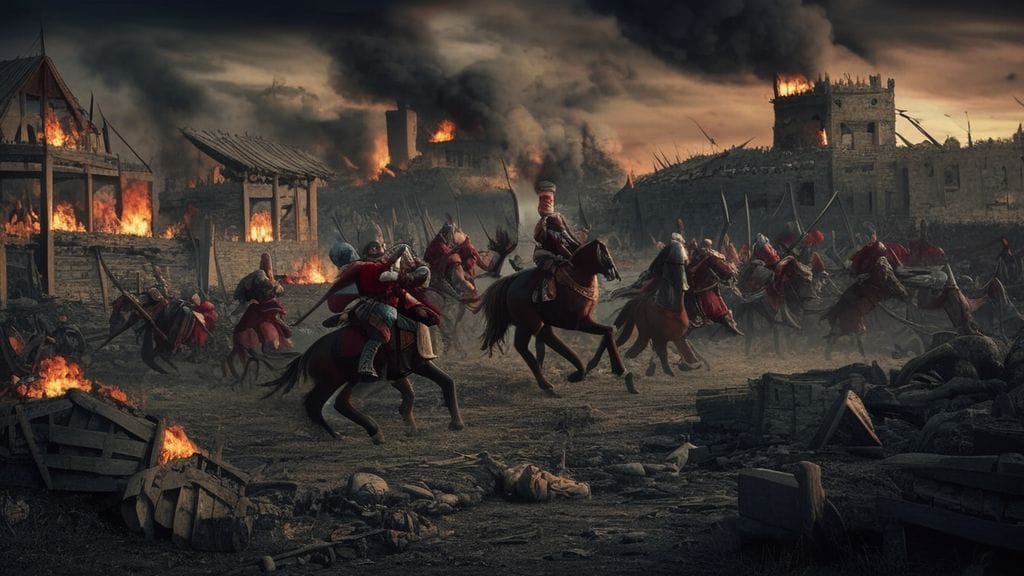
But numbers, organization, and momentum favored the Mongols. Once the first wave forced its way through, more troops poured in behind them, fanning out into adjacent streets. The defensive line bent, then snapped. Fighting retreated from the walls into the heart of the city. Narrow lanes, courtyards, and churchyards became killing grounds. The sack of kiev by mongols had begun in earnest, not as a slow attrition but as a sudden, cascading collapse of urban defense.
Three Days of Fire: Massacre, Plunder, and the Fall of Kiev
What followed the breach was, in the words of one later chronicler, “a slaughter such as our land had never seen.” Once a city that had resisted was taken by storm, Mongol practice, consistent with the norms of medieval warfare across many cultures, permitted systematic looting and killing. But in Kiev’s case, the scale and symbolism of the destruction seared itself into memory. The sack of kiev by mongols became a byword for ruin.
For approximately three days—though different sources vary—the city burned and bled. Mongol soldiers moved from house to house, seizing valuables, killing or capturing inhabitants. Some residents were likely slaughtered where they stood; others were bound together with ropes, to be taken as slaves. Churches, filled with those seeking sanctuary, offered no sure refuge. Many were set alight; others were stripped of their treasures. The great Cathedral of St. Sophia may have survived structurally, but other churches and monastic complexes were badly damaged or destroyed.
Archaeological evidence supports the literary record. Burned layers, collapsed buildings, and a sharp decline in material culture in the mid-thirteenth century testify to a traumatic break. One particularly vivid anecdote, preserved in later chronicles, tells of people crowding into the stone Church of the Tithes (Desiatinnaya) as the Mongols stormed the city. So many sought shelter inside, it is said, that the church collapsed under their combined weight, killing those within. Whether literally accurate or not, the story captures the sense of utter desperation: sacred walls turned into mass graves.
The Mongols distinguished between those they intended to kill and those they could profit from. Artisans, scribes, and certain specialists might be spared and deported to serve in the victors’ domains. Some members of the elite were ransomed; others, perhaps, executed to forestall future resistance. Women and children were taken in large numbers as captives. Property that could not be carried off was destroyed. Fire danced across rooftops; smoke hid the winter sky. The soundscape of Kiev changed from the call of bells to the screams of the dying and the shouts of conquerors.
By the end of this orgy of violence, Kiev was not empty, but it was a shell of its former self. Estimates of the death toll vary wildly, often reaching into the hundreds of thousands—numbers that exceed what most historians think the city’s population could have been. The exact figure will never be known. What matters is the scale of the demographic shock: a major urban center was gutted, its population reduced by death and deportation, its urban fabric scarred for generations.
Ruins and Survivors: Voices from a Shattered Metropolis
Out of this devastation, a few voices speak to us, faint but insistent. Rus’ chronicles, written in monasteries that survived or were rebuilt, offer terse and often formulaic descriptions of the sack of kiev by mongols, yet behind their liturgical laments we can glimpse human anguish. One chronicle laments that “there was none to bury the dead,” a stark image of corpses lying unburied in the snow, violating both religious duty and human instinct.
Archaeology adds another layer to these voices. In certain districts, mass graves show hurried burials, sometimes with multiple individuals thrown together without the usual care for orientation or grave goods. Broken household items—pottery, tools, ornaments—found in these strata tell of lives interrupted without time to pack or hide possessions. Some houses show signs of being rebuilt on top of charred remains, evidence that not everyone fled, that some stubbornly or desperately tried to reclaim a life amid the ashes.
Survivors, we must imagine, included a cross-section of society: peasants who had taken shelter in the city, artisans whose skills spared them from immediate execution, clergy whom the conquerors found useful as intermediaries, and perhaps even a few members of the former elite. Their experiences varied. Some were marched eastward, crossing frozen rivers to distant camps in the steppe or even farther, becoming part of the human mosaic of the Mongol Empire. Others remained under the new order, paying tribute to distant overlords through whatever local authorities the Mongols installed or tolerated.
The trauma they carried cannot be measured, only inferred. Children orphaned overnight; spouses torn apart; communities shattered. For years afterward, those who lived through the sack of kiev by mongols would have measured time as “before the Mongols” and “after the Mongols,” a dividing line in personal and communal memory. The city’s skyline, once beloved and familiar, now bore gaps where churches had stood, and scorched scars where prosperous streets had run. The silence after the conquerors moved on must have felt almost as oppressive as the noise of battle.
A New Order from the Ashes: Mongol Rule over Rus’ Lands
The Mongols did not linger long among the smoldering ruins. Their objectives were strategic and fiscal, not the permanent occupation of every stone. After the sack of kiev by mongols, Batu and his generals moved farther west, cutting through Poland and Hungary in a devastating arc of conquest before eventually halting and consolidating their gains on the steppe. From these conquests emerged the polity later known as the Golden Horde, an ulus of the Mongol Empire that would dominate the Rus’ lands for generations.
In the Mongol system, control was often exercised indirectly. Local princes were confirmed in their positions—or replaced—through the granting of yarlyks, official charters issued by the khan. In exchange, these princes paid regular tribute, supplied troops on demand, and acknowledged the khan’s superiority. Tax-farming practices, census-taking, and tribute collection reshaped the economic and administrative landscape of the former Kievan realm.
Kiev, deprived of its earlier prominence, became one among several subordinate centers. New principalities, especially in the northeast, took on greater weight. The Mongols’ interest in Kiev was largely fiscal and strategic: it was a node in their tributary network, a waypoint on routes between steppe and forest. The city’s political autonomy was sharply curtailed. While the Mongols generally did not seek to interfere with local customs or religious practices, they were ruthless in suppressing rebellion. The memory of cities that had resisted and been annihilated—including Kiev—hovered over all political decisions.
This new order was not static. Internal struggles within the Golden Horde, shifting alliances among Rus’ princes, and external pressures from Lithuania and Poland would all play their part over time. Yet the baseline fact remained: for roughly two centuries, Mongol overlordship—what later Russian historiography would call the “Tatar Yoke”—structured the possibilities and limits of political action in the region. The echoes of the sack of kiev by mongols could be heard in every petition carried to the Horde’s capital, in every caravan of tribute moving across the steppe.
The Long Shadow: Economic and Cultural Consequences of the Sack
The destruction of Kiev in 1240 was more than a local tragedy. It helped redirect the economic and cultural currents of Eastern Europe. Once an important link on the “route from the Varangians to the Greeks,” the city’s devastation and the broader Mongol conquests disrupted traditional north-south trade along the Dnieper. Merchants sought alternative paths, often favoring routes through the northeast or the Baltic, and, in time, contributing to the relative rise of cities like Novgorod and later Moscow.
Demographic consequences were profound. Weakened by massacre and deportation, Kiev’s population dwindled. Some neighborhoods were abandoned; others rebuilt only partially. Surrounding rural areas, already ravaged, struggled to support pre-existing levels of urban demand. Patterns of settlement shifted as refugees fled to safer or more remote areas. Such movements, repeated across multiple cities, changed the human geography of the Rus’ lands.
Culturally, the impact was ambivalent. On one hand, the sack of kiev by mongols destroyed or dispersed an enormous amount of material culture: manuscripts, icons, reliquaries, and buildings that embodied the spiritual and artistic achievements of Kievan Rus’. Some were taken as trophies into Mongol or allied courts; others simply vanished in the flames. On the other hand, the very experience of trauma generated new cultural production: laments, hagiographies, and chronicles that interpreted the catastrophe as divine punishment, a test of faith, or a prelude to renewal.
Economically, Mongol rule imposed a heavy burden of tribute but also, paradoxically, offered certain benefits. The so-called “Pax Mongolica” facilitated long-distance trade across Eurasia. Rus’ merchants traveled under Mongol protection to Central Asia and beyond, while goods from China and the Islamic world flowed westward. Yet these advantages were unevenly distributed and could not compensate Kiev for the specific loss of its pre-Mongol position as a thriving, autonomous capital.
Faith Under Fire: The Orthodox Church, Relics, and Spiritual Trauma
The fall of Kiev struck at the heart of the Orthodox Church in the Rus’ lands. As metropolitan seat and shrine-filled center, the city had been both a spiritual and administrative hub. When Mongol soldiers trampled its churches and scattered its congregations, believers had to grapple not only with physical loss but with deep theological questions. Why had God allowed the infidels to triumph? What did this say about the sins or failures of Christian rulers and people?
Clerical writers responded in multiple ways. Some framed the sack of kiev by mongols as divine chastisement—a punishment for the internal divisions, greed, and moral decay of the princes and the populace. Others emphasized the endurance of faith amid suffering, portraying those killed defending churches as martyrs. Certain monasteries may have become sites of pilgrimage precisely because they had survived or because they guarded relics rescued from destroyed sanctuaries.
The Orthodox hierarchy also had to adapt institutionally. Over time, the metropolitan seat moved, first to cities like Vladimir, then eventually to Moscow, following patterns of political and demographic shift. This relocation symbolized a re-centering of the Rus’ world, away from the ruined splendor of Kiev and towards emergent power centers that were better positioned to navigate Mongol politics. Yet Kiev retained an aura of sanctity. Its remaining churches and monasteries, once rebuilt, became living memorials to both pre-Mongol glory and Mongol-inflicted suffering.
One Russian scholar in the twentieth century, writing about this period, noted that “the faith that survived in the ashes of Kiev became the seed of a new spiritual geography” (as paraphrased in English by historian David Goldfrank). In other words, the Church’s response to the catastrophe helped fashion a narrative of resilience and continuity, even as institutions and populations relocated. The memory of the sack of kiev by mongols thus entered not only secular history but also sacred historiography.
From Kiev to Moscow: Shifting Centers of Power in the Rus’ World
The destruction of Kiev did not single-handedly create Moscow’s future preeminence, but it removed or weakened a key rival. In the centuries after 1240, power gradually shifted north and east. Principalities such as Vladimir-Suzdal, Tver, and eventually Moscow learned to navigate the structures of Mongol rule, acquiring yarlyks, collecting tribute on the khan’s behalf, and accumulating resources and legitimacy.
Moscow, in particular, benefitted from geography and politics. More remote from the steppe frontier than Kiev, it was somewhat better shielded from the full force of nomadic raids. Its princes proved adept at cultivating favor with the khans while also expanding their control over neighboring territories. Over time, the grand princely title—once associated with Kiev—became bound to Moscow instead. When the Mongol grip weakened in the late fourteenth and fifteenth centuries, Moscow was positioned to assume a leading role in resisting and eventually casting off their overlordship.
In this long arc, the sack of kiev by mongols stands as a pivot. By shattering the old capital and redirecting trade and population, it helped open space for new centers to rise. Later Moscow rulers, intent on constructing a narrative of their own legitimacy, both invoked and downplayed Kiev’s fate. On one hand, they claimed inheritance of Kievan traditions, presenting themselves as restorers of Rus’ unity after the chaos initiated by the Mongol invasions. On the other, they emphasized their own city’s resilience and providential role in defeating the remnants of the Horde.
Kiev itself never vanished. Over the centuries, it slowly rebuilt, serving under various overlords and within different political configurations—Lithuanian, Polish-Lithuanian, Russian imperial. But the center of gravity in the East Slavic world had shifted. The Mongols, unintentionally, had helped redraw the political map. What had once been an eastward extension of Kievan influence became, in time, a core zone of a new state claiming to be the true heir of Rus’.
Memory, Chronicle, and Legend: How the Sack of Kiev Was Remembered
Events like the sack of kiev by mongols do not live only in the moment; they reverberate through time via stories, chronicles, and rituals of remembrance. Medieval Rus’ chroniclers, often monks writing decades after 1240, shaped how subsequent generations would understand the catastrophe. Their accounts are laced with biblical allusions—Kiev compared to Jerusalem, the Mongols to Assyrians or Babylonians, the destruction read as a sign of divine displeasure.
These texts are not simple records; they are interpretations. They highlight the sins of the princes, the faithfulness of certain martyrs, the helplessness of common folk caught in the crossfire. Numbers are often exaggerated to convey moral weight. A chronicler might claim that “innumerable multitudes” died, not because he counted bodies, but because he wanted readers to feel the enormity of the loss. Legends, too, grew around particular episodes: the collapsing Church of the Tithes, holy icons that miraculously survived flames, or visions of saints appearing on the walls during the siege.
Later historians, both in the Russian Empire and in other countries, grappled with these sources. Some nineteenth-century scholars, influenced by nationalist and romantic currents, emphasized the sack of kiev by mongols as a founding trauma—a moment that forged a sense of shared suffering among the East Slavs. Others, especially in the Soviet period, framed the event within broader narratives of class struggle, feudal fragmentation, and the impact of foreign invasions on socioeconomic development.
Modern scholarship tends to be more cautious. It cross-examines chronicles with archaeological findings, environmental data, and comparative Mongol studies. Yet even as historians refine numbers and question older narratives, the emotional charge of the event persists. Kiev’s fall is still invoked in literature, film, and public discourse as a symbol: of national martyrdom, of imperial cruelty, or of the resilience required to rebuild after disaster.
Europe Awakes: Western Reactions to the Mongol Conquests
While Kiev burned, eyes in Western Europe began to turn uneasily eastward. Reports of the Mongol advance—often garbled and exaggerated—reached the courts of Hungary, Poland, and beyond. The same campaign that produced the sack of kiev by mongols also brought devastation to Silesia and the Hungarian plain. At the Battle of Legnica in 1241, a coalition of European forces was defeated; in Hungary, Mongol forces penetrated deep before eventually withdrawing after the death of the Great Khan Ögödei.
To Western observers, the Mongols were at first an almost incomprehensible menace. Some wondered if they were the biblical Gog and Magog, unleashed at the end of days. Others speculated fancifully that they might be the fabled “Prester John” or some other distant Christian power. Papal legates and envoys, such as Giovanni da Pian del Carpine and later William of Rubruck, were dispatched to the Mongol court to gather intelligence and, if possible, seek diplomatic accommodations.
These envoys provided some of the earliest detailed descriptions in Latin Christendom of the Mongol state, its rulers, and its methods of war. They learned, for example, of the destruction inflicted on Rus’ cities and brought back accounts of the sack of kiev by mongols and similar tragedies, though often colored by secondhand information. Their writings introduced Europeans to a new geopolitical reality: an empire that spanned from China to Eastern Europe, one that could, in theory, return in strength.
European military thinkers also took note. The Mongols’ use of disciplined cavalry, complex signaling systems, and coordinated multi-pronged offensives challenged existing strategic assumptions. Yet the immediate threat receded after the mid-thirteenth century, and Europe remained divided. The experience of Kiev and the Rus’ principalities, though occasionally referenced, did not spur a lasting pan-European strategy. The Mongol legacy instead became a cautionary tale, an example of what might happen when an unprepared region faced a ruthless, well-organized invader.
Debates Among Historians: Interpreting the Fall of a Medieval Capital
In modern historiography, the sack of kiev by mongols has been the subject of debate on several fronts. One central question concerns the scale of the destruction. Early scholars often took the chronicles at face value, envisioning near-total annihilation. Later researchers, using archaeological surveys, have argued for a more nuanced picture: while certain districts were devastated and the city’s population sharply reduced, not every quarter was erased, and some continuity of habitation persisted.
Another debate revolves around causation and responsibility. To what extent was the fall of Kiev the inevitable outcome of Mongol military superiority, and to what extent did internal weaknesses of Kievan Rus’—political fragmentation, economic shifts, and strategic miscalculations—set the stage? Some historians emphasize structural factors: the long-term decline of Kiev’s trade position, the vulnerability of timber-and-earth fortifications against advanced siege technology, and the absence of a centralized military apparatus. Others point to contingency: a different set of alliances, a more effective defensive strategy, or timely assistance from neighboring powers might at least have altered the timing or severity of the fall.
There is also discussion about the broader impact of Mongol rule on the development of the region. Was the sack of kiev by mongols and the subsequent “Tatar Yoke” primarily a brake on progress, isolating Rus’ from Western Europe and delaying state formation? Or did Mongol administrative practices, military organization, and trans-Eurasian trade networks, however brutally imposed, also contribute to the formation of later states like Muscovy? Scholars such as Charles Halperin have argued for a more balanced view, acknowledging both destructive and transformative aspects.
What unites these debates is a recognition that 1240 cannot be reduced to a simple narrative of barbarian conquest. It was a meeting point of different political systems, military technologies, and cultural worlds. The historian’s task is to sift through partial, often partisan sources, to reconstruct both the horror of the moment and the complex legacies that followed.
Echoes in Modern Identity: Kiev, Empire, and the Uses of History
In the modern era, the memory of the sack of kiev by mongols has not remained confined to scholarly books. It has entered the contested terrain of national identity and political rhetoric. Ukrainians, Russians, and others who trace part of their heritage to Kievan Rus’ have all, at times, claimed Kiev’s medieval glories and its sufferings as part of their own story.
In Ukrainian national narratives, Kiev is often portrayed as the cradle of a distinct people and culture, brutally interrupted by foreign domination—first Mongol, later Polish-Lithuanian, Russian, and Soviet. The 1240 catastrophe becomes an early chapter in a long history of resilience amid conquest. Russian narratives, especially in imperial and some post-imperial forms, have tended to emphasize continuity: Kievan Rus’ as the shared ancestor of modern Russia, with Moscow eventually inheriting Kiev’s legacy and avenging the Mongol humiliation.
These narratives are not merely academic. They shape public monuments, school curricula, and political speeches. Commemorations of historical sieges and invasions, including the Mongol one, are used to foster a sense of collective endurance and to justify contemporary geopolitical stances. In this way, the sack of kiev by mongols, a medieval event whose participants could not imagine modern nation-states, acquires new meanings in the present.
At the same time, global historical awareness encourages more nuanced interpretations. Comparative study of other cities ruined and rebuilt—Baghdad after the Mongol assault of 1258, or European centers devastated in the world wars—places Kiev’s experience within a broader human pattern of destruction and renewal. The story of 1240 becomes not only a national trauma but also part of a universality of suffering and reconstruction that links different cultures and eras.
Conclusion
The fall of Kiev in December 1240 was a moment of concentrated catastrophe: a great city besieged in winter, its defenses shattered by unprecedented force, its streets turned into fields of death. Yet as we have seen, the sack of kiev by mongols was neither an isolated calamity nor a simple story of barbarism overwhelming civilization. It emerged from a convergence of factors: the long-term fragmentation and weakening of Kievan Rus’, the formidable military machine forged by Genghis Khan and refined by his heirs, and a series of miscalculations and constraints that left Kiev exposed at precisely the worst moment.
In its aftermath, the city’s charred ruins bore witness to immense human suffering—the dead left unburied, the survivors enslaved or scattered, the sacred spaces defiled. But they also marked a turning point in the political and cultural evolution of Eastern Europe. Power shifted north and east; new centers like Moscow gradually eclipsed the old capital. Under the Golden Horde, a new pattern of overlordship, tribute, and indirect rule took shape, binding the Rus’ principalities into a broader imperial system even as it imposed heavy costs.
Over the centuries, the memory of 1240 has been layered with meaning. Chroniclers cast it as divine punishment and a moral lesson; nationalist thinkers turned it into a symbol of collective martyrdom or eventual redemption; modern historians, armed with archaeology and critical methods, have sought to disentangle myth from fact without stripping the event of its emotional power. Today, as debates over identity, sovereignty, and historical inheritance swirl around Kiev once more, the distant echo of the Mongol siege reminds us how deeply the past can shape the stories people tell about themselves.
And yet, perhaps the most striking lesson is not only about destruction but about endurance. Kiev did not disappear. It rebuilt, adapted, and reimagined itself under changing masters and in changing worlds. The sack of kiev by mongols was a profound rupture, but not an ending. In the charred stones and fractured memories of 1240 lies both a warning about the costs of division and unpreparedness, and a testament to the capacity of cities and societies to survive, remember, and begin again.
FAQs
- What was the sack of Kiev by Mongols?
The sack of Kiev by Mongols refers to the capture and brutal destruction of the city of Kiev by the forces of Batu Khan, a grandson of Genghis Khan, in early December 1240. The Mongol army breached the city’s defenses, killed or enslaved a large part of its population, looted churches and homes, and left much of the city in ruins. - Why did the Mongols attack Kiev?
Kiev was attacked as part of the Mongol western campaign to subdue the Rus’ principalities and extend Mongol power into Eastern Europe. As a major political and religious center of Kievan Rus’, Kiev was both strategically and symbolically important. Its destruction was intended to eliminate resistance and demonstrate the futility of defying Mongol demands for submission and tribute. - How long did the siege of Kiev last?
The exact length of the siege is debated by historians due to limited and sometimes contradictory sources. Most estimates suggest a relatively short period of full-scale bombardment—perhaps several days to a couple of weeks—preceded by a longer phase of encirclement and regional devastation that cut Kiev off from potential allies and supplies. - How many people died in the sack of Kiev?
Medieval chronicles claim extraordinarily high death tolls, sometimes in the hundreds of thousands, but these figures likely exaggerate the true number. While exact statistics are impossible to determine, archaeological and demographic studies agree that the loss of life and subsequent depopulation were severe, dramatically reducing Kiev’s population and importance for generations. - What happened to Kiev after the Mongol conquest?
After the sack of Kiev by mongols, the city remained under Mongol overlordship as part of the Golden Horde’s domain. Its political influence diminished, and it became one of several subordinate centers in the Rus’ lands. Over time, power shifted towards northern and northeastern cities, particularly Moscow, though Kiev slowly rebuilt and retained significance as a religious and cultural site. - Did any churches or religious institutions survive?
Yes. While many churches and monasteries were damaged, looted, or destroyed, some important structures, such as the Cathedral of St. Sophia, survived in altered form. Religious institutions played a key role in preserving memory of the catastrophe, interpreting it in spiritual terms, and helping to rebuild the city’s religious life in the centuries that followed. - How did the Mongol conquest affect the development of Russia and Ukraine?
The Mongol conquest, including the sack of Kiev, contributed to the decline of Kievan Rus’ as a unified entity and encouraged the rise of new power centers, especially in the northeast. Over time, these centers—most notably Moscow—formed the core of states that would later become the Russian Empire. For Ukrainian history, the fall of Kiev is seen as an early rupture in a long struggle to maintain autonomy and cultural continuity amid foreign domination. - Were the Mongols uniquely brutal compared to other medieval powers?
The Mongols used terror and large-scale destruction more systematically than many of their contemporaries, especially against cities that resisted. However, brutality toward defeated foes was common in medieval warfare across many regions. What distinguished the Mongols was the combination of military efficiency, psychological warfare, and the scale of their conquests, which amplified the impact of events like the sack of Kiev. - Is the exact date of Kiev’s fall known?
The commonly cited date for the capture and sack of Kiev by Mongols is 6 December 1240, based on chronicle evidence. While medieval dating can be imprecise due to differing calendars and later copying errors, this date is generally accepted by historians as a reasonable approximation of when the city was taken. - Can we still see traces of the 1240 sack in Kiev today?
Direct, visible traces on the modern cityscape are limited, given centuries of rebuilding, later wars, and urban development. However, archaeological excavations in Kiev have uncovered burned layers, ruined structures, and mass graves associated with the thirteenth-century destruction. Museums and historical narratives in the city also preserve and interpret the memory of the Mongol assault.
External Resource
Internal Link
Other Resources
- Encyclopaedia Britannica – general search for the exact subject
- Google Scholar – academic search for the exact subject
- Internet Archive – digital library search for the exact subject

