Table of Contents
- A City Before the Storm: Nishapur at the Dawn of the 13th Century
- The Mongol Tempest Gathers: From Steppe Confederation to World-Conquering Empire
- A Fractured Islamic World: Khwarazm, Khorasan, and Political Fault Lines
- An Insult to Empire: The Road from Otrar to Nishapur
- The First Mongol Shadows over Khorasan
- Nishapur in 1221: Life on the Edge of Catastrophe
- The Siege Tightens: Encirclement, Engines, and Fear
- The Death of Toquchar: A Prince Falls Before the Walls
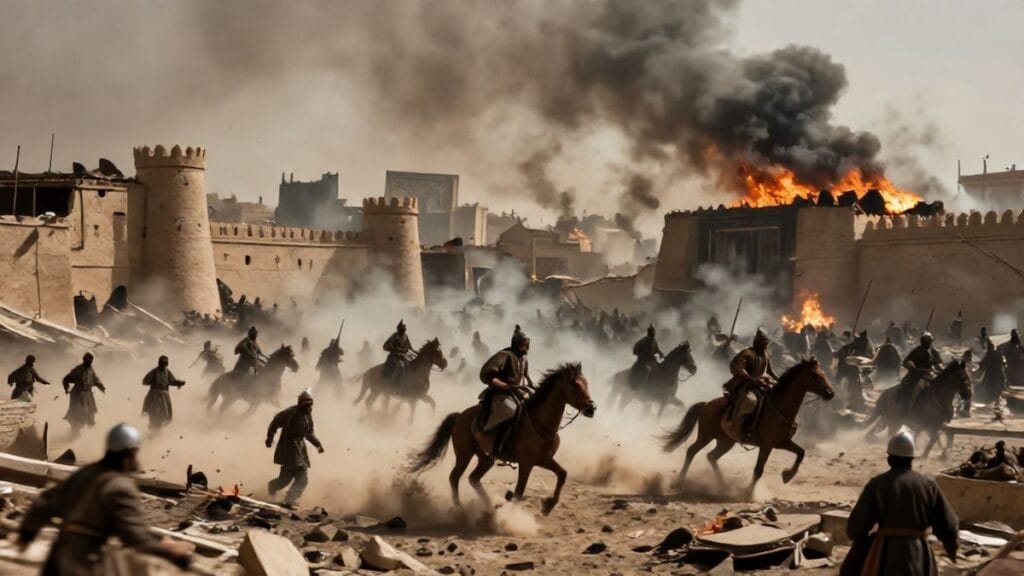
- April 10, 1221: The Sack of Nishapur by Mongols
- A City Erased: Massacre, Ruin, and the Counting of Skulls
- Jenghiz Khan, Tolui, and the Politics of Vengeance
- Survivors, Captives, and the Silent Aftermath
- Echoes Across Khorasan: Terror as a Strategy of Conquest
- Memory, Chronicle, and Legend: How the Sack Was Remembered
- Demographic and Cultural Rupture in Eastern Iran
- From Ashes to New Foundations: Nishapur’s Long Road to Recovery
- Comparing Catastrophes: Nishapur Among the Great Medieval Massacres
- Violence, Empire, and Moral Judgment: Historians and the Mongol Legacy
- Conclusion
- FAQs
- External Resource
- Internal Link
Article Summary: In the spring of 1221, the ancient Iranian city of Nishapur met a fate so devastating that it would echo through centuries of chronicles: the sack of nishapur by mongols. This article follows the city from its days as a thriving center of trade, scholarship, and spirituality to its abrupt transformation into a wasteland of rubble and bones. It traces how the rise of the Mongol Empire, the fragility of the Khwarazmian state, and a chain of diplomatic insults and military miscalculations converged on one fateful day, April 10, 1221. Through a blend of narrative reconstruction and historical analysis, the tale moves from the first sight of Mongol scouts to the siege, the fall, and the orchestrated massacre that followed. Along the way, it examines the political motives behind such extreme violence, the role of personal vengeance in imperial policy, and the horror experienced by ordinary inhabitants. The article also explores how medieval writers, from Persian chroniclers to later historians, remembered and debated the numbers, stories, and meanings of the event. By situating the sack of nishapur by mongols within the broader Mongol campaigns across Khorasan, it shows how terror was deliberately used as a tool of conquest. Finally, it looks at the long shadow cast by the destruction—on demography, culture, memory, and our moral understanding of empire.
A City Before the Storm: Nishapur at the Dawn of the 13th Century
On the high plains of northeastern Iran, where the caravan routes of Central Asia began to dissolve into the vast Iranian plateau, lay Nishapur, a city that seemed to gather the world into its streets. By the early 13th century, Nishapur was not just a dot on a map; it was a thriving metropolis of perhaps several hundred thousand souls, a place whose name evoked gardens, turquoise, and learning. Poets had praised its orchards and the subtlety of its scholars. Merchants could walk from one end of its bazaars to the other accompanied by the scents of saffron and musk, the clatter of metal, the murmur of Qur’anic recitation.
Nishapur’s history reached back to the age of the Sasanian kings; it had been refounded, rebuilt, and adorned under different dynasties. Under the early Islamic caliphates, it became an anchor of Khorasan, a region so central to the fortunes of empires that medieval writers often presented it as a world unto itself. In Nishapur, one could study law in the Nizamiyya madrasas, consult astronomers who plotted the movements of the heavens, or sit at the feet of mystics who practiced Sufism in humble lodges. The city had known earthquakes and wars, plagues and changes of rulers, yet it always rose again, as if it carried in its foundations a stubborn confidence that civilization would endure.
By 1221, the people of Nishapur lived in a city of brick and baked earth, its skyline punctuated by minarets and domes, its neighborhoods divided into quarters by ethnic, economic, and religious distinctions. Artisans fired famous turquoise in nearby mines and produced ceramics of striking blue and white glazes that would be traded from the Levant to India. Booksellers lined entire streets; copyists and illuminators fed the hunger of scholars and bureaucrats. In the evenings, the city’s scholars gathered in mosques and private salons to debate theology, philosophy, and jurisprudence in Arabic and Persian. It is astonishing, isn’t it, to imagine such a dense web of life on the very eve of obliteration?
Yet beneath this veneer of stability, anxieties were growing. The eastern horizon carried rumors like storm clouds: stories of a new power rising on the steppes, horsemen who seemed to strike from nowhere and vanish again like ghosts. Messengers arriving from Transoxiana spoke of cities with names familiar to Nishapur’s merchants—Bukhara, Samarkand—now falling under the hooves of Mongol cavalry. But like many great cities before their destruction, Nishapur was too deeply invested in its own continuity to accept the full implications of those reports. Life went on; contracts were signed, marriages arranged, crops harvested. The city’s walls had withstood enemies before. The people clung to the faith that they would do so again.
The Mongol Tempest Gathers: From Steppe Confederation to World-Conquering Empire
Far to the northeast, beyond deserts and mountain chains, the Mongols were forging something unprecedented. At the turn of the 13th century, Temüjin, born the son of a minor chieftain, had undertaken the brutal and uncertain work of unifying the fractious steppe tribes. Through a combination of charismatic leadership, ruthless punishment, strategic alliances, and sheer military talent, he welded clans that had once feuded for pastures into a disciplined engine of conquest. In 1206, at a great assembly on the banks of the Onon River, he was acclaimed as Chinggis Khan—Jenghiz Khan, “Universal Ruler.”
What Jenghiz Khan commanded was not a conventional state but a mobility-focused war machine. Its core lay in its cavalry: men and horses hardened by the bitter winters and boundless horizons of the steppe. Each warrior carried multiple bows, a quiver heavy with arrows, and often spare horses, enabling unparalleled speed. The Mongol army was organized into decimal units—100, 1,000, 10,000—bound by fierce discipline. Orders came not only with promises of plunder, but with the threat of death for disobedience. Intelligence gathering, relay posts, and a network of horse stations allowed the Khan to know, decide, and strike with unnerving precision.
Initially, the Mongols’ ambitions focused on the steppe world itself: rival nomads, Tangut Xia, the Jurchen Jin dynasty in northern China. Yet as Jenghiz Khan’s successes mounted, horizons widened. The wealth of the sedentary civilizations to the west—Transoxiana, Iran, the Islamic heartlands—beckoned. But the Mongols did not simply lunge blindly toward these lands. Their expansion westward began as a punitive response to a diplomatic affront, a clash of commercial and political cultures that would, in time, set Nishapur on a collision course with the steppe empire.
The Mongol tempest was not only military. It carried within it a new model of imperial order: flexible in religion, ruthless in war, pragmatic in administration. For officials in Khorasan used to the slow rituals of court politics and the protections of city walls, the reports of an enemy who could move hundreds of kilometers in a few days, besiege fortified towns with sophisticated siege engines learned from Chinese engineers, and exterminate entire populations when defied sounded like tales whispered to frighten children. Yet those whispers would soon become the roar of hooves outside their gates.
A Fractured Islamic World: Khwarazm, Khorasan, and Political Fault Lines
To understand why the sack of nishapur by mongols could unfold with such catastrophic totality, one must glance at the political map of the Islamic East in the early 13th century. The Abbasid caliphate in Baghdad still existed, but its authority had long been ceremonial. Real power in Khorasan and beyond lay with the Khwarazmian Empire, an aggressively expanding state stretching from the Aral Sea to the Persian Gulf, from the Indus River toward the fringes of Anatolia. The ruler who presided over this sprawling domain was Ala al-Din Muhammad II, the Khwarazmshah.
On paper, Muhammad II was master of a formidable realm, including cities that had once been under Seljuk or local dynastic control—Nishapur among them. In reality, his empire rested on fragile foundations. Its rapid expansion had outpaced the integration of its provinces; loyalties were shallow, and rival power centers persisted. Local elites in Khorasan navigated a delicate balance between deference to the Khwarazmshah and maintenance of their own influence. Further complicating matters, Muhammad II’s relationship with the Abbasid caliph was marred by rivalry and resentment. Ambitions of replacing or overshadowing the caliph created diplomatic tensions that diverted attention from the rising Mongol threat in the east.
Khorasan, despite its wealth and fame, suffered from the same instability. Power had shifted repeatedly between dynasties—Ghaznavids, Seljuks, local amirs—each leaving behind layers of patronage networks and grudges. City militias and local garrisons existed, but the central authority’s ability to coordinate a united defense was doubtful. When fear of the Mongols began to spread, some proposed fortifying major cities and preparing a grand army; others counseled diplomacy, tribute, or strategic withdrawal. Very little of this internal debate translated into coherent policy.
Within this fractured landscape, individual decisions could tip the balance between survival and catastrophe. Governors with personal grievances against the Khwarazmshah might see in the Mongols an opportunity for revenge or autonomy. Urban notables, anxious about their property and families, could be tempted to negotiate separate deals with invading generals. It was precisely into this world—proud, cultured, yet politically fissured—that Jenghiz Khan would thrust his armies, beginning a chain of events that would culminate in the annihilation of Nishapur.
An Insult to Empire: The Road from Otrar to Nishapur
The immediate spark that would one day set Nishapur ablaze was lit not in Iran but in the city of Otrar, near the Syr Darya river. Around 1218, Jenghiz Khan, seeking to open trade and perhaps test the diplomatic waters with his western neighbor, sent a caravan of merchants and envoys to the Khwarazmian domains. The caravan reached Otrar, where the local governor, Inalchuq—sometimes called Ghayir Khan—saw in these foreigners an opportunity. Whether driven by suspicion, greed, or a desire to prove loyalty to his own sovereign, he accused the caravan of spying, seized their goods, and executed many of them.
News of this outrage soon reached Jenghiz Khan. According to several chronicles, he responded with relative restraint at first, dispatching envoys to Muhammad II demanding punishment of Inalchuq and redress for the murdered merchants. The Khwarazmshah, however, either out of arrogance or fear of appearing weak, escalated the conflict. One of Jenghiz Khan’s envoys was killed, and the others had their beards shaven—a calculated humiliation. In a world where the safety of ambassadors was a sacred principle, this was a declaration of war.
From that moment, the Mongol invasion of the Islamic East was virtually inevitable. Jenghiz Khan gathered his tumens and, in 1219, launched a vast, coordinated campaign across the Jaxartes. The early stages of this confrontation are better documented than many medieval wars. Cities like Otrar, Bukhara, and Samarkand, each with its own stories of resistance, betrayal, and massacre, fell in turn. The Mongols demonstrated a harsh pattern: those who resisted to the end were annihilated; those who surrendered early might be spared in part, though often at brutal cost.
As the Mongol armies advanced westward and southward, the Khwarazmshah’s authority crumbled. Muhammad II fled, dying in obscurity on an island in the Caspian Sea. Leadership of resistance in some regions fell to his son Jalal al-Din, who would fight the Mongols with courage but limited resources. Khorasan, exposed and disoriented, now lay open. It is within this broader arc—from Otrar’s blood to the crumbling palaces of the Khwarazmshahs—that we must place the sack of nishapur by mongols, for it was not an isolated tragedy but part of a relentless imperial retribution.
The First Mongol Shadows over Khorasan
By 1220, the Mongol advance reached the heartlands of Khorasan. Tasked with the subjugation of this wealthy region, Jenghiz Khan dispatched several of his most capable commanders: his sons, Tolui and Chagatai, and trusted generals such as Subedei and Jebe. Their operations were not simply random rampages; they were part of a carefully orchestrated campaign to neutralize all centers of resistance, seize key routes, and terrorize cities into submission.
The first major shock came with the fall of cities like Balkh and Merv. Merv, once known as “the mother of the world,” suffered a devastation so complete that later chroniclers struggled for words. One Persian historian, ‘Ata-Malik Juvayni, wrote of a slaughter in which hundreds of thousands perished—figures that may be exaggerated, yet speak to the impression of boundless horror. Refugees streamed westward from these shattered cities, carrying tales of Mongol cruelty: of entire populations marched out and systematically executed, of artisans separated for deportation, of libraries and mosques destroyed.
Such stories preceded the Mongol vanguards like a dark wind. In Nishapur, as in other Khorasani cities, these accounts provoked debate and dread. Should they trust the rumors, or dismiss them as the usual exaggerations of war? Some officials argued that surrender and negotiation might save the city’s inhabitants, even if it meant paying tribute and accepting a Mongol overseer. Others insisted that the only honorable path was resistance: did not Islamic law and tradition prize the defense of Muslim lands against infidel invaders?
Near the end of 1220, Mongol detachments began probing deeper into the region around Nishapur. Scouts surveyed the landscape, measured the strength of its defenses, and mapped routes of approach. Skirmishes with outlying villages and estates hinted at what was to come. The people of Nishapur now lived in the penumbra of fear, their nights haunted by distant fires and their days filled with rumors from the roads—rumors that the Mongols were near, that they had taken another town, that they had accepted surrender in one place only to massacre its people in another. The city was not yet doomed, but the circle was tightening.
Nishapur in 1221: Life on the Edge of Catastrophe
To imagine Nishapur in early 1221 is to picture a city simultaneously bustling and anxious, where daily life continued even as the very foundations of order trembled. The markets opened each morning, their vendors piling figs, dates, cloth, and copperware under awnings that flapped in the spring winds. Scholars still held classes in the madrasas, debating the fine points of Shafi‘i jurisprudence or the commentaries of al-Ghazali. Sufis continued to chant in their lodges, some perhaps whispering dark prophecies about the scourge from the east.
Yet everywhere, unease gnawed. The city’s leaders—governors appointed by the Khwarazmshah, military commanders, qadis and jurists, merchant notables—met behind closed doors. They weighed options, studied the shrinking possibilities. The central government was distant, its armies shattered. Help would not come from the Khwarazmian court; that much was clear. The walls of Nishapur were sturdy, its defenders numerous, but reports of Mongol siege craft, learned in previous campaigns against Chinese fortifications, raised questions about whether bricks and mortar would be enough.
Among the population, opinions were as varied as the city’s streets. Some, recalling older invasions that had been repelled or bought off, believed that this storm, too, would pass. Others argued vigorously for submitting to the Mongols, citing the fate of Merv and Balkh as warnings against stubbornness. A third group, perhaps the largest, could only wait and hope, powerless to shape the decisions that would determine their fate.
We must also remember that, on the eve of the sack of nishapur by mongols, this was a living, breathing human community. Children played in courtyards; artisans worried about debts; mothers arranged marriages. Bakers kneaded dough for the next day’s bread; calligraphers bent over pages that they did not know would soon be scattered and burned. The looming disaster did not erase the intimate routines of life—at least not yet. That tension between ordinary existence and incoming catastrophe is one of the most poignant aspects of Nishapur’s final days.
The Siege Tightens: Encirclement, Engines, and Fear
When the Mongols finally moved in force against Nishapur, they did so with the cold deliberation that had characterized their earlier campaigns. Under the command of Tolui, the youngest son of Jenghiz Khan, Mongol forces approached the city, encamping at calculated distances to control roads and water sources. Scouts and engineers surveyed the walls, noting weak points and planning positions for siege machines. For the citizens watching from the battlements, the sight must have been terrifying: endless ranks of horsemen, banners flickering, herds of livestock following the army, and, behind it all, the uncanny order of a people accustomed to dismantling cities as methodically as they had once dismantled rival tribes.
The initial phase of the siege followed a grimly familiar pattern. Negotiations were likely attempted—perhaps emissaries rode out from Nishapur to parley with Tolui, offering tribute or hostages in exchange for leniency. Yet the context for such talks was already poisoned. The region had seen too many broken promises on both sides; mistrust ran deep. Some reports suggest that earlier Mongol control over the city had been momentarily established and then overthrown in a local uprising, strengthening the Mongols’ resolve to punish Nishapur more harshly than other towns. Whether or not every detail of these accounts is accurate, the main point stands: by early April 1221, the Mongols had fixed upon Nishapur as a city to be broken, not merely subdued.
Siege machines rolled into place: catapults, probably of the traction type but perhaps also some heavier counterweight engines learned from Chinese practice, began to hurl stones and incendiary ammunition atop the walls. Arrows darkened the air. Day after day, the defenders strained their resources, patching breaches during the night, dousing fires, hurling their own missiles down on attackers when they came too close. Within the city, water supplies began to run short in some districts; food stores, while not exhausted, were finite.
The psychological pressure was immense. Every day that passed without relief from outside confirmed what many had feared: Nishapur stood alone. Some among the defenders may have clung to the hope that Jalal al-Din or some regional commander would muster a force to attack the Mongols from the rear, but no such rescue materialized. The Mongols, for their part, were patient. They knew that time, hunger, and fear were their allies. And then, somewhere amid the chaos of siege warfare, a pivotal event occurred that would amplify the rage of the besiegers: the death of a Mongol prince.
The Death of Toquchar: A Prince Falls Before the Walls
Among the Mongol commanders besieging Nishapur was Toquchar (often rendered Toghachar or Toquchar), a son-in-law of Jenghiz Khan. During one of the assaults on the city’s defenses, he was reportedly struck and killed by an arrow loosed from the walls. In the calculus of Mongol warfare, the death of a noble warrior was not merely a battlefield loss; it was a matter of personal and dynastic honor. Toquchar’s fall ignited a thirst for vengeance that would shape the character of the coming sack.
Accounts differ slightly in their details, as medieval chronicles so often do. Some say that Toquchar died in the midst of a major assault, his body falling among heaps of the slain. Others imagine him directing a siege engine when the fatal arrow found him. But all agree that his death enraged the Mongol command. When word reached Jenghiz Khan, it reportedly pierced him with a father’s anger and a ruler’s resolve to make an example. According to later sources, he ordered Tolui to take Nishapur and to leave nothing living within its walls—an instruction that, whether literal or rhetorical in origin, was interpreted with ruthless literalness.
Tolui, already known as a hardened commander, now bore not only the strategic task of conquering a key Khorasani city but also the emotional burden of avenging his fallen kinsman. Vengeance and strategy intertwined. Punishing Nishapur would serve both to satisfy a personal sense of honor and to send a message across Khorasan: this is what happens to those who dare to kill the kin of the Khan, this is the fate of cities that resist.
For the people of Nishapur, the arrow that killed Toquchar was an act of defense, perhaps even of desperate heroism. Yet in the unforgiving logic of Mongol retribution, it sealed the city’s doom. From this point on, the siege was no longer a question of whether Nishapur would fall, but what would be left once it did. The sack of nishapur by mongols was becoming not just another conquest, but a ritual of annihilation bound up with blood and honor at the highest levels of the Mongol leadership.
April 10, 1221: The Sack of Nishapur by Mongols
The final assault likely came after days of intensified bombardment. By early April, breaches in the walls had become too numerous or too wide to repair. Defenders exhausted their arrows and strength. At dawn on April 10, 1221—as recorded in several later sources—the Mongols launched the decisive attack. Waves of cavalry and infantry surged toward the shattered sections of the fortifications, scaling ladders, filling ditches, clambering over rubble.
Inside the city, panic erupted. Families fled toward mosques and supposed sanctuaries, clutching children and precious possessions. Some tried to fight in the streets; others sought to hide in cellars, wells, or behind false walls. Fire spread as missiles ignited rooftops. The soundscape of that day would have been unbearable: the crack of collapsing masonry, the cries of the wounded, the shouts of Mongol warriors driving their men forward, the desperate prayers of those who understood that their world was ending.
The defenders, though courageous, could not stem the tide. Once the Mongols gained firm footholds within the city, their methodical nature took over. Units were assigned to clear quarter after quarter, to remove pockets of resistance, and to secure strategic points—gates, arsenals, religious and administrative buildings. Whatever command structure Nishapur’s leaders had maintained during the siege disintegrated amidst the smoke and slaughter.
By nightfall, the city that had once been a hub of learning and trade lay at the mercy of conquerors who had been explicitly commanded to leave nothing alive. The sack of nishapur by mongols had truly begun. Conquest turned into a massacre, an organized, almost industrial killing whose horror would later be magnified in texts and memories. For those trapped within the city, there was no longer a distinction between civilian and combatant, sacred and profane. Everyone and everything had become part of the spoils—and the vengeance—of empire.
A City Erased: Massacre, Ruin, and the Counting of Skulls
What followed the fall of Nishapur is among the most chilling episodes in medieval history. The Mongols, having secured the city, began the process of systematic slaughter. Later chroniclers, both Muslim and later Mongol-influenced, describe the population being driven out of their homes and gathered in groups. In some accounts, the inhabitants were divided among Mongol soldiers, each warrior responsible for executing a fixed number of captives—an attempt to distribute the grim work evenly and ensure that none could shirk what had been ordered.
The figures given for the dead are staggering. One oft-cited number is 1.7 million, though modern historians, noting the tendency of medieval writers to use hyperbolic statistics to convey enormity, regard this as impossible. Yet even a fraction of that number would represent a catastrophe of immense scale. Juvayni, writing in the mid-13th century, describes heaps of severed heads arranged in pyramids outside the city—an image that encapsulates both symbolic terror and grotesque practicality. Whether literally accurate or not, such details capture the sense that the sack of nishapur by mongols was meant not only to destroy a city but to broadcast a warning.
The killings did not spare women or children. Artisans, scholars, merchants, peasants—all were swept together in the torrent of extermination. Exceptions were made, but these only underline the rule. Skilled craftsmen—especially metalworkers, weavers, and builders—were often selected for deportation to Mongol camps or cities in Central Asia. Young women and boys might be taken as slaves, to be dispersed among the victorious armies. A thin thread of captured life left Nishapur even as most of its inhabitants were consigned to anonymous pits.
The destruction extended beyond human lives. Mosques, madrasas, libraries, and bazaars were looted and burned. Manuscripts that had taken generations to copy and comment upon were reduced to ash. The domes, minarets, and houses of the city were torn down or set alight. Some chroniclers claim that the Mongols plowed the ground where Nishapur once stood, a powerful image of erasure even if the literal agricultural act remains uncertain. In any case, the urban fabric was so thoroughly wrecked that later visitors saw little more than ruins and silence.
Historian David Morgan, in his study of the Mongols, notes that “the massacre of Nishapur was one of the most appalling events of the Mongol conquests,” not only for its death toll but for the comprehensiveness of its destruction. It exemplified what Jenghiz Khan’s armies could and would do when they judged that an enemy city had deeply offended them. Later generations would speak of Nishapur in the same breath as Merv, Herat, and Baghdad, as one of those urban catastrophes that seemed to suspend all normal moral constraints in the name of imperial necessities and personal revenge.
Jenghiz Khan, Tolui, and the Politics of Vengeance
Behind the carnage lay strategic calculation and emotional politics. The sack of nishapur by mongols was not an uncontrolled riot of violence; it was a deliberate policy carried out by disciplined troops under the command of Tolui, with the sanction of Jenghiz Khan. Understanding their motives is crucial if we are to move beyond simple horror and begin to assess what this event reveals about Mongol rule.
For Jenghiz Khan, vengeance for Toquchar’s death could serve multiple purposes. Personally, as head of a clan culture that valued kinship honor, he could not let such a loss go unanswered without weakening his authority. Politically, a spectacular punishment would serve as a deterrent. If entire cities knew that the killing of a Mongol envoy or prince would lead to their annihilation, the temptation to resist would diminish. Terror, carefully staged, thus became a kind of negative diplomacy.
Tolui, executing this policy on the ground, emerges in some accounts as a grim, almost ritual figure, fulfilling his father’s orders without visible hesitation. Later sources—including some sympathetic to the Mongols—acknowledge the extremity of the measures taken at Nishapur. Yet within the Mongol worldview, such acts were not pathological cruelty but the harsh price of disobedience. The same power that could, in other contexts, show remarkable tolerance for different religions and legal customs could also unleash genocidal violence when challenged.
This duality complicates any moral judgment of Mongol rule. Some modern historians have likened Mongol terror strategies to psychological warfare, a brutally effective method of reducing the need for prolonged sieges by convincing potential targets to submit preemptively. The sack of nishapur by mongols, then, was both a local tragedy and a message inscribed in blood for an entire region. Khorasan’s other cities would read that message, and some would choose surrender out of grim prudence.
Survivors, Captives, and the Silent Aftermath
When the killing finally stopped, an eerie quiet must have fallen over Nishapur’s ruins. Smoke drifted through streets choked with debris and bodies. Dogs and carrion birds, sensing an unholy feast, began to converge. For the Mongol army, however, there was still work to be done: sorting plunder, gathering captives, and organizing the movements of troops toward their next objectives.
Among the living were those chosen for their skills. Blacksmiths were highly valued; the Mongols needed them to maintain weapons, armor, and horse gear. Craftsmen in textiles, ceramics, and construction likewise found themselves spared—if “spared” is the right word for being torn from home and forced into labor far from one’s native city. These captives were herded together, branded with the trauma of what they had witnessed, and marched eastward or northward under guard.
A smaller, shadowy population of survivors also existed: those who had hidden successfully during the massacre or returned in its immediate aftermath from the countryside. They crept among the ruins in search of food, water, and lost relatives. Some would later form the nucleus of a slowly reemerging Nishapur, though for years the place would exist more as a memory than as a functioning city.
The Mongols themselves did not linger indefinitely. Once they had made their point and extracted what wealth and labor they could, they moved on to fresh targets. The army was a living thing that could not remain idle; its energy required new campaigns, new plunder. In their wake lay a silence interrupted only by the crackling of dying fires and the low keening of the few left to mourn. That silence was perhaps the most eloquent commentary on what had occurred.
Echoes Across Khorasan: Terror as a Strategy of Conquest
Word of Nishapur’s fate traveled swiftly along the caravan routes and across the mountain passes of Khorasan. Merchants, refugees, and spies carried stories of the city’s annihilation to Herat, Tus, and the smaller towns scattered between. Even accounting for exaggeration, these reports had a profound psychological impact. If a city as rich and significant as Nishapur could be eradicated, what hope did lesser places have?
For Mongol commanders elsewhere in the region, the destruction of Nishapur served as a powerful tool. When they approached a new city, they could invoke the example: surrender, or you will end up like Nishapur. This threat was not abstract; people had seen the wandering survivors, had heard from travelers about the mounds of skulls and the charred skeletons of mosques. As a result, some towns opened their gates, negotiating for terms that might spare at least a portion of their populations. Others, driven by desperation or religious conviction, chose to fight anyway, sometimes meeting fates scarcely less grim.
From the Mongol perspective, terror saved resources. Prolonged sieges were costly in manpower and time; the empire’s strength lay in mobility and swift strikes. By cultivating a reputation for merciless punishment of defiance, they hoped to minimize the need to invest heavily in each new conquest. The sack of nishapur by mongols exemplified this logic at its darkest extreme: a single, unforgettable catastrophe designed to echo through the consciousness of an entire region.
Yet behind the strategic rationalization, the human cost remained immeasurable. Khorasan’s social fabric was ripped apart. Lines of trade and scholarship that had long connected its cities were severed. Entire families vanished; lineages that had produced scholars, poets, and jurists for generations were wiped from the record. Terror may have served an imperial function, but its residue was trauma—something that would seep into the poetry, prose, and religious reflections of the following centuries.
Memory, Chronicle, and Legend: How the Sack Was Remembered
The story of Nishapur did not die with its people. It lived on in chronicles, poems, sermons, and oral tales. Medieval Muslim historians such as Juvayni and Rashid al-Din, writing under Mongol or post-Mongol patronage, preserved detailed, if sometimes stylized, accounts of the city’s fate. Their narratives blend factual reporting with moral reflection, framing the catastrophe as both divine chastisement and human atrocity.
Juvayni, who served in the administration of the Mongol Ilkhanate, offers in his Tarikh-i Jahan-gusha (History of the World Conqueror) a haunting description of the Mongol conquests in Iran, including Nishapur. He writes with a mix of awe at Mongol power and sorrow at the destruction they wrought. Elsewhere, poets lamented the loss of cities like Nishapur and Merv in verses that cast them as martyrs of civilization, their ruins a testament to the fragility of worldly splendor. Preachers used these tales as cautionary examples of how arrogance and disunity could invite disaster.
Over time, legends accreted around specific details of the sack of nishapur by mongols. Some stories attribute the order for total extermination not only to Tolui but to his wife, said to have been Toquchar’s widow, who demanded that not even cats and dogs be spared in the city that had killed her husband. Whether this vignette is literal truth or later embellishment, it underscores the way personal emotions were woven into narratives of imperial violence.
Differing traditions also debated the numbers of the dead. While many Muslim sources cite enormous figures, modern historians, comparing urban demographics and logistical possibilities, argue for lower but still horrific totals. This tension between numeric precision and symbolic enormity is common in accounts of mass violence. As historian Thomas Allsen has noted in another context, medieval writers frequently used colossal numbers to signal not statistics but a sense of the uncountable. The story of Nishapur thus lives somewhere between fact and hyperbole, its outlines clear even as some details remain blurred.
Demographic and Cultural Rupture in Eastern Iran
The consequences of Nishapur’s destruction rippled far beyond the city limits. Demographically, the loss of such a populous center created a void in Khorasan. Neighboring regions faced sudden labor shortages, disrupted trade patterns, and an influx of refugees. The delicate balance between urban and rural life was disturbed, as peasants lost their markets and patrons, while artisans and scholars lost their institutions and students.
Culturally, the blow was immense. Nishapur had been home to scholars of hadith, law, and philosophy, as well as Sufi masters whose lodges attracted disciples from afar. The city had produced or nurtured figures whose works circulated across the Islamic world. The sack of nishapur by mongols, by decimating this concentration of intellect and spirituality, interrupted chains of transmission—teacher to student, copyist to reader—that are central to Islamic scholarly tradition.
The loss of libraries and private collections compounded this rupture. Manuscripts destroyed in Nishapur represented not only individual texts but entire interpretive traditions. Commentaries, marginal notes, and unique local compositions—things that might have offered historians later a richer view of Khorasani thought—were irretrievably lost. While some books were carried off as booty, most perished in flame or under collapsing walls.
Economically, the region adjusted slowly. Trade routes rerouted to other cities that survived or recovered more quickly. Merchants looked to Herat, Isfahan, or distant Baghdad. The name of Nishapur, once associated with prosperity, came to symbolize devastation. Even when the city was eventually resettled, it never fully regained its earlier prominence. A chapter in the story of eastern Iran had been brutally closed, its pages soaked in blood.
From Ashes to New Foundations: Nishapur’s Long Road to Recovery
The Mongols did not intend for Nishapur to remain a barren ruin forever. Their goal was to crush resistance and reshape the political landscape, not to permanently sterilize productive land. In the years following the sack, as Mongol rule in Iran gradually institutionalized into the Ilkhanate, authorities began to encourage resettlement of strategic locations, including Nishapur’s site or its immediate vicinity.
Recovery, however, was halting and incomplete. It began with a trickle: peasants returning to cultivate orchards that had gone wild, small groups of artisans seeking opportunity in the ruins, pious founders financing the rebuilding of a mosque or madrasa. Over time, a new urban community formed amid and atop the debris of the old. Streets were laid out again, though often differently; houses rose where bones had once lain uncovered.
The new Nishapur could not help but live in the shadow of its predecessor’s destruction. Memory is a powerful architect. People told and retold the story of 1221, pointing to certain mounds as former gates, to certain depressions as mass graves. Shrines and memorial sites emerged, blending religious veneration with civic mourning. The city’s identity became entwined with its own martyrdom, shaping how its inhabitants viewed both their past and their precarious present.
Under later Iranian dynasties, Nishapur would modestly revive as a regional center, its turquoise once again sought by jewelers, its fields once again productive. Yet it never quite reclaimed the stature it had enjoyed before the Mongol invasion. The sack of nishapur by mongols had not only destroyed brick and flesh; it had broken a certain trajectory of urban growth and cultural leadership. The city that rose from the ashes bore the same name, but carried a different destiny.
Comparing Catastrophes: Nishapur Among the Great Medieval Massacres
Placing Nishapur alongside other great massacres of the Mongol era and beyond helps illuminate both its uniqueness and its commonalities. Merv, sacked not long before, is often mentioned in the same breath, as are Herat and later Baghdad (1258), when the Abbasid caliphate was brought down in a tidal wave of blood and ruin. Each of these cities had its own story, its own proportions of resistance and surrender, its own specific grievances in Mongol eyes. Yet the pattern of punitive extermination and symbolic destruction recurs.
Outside the Mongol context, we might think of the Crusaders’ capture of Jerusalem in 1099, when chroniclers described streets running with blood, or of the Almohad campaigns in Iberia and North Africa, or of the many lesser-known but equally brutal sackings that punctuate medieval history. Nishapur fits into this wider history of urban cataclysm—a reminder that premodern warfare, for all its codes of honor and chivalry, could tip easily into collective punishment and atrocity.
What perhaps distinguishes the sack of nishapur by mongols is the clarity with which it embodies the Mongol strategy of using terror as policy. The deliberate, nearly systematic annihilation, the reported pyramids of skulls, the explicit motive of avenging Toquchar: these elements give the event a distilled quality, as if it were a case study in how to destroy a city not only physically but psychologically, as an object lesson. It stands at the intersection of personal rage, imperial ambition, and military doctrine.
Modern scholars, increasingly sensitive to the dynamics of genocide and mass killing, have revisited such episodes with new conceptual tools. Debates continue over whether the Mongol exterminations in certain regions fit the definition of genocide, given their selective nature and strategic framing. Nishapur is a crucial data point in these discussions, a medieval event that forces us to confront enduring questions about responsibility, intention, and the limits of acceptable violence in pursuit of political ends.
Violence, Empire, and Moral Judgment: Historians and the Mongol Legacy
The Mongols have long posed a challenge to historians. Were they ruthless barbarians who trampled a flourishing world under iron hooves, or were they pragmatic empire-builders who, after initial storms of conquest, fostered trade, cultural exchange, and relative stability across Eurasia? The answer, of course, lies somewhere between these extremes—and events like the sack of nishapur by mongols anchor the darker side of the balance.
Some modern scholars emphasize the transformative aspects of Mongol rule: the reopening and securing of the Silk Road, the protection of merchants, the movement of artisans and scholars across vast distances, and even a certain degree of religious tolerance compared to some contemporary regimes. These perspectives remind us that post-conquest governance could be more nuanced than the initial violence might suggest. Under the Ilkhanids, for example, Persian culture and language enjoyed renewed prestige, and important works of science and history were composed.
Yet against these achievements stand the smoking ruins of Nishapur and countless other cities. It is impossible to narrate the Mongol era without acknowledging the suffering of millions who perished in sieges, massacres, and forced migrations. Some historians, such as Timothy May, have argued that the Mongols’ use of terror was instrumental but not gratuitous: a cold calculus aimed at minimizing protracted warfare. Others caution against normalizing or rationalizing such brutality. As one scholar has put it, “To the people of Nishapur, the Mongol Empire was not a vehicle of global exchange; it was the horseman at the door.”
This tension echoes in contemporary reflections on empire and power. Nishapur’s fate asks us whether economic integration and political order can ever justify mass slaughter. It reminds us that behind abstract terms like “state-building” and “imperial consolidation” lie shattered lives and silenced voices. The city’s destruction is both a historical event and a moral mirror, reflecting uncomfortable truths about how easily human societies accept extreme violence when draped in the language of necessity.
Conclusion
On April 10, 1221, the walls of Nishapur fell, and with them fell a chapter of Khorasan’s greatness. The sack of nishapur by mongols, driven by revenge, strategy, and the inexorable momentum of conquest, transformed a thriving city into a smoldering grave. For the people who walked its streets during the final days, the catastrophe arrived not as an abstract pattern in world history but as the sudden collapse of everything familiar: family, faith, learning, property, and hope.
In tracing the story from the rise of Jenghiz Khan to the political fragility of the Khwarazmian Empire, from the first Mongol probes into Khorasan to the death of Toquchar and the ensuing massacre, we see how multiple forces converged on a single point in time. Nishapur’s destruction was not inevitable, yet it emerged from a chain of choices and circumstances that, in retrospect, seems tragically inexorable. The city’s ruins became a warning to others, proof of what Mongol power could accomplish when defied.
And yet, even in the aftermath, life refused to vanish entirely. Survivors returned; new settlers arrived; buildings rose among bones. Memory persisted—in chronicles, poems, and whispered family tales—ensuring that the horror was neither forgotten nor entirely repeated. The Nishapur that eventually reemerged bore scars that shaped its identity for centuries.
Standing at a distance of eight centuries, we can view the sack of nishapur by mongols as part of the broader drama of Eurasian transformation under Mongol rule, but we must resist the temptation to let macrohistory blur individual suffering. Each skull in those reported pyramids once housed a person with dreams, fears, and attachments. Remembering Nishapur demands that we hold together both scales of vision: the global and the intimate, the strategic and the human. Only then can we fully grasp what was lost when that city, “mother of martyrs” among Khorasani towns, was ground into dust beneath the hooves of an empire.
FAQs
- What was Nishapur before the Mongol attack?
Nishapur was a major city in the region of Khorasan (in present-day northeastern Iran), renowned for its trade, scholarship, and religious institutions. It was a key urban center in the Khwarazmian Empire, with bustling bazaars, important madrasas, and a long history dating back to pre-Islamic times. - Why did the Mongols destroy Nishapur so completely?
The destruction was partly strategic and partly driven by revenge. During the siege, a Mongol prince named Toquchar, a son-in-law of Jenghiz Khan, was killed by an arrow from the city’s defenders. In response, Jenghiz Khan reportedly ordered his son Tolui to take Nishapur and leave nothing alive, turning the conquest into a calculated act of terror meant to deter other cities from resisting. - How many people were killed in the sack of Nishapur by Mongols?
Medieval sources give enormous figures—often up to 1.7 million dead—but modern historians consider such numbers exaggerated. The true death toll is unknown, but there is broad agreement that tens of thousands, and possibly hundreds of thousands, perished. Regardless of the exact number, the event ranks among the most devastating urban massacres of the medieval period. - Did anyone survive the sack of Nishapur?
Yes, some people survived. Skilled artisans, especially metalworkers and craftsmen, were often spared for deportation to Mongol-held territories. Others survived by hiding or by being outside the city during the massacre and returning later. These survivors and later migrants formed the basis of Nishapur’s eventual, though limited, recovery. - What happened to Nishapur after the Mongols left?
In the immediate aftermath, Nishapur was largely in ruins, with its population decimated and its infrastructure destroyed. Over time, under Mongol and later Iranian dynasties, efforts were made to resettle and rebuild the city or nearby areas. Although Nishapur did regain some regional importance, it never fully recovered its pre-1221 status as a major political and cultural center. - How do historians know about the sack of Nishapur?
Our knowledge comes from a combination of medieval chronicles, such as those by ‘Ata-Malik Juvayni and Rashid al-Din, later historical compilations, archaeological evidence, and modern scholarly analysis. These sources vary in reliability and emphasis, so historians compare them carefully, taking into account exaggeration and bias, to reconstruct the most plausible narrative. - Was the sack of Nishapur typical of Mongol warfare?
The Mongols frequently used extreme violence against cities that resisted them, but Nishapur is remembered as one of the most complete and vengeful destructions. In some other cases, cities that surrendered early were treated less harshly, though often still subjected to heavy tribute and partial massacres. Nishapur stands at the severe end of a spectrum of Mongol punitive practices. - How did the sack of Nishapur affect the wider region of Khorasan?
The destruction of such a major city destabilized trade networks, reduced population density, and contributed to a climate of terror. Neighboring towns faced waves of refugees and had to decide whether to resist or submit to the Mongols, often using Nishapur’s fate as a key reference point. Culturally, the loss of Nishapur’s scholars, libraries, and institutions created lasting gaps in the intellectual life of eastern Iran.
External Resource
Internal Link
Other Resources
- Encyclopaedia Britannica – general search for the exact subject
- Google Scholar – academic search for the exact subject
- Internet Archive – digital library search for the exact subject

