Table of Contents
- Dawn over a Fractured Empire: Setting the Stage in 1185
- The Queen of the Aegean: Thessalonica before the Storm
- Norman Ambitions: From Sicilian Shores to Byzantine Dreams
- Manuel I’s Legacy and the Unraveling of Byzantine Power
- A City in Fear: Portents and Politics inside Thessalonica
- On the March: The Norman Invasion of 1185 Takes Shape
- Encircling the City: The Siege Begins
- Walls under Thunder: Assault, Betrayal, and the Breach
- The Sack of Thessalonica by Normans: A City Put to the Sword
- Blood, Fire, and Plunder: Voices from the Ruins
- Shockwaves in Constantinople: Revolt and the Fall of Andronikos I
- Norman Triumph, Norman Disaster: From Thessalonica to Strymon and Beyond
- Faith under Siege: Church, Martyrdom, and Memory
- Commerce Interrupted: Economic and Demographic Scars
- Stories that Wouldn’t Die: Chroniclers, Bias, and the Making of a Trauma
- From 1185 to 1204: A Prelude to the Fourth Crusade
- The Sack in Modern Eyes: Historians, Debates, and Myths
- Echoes in the Present: Thessalonica’s Long Memory
- Conclusion
- FAQs
- External Resource
- Internal Link
Article Summary: In August 1185, the sack of Thessalonica by Normans shattered one of Byzantium’s greatest cities and exposed the deep fractures of a fading empire. This article immerses you in the world of late twelfth‑century Byzantium, tracing how political intrigue, military decline, and foreign ambition converged upon the walls of Thessalonica. It follows the Norman campaign from Sicily to Macedonia, through siege, breach, and massacre, showing the violence of conquest but also the human stories inside the catastrophe. The narrative explores how the sack of thessalonica by normans toppled Emperor Andronikos I, shocked Christendom, and destabilized Byzantine authority in the Balkans. It examines religious and economic consequences, from ruined churches to disrupted trade routes and displaced populations. Drawing on medieval chroniclers and modern historians, it dissects exaggeration, bias, and the shaping of collective memory. In doing so, it situates the sack of thessalonica by normans within the broader arc that leads toward the Fourth Crusade and the eventual fall of Constantinople in 1204. Ultimately, the article reflects on how this single night of terror became a symbol of imperial fragility and the vulnerability of even the mightiest cities.
Dawn over a Fractured Empire: Setting the Stage in 1185
The morning of 15 August 1185 rose over Thessalonica like any other late-summer feast day in the Byzantine world. The air was already warm, the sea hazy with light, and bells summoned the faithful to celebrate the Dormition of the Theotokos, one of the most solemn festivals of the Christian year. Yet almost everything that seemed solid about this world was, in fact, crumbling. The Byzantine Empire still stretched from the Adriatic to Anatolia, but its borders were frayed, its enemies emboldened, its people restless. The empire’s second city—Thessalonica—stood as both a jewel and a fault line, radiant and vulnerable.
By 1185, the long reign of Emperor Manuel I Komnenos was over, and with him had died a certain vision of imperial grandeur. In its place stood a brittle regime led by his successor, Andronikos I Komnenos, whose mixture of reformist zeal, brutality, and paranoia had unsettled Constantinople and alienated powerful elites. Military garrisons in the Balkans were underfunded, provincial governors were suspicious of the capital, and the once-vaunted Byzantine army was a patchwork of local levies, foreign mercenaries, and overconfident officials. The stage was set for a catastrophe, even if few could guess it would arrive so violently in the streets of Thessalonica.
To the west, across the Ionian Sea, another power had been growing in strength and audacity: the Norman kingdom of Sicily. Forged from the conquests of adventurous warriors from Normandy and southern Italy, it had evolved into a sophisticated, wealthy realm that blended Latin, Greek, and Arab influences. Under King William II—known later as William the Good—the Normans held restless memories of past campaigns against Byzantium, dreams of imperial plunder, and a tradition of opportunism that sought out any sign of weakness in their neighbors. News from Constantinople suggested that the time was ripe.
The sack of thessalonica by normans would not be an accident of history or a sudden burst of barbarian violence; it emerged from a complex web of rivalries, succession crises, and strategic calculations. The empire’s diplomatic alliances were fraying, particularly with the West, where the papacy, the Holy Roman Empire, and the Normans of Sicily jostled for influence. Venice and other maritime republics eyed Byzantine trade with a mixture of envy and resentment. In the Balkans, Bulgarians watched the empire’s difficulties carefully, waiting for a chance to restore their own power. This was not merely a single city at risk, but a whole geopolitical order beginning to slide.
In such a climate, Thessalonica’s prosperity made it both a prize and a target. Merchants poured in from Italy, the Aegean islands, and the Balkan hinterland. Grain, wine, timber, and textiles flowed through its busy port. Monasteries and churches possessed land and wealth; aristocratic houses displayed their riches in stone and silk. What the citizens did not know—what perhaps no one fully knew—was how quickly the currents of war and ambition would rip away this life. The events of August 1185 would leave scars not only on the city’s walls and streets, but on the memory of Byzantium itself.
The Queen of the Aegean: Thessalonica before the Storm
Before it became synonymous with disaster in 1185, Thessalonica was a city of layered glories. Founded in the Hellenistic era and nurtured under Rome, it had long been a key node in the network of Mediterranean trade and imperial administration. By the twelfth century, it was firmly entrenched as the second city of the Byzantine Empire, a place whose name evoked both commercial energy and spiritual prestige. Pilgrims came to venerate relics of St. Demetrios, the city’s martyr-protector, whose church stood as a monumental symbol of divine guardianship. Sailors, traders, monks, and soldiers mingled in its markets, speaking Greek, Italian dialects, Slavic tongues, and the legal language of contracts and imperial decrees.
The geography of Thessalonica made it formidable and seductive in equal measure. Nestled along the Thermaic Gulf, it was framed by mountains and open to the sea, guarded by impressive walls that traced a semi-circle from the harbor to the acropolis on the hill. From those upper fortifications, one could look out toward the Aegean and imagine all the ships that had ever sailed into its waters: Roman fleets, Arab raiders, Byzantine tax collectors, Venetian merchants. Inside the walls lay a dense urban fabric of workshops, warehouses, narrow lanes, and grand avenues leading to the agora and church complexes. Its port linked the city to Constantinople, to southern Italy, and further west to the Latin Christian world.
Economically, Thessalonica thrived as a crossroads. Goods traveled down from the Balkans along the Via Egnatia, an ancient Roman road that still hummed with carts and caravans, bringing furs, wax, honey, and salt. From the sea came spices, textiles, and luxury items. The city’s elites—civil bureaucrats, landowners, military officials, and churchmen—benefited from this circulation of wealth. They endowed religious foundations, built townhouses, and took pride in a civic culture that blended classical heritage with Christian piety. For many Byzantines, Thessalonica was almost a second capital, a place where imperial authority was refracted but not diminished.
Culturally, the city was alive with debate and devotion. Schools trained scribes and clerks in the subtleties of Greek rhetoric. Monastic communities copied texts, preserved relics, and mediated between town and countryside. Processions wound through the streets on feast days—the Dormition chief among them—binding together the population in shared ritual. The figure of St. Demetrios loomed large in sermons and songs, invoked not only as a spiritual intercessor but as a literal military defender, the invisible general of Thessalonica’s garrison. It is precisely this image—that of a city under the patronage of a warrior-saint—that would make the catastrophe of 1185 feel so unbearable to many contemporaries.
Yet beneath this image of stability were cracks. The city’s administrative links to Constantinople meant it was dependent on the quality of imperial governance. If the capital was strong, Thessalonica’s garrison was paid, its officers loyal, its supplies steady. If the capital faltered, discontent multiplied quickly. In the years leading up to 1185, shifting policies, tax pressures, and factional struggles left the region unsettled. Some local magnates held grudges against Andronikos I for his campaigns against perceived corrupt aristocrats. Others simply sensed that the empire was no longer the unassailable force it had been under Manuel I.
When rumors spread that Norman ships had been sighted in the Ionian Sea, or that detachments had crossed into western Byzantine territories, many in Thessalonica may have reassured themselves—as cities often do—that the danger would pass them by. After all, the city’s walls were strong, its numbers large, its saint vigilant. What they could not foresee was that the sack of thessalonica by normans would not only breach stone defenses but overturn the psychological assurance that a city so venerable could not fall in such a way. When the storm finally broke, it would do so with a fury that stunned all of Christendom.
Norman Ambitions: From Sicilian Shores to Byzantine Dreams
The Normans who would eventually descend on Thessalonica were not mere pirates or wandering raiders. They were the heirs of a century and a half of expansion, a dynasty that had seized southern Italy and Sicily from Lombards, Byzantines, and Muslims alike. By the late twelfth century, the Norman kingdom of Sicily stood as a maritime power in the central Mediterranean, deeply entangled in the politics of both Latin and Greek worlds. William II, though remembered as “the Good,” ruled over a court that could quickly become bellicose when opportunity beckoned.
Relations between Normans and Byzantines had been uneasy for decades. The Normans had fought Byzantium in the Balkans and southern Italy, sometimes losing, sometimes winning, always testing the empire’s western flank. They carried bitter memories of imperial intrigues that had supported rebellions against them in Apulia and Calabria. In turn, Byzantine rulers remembered with alarm the Norman siege of Dyrrhachium and other assaults on their Adriatic holdings. Peace treaties were signed and broken; marriage alliances were made and unmade. The two powers circled each other like wary predators sharing the same hunting grounds.
Under Manuel I, Byzantine diplomacy had sometimes managed to play Italy’s powers against each other, using the papacy, the Holy Roman Emperor, and the Normans to maintain a delicate balance. But with his death in 1180, that careful choreography collapsed. Andronikos I’s coup and his harsh policies sent waves of uncertainty across the Mediterranean. At the same time, disputes over claims in the Balkans and over the treatment of Western merchants in Byzantine ports created fresh points of friction. William II and his advisors, including the energetic admiral Margaritus of Brindisi, saw in all this an opening to expand Norman influence and, perhaps, to land a decisive blow against Byzantium.
Some sources hint that the Normans framed their expedition in quasi-crusading terms, a campaign by Latin Christians against a schismatic empire that often appeared arrogant and unreliable. Yet the underlying motivations seem less spiritual and more strategic and economic. Thessalonica, with its trade routes and symbolic status, presented an irresistible target. The Normans had ships capable of moving large forces quickly; they had experienced commanders; they possessed a tradition of daring sea-borne operations. For them, an offensive into Byzantine territory promised plunder, prestige, and leverage in negotiations with both Constantinople and the papacy.
Thus plans were laid: fleets assembled in southern Italian ports, troops levied, mercenaries hired. Heavy cavalry, the core of Norman strength, would be transported by sea and then unleashed in the plains of the Balkans. Infantry and siege engineers would follow. Supply arrangements, always difficult in medieval warfare, were improvised through a combination of coastal foraging, intimidation of local populations, and the use of established harbors. It was a high-stakes gamble; if the campaign succeeded, William II might reshape the balance of power in the eastern Mediterranean. If it failed, resources would be drained and enemies emboldened.
In this context, the sack of thessalonica by normans was both a tactical objective and a psychological weapon. Capturing and devastating Byzantium’s second city would send a message to all powers watching: the empire could be wounded deeply, its urban heartlands were no longer invulnerable, and Norman arms could reach far into what had once been secure Byzantine territory. With this vision before them, the Norman leaders set sail, bearing not only swords and siege engines, but the ambitions of a kingdom hungry for glory and gain.
Manuel I’s Legacy and the Unraveling of Byzantine Power
To understand why Thessalonica could fall in 1185, one must look back to the uneasy legacy of Emperor Manuel I Komnenos, who ruled from 1143 to 1180. Manuel had embodied a confident, outward-looking Byzantium. He courted Western allies, entertained crusaders in Constantinople, and led campaigns into Italy and the Balkans. His reign was marked by grand gestures—alliances with the papacy, flirtations with the Holy Roman Empire, and a taste for chivalric culture that some contemporaries thought un-Byzantine. Under his command, the empire often seemed vigorous, even expansionist.
But Manuel’s policies were costly. His military ventures strained the treasury, while his reliance on mercenaries and favoritism toward certain aristocratic families bred resentment. Defeats—like the disaster at Myriokephalon against the Seljuk Turks in 1176—revealed the limits of imperial might and exposed Anatolian defenses. His efforts to manage the Balkans, including dealings with Serbs and Hungarians, were only partly successful. When he died, he left a realm that appeared impressive on the surface but was structurally fatigued, with overextended commitments and internal factions lying in wait.
His young son, Alexios II, was unable to command loyalty, and power fell into the hands of regents and rivals. Into this turmoil stepped Andronikos I Komnenos, Manuel’s cousin, a charismatic yet ruthless figure with a long history of exile and rebellion. Presenting himself as a champion of justice against corrupt aristocrats and foreign parasites, Andronikos seized power in 1182–1183 in a whirlwind of populist rhetoric and brutal retribution. The infamous massacre of Latin inhabitants in Constantinople in 1182, which unfolded during his rise, poisoned relations with the West and sent chill warnings to Western merchants and rulers alike.
Once on the throne, Andronikos tried to reform the administration, curbing abuses and reasserting central control. But his methods—blinding, executions, confiscations—alienated the very elites whose support he needed. Fear replaced loyalty; plots multiplied. The army, already weakened, suffered from the climate of suspicion. Officers worried more about court intrigues than frontier defense. In such an atmosphere, provincial commanders in places like Thessalonica could not count on timely reinforcements or clear directives from Constantinople.
The empire’s diplomatic position also deteriorated. Latin powers, angered by the massacres and wary of Andronikos, were less inclined to view Byzantium as a partner. The papacy watched with disapproval; the Normans in Sicily heard tales of chaos and anti-Latin violence that they could use as moral justification for attack. At the same time, Bulgarians and Serbs probed the frontiers. The sense that Byzantine authority was wobbling became widespread.
Thus, when the Norman war machine began to move eastward in 1185, the empire faced the threat with a leadership paralyzed by fear and faction. Military resources that could have been concentrated to defend the western approaches were scattered or locked in political games. Thessalonica’s defense would suffer directly from this broader imperial unraveling. The sack of thessalonica by normans, in that sense, was not just the story of a city’s failure, but the tangible consequence of years of strategic overreach and internal corrosion at the highest levels of power.
A City in Fear: Portents and Politics inside Thessalonica
As word filtered in that Norman forces had landed on Byzantine soil and were advancing inland, Thessalonica entered a period of anxious waiting. News in the medieval world traveled in bursts—merchants, messengers, frightened villagers fleeing ahead of armies. One day, rumors would say that the Normans had taken a fortress on the Adriatic; another day, that they had suffered a setback in the interior. For city dwellers, the uncertainty was a torment. Should they prepare for siege or rely on imperial armies to intercept the invaders?
The Byzantine governor of Thessalonica at this time, often identified as David Komnenos, faced conflicting pressures. On paper, his city was strongly fortified. The walls had withstood earlier threats; the garrison, though not enormous, was formidable enough against raiders. But against a full-scale Norman expedition, equipped with siege engines and professional troops, mere stone would not be sufficient. Reinforcements from Constantinople were requested. Promises may have been made. Yet no rescue army arrived in time. As the Normans cut their way through western Macedonia, the realization dawned that Thessalonica would have to stand largely on its own.
Inside the city, politics grew tense. Some members of the local elite may have considered clandestine negotiations with the Normans, hoping to spare their estates and lives by offering cooperation. Others, convinced of the city’s sanctity under St. Demetrios, argued for resistance at all costs. The clergy led prayers and processions, carrying icons along the walls, begging the saint to intervene as he reportedly had in earlier centuries against barbarian invaders. The memory of miraculous deliverances—stories of St. Demetrios appearing on the ramparts to repel enemies—was strong enough to lull some into fatal complacency.
At the same time, ordinary citizens stocked what supplies they could, while poorer inhabitants likely felt the immediate sting of requisitions. Grain prices may have risen; livestock would have been driven into the city, adding to crowding and stench. Craftsmen debated whether to send families away if possible or to keep them close. For many, there was nowhere else to go. Thessalonica was their whole world; its walls were both protection and prison. To flee into the countryside, with armies on the move, seemed even more dangerous than staying put.
Portents and omens played their part. Chroniclers tell of strange lights in the sky, of inexplicable sounds near the walls, of dreams in which saints appeared silent or turned away. Whether these tales are embroidered after the fact or reflect genuine contemporary fears, they capture the mood of a city caught between faith and dread. The festival of the Dormition in mid-August, normally a time of solemn joy, approached under a gathering shadow. Still, many clung to the belief that the empire could not abandon its second city, that Norman bravado would fade before the sheer weight of Byzantine civilization.
They were wrong. The empire’s paralysis and Andronikos’s terror-driven regime left Thessalonica dangerously isolated. When the Normans finally drew near, with banners lifted and trumpets sounding, the people on the walls saw not a raiding party to be brushed aside, but the vanguard of a well-organized invasion force. The scene was set for a siege that would end in one of the most infamous urban disasters of medieval Byzantium.
On the March: The Norman Invasion of 1185 Takes Shape
The Norman army that advanced toward Thessalonica in 1185 combined maritime mobility with ruthless land warfare. Sailing from ports in Apulia and Sicily, their fleets crossed the Adriatic and Ionian Seas, striking at coastal positions and establishing footholds in western Byzantine territories. Dyrrhachium, that old battleground between Normans and Byzantines, again felt the weight of their presence. This time, resistance was weaker; the empire’s western defenses were simply not ready for a campaign on this scale.
Norman commanders, including the capable Tancred of Lecce and the admiral Margaritus, coordinated sea and land movements. Ships ferried horses and heavy equipment to suitable landing sites, after which cavalry could push inland rapidly. Infantry and siege engineers followed, clearing obstacles and preparing for larger operations. Villages in the path of the army were plundered—partly to supply the troops, partly to terrorize the countryside into submission. Those who resisted were killed or driven off; those who yielded were stripped of valuables and forced to provide provisions.
Byzantine attempts to muster a coherent response faltered. Communication between frontiers and capital was slow and haphazard. Commanders feared to take bold initiatives that might later be judged as disobedience or treason by the suspicious Andronikos. Mercenaries, unpaid or poorly led, were unreliable. As the Normans pushed into Macedonia, their confidence grew. Each unopposed movement reinforced the impression that the empire was too divided to coordinate its defense.
Contemporary accounts suggest that the Norman army numbered in the tens of thousands, though medieval figures are often exaggerated. Even if we allow for inflation in the sources, it was clearly a formidable force by regional standards. Crucially, their reputation preceded them. Stories of Norman ferocity on the battlefield and in previous sacks—of Taranto, Bari, or other Mediterranean cities—spread along the routes ahead of them, sapping morale long before their vanguard appeared.
As they approached the vicinity of Thessalonica, the Normans faced a choice: attempt to bypass the city and move deeper into Byzantine territory, or strike directly at this great urban center. Strategically, the latter made more sense. To leave such a powerful city in their rear was to invite counterattack; to capture it was to secure a major base and deliver a psychological blow that might topple Andronikos’s fragile rule. The decision was made: Thessalonica would be besieged, and if necessary, taken by storm.
Thus, by mid-August, Norman detachments began to appear on the roads and hills around the city. Scouts tested the approaches, while engineers considered the best points at which to bring up siege engines. Inside the walls, watchers counted the enemy banners and tried to guess the direction of the main assault. Tension rose with each passing day. The sack of thessalonica by normans, which would soon sear itself into the historical record, was moving from possibility to inevitability.
Encircling the City: The Siege Begins
When the Normans completed their encirclement of Thessalonica, the city’s isolation became starkly visible. Patrols along the curtain walls could look out and see enemy camps taking shape, fires being lit, horses tethered, siege materials stacked in grim preparation. The sea, which might have offered an avenue for relief or escape, was also threatened, as Norman ships prowled the gulf, ready to intercept any attempt to break the blockade. What had been a bustling hub of trade now felt like a trapped island.
The early days of the siege were marked by probing attacks and counter-maneuvers. Norman archers and crossbowmen tested the defenders’ reactions, loosing volleys to disrupt those on the ramparts. Byzantine bowmen responded in kind, sending shafts into the siege lines. Skirmishes broke out near the gates, where bolder defenders attempted sudden sallies to burn equipment or harass workers. But each time they ventured out, they risked being cut off by Norman cavalry, which could quickly wheel and surround isolated groups.
Inside the city, the leadership tried to maintain control. Orders were given for rationing; strategic points along the walls were reinforced. Yet there were signs of disunity. Some sectors may have been less well-manned than others; rumors spread of incompetence or even cowardice among certain officers. The common people, packed closer together than usual as refugees from nearby villages took shelter inside, grew increasingly anxious. Every shout from the walls, every sudden clatter of arms, every distant trumpet call, drove home the reality that they were under serious attack.
The Normans began constructing siege engines—battering rams, perhaps siege towers, certainly ladders and covered approaches. Trees from the surrounding area were cut down to provide timber. Engineers looked for weak points: sections of wall in disrepair, lower elevations where assault might be easier, gates that might be battered open. The defenders did what they could to respond, preparing stocks of stones, boiling liquids, and incendiaries to hurl down on attackers. But they lacked the numbers and perhaps the discipline to meet the threat everywhere at once.
Medieval sieges could stretch on for months, but in this case, time favored the Normans. Byzantine relief forces were nowhere in sight; the empire’s internal crisis meant that no strong army marched to break the encirclement. As days passed, Norman commanders grew bolder. Test attacks along various sectors of the wall probed for weaknesses and strained the defenders’ endurance. Each night, citizens slept uneasily, wondering if the next dawn would bring a general assault.
In such a fraught environment, the psychological dimension of the siege was as important as the physical. Some within the city began to despair of relief, perhaps contemplating surrender. Others clung desperately to the hope of a miracle—of St. Demetrios appearing, of imperial banners suddenly appearing on the horizon. Chroniclers later would suggest that negligence, division, or even betrayal played a role in what happened next. Whatever the precise combination of factors, the balance tipped. The walls of Thessalonica, long a symbol of security, were about to be breached.
Walls under Thunder: Assault, Betrayal, and the Breach
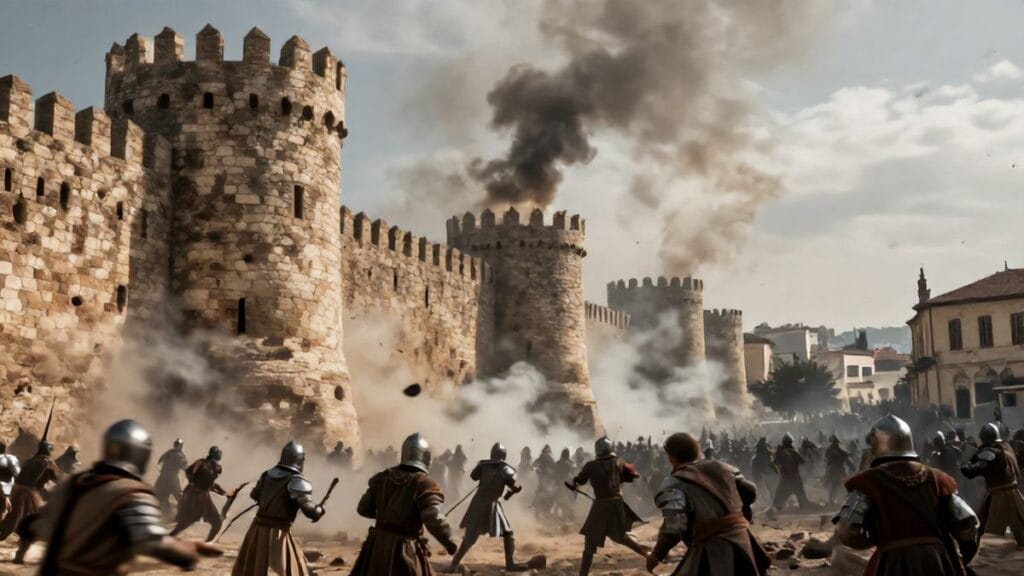
The decisive storming of Thessalonica came with a violence that seemed to many like the very wrath of God. Accounts differ in their details, but they converge on the image of a city overwhelmed by a concentrated, determined assault. Norman siege engines were brought up close to the walls under cover of missile fire. Battering rams crashed against gates; ladders were raised along vulnerable sections. Trumpets blared, drums beat time, and shouts in Latin and Italian dialects rose in a terrifying chorus.
On the walls, defenders scrambled to respond. Stones and beams were hurled down onto the attackers; arrows and javelins flew. Boiling liquids, perhaps oil or water mixed with lime, scalded those trying to climb. Yet sheer numbers and organization took their toll. Where a ladder was thrown down, another was raised. Where a gate held against the ram, sappers worked below to undermine the foundations. Foot by foot, the Normans advanced their deadly architecture against the city’s ancient masonry.
Some Byzantine sources, including the vivid account of the archbishop Eustathios of Thessalonica, hint at moments of panic and breakdown among the defenders. Sections of the wall may have been inadequately manned; certain officers may have failed to stand their ground. Others speak darkly of treachery—of a gate opened, a weakness deliberately exposed. Whether or not actual betrayal occurred, the defenders’ morale was clearly fragile. Once a serious breach opened, the psychological barrier that had sustained resistance crumbled.
When at last part of the wall gave way or a gate was forced, Norman troops poured through with unstoppable momentum. Infantry rushed into the breach, seeking to widen it and secure space for cavalry to follow. The defenders who had held that sector were cut down or driven back in chaos, desperately trying to rally in the narrow streets beyond. Trumpets inside the city sounded emergency calls; church bells rang wildly, turning liturgical instruments into alarms of war.
What followed was the rapid multiplication of terror. Having gained a foothold within the walls, Norman contingents fanned out, seizing key intersections, towers, and gates from the inside. One captured gate could then be thrown open, allowing more troops to rush in. Resistance pockets were isolated and overwhelmed. From the acropolis to the harbor, the geography of the city that had structured daily life now became an obstacle course of flight and slaughter.
For the people of Thessalonica, the moment of breach was the end of one world and the beginning of another. The sack of thessalonica by normans—up to this point a looming threat—now broke storm-like over the city. Priests who had prayed for deliverance now faced armed intruders in their sanctuaries. Merchants who had once calculated profit and loss now calculated chances of survival. Families who had taken shelter behind thick walls now discovered that stone could not protect them from men with swords and torches inside their streets.
The Sack of Thessalonica by Normans: A City Put to the Sword
Once the walls were breached and organized resistance collapsed, the sack of Thessalonica by Normans unleashed horrors that would echo in chronicles for centuries. Medieval warfare did not distinguish between combatants and noncombatants in the way modern sensibilities expect. A captured city, especially one taken by storm rather than surrender, was traditionally subject to plunder, and its inhabitants to the mercy—or lack thereof—of the victors. In 1185, that grim tradition took its full course.
Norman soldiers fanned out through the city, driven by a mix of adrenaline, greed, and fear. They kicked in doors, ransacked houses, and cut down those who resisted. Jewelry was torn from necks and ears; silks and furs were stripped from bodies, whether living or dead. Wealthy households suffered particularly, as soldiers sought out gold, coin hoards, and portable luxuries. Churches and monasteries, often believed to harbor treasure, became prime targets. Relics were seized or desecrated; liturgical vessels—chalices, patens, censers of precious metal—were bundled up as loot.
The violence was not only about wealth. Rape and humiliation accompanied the sword. Chroniclers speak with anguish of women violated in the streets or in the supposed sanctity of churches. Children were not spared; some were killed outright, others seized as captives for sale. Elderly inhabitants, who could not flee, found themselves trampled, beaten, or burned alive as houses caught fire. The normal protections of age, gender, and status dissolved in the chaos. Normans, hardened by previous campaigns, were unlikely to restrain their men with strict discipline amid such a frenzy of opportunity.
One of our most important witnesses, Archbishop Eustathios, writes with searing emotion about what he saw. He describes not only the physical destruction but the moral shock, the sense that a Christian city, under the patronage of a famous saint, could suffer such a fate at the hands of fellow Christians. Eustathios’s account, studied by modern historians like Michael Angold, combines eyewitness testimony with classical rhetoric, drawing comparisons to Troy and other ancient catastrophes. His condemnation of the attackers is fierce; his sorrow for his flock almost unbearable to read.
Amid the carnage, some attempted to negotiate or buy safety. Those who spoke Italian or Latin, or had prior dealings with Western merchants, may have tried to appeal to shared interests or old acquaintances. A few might have succeeded in securing protection from individual officers or knights, but such islands of mercy were small in a sea of indiscriminate violence. Once a sack began, it was hard even for commanders to fully control their troops; the logic of terror and greed took on its own momentum.
Fires broke out—whether deliberately set or caused by the mayhem remains debated. Flames leapt from house to house, carried by late-summer winds. Smoke blotted out the sun in some quarters, while collapsing roofs trapped those who had hidden in cellars or upper rooms. The soundscape of the city was transformed: no more market chatter or liturgical chants, but screams, cracking timbers, and the clatter of arms. This, too, is part of what contemporaries meant when they said that Thessalonica “fell”: it was not merely conquered, but unmade and remade as a place of ruin.
The sack of thessalonica by normans lasted days, not hours. During this time, the city’s social fabric tore apart. Families were separated, with some members killed, others enslaved, others left injured or destitute. The clergy tried, where they could, to intercede, to offer themselves as shields for the vulnerable, or to preserve sacred objects from desecration. Some died in the attempt. Others, like Eustathios, survived to bear witness, their words the only fragile defense they could mount after the fact against the oblivion of forgetfulness.
Blood, Fire, and Plunder: Voices from the Ruins
When the initial fury of the sack subsided, Thessalonica was left as a wounded carcass, picked over by its conquerors. Buildings lay blackened and gutted; streets were choked with debris and corpses. Survivors emerged from hiding places—cellars, cisterns, half-collapsed houses—to confront a transformed landscape. Where once had stood the familiar outlines of their city now loomed broken walls, smoldering ruins, and foreign sentries posted at intersections. For those who had lost everything, the future narrowed to bare survival.
We know what this aftermath felt like primarily through the words of Eustathios and other Byzantine writers, who preserved the voices of the traumatized. Eustathios evokes widows searching for husbands among the dead, parents cradling lifeless children, parish priests trying to count missing parishioners. He notes the bitter irony of holy places violated—the shrine of St. Demetrios, the great basilicas, the monasteries on the hill. For many, the question was not only “How could the Normans do this?” but “Why did God allow this? Why did St. Demetrios not intervene?” In a theologically saturated world, catastrophe demanded explanation.
To some, the answer lay in sin—both personal and collective. Perhaps the city had grown complacent and corrupt, its elites arrogant, its people neglectful of true piety. Perhaps Andronikos’s crimes at the capital had invited divine punishment on the empire, and Thessalonica had been chosen as the vessel of that wrath. Such interpretations did little to comfort the bereaved, but they fit into a long tradition of Christian reflection on disaster, from the sack of Rome in 410 to later calamities. They also allowed some measure of hope: if punishment had been meted out, perhaps repentance could restore favor.
From the Norman side, by contrast, few narrative accounts survive to tell us what their soldiers and leaders thought as they moved through the devastated city. Did they see themselves as instruments of justice against a treacherous empire, or simply as victors enjoying the fruits of war? Some may have felt private unease at the scale of slaughter, others pride at having brought Byzantium’s vaunted second city to its knees. What they could hardly ignore, however, was the wealth they had seized—gold, silver, textiles, captives—for transport back to Sicily and southern Italy.
Captivity was one of the most haunting outcomes of the sack. Men, women, and children were gathered, chained, and marched to holding points awaiting shipment across the sea. Families were broken as individuals were chosen for ransom or for sale. A wealthy merchant might scrape together resources, or appeal to distant kin, to buy his release; a poor laborer had little to bargain with. The human cost of the sack would thus be borne not only in immediate deaths, but in years of exile and servitude for those carried off to foreign lands.
In the weeks that followed, the surviving civic and ecclesiastical leadership faced a grim task: to bury the dead, tend the wounded, and restart some semblance of urban life under occupation. Normans installed their own garrison and administrators, asserting control over what remained of Thessalonica’s infrastructure. Markets reopened in reduced form; basic trade in food and necessities resumed. But the city’s former vibrancy was shattered. Even those who remained free lived under the constant reminder of defeat, their movements watched, their wealth diminished, their memories haunted by scenes they could never forget.
In this shattered city, the sack of thessalonica by normans was no longer just an event; it was a daily presence—a smell in the air, a gap in a family, a burned-out church at the end of the street. It would be years before the physical scars began to heal, and generations before the trauma faded from collective memory, if it ever truly did.
Shockwaves in Constantinople: Revolt and the Fall of Andronikos I
News of Thessalonica’s fall reached Constantinople like a thunderclap. The empire’s second city, long considered a cornerstone of imperial authority in the Balkans, had not only been taken, but subjected to wholesale sack by a Western power. For many in the capital, it was more than a military defeat; it was the collapse of an entire vision of Byzantine invincibility. The sack of thessalonica by normans exposed the hollowness of Andronikos I’s rule, his failure to protect the realm, and his disastrous alienation of key elites.
Already unpopular among segments of the aristocracy and clergy, Andronikos now faced a crisis of legitimacy. His harsh methods, once tolerated by some as necessary to curb corruption, now seemed like mere tyranny. The loss of Thessalonica made clear that he could not even fulfil the basic imperial duty of safeguarding cities and subjects. Discontent boiled over. Plots that had previously simmered in private now moved into the open. The Constantinopolitan populace, prone to sudden shifts of mood, turned against their emperor.
In September 1185, a revolt erupted in the capital, centered around Isaac Angelos, a member of a prominent aristocratic family. When Andronikos attempted to arrest Isaac, the latter fought back and sought refuge in the Hagia Sophia, rallying supporters under the sacred canopy of the Great Church. Crowds gathered; the mood turned insurrectionary. The combination of outrage at Thessalonica’s fate and anger at Andronikos’s brutality proved irresistible. The emperor’s authority, once terrifying, now evaporated.
Within days, Andronikos was overthrown. He was captured, subjected to brutal public humiliation, and finally executed in a grisly spectacle on the streets of Constantinople. His death marked the end of the Komnenian era that had dominated Byzantine politics since the mid-eleventh century. In his place, Isaac II Angelos was proclaimed emperor, inheriting an empire shaken to its core. The new regime promised a restoration of just rule and better defense, but it inherited all the structural weaknesses that Thessalonica’s fall had laid bare.
The political consequences of the sack thus extended far beyond the city’s walls. A single military disaster had toppled a ruler, ended a dynasty, and thrown the empire into a new phase of instability. The Norman invasion, while perhaps not consciously intended to achieve regime change in Constantinople, had in effect done just that. Regional elites, watching events unfold, could only conclude that the central government was no longer a reliable protector. In the longer term, this contributed to centrifugal tendencies that would fragment Byzantine authority in the coming decades.
At the same time, the spectacle of a Christian empire’s city falling to another Christian kingdom raised awkward questions in the Latin West. While some there rejoiced at Byzantium’s humiliation, others worried about the precedent. If Norman armies could sack Thessalonica, what might happen if similar rivalries unfolded between other Christian powers? The ideal of a united Christendom, already fragile, took another blow as realpolitik trumped confessional solidarity.
Norman Triumph, Norman Disaster: From Thessalonica to Strymon and Beyond
For the Norman kingdom of Sicily, the capture and sack of Thessalonica initially looked like a stunning triumph. Here was tangible proof of their ability to challenge Byzantium at its heart, to seize not just coastal strongholds but major inland cities. The wealth carried off from the city—gold, silver, relics, textiles, and human captives—testified to the material rewards of the campaign. In Sicily and southern Italy, the news must have been greeted with celebrations, stories of valor, and grand parades displaying spoils.
Yet the triumph contained seeds of disaster. In pushing so far into Byzantine territory, the Normans had stretched their supply lines and risked overextension. Holding Thessalonica and surrounding areas required garrisons and ongoing logistical support. The longer they stayed, the more likely it became that local resistance would coalesce and that Byzantium would eventually mount a counterattack. Moreover, the brutality of the sack turned many local inhabitants—even those previously ambivalent toward the empire—into bitter enemies of Norman rule.
The turning point came not long after the sack, when a Byzantine force under Alexios Branas confronted the Normans near the Strymon River. There, in late 1185, the Normans suffered a significant defeat. The reasons are multifaceted: overconfidence, fatigue, difficulties in coordination, and the renewed determination of Byzantines desperate to prevent further incursions. Whatever the exact balance of factors, the result was clear. Norman momentum stalled, then reversed. Their position in the Balkans, exposed and increasingly untenable, could not be sustained.
Within months, Norman troops began to withdraw. Thessalonica, that once-mighty prize, was gradually abandoned as a permanent holding. The sack had extracted a terrible toll in lives and treasure but had not delivered lasting territorial gains. The Norman kingdom of Sicily would face new challenges in the years ahead, including internal disputes and external threats, notably from the Hohenstaufen dynasty of the Holy Roman Empire. The glory of 1185 would fade, overshadowed by later conflicts and eventual dynastic change.
For the Normans themselves, then, the sack of Thessalonica was a victory that slipped through their fingers. It demonstrated their capacity to strike hard and deep, but also their limits. They could wound Byzantium, but not replace it. They could topple Andronikos indirectly, but not install their own hegemony in his stead. In strategic terms, the campaign stands as an example of how a dramatic tactical success—taking and plundering a major city—can fail to translate into enduring political advantage.
Nevertheless, the memory of the sack lingered on both sides of the Adriatic. In Norman circles, it could be invoked as proof of their martial prowess. In Byzantine memory, it was a warning of what happened when imperial unity fractured and foreign powers were underestimated. Between triumphal songs in Sicily and lamentations in Macedonia lay a complicated reality: an empire battered but still standing, and a conquering kingdom unable to transform devastation into durable conquest.
Faith under Siege: Church, Martyrdom, and Memory
The religious dimension of the sack of Thessalonica is inseparable from its political and military aspects. Thessalonica was not only a strategic port and commercial hub; it was a city steeped in Christian tradition, from the letters of the Apostle Paul to the cult of St. Demetrios. When this city fell, the spiritual shock was immense. For many Byzantines, the question was as much “Where was St. Demetrios?” as “Where was the emperor?” The apparent failure of divine protection forced a wrenching re-examination of faith, sin, and providence.
Churches across the city bore the marks of violence. Sanctuaries were looted; altars were overturned; sacred vessels disappeared into Norman saddlebags. Some clergy were killed defending their flocks or refusing to reveal hidden treasures. Others survived to minister among ruins. The icon of St. Demetrios, long credited with saving Thessalonica from Slavic and Avar attacks centuries earlier, remained, but its presence now raised uncomfortable questions. How could the protecting martyr stand by while his city was ravaged by fellow Christians?
Theologians and preachers grappled with these issues. Some emphasized the theme of divine chastisement: the city had been punished not for lack of faith per se, but for moral failings—greed, injustice, neglect of the poor. This interpretation allowed continued veneration of St. Demetrios while explaining his apparent inaction. Others focused on the idea of martyrdom. Those who died in the sack, especially clergy and devout laypeople, could be seen as martyrs, witnesses whose blood would fertilize the future spiritual life of the city.
Liturgical commemorations began to incorporate memories of the disaster. On certain feast days, prayers were added for the victims of the sack, for captives held in foreign lands, for the restoration of the city’s churches. The basilica of St. Demetrios, though damaged, remained a focal point, its mosaics and relics taking on an even more poignant meaning in light of the suffering endured. Pilgrims who visited in later years would not only venerate the saint but also hear stories of 1185, of how the city had fallen and slowly risen again.
Over time, a theology of resilience emerged. Thessalonica, it was said, had been tested like Job—brought low, stripped of possessions, yet not destroyed in faith. The sack became part of a larger narrative of Byzantine endurance amid repeated blows: from Persians, Arabs, Bulgarians, and now Latins. By embedding the catastrophe in a providential framework, religious leaders helped their communities make sense of trauma and move forward, even as the memory of the sack remained raw.
In this way, faith did not simply collapse under the weight of disaster. It adapted, mourned, and reinterpreted. The sack of thessalonica by normans, far from extinguishing the city’s spiritual life, gave rise to new forms of devotion and reflection, ensuring that the legacy of 1185 would be not only one of ruins and bones, but also of prayers and stories carried down generations.
Commerce Interrupted: Economic and Demographic Scars
The economic consequences of the sack were immense and long-lasting. Thessalonica’s prosperity before 1185 had rested on its role as a trading hub linking the Aegean with the Balkans and beyond. The city’s merchants dealt in grain, wine, salt, timber, furs, precious metals, and textiles; its artisans produced goods for both local consumption and export. Tax revenues from its markets and port contributed significantly to the imperial treasury. All of this was placed in jeopardy by the shock of invasion and plunder.
In the immediate aftermath, trade ground to a halt. Warehouses were burned or looted; merchant houses destroyed; records lost. Many of the city’s wealthiest trading families were killed, captured, or reduced to poverty. Foreign merchants—Italians from Venice, Genoa, or Pisa, among others—faced losses as their investments and stored goods vanished in the flames. Some may have left the city altogether, fearing further instability. The intricate web of credit and debt that underpinned medieval commerce was badly torn.
Demographically, the city suffered heavy losses. Exact numbers are impossible to reconstruct, but between those killed in the fighting and the sack, those who died later from wounds or disease, and those carried off as captives, Thessalonica’s population was significantly reduced. Entire neighborhoods may have been depopulated; certain professions or guilds lost a large portion of their members. The labor force needed to rebuild houses, ships, and workshops was greatly diminished.
Under Norman occupation and subsequent withdrawal, attempts were made to restart basic economic life. Markets reopened, albeit on a smaller scale. Peasants from surrounding areas, if they had not been too badly hit themselves, brought in food to sell or barter. The city’s remaining artisans began repairs where possible. Over the longer term, imperial authorities would encourage repopulation and reconstruction, perhaps offering tax incentives or privileges to those willing to invest in rebuilding. But confidence—a crucial ingredient in commerce—was slow to return.
Thessalonica’s reduced state also had ripple effects in the region. Smaller towns and villages that had depended on the city as a marketplace and administrative center found their own prospects dimmed. Trade routes shifted as merchants sought more secure alternatives; some business undoubtedly migrated to other ports or inland centers perceived as safer. Neighboring powers watched with interest, sensing opportunities or vulnerabilities. For Byzantium as a whole, the blow to Thessalonica weakened its economic and strategic position in the Balkans for years to come.
Yet cities are resilient organisms. In the decades after 1185, Thessalonica did gradually regain some of its commercial vitality, though it would never entirely shake the memory of the sack. New families rose to prominence where old ones had vanished; new trading relationships were forged. Still, whenever business faltered or danger loomed, some must have remembered the day the Normans came, and the terrible lesson that even the richest of cities could be stripped bare in a matter of hours.
Stories that Wouldn’t Die: Chroniclers, Bias, and the Making of a Trauma
Our understanding of the sack of Thessalonica by Normans is filtered through the pens of medieval chroniclers, each with their own perspectives, agendas, and literary habits. Chief among them is Eustathios of Thessalonica, whose detailed account offers a rare, almost journalistic window into the experience of siege and sack. Yet Eustathios was also a highly educated rhetorician, steeped in classical literature. His descriptions are colored by comparisons to Troy and other ancient catastrophes, blending eyewitness testimony with learned allusion.
Another key source is the historian Niketas Choniates, writing from the vantage point of Constantinople. Choniates situates the sack within a larger narrative of imperial decline, focusing on the failures of Andronikos I and the errors of policy that allowed such a disaster to occur. For him, Thessalonica’s fall is both symptom and symbol: symptom of military weakness and political folly, symbol of divine judgment on a corrupt regime. His account, while not based on direct observation of the events in the city, reflects the shock they caused among the imperial elite.
Western sources are fewer and more fragmentary. Some Latin chronicles mention the Norman campaign and the capture of Thessalonica, but often in brief, triumphal terms, emphasizing the success rather than the suffering. Details of the sack as experienced by the inhabitants are largely absent from these writings. This asymmetry in documentation has shaped modern understanding: the story is told primarily from the perspective of the victims, not the victors. That, in turn, has contributed to the event’s strong resonance in Byzantine and Greek memory.
Modern historians must navigate these sources critically. Numbers of dead, for instance, are notoriously difficult to verify. Medieval authors often used inflated figures to underscore the horror or importance of an event. Descriptions of atrocities may also reflect rhetorical conventions—topoi of cruelty and sacrilege—rather than precise data. Yet to dismiss them entirely as exaggeration would be to risk minimizing real suffering. Scholars like Mark Bartusis and Michael Angold balance close reading of texts with archaeological and comparative evidence to construct nuanced reconstructions.
What emerges from this interplay of voices is not a neat, single narrative but a layered memory. The sack of thessalonica by normans becomes, in retrospect, both a historical event and a moral exemplum. It is cited in later centuries to warn against political division, to condemn Western aggression, to lament the fragility of cities, or to illustrate the justice (or inscrutability) of divine judgment. Each retelling selects and emphasizes different aspects, ensuring that the trauma never quite settles into mere fact.
It is astonishing, isn’t it, how stories outlive the stones they describe? The walls of twelfth-century Thessalonica have long since been modified, rebuilt, or eroded. The exact streets on which certain atrocities occurred are lost to urban change. Yet the narratives survive, copied in manuscripts, quoted in sermons, analyzed in scholarly monographs. In this way, the sack continues to happen in the realm of memory and discourse, shaping identities long after the last Norman soldier left the city’s harbor.
From 1185 to 1204: A Prelude to the Fourth Crusade
Looking back from the vantage point of the Fourth Crusade and the sack of Constantinople in 1204, the events at Thessalonica in 1185 appear as a dark foreshadowing. In both cases, a great Byzantine city fell to Western Christian forces; in both, sack and plunder followed; in both, the blow shook the empire to its core. The parallels have not been lost on historians, some of whom see the sack of Thessalonica as an early warning of trends that would culminate in the more famous catastrophe of 1204.
After 1185, Byzantium under the Angeloi rulers continued to weaken. Isaac II and his successor, Alexios III, presided over a period of mismanagement, corruption, and military decay. Taxation grew more arbitrary; provincial defenses deteriorated. In the Balkans, the restored Bulgarian Empire under the Asen dynasty pressed hard against Byzantine frontiers, exploiting the same vulnerabilities the Normans had exposed. Economic relations with Italian maritime republics became more fraught as Venice, Genoa, and Pisa vied for commercial privileges.
The memory of Thessalonica’s fall fed both external perceptions and internal anxieties. To Western observers, it underscored Byzantine weakness and unreliability. Some Latin churchmen and knights, already suspicious of Greek Orthodoxy and resentful of past Byzantine policies, pointed to 1185 as proof that the empire could not be fully trusted or depended on as a bulwark. To Byzantines, it was a cautionary tale about the consequences of political infighting and failure to maintain strong military leadership.
When the Fourth Crusade gathered at the turn of the thirteenth century, these perceptions played into decisions that would steer the expedition away from the Holy Land and toward Constantinople. The idea that Byzantine cities could be taken—and that vast wealth could be obtained through such ventures—was no longer theoretical. Thessalonica’s fate had demonstrated that even a major urban center could be overwhelmed by a determined Latin force. The precedent made it easier, psychologically and politically, for crusader leaders and Venetian merchants to contemplate turning their armies against the empire.
The sack of Constantinople in 1204 would dwarf that of Thessalonica in scale and historical impact, fragmenting the Byzantine world into successor states and altering the balance of power in the eastern Mediterranean for generations. Yet the logic of violence, plunder, and religiously-tinged enmity that unfolded in 1204 had earlier rehearsals. Among them, the sack of thessalonica by normans stands out as a grim milestone, a moment when the walls between Latin and Greek Christendom—already weakened by theological and political disputes—were breached not just metaphorically but in stone and blood.
In this sense, 1185 and 1204 form a tragic arc: from the second city to the first, from a warning blow to a near-fatal one. The cities are different, the armies not the same, the circumstances distinct—but the underlying patterns of mistrust, opportunism, and imperial fragility bind them together in the longer story of Byzantium’s decline.
The Sack in Modern Eyes: Historians, Debates, and Myths
Modern scholarship has approached the sack of Thessalonica with a mixture of fascination and caution. On the one hand, the event offers a vivid case study of medieval urban warfare, cross-cultural conflict within Christendom, and the vulnerabilities of empires. On the other, the charged nature of the sources and later nationalist appropriations require careful disentangling of myth from reality. Historians sift through chronicles, charters, and archaeological traces to reconstruct what happened without succumbing to either romanticization or anachronistic judgment.
One area of debate concerns the scale of the slaughter and destruction. While Byzantine chroniclers understandably emphasize the horror and vast numbers of dead, some modern scholars suggest that these figures may be exaggerated. They compare descriptions of Thessalonica’s sack with those of other sieges in the period, looking for recurring rhetorical patterns. Yet even those who question raw numbers do not deny that the sack was exceptionally brutal by contemporary standards. The testimonies of Eustathios and Choniates, though shaped by their moral and literary agendas, remain powerful witnesses to widespread devastation.
Another discussion focuses on Norman motives. Was the campaign against Thessalonica primarily driven by opportunistic greed and territorial ambition, or did religious and ideological elements play a significant role? Some older narratives, influenced by confessional polemics, framed the attack as yet another episode in a long series of Latin aggressions against Byzantium. More recent work nuances this picture by examining the political context in Sicily, the dynamics of Norman court factions, and the broader international situation. As one historian has put it, “religion provided the language, but power supplied the logic.”
Nationalist historiography in both Greece and Italy has, at times, used the sack to support modern identities and grievances. For Greek narratives, 1185 can appear as an early example of Western betrayal and aggression, foreshadowing later interventions in Greek affairs. For Italian or Sicilian perspectives, it can be cast as a moment of medieval glory, proof of southern Italy’s historical potency. Both uses flatten the complexity of the twelfth-century world, yet they also demonstrate how enduring the memory of the sack has been.
Comparative historians place Thessalonica alongside other medieval urban sacks—of Lisbon, Jerusalem, Béziers, and later Constantinople—to explore common patterns: the interplay of siege tactics and terror, the role of religious rhetoric, the economic calculus of plunder versus ransom. In this wider frame, the sack of thessalonica by normans stands as part of a grim but illuminating catalogue of how medieval societies waged war on cities. It reminds us that the sharp line we draw today between “combatant” and “civilian” was largely absent in the mental universe of the twelfth century.
Ultimately, modern scholarship does not so much “solve” the event as deepen our appreciation of its layers. We see in it the convergence of high politics and everyday suffering, of strategic calculation and random cruelty, of narratives crafted to condemn, justify, or mourn. The sack becomes not only a subject of study but also a mirror in which we can reflect on how we, in our own time, represent violence and catastrophe.
Echoes in the Present: Thessalonica’s Long Memory
Today, walking through modern Thessaloniki—the bustling Greek city that grew from the medieval Thessalonica—it is easy to overlook the events of 1185 amid apartment blocks, cafés, and traffic. Yet the past is not entirely buried. Fragments of the old walls still stand, some sections restored, others worn by time. The basilica of St. Demetrios, rebuilt and restored over centuries, continues to draw worshippers and tourists. Beneath its floors and in its crypts lie traces of the city’s long Christian history, including the era of Norman fire and sword.
Local historians and guides occasionally recount the story of the sack, connecting it to the broader tapestry of Thessaloniki’s past: Roman foundation, Byzantine glory, Ottoman rule, the city’s Jewish heritage, the Great Fire of 1917, and the upheavals of the twentieth century. In this layered narrative, 1185 is one trauma among many, but it remains significant as one of the earliest recorded large-scale devastations in the city’s history. It shaped patterns of fortification, administration, and historical consciousness that would echo in later crises.
In Greek cultural memory, especially among those steeped in Byzantine history, the sack serves as a symbol of vulnerability and endurance. It is sometimes invoked in broader reflections on the empire’s decline, on the perils of disunity, on the recurring danger posed by external powers when internal cohesion fails. Writers and scholars draw parallels—with due caution—between 1185 and later moments when Thessaloniki or Greece more generally stood at the crossroads of great-power rivalries.
The city’s physical evolution has, in some ways, mirrored its historical resilience. Rebuilt after fires, wars, and earthquakes, Thessaloniki embodies the capacity of urban communities to absorb catastrophe and continue. Archaeological excavations occasionally unearth remains from the twelfth-century layers—walls, houses, pottery shards—silent witnesses to the world in which the Normans came. Each find adds a small piece to the puzzle of what the city looked like before and after the sack.
For visitors contemplating the basilica of St. Demetrios or the surviving stretch of the Heptapyrgion fortress, the story of the sack of thessalonica by normans can lend a different weight to the stones. They are not only picturesque ruins or architectural heritage; they are the survivors of a day when faith was tested, when empire cracked, and when thousands met fates now known only to God and to a handful of remaining texts. In this way, the echo of 1185 continues to murmur beneath the modern city’s noise, a reminder that every urban landscape carries within it the sediments of forgotten storms.
Conclusion
The sack of Thessalonica by Normans in August 1185 stands as one of the most searing episodes in the late history of the Byzantine Empire. It was not an isolated outburst of violence, but the culmination of long-building tensions: Norman ambition, Byzantine overreach and internal decay, strained relations between Latin and Greek Christendom, and the vulnerabilities of a great urban center caught between empire and sea. The fall of the city exposed the fragility of imperial authority, toppled Andronikos I, and contributed to a trajectory that would lead, less than twenty years later, to the even greater calamity of the Fourth Crusade’s sack of Constantinople.
Yet the story is more than a tale of strategic failure and political consequence. At its heart lie the lives of Thessalonica’s inhabitants—the merchants, monks, artisans, sailors, children, and clergy who woke on a feast day and went to sleep, if they survived at all, in a world transformed by fire and blood. Their voices, faintly preserved in the grief-stricken prose of Eustathios and the sober analysis of Choniates, remind us that history’s turning points are always experienced most acutely by those far from thrones and councils.
The sack’s religious and cultural reverberations shaped how Byzantines thought about sin, punishment, and endurance. It entered liturgical memory, homiletic reflection, and later historical writing as both warning and lament. Economically and demographically, the city staggered under the blow, yet gradually found ways to rebuild and re-knit its social fabric. In this mixture of devastation and resilience, Thessalonica’s experience prefigures many other urban traumas across the centuries.
Modern historians, parsing sources with critical care, have moved beyond simple narratives of villainy and victimhood to uncover the complex matrix of motives, structures, and contingencies that made the sack possible. Still, the moral force of the event resists complete neutralization; reading about it, one cannot help but feel outrage and sorrow. The sack of thessalonica by normans remains a stark example of how quickly human-made systems of security—walls, laws, alliances, reputations—can fail when stressed beyond their limits.
In the end, the story of 1185 invites reflection on the precariousness of cities, the responsibilities of rulers, and the enduring power of memory. Thessalonica survived, changed but unextinguished. The empire that failed to save it would, in time, crumble. The Normans who conquered it would lose their gains. What persists is the lesson: that greatness without cohesion is brittle, that arrogance invites challenge, and that even amid catastrophe, human communities can find ways to remember, to rebuild, and to tell their stories anew.
FAQs
- What was the sack of Thessalonica by Normans?
The sack of Thessalonica by Normans was the violent capture and plunder of the Byzantine Empire’s second city by the Norman kingdom of Sicily in August 1185. After besieging the city and breaching its walls, Norman troops looted homes, churches, and monasteries, killed many inhabitants, and carried off others as captives. The event shocked contemporaries and is vividly described by the city’s archbishop, Eustathios of Thessalonica. - Why did the Normans attack Thessalonica?
The Normans attacked Thessalonica as part of a larger campaign to exploit Byzantine weakness after the death of Emperor Manuel I and the troubled reign of Andronikos I. Thessalonica was a rich commercial hub and symbolic second capital, so capturing it promised enormous plunder and strategic advantage. The invasion also reflected long-standing Norman-Byzantine rivalries and the broader competition between Latin and Greek powers in the eastern Mediterranean. - How did the Normans manage to capture such a well-fortified city?
Although Thessalonica’s walls were strong, the city suffered from insufficient and poorly coordinated defense, in part due to the empire’s political turmoil. The Norman army was well organized, equipped with siege engines, and benefited from the lack of an effective Byzantine relief force. Probing attacks and sustained assault eventually opened a breach in the defenses—possibly aided by panic, incompetence, or even betrayal among the defenders—allowing Norman troops to pour into the city. - What were the immediate consequences for Thessalonica’s inhabitants?
The immediate consequences were catastrophic. Many residents were killed during the assault and subsequent sack; others were injured, traumatized, or left homeless as fires and looting ravaged the city. A significant number of people were taken captive and transported to Norman-held territories to be sold as slaves or ransomed. Churches were desecrated, property stripped, and the city’s economic and social structures badly damaged. - How did the sack affect the Byzantine Empire politically?
The fall and sack of Thessalonica severely undermined Emperor Andronikos I’s legitimacy, highlighting his failure to defend a key imperial center. News of the disaster contributed directly to a revolt in Constantinople that toppled Andronikos and brought Isaac II Angelos to the throne. More broadly, the event exposed the empire’s military and administrative weaknesses, emboldened its enemies, and deepened internal instability in the years leading up to the Fourth Crusade. - Did the Normans keep control of Thessalonica after the sack?
No, Norman control of Thessalonica was short-lived. Although they initially installed garrisons and tried to consolidate their gains, the Normans soon faced effective Byzantine resistance, notably a defeat near the Strymon River. Overstretched and vulnerable far from their bases in Italy and Sicily, they were eventually forced to withdraw, giving up their foothold in the Balkans and abandoning Thessalonica as a permanent possession. - How reliable are the sources describing the sack?
The main sources—especially the account of Archbishop Eustathios and the writings of Niketas Choniates—are invaluable but must be read critically. Both authors had strong moral and political viewpoints and used literary conventions that could amplify horror and pathos. Modern historians cross-check these narratives with other texts and material evidence, concluding that while exact figures may be exaggerated, the essential picture of a brutal, large-scale sack is accurate. - What role did religion play in the interpretation of the sack?
Religion was central to how contemporaries interpreted the catastrophe. Many saw the sack as divine punishment for sins—whether those of the city, the empire, or its rulers. The apparent failure of St. Demetrios to protect Thessalonica forced reflection on the conditions of saintly intercession. Over time, the dead of 1185 were sometimes viewed through the lens of martyrdom, and the event entered liturgical and devotional memory as both warning and call to repentance. - Was the sack of Thessalonica related to the later Fourth Crusade?
While there was no direct causal chain, the sack of Thessalonica foreshadowed the dynamics that would lead to the Fourth Crusade’s sack of Constantinople in 1204. It demonstrated that major Byzantine cities could fall to Western Christian forces and reinforced perceptions of Byzantine weakness and unreliability in Latin Europe. The event thus formed part of the broader context of mistrust, opportunism, and imperial fragility that shaped decisions in the early thirteenth century. - How is the sack remembered in Thessaloniki and historical scholarship today?
In modern Thessaloniki, the sack of 1185 is one episode in a long and turbulent history, remembered mainly by historians, scholars, and those interested in Byzantine heritage. Academic studies treat it as a key example of late Byzantine vulnerability and medieval urban warfare. While not as widely known as the sack of Constantinople in 1204, it remains an important subject in Byzantine studies and a poignant chapter in the city’s collective past.
External Resource
Internal Link
Other Resources
- Encyclopaedia Britannica – general search for the exact subject
- Google Scholar – academic search for the exact subject
- Internet Archive – digital library search for the exact subject

