Table of Contents
- Opening the Doors to Destiny: The Dawn of the San Remo Conference
- The Aftermath of War: Europe at a Crossroads in 1920
- The Great Powers Assemble: Who Held the Cards?
- Redrawing the Map of the Middle East: The Stakes Revealed
- The League of Nations Mandate System: An Innovation or Imperialism?
- Sharpening the Lines: The Fate of Palestine on the Table
- French Ambitions and Syrian Hopes: A Tenuous Balance
- British Interests and the Iraqi Question: The Empire’s Reach
- Italy’s Role and Its Claims: Between Ambition and Reality
- Arab Voices and Silent Rooms: The Marginalization of Local Actors
- Zionism at the Conference: Dreams of a National Home
- The Negotiations: Tense Days, Lingering Shadows
- Agreements Signed, Futures Decided: The Mandates Confirmed
- The Human Impact: Dreams Deferred and Promises Broken
- The Legacy of San Remo: Seeds of Conflicts Yet to Come
- Remembering 1920: How San Remo Shapes Modern Middle East
- The Mandate System under Scrutiny: Criticism and Debates
- The Echoes of Versailles and San Remo: The Interwar Political Order
- Reflections from Leaders: Statements and Correspondences
- Cultural Dimensions: Representations and Memory in Literature
- San Remo Beyond Politics: Economic and Social Repercussions
- Conclusion: The San Remo Conference as a Turning Point in Middle Eastern History
- FAQs
- External Resource
- Internal Link
Opening the Doors to Destiny: The Dawn of the San Remo Conference
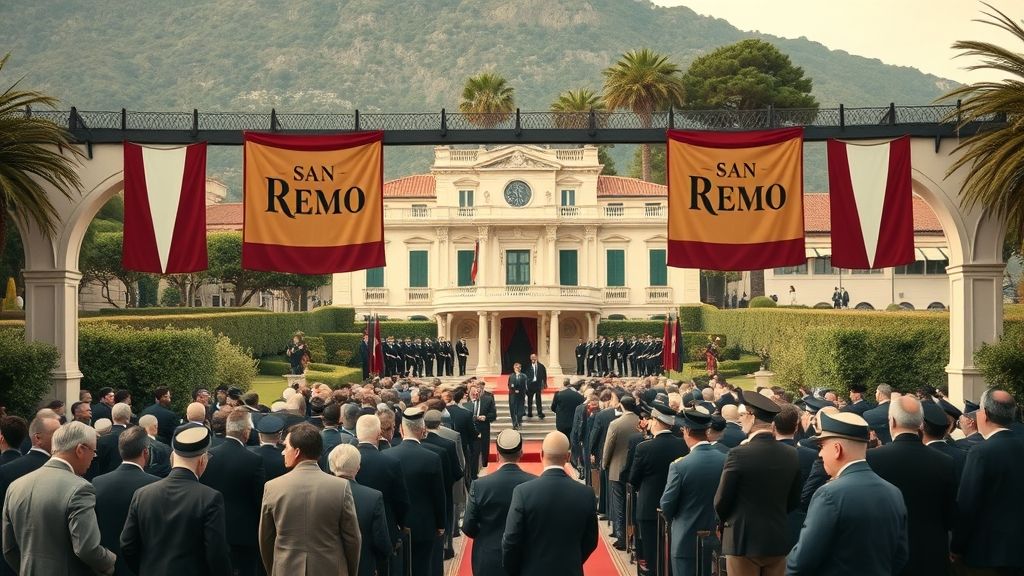
On April 19, 1920, the tranquil Italian seaside town of San Remo found itself thrust onto the stage of history. The gentle waves along the Ligurian coast belied the gravity of the discussions underway in the stately Villa Devachan, where representatives of the victorious Allied Powers convened amid swirling clouds of post-war uncertainty. The air was heavy with cigarette smoke, the murmur of guarded conversations, and the palpable tension of a world reshaped by the Great War’s devastation. Few present in that softly sunlit room could foresee how the decrees hammered out in those days would echo for a century, carving borders, fanning hopes, and igniting conflicts in the fragile lands of the Middle East.
The San Remo Conference was more than a diplomatic gathering; it was a crucible where the shadows of empire met the aspirations of emerging nations. The conference’s opening was marked by a mixture of triumph and foreboding—a glimpse into a new world order that promised peace but wove seeds of future strife.
The Aftermath of War: Europe at a Crossroads in 1920
The First World War had ended less than two years earlier, in November 1918, leaving Europe battered and exhausted. The old empires—Ottoman, Austro-Hungarian, Russian, and German—had crumbled, and a fragile peace was attempting to take root, fostered by the Treaty of Versailles. Yet behind the celebrations and the artful rhetoric of “making the world safe for democracy” lurked complex, often competing, interests. The Middle East, once the heartland of the Ottoman Empire, was now a prize up for grabs.
The war dramatically transformed the political landscape, especially in the Ottoman Arab provinces. The British and French had made secret commitments during the war—at times contradictory—regarding the fate of these territories. The Sykes-Picot Agreement of 1916, though largely hidden from public knowledge, had already planted the seeds of division by partitioning the region into zones of influence. At San Remo, the task was to formalize and publicly recognize these arrangements under the League of Nations’ growing influence.
The Great Powers Assemble: Who Held the Cards?
The conference brought together the principal Allied powers: Britain, France, Italy, and Japan, with smaller allied states in attendance. With Germany and the defeated Central Powers excluded, and the United States opting out of direct Mediterranean diplomacy despite President Wilson’s earlier idealism, it was the European colonial powers that held sway.
British Prime Minister David Lloyd George and French Prime Minister Alexandre Millerand attended, alongside Italian Prime Minister Francesco Nitti, underscoring the political weight of the meeting. The balance of power between Britain and France, the two imperial giants, was delicate—their ambitions overlapped but were not identical.
Italy, eager to cement its role among the victorious nations, viewed the conference as a chance to assert claims not only in the Middle East but in the Mediterranean basin. Japan, though less influential in Middle Eastern affairs, nonetheless participated as part of the new geopolitical fabric.
Redrawing the Map of the Middle East: The Stakes Revealed
San Remo’s paramount purpose was to determine the governance of former Ottoman territories. The map of the Middle East had long been vague—tribal loyalties, religious affiliations, and ancient empires had made border demarcations fluid, and the war’s end presented both opportunity and challenge in imposing new boundaries.
The territories under scrutiny were vast: Syria, Lebanon, Palestine, Mesopotamia (modern Iraq), and parts of Arabia. Each was home to diverse peoples—Arabs, Kurds, Jews, Druze, Armenians, and others—whose aspirations could not be contained by foreign impositions.
As discussions commenced, it became clear that the Allied powers saw these lands primarily through the lens of strategic interests: control of trade routes, oil reserves, and influence over regional politics. Questions of self-determination clashed with imperial ambitions.
The League of Nations Mandate System: An Innovation or Imperialism?
One of the conference's pivotal outcomes was the formalizing of the mandate system, proposed as a “trusteeship” under the auspices of the newly established League of Nations. Ostensibly, mandates were territories deemed “not yet able to stand by themselves” and thus placed under the supervision and administration of the victor powers to guide them toward independence.
Yet, critics have long argued that the mandate system was a thin veil for continued colonial rule, repackaged as humanitarian stewardship. The mandates would effectively legalize British and French control over key Middle Eastern regions, replacing Ottoman sovereignty with Western oversight.
For the inhabitants of these lands, the mandate system offered little in terms of self-rule. It redefined sovereignty through an international framework but scarcely altered the reality of imperial dominion.
Sharpening the Lines: The Fate of Palestine on the Table
Perhaps the most historically resonant discussion at San Remo concerned Palestine. The British, having occupied this region during the war, were now tasked with formalizing its future status under a mandate.
San Remo reinforced the Balfour Declaration of 1917, which expressed British support for the establishment of a "national home for the Jewish people" in Palestine—an assertion that would ignite profound repercussions for Arab-Jewish relations.
The adoption of this principle represented an ambiguous promise. It failed to clarify the political rights of the existing Arab majority or how the Jewish national home would be implemented without provoking conflict. The seeds of the Israeli-Palestinian conflict are often traced directly to these momentous decisions.
French Ambitions and Syrian Hopes: A Tenuous Balance
France emerged from San Remo confirmed as the mandatory power in Syria and Lebanon. This formal recognition endorsed French aspirations dating back to colonial rivalry with Britain and slumbering designs on Levant territories.
For the local Arab population, the French mandate dashed the dreams of the short-lived Arab Kingdom of Syria declared under Emir Faisal. France moved swiftly to assert control, provoking resistance and sowing discord.
Lebanon, especially, was delineated with new borders to include a significant Christian Maronite population, responding to French religious and cultural interests as a supposed stabilizing factor. But this titling of the area as a separate mandate planted future sectarian tensions.
British Interests and the Iraqi Question: The Empire’s Reach
Mesopotamia, modern-day Iraq, had been under British military control since 1917. San Remo’s decisions transferred formal authority to Britain under a League of Nations mandate, enabling London to consolidate control.
The British faced complex challenges administering a land with Sunni, Shi’a, Kurdish, and other diverse groups. Loyalties were divided, and nationalist uprisings, like the 1920 Revolt, erupted in reaction to foreign rule.
Yet behind these difficulties lurked the British strategic priority: securing access to oil, confirming influence over the Persian Gulf, and maintaining routes to India, the empire’s jewel.
Italy’s Role and Its Claims: Between Ambition and Reality
Italy, though a victor in the Great War, found its ambitions tempered by realpolitik at San Remo. It emerged with a formal mandate over parts of former Ottoman territories in Asia Minor, including the city of Antalya.
Italy’s participation reflected both its desire to be counted among the great powers and to secure its place in the colonial scramble. However, its limited mandate and competition with other powers highlighted Italy's constrained influence.
These modest gains foreshadowed Italy’s increasing assertiveness in the interwar period, searching for prestige through imperial ventures.
Arab Voices and Silent Rooms: The Marginalization of Local Actors
Notably absent from the conference were representatives of the Arab populations themselves. Political leaders who had allied with the British during the war, such as Sharif Hussein of Mecca, and his son Faisal, found their claims sidelined.
The fundamental principle of self-determination championed by U.S. President Woodrow Wilson was applied unevenly, often subordinated to imperial designs. Arab delegations petitioned and protested but had no seat at the main table.
This sidelining bred resentment and skepticism toward Western powers, fueling future nationalist movements and anti-colonial struggles.
Zionism at the Conference: Dreams of a National Home
Zionist leaders had worked hard behind the scenes to influence the San Remo decisions. The confirmation of the Balfour Declaration at the conference was a milestone for the movement, seen as an international endorsement for Jewish homeland aspirations.
However, Zionism’s ambitions were entangled with British imperial strategy and the uncertain politics of local Arab opposition. Figures like Chaim Weizmann celebrated the moment but understood that the path ahead would be fraught with conflict.
This duality—hope fused with precariousness—characterizes the early Zionist narrative in Mandate Palestine.
The Negotiations: Tense Days, Lingering Shadows
The conference proceedings were marked by intense negotiations, suspicions, and diplomatic wrangling. Agreements were reached after long debates about the extent of mandates, the level of local autonomy, and the rights of minorities.
The fragile compromise reflected the often contradictory nature of the powers’ ambitions. Yet the rapid pace of decisions and lack of local participation sowed discord.
Behind closed doors, the future of millions was shaped with little regard to their voices—a colonial drama disguised as international lawmaking.
Agreements Signed, Futures Decided: The Mandates Confirmed
By the end of April 1920, the San Remo Conference concluded with formal decisions allocating mandates:
- Britain gained Palestine and Mesopotamia (Iraq).
- France acquired Syria and Lebanon.
- Italy obtained a smaller, but symbolically significant, share in Anatolia.
The League of Nations would later ratify these decisions officially in 1922–23, but San Remo set the definitive framework.
These mandates officially ended Ottoman sovereignty but replaced it not with independence but international custodianship—often little more than disguised colonialism.
The Human Impact: Dreams Deferred and Promises Broken
For the peoples of the Middle East, the conference marked the beginning of new struggles. Arab hopes for independence were largely unfulfilled. Many saw the mandates as betrayals of wartime promises.
In Palestine, tensions simmered as Jewish immigration increased, leading to communal clashes and social upheaval. Syria and Lebanon saw resistance movements emerge against French rule. Iraq wrestled with the imposition of a foreign king and British influence.
The human cost was profound: wars, displacements, cultural disruptions, and political repression shadowed the mandates’ first decades.
The Legacy of San Remo: Seeds of Conflicts Yet to Come
The San Remo Conference laid down borders and policies that have proven among the most contentious in modern history. The decisions taken on these few spring days set in motion conflicts that have reverberated into the 21st century.
Its legacy includes the ongoing Israeli-Palestinian conflict, sectarian rivalries in Lebanon, political instability in Syria and Iraq, and wide Arab resentment toward Western intervention.
San Remo is thus remembered both as a defining moment of post-war pragmatism and a cautionary tale about the perils of drawing borders without local consent.
Remembering 1920: How San Remo Shapes Modern Middle East
Today, scholars and politicians alike look back on the San Remo Conference as a turning point. Its outcomes are embedded in historical memory and the political consciousness of the Middle East.
Memorialization varies: for some, it symbolizes betrayal, for others, the birth of international governance. Understanding San Remo is essential to grasping the complex roots of modern Middle Eastern geopolitics.
The Mandate System under Scrutiny: Criticism and Debates
Since its inception, the mandate system has been debated. Was it a genuine step toward guiding former colonies toward independence, or merely a formalization of imperial control?
Many have argued that it extended European imperialism under the guise of international law. The mandates offered a façade of progressiveness but ignored self-rule.
This debate continues to inform critiques of international governance and colonial legacies worldwide.
The Echoes of Versailles and San Remo: The Interwar Political Order
San Remo must also be placed alongside the Treaty of Versailles and other post-war settlements. Together, they formed the architecture of the interwar order.
This system attempted to impose stability but in many ways sowed seeds of future upheaval, as fragile peace agreements failed to address underlying ethnic, national, and social tensions.
The Great War’s end was thus also the start of uneasy peace.
Reflections from Leaders: Statements and Correspondences
The conference participants left behind statements, letters, and memoirs that capture the complex mood of the moment.
Lloyd George emphasized the necessity of mandating these territories to secure peace and order. French diplomats spoke of “civilizing missions” and historic rights. Arab leaders expressed deep disillusionment in private.
These voices reveal the gap between official rhetoric and lived realities.
Cultural Dimensions: Representations and Memory in Literature
San Remo and its aftermath have been depicted in literature, cinema, and scholarship, reflecting diverse perspectives. Novels, poems, and historical works explore the human dimension—the aspirations, betrayals, and resilience of peoples affected.
This cultural memory continues to shape debates over identity, history, and justice in the Middle East.
San Remo Beyond Politics: Economic and Social Repercussions
Beyond borders, the mandates influenced economic structures and social relations. The introduction of new administration, infrastructure projects, and resource exploitation affected livelihoods.
British and French control opened the region to geopolitical and commercial interests, particularly in oil, shaping economic dependencies lasting decades.
The social landscape transformed under foreign mandates.
Conclusion: The San Remo Conference as a Turning Point in Middle Eastern History
The San Remo Conference of April 1920 was not merely a diplomatic meeting; it was a watershed moment that reshaped the Middle East’s destiny. Against the backdrop of post-war idealism and imperial realpolitik, decisions were taken that would shape the lives of millions, define nations, and trigger conflicts that echo to this day.
It reveals the complexity of building peace in a fractured world—a process filled with hope, compromise, but also profound injustices. Remembering San Remo reminds us that history’s turning points are forged not just by treaties on paper, but by the human stories entwined with them.
FAQs
Q1: What was the main purpose of the San Remo Conference?
A1: The conference aimed to determine the administration of former Ottoman territories in the Middle East after World War I by dividing them into mandates under the League of Nations.
Q2: Which countries were granted mandates at San Remo?
A2: Britain received mandates over Palestine and Mesopotamia (now Iraq), France over Syria and Lebanon, and Italy was granted control over parts of Anatolia.
Q3: How did San Remo impact the Israeli-Palestinian conflict?
A3: San Remo endorsed the Balfour Declaration, supporting a Jewish national home in Palestine without clear protections for the Arab majority, laying groundwork for future conflict.
Q4: Were local Arab populations represented at the conference?
A4: No, Arab leaders were largely excluded from decision-making, leading to a sense of betrayal and fueling nationalist resentment.
Q5: What was the League of Nations mandate system?
A5: It was an international framework designed to manage territories deemed unable to self-govern, ostensibly preparing them for independence but effectively extending imperial control.
Q6: Why is the San Remo Conference considered a turning point?
A6: Because it formalized the new political order in the Middle East post-WWI, initiating mandates and borders that influence regional dynamics to the present day.
Q7: How did Italy's role at San Remo reflect its status among the victors?
A7: Italy gained a smaller mandate in Anatolia, representing its ambition to be a great power though with limited influence compared to Britain and France.
Q8: What are the long-term legacies of the San Remo decisions?
A8: The conference’s decisions contributed to ongoing conflicts, nationalist movements, and debates over colonialism and self-determination in the Middle East.