Table of Contents
- The Long Shadow of Rivalry: Byzantium and the Sassanian Empire
- Khosrow I Ascends: The Visionary Shahanshah
- The Eastern Frontier on Edge: Mesopotamia’s Strategic Weight
- The Flicker Before the Flame: Prelude to Renewed Hostilities
- The First Clashes: Skirmishes That Signaled a Bigger War
- Siege of Dara: The Crux of Military Innovation and Strategy
- The Role of Totila and the Ostrogoths: A Byzantine Wildcard
- Khosrow’s Military Reforms: A New Era of Persian Warfare
- The Byzantine Response: Emperor Justinian’s Calculated Resolve
- The Tide Turns: Key Battles and Shifting Control in Mesopotamia
- The Human Cost: Lives, Cities, and the Trauma of Warfare
- Diplomacy on the Knife-edge: Ambassadors, Espionage, and Intrigue
- The Truce of 561: Exhaustion and Fragile Peace
- Legacy of the War: Influences on Later Byzantine-Sassanian Conflicts
- Cultural Exchanges Amidst Conflict: Art, Knowledge, and Religion
- How This War Shaped the Future Islamic Conquests
- Lessons from Khosrow I’s Campaigns: Leadership and War in Late Antiquity
- Conclusion: The Echoes of War Between Two Great Empires
- FAQs
- External Resource
- Internal Link
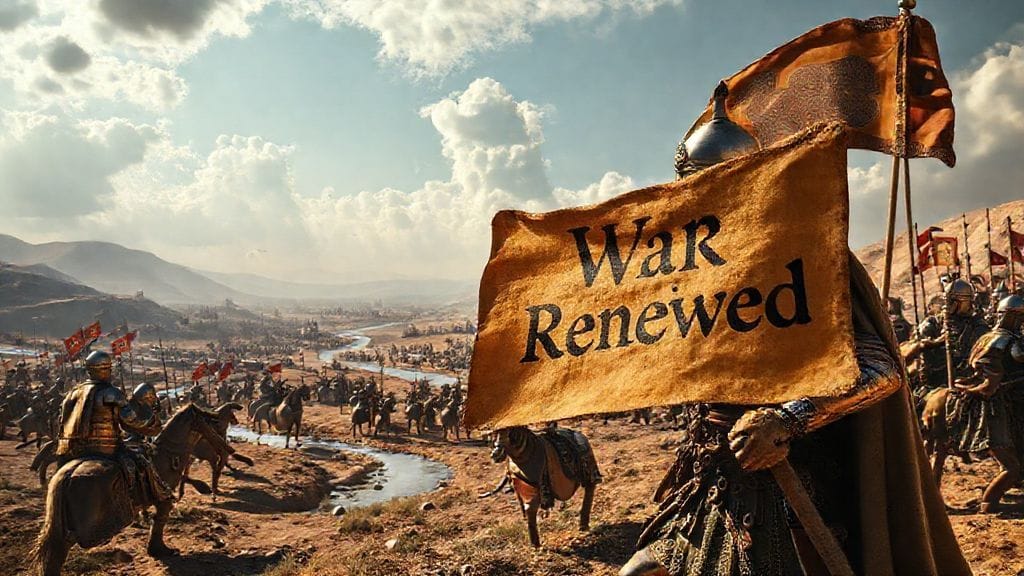
The golden light of a Mesopotamian dusk spilled over ruined battlements, the air thick with dust and the bitter scent of smoldering earth. Soldiers hunched behind crumbling walls whispered prayers to both Zoroastran and Christian gods, silently wrestling with the fate that war had forced upon them. Around them swirled not just military conflict, but a centuries-old rivalry between two colossi: the Sassanian Empire and the Byzantine Empire. It was the mid-sixth century — an epoch of shifting power, soaring ambitions, and the stirring of destinies that would echo across millennia.
War had erupted anew under the iron will of Khosrow I, the Sassanian Shahanshah whose visionary spirit sought to restore Persia’s ancient glory. Mesopotamia would become the battered chessboard on which strategy, courage, and sheer endurance played out in a brutal contest. The year was the 540s, and the bloodlines of empire would once again be tested under an unforgiving sun.
But how did this conflict rekindle? Who were the masterminds behind the storm of swords and siege engines? And what would be the enduring impact of this brutal dance between two of the ancient world’s mightiest powers?
The Long Shadow of Rivalry: Byzantium and the Sassanian Empire
For centuries, Byzantium and the Sassanian Empire had traded more than just caravans across their shared borders. They exchanged fire and steel, alliances and betrayals, philosophies and faiths. The eastern frontier was not just a line on a map; it was a theatre seething with political machinations and military brinkmanship.
The Sassanian dynasty, founded in the third century CE, carried Persian imperial traditions forward with new vigor. Byzantium — successor to Rome’s eastern glory — stood as a formidable fortress of Christianity and Hellenistic culture. Their contests for control over Mesopotamia, Armenia, and the Levant were almost ritualistic, part of a perennial saga where neither would accept permanent defeat.
By the early 6th century, this rivalry had already seen devastating wars, with battles like Satala in 530 CE exposing the fragile equilibrium between these giants. The stalemate was broken only by moments of truce, uneasy and temporary.
Khosrow I Ascends: The Visionary Shahanshah
Born as Anushiruwan, Khosrow I took the throne in 531 CE determined to transform Persia — not just militarily, but culturally and administratively. Unlike some of his predecessors concerned mainly with conquest, Khosrow’s vision was broad: reform taxation, strengthen the navy, overhaul the army’s command, and champion justice (earning him the nickname Anushiruwan the Just).
Under his reign, the Sassanian Empire experienced a renaissance of sorts. His reforms enhanced the empire’s ability to project power. Yet, Khosrow also harbored a keen geopolitical insight: the Byzantine Empire was weakened by internal strife and external pressures, perhaps vulnerable to a decisive strike.
This dynamic set the stage for the renewed war in Mesopotamia, as Khosrow sought to capitalize on Byzantium’s overextension while safeguarding Persia’s borders—which were ever porous and contested.
The Eastern Frontier on Edge: Mesopotamia’s Strategic Weight
Mesopotamia was the jewel in the volatile borderlands between Byzantium and Persia. Fertile, dotted with ancient cities like Nisibis and Dara, it was both a prize and a battleground.
Control over Mesopotamia meant control of trade routes running from the Persian Gulf through the Fertile Crescent, vital for both empires’ economies. Militarily, forts and cities here served as bulwarks or launching pads for invasion. The vast plains and river networks created a landscape suiting cavalry maneuvers and siege tactics alike.
For Khosrow, seizing Mesopotamia wasn’t merely territorial—it was a message: Persia was reasserting itself on the world stage.
The Flicker Before the Flame: Prelude to Renewed Hostilities
The peace forged under Emperor Justinian I was tenuous. Byzantine efforts to restore Italy and reclaim old Roman provinces drained imperial coffers and attention. Meanwhile, diplomatic missteps, border raids, and local revolts festered.
Skirmishes intensified around frontier towns. Persian incursions tested Byzantine resolve; Byzantine patrols pushed retaliatory strikes. The fragile calm shattered when a Persian assault on a strategic Byzantine fortress ignited full-scale war.
Despite Justinian’s desire for peace, his generals in the East—led by the capable but often divided Belisarius and Narses—prepared for a prolonged contest. Khosrow, confident and disciplined, marshaled his forces with an eye to crushing his adversary.
The First Clashes: Skirmishes That Signaled a Bigger War
Initial engagements in the early 540s were as brutal as they were telling. Battle lines formed along the Tigris and Euphrates, villages razed, and towns besieged. The war was as much attritional as it was strategic — a grinding test of supply lines and morale.
Perhaps most emblematic was the struggle for the city of Dara in 540. This fortress, only a few miles from the border, had been constructed by Byzantines decades earlier expressly to check Persian advances. Now it became the focal point of a deadly standoff.
Khosrow’s siege attempts pushed Byzantine defenders to their limits. Meanwhile, Byzantine armies worked tirelessly to hold their lines and prevent fissures from becoming breaches.
Siege of Dara: The Crux of Military Innovation and Strategy
The siege of Dara is remembered as one of the defining military episodes of the conflict. Both sides exhibited remarkable ingenuity: Romans rebuilt walls overnight, repaired aqueducts, and launched daring sorties. The Persians employed powerful siege engines and tactical feints.
Khosrow’s commanders introduced new formations and adapted Persian cavalry techniques to the city’s confines, engaging in subterranean warfare and psychological tactics. The combat stretched for years, draining resources and fortitudes.
Despite repeated assaults, Dara endured, emblematic of Byzantine endurance — yet at immense human expense.
The Role of Totila and the Ostrogoths: A Byzantine Wildcard
While the Sassanian-Byzantine theater raged in Mesopotamia, another storm brewed in the West: Justinian’s campaign to reclaim Italy from the Ostrogoths. Totila, the Ostrogothic king, was no mere bystander; his successes in Italy complicated Justinian’s ability to divert sufficient resources eastward.
This Western front strained Byzantine strategic options. It forced Justinian’s generals in the East to adopt more defensive postures, buying time for reinforcements and adaptation.
Totila’s campaigns, though geographically distinct, indirectly influenced the pace and nature of the renewed Persian war.
Khosrow’s Military Reforms: A New Era of Persian Warfare
Khosrow I’s reforms were not only administrative but deeply military. Recognizing previous weaknesses, he overhauled the Persian army’s command hierarchy, incorporated more cavalry archers with enhanced mobility, and streamlined supply logistics.
He also invested in intelligence networks, allowing Persian forces to anticipate Byzantine motions.
This professionalization elevated Sassanian capabilities, making their campaigns more coordinated and deadly, fundamentally altering the balance in Mesopotamia.
The Byzantine Response: Emperor Justinian’s Calculated Resolve
Facing these challenges, Emperor Justinian I embodied a blend of idealism and pragmatism. His vision of restoring the Roman Empire was grand, yet he keenly understood the precariousness of Byzantium’s position.
He pushed for fortified defenses across frontier cities, encouraged new military treaties with Arab tribes as buffers, and invested heavily in his generals’ leadership.
Justinian’s persistence in holding Mesopotamian lines — despite setbacks — demonstrated his political will to preserve Byzantine Eastern provinces.
The Tide Turns: Key Battles and Shifting Control in Mesopotamia
Between the late 540s and early 560s, battlefronts in Mesopotamia swung like a pendulum. Cities fell, were retaken. Armies met on plains slick with blood and mud.
Notable moments included the Persian capture of sway over Dara’s outskirts, and Byzantine recaptures of key passes.
Such fluctuating fortunes underscored the war’s exhaustion and the resilience of both sides.
Ultimately, neither empire could claim unequivocal victory, but the attrition wore heavily on Byzantium’s treasury and Persia’s manpower.
The Human Cost: Lives, Cities, and the Trauma of Warfare
Beyond strategy lay the human toll — the fear of civilians living under the shadow of marauding armies, the devastation of once prosperous towns, and waves of refugees fleeing the carnage.
Chroniclers spoke of entire villages wiped out, harvests destroyed, and trade disrupted. Mesopotamia’s landscape bore scars from which it needed decades to recover.
The suffering reminded all Easterners that imperial designs exacted profound human tragedy.
Diplomacy on the Knife-edge: Ambassadors, Espionage, and Intrigue
Amidst battles, diplomacy played a covert yet vital role. Envoys exchanged coded messages, prisoners were bargained, and secret talks brewed hopes for peace.
Khosrow and Justinian engaged indirect diplomacy through intermediaries, yet mutual suspicion hindered permanent agreements.
The period also saw episodes of espionage, with Persian and Byzantine agents attempting to undermine each other’s preparations.
These layers of intrigue enriched the complexity of a war fought not just on battlefields, but in shadowy corridors.
The Truce of 561: Exhaustion and Fragile Peace
By 561 CE, both empires were weary. Prolonged fighting coupled with threats on other frontiers necessitated a temporary ceasefire.
The peace treaty that followed confirmed territorial holdings but did little to resolve underlying tensions.
Historians often see this truce as a fragile pause—neither side conceding defeat, but each recognizing limits to expansion.
Still, it paved the way for a temporary stabilization in the region.
Legacy of the War: Influences on Later Byzantine-Sassanian Conflicts
Though inconclusive, the war under Khosrow I set precedents. Military tactics evolved, border defenses hardened, and mutual enmity deepened.
This conflict foreshadowed later devastating wars, including those shortly before the rise of Islam.
Its lessons about leadership, logistics, and perseverance echoed in the strategies of subsequent rulers on both sides.
Cultural Exchanges Amidst Conflict: Art, Knowledge, and Religion
Interestingly, despite warfare, cultural interactions flourished. Trade caravan routes reopened intermittently, artisans exchanged motifs, and scholars translated texts preserving knowledge.
Nestorian Christianity in Persian-controlled territories grew, alongside Zoroastrian influence in Byzantine border zones.
This phenomenon illustrated how conflict zones often become unexpected sites of cross-cultural fertilization.
How This War Shaped the Future Islamic Conquests
The exhaustion inflicted on both Byzantium and Persia during the 6th century arguably weakened these empires before the Islamic conquests of the 7th century.
The resources drained, political fractures widened—creating power vacuums that new Arab forces would exploit.
Thus, the Sassanian-Byzantine war under Khosrow I was part of the large historical arc leading to profound shifts in Middle Eastern geopolitics.
Lessons from Khosrow I’s Campaigns: Leadership and War in Late Antiquity
Khosrow I’s campaigns exemplify leadership balancing ambition with pragmatism. His vision extended beyond battlefield victories to durable governance reforms.
The war teaches modern readers about the limits of empire-building, the role of innovation in military affairs, and the human costs wrapped in civilizational rivalry.
Studying this conflict enriches our understanding of Late Antiquity’s complex political landscape.
Conclusion
The renewed Sassanian-Byzantine war in Mesopotamia under Khosrow I was far more than a clash of armies; it was a crucible where the fate of empires hung in delicate balance. The struggle was brutal—marked by brilliant military feats, eroding human endurance, and enduring strategic lessons.
Yet beyond the bloodshed, the war offers a sobering reflection on the cyclical nature of history: how great powers contest borders, how visionaries wield politics and warfare, and how civilians bear the weight of imperial ambitions. Khosrow’s Persia and Justinian’s Byzantium, locked in this tumultuous dance, etched a narrative that shaped the region’s history profoundly and irreversibly.
This story reminds us that beneath the grand sweep of history lie countless lives, moments of courage, despair, and resilience. The war in Mesopotamia was one such epic, where empires rose, clashed, and left their mark on the annals of time.
FAQs
Q1: What motivated Khosrow I to renew the war against Byzantium in the 540s?
A1: Khosrow sought to capitalize on Byzantine distractions in the West and to assert Persia’s dominance on the eastern frontier. His reforms gave him confidence to push for territorial and strategic gains.
Q2: How did the geography of Mesopotamia influence the war?
A2: Mesopotamia’s fertile plains, river networks, and fortified cities made it a valuable but difficult battleground, favoring both cavalry maneuvers and sieges, shaping the war’s dynamics significantly.
Q3: What were the main military innovations introduced by Khosrow I?
A3: Khosrow improved command structures, enhanced cavalry mobility, refined siege tactics, and developed better logistics and intelligence networks.
Q4: How did conflicts in the West impact the Byzantine ability to fight in Mesopotamia?
A4: The Gothic wars in Italy, particularly under Totila, diverted Byzantine manpower and resources, limiting their capacity to fully engage Persian forces in the East.
Q5: Did the war lead to any lasting territorial changes?
A5: The war ended with a truce maintaining the status quo largely intact, but it profoundly weakened both empires, setting the stage for future conflicts and the eventual Islamic conquests.
Q6: Were there any significant cultural exchanges during this conflict?
A6: Yes, despite warfare, trade and intellectual exchanges continued, including Nestorian Christian influence in Persia and the blending of artistic motifs.
Q7: How did this war influence later Byzantine-Sassanian relations?
A7: It intensified the rivalry, reinforced military reforms on both sides, and contributed to the ongoing pattern of warfare that defined their interactions until the Islamic expansions.
Q8: What is the historical significance of this war for the wider Middle East?
A8: This conflict marked a turning point that weakened both empire’s hold over the region, indirectly facilitating the rise of new powers and reshaping Middle Eastern geopolitics.

