Table of Contents
- A Nation’s Choice: The Day of the Scottish Devolution Referendum
- The Lingering Shadow of Union: Scotland’s Historical Context
- The Rise of Devolution: Political Turbulence in Late 20th Century Britain
- Key Players and Voices: The Architects and Opponents of Change
- Campaigns that Stirred the Soul: Hope, Fear, and the Quest for Self-Governance
- September 11, 1997: The Referendum Unfolds
- The Numbers That Shook the Union: Voting Patterns and Regional Divides
- What Is Devolution? Defining the Scottish Parliament’s Powers and Limits
- The Immediate Aftermath: Political and Public Reactions in Scotland and Westminster
- The Birth of the Scottish Parliament: A New Dawn in Edinburgh
- The Cultural Awakening: Revival of Scottish Identity and Pride
- Economic Implications: Autonomy in Fiscal Decision-Making
- Britain’s Changing Political Landscape: The Ripple Effects Across the UK
- Challenges and Controversies: The Roadblocks and Criticisms Post-Referendum
- Devolution and the Question of Independence: Seeds for Future Debates
- Voices from the People: Anecdotes and Personal Reflections
- The Global Context: Devolution Movements Around the World
- Lessons Learned: What the 1997 Referendum Teaches Us Today
- The Scottish Parliament Today: Evolution and Current Influence
- Conclusion: The Lasting Legacy of Scotland’s 1997 Choice
- FAQs: Untangling the Complexities of Scottish Devolution
- External Resource
- Internal Link
1. A Nation’s Choice: The Day of the Scottish Devolution Referendum
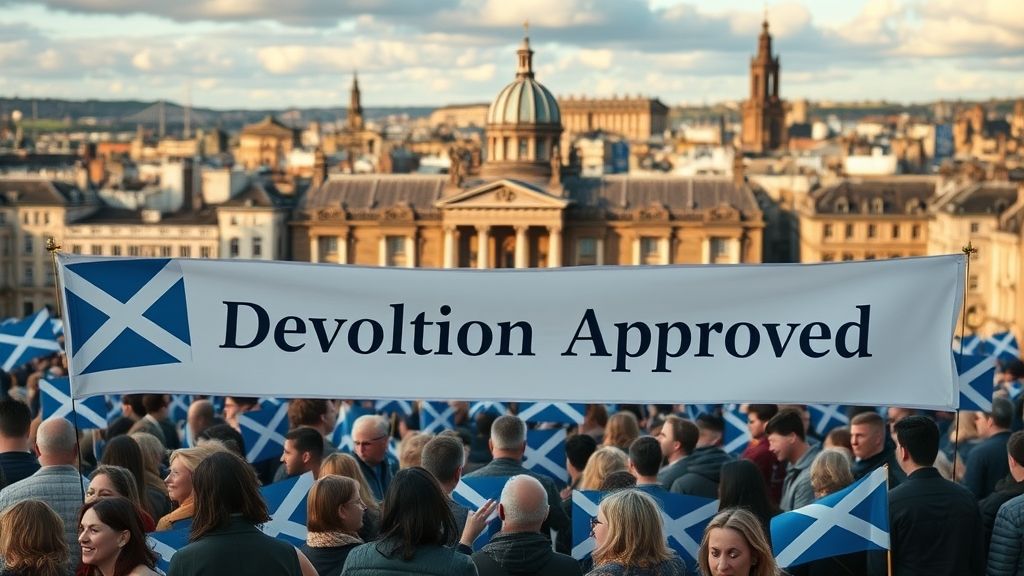
On a bright and brisk morning of September 11, 1997, the air in Edinburgh was thick with anticipation and quiet determination. Across Scotland, ordinary citizens queued in their village halls, church basements, and school gyms to cast their votes in a referendum that would forever alter the political fabric of the United Kingdom. For many, it was more than a simple "Yes" or "No" — it was the culmination of centuries of yearning for a distinct place within the British state. The Scottish Devolution Referendum, held under the shadow of history yet illuminated by hope, promised to bring to life the dream of a Scottish Parliament, endowed with new powers of self-governance. As ballots were cast, hushed conversations rippled through the crowds, blending cautious optimism with the weighty knowledge that their decision marked a historic turning point. Scotland was on the verge of transformation, seeing beyond the rigid lines of the Union into a future where its voice would ring out more clearly.
2. The Lingering Shadow of Union: Scotland’s Historical Context
To grasp the significance of the 1997 referendum, one must travel back over three centuries to the 1707 Acts of Union, which welded the Scottish and English parliaments into one British Parliament seated in Westminster. While the union promised economic benefits and political stability, it also forged a persistent tension in Scotland’s identity — a tension between loyalty to the United Kingdom and the distinctiveness of Scottish nationhood.
Throughout the 19th and 20th centuries, although Scots played pivotal roles in British governance and culture, the question of political representation and autonomy simmered. Grievances over centralized decision-making, economic disparities, and cultural recognition nourished occasional calls for more local control. The 20th century saw these calls coalesce into political movements, culminating in the demand for devolution — a process by which Scotland could govern itself in domestic matters while remaining part of the UK.
3. The Rise of Devolution: Political Turbulence in Late 20th Century Britain
The decades leading up to 1997 were marked by turbulent political shifts. Conservative governments under Margaret Thatcher and John Major largely resisted devolving power, exacerbating feelings of alienation in Scotland. Economic restructuring, particularly the decline of traditional industries like shipbuilding and coal mining, deepened social hardships and fueled resentment.
The Labour Party’s landslide victory in May 1997 brought a renewed promise: that devolution would not be delayed any longer. Tony Blair’s “New Labour” platform championed constitutional reform — including the establishment of a Scottish Parliament — as a way to heal divisions and modernize Britain’s political system. This commitment reignited debates, catalyzed movements, and set the stage for the referendum that would decide Scotland’s immediate political future.
4. Key Players and Voices: The Architects and Opponents of Change
The referendum’s story is illuminated best by the figures who championed or opposed it. Donald Dewar, known as the “Father of the Nation” in Scotland’s devolution journey, was a towering presence. His dedication, empathy, and pragmatism steered the pro-devolution campaign with profound conviction.
Opposition came from diverse quarters: the Conservatives, wary of fracturing the union, campaigned for a “No” vote along with some members of Labour and the Liberal Democrats who feared the referendum could destabilize UK governance. Meanwhile, the Scottish National Party (SNP) supported devolution as a step toward full independence, though not uniformly satisfied with the proposed powers of the new parliament.
Voices from ordinary Scots — farmers, teachers, factory workers, and students — added texture and depth to the debate, revealing fears about economic uncertainty and hopes for a more responsive government.
5. Campaigns that Stirred the Soul: Hope, Fear, and the Quest for Self-Governance
Campaigning ahead of September 11 was fierce and impassioned. Leaflets and posters bearing slogans like “For Scotland, For Tomorrow” contrasted with warnings of a fractured Britain. Town hall meetings teemed with debate; pubs turned into impromptu political forums. Television broadcasts and radio programs carried heated discussions and heartfelt testimonies.
The “Yes” campaign painted devolution as reclaiming Scotland’s voice — a political awakening that promised education, health, and local policies truly reflective of Scottish needs. The “No” camp warned against the pitfalls of fragmentation, costs, and potential powers that might not sufficiently satisfy nationalists anyway.
In moments of quiet reflection amidst the clamor, voters weighed their personal histories with the collective future, unsure yet hopeful.
6. September 11, 1997: The Referendum Unfolds
Dawn broke on referendum day with a sense of calm purpose. Polling stations opened, greeted by voters who braved the drizzle and cool autumn air. By evening, the numbers began to pour in. With a voter turnout of approximately 60%, the democratic engagement was vigorous.
The question was twofold: first, whether a Scottish Parliament should be established, and second, whether that parliament should have tax-varying powers. Both questions saw overwhelming majorities in favor — approximately 74% voted for a Scottish Parliament, and 63.5% backed tax-varying authority.
As the results were announced, jubilation and relief rippled through the ‘Yes’ camps. For some, the victory was bittersweet — a step forward but far from full independence. Yet, the verdict was unambiguous: Scotland had chosen self-governance.
7. The Numbers That Shook the Union: Voting Patterns and Regional Divides
The vote revealed fascinating nuances. Urban centers like Glasgow and Edinburgh showed strong “Yes” majorities, buoyed by historically Labour-supporting constituencies. Rural areas were more mixed, with some regions exhibiting cautious skepticism. Notably, the Western Isles and parts of the Highlands showed vibrant support — a testament to localized cultural pride.
The tax-varying power question revealed slightly less enthusiasm but underscored the Scots’ appetite for concrete authority over their finances. These electoral patterns forged a complex tapestry of political will, revealing a population ready to embrace devolution but aware of its limitations.
8. What Is Devolution? Defining the Scottish Parliament’s Powers and Limits
Devolution was no revolution: it promised a new governance layer with competencies in education, health, transport, and housing, while Westminster retained powers over defense, foreign policy, and monetary regulation. The Scottish Parliament was also to have the ability to alter income tax rates by a few percentage points — a first for any regional authority in the UK.
This “asymmetric devolution” was carefully calibrated to respect the union yet provide real change. Critics argued that this half-measure might inject confusion and second-guessing, but proponents saw it as a vital compromise.
9. The Immediate Aftermath: Political and Public Reactions in Scotland and Westminster
In Scotland, the result sparked celebrations tempered by pragmatic planning. Donald Dewar, soon to become Scotland’s first First Minister, declared it “a new beginning for Scotland” while urging unity. Across the UK, reactions were mixed: some English politicians saw devolution as a necessary modernization; others cautioned against triggering similar demands from Wales or Northern Ireland.
Media coverage highlighted both the democracy of the exercise and the challenges ahead. Public opinion generally welcomed the new powers, but many wondered whether Edinburgh’s castle would truly become the seat of a strong, independent decision-making body or a symbolic halfway house.
10. The Birth of the Scottish Parliament: A New Dawn in Edinburgh
On July 1, 1999, less than two years later, Scotland’s Parliament officially opened in new buildings beside the historic Holyrood Palace. This was both a literal and figurative homecoming for Scottish democracy. The Parliament's distinctive architecture embodied transparency and openness — a stark contrast to the imposing Westminster.
The institution quickly proved its vitality, addressing issues closer to the Scottish people’s everyday lives and fostering a political culture attuned to local voices. This was devolution in practice — tangible, dynamic, and evolving.
11. The Cultural Awakening: Revival of Scottish Identity and Pride
Devolution infused a new energy into Scottish culture. Traditional music, literature, and language saw renewed interest, fueled by a sense of political empowerment. Schools incorporated Scottish history more prominently; media outlets expanded Scottish programming.
Public events celebrated the nation’s unique heritage with fresh pride. The devolution referendum crystallized a broader cultural renaissance, making politics inseparable from identity.
12. Economic Implications: Autonomy in Fiscal Decision-Making
Though limited, the tax-varying power was significant. It symbolized fiscal recognition and opened debates about economic planning tailored to Scotland’s needs. Over time, devolution influenced economic policies on enterprise, investment, and public services.
However, economic challenges remained: Scotland grappled with disparities and unemployment, while navigating the complex interaction of UK-wide and devolved fiscal controls.
13. Britain’s Changing Political Landscape: The Ripple Effects Across the UK
Scotland’s devolution set off reverberations elsewhere. Wales followed with its own assembly, and Northern Ireland’s power-sharing agreement emerged in tandem with peace processes. The UK’s constitutional arrangement became more flexible, less centralized.
At the same time, English politics faced new questions of representation and governance, stirring debates about the so-called “West Lothian question” and the nature of British unionism.
14. Challenges and Controversies: The Roadblocks and Criticisms Post-Referendum
No political reform comes without friction. Early Scottish Parliaments wrestled with how much autonomy should be exercised versus Westminster’s supremacy. Critics alleged that devolution could create duplication, inefficiency, or inequality.
Furthermore, some unionists feared devolution was a slippery slope towards independence — a concern that would resurface vividly in the decades to come.
15. Devolution and the Question of Independence: Seeds for Future Debates
While devolution was a compromise, it also reignited the debate over full autonomy. The SNP grew in strength, arguing that taxes and laws should be made entirely in Scotland. The 1997 referendum planted seeds for future contests about national sovereignty.
This lingering tension shaped Scotland’s political discourse and public engagement for years — culminating in the 2014 independence referendum and continuing to shape UK politics.
16. Voices from the People: Anecdotes and Personal Reflections
Ordinary Scots remember September 11, 1997, with a mixture of pride and introspection. Jane MacLeod, a schoolteacher in Aberdeen, recalled “the excitement in every classroom — a sense that we had a say for the first time in a long while.”
Ewan Campbell, a retired shipyard worker from Glasgow, confessed: “I voted Yes because I believed it meant respect for the working people, but I worried if it would change anything.”
These personal memories underscore how political decisions touch lives deeply and inspire enduring hopes.
17. The Global Context: Devolution Movements Around the World
Scotland’s referendum resonated far beyond UK borders. Movements in Catalonia, Quebec, and Wales watched keenly; the Scottish model became a case study in peaceful, democratic self-rule within a larger state.
It exemplified how nationalist aspirations need not necessarily fracture nations but could coexist with unity — an idea with continuing relevance in global politics.
18. Lessons Learned: What the 1997 Referendum Teaches Us Today
The 1997 referendum teaches us about patience, compromise, and the power of political dialogue. It reveals the aspirations of a people shaped by history but looking forward. The experience highlights that identity, governance, and democracy are often a delicate balance, negotiated through votes and voices rather than force.
It reminds us also that political reforms evolve — responding to new pressures, changing circumstances, and the unrelenting quest for self-determination.
19. The Scottish Parliament Today: Evolution and Current Influence
More than two decades after the first vote, the Scottish Parliament plays a central role in shaping domestic policy. Its powers have expanded, especially after further devolution acts in 2012 and 2016. Issues like health, education, environment, and justice now reflect distinctly Scottish priorities.
The institution is a vital forum for political innovation, societal debate, and cultural affirmation.
20. Conclusion: The Lasting Legacy of Scotland’s 1997 Choice
The path to devolution was neither quick nor easy, but the 1997 referendum marked a profound transformation. It was a moment when a nation stepped forward to claim a voice, a moment that reshaped British constitutional arrangements forever.
Today, Scottish devolution stands as a testament to the power of democracy to adapt and the enduring desire of people to shape their destinies. It was not the end of a journey, but a luminous beginning — a story still unfolding.
Conclusion
The Scottish Devolution Referendum of 1997 was more than a political exercise—it was a bold reclaiming of identity, a careful recalibration of power, and a profound statement about democracy in the modern world. Against a complex backdrop of history, economic challenges, and political shifts, the Scottish people chose to embark on a path of self-governance without breaking the Union. This choice echoed far beyond Edinburgh’s chambers, rippling through the United Kingdom and inspiring similar movements worldwide.
Yet, the referendum was just the start of Scotland’s evolving political narrative, opening new debates, new conflicts, and new hopes. Through it all, the spirit of participation and respect for collective will has endured. When generations look back, they will see September 11, 1997, as the day Scotland embraced a voice that had long been whispered but was now loudly proclaimed.
FAQs
Q1: What triggered the Scottish Devolution Referendum in 1997?
The referendum was triggered by longstanding demands for greater political autonomy and the Labour Party’s 1997 election manifesto promise to establish a devolved Scottish Parliament.
Q2: What were the two questions posed to Scottish voters?
Voters were asked whether they wanted a Scottish Parliament established and whether that parliament should have tax-varying powers.
Q3: Who was Donald Dewar and what role did he play?
Donald Dewar was the leading proponent of devolution, instrumental in campaigning for the referendum and later became the first First Minister of Scotland.
Q4: How did the referendum affect the United Kingdom’s political landscape?
It set a precedent for devolution in Wales and Northern Ireland, altered UK governance by decentralizing power, and sparked ongoing debates about regional autonomy and the union’s future.
Q5: What powers were granted to the Scottish Parliament after devolution?
The Scottish Parliament was granted powers over education, health, transport, and limited tax-varying authority while Westminster retained control over defense and foreign policy.
Q6: Did the 1997 referendum lead directly to Scottish independence?
No, it established devolved governance but kept Scotland within the UK; however, it intensified discussions that later culminated in the 2014 Scottish independence referendum.
Q7: How did the public perceive the referendum results immediately after?
The results were met with enthusiasm and relief by supporters, cautious optimism among many citizens, and apprehension among unionists concerned about national unity.
Q8: How is Scottish devolution significant in a global context?
It serves as a peaceful, democratic example of granting regional autonomy within a larger sovereign state, influencing other nationalist and devolutionist movements worldwide.