Table of Contents
- A City at the Edge of Defeat and Deliverance
- From Heraclius to Leo III: The Road to the Second Arab Siege
- The Umayyad Ambition: A Caliphate Looks to Constantinople
- Byzantium Under Siege: Memories of 674–678
- The Gathering Storm: Armies, Fleets, and Oaths of Victory
- The Walls of Theodosius and the Soul of an Empire
- The Siege Begins: Summer 717 and the Closing Ring of Iron
- Fire on the Water: Greek Fire and the Battle for the Bosporus
- Hunger, Winter, and Plague: The Human Cost Inside and Outside the Walls
- Betrayals, Bulgars, and Fate: The Turning of the Tide
- The Long Retreat: The Umayyad Flight and the End of the Second Siege
- Faith, Propaganda, and Memory: How Victory Was Explained
- Shifting Frontiers: The Siege’s Impact on the Byzantine and Umayyad Worlds
- Everyday Lives in the Shadow of Catapults and Crosses
- Technology, Tactics, and the Lessons of 717–718
- From Survival to Iconoclasm: Leo III and the Reforging of Byzantium
- A Wall Against the West: How Constantinople’s Survival Shaped Europe
- Echoes in Chronicles and Legends: How Historians Remembered the Siege
- Counterfactuals: If Constantinople Had Fallen in 718
- Conclusion
- FAQs
- External Resource
- Internal Link
Article Summary: In the late summer of 718, the Byzantine capital of Constantinople emerged from one of the darkest years in its history, as the second arab siege of constantinople collapsed in hunger, disease, and defeat. This article follows the dramatic arc from the rise of the Umayyad Caliphate and its imperial ambitions to the desperate defense organized by Emperor Leo III and his people. It reconstructs the chaos of the siege—its naval clashes, brutal winters, diplomatic gambles, and the role of Bulgar allies—through a narrative that weaves together political strategy and human suffering. It explores how the end of the Second Arab Siege reshaped the balance of power between Byzantium and the Islamic world and, indirectly, the destiny of medieval Europe. Along the way, it analyzes technology like Greek fire, the symbolism of the city’s walls, and the wider religious and ideological stakes claimed by both sides. The survival of Constantinople did not end the conflict between empire and caliphate, but it imposed limits on Umayyad expansion and bought centuries for the Christian East. Above all, the siege’s end became a powerful legend of endurance, faith, and contingency in world history.
A City at the Edge of Defeat and Deliverance
On a cool August morning in the year 718, watchers on the battered ramparts of Constantinople stared in disbelief: the great Arab camp that had strangled the city for a year was breaking apart. Ships that had once filled the Bosporus like a forest of masts now limped away, many half-rotten, some barely afloat. Along the land walls, where siege towers had loomed and catapults had thundered, only charred timbers and mass graves remained. The second arab siege of constantinople, which had threatened to extinguish the millennium-long dream of a Roman empire centered on this city, was ending not with a heroic last charge, but with a slow, painful unraveling of an exhausted invading host.
To the exhausted Byzantines peering from the Theodosian Walls, it must have seemed as though the world itself was exhaling. For months, famine had gnawed at the bellies of the city’s defenders. The winter of 717–718 had been one of the coldest in memory; corpses had frozen where they fell, and even seasoned soldiers spoke of despair. The Umayyad forces surrounding the city—great armies and fleets sent by the most powerful Islamic state the world had ever seen—had sworn to take Constantinople for Islam and for the Caliph. Victory had seemed inevitable. Yet, as fires burned in the departing camps and the last sails disappeared toward the south, a different story was etched into history: the empire at bay had survived.
But this was only the beginning of the tale. To understand why this siege mattered, one must rewind half a century, to earlier wars and older dreams. The second arab siege of constantinople was not an isolated act of aggression; it was the climax of a long struggle between the revitalized Eastern Roman Empire—what we call Byzantium—and the astonishingly rapid expansion of the Arab Muslim world under the Umayyad dynasty. The city’s survival in 718 was not just a local miracle. It marked a turning point in the entangled destinies of Europe and the Near East, a moment when geography, weather, technology, diplomacy, and faith fused into a single razor-thin escape from catastrophe.
In this story, emperors and caliphs stride across the stage, but so do nameless sailors who braved flaming seas, peasants who starved behind the walls, and soldiers who froze in tents on the Thracian plain. The siege’s end in August 718 was the visible tip of an immense, submerged iceberg of political gambits, logistical nightmares, and human choices. To enter that world, we must trace the road that led both empires—Byzantine and Umayyad—to risk everything at the gates of Constantinople.
From Heraclius to Leo III: The Road to the Second Arab Siege
Half a century before the siege of 717–718, the Eastern Roman Empire seemed to have found a savior. Emperor Heraclius, who came to power in 610, had rescued the empire from collapse at the hands of the Sasanian Persians. With bold campaigns deep into Persia, he shattered an enemy that had once stood at Chalcedon, within sight of Constantinople’s walls. By the early 630s, the Persians were beaten, the True Cross had been triumphantly restored to Jerusalem, and many in Constantinople believed that Christ had vindicated the Roman Empire. The empire’s frontiers stretched from the Balkans to Syria and Egypt. It was wounded, yes, but intact.
Yet behind the celebrations, a silent storm was gathering. The long war with Persia had drained the empire’s coffers, sacrificed whole generations of soldiers, and devastated farmland. The provinces of Syria, Palestine, and Egypt, though rich, were religiously divided. Many of their Christian inhabitants held to Monophysite beliefs at odds with Constantinople’s Chalcedonian orthodoxy. Heavy taxation and doctrinal disputes frayed loyalty to the distant imperial capital. When Arab forces, inspired by a new faith and led by generals under the Rashidun and then Umayyad caliphs, swept north from Arabia, these provinces were brittle targets.
In a matter of decades, Arab armies overran Syria (by 636), Palestine, Egypt, and much of North Africa. They shattered Byzantine field forces that were still recovering from the Persian war, most notably at the catastrophic Battle of Yarmouk. For the Byzantines, this was more than the loss of provinces—it was the loss of some of their richest tax bases and their historic Christian heartlands. For the expanding Islamic Caliphate, it was the beginning of an imperial project that would eventually stretch from the Atlantic to Central Asia.
Heraclius died in 641, an old man who had lived to see his brilliant victories undone by a force the empire had barely known a generation earlier. In the following decades, a succession of emperors struggled to adapt to the new geopolitical reality. Some tried to negotiate; others launched ill-prepared counterattacks. None could fully stem the tide. The Umayyad Caliphate, ruling from Damascus after 661, turned its face increasingly toward the imperial prize of Constantinople.
By the early eighth century, the throne in Constantinople was anything but stable. Usurpations, palace coups, and military revolts repeatedly toppled emperors. It was in this atmosphere of internal chaos that an Isaurian general named Leo, from the rugged regions of Anatolia, rose to prominence. In 717, amid political confusion and Arab military pressure, Leo seized the throne and became Emperor Leo III. He inherited an empire besieged in all but name: Anatolia ravaged by annual raids, the Balkans precarious, and the fleet challenged in its own seas. Within months, Leo would face the most formidable test a Byzantine emperor could imagine—the second arab siege of constantinople, launched by the most powerful Umayyad ruler yet, Caliph Sulayman and then his successor, Umar II.
The Umayyad Ambition: A Caliphate Looks to Constantinople
To the Umayyad caliphs, Constantinople was more than a strategic objective; it was a symbol. It was the capital of the Romans, heirs of a pagan and then Christian empire that had inherited the mantle of universal rule. To conquer it would be to confirm, before the watching world, that God favored the Caliphate. The city’s mixture of wealth, prestige, and religious meaning was intoxicating.
The first Arab attempts to reach Constantinople had come relatively early. In the mid-660s and 670s, Arab fleets probed the Aegean and the coasts of Asia Minor. Raiding gave way to ambition, and between 674 and 678 the Umayyads mounted what many sources portray as the first siege of Constantinople. That earlier attempt, drawn-out and episodic, ended in failure, largely due to the resilience of the city’s defenses and the dramatic appearance of a new Byzantine weapon: Greek fire. Yet the memory of those years did not deter Damascus. Rather, they offered lessons. The caliphs learned about the logistical demands of maintaining fleets and armies far from their home bases, about the city’s defensive rhythms, and about the stubbornness of a cornered empire.
By the early 700s, the Caliphate was at its territorial height. It had reached the Indus in the east and the Atlantic in the west. Arab and Berber forces had crossed into Iberia in 711 and crushed the Visigothic kingdom, establishing Muslim rule in al-Andalus. The idea that Constantinople, the great Christian capital between Europe and Asia, could remain forever out of reach began to seem less like caution and more like defeatism.
Caliph Sulayman (r. 715–717), inspired partly by earlier prophetic traditions that hinted at the conquest of Constantinople and partly by personal ambition, resolved to finish what his predecessors had begun. He ordered the mustering of a massive army from Syria and Mesopotamia and a powerful fleet from Egyptian, Syrian, and North African shipyards. His goal was explicit: Constantinople must fall. Contemporary chroniclers refer to tens of thousands of troops and hundreds, perhaps over a thousand, ships. Medieval figures are notoriously inflated, but even with cautious estimates, the scale of the enterprise was enormous for its time.
When Sulayman died in 717, his successor, Caliph Umar II, inherited both the plan and the responsibility. Despite Umar’s reputation for piety and prudence, he did not recall the host. The armies were already on the march, the fleets already at sea. The die was cast. The Umayyad state had committed itself to one of the most ambitious sieges in medieval history, determined that the second arab siege of constantinople would succeed where the first had failed.
Byzantium Under Siege: Memories of 674–678
Inside Constantinople, memories of the earlier siege were still alive. Elderly citizens could recall the years when Arab fleets had dotted the Marmara and the Aegean, when outlying suburbs had been burned, when there had been real fear that the city might fall. The victory of 678, followed by a favorable peace treaty, had felt like a divine reprieve. The Byzantines credited their salvation in large part to their mysterious incendiary weapon, Greek fire, projected from ships and siphons to engulf enemy vessels in flames that could not be doused with water.
But forty years had passed. The empire of 717 was poorer, its army smaller, its navy diminished. The losses of Syria and Egypt had permanently altered the imperial economy. The Balkans were still unstable, with Slavic groups occupying large swaths of territory. The empire relied increasingly on its Anatolian heartland, organized into military-administrative districts called themes. These themes could provide soldiers, but not in unlimited numbers. Every campaigning season cost precious manpower that could not be easily replaced.
What Constantinople still had, however, were its walls and its strategic position. The city, straddling the Bosporus, controlled the gateway between the Black Sea and the Mediterranean. Its triple land walls—the Theodosian Walls—had repelled barbarian invasions for centuries. Over water, a massive chain could be raised across the Golden Horn to block enemy fleets. In the collective imagination of its inhabitants, the city was not only well-defended; it was protected by the Virgin Mary herself, the Theotokos, whose icons were paraded upon the walls in times of danger.
When news arrived that an immense Arab armada and army were assembling, the city’s mood oscillated between dread and grim determination. Leo III, newly crowned and still consolidating his authority, recognized that the siege could either destroy him or define his reign. He began to stockpile grain, repair fortifications, and recall the city’s defenders from surrounding regions. The empire could not field a field army to meet the Arabs in open battle on equal terms. Its best hope was to hold the city—its heart, its brain, its last line of defense—and let siege, weather, and providence take their course.
The Gathering Storm: Armies, Fleets, and Oaths of Victory
The logistical effort behind the second arab siege of constantinople was staggering. From Damascus, orders went out to provincial governors. Troops from Syria, Mesopotamia, and perhaps even beyond were summoned. Arab chroniclers speak of contingents who had fought in North Africa and Iberia now being redirected toward the eastern Mediterranean. Supplies had to be gathered, siege engines constructed, and fleets equipped with crews and marines.
The land army, commanded by the experienced general Maslama ibn Abd al-Malik—brother of the late Caliph Sulayman—marched through Anatolia, taking advantage of years of raiding experience. Some Byzantine fortresses along the route fell; others withdrew behind their own walls and hoped to hold out long enough to be bypassed. This advancing host would eventually encamp on the Thracian side of Constantinople, stretching from the Propontis (Sea of Marmara) across the land approaches northward.
Meanwhile, the Arab fleet sailed via the southern coasts of Anatolia and island-hopped through the Aegean. It had to pass dangerous straits and deal with variable winds. Still, it represented a formidable naval force, perhaps one of the largest sea-borne expeditions mounted before the Crusades. In addition to warships, there were transports laden with siege materials, provisions, and animals. The plan was clear: encircle Constantinople by land and sea, cut it off entirely, and force it into submission.
On the eve of the campaign, Arab soldiers reportedly took oaths of victory. One can imagine the atmosphere in the mustering camps: campfires flickering, poets reciting verses of conquest, imams exhorting warriors with promises of reward. The fall of the “City of the Romans” would be a signal to the world that the Caliphate’s rise was unstoppable. Some traditions even spoke of the special merit of those who fought at Constantinople. Later Muslim writers, like al-Tabari, would preserve traces of these expectations, though their accounts are layered with later interpretations.
For the Byzantines bracing for impact, each rumor of the approaching host increased the sense of impending doom. Yet Leo III refused to panic. He sent envoys to potential allies, including the Bulgar khan to the north, and continued to stockpile what he could. The race was on: would the city complete its preparations before the steel ring closed?
The Walls of Theodosius and the Soul of an Empire
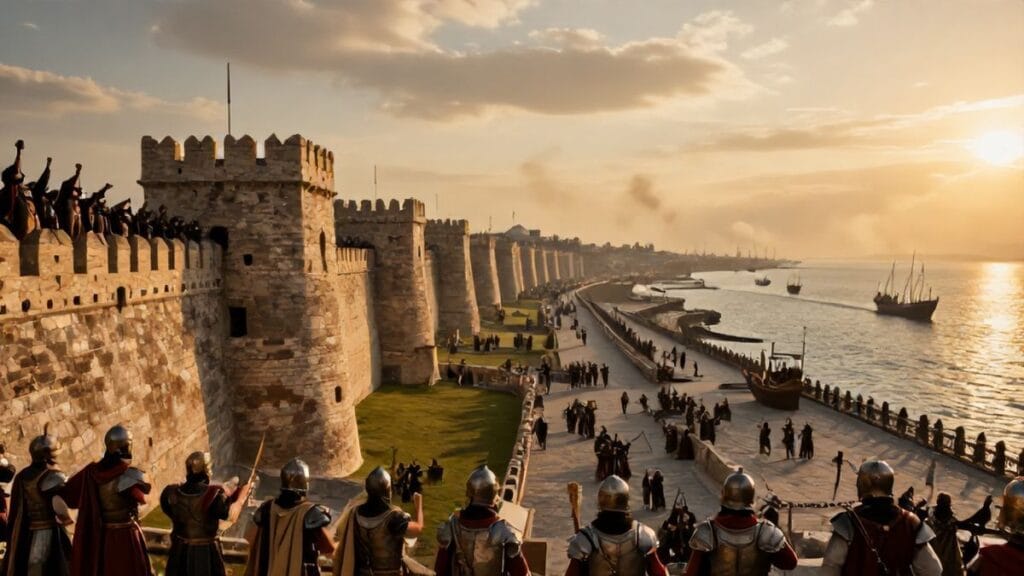
As the Arab armies and fleets drew nearer, the defenders turned again and again to the physical and symbolic bulwark of their survival: the walls of Constantinople. Initially constructed in the fifth century under Emperor Theodosius II, the land walls extended roughly 6.5 kilometers across the peninsula from the Sea of Marmara to the Golden Horn. They were not a simple barrier but a system: an outer wall and moat, an inner wall with massive towers, and strategically positioned gates. Together, they had rendered countless barbarian assaults futile.
In 717, these walls were not pristine. Earthquakes and time had taken their toll, and past sieges had left scars. Yet they remained one of the most formidable fortification systems in the medieval world. Inside, masons scrambled to repair weak points. Artillery crews—men trained to operate ballistae and catapults—checked their engines. Archers were assigned sectors. The city’s population, including monks, artisans, and even some women and children, were drawn into the defense effort, whether to haul stones, prepare fire, or tend to the wounded.
Spiritually, the walls were seen as more than stone. They were lines of contact between heaven and earth. Processions carried relics and icons to the ramparts. The icon of the Virgin Hodegetria, believed to guide and protect the city, was displayed prominently. Priests chanted supplications late into the night as the enemy campfires glowed in the distance. For many Byzantines, the second arab siege of constantinople was not only a geopolitical crisis; it was a test of divine favor. Had God abandoned the “New Rome,” or would He once again rescue His chosen city?
There was also a psychological drama unfolding within the walls. The presence of refugees from the countryside, the uncertainty about supplies, and fear of betrayal created tension. Emperor Leo walked a narrow path. He had come to power through a revolt against his predecessor, Theodosius III. Some factions might see an opportunity in the chaos. To keep order, Leo mixed stern discipline with public displays of piety and leadership, appearing on the walls in armor, inspecting troops, and joining public prayers.
The Siege Begins: Summer 717 and the Closing Ring of Iron
By late summer of 717, the Arab host had arrived. Maslama’s land army took its position on the Thracian plain, entrenching itself and beginning the grim work of encirclement. The Arab fleet, after navigating the Dardanelles and the Sea of Marmara, appeared off the coasts of the city. Sailors staring up at the city’s skyline—the domes of Hagia Sophia, the shimmering palace roofs—would have felt both awe and determination. This was what they had come for.
The Byzantines responded swiftly. The chain across the Golden Horn was raised, sealing the inner harbor from direct naval attack. Patrol ships armed with Greek fire prepared to intercept enemy vessels trying to edge too close. On land, sorties from the gates probed the besiegers’ lines, but Leo avoided committing to a decisive engagement. He knew his forces were outnumbered and that the city’s true strength lay in outlasting, not in smashing, the encircling armies.
The initial clashes were sharp. Arab engineers advanced with wooden mantlets, trying to get siege engines into position. Byzantine defenders rained down missiles and stones. When the Arab fleet attempted to test the city’s defenses at sea, they encountered something they could not have fully prepared for: the renewed, refined deployment of Greek fire.
Greek fire, a closely guarded Byzantine state secret, was more than just burning oil. It was a sophisticated incendiary mixture, possibly including petroleum-based ingredients, resin, and other additives, projected under pressure through bronze tubes. When it struck an enemy ship, it clung and burned even on water. The psychological shock this weapon inflicted cannot be overstated. To see one’s comrades engulfed in roaring, liquid fire would rattle even veteran sailors.
The first Arab ships that ventured too near were set ablaze in a spectacle that lit up the night. Flames reflected on the water as charred hulls sank slowly. The Arab sailors retreated in confusion, then regrouped further away, wary now of the fiery monsters that darted from the city’s walls and harbor. It’s astonishing, isn’t it, how a single technological edge can tilt the calculus of a siege?
Fire on the Water: Greek Fire and the Battle for the Bosporus
Over the following weeks, the Bosporus and the Sea of Marmara became a chessboard of ships, wind, and flame. The Arab fleet, though wary, tried to maintain a blockade, anchoring in positions that could interdict any attempt by the Byzantines to resupply their city. Still, the Byzantines had home advantage. They knew the currents, the hidden shoals, the sudden weather shifts. More importantly, they could sally forth from protected harbors with specialized Greek-fire-carrying dromons—fast warships designed for both ramming and incendiary attacks.
One of the key naval engagements occurred when part of the Arab fleet attempted to establish a secure anchorage on the Asian shore, hoping to dominate both sides of the strait. Leo’s admirals seized the opportunity. Under cover of darkness and using favorable winds, Byzantine ships closed in, unleashing Greek fire at close range. Arab vessels burst into towering sheets of flame. Those that tried to flee in panic collided with their own comrades or ran aground. The Byzantines could not annihilate the entire Arab armada, but they inflicted enough damage to break its confidence and reduce its effective control of the waterways.
Naval losses also exacerbated supply problems. The second arab siege of constantinople depended on regular shipments of grain and fodder from the Caliphate’s rich provinces. Each lost transport ship meant fewer supplies for the besieging troops. Each damaged warship reduced the fleet’s ability to deter Byzantine counterattacks. Over time, a pattern emerged: the Arabs maintained an outer ring of naval presence, but they never again fully dominated the seas around the city.
Water itself became an adversary. Storms battered anchored ships. Improvised repairs strained exhausted crews. For the men aboard, nights were filled with the creak of ropes, the slap of waves, and the memory of comrades screaming in Greek fire. The siege became not only a trial of courage but of endurance in a hostile maritime environment.
Hunger, Winter, and Plague: The Human Cost Inside and Outside the Walls
As autumn turned to winter, the siege entered its most brutal phase. If the initial clashes had been marked by fireworks of Greek fire and the thunder of catapults, the coming months were dominated by slower, quieter killers: hunger, cold, and disease.
Inside Constantinople, Leo’s stockpiling efforts paid off—but only partially. The city had been provisioned, but it was large, perhaps still harboring hundreds of thousands of people if one counts refugees. Rationing was instituted; bread grew coarser, meat scarcer. Those with means dipped into private stores; the poor lined up at distribution points or went hungry. Chroniclers speak of people eating grass, leather, and whatever they could find during the worst stretches. Though such descriptions may be embellished, the underlying reality was grim: the population teetered on the edge of starvation.
Outside the walls, the situation was even more dire. Maslama’s army had expected to feed itself partially from the surrounding countryside, but the Byzantines had followed a scorched-earth strategy, withdrawing livestock and burning crops where they could. As winter descended with unusual severity, snow and ice blanketed the Thracian plain. Arab soldiers, many from warmer climates, found themselves trying to survive in flimsy tents under freezing winds. Animals died in droves. Fires were hard to maintain in the open. Frostbite and exposure took their toll.
Then came disease. Camp conditions were perfect breeding grounds for epidemics: overcrowded tents, spoiled food, contaminated water. Plague and dysentery stalked the besiegers’ lines. Corpses—of men and beasts—piled up, attracting scavengers and poisoning the air. The Byzantines on the walls could see, and smell, the decay of the army that had come to crush them. For their part, they were not immune; disease did not respect walls. Yet the concentrated misery in the besieging camp was unparalleled.
One can imagine the psychological erosion that came with each day of grinding hardship. The glorious rhetoric with which the campaign had begun—of swift conquest and divine favor—faded into a struggle to stay warm and alive. Letters to Damascus, if they could be sent at all, must have reflected a growing disillusionment. The Caliph Umar II faced a stark dilemma: reinforce and prolong the agony, or risk the humiliation of an ordered withdrawal.
Betrayals, Bulgars, and Fate: The Turning of the Tide
While nature battered the Arab army, politics and diplomacy slowly tightened the noose. Leo III, far from being a passive defender, sought every advantage he could. One of his key moves was to secure the support—or at least the opportunistic cooperation—of the Bulgars to the north.
The Bulgar khan, Tervel, had his own reasons to intervene. His people, settled in the Balkans, were wary of both Byzantium and the Caliphate. A strong Byzantium could threaten Bulgar independence; a victorious Caliphate, entrenched in Constantinople, might prove even more dangerous. Tervel calculated that a weakened but surviving Byzantine Empire was the preferable neighbor. Responding to Leo’s diplomatic efforts and incentives—perhaps money, titles, or promises of territory—he led Bulgar forces into the rear of the Arab besieging army.
The attack was devastating. Striking at an enemy already weakened by hunger and disease, the Bulgars inflicted heavy casualties, disrupting supply and communication lines. Arab sources later lamented massacres in the tens of thousands. While these numbers are debated, the effect on morale is beyond doubt. Maslama now faced not only the impregnable city in front of him and the treacherous sea at his flank, but also a ferocious enemy harassing his back.
There were also rumors—preserved in both Byzantine and Arab accounts—of negotiations and deception. Some sources suggest that Leo and Maslama engaged in talks in which the emperor promised tribute or concessions if the siege were lifted. Others hint that Maslama, perhaps misinformed about the city’s actual strength and supplies, delayed decisive actions in the hope that Constantinople would soon surrender. Modern historians are cautious about these stories, but they reveal a deeper truth: information during a medieval siege was fragmentary, and decisions often rested on a fog of rumor and hope.
As winter finally gave way to the hesitant warmth of spring 718, the strategic balance had shifted. The Arab army was battered, its fleet reduced, its supply lines compromised. Reinforcements from the Caliphate were hampered by distance, piracy, and Byzantine naval harassment. The Caliph himself was reportedly ill and increasingly skeptical about pouring more resources into what looked like a disaster in slow motion.
The Long Retreat: The Umayyad Flight and the End of the Second Siege
The decision to withdraw from a grand campaign is never taken lightly, especially when that campaign has been cast in ideological, even eschatological, terms. For the Umayyad leadership, ordering a retreat from Constantinople meant acknowledging that the second arab siege of constantinople—this mighty, year-long effort—had failed. Yet reality brooked no alternative.
In the late spring and early summer of 718, Arab commanders began preparations for an orderly disengagement that turned, under the pressure of circumstances, into something more chaotic. The land forces, reduced by hunger, cold, disease, and Bulgar attacks, started to break camp. Siege engines were burned or abandoned. The sick and wounded had to be left behind, a harrowing choice for any army. Discipline frayed. Desertions increased.
The fleet, intended to provide a dignified exit route and protect the withdrawing troops, now faced its own perils. As the ships set sail southward through the Sea of Marmara and toward the Aegean, they encountered storms and, according to some accounts, further Byzantine naval attacks. Greek fire may again have played a role, though the worst damage likely came from weather and the already weakened condition of the fleet. Some ships sank outright; others were driven onto hostile shores.
Contemporary Christian chroniclers, such as Theophanes the Confessor, describe the retreat as an almost biblical catastrophe for the Arabs, with tens of thousands lost on land and sea. Arab sources, naturally, are more restrained, but they do not deny the scale of the hardship. A campaign that had begun with such confidence ended with a quiet, painful slink back to friendly territory.
For the Byzantines, the realization that the siege was truly lifting took time to sink in. At first, it may have looked like a mere redeployment. Only as days passed and no new assaults came, as smoke from burnt siege equipment faded, and as scouts reported the steady southward movement of the enemy, did the truth become clear: they had survived. On August days in 718, processions wound through the city, hymns rang out in Hagia Sophia, and many saw in the enemy’s departure the direct hand of God.
But victory carried a complicated aftertaste. The city was scarred. Many had died behind the walls from hunger and disease. Fields in Thrace and parts of Anatolia were ravaged. The empire remained fragile, its foes still numerous. Yet, in the great ledger of history, this moment stood out: Constantinople had withstood the most serious attempt yet by the Islamic world to seize it, and in doing so had transformed the trajectory of both empires.
Faith, Propaganda, and Memory: How Victory Was Explained
In the months and years that followed, both Byzantines and Muslims struggled to make sense of what had happened. Victory and defeat were never purely military concepts in this age; they were read as signs of divine favor or displeasure.
In Constantinople, the narrative crystalized quickly. The Virgin Mary, the Theotokos, had once again safeguarded her city. Processions in her honor became ever more elaborate. The city’s chroniclers and clergy linked the lifting of the siege to prayers, vigils, and the display of holy relics on the walls. Emperor Leo III was praised as a new Constantine, a leader anointed by heaven and proven in battle. The second arab siege of constantinople was woven into the tapestry of Byzantine salvation history—a chapter where the city, like Israel of old, had been tested and preserved.
Religious imagery saturated the memory. Icons showed the Virgin sheltering the city under her mantle, or Christ blessing its walls. Sermons emphasized repentance and gratitude. At the same time, the more earthly factors—Bulgar intervention, Greek fire, the empire’s naval tactics—were not forgotten, but they were framed as instruments of divine will.
In the Islamic world, the interpretation was more complicated. For some, the failure of the siege was a test from God, a reminder that victory could not be taken for granted even when fighting unbelievers. Caliph Umar II’s piety and later reforms earned him respect, but his association with the failed campaign may also have colored his reputation. Later historians, like al-Tabari, would record the siege in sober tones, acknowledging its scale without dwelling too much on its humiliation. Over time, attention shifted to other fronts where the Caliphate had triumphed—on the edges of Central Asia, in North Africa, in al-Andalus—leaving the memory of the siege as a somber lesson rather than a defining disaster.
Propaganda, in both empires, did its quiet work. In Byzantium, the story stiffened resistance against future Muslim incursions, reinforcing a sense of chosenness and resilience. In the Caliphate, the memory may have injected a measure of caution into grand designs against heavily fortified, distant targets, even as expansion on other frontiers continued.
Shifting Frontiers: The Siege’s Impact on the Byzantine and Umayyad Worlds
The failure of the siege did not end the conflict between Byzantium and the Islamic world, but it set boundaries. For the Umayyads, Constantinople remained a distant dream rather than an imminent prize. Raids into Anatolia continued, sometimes devastatingly, but the idea of a full, all-out siege on the scale of 717–718 lost much of its appeal. The Caliphate’s strategic attention turned increasingly toward internal issues and other frontiers: Berber revolts in North Africa, resistance in Central Asia, political unrest at home.
For Byzantium, the siege’s end provided a narrow window of recovery. Leo III and his successors could now plan long-term reforms without the immediate threat of annihilation. The empire’s frontiers in Anatolia, though still porous, became more stable in the sense that seasonal raiding replaced existential siege. The themes system evolved further, embedding military obligations into the very fabric of provincial life. Frontier fortresses were strengthened; populations were sometimes relocated for strategic purposes.
Economically, the loss of Syria and Egypt remained a permanent wound, but the survival of Constantinople ensured that the empire maintained its role as a commercial hub. Grain from the Black Sea regions and internal Anatolian production substituted, in part, for the old Egyptian flows. Diplomatic relations with the Bulgars and other neighboring peoples were recalibrated, shaped by the memory of shared interest during the siege.
Most subtly, the siege redefined each empire’s self-image. The Umayyads had to accept that there were limits to their expansion, that not all enemies could be overrun, that even a divinely guided community could suffer reverses. Byzantium, conversely, internalized the notion that it could outlast more powerful foes through resilience, cunning, and faith. These lessons would echo through subsequent centuries of Byzantine-Islamic rivalry.
Everyday Lives in the Shadow of Catapults and Crosses
Grand narratives often obscure the lives of ordinary people, yet the second arab siege of constantinople was, at its core, a human disaster and a human triumph. Consider, for a moment, a weaver in one of the city’s crowded quarters, watching as prices climbed and bread grew thinner. By day, he might patch sails or mend uniforms for the garrison, his craft repurposed for war. By night, he would huddle with his family, listening to the distant rumble of siege engines and the closer murmur of prayers.
Women, too, bore heavy burdens. Many cared for children and elderly relatives while their husbands and brothers manned the walls. Others worked directly in the defense effort: carrying stones and water, preparing bandages, or even, in emergencies, joining bucket brigades to douse fires started by enemy missiles. Monastic communities inside the city opened their doors to refugees, turning cloisters into makeshift dormitories dank with the smell of sweat, incense, and anxiety.
Outside the walls, in the Arab camp, similar but differently inflected scenes unfolded. A soldier from Kufa or Basra, far from home, might recall the warmth of his native date groves as he shivered in a Thracian winter. Letters from home, if they came at all, took months to arrive. Some may have converted their hopes into stories: “When Constantinople falls, we will return with wealth and glory.” Others—especially as the months dragged on—no doubt whispered complaints in the privacy of their tents.
Children in nearby villages grew up with the surreal experience of seeing the armies of two civilizations clash in their backyard. Some were forcibly conscripted as laborers; others fled with what they could carry, joining the flood of displaced persons seeking safety behind the city’s walls. Livelihoods based on seasonal agriculture were disrupted; the scars of the siege would linger in the countryside long after the armies had departed.
The siege also reshaped religious practice at the popular level. Votive offerings multiplied in churches and shrines. People promised candles, fasts, and pilgrimages if their loved ones returned or if the city survived. In the Arab camp, imams led prayers for victory and for the souls of the dead. The shared fragility of life under siege taught both sides hard truths about mortality, endurance, and hope.
Technology, Tactics, and the Lessons of 717–718
Beyond its emotional and spiritual resonance, the siege also stands as a landmark in the history of military technology and strategy. Greek fire is the most famous element, of course, and modern scholars have debated its exact composition and delivery systems for decades. What matters historically is its effect: it granted the Byzantines a decisive edge in naval warfare at a critical moment. As one modern historian, John Haldon, has noted, the combination of fortifications and technological innovations allowed a shrinking empire to punch far above its demographic and economic weight.
But Greek fire was only one piece of a larger tactical puzzle. The Byzantine defensive strategy combined passive resilience with active harassment: sorties to disrupt enemy siege works, naval raids to threaten supply lines, and calculated diplomacy to bring allies like the Bulgars into the fray. The empire could not match the Caliphate man-for-man, but it could fight asymmetrically, exploiting interior lines and superior local knowledge.
The Arabs, for their part, demonstrated remarkable logistical capability in sustaining a large host so far from their heartlands for so long. They built and deployed siege engines, coordinated land and naval forces, and managed complex supply systems—at least until weather and opposition overwhelmed them. Their failure did not stem from incompetence but from the sheer difficulty of the task: besieging one of the strongest fortresses on earth in a hostile climate, against a desperate and cunning enemy.
Subsequent generations of military leaders—both Byzantine and Muslim—studied the siege’s lessons. For the Byzantines, it reinforced the value of maintaining a strong navy and protecting the secrecy of strategic technologies. For the Caliphate and its successors, it highlighted the importance of intelligence, local alliances, and the dangers of overextension. The second arab siege of constantinople thus became an implicit case study in strategic planning and the limits of imperial ambition.
From Survival to Iconoclasm: Leo III and the Reforging of Byzantium
Leo III emerged from the siege not just as a survivor but as a ruler with newfound authority. His successful leadership during the crisis solidified his grip on the throne and gave him the political capital to undertake far-reaching reforms. In the decades that followed, Leo would initiate changes that reshaped the empire’s religious and administrative landscape—most controversially, his embrace of iconoclasm, the rejection and destruction of religious images.
Many historians have debated the relationship between the siege and Leo’s iconoclastic policies. Some suggest that the trauma of near destruction, combined with a desire to purify the empire and please a God perceived as angry, contributed to his conviction that icons were a form of idolatry. Others argue that iconoclasm was driven more by internal theological debates and the influence of certain eastern provinces. Whatever the precise motive, it is hard to ignore that a ruler who had seen the empire brought to the brink might have interpreted military survival as a sign that drastic religious reform was both necessary and divinely endorsed.
Administratively, Leo tightened control over the themes, restructured taxation, and sought to strengthen the empire’s capacity to wage defensive warfare. The siege had shown that a well-organized, resilient state apparatus could compensate for territorial losses. Leo and his successors leaned into this lesson, gradually transforming Byzantium into a leaner but more tenacious power.
These internal developments, though seemingly far removed from the Arab tents and frozen corpses of 717–718, were part of the siege’s long shadow. Surviving an existential crisis tends to radicalize politics, sharpen identities, and embolden rulers. In that sense, the siege’s end was not merely a closing chapter but a catalyst for a new, more hard-edged phase of Byzantine history.
A Wall Against the West: How Constantinople’s Survival Shaped Europe
The implications of the siege’s outcome extended well beyond the Bosporus. By preventing the fall of Constantinople in 718, the Byzantines effectively preserved a barrier—geographical, political, and cultural—between the expanding Islamic world and the still-fragile societies of Western Europe. While it would be simplistic to claim that all of Europe would have fallen had the city been taken, the survival of a strong, Christian Eastern Empire certainly influenced the pace and direction of events west of the Balkans.
At the time of the siege, the Frankish realms were in flux, the Lombards held sway over much of Italy, and Anglo-Saxon kingdoms dotted Britain. Islam had already crossed into Iberia, and within a few years Muslim forces would push into southern Gaul before being checked at battles like that of Tours in 732. In this context, a Muslim-controlled Constantinople, commanding the routes into the Balkans and Central Europe, would have posed a profound strategic challenge to emerging Western powers.
Instead, Byzantium remained, bruised but obstinate, as a buffer and a bridge. It traded with Western polities, transmitted classical learning, and, through its missions and diplomacy, influenced the Christianization of the Slavs. The city’s liturgy, art, and political models traveled through this network. One can draw a crooked but real line from the survival of Constantinople during the second arab siege of constantinople to later developments like the Christianization of Bulgaria and Kievan Rus, and eventually to the cultural inheritance of Eastern Orthodoxy in Eastern Europe.
Modern historians, such as Walter Kaegi, have emphasized that while the siege did not “save Europe” in some simplistic, heroic sense, it did help define the contours of a world in which a Latin West, a Greek East, and an Islamic South coexisted in dynamic tension. The continued existence of a powerful Eastern Christian state at the hinge of continents shaped trade, diplomacy, and religious identity across the medieval Mediterranean.
Echoes in Chronicles and Legends: How Historians Remembered the Siege
Our knowledge of the siege rests on a patchwork of sources, each with its own biases and emphases. The Byzantine chronicler Theophanes the Confessor, writing in the early ninth century, gives one of the most detailed accounts from the Christian side. He portrays the siege as a near-apocalyptic trial, full of divine interventions, heroic emperors, and miraculous deliverances. His work, like that of later Byzantine writers, became foundational for the city’s self-understanding.
Arab historians, writing from the vantage point of the Caliphate, offer a complementary perspective. Al-Tabari and others, drawing on earlier traditions, framed the siege within the broader narrative of jihad and imperial expansion. They acknowledged the hardships and ultimate failure without letting the episode overshadow the many other victories of the early Islamic centuries. Over time, the siege faded somewhat in the Arab historical imagination, overshadowed by the glories of conquests elsewhere.
Legends also grew around the event. In Byzantine folklore, tales circulated of angels seen on the walls, of enemy generals struck down by divine lightning, of relics that glowed with supernatural light at critical moments. In some later Christian traditions, the siege was remembered alongside other “miraculous” defenses of the city, forming part of a mythic cycle that cast Constantinople as an almost holy city, destined to endure until the end times.
Modern scholarship has tried to sift myth from fact, comparing accounts, analyzing logistical feasibility, and evaluating archaeological evidence. Yet even the most critical historians cannot entirely strip the siege of its dramatic power. It remains a set-piece in the story of global history, a moment when two great civilizations collided in a contest that seemed to pit not only armies and fleets, but entire worldviews against each other.
Counterfactuals: If Constantinople Had Fallen in 718
It is always risky to speculate about what might have been, but counterfactuals can illuminate what was at stake. Suppose the second arab siege of constantinople had succeeded. Suppose Maslama’s men had breached the Theodosian Walls, or starvation had forced Leo to surrender. The Byzantine court would have been toppled; the emperor might have been killed, forced to flee, or reduced to a puppet. The city’s churches, including Hagia Sophia, would likely have been converted into mosques, as happened in other conquered cities.
A Muslim-controlled Constantinople would have given the Caliphate direct access to the Danubian frontier and easier routes into Central Europe. Trade patterns would have shifted dramatically, with the Bosporus under Islamic control and the Mediterranean’s balance further tilting south and east. The symbol of a Christian “New Rome” might have vanished centuries before 1453, altering the self-perception of both Eastern and Western Christendom.
Without a Byzantine buffer, Slavic and Bulgar polities might have confronted the Caliphate directly, perhaps aligning more tightly with the Latin West or developing different religious identities altogether. The spread of Eastern Orthodoxy, with its characteristic liturgy, art, and theology, could have been stunted or taken radically different forms. The Carolingian world, already emerging in the eighth century, might have confronted a different configuration of threats and opportunities.
Of course, even a victorious Caliphate would have faced enormous challenges holding such a distant, heavily fortified city, surrounded by populations with long traditions of resistance. Empires are not omnipotent, and conquest does not equate to permanent control. Yet imagining a medieval Mediterranean without a Byzantine Constantinople underscores how contingent our history is—and how much hung on those freezing nights and burning ships in 717–718.
Conclusion
The end of the Second Arab Siege of Constantinople in August 718 stands as one of those rare historical moments when a city, an empire, and perhaps an entire geopolitical order teetered on a knife’s edge. For a year, the fate of the Eastern Roman Empire hung in the balance as the Umayyad Caliphate marshaled its vast resources to crush the last great bastion of Roman power in the East. Through a combination of stubborn fortifications, naval ingenuity, diplomatic maneuvering, and the raw intervention of winter and disease, Constantinople survived.
The second arab siege of constantinople was not just a clash of armies but a collision of visions—between a Christian empire that saw itself as the heir of Rome and guardian of orthodoxy, and an Islamic caliphate propelled by a transformative new faith and an astonishing record of conquests. Its outcome marked a turning point: the Caliphate learned that its expansion had limits, while Byzantium discovered that it could endure even in its reduced, embattled state.
The siege’s legacy flowed outward in widening circles: in the reforms of Leo III and the internal transformations of Byzantium; in the recalibrated ambitions of the Umayyads; in the preservation of Constantinople as a Christian stronghold that would shape the religious and cultural landscape of Eastern Europe; and in the enduring fascination of historians and storytellers with this episode of near catastrophe and improbable escape.
In the end, what makes the siege so compelling is not just its scale, but its humanity. Behind the chronicles and strategies were real people: sailors scorched by Greek fire, peasants foraging for scraps beyond the walls, soldiers from desert towns freezing under Thracian snow, children in both camps asking their parents when the war would end. Their suffering and endurance testify to the costs of imperial ambition and the precariousness of civilizations that so often feel eternal.
Standing, in imagination, upon the walls of Constantinople as the last Arab ships drift away in 718, we glimpse a world that might have been lost—and the fragile thread by which our own inherited world once hung.
FAQs
- What was the Second Arab Siege of Constantinople?
The Second Arab Siege of Constantinople was a massive Umayyad campaign against the Byzantine capital conducted from 717 to 718. A combined land and naval force under the general Maslama ibn Abd al-Malik sought to capture the city and break the Eastern Roman Empire. Despite initial successes, the siege failed due to strong Byzantine defenses, the use of Greek fire, severe winter conditions, disease, and Bulgar attacks on the Arab rear. - Why did the Umayyad Caliphate want to capture Constantinople?
Constantinople was the political and symbolic center of the Eastern Roman (Byzantine) Empire and a key commercial hub controlling the passage between the Black Sea and the Mediterranean. For the Umayyad Caliphate, seizing it would have been both a major strategic gain and a powerful ideological victory, demonstrating the superiority of the Islamic empire over the long-standing Roman-Christian rival. - How did the Byzantines manage to resist such a large siege?
The Byzantines relied on the formidable Theodosian Walls, a well-prepared defensive strategy, and a strong, if diminished, navy. They used Greek fire to inflict heavy damage on the Arab fleet, implemented a scorched-earth policy in the surrounding countryside, and secured the support of the Bulgar khan Tervel, whose attacks on the Arab rear were crucial. Harsh winter weather, hunger, and disease further weakened the besieging forces. - What role did Greek fire play in the siege?
Greek fire was a secret Byzantine incendiary weapon that burned even on water, giving the empire a decisive advantage at sea. Deployed from specialized ships and possibly from the city’s walls, it destroyed or frightened off significant portions of the Arab fleet, undermining the naval blockade and making it harder for the Umayyads to maintain steady supplies to their army. - What were the long-term consequences of the siege’s failure for the Umayyad Caliphate?
The failed siege demonstrated that the Caliphate could not easily conquer heavily fortified, distant targets like Constantinople, imposing psychological and practical limits on its expansion. While the Umayyads continued to win battles elsewhere, the setback contributed to a more cautious approach on the Byzantine frontier and added to the accumulating strains—rebellions, logistical overreach, internal dissent—that eventually helped destabilize the dynasty in the mid-eighth century. - How did the siege affect the Byzantine Empire internally?
Surviving the siege bolstered Emperor Leo III’s legitimacy and allowed him to implement significant administrative and military reforms. It also contributed, directly or indirectly, to his controversial religious policy of iconoclasm. The empire remained territorially reduced but became more militarized and better organized, focused on defensive resilience and the maintenance of its core territories. - Did the siege really “save” Europe from Islamic conquest?
The siege’s failure certainly limited the immediate prospects of a direct, overland Islamic expansion into the Balkans and Central Europe via a captured Constantinople. However, Islamic expansion continued in other directions, notably into Iberia and parts of Gaul. Historians caution against simplistic claims that the siege “saved Europe,” but they agree that Constantinople’s survival helped shape a world in which a distinct Latin West, Greek East, and Islamic South developed in complex interaction rather than under a single imperial power. - What sources do historians use to study the siege?
Historians rely on a combination of Byzantine chronicles (such as Theophanes the Confessor), Arabic historical works (including al-Tabari), later medieval narratives, and modern analyses of military logistics and archaeology. Each source has biases, so scholars compare accounts carefully and cross-check them with what is known about geography, climate, and warfare of the period.
External Resource
Internal Link
Other Resources
- Encyclopaedia Britannica – general search for the exact subject
- Google Scholar – academic search for the exact subject
- Internet Archive – digital library search for the exact subject