Table of Contents
- The Dawn of a Controversy: Setting the Stage for the Second Council of Nicaea
- The First Council’s Shadow: Iconoclasm and Its Origins
- The Political and Religious Turmoil of the Eighth Century Byzantine Empire
- The Rise of Empress Irene: A Pivotal Figure in Restoring Icons
- The Gathering Storm: The Call for a New Council
- Arrival at Nicaea: A City Steeped in History and Hope
- The Opening Sessions: Debates, Drama, and Devotion
- Theological Arguments: Defending the Veneration of Images
- The Iconoclast Opposition: Voices of Rejection and Resistance
- The Role of Monks and Bishops: Champions of the Holy Images
- The Moment of Decision: Restoring the Icons as Orthodox Practice
- The Decrees of the Council: Canons and Agreements
- Celebrations and Controversies: Reactions Across Christendom
- The Long Shadow of the Council: Political and Cultural Ramifications
- Icons and Art: The Revival of Byzantine Religious Imagery
- The Legacy of the Second Council in Eastern Orthodoxy
- Western Christendom’s Reception and the Road to Schism
- The Council’s Impact on Christian Liturgy and Devotion
- Iconoclasm’s Resurgence and Final Decline
- Reflections on Faith, Power, and Image: Lessons from Nicaea II
- The Council in Modern Memory and Scholarship
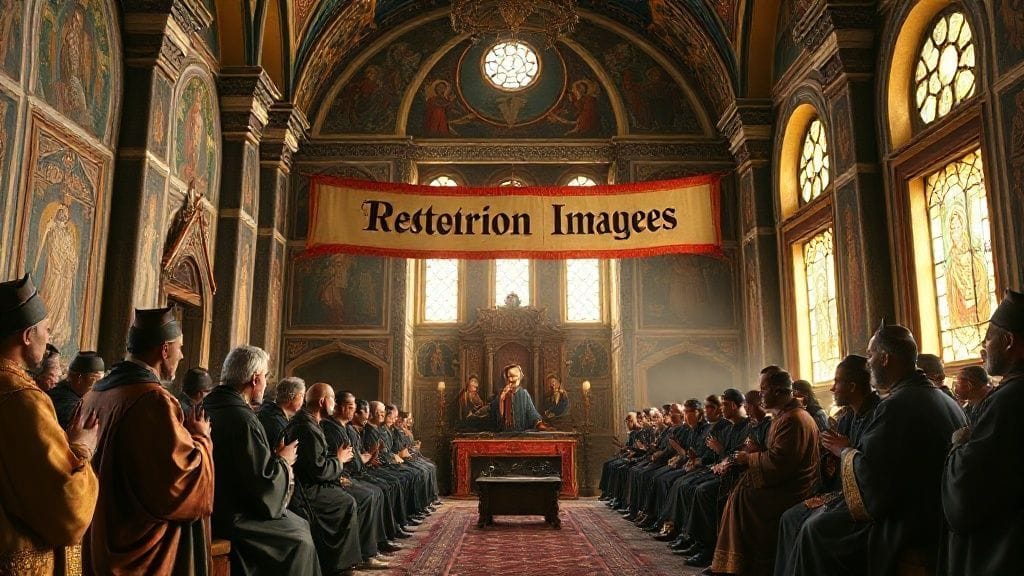
The late summer sun dipped low over the ancient hills surrounding Nicaea in 787 CE, casting long shadows over a city that bore the weight of centuries — a city where the echoes of Constantine’s first great council still reverberated. Clerics in richly embroidered robes and austere monks from far-flung corners of the Byzantine Empire gathered beneath the heavy stone arches of the imperial palace and the cathedral halls. The air was thick with incense, expectation, and the undercurrent of tension. This was no ordinary assembly. Here, at the Second Council of Nicaea, a profound question was about to be answered — should the images of Christ, the Virgin Mary, and the saints, torn from Byzantine churches a generation before, be restored? Would the sacred art once considered heretical be exalted once more as vessels of divine grace? The fate of icons, and perhaps the faith itself, hung in delicate balance.
This moment was the culmination of decades of fervent discord known as the Iconoclast Controversy, a defining conflict that fractured the heart of Eastern Christianity. The council’s decision would resonate not only within the gilded domes of Byzantine basilicas but across the lands and centuries, shaping how millions understood the visual and spiritual language of their faith. The Second Council of Nicaea was more than a meeting; it was a crucible of belief, power, and cultural identity that restored a central pillar of Orthodox piety.
The Dawn of a Controversy: Setting the Stage for the Second Council of Nicaea
To appreciate the gravity of the council’s deliberations, one must first travel back to the roots of the controversy that stirred so many passions. The 8th century was an epoch of upheaval within the Byzantine Empire where religion and imperial politics entwined inseparably. The Iconoclast Controversy was more than a theological dispute—it was a battlefield over identity and authority: the clash between image and word, between tradition and reform.
The worship and veneration of icons—sacred images depicting Christ, the Virgin Mary, and the saints—had long been integral to Christian worship. These images, far from mere decoration, were believed to act as windows into the divine, conduits of grace accessible to the faithful’s eyes and hearts. Yet, to some Byzantine emperors and clergy influenced by puritanical readings of Scripture and the surge of Islamic aniconism—a strand of religious practice strictly prohibiting images—icons became symbols of idolatry, distractions from the true worship of God.
This theological tension escalated into imperial policy under Emperor Leo III, who in 726 CE famously ordered the removal of icons from churches. This act of iconoclasm (“image-breaking”) ignited a fierce backlash from monks, bishops, and laypeople, setting a course for decades of persecution, destruction of art, and social unrest.
The First Council’s Shadow: Iconoclasm and Its Origins
The roots of iconoclasm were complex and multifaceted. Historically, the Eastern Roman Empire had endured waves of military crises and economic challenges. Emperors like Leo III saw the political necessity in reforming what they perceived as religious abuses possibly causing divine displeasure. The argument was that venerating images bordered on idolatry—a violation of the Ten Commandments.
Leo’s edicts dismantled centuries of tradition, ordering the smashing of icons and the reorientation of worship practices. The church’s highest authorities were split: many monks and clergy resisted fiercely, seeing the emperor’s actions as sacrilegious. However, others within the hierarchy acquiesced, leading to fractures within Christian leadership.
This rift simmered through the reigns of Leo’s successors, including Constantine V, who intensified iconoclastic policies with brutal purges of iconodules (supporters of icons). The empire was deeply divided between iconoclasts, backed by certain imperial factions, and iconodules, supported by powerful monastic communities and parts of the populace.
The Political and Religious Turmoil of the Eighth Century Byzantine Empire
Parallel to religious turmoil, the Byzantine Empire faced external pressures. The Islamic Caliphates dominated the southern lands, eroding Byzantine influence and feeding anxieties about divine favor. Internally, court intrigue and shifting alliances undermined stability.
The emperors saw iconoclasm not only as spiritual purification but also as a tool to centralize control over the church and consolidate imperial power. By delegitimizing the monks and clergy who used icons to assert influence, emperors hoped to strengthen their own authority. Yet such attempts often backfired, as the spiritual and emotional resonance of icons among the people could not be easily suppressed.
The Rise of Empress Irene: A Pivotal Figure in Restoring Icons
Amid growing fatigue with decades of iconoclastic strife, Empress Irene emerged as a beacon of restoration. The widow of Emperor Leo IV and regent for her young son Constantine VI, Irene wielded power in a male-dominated imperial court with a resolute vision. A devout supporter of the iconodules, she perceived the restoration of icons not only as an act of piety but as a political strategy to heal the empire’s religious wounds and legitimize her rule.
Irene’s reign marked a turning point. In 787, she convened the Second Council of Nicaea, inviting bishops from across Christendom to resolve the divisive issue once and for all. The move was bold; not all accepted her authority, and delicate negotiations awaited at the council.
The Gathering Storm: The Call for a New Council
The restoration of icons demanded a pan-Christian consensus, a definitive theological pronouncement to counteract iconoclast doctrines and end the violence. Empress Irene’s call for the council was a summons for bishops, abbots, and imperial representatives to converge on Nicaea, the same city where the first ecumenical council had forged unity in doctrine centuries earlier.
Letters and envoys traversed dangerous routes, as participants prepared to debate the fate of the images and, by extension, the soul of Byzantine Christianity. The stakes were immense—not only faith but the legitimacy of rulers and the unity of the church.
Arrival at Nicaea: A City Steeped in History and Hope
The delegates arrived laden with the weight of history. Nicaea’s sacred spaces, once host to the formulation of the Nicene Creed under Constantine the Great, now reopened their doors as battlegrounds of belief. Imperial guards maintained order amid the throngs of attendees, pilgrims, and curious locals.
The atmosphere was electric, a mixture of pious solemnity and political calculation. The council would last several weeks, during which arguments would boil over with passion, scholarship, and sometimes rancor.
The Opening Sessions: Debates, Drama, and Devotion
At the council’s opening, bishops presented their credentials and statements of faith. Empress Irene, from Constantinople, sent powerful messages endorsing the veneration of images as consonant with Orthodox doctrine. The floor soon became a stage for theological debate, with impassioned speeches from leading churchmen.
Behind the decorum lurked tension: iconoclast sympathizers questioned the orthodoxy of image veneration; iconodules insisted on the ancient tradition and the necessity of sacred art for teaching and worship. The debates revealed deep divisions but also theological brilliance, as scriptural exegesis, patristic writings, and liturgical traditions were deployed vigorously.
Theological Arguments: Defending the Veneration of Images
At the heart of the council’s deliberations was a nuanced theological argument about the nature of Christ and the role of images. Iconodules asserted that because Christ had taken human form — a visible, incarnate presence — He could be depicted. Thus, honoring images was not idolatry but a way of honoring the prototype.
The famous argument from Saint John of Damascus was invoked: the image of Christ is honored “not in itself but in its prototype.” Furthermore, the distinction between veneration (proskynesis) and worship (latreia) was clarified — worship was due to God alone, while veneration was a reverential honor given to images as conduits of divine grace.
Several bishops illustrated the pedagogical role of icons: a largely illiterate populace encountered the mysteries of salvation through visual theology. The images served as ‘books for the illiterate,’ connecting worshipers to the divine narrative.
The Iconoclast Opposition: Voices of Rejection and Resistance
Opposition persisted, though increasingly marginalized. Iconoclast representatives questioned the council’s premises, invoking Old Testament prohibitions against graven images and warning of idolatrous practices creeping into the church.
Their arguments also had political dimensions: restoring the icons would re-empower monastic communities and clerics who had opposed imperial authority. The controversy was far from resolved outside Nicaea, and some iconoclast factions harbored hopes of reversal.
The Role of Monks and Bishops: Champions of the Holy Images
Monks stood at the forefront of the iconodule cause. Many had suffered under iconoclastic persecutions. Their testimonies infused the council with living memory of loss and hope. Bishops sympathetic to the cause used their diocesan authority to argue for restoration to soothe the faithful and mend ecclesiastical fractures.
The council’s agenda was shaped by these impassioned voices, ensuring that the final decisions were deeply rooted in pastoral concerns as well as theological rigour.
The Moment of Decision: Restoring the Icons as Orthodox Practice
After intense debate, the council reached consensus. The prohibition against images was formally condemned as heretical. The restoration of holy images was proclaimed an essential tenet of the Orthodox faith.
The council decreed that venerating icons was to be allowed in churches, homes, and wherever Christian devotion was practiced. Restoration efforts would follow, cleansing churches of iconoclastic damage and replacing destroyed works with new sacred art.
The Decrees of the Council: Canons and Agreements
In addition to theological affirmations, the council issued canons governing the appropriate use of images, including respecting their sacredness, abstaining from idolatrous worship, and condemning abuse or superstition connected to images.
These decrees cemented a balanced approach — avoiding extremes of iconoclasm and of superstition — to preserve the spiritual and artistic integrity of Byzantine worship.
Celebrations and Controversies: Reactions Across Christendom
The news of the council’s decisions spread rapidly. Monastic communities rejoiced; Byzantine churches began the painstaking process of restoring images. However, some iconoclast holdouts resisted or denounced the council as politically motivated.
In the West, reactions were mixed but generally favorable. Popes in Rome had long opposed iconoclasm, and the council’s decrees would help align theological positions between East and West, even if deeper fissures would later emerge.
The Long Shadow of the Council: Political and Cultural Ramifications
The council’s success fortified Empress Irene’s reign, though controversies would persist. Some iconoclast emperors would briefly reassert their views in the early 9th century, but the restoration of icons had taken an irreversible cultural root.
Politically, the iconodule victory signaled a shift in power toward the church and monastic orders. Culturally, it inspired a renaissance in Byzantine art, architecture, and liturgy — a flowering that marked the empire’s spiritual identity for centuries.
Icons and Art: The Revival of Byzantine Religious Imagery
Post-council, Byzantine iconography blossomed with renewed vigor. Masters of mosaic, fresco, and panel painting employed symbolic conventions refined by theological debates.
Icons were central in churches as focal points of prayer and teaching, richly embodying doctrine in color and form. The visual language of Byzantium shaped Christian art across Eastern Europe and beyond, leaving a lasting heritage.
The Legacy of the Second Council in Eastern Orthodoxy
For Eastern Orthodox Christianity, the Second Council of Nicaea remains a foundational moment. It affirmed the legitimacy of icons and established a theological and liturgical framework still invoked in Orthodox worship today.
The council underscored the interplay of theology, devotion, and imperial politics in shaping the faith’s expression and identity.
Western Christendom’s Reception and the Road to Schism
While Rome largely supported the council’s decisions, differences in ritual, authority, and theology widened over subsequent centuries. The icon question was one among many that contributed to the eventual East-West Schism of 1054.
Nonetheless, the council’s restoration of images influenced Western medieval art and devotion, confirming the universal Christian importance of sacred imagery.
The Council’s Impact on Christian Liturgy and Devotion
The reinstatement of icons affected worship profoundly. Liturgical practices integrated icons as focal points for prayer, processions, and feast days. Popular piety found expression in the veneration of saints’ images that inspired faith and moral example.
Icons became a crucial part of both public worship and private devotion, embedding a sensory richness in Christian religious life.
Iconoclasm’s Resurgence and Final Decline
Though the council marked a turning point, iconoclasm flared briefly again under Emperor Leo V in the early 9th century. The final and definitive end to iconoclasm came during the reign of Empress Theodora in 843, commemorated as the “Triumph of Orthodoxy,” an annual feast in the Orthodox Church.
This reaffirmation erased the last iconoclastic obstacles and solidified the council’s legacy.
Reflections on Faith, Power, and Image: Lessons from Nicaea II
The Second Council of Nicaea teaches us about the fragile relationship between faith and political authority, between doctrine and culture. It reveals how images—visual, emotional, and symbolic—can become arenas of conflict and reconciliation.
The council’s story reminds us resilience and dialogue often pave the way for spiritual renewal.
The Council in Modern Memory and Scholarship
Today, historians view the council as a pivotal juncture in Byzantine history, art history, and theology. Scholars debate its political motives, theological nuances, and cultural significance, enriching our understanding of how past societies grappled with identity and belief.
The council remains a rich subject for contemplating the power of images and the enduring quest to express the divine.
Conclusion
The Second Council of Nicaea stands not just as a historical event but as a profound narrative about how humanity confronts the sacred through art, doctrine, and authority. It was the story of a fractured empire seeking unity through faith, of women and men, emperors and monks, bishops and artisans wrestling with the meaning of divine presence in a tangible form.
In restoring the icons, the council restored not only images but a bridge between the faithful and the divine — a bridge that transcended stone and pigment to touch the very soul of Christendom. It reminds us, centuries later, that faith is both seen and felt, that the human heart often finds words in colors and shapes, and that history’s greatest councils are those that listen not only to dogma but to the lived experience of worship and wonder.
FAQs
Q1: What was the Iconoclast Controversy, and why did it arise?
A1: The Iconoclast Controversy was a theological and political conflict in the Byzantine Empire during the 8th and 9th centuries centered on the use and veneration of religious images. It arose from concerns that icons constituted idolatry, influenced by stricter interpretations of biblical commandments and possibly the example of Islamic aniconism.
Q2: Who was Empress Irene, and what role did she play in the council?
A2: Empress Irene was the regent and later ruler of the Byzantine Empire who convened the Second Council of Nicaea in 787. She was a staunch supporter of icons and aimed to restore them as orthodox practice, helping to end the first phase of iconoclasm.
Q3: What theological arguments supported the veneration of icons?
A3: Theologians argued that because Christ became incarnate in visible human form, it was acceptable to depict Him and other holy figures. Veneration of images differed from worship; images were honored as points of connection to their prototypes, not as divine themselves.
Q4: How did the council’s decisions affect Byzantine art?
A4: The council’s restoration of icons led to a renaissance in Byzantine religious art, with vigorous production of mosaics, frescoes, and panel icons becoming central in liturgy and worship throughout the empire.
Q5: Did the Second Council of Nicaea end the Iconoclast Controversy immediately?
A5: Not entirely. Though the council marked a decisive iconodule victory, iconoclasm resurged briefly in the early 9th century before finally ending under Empress Theodora’s reign in 843, celebrated as the “Triumph of Orthodoxy.”
Q6: How did Western Christendom view the council?
A6: While the council’s decisions aligned with the Western church’s opposition to iconoclasm, existing political and theological differences later contributed to the East-West Schism, but the restoration of images influenced Western Christian art and liturgical practices.
Q7: What is the lasting significance of the Second Council of Nicaea?
A7: The council established the theological and liturgical foundation for the veneration of icons in Eastern Orthodoxy and influenced Christian art and worship broadly. It highlights the dynamic interplay of doctrine, culture, and power in shaping religious tradition.
Q8: Is the council recognized as an ecumenical council?
A8: Yes, the Second Council of Nicaea is the Seventh Ecumenical Council in both Eastern Orthodox and most Catholic traditions, affirming its authority and doctrinal importance.

