Table of Contents
- The Rallying Cry at Vézelay: Bernard of Clairvaux’s Fervent Sermon
- Europe on the Brink: The Sociopolitical Climate of the Mid-12th Century
- The Shadow of the First Crusade: Echoes and Expectations
- King Louis VII and Conrad III: Monarchs United in a Holy Purpose
- The Role of the Papacy: Pope Eugenius III’s Call to Arms
- From Pilgrimage to War: Mobilizing a Continent
- The Journey Begins: Routes, Perils, and Piety
- The German Army’s Ordeal: Crossing into Byzantine and Seljuk Territories
- Louis VII’s March through the Kingdoms of Eastern Europe
- The Siege of Damascus: A Devastating Turning Point
- Internal Divisions and Failed Alliances Among the Crusaders
- The Muslim Response: Uniting Under Zengi and Nur ad-Din
- The Collapse of the Crusader States’ Morale and Territory
- The Aftermath in Europe: Disillusionment and Political Repercussions
- The Second Crusade’s Legacy: Myths, Memory, and Lessons Learned
- How the Second Crusade Shaped the Later Crusading Movement
- Cultural and Religious Impacts Across Christendom and the Muslim World
- The Voices from the Crusade: Chroniclers, Nobles, and Commoners
- Analyzing the Crusade’s Strategic Failures with Modern Eyes
- The Second Crusade in Art and Literature Through the Ages
- Conclusion
- FAQs
- External Resource
- Internal Link
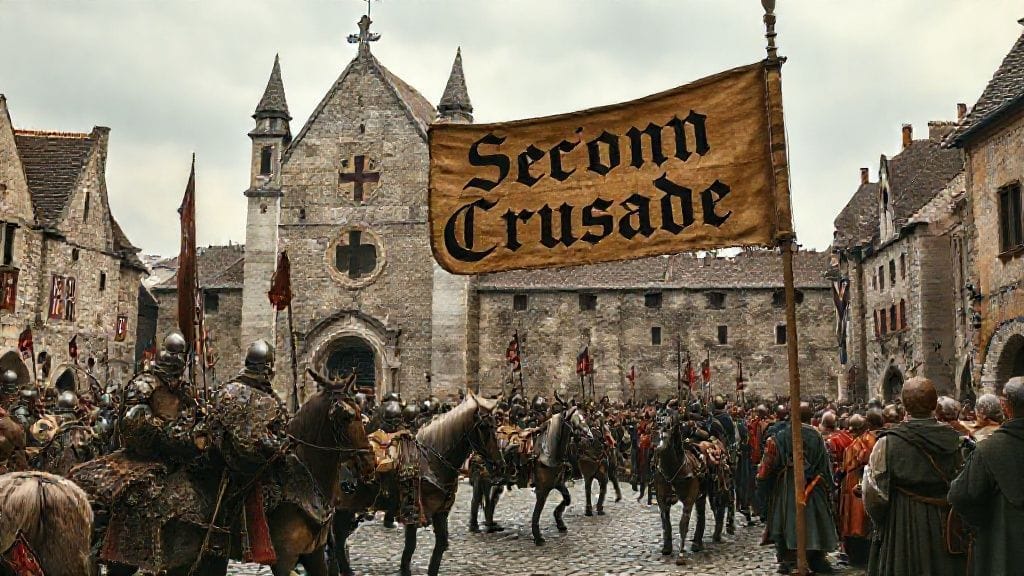
The spring of 1146 dawned bright and tense over the rolling hills of Vézelay, a small town nestled in the heart of Burgundy, France. Thousands gathered there in the shadow of the basilica, their faces alight with hope, terror, and devout fervor. There, before a sea of humanity stirred by hope and duty, Bernard of Clairvaux stood, a preacher whose words would send ripples through kingdoms and across seas. His sermon was not just a call to arms; it was a summons of destiny. “Go forth, and take back the lands,” he cried, voice rising above the crowd like a clarion call. Thus began the Second Crusade, an ambitious and tragic effort to revive the dream of a Holy Land under Christian control.
The Rallying Cry at Vézelay: Bernard of Clairvaux’s Fervent Sermon
Bernard’s sermon at Vézelay was nothing short of electrifying. The Cistercian monk’s reputation as an orator and mystic had preceded him, and on that May day in 1146, he ignited a flame within the hearts of nobles and peasants alike. King Louis VII of France, present in the crowd, swore to take the cross, as did many other members of the nobility.
Bernard’s message was clear and urgent. The recent disasters suffered by the crusader states—particularly the fall of the County of Edessa in 1144—were portrayed as both a spiritual and strategic catastrophe that must be reversed. He framed the crusade not only as a martial campaign but as a sacred pilgrimage and a path to redemption. His appeal resonated widely, sparking an unprecedented mobilization across France and Germany.
Europe on the Brink: The Sociopolitical Climate of the Mid-12th Century
To understand the Second Crusade’s eruption, we must first peer into the complex mosaic of 12th-century Europe. The continent was a patchwork of feudal realms, burgeoning monarchies, and fractious noble houses. Christianity was the unifying ideology, but beneath the surface simmered rivalries and tensions.
King Louis VII of France was a young monarch, facing internal dissent and the challenge of consolidating royal power over fractious aristocrats. Meanwhile, Conrad III of Germany’s rule was weak, his realm riddled with internal strife and the pressing demands of keeping the Holy Roman Empire cohesive.
The papacy, under Pope Eugenius III, was likewise invested in demonstrating its spiritual authority and political influence by endorsing a new crusade. The memory of the First Crusade’s miraculous victory still lingered, but Europe was no unshaken monolith; it was a continent on the verge of transformation, where old powers clashed with emerging forces.
The Shadow of the First Crusade: Echoes and Expectations
The First Crusade (1096–1099) was a watershed in medieval history—a triumphant, if brutal, enterprise that captured Jerusalem and established a series of Latin states in the Levant. It was a tale of religious zeal infused with violent conquest, creating legends that permeated culture for generations.
Now, half a century later, the Second Crusade bore the heavy burden of these memories. It was cast as a sacred endeavor to defend those hard-won Christian holdings—particularly after the catastrophic collapse of Edessa, the first crusader state to fall back into Muslim hands.
The idealism and heroic tales of the First Crusade shaped the expectations of the second. Yet, cracks in the unity of Christendom, political rivalries, and rising Muslim military power hinted that the second effort would face greater challenges.
King Louis VII and Conrad III: Monarchs United in a Holy Purpose
In what was one of the rare moments of cooperation between the French and German crowns, Louis VII and Conrad III answered the papal call together, pledging to lead armies eastward. This was unprecedented—crusading efforts before had been largely noble-led affairs; this time kings themselves took center stage.
Louis, a pious man often overshadowed by political rivals, sought legitimacy and spiritual redemption through crusade. Conrad, freshly crowned King of Germany, saw the crusade as a means to consolidate his authority, even as his grip on the Holy Roman Empire was tenuous.
Their dual leadership symbolized the crusade’s breadth but also sowed the seeds for future divisions—a fragmented coalition bound by faith but divided by earthly ambitions.
The Role of the Papacy: Pope Eugenius III’s Call to Arms
Pope Eugenius III's papacy was marked by a desire to reassert the Church’s dominance in European politics and safeguard Christianity’s frontiers in the East. His bull, Quantum praedecessores, issued in December 1145, formalized the call for the Second Crusade with the urgency and rhetorical fervor that burnished papal authority.
Unlike Pope Urban II’s spontaneous First Crusade call, Eugenius’s proclamation was more calculated, relying heavily on Bernard of Clairvaux’s charisma to inspire the masses. The pope’s message emphasized penitence, divine favor, and eternal reward, drawing on the medieval belief in spiritual warfare as deeply intertwined with earthly contests.
From Pilgrimage to War: Mobilizing a Continent
Across Europe, the call ignited a wave of enthusiasm unlike anything seen since the First Crusade. Pilgrims, knights, peasants, and princes took the cross—some driven by spiritual yearning, others by promises of land and glory.
The logistics were staggering. Raising and supplying armies across vast terrains was daunting. Nobles gathered banners, peasants furnished provisions, and church officials organized financial support through tithes and donations.
Yet this mass mobilization revealed deep inequalities—the burdens often fell on the peasantry, while noble contingents vied for prominence. The crusade became as much a tapestry of competing interests as a unified quest.
The Journey Begins: Routes, Perils, and Piety
In 1147, the armies of Louis VII and Conrad III set out on distinct routes toward the Levant, reflecting their separate realms and political concerns. Conrad led his German forces through Hungary and into Byzantine territory; Louis’s French army took a different southern path.
The journey was arduous. Harsh terrain, disease, and hostile encounters dogged their progress. Relations with locals and Byzantine rulers were strained, often sapping morale. Still, religious fervor sustained the crusaders as they marched toward the Holy Land—a land both physical and symbolic of salvation.
The German Army’s Ordeal: Crossing into Byzantine and Seljuk Territories
Conrad III’s forces suffered greatly en route. Crossing into Byzantine lands, suspicion and misunderstanding marred relations with Emperor Manuel I Comnenus. The Germans, unable to secure reliable support, were further tested by hostile Seljuk Turks in Anatolia.
At the Battle of Dorylaeum in late 1147, Conrad’s army was badly defeated. This loss devastated German morale and depleted their forces significantly before they reached Jerusalem, signaling that the crusade’s military prospects were already grim.
Louis VII’s March through the Kingdoms of Eastern Europe
Louis VII’s journey was no less challenging. Passing through Hungary and the Byzantine Empire, his army encountered logistical difficulties, food shortages, and tensions with local rulers who viewed the crusaders with wary eyes.
The French king, deeply devout and driven by spiritual motives, struggled to maintain discipline among his troops. Their slow progress and constant harassment drained resources and optimism. Yet Louis remained committed, propelled by the belief that Jerusalem—and Christendom itself—was at stake.
The Siege of Damascus: A Devastating Turning Point
The climax—and tragedy—of the Second Crusade unfolded at Damascus in the summer of 1148. The crusaders, together with local Christian and Muslim allies, sought to wrest control of this strategic city from Muslim rulers.
But alliances were fraught, planning disjointed, and motivations conflicting. After just a few days of siege, the crusaders abruptly abandoned the effort, apparently due to distrust of local allies and fear of counterattacks.
This failure shattered any hope of reclaiming lost territory. Damascus remained in Muslim hands, altering the political landscape of the Levant and marking a humiliating defeat for the crusaders.
Internal Divisions and Failed Alliances Among the Crusaders
Behind battlefield defeats lay deeper problems—fractures within the crusader leadership and competing agendas eroded unity. Louis and Conrad failed to coordinate, Byzantine hostility undermined logistical efforts, and rivalries between knights led to disorganization.
Moreover, many Muslim states, previously fragmented, began to find common cause in response to the crusade’s threat, under the leadership of figures like Zengi’s successors and Nur ad-Din.
The crusaders’ inability to forge durable alliances, either among themselves or with local forces, was a decisive factor in their failure.
The Muslim Response: Uniting Under Zengi and Nur ad-Din
The loss of Edessa in 1144 was a catalyst that galvanized Muslim powers. Zengi, atabeg of Mosul and Aleppo, had initiated the pushback against Crusader states, but his assassination in 1146 passed the mantle to his son, Nur ad-Din.
Nur ad-Din emerged as a formidable leader, uniting disparate Muslim factions and championing jihad against the crusaders. His political and military acumen reversed many Christian gains, setting the stage for further Muslim consolidation in Syria.
Thus, the Second Crusade unintentionally accelerated Muslim unity and resilience.
The Collapse of the Crusader States’ Morale and Territory
As news of the crusaders’ defeats spread, morale in the Latin holdings of the Levant plummeted. The hope that reinforcements would stem Muslim advances faded.
Edessa was lost permanently, and other crusader states faced increasing insecurity. The fragile Latin East seemed doomed to an inexorable decline, a reality that contrasted starkly with the initial optimism of 1146.
The Second Crusade’s failure marked the beginning of a difficult era for Christian powers in the region.
The Aftermath in Europe: Disillusionment and Political Repercussions
Back in Europe, the crusade’s failures sowed disillusionment. King Louis VII returned chastened, his reputation damaged. Political rivals exploited his humiliation, and his marriage to Eleanor of Aquitaine was strained, eventually ending in divorce—a personal and political rupture with lasting consequences.
Conrad’s setbacks eroded his standing too, contributing to ongoing instability within the Holy Roman Empire.
The papacy’s prestige suffered, though it would still call for future crusades. More broadly, the Second Crusade challenged the myth of crusading invincibility and helped usher in an era of more circumspect military ventures.
The Second Crusade’s Legacy: Myths, Memory, and Lessons Learned
Despite its failure, the Second Crusade left a deep imprint on medieval imagination. Chroniclers like William of Tyre recorded its events with a mixture of awe and sorrow, while later generations debated its causes and errors.
Lessons about the necessity of unity, preparation, and reliable alliances paved the way for subsequent crusading efforts. It also served as a cautionary tale about the dangers of overreliance on faith without pragmatic strategy.
The crusade became a symbol—both of heroic zeal and tragic miscalculation.
How the Second Crusade Shaped the Later Crusading Movement
The failure in the Levant influenced how later crusades were conceived and conducted. New military orders like the Templars and Hospitallers gained importance as professionalized forces.
European monarchs became more cautious, often delegating command to seasoned knights. The experience also deepened the mistrust between Byzantium and Western powers, a rift with far-reaching consequences during the Fourth Crusade.
Thus, the Second Crusade was a turning point—a harsh tutor for Christian Europe in the art of holy war.
Cultural and Religious Impacts Across Christendom and the Muslim World
The crusade’s spiritual fervor invigorated religious life in Europe—with new monastic foundations and pilgrim routes flourishing. Yet, it also hardened attitudes across religious divides.
In the Muslim world, the resilient defense against the crusaders inspired the growth of Sunni jihad ideology under Nur ad-Din and later Saladin, embedding a legacy of resistance that balanced faith with political unification.
Therefore, the Second Crusade was as much a crucible for spiritual identity as a battlefield of armies.
The Voices from the Crusade: Chroniclers, Nobles, and Commoners
The Second Crusade’s story is pieced together from a variety of perspectives. Chroniclers like Odo of Deuil painted grand narratives tinged with royal piety, while Muslim historians such as Ibn al-Qalanisi recorded the rise of Nur ad-Din and the defense of Damascus.
Letters from knights, accounts of pilgrims, and tales passed orally reveal a spectrum of personal experiences—hope, suffering, valor, and disillusionment.
These voices humanize the crusade, reminding us it was not just a political-military event but a profound human drama.
Analyzing the Crusade’s Strategic Failures with Modern Eyes
Modern historians frequently analyze the Second Crusade as a case of flawed leadership, poor logistics, and political miscalculations. The divided command structure, overreliance on Byzantine cooperation, underestimation of Muslim resolve, and impatience during sieges are commonly cited failures.
Yet, it would be simplistic to cast the crusade purely as incompetence: the complex interplay of faith, politics, and culture made success extraordinarily difficult. The lessons gleaned continue to inform studies of coalition warfare and religious conflict today.
The Second Crusade in Art and Literature Through the Ages
The crusade’s dramatic rise and fall have inspired works from medieval chansons de geste to modern novels and operas. Its tragic heroism and catastrophic setbacks have been retold as cautionary tales and romantic epics.
In art, the image of Bernard of Clairvaux preaching remains iconic, symbolizing the fusion of faith and martial fervor. The crusade’s memory persists as a profound chapter in the narrative of medieval Christendom.
Conclusion
The Second Crusade was a crucible of faith, ambition, and human frailty. Born from urgent devotion and religious idealism, it unfolded amidst the tangled politics of a fracturing Christendom and the rising strength of Muslim powers. While it ended in military failure and political embarrassment, its legacy resonates through history as a moment when the medieval world wrestled with its own contradictions—between hope and disillusionment, unity and division, heaven and earth.
The voices of kings and monks, soldiers and scribes, echo across the centuries, reminding us that history is not merely a chronicle of victories or defeats but a tapestry woven from human dreams and despair. The Second Crusade teaches us that even in loss, there is profound meaning: a call to examine the complex forces that shape our world, and the enduring power of faith and courage amid uncertainty.
FAQs
1. What prompted the launch of the Second Crusade?
The immediate cause was the fall of the County of Edessa to Muslim forces in 1144, which shocked and alarmed Christian Europe. The loss undermined the security of the crusader states and prompted Pope Eugenius III to call for a renewed crusade to defend and reclaim the Holy Land.
2. Who were the main leaders of the Second Crusade?
The two leading monarchs were King Louis VII of France and King Conrad III of Germany. Both took the cross and led large armies eastward, marking one of the few times European kings directly commanded a crusading force together.
3. Why did the crusade fail militarily?
Poor coordination between the French and German armies, logistical difficulties, hostile relations with the Byzantine Empire, and strong, unified resistance from Muslim leaders like Nur ad-Din led to significant defeats. The failed siege of Damascus was a decisive low point.
4. What role did Bernard of Clairvaux play in the crusade?
Bernard was the chief spiritual motivator, especially through his preaching at Vézelay, which helped rally widespread support. He framed the crusade as a penitential and holy mission but did not participate in the fighting directly.
5. How did the Second Crusade affect relations between the Crusaders and the Byzantine Empire?
Relations were strained and deteriorated further because the crusaders mistrusted the Byzantines, suspecting them of duplicity or reluctance to assist. This mistrust deepened the schism and would have adverse effects on future crusades.
6. What was the impact of the Second Crusade on Muslim political dynamics?
The crusade spurred increased unity among Muslim states, particularly under Nur ad-Din, who expanded his power and consolidated resistance against the crusaders, laying groundwork for later figures like Saladin.
7. Did the Second Crusade influence later crusades?
Yes, the failure prompted reevaluation of crusading strategies, encouraged the rise of military orders, and highlighted the necessity of better coordination and realistic planning for future campaigns.
8. How is the Second Crusade remembered today?
It is often viewed as a cautionary tale of religious idealism marred by political fragmentation and logistical failure. Still, it remains a powerful episode illustrating medieval society’s complexities and the enduring human experience amid conflict.

