Table of Contents
- The Dawn of a New Century’s Quest for Peace
- Setting the Stage: The World in the Early 1900s
- The Legacy of the First Hague Conference (1899)
- Rising Global Tensions Prompt a Second Gathering
- June 15, 1907: The Conference Begins Amidst Hope and Skepticism
- Key Actors and Leading Voices at The Hague
- The Conflicting Interests of Imperial Powers
- Major Debates: Disarmament and Rules of War
- The Question of Neutrality and Maritime Warfare
- The Role of Non-European Nations in Shaping the Agenda
- The Dispute over Arbitration and Enforcement Mechanisms
- Women’s Peace Movements and Civil Society Engagement
- Tactical Alliances and Political Maneuvering Behind Closed Doors
- The Dramatic Rejection of the Anti-War Arbitration Clause
- Breakthroughs: Achievements on Prisoners of War and Expanding the Permanent Court
- The Final Act: Signing the Hague Conventions of 1907
- Immediate Reactions: Jubilation, Criticism, and Wariness
- The Conference’s Unrealized Aspirations on Disarmament
- Seeds of Future International Law and the League of Nations
- How the 1907 Conference Influenced World War I and Beyond
- The Cultural Echoes: Art, Literature, and Public Perception of Peace
- Lessons Learned: The Failure and Promise of Early 20th-Century Diplomacy
- Revisiting The Hague Today: A Living Legacy
- Conclusion: The Persistent Quest for Peace in an Imperfect World
- FAQs: Understanding the Second Hague Peace Conference
- External Resource
- Internal Link
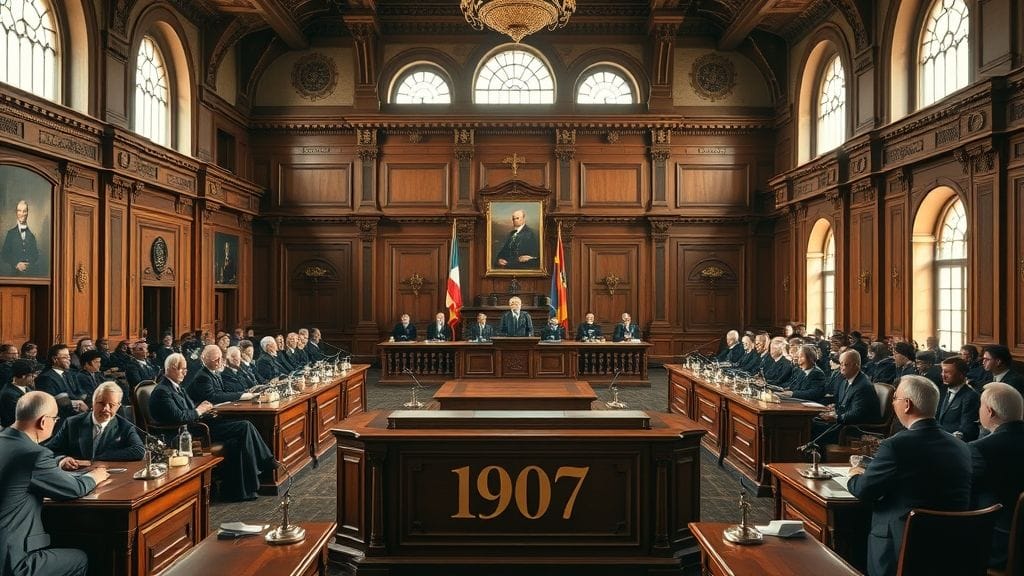
The summer air of June 15, 1907, was thick with optimism and unease; diplomats, soldiers, pacifists, and journalists alike gathered in The Hague, Netherlands, within the grand halls of the Peace Palace. The world was hurtling toward unprecedented conflict, yet here was a moment when hope briefly flickered. The Second Hague Peace Conference had opened — a gathering charged with ambition to curb the horrors of war, regulate military conduct, and further cement a nascent international order rooted in law and arbitration. But beyond the protocol and proclamations lay fierce debates, deep mistrust, and competing visions of peace that would echo tragically through the decades to come.
The Dawn of a New Century’s Quest for Peace
At the turn of the 20th century, humanity stood at a crossroads. Industrialization had connected continents, birthed new economies, yet also birthed new rivalries and arms races. The horrors of previous conflicts and the rapid evolution of weaponry weighed heavily on collective consciousness. The first Hague Peace Conference in 1899 had planted a seed—a fragile, early blueprint advocating for the peaceful resolution of disputes. Yet war’s shadow loomed large. Seven years later, a more ambitious assembly convened to build upon that fragile promise.
Setting the Stage: The World in the Early 1900s
Europe was the epicenter of imperial ambition. The Great Powers—Britain, Germany, Russia, France, Austria-Hungary, Italy, and the United States—jostled for position on a globe carved up like a game board. Nationalism surged with fervor, alliances hardened, and colonial conflicts simmered. The Russo-Japanese War had recently shattered illusions of invincibility among European powers, the Moroccan Crisis inflamed tensions between France and Germany, and naval arms races threatened to ignite confrontation. Amid these pressures, the idealists dreamed of diplomacy as a safeguard.
The Legacy of the First Hague Conference (1899)
The inaugural 1899 conference had introduced groundbreaking ideas: the Permanent Court of Arbitration, initial rules on the conduct of war, and attempts at disarmament. But despite its progressive undertones, it was hamstrung by limited participation, vague agreements, and lack of enforcement. The 1907 conference sought to rectify these shortcomings, raising questions: Could international law restrain sovereign states? Could nations willingly bind themselves to peace in a world dictated by power?
Rising Global Tensions Prompt a Second Gathering
The years between 1899 and 1907 witnessed seismic geopolitical shifts. The balance of power teetered precariously. Alarmed by aggressive military expansions—naval and land-based—and the rise of nationalist militias, many voices clamored to reaffirm peace. The Hague, already symbolic as a city of neutrality and justice, became the logical nexus for renewed talks.
June 15, 1907: The Conference Begins Amidst Hope and Skepticism
Delegates from 44 nations, representing nearly all recognized states except Colombia and a few others, assembled beneath the vaulted ceilings of the Peace Palace. The ambiance was formal yet charged; beneath the polished veneer lay conflicting agendas. Some came as committed pacifists; others as realists seeking to secure their nation’s strategic interests. The opening speeches balanced lofty ideals against palpable political calculation.
Key Actors and Leading Voices at The Hague
Figures like Theodore Roosevelt, then U.S. President, embodied a paradox: advocate for peace yet attentive to power. Russia’s delegates championed strict limitations on arms, while Germany pressed for greater autonomy in military matters. Smaller states viewed the conference as an opportunity to assert their sovereignty on the global stage. Intellectuals, legal experts, and diplomats contributed technical expertise amid the storm of political imperatives.
The Conflicting Interests of Imperial Powers
The conference became a theater of imperial rivalry. Britain aimed to maintain naval supremacy and protect its empire; Germany sought recognition and parity; Russia, still nursing wounds from the Far East, sought to reassert itself. Each imperial power renegotiated allegiances and asserted “spheres of influence” through discourse as much as diplomacy. The risk was that disagreement would render the gathering symbolic rather than substantive.
Major Debates: Disarmament and Rules of War
Disarmament proved the most difficult topic. The idea of reducing armaments—guns, soldiers, battleships—was noble but collided with states’ fears of vulnerability. The conference argued over definitions: what constituted "arms"? How enforceable would any reductions be? Despite impassioned pleas, the final agreements skirted sweeping disarmament, offering instead incremental regulations on the conduct of hostilities, including prohibitions on certain weapons and protections for civilians.
The Question of Neutrality and Maritime Warfare
Neutrality was a fraught concept, especially regarding naval blocks and contraband during wartime. Nations with overseas colonies depended heavily on maritime commerce and naval power projection. Delegates wrestled with defining the rights and duties of neutral states, the legality of naval blockade, and the treatment of neutral vessels, laying groundwork for future conflicts over maritime law but leaving many clauses deliberately vague.
The Role of Non-European Nations in Shaping the Agenda
While Europe dominated, non-European countries increasingly asserted influence. Japan, fresh from victory over Russia, projected its rising status. The United States, an emerging global power, advocated arbitration and international law. Latin American nations sought recognition and protections against imperial encroachment. Their presence complicated discussions but enriched the conference’s vision from regional contest to global diplomacy.
The Dispute over Arbitration and Enforcement Mechanisms
Disarmament aside, the 1907 conference prioritized bolstering international arbitration as a peacekeeping tool. The Permanent Court of Arbitration was expanded and its procedures refined. Yet questions arose: How binding would arbitral decisions be? How would recalcitrant states be handled? Without a global enforcement authority, the machinery of peace remained fragile, vulnerable to national interests overriding collective good.
Women’s Peace Movements and Civil Society Engagement
Though the conference halls were male-dominated, the zeitgeist of peace was invigorated by women’s organizations. Activists like Bertha von Suttner had prefigured the movement, and their quiet influence permeated debates. The broader public followed the conference with hope and suspicion, inspired by peace tracts, public lectures, and burgeoning internationalist movements. Civil society’s role foreshadowed later global humanitarian initiatives.
Tactical Alliances and Political Maneuvering Behind Closed Doors
Behind formal sessions, delegates engaged in intense horse-trading, making deals and concessions. Smaller powers aligned with protectors; great powers leveraged threats and promises. The confidential nature of some talks allowed for pragmatic compromises but also sowed seeds of future mistrust. The balance between transparency and diplomatic discretion was as delicate as the peace they sought.
The Dramatic Rejection of the Anti-War Arbitration Clause
Perhaps the conference’s most poignant moment was the failure to agree on a compulsory arbitration clause to resolve future conflicts. Advocates envisioned a world free from war’s randomness; skeptics, wielding realpolitik, feared loss of sovereignty. The rejection underscored the limits of idealism and the primacy of power, foreshadowing the outbreak of world war just a few years later.
Breakthroughs: Achievements on Prisoners of War and Expanding the Permanent Court
Yet the conference was not without success. Important conventions were agreed upon concerning the humane treatment of prisoners of war, the conduct of hostilities, and the addition of new member states to the Permanent Court of Arbitration. These elements would later be invoked during World War I, providing at least some legal standards amid chaos.
The Final Act: Signing the Hague Conventions of 1907
On a summer’s day after weeks of rigorous debate, 13 conventions and 3 declarations were signed. The ratifications assured that nations pledged support for peace protocols and legal regulation in war—though within clearly limited and negotiable bounds. The resulting Hague Conventions became milestones in the codification of international law, referenced by generations of diplomats and jurists.
Immediate Reactions: Jubilation, Criticism, and Wariness
Newspapers hailed the conference as a triumph of diplomacy, yet observers noted the thin line between hope and hubris. Peace activists rejoiced and urged further action. Militarists warned of the naive optimism. Scholars debated whether law could restrain power. Governments approached the agreements with cautious pragmatism.
The Conference’s Unrealized Aspirations on Disarmament
Despite earnest discussions, the conference failed to curb the arms race that was accelerating through the early 20th century. Germany’s zealous naval build-up and other powers’ military expansions soon rendered the disarmament hopes illusory. This limitation cast a shadow on the entire enterprise’s ability to prevent conflict, as the world lurched towards 1914.
Seeds of Future International Law and the League of Nations
Still, the 1907 conference laid an indispensable foundation for modern international law. It strengthened institutional frameworks like the Permanent Court of Arbitration and established norms that shaped the League of Nations after World War I and, eventually, the United Nations. Its influence echoes in contemporary efforts to regulate conflict and uphold humanitarian principles.
How the 1907 Conference Influenced World War I and Beyond
When the guns of August 1914 sounded, many saw them as the failure of diplomacy. Yet some argue the conference’s legal frameworks moderated wartime conduct. Others believe its very shortcomings sharpened tensions. In hindsight, it epitomizes the tragedy of early 20th-century idealism confronting realpolitik — a poignant warning and an enduring inspiration.
The Cultural Echoes: Art, Literature, and Public Perception of Peace
The conference resonated beyond diplomacy. Writers like Romain Rolland and Rosa Luxemburg grappled with its ideals. Artists captured the brittle hope of peace in a world geared for war. Public debates on international law and peace sprang to vivid life in coffeehouses, salons, and newspapers—suggesting that peace was as much a social project as a political one.
Lessons Learned: The Failure and Promise of Early 20th-Century Diplomacy
The Second Hague Peace Conference stands as a testament to humanity’s perennial struggle to reconcile power with justice. Its partial successes and glaring failures sparked debate over the nature of sovereignty, the limits of law, and the meaning of security—a debate that continues today in institutions wrestling with war and peace.
Revisiting The Hague Today: A Living Legacy
Today, The Hague remains a global center for international justice. The Peace Palace hosts the International Court of Justice and tribunals dealing with crimes against humanity. The 1907 conference is a foundational chapter in this story—a reminder that peace is an ongoing journey, requiring persistence, compromise, and courage.
Conclusion
The Second Hague Peace Conference of 1907 was, in many ways, a moment suspended between hope and impending catastrophe. It offered a visionary set of ideas—rules to civilize war, forums for arbitration, guidelines for disarmament—that still reverberate in modern international law. Yet it also revealed the stubborn realities of nationalism, empire, and militarism that would soon plunge the world into unprecedented bloodshed.
This conference embodied a deeply human story: the yearning for peace amidst the machinery of war, the tension between idealism and pragmatism, and the eternal quest to find order in chaos. While it failed to prevent the Great War, the groundwork it laid became indispensable for the 20th century’s ongoing struggle to build a world governed by justice rather than might.
The story of that June 1907 assembly reminds us that peace is never final, never given—always to be earned anew by each generation’s courage to dream, negotiate, and act.
FAQs
Q1: What prompted the convening of the Second Hague Peace Conference in 1907?
A1: Rising global tensions from imperial rivalries, an intensifying arms race, and the limited success of the First Hague Conference in 1899 urged nations to reconvene. There was a strong desire to strengthen international law and mechanisms of arbitration to prevent war.
Q2: Which countries were the primary participants in the 1907 conference?
A2: Forty-four nations participated, including all major powers such as Britain, Germany, Russia, France, Austria-Hungary, Italy, and the United States. Few countries, notably Colombia, were absent.
Q3: Did the conference succeed in achieving disarmament?
A3: No, despite earnest discussions, the conference could not reach agreement on significant disarmament measures due to mutual suspicion between powers and concerns about national security.
Q4: What were the major legal outcomes of the conference?
A4: The signing of 13 conventions and 3 declarations expanded the rules of warfare, humane treatment of prisoners, the rights of neutral powers, and strengthened the Permanent Court of Arbitration, which influenced future international law.
Q5: How did the conference affect the lead-up to World War I?
A5: It failed to prevent the arms race and alliances that triggered World War I, but its legal frameworks influenced wartime conduct and later international organizations like the League of Nations.
Q6: What role did non-European countries play?
A6: Non-European nations like the U.S. and Japan increasingly influenced the agenda, pushing for arbitration and new forms of international engagement beyond Europe’s traditional imperial contests.
Q7: How is the 1907 conference remembered today?
A7: It is recognized as a critical, if flawed, milestone in international diplomacy, highlighting early efforts to regulate war and laying foundations for institutions that continue to pursue global justice.
Q8: Were civil society and peace activists involved in the conference process?
A8: While largely excluded from the formal process, peace activists, especially women’s movements, exerted moral pressure and inspired public support for the conference’s ideals.