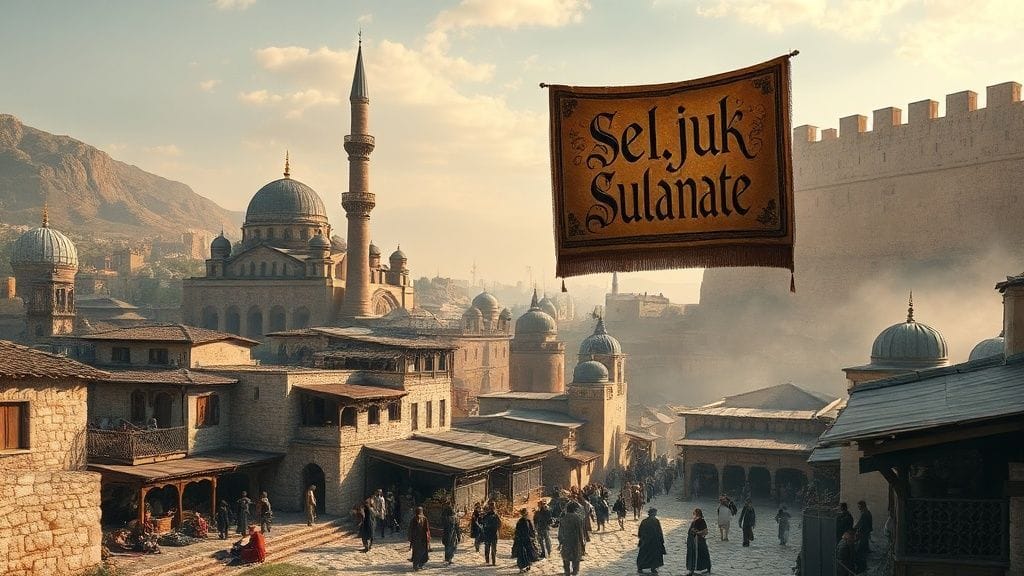
Table of Contents
- Dawn of a New Power: The Seljuk Arrival in Anatolia
- The Byzantine Backdrop: A Crumbling Empire
- The Battle of Manzikert, 1071: A Turning Point
- Flight and Foothold: The Seljuk Advance to Nicaea
- Nicaea as a Nexus: Fortress and Fledgling Capital
- Iconium: The Transformation into the Sultanate’s Heart
- The Founding of the Sultanate of Rum: Identity and Legitimacy
- Leadership Under Suleiman ibn Qutulmish
- Political Structure and Administration: Bridging Cultures
- Religious and Cultural Dynamics in Anatolia
- Military Campaigns and Border Expansion
- The Role of the Byzantine Successor States
- Economic Networks and Urban Revival
- The Interplay of Seljuk Turks with Christian Powers
- Architectural and Artistic Achievements
- The Sultanate Amid Crusader Turmoil
- Social Fabric and Demographic Changes
- Decline, Fragmentation, and Successor States
- Long-Term Legacies in Anatolian History
- Conclusion: The Sultanate’s Enduring Imprint
- FAQs on the Seljuk Sultanate of Rum
- External Resource
- Internal Link
Dawn of a New Power: The Seljuk Arrival in Anatolia
The first light of dawn cast long shadows over the rugged Anatolian landscape, a land that was on the brink of profound transformation. Clad in chainmail, the horses of the Seljuk warriors thundered across the plains, their banners fluttering in the autumn breeze. Smoke spiraled faintly in the distance—signs of skirmishes and conquest. The mid-century years of the 1070s heralded an epochal upheaval in this crossroads of East and West. This was the birth of the Seljuk Sultanate of Rum, an Islamic polity established on the ruins of Byzantine authority, poised to redefine the cultural and political contours of Anatolia for centuries to come.
The echoes of past glory still resonated in the walls of ancient cities like Nicaea and Iconium, but change was relentless. It was an era marked by the violent collision of empires, the flux of power, and the mingling of races and faiths. To understand the making of the Sultanate of Rum is to peer deeply into a story of conquest and cohabitation, ambition and adaptation—a story that reshaped the medieval Near East.
The Byzantine Backdrop: A Crumbling Empire
To grasp the significance of the Seljuk Sultanate's emergence, one must first understand the fragile state of Byzantium. By the mid-11th century, the Byzantine Empire, the heir to Roman legacy and guardian of Orthodox Christianity, was plagued by internal strife, military overextension, and political intrigue. Its control over Anatolia—the empire's heartland and breadbasket—was tenuous at best.
The empire grappled with defensive weaknesses, exacerbated by complacency and corruption within its ranks. The encroaching pressures from the Seljuk Turks in the east were felt acutely. The Byzantines’ traditional defensive provinces along the Taurus Mountains were no longer impregnable bastions but contested zones vulnerable to raids and incursions.
This period was also marked by a certain underestimation of the Turkish nomads, who, despite their relatively recent entry into Anatolia, demonstrated an uncanny ability to adapt, settle, and consolidate power rapidly. As one Byzantine chronicler lamented, “These barbarians are not like the past invaders—they come not to pillage, but to stay.”
The Battle of Manzikert, 1071: A Turning Point
The year 1071 stands as one of the most consequential dates in medieval Middle Eastern and Anatolian history. The Byzantine Emperor Romanos IV Diogenes confronted the Seljuk Sultan Alp Arslan near Manzikert, a small fortress town on the eastern frontier. What transpired was devastating: the Byzantine army was routed in a brutal melee, and Romanos himself captured.
The defeat at Manzikert shattered Byzantine military prestige and opened the floodgates for Seljuk incursions into Anatolia. But the battle's aftermath was more complex than a simple conquest. Internal Byzantine divisions and a chaotic succession crisis following Romanos’s release hampered organized defense. Meanwhile, Alp Arslan, pragmatic and politically savvy, allowed some Christian autonomy in returned territories, setting a precedent for coexistence.
This loss effectively marked the beginning of the end for Byzantine dominance in Asia Minor and paved the way for Turkish settlement and state-building in the void that followed.
Flight and Foothold: The Seljuk Advance to Nicaea
In the wake of Manzikert, waves of Seljuk warriors and nomadic tribes poured into Anatolia, driven both by the promise of plunder and the opportunity for new lands. Nicaea, a city with deep Christian significance and a bulwark of Byzantine power near the Sea of Marmara, quickly became a strategic prize.
In the mid-1070s, the Seljuks laid siege to Nicaea. Unlike other cities that fell by force, Nicaea’s fall signaled not just military conquest but the opening of a new chapter—where a blend of cultures and administrations would define the city’s identity.
Securing Nicaea was critical; it served as a gateway to the western parts of Anatolia and proximity to Constantinople. Holding it lent the Seljuks legitimacy and leverage amid the complex web of regional powers.
Nicaea as a Nexus: Fortress and Fledgling Capital
Once a major center of early Byzantine Christianity and the site of the famed First Council of Nicaea in 325, the city now became the northern anchor of Seljuk power. Its fortifications were adapted and extended to solidify Turkish control.
More than a military post, Nicaea evolved as an administrative hub. A confluence of Persian-influenced legal traditions, Islamic governance, and remnants of Byzantine bureaucracy took shape here, reflecting the hybrid nature of the emerging Sultanate.
This fusion was not without tension: religious minorities—Armenians, Greeks, Syriac Christians—lived under new rulers, negotiating spaces between accommodation and resistance. Yet, as the city blossomed economically and culturally, it embodied the transitional spirit of the period.
Iconium: The Transformation into the Sultanate’s Heart
Further inland, Iconium (modern Konya) was destined to become the beating heart of the Seljuk Sultanate. Originally a Byzantine castellum, its capture around the 1080s marked a decisive moment in consolidating Seljuk power.
Under the leadership of Suleiman ibn Qutulmish, a distant cousin of Alp Arslan, Iconium was established as the sultanate’s capital. Suleiman ingeniously wielded both military prowess and diplomatic acumen, carving out a durable realm between the fractured Byzantine domains, Crusader principalities, and the Seljuk core in Persia.
Iconium became more than an administrative center; it was transformed into a thriving cultural nexus. It attracted poets, scholars, artisans, and merchants, rapidly morphing from a provincial town into a city of splendor.
The Founding of the Sultanate of Rum: Identity and Legitimacy
The name “Rum” itself is laden with meaning—it means “Rome,” a testament to the Seljuks’ perception of their realm as a successor to the Roman (Byzantine) imperial heritage. By adopting this label, the Seljuk rulers sought not only to claim territorial domination but also political and cultural legitimacy.
The Sultanate of Rum was, in many ways, a slate where East met West. It embraced Turkish tribal traditions, Seljuk Persian court customs, and accepted the Byzantine political and economic patterns. The heritage of Roman law and infrastructure combined with Islamic theology and Persianate culture to create a unique polity.
This identity was fluid and dynamic, reflecting both triumph and challenge as the Seljuks navigated complex neighborly relations.
Leadership Under Suleiman ibn Qutulmish
Suleiman ibn Qutulmish remains a towering figure in this early era, celebrated both for military skill and statecraft. A great-grandson of the Seljuk dynasty’s founder, he skillfully extended Seljuk influence from Cappadocia to the Aegean coast.
Suleiman’s rule was marked by pragmatic governance. While Islamic law informed the administration, he preserved a degree of tolerance toward Christian subjects, an essential policy for ruling a diverse population.
His death in 1086, during a conflict with rival Seljuk factions, proved a blow but the institutions he laid down endured.
Political Structure and Administration: Bridging Cultures
The Sultanate of Rum adopted a hybrid form of government. The sultan stood at the apex, wielding military, judicial, and religious authority. However, the administration was staffed with Persians, Turks, and local Byzantine officials, reflecting the multicultural constituency.
Legal frameworks combined sharia law with preexisting Roman legal traditions. Taxation systems retained Byzantine efficiency mechanisms but adapted to nomadic and rural economies. Such administrative sophistication ensured the survival of the sultanate amid constant external pressures.
Religious and Cultural Dynamics in Anatolia
Anatolia’s population was a mosaic of ethnicities and faiths: Orthodox Christians, Armenians, Syriacs, Turkic Muslims, and others. The Seljuks pragmatically delineated religious tolerance within limits, facilitating coexistence while promoting Islam.
Mosques rose alongside churches; madrasas (Islamic schools) spread, fostering philosophical and theological debates. The Seljuk period is remembered as a cultural renaissance in Anatolia, setting the stage for later Ottoman triumphs.
Military Campaigns and Border Expansion
The Sultanate’s military was a blend of traditional horse archers and mounted cavalry, skilled in siege warfare and rapid maneuvering. Campaigns against Byzantine successor states, Crusaders, and rival Turkish factions defined the sultanate’s expansionist phase.
Despite being overshadowed often by the Crusades, the Sultanate maintained a delicate balance, sometimes allying with Crusaders against Byzantines or vice versa. Military adaptability was key to survival.
The Role of the Byzantine Successor States
The Byzantine collapse after Manzikert gave rise to successor polities—chapters of fragmented authority such as the Empire of Nicaea and the Despotate of Epirus. These states contested with the Seljuks for control but often prioritized survival over outright war.
A complex web of diplomacy, marriage alliances, warfare, and trade linked these entities. The Seljuks, more often than not, found it practical to coexist rather than annihilate.
Economic Networks and Urban Revival
Under Seljuk patronage, Anatolian cities flourished. Trade routes connecting Persia, the Mediterranean, and the Black Sea revitalized commerce. The revival of caravanserais improved connectivity and security.
Markets brimmed with goods: silk, spices, ceramics, and textiles. This prosperity fostered social mobility and cultural exchanges, making the Sultanate a vibrant medieval economic hub.
The Interplay of Seljuk Turks with Christian Powers
The Crusaders arrived around the same time as the Seljuk consolidation, adding a volatile element to Anatolian politics. The sultanate faced intermittent Crusader raids and sieges, yet sometimes forged tactical alliances.
Religious conflict interlaced with political pragmatism. The Seljuks often portrayed themselves as defenders of Islam while simultaneously engaging in complex negotiations with their Christian neighbors.
Architectural and Artistic Achievements
Seljuk architecture in Anatolia introduced distinct features: monumental portals, intricate stone carvings, tile work, and geometric patterns. Caravanserais, madrasas, mosques, and bridges stood as testaments to their aesthetic and engineering prowess.
Konya’s Alaeddin Mosque and the caravanserai at Sultanhan are emblematic of Seljuk sophistication, blending function with artistic grandeur.
The Sultanate Amid Crusader Turmoil
The Crusades forced the Sultanate of Rum into the heart of a wider geopolitical struggle. While the First Crusade (1096–1099) disrupted regional stability, the sultanate weathered these storms, sometimes losing territory but often absorbing Crusader refugees and mercenaries.
The Crusades also entrenched the Sultanate’s role as a Muslim frontier state along the volatile Christian-Muslim divide.
Social Fabric and Demographic Changes
The Seljuk advance led to demographic shifts: Turkish nomads settled, gradually integrating with the local population. Inter-marriage and cultural exchange blurred ethnic lines.
Rural to urban migrations fostered new social classes, including emerging merchant and artisan guilds. Despite tensions, a shared Anatolian identity began to crystallize.
Decline, Fragmentation, and Successor States
By the late 12th century, internal strife and external pressures, notably from the Mongols, weakened the Sultanate. It fragmented into smaller emirates, known as beyliks, creating a political landscape ripe for new powers.
One of these beyliks, the nascent Ottoman principality, would eventually inherit and transcend the Seljuk legacy.
Long-Term Legacies in Anatolian History
The Sultanate of Rum bequeathed an indelible imprint on Anatolia’s landscape. It bridged the Byzantine past and the Ottoman future, embedding Islam and Turkish culture deep within the region.
Its urban developments, artistic accomplishments, and political innovations provided scaffolding for future empires. Today, the ruins and cities of Konya and Nicaea echo those transformations.
Conclusion
The establishment of the Seljuk Sultanate of Rum was more than a mere territorial conquest—it was a profound reimagining of Anatolia’s identity and destiny. Emerging from the ashes of Byzantine decline and the shock of Manzikert, the Sultanate forged a new synthesis of cultures, religions, and political traditions.
Its rulers balanced militaristic ambition with pragmatic governance, creating a resilient state amid the upheavals of the Middle Ages. The Sultanate’s legacy is felt not only in history books but in the continued cultural and architectural heritage scattered across Turkey’s landscape.
Ultimately, the Sultanate of Rum represents a story of transformation—how conquest can seed coexistence, and how a frontier land can become a cradle for civilization. It reminds us that history is never static, but a living dialogue between past and future.
FAQs on the Seljuk Sultanate of Rum
Q1: What led to the foundation of the Seljuk Sultanate of Rum?
The foundation was precipitated by the decisive Byzantine defeat at the Battle of Manzikert in 1071, which opened Anatolia to Turkish migration and conquest. The Seljuk Turks, under leaders like Suleiman ibn Qutulmish, capitalized on Byzantine weakness to establish control over key cities like Nicaea and Iconium.
Q2: Why is the name “Rum” significant?
“Rum” means “Rome” in Arabic and Persian, signifying the Seljuk claim to the territorial and cultural inheritance of the Roman (Byzantine) Empire in Anatolia. It reflects their ambition to be seen as successors rather than mere conquerors.
Q3: How did the Seljuk Sultanate manage religious diversity?
The sultanate practiced a pragmatic approach toward religious minorities, particularly Christians and Armenians, allowing a degree of religious autonomy while promoting Islam as the state faith. This balance helped maintain social stability.
Q4: What role did Iconium play in the Sultanate?
Iconium served as the capital city and cultural hub of the Sultanate of Rum. Under Suleiman ibn Qutulmish and his successors, it became a center of administration, learning, and architectural innovation.
Q5: How did the Seljuks interact with the Crusaders?
The Seljuk Sultanate experienced both conflict and cooperation with Crusader states. While often adversaries during Crusader incursions, they sometimes formed tactical alliances or adapted to Crusader presence through diplomacy.
Q6: What caused the decline of the Seljuk Sultanate of Rum?
A combination of internal dynastic struggles, increasing pressure from Mongol invasions, and rising local emirates contributed to the fragmentation and ultimate decline of the Sultanate by the late 12th and early 13th centuries.
Q7: What is the lasting cultural legacy of the Sultanate?
The Sultanate left lasting impacts in architecture, urban development, and cultural synthesis. It laid the groundwork for Turkish Islamic identity in Anatolia, influencing the Ottoman Empire and modern Turkey’s historical narrative.
Q8: How is the Sultanate remembered in modern Turkey?
The Sultanate is regarded as a foundational era for Turkish presence in Anatolia. Sites like Konya are celebrated for their Seljuk heritage, and the period is studied as a pivotal chapter preceding Ottoman ascendancy.

