Table of Contents
- The Empire at a Crossroads: Rome in the Early Third Century
- The Rise of Septimius Severus: From Unlikely Origins to Emperor
- Imperial Ambitions: Severus and the Reorientation of Power
- Britain on the Fringe: The Province and Its Military Significance
- The March to the Edge of the Empire: Severus Arrives in Britain
- A City Transformed: Eboracum as Imperial Headquarters
- The Campaigns of Severus: Subduing the Northern Tribes
- The Weight of Rule: Health, Age, and the Burden of the Emperor
- The Final Days in Eboracum: Death in the Northern Hospitals
- The Succession Struggle: Caracalla and Geta’s Bitter Legacy
- Britain’s Moment in the Imperial Spotlight
- The Political Aftershocks Across the Roman Empire
- Septimius Severus’ Military Legacy: Reforms and Fortifications
- The Human Face of Power: Anecdotes from the Emperor’s Last Days
- Severus in Memory: Historians, Poets, and the Imperial Cult
- The Impact of Severus’ Death on the Roman Frontier Strategy
- The Evolution of Eboracum Post-Severus: From Garrison to City
- Ancient Medicine and the Emperor’s Final Illness
- Cultural Interactions on the Edge of Rome: Severus’ Britain
- Conclusion: The End of an Era and the Dawn of a New Imperial Phase
- FAQs
- External Resource
- Internal Link
The Empire at a Crossroads: Rome in the Early Third Century
The year 211 AD was a tumultuous moment in the sprawling Roman Empire. Stretching from the sunbathed shores of Hispania in the west to the exotic and chaotic provinces of the east, Rome was a leviathan of political intrigue, military struggles, and cultural diversity. Yet, beneath its formidable exterior, tensions simmered. The era marked by the Severan dynasty had brought both strength and uncertainty, as the age of Pax Romana quietly waned and the empire’s centrifugal forces gained momentum.
In this landscape stood Lucius Septimius Severus—a figure as imposing as the Empire itself. His reign, beginning in 193 CE after the bloody Year of the Five Emperors, had restored a semblance of order to a fractured world. But even the mightiest fall, inevitably.
On a cold February morning, far from the marble palaces of Rome, the Emperor’s final breaths were taken in Eboracum, modern-day York, Britain—one of the farthest outposts of Roman civilization. It was here, in this northern fortress city, that the story of Severus' death would mark not only the end of an emperor’s life but intensify the challenges awaiting Rome’s fragile imperial project.
The Rise of Septimius Severus: From Unlikely Origins to Emperor
Born in 145 AD in Leptis Magna, a thriving city in present-day Libya, Septimius Severus was a man shaped by the edges of empire. His North African roots blended Roman citizenship with Punic heritage, reflecting the multicultural complexity of Rome’s dominion. With early military and legal training, Severus steadily climbed the ranks of the Roman elite—an ascent marked by cunning, martial prowess, and political agility.
His seizing of power in 193, amid the assassination of Emperor Commodus and the chaotic power struggles that followed, was a decisive moment. Against multiple rivals, Severus proved an indomitable force, waging civil war and consolidating his position. His reign promised a return to military discipline and imperial grandeur.
Yet behind this victory lay an empire still fraying at the edges, vulnerable to both internal rebellions and external barbarians. Severus knew he must turn to the frontiers, where Rome’s might was tested daily.
Imperial Ambitions: Severus and the Reorientation of Power
Severus’ rule marked a turning point in the relationship between emperor and army. He increased military pay, allowed soldiers to marry, and personally drilled his legions, enhancing their loyalty. The emperor’s power was now inseparable from his command of the defenses—a delicate but potent balance.
His policies reoriented imperial focus from the Mediterranean heartlands to the peripheral provinces, where threats loomed large. Severus was a soldier-emperor, restless and decisive, seeking to reinforce Rome’s boundaries and secure his legacy by campaigns on the empire’s frontiers.
Nowhere was this more evident than in Britain.
Britain on the Fringe: The Province and Its Military Significance
To many Romans, Britain was a wild land, the “edge of the world,” a place of fierce tribes and unforgiving landscapes. Yet it was also a province of immense strategic and economic value—rich in minerals, timber, and manpower.
By the early third century, Roman Britain was secured behind Hadrian’s Wall and the Antonine Wall, but northern tribes such as the Caledonians and Maeatae posed persistent threats. The legions stationed there kept a vigilant watch, ready to repel incursions or support imperial campaigns.
Britain was a land of soldiers and settlements, frontier fortresses and Romanized towns. Yet, it was also a land where the emperor could summit with his commanders and troops—a place that served as Severus’ temporary seat of power in his last days.
The March to the Edge of the Empire: Severus Arrives in Britain
In 208 AD, Septimius Severus embarked on an arduous journey to Britain with a large army, aiming to subdue rebellious tribes in the north. His decision to personally lead campaigns so far from Rome highlighted his hands-on approach and the importance of the region.
The emperor’s arrival was both a show of strength and a necessity. Roman control had weakened, and local uprisings threatened the province’s stability. Severus intended to crush the resistance, extend Roman influence northward, and bolster the empire’s prestige.
His army traversed rugged terrain, enduring harsh weather and skirmishes, before setting up a base at Eboracum—the northernmost imperial headquarters ever established in Roman history.
A City Transformed: Eboracum as Imperial Headquarters
Eboracum, originally a legionary fortress, grew into a significant urban center under Roman rule. Its walls, streets, and baths reflected the grandeur of Rome, yet its harsh northern climate and proximity to hostile tribes gave it a frontier character unlike any other imperial city.
When Severus arrived, Eboracum was transformed overnight into a nerve center of military and administrative command. The emperor’s presence brought governors, advisors, and dignitaries, turning the remote outpost into a cauldron of imperial politics and martial enterprise.
The city was alive with tension and purpose—here, on the empire’s northern periphery, the future of Rome’s northern frontier would be decided.
The Campaigns of Severus: Subduing the Northern Tribes
Severus launched a series of rigorous and relentless campaigns against the Caledonians and other resistant peoples in the hills and forests beyond Hadrian’s Wall. His strategy combined overwhelming force with fortified advances, intended to pacify the region once and for all.
Yet the resistance was fierce. The tribes knew their terrain intimately and employed guerrilla tactics against the organized legions. The fighting was brutal and costly, a war of attrition that exhausted men and resources.
Historians record that the campaigns took a heavy toll on both side, but Severus’ ultimate goal was clear: to secure the empire’s northern boundary permanently.
The Weight of Rule: Health, Age, and the Burden of the Emperor
By the time Severus arrived in Britain, the years of campaigning and constant pressure had visibly taken their toll on the emperor. At nearly 66, he was no longer the vigorous youth who had seized power.
Roman sources speak of his increasing frailty, yet his will remained ironclad. The burden of command and the isolation of the frontier weighed heavily on him. Letters and inscriptions from the time hint at fatigue and looming mortality.
Yet Severus refused to relinquish his authority, determined to oversee the campaign and secure the empire’s future, no matter the personal cost.
The Final Days in Eboracum: Death in the Northern Hospitals
In early February 211 AD, the inevitable happened. Septimius Severus fell gravely ill in Eboracum. Ancient medical knowledge was limited, and despite the efforts of physicians and attendants, the emperor’s condition deteriorated rapidly.
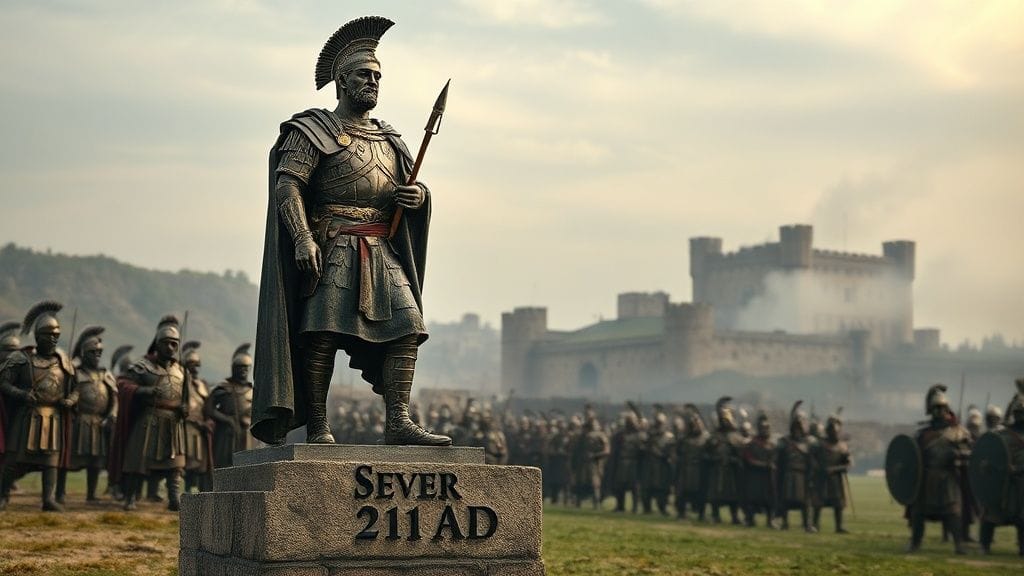
Accounts describe a somber atmosphere in the imperial quarters: generals gathering, soldiers whispering, and the city holding its breath. His death on February 4, 211 marked the end of a long and dynamic rule but also the start of a power shift that would ripple through Rome and beyond.
Severus’ passing far from the city of Rome, in a distant fortress city, underscored the vastness and vulnerability of the empire he had ruled.
The Succession Struggle: Caracalla and Geta’s Bitter Legacy
Severus’ death launched an immediate succession crisis. His two sons, Caracalla and Geta, inherited co-emperorship, but their relationship was marked by rivalry and suspicion.
This fractious co-rule escalated into fratricidal conflict, culminating in Caracalla’s assassination of Geta just a year later. The violence that followed plunged the empire into political instability, complicating the legacy of Severus’ reign.
The power dynamics unleashed by Severus’ death would shape the imperial history of the third century, influencing military campaigns, imperial policy, and the very survival of Roman authority.
Britain’s Moment in the Imperial Spotlight
Severus’ sojourn in Britain was a rare and momentous event. Few emperors had ventured so far from Rome. For a time, the province was the heart of imperial administration and military strategy.
This period left tangible marks on Britain’s archaeology and culture: new fortifications, inscriptions praising Severus, and myths that intertwined with local traditions. Britain experienced a fleeting moment of direct imperial patronage which elevated its standing within the Roman world.
Yet, this brilliance would soon fade as the region receded once more into the empire’s margins.
The Political Aftershocks Across the Roman Empire
The emperor’s death reverberated across Rome’s sprawling domains. Military commanders vied for influence; provincial governors maneuvered to secure their positions. Meanwhile, the Senate in Rome watched anxiously.
Severus’ policies had fortified the army but strained the empire’s finances. His absence exposed weaknesses in centralized control and emboldened external enemies.
The Severan dynasty’s fragile grip on power was tested repeatedly in the subsequent decades, as Rome edged closer to the crises of the third century—a time historians call the Imperial Crisis.
Septimius Severus’ Military Legacy: Reforms and Fortifications
Severus’ reign transformed the Roman military system. His reforms in pay, legion composition, and frontier defense left a durable imprint.
Among the notable legacies was the reinforcement of Hadrian’s Wall and other northern fortifications in Britain. These structures, strengthened under Severus, stood sentinel for centuries.
His integration of provincial troops and emphasis on mobility changed Roman warfare’s character, echoing in later imperial doctrines.
The Human Face of Power: Anecdotes from the Emperor’s Last Days
Beyond the grand strategies and battles, subtle moments reveal the man behind the imperial title. Ancient writers recount how Severus, despite his sickness, remained concerned for his soldiers' welfare and the integrity of Roman order.
One story tells of a faint smile as he received news of a successful skirmish. Another, more melancholic, recalls his whispered directions to Caracalla about governance—reflecting a father’s final guidance mixed with imperial expectation.
These glimpses humanize a ruler often painted as stern and unapproachable.
Severus in Memory: Historians, Poets, and the Imperial Cult
The memory of Septimius Severus was preserved and contested. Roman historians like Cassius Dio painted him as a complex figure: a capable ruler but also ruthless.
His deification after death fostered cult worship, tying the earthly empire to divine sanction. Poets and sculptors immortalized his visage, projecting an image of invincibility.
Yet, to provincial subjects in Britain and Africa alike, he remained a man of flesh and will, a symbol of Rome’s might tempered with human frailty.
The Impact of Severus’ Death on the Roman Frontier Strategy
Severus’ campaigns in Britain signaled a zenith in Rome’s northern ambitions. Yet, his death marked a turning point: subsequent emperors would adopt different strategies, often more defensive.
The expenditure and human cost of Severus’ wars in Britain echoed in the empire’s shifting military doctrines, contributing to a gradual withdrawal and recalibration of frontiers.
This pivot had long-term implications, setting the stage for later conflicts and transformations in British and Roman history.
The Evolution of Eboracum Post-Severus: From Garrison to City
After Severus, Eboracum continued to develop, evolving from a strict military camp into a bustling Roman city. New civilian structures appeared alongside the legionary fortress.
The city became a melting pot of traders, soldiers, artisans, and immigrants—a microcosm of the empire’s diversity. Its strategic importance remained, but it adapted to changing political winds and imperial priorities.
Today, York’s Roman heritage echoes with traces of this vibrant, multicultural past.
Ancient Medicine and the Emperor’s Final Illness
The mystery of Severus’ final illness intrigues historians and medical scholars alike. Ancient remedies, rituals, and the limits of Roman medical knowledge created an environment of hope and despair.
The emperor’s symptoms remain speculative, yet sources suggest chronic illness exacerbated by the campaign’s hardships.
The story illustrates both the vulnerability of even the most powerful and the period’s medical understanding—a poignant human element amid imperial grandeur.
Cultural Interactions on the Edge of Rome: Severus’ Britain
Severus’ time in Britain was more than military conquest. It was also an encounter between Roman and local cultures, shaping identity and heritage.
Archaeological finds—temples, inscriptions, and art—reflect exchanges between Roman soldiers and native tribes. Latin mixed with Celtic languages; religious practices merged.
This cultural dialogue enriched both sides and left enduring marks on Britain’s historic tapestry.
Conclusion: The End of an Era and the Dawn of a New Imperial Phase
Feb. 4, 211 in Eboracum was not merely the death of an emperor—it was the closing chapter of a defining epoch. Septimius Severus had forged an empire revitalized by military might, yet vulnerable to succession crises and external pressures.
His demise on the empire’s distant northern frontier was emblematic of Rome’s stretched ambitions and fragile unity. The legacy of Severus was a mixture of strength and turmoil, a reflection of imperial power’s dual nature.
As Caracalla seized sole control, the Roman world moved uneasily into a century of transformation and challenge—forever shaped by the man who died in York in a bitter winter’s dawn.
FAQs
1. Why did Septimius Severus choose to campaign in Britain late in his reign?
Severus saw Britain as a key frontier plagued by rebellious northern tribes threatening Roman control. His presence aimed to restore order, extend Roman authority, and secure the northern border.
2. What was the significance of Eboracum in Severus’ reign?
Eboracum served as Severus’ military and political base during his British campaigns. It became an imperial seat far from Rome, underscoring Britain’s strategic importance.
3. How did Severus’ death affect the Roman Empire politically?
His death led to a fraught co-emperorship between his sons Caracalla and Geta, eventually resulting in civil strife and instability, weakening imperial governance.
4. What military reforms did Severus implement?
Severus increased soldiers' pay, allowed marriage in the army, and reorganized legions to enhance loyalty and combat effectiveness — changes with long-lasting military impact.
5. How did Severus’ campaigns influence Roman frontier policy?
Though initially expansionist and aggressive, Severus’ costly wars prompted later emperors to adopt more defensive and conservative frontier strategies.
6. What is known about Severus’ final illness?
Contemporary sources indicate a serious, possibly chronic illness worsened by campaign conditions, but precise diagnosis remains uncertain.
7. How is Septimius Severus remembered in British history?
Locally, Severus is remembered as a powerful but distant ruler whose campaigns left physical and cultural legacies, contributing to Britain’s Roman identity.
8. What was the cultural impact of Severus’ presence in Britain?
His reign initiated stronger Romanization and cultural exchanges, leaving archaeological evidence of religious, linguistic, and social blending.