Table of Contents
- The Storm Gathers: Crusaders Lay Siege to Antioch
- Antioch in the 11th Century: A City at the Crossroads
- The First Crusade’s Ambition: Why Antioch Mattered
- The Long Wait: Famine, Fever, and Fractures among the Crusaders
- The Defenders’ Resolve: Inside the Walls of Antioch
- A City Divided: Religious and Political Tensions in Antioch
- The Turning Point: The Discovery of the Holy Lance
- Betrayal from Within: The Secret Negotiations and Opening of the Gates
- The Carnage and Chaos: The Fall of a City
- Bohemond of Taranto: The Architect of Victory
- The Aftermath: Establishing the Principality of Antioch
- The Siege’s Psychological Impact on Both Sides
- Myth, Legend, and Memory: The Siege of Antioch in Crusader Chronicles
- Consequences for the Near East: Power Shifts and Resistance
- The Siege’s Legacy in Modern Historical Thought
- Remembering Antioch: Archaeological Discoveries and Historical Sites
- The Siege Through the Lens of Contemporary Muslim Sources
- Women and Non-Combatants: The Human Cost of the Siege
- Logistic Marvels and Medieval Warfare: The Art of Siegecraft
- The Role of Religion: Faith as Weapon and Shield
- The Siege’s Impact on Crusader Military Strategy
- Captivity and Exchange: Prisoners and Diplomacy After the Fall
- Global Perspectives: How the Siege Influenced Europe and the Islamic World
- Conclusion – A City Fallen, an Era Transformed
- FAQs – Unraveling the Mysteries of the Siege of Antioch
- External Resource
- Internal Link
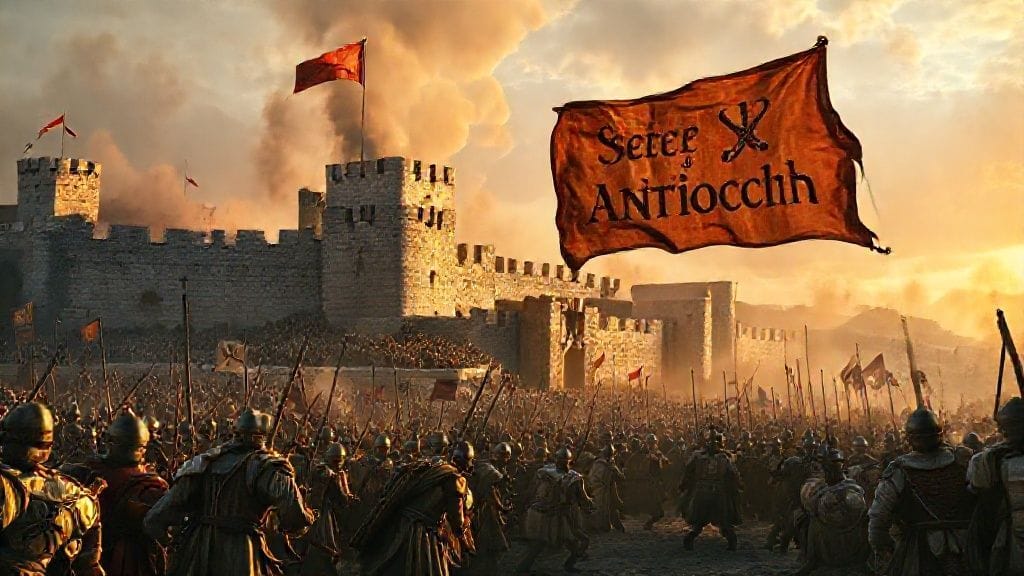
The summer of 1098 arrived with a heavy, almost suffocating heat descending upon the plain surrounding Antioch—a city that had withstood centuries of sieges, conquests, and imperial struggles. For months, an army composed of weary yet determined Crusaders from Western Europe had encircled its massive fortifications. The siege had stretched the patience, morale, and supplies of both besiegers and besieged to their limits. Dust danced amid the groans of the sick and hungry; the cries of children mixed with the clang of armor; prayers whispered by knights under the starry sky mingled with the harsh commands of commanders. And then, on the 3rd of June, 1098, after nearly eight months of relentless siege, the walls of Antioch finally fell. The city that sits at the gateway between the East and West, a jewel of the Levant, crumbled under a mix of carnage, betrayal, and fervent hope—a turning point whose echoes have rippled through history ever since.
1. The Storm Gathers: Crusaders Lay Siege to Antioch
The initial approach of the First Crusade towards Antioch was marked by a mixture of urgency and calculation. Following a victorious yet taxing march from Constantinople, the Crusader army knew that Antioch was a crucial prize. Not only was it a formidable stronghold commanding major trade routes between Asia Minor and the Levant, but controlling it would grant the Crusaders a vital foothold in the heart of Muslim-controlled territories.
From October 1097, the Crusaders encamped around Antioch, preparing for a siege that would test their endurance as much as their skill. The city's massive walls—stretching over 6 kilometers and reinforced with both Roman and Byzantine architecture—had never been easily taken. The Crusaders, a motley coalition of knights, foot soldiers, clergy, and pilgrims, faced not just walls but an urban population braced for a desperate defense.
2. Antioch in the 11th Century: A City at the Crossroads
Antioch was no ordinary city. Founded by one of Alexander the Great’s generals, Seleucus I Nicator, in the late 4th century BCE, it had since evolved into a melting pot of cultures, religions, and empires. By the late 11th century, it was a vital Byzantine outpost before falling into Seljuk Turk hands earlier in the century. Its population was a mosaic of Greeks, Armenians, Arabs, Jews, and others—each with their own faiths, loyalties, and expectations.
The city's strategic importance was immense; it controlled key mountain passes and trade routes connecting the Mediterranean coast to inland Syria and beyond. Politically, it was governed by a Seljuk-appointed wali, but internal divisions and shifting allegiances made its defense precarious against a resolute Crusader siege.
3. The First Crusade’s Ambition: Why Antioch Mattered
For the Crusaders, Antioch represented not just a military objective but a spiritual and symbolic one. It was regarded as the gateway to Jerusalem and the Holy Land itself. Taking Antioch would open the door to their ultimate goal—liberating the Holy Sepulchre and establishing Christian rule in Palestine.
Moreover, control over Antioch meant controlling the northern Levant, a buffer zone that would secure the Crusader states from counterattacks and supply routes. Leaders such as Bohemond of Taranto had personal ambitions as well: Antioch could become a princely domain, carving out a sphere of influence for themselves in the new Latin East.
4. The Long Wait: Famine, Fever, and Fractures among the Crusaders
The siege dragged on through bleak autumn and winter months. Starvation and disease became as much an enemy as the city's defenders. Dysentery and scurvy ravaged the Crusader camp, reducing their numbers steadily. Supply lines stretched thin, and the harsh terrain provided little relief.
Dissent among the Crusader princes grew. Some questioned the wisdom of continuing the siege, while others clung to hope and faith-driven resolve. Morale flickered unevenly beside the smoking ruins of ration fires and the shouts of sentries.
5. The Defenders’ Resolve: Inside the Walls of Antioch
Inside the city, the defenders—composed mainly of Seljuk Turks, Arab militias, and local Christian factions wary of the Crusaders—prepared for a protracted resistance. They repaired damaged walls, fortified towers, and stockpiled provisions gained from inside stores.
The civilian population endured immense hardship. Women, children, and elderly bore the brunt of shortages and bombardments. Yet, the hope that relief forces might arrive sustained the defenders’ resistance amid the claustrophobic streets and sheltering shadows of ancient basilicas.
6. A City Divided: Religious and Political Tensions in Antioch
Antioch's divided loyalties complicated its defense. The city housed multiple Christian sects—Greek Orthodox, Armenian, Syriac—as well as Muslim inhabitants. Some factions advocated negotiation, while others favored total resistance.
This internal fragmentation weakened coordinated defense efforts, just as rivalries among the Crusader leaders tested their unity. The political landscape of Antioch was as labyrinthine as its winding streets, with alliances shifting like desert sands.
7. The Turning Point: The Discovery of the Holy Lance
In a moment that would become enshrined in legend, a monk named Peter Bartholomew claimed to have visions revealing the location of the Holy Lance—the spear that had pierced Christ’s side during the crucifixion—buried beneath the city.
Whether through genuine faith or political necessity, the discovery galvanized the Crusaders. The lance became a potent symbol, burning away doubts and renewing the warriors’ spirit. Many knights believed that holding this relic meant divine favor, a miraculous omen that their victory was ordained.
8. Betrayal from Within: The Secret Negotiations and Opening of the Gates
Victory would not come solely from brute force or miraculous relics. Bohemond of Taranto, a cunning and ambitious leader, entered into secret negotiations with a disaffected guard within Antioch.
The treachery paid off. Under cover of darkness and amid confusion unleashed by a simultaneous sortie, Crusader forces were let inside the city gates. What followed was a brutal, chaotic storming that shattered the fragile defenses and opened the gates to conquest.
9. The Carnage and Chaos: The Fall of a City
Once the gates were breached, the city descended into violence and pandemonium. The Crusaders slaughtered defenders, looted homes, and exacted vengeance. Contemporary chronicles describe scenes of horror—innocents caught in crossfire, sacred spaces desecrated, and streets running red with blood.
For some Crusaders, it was a triumph of faith and military prowess; for others, an anguished episode revealing the grisly costs of war and conquest.
10. Bohemond of Taranto: The Architect of Victory
Bohemond emerged not only as a victor but as a power broker of the Levant. By seizing Antioch, he claimed the title of Prince of Antioch, effectively creating one of the Crusader states.
His political maneuvering, military skill, and opportunism shaped the unfolding Crusader presence in the East, marking the siege as his defining achievement.
11. The Aftermath: Establishing the Principality of Antioch
With the city under Crusader control, a new political entity took shape. The Principality of Antioch became a linchpin in the network of Crusader states, a buffer and bridge between Europe and the Muslim world.
Governance, fortification, and efforts to integrate diverse populations under Latin Christian rule began immediately, but tensions remained fierce.
12. The Siege’s Psychological Impact on Both Sides
The siege left deep scars on all involved. For the Crusaders, it was a moment of overwhelming trial and fragile triumph. Many suffered trauma from starvation, disease, and combat.
For the Muslim defenders and inhabitants, it was a devastating loss with reverberations of despair and resistance. The psychological toll shaped the narratives each side would tell about valor, divine justice, and betrayal.
13. Myth, Legend, and Memory: The Siege of Antioch in Crusader Chronicles
Chroniclers such as Fulcher of Chartres and Raymond of Aguilers wove the siege into legends emphasizing divine intervention and heroic endurance.
The Holy Lance, secret betrayals, miraculous victories became central motifs, blurring history with myth, and casting the siege as a defining saga of the First Crusade.
14. Consequences for the Near East: Power Shifts and Resistance
Antioch’s fall disrupted the balance of power in the Near East. It emboldened Crusader advances but also hardened Muslim resolve.
New alliances formed to counter Latin presence, catalyzing centuries of intermittent warfare and negotiation.
15. The Siege’s Legacy in Modern Historical Thought
Modern historians view the siege through more nuanced lenses, recognizing the complex interplay of religion, politics, culture, and human suffering.
It stands as both a landmark of medieval warfare and a cautionary tale on the costs of conquest and religious conflict.
16. Remembering Antioch: Archaeological Discoveries and Historical Sites
Today, excavations reveal layers of Antioch’s past, from Roman baths to Crusader fortifications.
The site is a palimpsest of history, inviting reflection on the city’s strategic importance and the human stories buried beneath.
17. The Siege Through the Lens of Contemporary Muslim Sources
Chroniclers such as Ibn al-Qalanisi and Ali ibn al-Athir provide alternative perspectives, describing the siege’s brutality and the defenders’ valor.
Their accounts enrich understanding, challenging monolithic histories and underscoring the multifaceted nature of the event.
18. Women and Non-Combatants: The Human Cost of the Siege
Amid sieges and battles, women, children, and the elderly bore unseen sufferings: starvation, displacement, captivity.
Their stories, often marginalized, reveal the full human cost of medieval warfare beyond glorified chronicles.
19. Logistic Marvels and Medieval Warfare: The Art of Siegecraft
The siege exemplified medieval military engineering: blockades, mining, trebuchets, and psychological warfare.
Both sides deployed innovations, underscoring the siege as a testament to evolving martial strategies.
20. The Role of Religion: Faith as Weapon and Shield
Religion permeated every facet—morale, justification, acts of cruelty, and mercy.
It served both as a source of hope and a catalyst for violence, entwined with the identities and motivations of combatants.
21. The Siege’s Impact on Crusader Military Strategy
Antioch’s capture shifted Crusader tactics from rapid campaign movement to establishing fortified strongholds—foundations of the Crusader states.
Lessons learned influenced subsequent sieges like that of Jerusalem.
22. Captivity and Exchange: Prisoners and Diplomacy After the Fall
The chaotic aftermath saw captives taken, ransoms demanded, and uneasy truces negotiated.
These interactions reflected the complex human realities amid religious warfare.
23. Global Perspectives: How the Siege Influenced Europe and the Islamic World
News of the fall spread across continents, inspiring further Crusader efforts and resistance.
It shaped contemporary political narratives and the wider medieval worldview.
Conclusion
The Siege of Antioch in 1098 was more than a military engagement—it was a crucible of human endurance, faith, ambition, and tragedy. For nearly eight months, a fractured army of Crusaders endured starvation, disease, and despair to capture a city steeped in history, culture, and loathing. Their victory was not merely a conquest of stone walls but a profound upheaval resonating across continents.
Bohemond’s ascent, the discovery of the Holy Lance, and the desperate acts within Antioch’s maze of streets illuminated the searing interplay of hope and horror that defines war. The siege’s legacy—its myths, its lessons, and its costs—remains etched into the medieval memory as a testament to the complexity of conquest and the indomitable will of those caught in history’s tides.
FAQs
Q: Why was Antioch such a strategic target for the Crusaders?
A: Antioch controlled key trade routes and mountain passes in the Near East, serving as a gateway to the Holy Land. Capturing it secured a vital base for further Crusader operations and protected supply lines.
Q: How long did the Siege of Antioch last?
A: The siege lasted approximately eight months, from October 1097 until June 3, 1098.
Q: Who was Bohemond of Taranto and what was his role?
A: Bohemond was a Norman leader of the Crusader army who masterminded secret negotiations allowing Crusaders to enter Antioch. He later became the first Prince of Antioch.
Q: What is the significance of the Holy Lance in the siege narrative?
A: The discovery of the Holy Lance by Peter Bartholomew was considered a divine sign that revitalized Crusader morale at a critical moment, motivating the final assault.
Q: What were the immediate consequences of Antioch’s fall?
A: The Crusaders established the Principality of Antioch, a lasting Crusader state, but also faced continuous resistance from surrounding Muslim powers.
Q: How do Muslim sources portray the siege?
A: Muslim chroniclers describe fierce defense, great suffering, and tragedy but also highlight internal divisions and the heroism of Antioch’s defenders.
Q: What lessons about medieval warfare does the siege reveal?
A: The siege illustrates the importance of siegecraft techniques, prolonged logistics, psychological warfare, and the decisive impact of internal betrayal.
Q: How has the siege influenced modern perceptions of the Crusades?
A: It highlights the complexity of motivations—religious zeal, political ambition, human sacrifice—and remains a symbol of both valor and atrocity.

