Table of Contents
- The Dawn of Despair: Paris on the Brink, September 1870
- The Franco-Prussian War: A Storm Gathering on Europe’s Horizon
- Political Rivalries and National Pride: France in Turmoil
- The Prussian Advance: Encircling the Heart of France
- September 19, 1870: The Siege of Paris Commences
- Life Under Siege: The City’s Transformation
- The Psychological Weight of Encirclement
- Military Strategies and Failed Sorties
- The Role of Civilians: Courage, Scarcity, and Resilience
- Communication Attempts: Messages Beyond the Walls
- The Impact on French National Identity
- International Reactions and Diplomatic Chess
- The Rise of New Leaders and Shifting Loyalties
- The Fall of Napoleon III and the Birth of the Third Republic
- The Siege’s Grim Toll: Starvation, Disease, and Desperation
- The Endgame: Surrender and the Aftermath
- France’s Humiliation and the Paris Commune’s Fiery Dawn
- The Siege’s Legacy in French Memory and Global History
- Lessons in Modern Warfare and Urban Resistance
- Closing Reflections: When a City Becomes a Battlefield
- Frequently Asked Questions on the Siege of Paris
- External Resource
- Internal Link
The Dawn of Despair: Paris on the Brink, September 1870
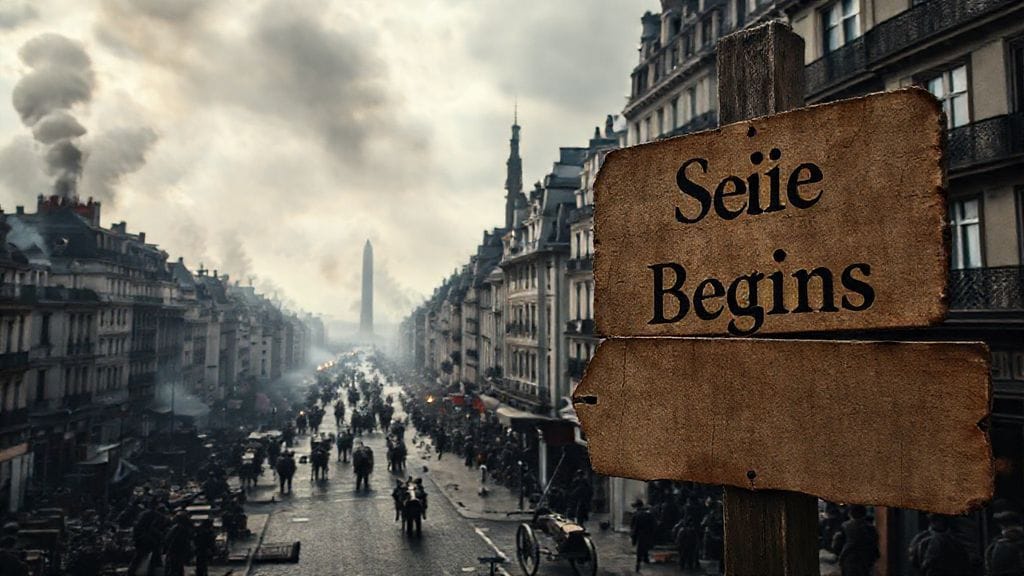
Paris woke in the early hours of September 19, 1870, not with the usual bustle of a thriving metropolis but with the heavy silence of impending doom. The city’s grand boulevards, lined with chestnut trees that had seen centuries of revolution and revolutionaries, now bore the marks of hastily constructed barricades. Smoke hung low in the early morning fog, not from joyful hearth fires, but from the distant Prussian encampments tightening their noose around the French capital. Mothers clutched children while shopkeepers shuttered windows, their faces etched with fear, hope, and defiance.
This was the beginning of the Siege of Paris, a grim episode that would last over four months and scar the soul of France forever. It was more than a military encirclement; it was the moment the French nation, poised between pride and despair, faced a test of endurance, identity, and survival.
The Franco-Prussian War: A Storm Gathering on Europe’s Horizon
To understand why Paris found itself trapped in such a dire predicament, we must journey back several months to the simmering tensions between French and Prussian ambitions. The Franco-Prussian War was no mere clash of armies; it was the culmination of a larger power struggle for dominance over not only Germany but the very balance of power in Europe.
Prussia, under the iron will of Chancellor Otto von Bismarck, sought unification of German states under its aegis. France, ruled by Emperor Napoleon III, saw this rising colossus as a direct threat to French hegemony in Europe. National pride, territorial integrity, and the faint echoes of earlier imperial glories fueled a conflict that many believed could be won swiftly.
Yet, as the bitter summer of 1870 passed, it became clear that the war would be no quick march to victory.
Political Rivalries and National Pride: France in Turmoil
France entered the war with overconfidence, buoyed by Napoleon III’s imperial legacy and a belief in the superiority of its military tradition. However, inside the political salons of Paris and provincial towns alike, the air was thick with uncertainty. The Third Republic had not yet been proclaimed; the Second Empire bore the weight of decades of contradictions—modernity clashing with autocracy, liberalism shadowed by authoritarian ambitions.
This internal discord rendered the French war effort disjointed. Command structures were muddled, and the morale of soldiers and civilians alike fluctuated wildly. It was in this cauldron of tension that the Prussian armies—disciplined, efficient, and ruthless—pushed their invasion deeper.
The Prussian Advance: Encircling the Heart of France
July and August of 1870 were catastrophic for France. The stunning defeat at the Battle of Sedan on September 1, where Emperor Napoleon III was captured, marked an irreversible turning point. The capture of the emperor sent shockwaves through Paris and galvanized the Prussian forces.
The victor’s plan was clear: trap the French capital and starve it into submission. Troop columns spread through the countryside, cutting off supply routes and reinforcing positions that blocked any potential breakout. By mid-September, the formidable ring around Paris was nearly complete.
September 19, 1870: The Siege of Paris Commences
On that fateful day, the city officially realized it was under siege. Paris, so long the beacon of culture and power, became a fortress slapped onto the world’s stage. The news spread quickly—there would be no easy victory, no rapid relief.
The city’s population—nearly two million—prepared to endure hardships almost unimaginable. Soldiers took up arms on the ramparts, noblemen and peasants alike worked to fortify defenses, and the government scrambled to adapt from an imperial seat to a republic locked behind stone walls.
Life Under Siege: The City’s Transformation
What was it like to live under siege? The idyllic cafes and elegant theaters would soon be overshadowed by ration lines, telegrams of grim news, and the ever-present sound of distant artillery. Markets emptied, food supplies dwindled, and the city transformed from a vibrant capital to a pressure cooker of anxiety.
Horse meat—once unthinkable—was consumed, dogs and cats disappeared from the streets, and winter’s approach added cold to the cocktail of misery. Yet, in that bleakness, Parisians exhibited extraordinary resilience, organizing soup kitchens and committees to care for the sick and starving.
The Psychological Weight of Encirclement
“The city is a prison,” wrote a young Parisian diarist during those dark months. The psychological toll was immense. Families confined in cramped apartments, refugees flooding in from rural areas, and the officers who paced endlessly along battlements all carried the weight of uncertainty.
Fear mingled with fierce patriotism. Artists painted scenes of the siege; writers penned impassioned pleas and reflections. Yet despair threatened to unravel the social fabric at every turn.
Military Strategies and Failed Sorties
Despite the encirclement, the French forces within Paris refused to capitulate. Several attempts were made to break through Prussian lines, but each sortie was met with brutal resistance. Commanders such as General Trochu struggled to organize a coherent defense while balancing the demands of civil leadership.
These battles, fought in the grey light of dawn and under the cloak of night, became brutal tests of courage and resourcefulness. Often, they resulted in heavy casualties with little strategic gain.
The Role of Civilians: Courage, Scarcity, and Resilience
If the soldiers were the city’s defenders, the civilians were its lifeblood. Women knitted scarves and uniforms; men dug trenches and manned defenses; children were sent to rural relatives or became part of the collective spirit that refused to bow.
Despite hunger pangs and nights lit by cannon fire, Parisians organized schools, theaters, and social clubs within the walls to stoke morale. The phrase “Liberté, égalité, fraternité” was not just propaganda—it became a lived reality under siege.
Communication Attempts: Messages Beyond the Walls
Cut off by land, Paris turned to inventive methods of communication. Carrier pigeons, hot-air balloons, and coded telegrams were employed to maintain contact with the outside world. Balloons floated over enemy lines, carrying news, letters, and sometimes even propaganda.
These daring messages were lifelines, feeding hope and information back into the besieged city, but they were also fraught with danger and uncertainty.
The Impact on French National Identity
The siege marked a profound moment in French collective consciousness. The image of the heroic yet suffering Parisian became emblematic of a nation’s resilience. At the same time, the defeat exposed cracks in the myth of imperial grandeur.
It was a time when the French people began to question old identities and forge new bonds—ideas that would shape the Third Republic and the nation’s course for decades.
International Reactions and Diplomatic Chess
The siege did not unfold in isolation. Europe watched with a mixture of apprehension, opportunism, and sympathy. Britain, Russia, and Austria-Hungary balanced delicate diplomatic stances, wary of the war’s expansion.
Meanwhile, the Prussian victory at Paris promised to redraw the map of Europe, setting the stage for future conflicts and alliances that would resonate into the 20th century.
The Rise of New Leaders and Shifting Loyalties
Within Paris, the power vacuum left by Napoleon III’s capture allowed new leadership to emerge. Figures such as Léon Gambetta became symbols of republican determination. They sought to rally both military and civilian efforts to hold the city and eventually revive France.
Political factions vied for dominance, some advocating for continued resistance, others for negotiation—a tension that foreshadowed the conflicts that would erupt after the siege ended.
The Fall of Napoleon III and the Birth of the Third Republic
The capture of Napoleon III and the collapse of the Second Empire heralded the birth of the Third Republic. The government-in-exile moved to Tours and then Bordeaux, while Parisians managed their own affairs amidst the siege.
The establishment of the Republic marked a shift not only in France’s political structure but in its national identity—a fragile democracy forged in the crucible of defeat and resilience.
The Siege’s Grim Toll: Starvation, Disease, and Desperation
As weeks turned into months, the siege’s brutality intensified. Starvation stalked the streets; diseases such as typhoid and cholera spread among overcrowded quarters. The city’s hospitals were overwhelmed, and burial pits grew.
Yet even in this darkness, acts of generosity, heroism, and human dignity shone. The stories of those who endured have echoed through history as testaments to the human spirit.
The Endgame: Surrender and the Aftermath
On January 28, 1871, after 135 days of encirclement, Paris surrendered. The terms were harsh—Prussian troops marched in, France conceded Alsace-Lorraine, and the humiliation was palpable.
The city’s people, shattered but not broken, faced the daunting task of rebuilding. The political and social repercussions would soon ignite new fires—most famously the Paris Commune uprising.
France’s Humiliation and the Paris Commune’s Fiery Dawn
The defeat and surrender led to a political and social explosion. The Paris Commune of spring 1871 was both a response to the siege’s trauma and a radical experiment in governance.
Though short-lived and violently suppressed, it left a lasting imprint on French and world revolutionary thought, proving that the siege’s impact went beyond military defeat.
The Siege’s Legacy in French Memory and Global History
Today, the Siege of Paris is remembered not merely as a military episode but as a crucible of modern French identity. Memorials, literature, and commemorations continue to evoke the suffering and heroism of those months.
Internationally, the siege serves as a case study in urban warfare, civil resilience, and the brutal realities of 19th-century conflict.
Lessons in Modern Warfare and Urban Resistance
The encirclement of Paris demonstrated the evolving nature of war—how industrial might, communications, and civilian populations became intertwined in conflict. The siege foreshadowed the horrors of later urban battles and sieges in both World Wars.
It remains a testament to how cities can become battlegrounds where the fates of nations are decided not just by armies, but by the will of their people.
Closing Reflections: When a City Becomes a Battlefield
The Siege of Paris was more than a military operation; it was a profound human saga. It revealed the fragility of empire, the tenacity of a people, and the costs of national ambition.
As autumn leaves fell on the barricades and the bitter cold deepened, Paris taught the world a lesson still resonant: in the heart of siege, courage often outshines conquest.
Conclusion
The Siege of Paris in 1870-1871 was an epoch-defining event, a crucible of suffering and strength that transformed a proud city into a fortified prison and, ultimately, a symbol of national endurance and renewal. It forced France to confront not only military defeat but the very essence of its identity, governance, and place on the European stage.
Yet, amid starvation and strife, Parisians crafted a new narrative—one of stubborn hope and collective resilience. They redefined what it meant to be French, within walls under fire and in hearts refusing to surrender.
History teaches us through these moments that the endurance of a people is often their most potent weapon, a truth etched into Paris’s cobblestones forever.
FAQs
1. What triggered the Siege of Paris in 1870?
The siege began after the decisive Prussian victory at the Battle of Sedan, where Emperor Napoleon III was captured, leaving Paris isolated and vulnerable to encirclement by Prussian forces.
2. How long did the Siege of Paris last?
The siege lasted approximately 135 days, from September 19, 1870, to January 28, 1871.
3. What were the conditions like for civilians during the siege?
Conditions were dire, marked by food shortages, harsh winters, disease outbreaks, and constant bombardment. Civilians endured hunger to the point of eating horses and other unconventional food sources.
4. How did the siege affect French political structures?
The capture of Napoleon III led to the collapse of the Second Empire and the rise of the Third Republic, even as Paris endured the siege and governmental authority was split.
5. What role did technological innovations play in the siege?
Innovations such as hot-air balloons and carrier pigeons were crucial for communication beyond the Prussian lines during the siege.
6. What was the international reaction to the Siege of Paris?
European powers watched cautiously, balancing diplomatic interests. The siege and subsequent French defeat dramatically altered the continental balance of power.
7. How did the siege influence future urban warfare?
It highlighted the importance of civilian resilience, supply lines, and the psychological impact of siege warfare, lessons applied in later conflicts worldwide.
8. What was the relationship between the siege and the Paris Commune?
The hardship and political instability following the siege contributed directly to the rise of the Paris Commune in 1871, a radical municipal government and revolution.