Table of Contents
- A City on the Edge of Empires: Patras Before the Storm
- The Long Shadow of the Slavic Migrations in the Peloponnese
- Byzantium Besieged: Empire in Crisis at the Turn of the Ninth Century
- Rumors of War: The Road to the Siege of 805
- Drawing the Noose: The Slavic Coalition Encircles Patras
- Inside the Walls: Fear, Faith, and Daily Life During the Siege
- The Legend of Saint Andrew and the Spirit of Resistance
- Steel and Strategy: How the Defenders Turned the Tide
- The Arrival of Imperial Aid: A Turning Point for Patras
- Collapse of the Besiegers: Defeat, Flight, and Retribution
- Repopulation and Reward: Patras After Its Deliverance
- Faith and Memory: How a Siege Became a Miracle
- From Frontier Outpost to Metropolitan See
- The Siege in Byzantine Eyes: Chronicles, Rhetoric, and Propaganda
- Archaeology and Landscape: Traces of a Forgotten Battlefield
- Slavs and Romans After the Siege: Accommodation, Control, and Assimilation
- Why the Siege of Patras, 805, Still Matters Today
- Conclusion
- FAQs
- External Resource
- Internal Link
Article Summary: In the early ninth century, on the western shores of the Peloponnese, a single city stood between the Byzantine Empire and the loss of an entire region: Patras. The siege of patras 805, carried out by a coalition of Slavic groups and their allies, became a defining confrontation in the slow reconquest of Greece by Constantinople. This article traces the long background of Slavic settlement in the Peloponnese, the political fragility of the empire, and the tense months when Patras’ fate hung in the balance. Blending narrative and analysis, it explores not only the military aspects of the siege but also the city’s inner life—its fears, its religious rituals, and the emergence of the cult of Saint Andrew as a rallying symbol. The siege of patras 805 marked the moment when a peripheral port transformed into a linchpin of imperial strategy and ecclesiastical authority. Through chronicles, hagiography, and modern scholarship, we will see how a local conflict was recast as a miracle and a turning point. The story of the siege of patras 805 continues to echo in debates about identity, migration, and memory in medieval Greece. And as we examine the aftermath, we discover how a battered city helped redraw the political and spiritual map of the Peloponnese.
A City on the Edge of Empires: Patras Before the Storm
The city of Patras, long before the clash of arms in 805, lived in the tension between sea and land, empire and frontier. Perched on the northern coast of the Peloponnese, gazing across the narrow gulf toward mainland Greece, Patras had once been a proud Roman colony and later a Byzantine coastal town, modest but resilient. Its streets followed the faint imprint of ancient Roman grids; its harbor, though silted and scarred by centuries of neglect, still opened a vital corridor toward Italy and the western Mediterranean. By the early ninth century, this once-ordinary city found itself in an extraordinary position: a lonely Byzantine stronghold in a peninsula where imperial control had frayed almost to nothing.
For decades, Patras had watched the hinterlands around it slip out of Constantinople’s grasp. Slavic tribes, pushed south by larger tides of migration and conflict, had settled widely in the Peloponnese during the late sixth and seventh centuries. They established villages in the mountain valleys and forested slopes, planting unfamiliar crops, building wooden churches or shrines, and living at the cautious edge of Byzantine awareness. To the citizens of Patras—Greeks, Latin-speakers, and others who still called themselves “Romans” (Rhomaioi)—the interior of the peninsula had become an ambiguous, shifting world: neither fully foreign nor fully theirs. The city’s walls, sturdy though aging, were less a symbol of imperial glory and more a necessary barrier against the unknown.
Yet life inside Patras did not unfold under the constant sound of alarm bells. Fishermen cast their nets from the rocky shore; farmers tended vineyards and olive groves on the slopes beyond the walls; merchants haggled over amphorae of wine and oil, bolts of rough cloth, and small consignments of imported wares from Italy and Sicily. The cathedral, dedicated to Saint Andrew—the apostle believed to have been martyred in the city long ago—anchored religious and social life. Peasants from nearby villages and a dwindling number of landowners from the surrounding countryside gathered for feast days, processions, and liturgies that linked Patras not only to Constantinople but to the Christian world beyond.
Even so, an undercurrent of anxiety ran through the city’s collective memory. People remembered raids, burned farms, and the distant glow of fires in the hills. Old men could recall stories told by their fathers of years when coastal towns feared Slavic incursions and when imperial soldiers marched south, then vanished again, leaving little trace beyond the wreckage of a few villages. The imperial tax collectors came infrequently, and when they did, they were accompanied by armed escorts. To live in Patras around 800 was to inhabit a zone of fragile security, poised between the decaying authority of Rome’s eastern heir and the emerging societies of the Slavic newcomers. On market days, one might even meet Slavic traders under the eye of wary guards, a reminder that coexistence and hostility lived side by side.
It is within this precarious frontier world that the siege of patras 805 would unfold, transforming a practically overlooked port into the stage of an imperial drama. The people who would soon face the encircling enemy were not heroic figures from legend but ordinary men and women—craftsmen, priests, sailors, widows, and soldiers—thrust into history’s spotlight by the convergence of geopolitical forces far beyond their control. Their city, once simply a marginal outpost, would become, in the eyes of chroniclers and churchmen, a place of miracle and destiny.
The Long Shadow of the Slavic Migrations in the Peloponnese
To understand why Patras, of all cities, would be besieged in 805, one must follow the long arc of the Slavic migrations into the Balkan Peninsula. From the late sixth century onward, groups we now call Slavs drifted or pushed southward, crossing rivers and mountain chains in waves that ebbed and flowed with the pressures of war, climate, and opportunity. The Byzantine Empire, overstretched by wars with Persia, the Avars, and later the Arabs, could not consistently police its vast northern frontiers. As imperial armies were drawn east to defend Syria and Anatolia, gaps opened in the Balkans, and into those gaps poured communities in search of arable land and safer homes.
The Peloponnese, with its rugged mountains, plentiful springs, and underpopulated valleys, proved especially attractive. Slavic groups—referred to in Byzantine sources under names like “Ezeritai” and “Melingoi”—settled widely during the seventh and eighth centuries. They cleared forests, built new villages, and established patterns of local governance that were largely autonomous. Imperial authority lingered along the coasts and in certain fortified towns—Corinth, Monemvasia, Patras—but much of the interior became, in effect, a Slavic-dominated world. Greek-speaking populations did not vanish, but they shared, negotiated, and sometimes lost space to these newcomers.
Sources from the period are fragmentary, but they suggest a complex tapestry of relations between Slavs and the remaining Byzantine enclaves. There were raids and conflicts, yes, but also trade, intermarriage, and periods of uneasy peace. Slavic groups often paid nominal tribute to the empire, especially when faced by imperial military expeditions that reminded them of Constantinople’s latent strength. Yet this tribute was intermittent, and Byzantine control was more aspirational than real. Chroniclers later described the Peloponnese as virtually “lost” to the empire for nearly two centuries, an exaggeration perhaps, but one that captures the sense of imperial withdrawal.
By the early ninth century, the Slavic communities of the Peloponnese were no longer new arrivals but established societies with their own memories, leaders, and grievances. Some had seen imperial officials attempt to reassert control, demanding tribute or service; others had experienced skirmishes with the garrisons of coastal towns. In Patras, this meant living under the constant awareness that beyond the hinterland farms lay territories ruled by chieftains who neither spoke Greek nor considered themselves subjects of the emperor in any meaningful way. These leaders saw the Byzantine enclaves as both threats and opportunities: targets for plunder, but also gateways to the wider economic networks of the Mediterranean.
Into this mixture came other actors, less visible but no less important: perhaps local magnates of mixed Slavic and Greek descent, churchmen seeking to extend Christian practice and rites into Slavic communities, and itinerant traders weaving economic ties across ethnic lines. The frontier around Patras was not a simple binary of Slavs against Byzantines; it was a layered world where identities overlapped and loyalties shifted with circumstance. But when circumstances hardened into open conflict, as they did in 805, the lines could suddenly become stark, and neighbors might find themselves on opposite sides of the walls.
Thus, when historians speak of the siege of patras 805, they are not describing an isolated flare-up, but the culmination of generations of contested coexistence. The Slavic leaders who would gather their forces outside Patras’ walls came from worlds shaped by both freedom and marginalization, autonomy and anxiety. The Byzantines within Patras looked upon them with a mix of disdain, fear, and grudging respect. The stage was set for confrontation, yet no one in those early years of the ninth century could have predicted quite how decisive the clash would be for the future of the Peloponnese.
Byzantium Besieged: Empire in Crisis at the Turn of the Ninth Century
While local tensions simmered around Patras, the overarching framework of power was the Byzantine Empire—a state both battered and resilient, facing crises on multiple fronts. Around 805, Byzantium was emerging from one of its most turbulent centuries. The Arab conquests of the seventh century had stripped the empire of its richest provinces—Syria, Egypt, much of North Africa—while repeated wars had drained manpower and resources. In the Balkans, the empire confronted not only Slavic settlements but the rise of new polities like the Bulgars, formidable horsemen who established their own kingdom north of the Haemus Mountains and pressed southward into imperial territory.
Yet Byzantium did not collapse. It changed. The imperial administration reorganized its provinces into military districts, or “themes,” placing soldiers on the land and delegating greater local authority to strategoi, the military governors. Taxation was reformed, land grants were made to soldiers to ensure their loyalty and readiness, and the empire’s economy gradually adapted to its reduced boundaries. Religiously, the iconoclastic controversy—an intense dispute over the use of icons in worship—had convulsed Byzantine society in the eighth century, pitting emperors, bishops, and monks against one another. By the time of the siege of patras 805, this struggle was easing, but its scars remained deep in the collective consciousness.
On the western horizon, another power had risen: the Frankish Kingdom under Charlemagne. In 800, just five years before the events at Patras, Charlemagne was crowned “Emperor of the Romans” in Rome by Pope Leo III, an act that infuriated Constantinople and created a rival imperial claim in the Latin West. This new “Holy Roman Empire” cast a long shadow over the Adriatic and the Balkans, competing for influence along the Dalmatian coast and in northern Italy. Patras, looking out across the water, existed within this strategic contest: it was a node in the fragile chain of Byzantine holdings connecting the Aegean world to Italy and beyond.
Within the empire, emperors sought to reassert control over the Balkans, including Greece and the Peloponnese. Campaigns were launched, sometimes successful, sometimes not, to remind Slavic groups of imperial might. Administrative reforms attempted to integrate reclaimed territory into the thematic system. The military resources available, however, were finite. Priority often went to the eastern frontier, where Arab raids threatened Asia Minor, the empire’s heartland and breadbasket. This left places like Patras dependent on relatively small garrisons and the loyalty of local militias.
It is against this backdrop that the siege of patras 805 acquires its larger meaning. It was not just a local attack on a coastal town; it was a test of Byzantine capacity to project power into a region long contested by Slavic settlements, under the watchful eye of a newly crowned western emperor. If Patras fell, it might open a door to deeper Slavic control of the Peloponnese and weaken imperial prestige across southern Greece. If it stood firm, it would signal that Constantinople’s slow reconquest of the Balkans was more than an aspiration—it was a reality unfolding, fortress by fortress, town by town.
The empire’s rulers, though distant, would have understood the stakes. Patras was a small piece in a vast geopolitical puzzle, but a crucial one. Its harbor was a lifeline to western sea routes, its bishopric a node of ecclesiastical authority, and its walls a physical and symbolic barrier against the further erosion of Roman rule. When word reached Constantinople that the city was under siege, it would have reverberated through the corridors of the Great Palace, demanding response despite the empire’s other pressing concerns.
Rumors of War: The Road to the Siege of 805
Conflict seldom erupts without warning. In the years and months leading up to 805, an accumulation of incidents and decisions nudged the Peloponnese toward confrontation. Tribute demands may have grown heavier; local disputes between Slavic villages and imperial agents may have sharpened; shifting alliances among Slavic groups themselves might have pushed ambitious leaders to seek plunder and prestige. The chronicles do not preserve a day-by-day account, but between their lines we can glimpse the rising tension.
Byzantine officials in Patras probably pressed nearby Slavic communities to reaffirm their submission—symbolic or otherwise—to the emperor. This may have involved sending hostages, paying tribute in kind (grain, livestock, timber), or providing guides and auxiliary troops for imperial expeditions. For Slavic leaders, such obligations could be both burdensome and humiliating. Leaders who accepted them risked appearing weak before their own warriors, while those who resisted faced punitive campaigns. In such an environment, a bold stroke—a coordinated strike on an exposed Byzantine stronghold—might seem an attractive way to reverse the balance of fear.
There is some evidence that the Slavs of the Peloponnese entered into alliances with outside forces, possibly including other Slavic or semi-independent groups in mainland Greece, or even elements linked to the Bulgars. Whether these external allies played an active role in the siege of patras 805 remains uncertain, but Byzantine writers, inclined to see conspiracies and grand coalitions, would later describe a wide-ranging “insurrection” of Slavs against imperial authority. It is striking that they chose Patras as their main target—perhaps because it was accessible, relatively isolated, and symbolically potent as a Christian urban center.
Inside the city, rumors would have swirled before the first enemy scouts appeared on the hills. Traders bringing goods from inland routes might have whispered of villages that refused imperial envoys, of mustered warriors in the highlands, of leaders boasting that the days of Roman enclaves were numbered. Priests may have increased the frequency of processions and special prayers, invoking Saint Andrew and the Mother of God to shield the city. The garrison’s officers would have inventoried weapons, repaired weak sections of the wall, and quietly prepared for the worst, even as they hoped the reports were exaggerated.
But the signs became too numerous to ignore. Shepherds fled in from distant pastures with tales of armed bands. Smoke rose from farms along the boundary between imperial and Slavic-ruled lands. Small patrols sent to investigate failed to return. The air in Patras would have thickened with dread: mothers rushing children indoors at the sound of distant horns, merchants hiding valuables in buried jars, and city officials convening urgent councils in dimly lit halls. Somewhere in those tense days, the decision was taken: the gates would be barred, watchtowers fully manned, and all food stores carefully guarded. The city braced itself to become a fortress.
When the coalition of Slavic forces finally appeared in strength outside the walls, it was not an unexpected blow, but a feared inevitability made real. The road to the siege had been paved by years of unresolved grievances and unfulfilled ambitions. As the attackers established their camps and ringed Patras with hostile fires, both sides understood that this would not be a mere raid to seize cattle or burn a suburb. It was an attempt to erase a bastion of Byzantine rule from the map of the Peloponnese.
Drawing the Noose: The Slavic Coalition Encircles Patras
The opening movements of the siege of patras 805 began not with dramatic assaults on the walls, but with the slow, deliberate drawing of a noose around the city. Slavic warbands, hardened by years of raiding and mountain warfare, advanced along multiple paths, converging on Patras from the inland valleys. Their leaders employed a simple but effective strategy: cut the roads, devastate the surrounding countryside, and isolate the city from any potential aid or supply.
Villages under Byzantine influence near Patras were the first to feel the blow. Some were burned, their inhabitants fleeing toward the safety of the walls; others, perhaps inhabited by mixed populations or previously under Slavic control, were spared or even joined the attackers. Fields of barley and wheat were trampled or set on fire, orchards hacked down, and wells polluted. This scorched-earth approach served a dual purpose: it deprived Patras of fresh supplies and sent a message to any wavering communities that the Slavic coalition meant to redraw the map of power in the region.
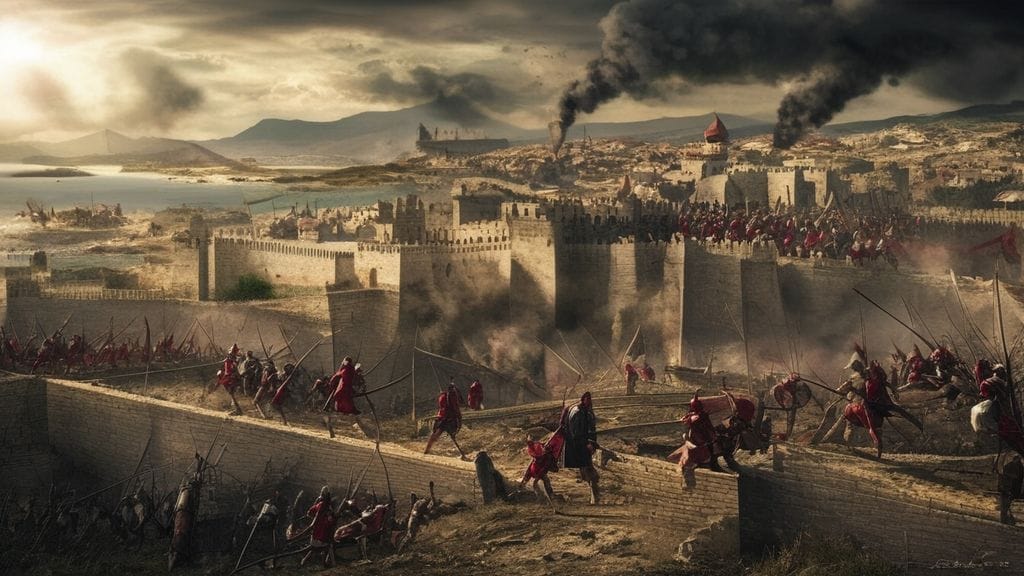
Before long, the city perched like an island in a sea of hostility. From the battlements, defenders could see the camps dotting the slopes and plains: smoky clusters of tents, makeshift wooden palisades, and corralled horses. War banners fluttered in the wind, each marking the presence of a particular group or chieftain. At night, the campfires formed an unsettling ring of light around the city, suggesting entrapment more eloquently than any words.
The Slavs lacked the sophisticated siege engines that characterized the great sieges of antiquity, but they compensated with numbers, persistence, and intimate knowledge of the terrain. They built simple wooden towers, ladders, and perhaps battering devices; they dug trenches to protect themselves from counterattacks and to move closer under cover. Archers and slingers harassed the walls during the day, seeking to sap the defenders’ strength and morale. Their goal was not an immediate, decisive storming, but a combination of blockade and attrition: starve the city, exhaust its garrison, and then unleash a final assault when weakness became visible.
For the defenders, watching the noose being drawn must have been an agonizing experience. They could do little to prevent the destruction of outlying farms or the capture of anyone who had failed to reach the safety of the walls in time. Each pillar of smoke on the horizon marked another loss: a homestead, a vineyard, perhaps the home of a cousin or friend. The city’s leaders, both secular and ecclesiastical, had to maintain order amid this gathering dread, assuring the people that help would come, that the walls would hold, that God and Saint Andrew would not abandon them.
Yet behind these public assurances lay harsh calculations. How much grain remained in storehouses, and how long would it last once rationed? How many usable weapons and shields were there, and could more be fashioned quickly by the city’s smiths? Were the wells inside the walls sufficient to sustain the population through a prolonged siege? And, most crucially, would the imperial authorities in distant Constantinople or in nearby Corinth dispatch troops in time—or at all—to relieve the city? No one could answer these questions with certainty. The people of Patras were entering a trial whose duration and outcome were utterly unknown.
Inside the Walls: Fear, Faith, and Daily Life During the Siege
Once the siege tightened, life in Patras took on a new, constricted rhythm. The city’s familiar sounds—market cries, the creak of wagon wheels, the thud of laden mules—faded, replaced by the constant murmur of watchmen on the walls, the clang of hammer on iron in the forges, and the muffled weeping of those who had lost homes or loved ones outside. The gates were sealed. No one entered or left without explicit military permission, and even then, only for short, risky sorties.
Food immediately became a central concern. The city authorities, likely led by the strategos (if a thematic commander was present) and the bishop, ordered a full inventory of grain, dried fruits, salted fish, oil, and wine. Rationing began with surprising speed and severity, as experience had taught the Byzantines that optimism could be fatal in a siege. Households were instructed to surrender surplus stores to centralized granaries, in exchange for measured distributions. Predictably, this bred resentment. Some families muttered that the wealthy were hiding their best supplies; others suspected corrupt officials of skimming. In times of fear, social fractures widened.
Meanwhile, the city’s spiritual life intensified. The siege of patras 805 was experienced not only as a military crisis but as a divine test. The clergy organized frequent processions along the walls, carrying icons and relics, chanting psalms, and sprinkling holy water from silver and bronze vessels. The faithful followed, crossing themselves, whispering prayers for protection, and sometimes shouting defiance at the besiegers below. The relics of Saint Andrew, long present in the city’s cultic life, acquired new immediacy: the apostle was now called upon not just as a patron, but as a protector and potential miracle-worker.
Inside crowded homes and workshops, daily life shrank to essentials. Families slept in close quarters, sharing blankets against the night chill. Craft production shifted toward war needs: blacksmiths repaired helmets and swords, carpenters shaped spear shafts and arrow shafts, leatherworkers patched armor and shields. Children, who had once roamed the streets freely, now played near doorways, under the anxious eyes of parents. Even in such constrained circumstances, moments of normal human interaction persisted—quiet jokes, whispered flirtations, careful storytelling to calm frightened youngsters—but they were shot through with an awareness that every day might bring catastrophe.
Social hierarchies did not vanish under siege, but they were subtly rearranged. Military and ecclesiastical leaders rose to the forefront of public life, overshadowing civilian elites whose wealth mattered less than organizational skill and moral authority. A bold captain who led successful sallies against Slavic forward positions might become a local hero, while a priest whose sermons brought tears and renewed resolve could sway the mood of entire neighborhoods. In the cloisters, monks and nuns prayed through the night, their chanting blending with the occasional thud of projectiles against the walls.
Illness and injury were constant threats. The crowded conditions and rationed food weakened immune systems, while wounds from stones, arrows, or stray missiles required urgent, often rudimentary treatment. Apothecaries and wise women applied salves of crushed herbs, honey, and vinegar; surgeons stitched gashes by firelight; the dying received confession and last rites. The communal nature of siege life meant that every loss was seen and felt. A fallen soldier was not just a statistic but a neighbor, a cousin, a familiar face at the market now gone.
As days turned into weeks, the people of Patras became, almost without realizing it, veterans of endurance. They learned to distinguish, by sound alone, the difference between a probing attack and a serious assault, between a volley of arrows and the groan of a ram. They adapted to sleeping in fragments, waking at odd hours when alarms rang. Underneath this grim adaptation lay a question no one dared voice too loudly: how long could they last if no relief came?
The Legend of Saint Andrew and the Spirit of Resistance
In later centuries, chroniclers and hagiographers would frame the siege of patras 805 not simply as a military engagement, but as a miracle story centered on the city’s patron, Saint Andrew. Their accounts, while written with pious embellishment, reveal an essential truth: for the defenders of Patras, spiritual conviction and communal faith were as vital as stone walls and sharpened steel.
According to one tradition preserved in Byzantine sources, at the moment when the siege was at its darkest, the bishop of Patras called for an extraordinary liturgy in honor of Saint Andrew. The city’s cathedral swelled with people: soldiers setting aside their helmets, women clutching their children, elderly men leaning on staffs. Candles flickered in the dim, incense-thick air, casting moving halos of light around icons painted on wood and silver. At the climax of the service, as the congregation pleaded for deliverance, a vision supposedly occurred: Saint Andrew himself appeared to some of the faithful, or to the bishop, promising aid and victory.
It is impossible, of course, to verify such visions, but their power lies not in historical certainty but in the effect they had on the city’s morale. The belief that a holy protector walked invisibly along the battlements, guiding arrows and steadying swords, transformed fear into defiance. The story spread rapidly: from the cathedral to the barracks, from the barracks to the marketplaces and makeshift shelters. Soon, it was said that the apostle had been seen on the walls at night, clad in radiant garments, directing the defenders where the assault would come next.
Religious symbols proliferated in daily life. Women sewed small crosses into the linings of their husbands’ tunics. Children were told that Saint Andrew would guard them as long as they obeyed their parents and did not give in to despair. Soldiers, before each sortie, kissed icons hastily affixed to the inner gates. The walls of the city themselves became a kind of perambulating shrine, as processions circled them almost incessantly, accompanied by hymns that echoed from stone to stone.
This intertwining of spiritual and military resistance was not unique to Patras; it echoed broader Byzantine attitudes in which the empire’s fortunes were seen as inextricably linked to divine favor. What makes Patras singular is how a localized crisis crystallized into a foundational legend. As historian Anthony Kaldellis and others have noted, such miracle narratives served both devotional and political purposes, affirming that God had not abandoned the empire’s peripheries and reinforcing the idea that loyalty to the emperor and loyalty to the saints were part of the same sacred order.
In practical terms, the legend of Saint Andrew’s intervention helped sustain the defenders through stretches when the siege seemed interminable. Every failed enemy assault, every day the walls still stood, was interpreted as confirmation that the apostle’s promise—whether spoken in vision or felt in the heart—remained active. For the besiegers, too, rumor of supernatural aid within the city might have had a demoralizing effect. Facing not only stone and steel but what the defenders believed to be the favor of heaven, their own courage could falter.
Thus, when we recount the siege of patras 805, we must see it as a battle fought on two intertwined fronts: the physical, where men clashed in close quarters beneath the walls, and the spiritual, where hymns, relics, and visions became weapons of another kind. The legend of Saint Andrew, far from being an ornamental tale tacked onto history, was part of the living experience of the siege, shaping choices, sustaining hope, and later, helping to legitimize the political transformations that followed.
Steel and Strategy: How the Defenders Turned the Tide
Even the strongest faith, however, required a foundation of practical skill and courage. The defenders of Patras, inspired perhaps by the cult of Saint Andrew, did not merely wait behind their walls praying for deliverance. They engaged in a dynamic, often perilous defense that combined classical siegecraft with local ingenuity. In this dance of offense and counteroffense, the balance of power began to tilt.
The besieging Slavic coalition launched repeated attempts to storm the walls. Using ladders and crude siege towers rolled toward weak points, they tried to overwhelm the ramparts through sheer numbers. At these moments, the walls of Patras became theatres of desperate hand-to-hand combat. Defenders hurled stones, poured boiling water or oil, and thrust spears downward into the press of attackers. Archers, positioned on the higher towers, picked off leaders and standard-bearers, sowing confusion below. Women and even children played their roles, ferrying water, ammunition, and makeshift bandages to the front lines.
The defenders’ strategy was not purely reactive. When the besiegers were least expecting it—often at night or during storms when vigilance slackened—small groups of chosen men slipped out through postern gates. These sortie teams, intimately familiar with the surrounding terrain, targeted supply lines, outlying pickets, and lightly guarded parts of the camp. They burned stored grain, cut tethered animals loose, and then vanished back into the darkness, leaving chaos behind. Such raids not only inflicted material damage but forced the attackers to divert precious warriors to guard duty, diluting their offensive strength.
Coordination and discipline within Patras were critical. The city’s military commander, perhaps supported by experienced officers who had served elsewhere in the empire, carefully managed rotations on the wall, ensuring that exhaustion did not erode effectiveness. Simple but crucial defensive measures—such as reinforcing gates with earth and timber, constructing internal ramps to move troops quickly between sectors, and establishing clear signaling systems—paid dividends. In an age without gunpowder, information and mobility were as important as raw courage.
At some point during the siege of patras 805, the attackers likely realized that their initial expectation of a quick triumph had been misplaced. Their casualties mounted. Disease, ever the stealthy companion of encamped armies, began to spread. Supplies had to be brought from further afield as local resources were exhausted or denied to them by the defenders’ raids. Internal strains within the coalition may have appeared: arguments among chieftains over strategy, precedence, or the distribution of future spoils.
Within the city, each repelled assault strengthened morale. People began to say—quietly at first, then more boldly—that the Slavs were not invincible, that the walls of Patras and the courage of its people could stand against overwhelming odds. Stories of individual heroism circulated: of a soldier who fought on with an arrow in his shoulder until the ladder he defended was cast down; of an elderly artisan who, though too frail to fight, crafted ingenious traps and barricades that turned narrow alleyways into deathtraps for any attacker who might breach the outer defenses.
The defenders’ growing confidence did not eliminate fear, but it gave fear a counterweight. The city had entered the siege wondering how long it could survive; now it began to ask a different question: might it actually win? This psychological pivot was critical. Whereas a besieged population can collapse inward under despair, the people of Patras, through a combination of spiritual conviction and tactical success, began to push outward, challenging the besiegers not just to maintain their pressure but to justify their continued losses.
Still, victory was not yet assured. Food stocks dwindled even as the defenders held the walls. Winter or the lean weeks before harvest would eventually bite. Without external intervention, the most heroic defense can wither. The city needed more than courage; it needed allies, reinforcements, the tangible arm of the empire that still claimed it. Somewhere beyond the encircling Slavic camps, imperial messengers rode, and military commanders weighed their options. The next act in the drama was about to unfold.
The Arrival of Imperial Aid: A Turning Point for Patras
In the annals of Byzantine history, relief armies often arrive at the last possible moment, a narrative pattern that reflects both the real slowness of medieval communications and the dramatic sensibilities of later chroniclers. In the case of the siege of patras 805, imperial intervention appears to have been decisive, though the scale and composition of the relief force remain debated among scholars. What is clear is that, after a period of isolation, the people of Patras suddenly found that they were not, in fact, alone.
Imagine the scene: a dawn like any other during the siege, grey and tense, with watchers on the walls straining their eyes across the foggy hinterland. Then, faintly at first, the glint of metal, the movement of ordered ranks, the ripple of standards bearing the imperial insignia—the cross, the labarum, perhaps the name of the reigning emperor stitched in gold. A murmur rises along the ramparts as recognition spreads. Word races through the city: “The Romans are coming. Our brothers are here.”
The relief force may have come from Corinth, from other fortified points in central Greece, or by sea from more distant bases. The empire, though stretched, could not afford to let a major city fall without response; its prestige and strategic interests demanded action. The commanders of this army, mindful of the risks of confronting a concentrated enemy in the open, likely coordinated their movements with the defenders of Patras, using smoke signals or messengers who slipped through the lines at night.
For the besiegers, the appearance of a disciplined imperial army on their flank or rear posed an immediate and severe dilemma. Continue the siege and risk entrapment between the city’s garrison and the new arrivals? Or break off, preserving their forces but abandoning the dream of taking Patras? The choice was not purely strategic; it was also a test of cohesion within the Slavic coalition. Some leaders might have argued for a bold confrontation, others for withdrawal. The very debates sapped their unity.
The chronicles suggest that the relieving forces and the defenders combined to strike a coordinated blow. At a moment chosen for maximum effect—perhaps when the besiegers were redeploying or scrambling to respond—the garrison of Patras launched a vigorous sortie while the imperial army attacked from outside. Caught between hammer and anvil, the besieging forces found their lines faltering. Confusion spread, then panic. What had once been a tightly held noose around the city loosened into scattered, desperate knots of resistance.
This turning point of the siege of patras 805 crystallized the larger meaning of the conflict. The city’s survival depended not only on its own efforts and the protection it believed it received from Saint Andrew, but also on the enduring, if delayed, capacity of the Byzantine state to project power. Patras was no longer an isolated outpost defending itself in a vacuum; it was demonstrably part of a broader imperial ecosystem, connected by the flows of soldiers, supplies, and orders that emanated from the emperor’s court.
The arrival of aid also reshaped the emotional landscape within the city. Where there had been a grim acceptance of possible martyrdom, there was now exhilaration. Families who had prepared themselves for death or enslavement suddenly glimpsed the possibility of normal life resuming: markets reopening, fields replanted, children growing up without the constant presence of enemy camps outside the walls. The defenders’ sacrifices acquired a new, triumphant frame: they had held long enough for rescue, becoming co-authors of their salvation rather than passive beneficiaries.
In later retellings, this conjunction of imperial and divine aid would be woven tightly together. The chronicles would not sharply distinguish between the intervention of Saint Andrew and the arrival of the emperor’s soldiers; both were signs that the cosmic order, with Patras securely within it, still held. The city’s salvation had been a joint venture: of heaven, earth, and the stubborn will of the people who refused to surrender.
Collapse of the Besiegers: Defeat, Flight, and Retribution
Once the tide turned, the siege unraveled with astonishing speed. What had been a carefully drawn encirclement became a fragmented battlefield as the Slavic coalition, hammered from within and without, tried to extricate itself. Panic is a contagion in war, and in the fields outside Patras, it spread faster than any commander could contain.
As the defenders surged out through the opened gates, supported by imperial troops pressing from the opposite side, Slavic warriors found their familiar positions overturned. Trenches that had once protected them now became obstacles to rapid retreat. Siege equipment—ladders, makeshift towers, battering rams—was abandoned where it stood. Men who had spent months slowly tightening their grip on the city now threw down shields to run faster, or turned to fight in small, desperate clusters.
The defenders, fueled by months of pent-up anger and fear, pursued with ferocity. For them, every fleeing figure in the enemy ranks represented the memory of a burned farm, a slain relative, a child who had died of hunger during the blockade. Mercy was not the dominant emotion. Imperial officers may have tried to restrain excesses, knowing that future political settlement with local Slavs would be necessary, but in the heat of pursuit, such considerations carried little weight.
Not all the besiegers could flee far. The rugged terrain that had once given them advantages now trapped some units in narrow passes or along the shores of the gulf. Many were cut down; others surrendered, seeking the status of subject rather than that of annihilated foe. Leaders of the coalition faced the worst danger. Identified by their attire, their retinues, or captured standards, they risked public execution or forced relocation as examples to others. Byzantine practice varied, but in a conflict that threatened the integrity of imperial rule, clemency for ringleaders was uncommon.
The battlefield, when the dust settled, presented a grim tableau. Corpses lay among trampled tents and shattered equipment; fires smoldered in abandoned camp kitchens and supply depots. The defenders of Patras, returning through their reopened gates, did so not in a mood of unalloyed joy but with the haunted looks familiar to all survivors of pitched battles. They had won, but at a cost: friends missing, neighbors confirmed dead, familiar faces never to be seen again at market or liturgy.
Retribution extended beyond the immediate battlefield. Imperial commanders, now in a position of strength, directed punitive expeditions into the territories of the defeated Slavic groups. Villages that had participated in the siege or sheltered its organizers were compelled to submit formally to imperial authority. Tribute arrangements were renegotiated under harsher terms; hostages were taken to guarantee loyalty. In some cases, populations were relocated, either closer to imperial centers where they could be monitored, or broken up and dispersed to prevent future unified resistance.
Yet, contrary to what might be imagined, the empire did not seek the extermination of the Slavic presence in the Peloponnese. Practicality dictated a different course. The Slavs were numerous, rooted in the land, and economically valuable as farmers and warriors. What Byzantium sought in the wake of the siege of patras 805 was not ethnic cleansing but political realignment: the transformation of autonomous, occasionally rebellious communities into integrated, tax-paying subjects within a reasserted imperial framework.
Thus, the collapse of the besieging coalition marked not the end of Slavic life in the region, but the end of an era in which they could threaten a major coastal city with relative impunity. The message was clear: the empire had returned to the Peloponnese, and its patience with local insurrections had limits. For Patras, the immediate danger had passed, but a new set of challenges—rebuilding, repopulating, redefining its role—now emerged from the shadows of victory.
Repopulation and Reward: Patras After Its Deliverance
The aftermath of the siege of patras 805 was not simply a time of relief; it was a moment of profound transformation. The city that emerged from the crucible of war was not the same as the one that had faced the encircling enemy months earlier. Its demographics, institutions, and status within the Byzantine world all began to shift in the wake of its hard-won survival.
First came the work of physical and social repair. Houses damaged by bombardment or incidental fires during the siege had to be rebuilt. Streets, long neglected due to the focus on survival, were cleared of rubble. The walls, scarred and cracked from repeated assaults, underwent hasty repairs, with fresh stone and timber filling the most dangerous gaps. The harbor, partially choked by neglect and any deliberate blockades imposed during the conflict, required dredging and restoration to resume normal trade.
Repopulation was crucial. During the siege, some inhabitants had died; others, particularly those with connections elsewhere in the empire, may have fled by sea before the noose fully tightened. To maintain and expand the city’s vitality, Byzantine authorities encouraged the settlement of new families in Patras. These might have included refugees from other troubled regions, soldiers rewarded with urban plots or nearby lands, and even relocated populations whose loyalty the empire wished to cement by tying them to a revived urban center.
In recognition of its loyalty and its role in preserving imperial authority, Patras was granted significant privileges. The city’s ecclesiastical status rose markedly. In the complex hierarchy of the Byzantine Church, such promotions were not merely spiritual honors; they had concrete political and economic implications. As Patras’ bishopric gained metropolitan rank over other sees in the Peloponnese, the city became a hub for ecclesiastical administration, drawing clerics, scribes, and petitioners from across the region. This influx of educated personnel and resources further invigorated urban life.
The link between victory in the siege and Patras’ elevation is explicitly drawn in some sources, which portray the city’s salvation as a sign of divine election. In one account, the apostle Andrew himself is said to have appeared to the emperor in a dream, urging him to honor Patras for its steadfastness. While such tales served devotional and propagandistic ends, they also reflected real policy decisions. By honoring and strengthening Patras, Constantinople sent a message both to loyalists and to former rebels: fidelity to the empire brought tangible rewards.
Economically, the city’s harbor flourished anew, now under the protective umbrella of a more assertive imperial presence in the region. Trade routes connecting the Peloponnese to Italy, the Adriatic, and other parts of the Mediterranean saw increased activity. Merchants, always attuned to shifts in security, invested in warehouses, ships, and ventures linking Patras to coastal towns and inland markets. The city’s markets, once constrained by siege rations, now buzzed with the sounds of haggling in multiple languages—Greek, Slavic, perhaps some Latin from visiting Italian or Dalmatian traders.
Socially, the memory of the siege remained fresh. Veterans of the defense, some bearing scars, others honored in official or unofficial ways, became living embodiments of civic pride. Stories of their heroism mingled with liturgical commemorations of Saint Andrew’s protection in the oral lore of families and neighborhoods. Annual processions and feasts incorporated references to the siege, turning history into ritual, and ritual into history remembered.
The city’s transformation was thus layered: concrete reconstruction, demographic renewal, institutional elevation, and symbolic redefinition. Patras had not only survived; it had been recast as a linchpin in the imperial project to reclaim and integrate the Peloponnese. The siege of patras 805, once merely a terrifying ordeal for those who lived through it, now formed the foundation of a new civic identity and a new place in the Byzantine world.
Faith and Memory: How a Siege Became a Miracle
Over time, the raw experience of the siege gave way to stories, and stories to structured narratives that framed the events according to the needs and beliefs of those who told them. What later generations knew about the siege of patras 805 was filtered through sermons, liturgical texts, local legends, and official chronicles. In this process of remembering, the brutal complexity of war was reshaped into a clearer story of trial, intercession, and triumph.
Central to this narrative was the figure of Saint Andrew. The apostle’s connection to Patras, already long established through earlier traditions of his martyrdom there, now became the axis around which local identity revolved. Hagiographical texts described how he had appeared in visions, strengthened the defenders’ hearts, and even—so some tales claimed—directly intervened on the battlefield, blinding enemy warriors or turning their weapons aside. Such accounts may strike modern readers as symbolic, but in the medieval mindset, the boundary between the physical and the spiritual realms was far more permeable.
These miracle stories were not merely private consolations; they were performative statements about what kind of place Patras was. A city protected by an apostle, a city that had endured siege and emerged stronger, a city chosen by God to stand as a bulwark of orthodoxy and imperial order—this was the image that Patras projected to itself and to others. Liturgical calendars incorporated commemorations of the siege, perhaps on the anniversary of its deliverance, with special hymns that recounted key moments and invoked the apostle’s continuing protection.
At the same time, imperial and ecclesiastical authorities had every reason to encourage and formalize this memory. A city that believed itself to have been miraculously saved was likely to be staunch in its loyalty and fervent in its religious devotion. The emperor, portrayed as responsive to Saint Andrew’s pleas on behalf of Patras, could appear as the earthly counterpart to divine grace. The synergy of throne and altar, of imperial policy and local cult, was embodied in the shared memory of the siege.
Modern historians approach such accounts with caution. They sift through rhetorical flourishes, noting that Byzantine writers often used disaster and deliverance narratives to illustrate theological points or to reinforce hierarchies of power. Yet, as one scholar writing on Byzantine hagiography observed, “Miracle stories tell us less about what happened than about what a community needed to believe in order to live with what happened.” By that measure, the miracle of Patras reveals a community seeking meaning in trauma, dignity in suffering, and coherence in the chaos of war.
Commemoration, of course, also entails selective forgetting. The suffering of Slavic communities after their defeat, their fears and losses, do not feature prominently in Patras’ miracle narratives. Nor do internal conflicts within the city, conflicts that likely surfaced during the siege and its aftermath. Memory highlights unity and righteousness, smoothing over divisions and ethical ambiguities. The story of Patras’ deliverance became, above all, a story about the rightness of the city’s cause and the legitimacy of its place within the Byzantine order.
In this way, the siege of patras 805 transcended its immediate historical context. It ceased to be merely an episode in frontier warfare and became a foundational myth, a narrative touchstone individuals could invoke in times of later danger or doubt. To recall the siege was to recall that Patras, no matter how threatened, was not abandoned, and that the city’s walls were more than stone—they were, in the language of faith, girded by the prayers of a saint whose blood had once soaked its soil.
From Frontier Outpost to Metropolitan See
The political and ecclesiastical consequences of the siege extended well beyond the city’s walls. In the decades that followed, Patras emerged from its status as a marginal, embattled outpost to become one of the key metropolitan centers of the Peloponnese, a transformation both enabled and justified by the memory of 805.
Ecclesiastically, Patras was elevated to metropolitan rank, becoming the head of a cluster of suffragan bishoprics in the region. This elevation was not simply honorary. It meant that bishops from other cities and towns in the Peloponnese would look to Patras for leadership, that appeals and disputes might be settled there, and that the city would host important synods and councils. Such gatherings brought clerics, theologians, and sometimes imperial envoys into its orbit, increasing its visibility and influence.
Administratively, the city’s strengthened position within the church dovetailed with Byzantine efforts to solidify control through the thematic system. Patras’ bishop-and-later-metropolitan frequently worked hand-in-hand with imperial officials, sharing information and coordinating policies aimed at disciplining former rebel areas and integrating Slavic populations. The church often served as a mediator in this process, offering baptism, marriage, and burial rites as points of contact through which imperial norms could be gently, or firmly, imposed.
The city’s urban fabric reflected this new status. Churches were renovated or newly built, adorned with mosaics and frescoes that advertised both piety and prosperity. Administrative buildings hosted scribes who produced charters, land grants, and correspondence, in which references to the siege and its miraculous outcome sometimes appeared as rhetorical flourishes. The harbor, more secure under imperial protection, attracted not only merchants but also occasional imperial warships, whose presence underscored Patras’ revived strategic importance.
Patras became, in essence, a hinge between multiple worlds. To the interior, it projected the authority of Constantinople—military, fiscal, and spiritual. To the sea, it opened the Peloponnese to broader networks linking the Aegean to the Adriatic and the central Mediterranean. For the Slavic communities gradually drawn into the empire’s orbit, Patras represented both opportunity and constraint: a place where one might gain access to trade, patronage, and the protections of imperial law, but also a reminder that autonomy had boundaries.
This new role was not without its tensions. As Patras grew in prominence, it inevitably became entangled in broader ecclesiastical and political disputes. Questions of jurisdiction, rivalry with other sees, and the ambitions of individual metropolitans all colored the city’s trajectory. Yet the foundational memory of the siege provided a legitimizing narrative that could be invoked whenever its authority was challenged. “This is the city that stood firm when all around was in revolt,” its leaders could assert, “the city marked by Saint Andrew’s favor.” Such claims carried weight in a society that took history and miracle seriously as arguments.
In this sense, the siege of patras 805 not only preserved a city; it created a center. What had been peripheral became pivotal, its earlier vulnerability reinterpreted as proof of its special role in the divine and imperial order. The stones of its walls, once merely fortifications, became relics of endurance, and the memory of hunger and fear became, paradoxically, a source of long-term prestige.
The Siege in Byzantine Eyes: Chronicles, Rhetoric, and Propaganda
Our knowledge of the siege comes primarily through the lenses of Byzantine writers, whose perspectives and agendas shaped how the events were recorded and remembered. Chronicles, hagiographies, and administrative texts together construct a picture that is vivid but partial, infused with rhetorical patterns characteristic of medieval Byzantine historiography.
Chroniclers often framed the siege as an episode in a larger narrative of imperial decline and recovery. In this storyline, the Slavic settlement of the Peloponnese was a symptom of earlier imperial weakness, while the defense and deliverance of Patras marked the turning of the tide. The siege of patras 805 could thus be portrayed as a microcosm of Byzantium’s wider struggle: surrounded by enemies, sustained by faith, and ultimately rescued through a combination of divine favor and persistent effort. Such framing allowed authors to moralize, attributing disasters to sin and victories to repentance and renewed piety.
Hagiographical works centered on Saint Andrew’s role as intercessor and protector. They often drew on established topoi: the saint appearing in dreams or visions to the bishop or the emperor; the sudden reversal of military fortune following fervent prayer; the punishment of impious enemies who dared attack a sacred city. These narratives employed elevated language, metaphors of light and darkness, and scriptural allusions. They were not intended as neutral reports but as edifying texts that would inspire readers and listeners to greater devotion.
Administrative documents, more prosaic, nonetheless contain clues. Charters and imperial edicts associated with Patras sometimes mention its “sufferings in war” and “steadfastness in faith,” using the memory of the siege as a justification for granting privileges or confirming properties. In these texts, the siege functions as a kind of currency of merit: a past sacrifice that warrants present reward. Such rhetorical use of history was typical in Byzantine official discourse, where precedent and exemplary experience played a central role.
Modern scholars have debated how literally to take the Byzantine accounts. Some, like the historian Florin Curta, have emphasized the political utility of emphasizing threats from Slavs to justify imperial interventions and reforms in the Balkans. Others caution that, while propaganda elements are real, the underlying events—the siege, the coalition of Slavic forces, the imperial relief—are supported by converging evidence. As with many medieval events, certainty is elusive, but patterns are discernible.
One thing is clear: for Byzantine readers, the siege of Patras was not just a local curiosity. It resonated as a symbol of the empire’s enduring claim to Greece and of the possibility that, even after profound losses, the “Romans” could reassert themselves. In a world where the memory of Rome and the reality of Byzantium coexisted in the imperial imagination, such symbols mattered enormously. Patras, through its ordeal and its subsequent exaltation, became part of the empire’s self-explanatory narrative—a proof text for the claim that history, guided by God, still favored Constantinople and its allies.
Archaeology and Landscape: Traces of a Forgotten Battlefield
Unlike some great sieges that left unmistakable physical scars—vast earthworks, layers of ash, shattered fortifications—the siege of patras 805 has left few visible traces that can be definitively tied to it. Yet archaeologists and historical geographers have, over time, pieced together a sense of the landscape within which the conflict unfolded, and in doing so, have given flesh to the textual skeleton preserved in the chronicles.
The core of Byzantine Patras lay on a low hill above the harbor, its walls following lines established in late antiquity but modified over centuries. Excavations have revealed sections of fortification that show signs of repair and reinforcement during the early medieval period, suggesting a response to renewed external threats. While it is difficult to associate any particular layer of masonry with the siege of 805, the very fact that these walls continued to be maintained underscores the city’s long-term military significance.
Beyond the walls, survey archaeology in the surrounding countryside has identified patterns of settlement disruption and reorganization between the seventh and ninth centuries. Some rural sites show abrupt abandonment, while others exhibit continuity or even growth under new cultural influences. Pottery styles, burial practices, and house forms point to a mosaic of populations, including Slavic groups and indigenous or Hellenized communities. In this shifting rural world, the approach routes to Patras—valleys, passes, and coastal plains—become more than lines on a map; they are the arteries along which the besiegers once advanced and the relief forces later marched.
Landscape studies also help us understand the logistical dimensions of the siege. The slopes and plains around Patras, while fertile in parts, would have struggled to support a large encamped army for an extended period, particularly if the defenders conducted successful raids on supplies. The availability of water sources, the position of defensible high ground suitable for encampment, and the proximity of wood for constructing siege equipment all shaped the course of the conflict. Archaeological evidence of temporary encampments from this specific period is tenuous, but the general constraints are clear.
Modern Patras, a bustling city with layers of construction and reconstruction, sits atop much of the medieval urban fabric. Roads, apartment blocks, and port facilities have obscured some traces while accidentally preserving others beneath foundations. Each new excavation for infrastructure risks destroying or revealing pieces of the city’s past. In occasional finds—bits of early medieval ceramics, the remains of modest houses or workshops—one can glimpse the world of the artisans and families who endured the siege, even if no inscription declares their involvement outright.
For visitors today, it takes imagination to stand on a modern street and picture Slavic warriors massing beyond sight, or imperial banners appearing on a distant ridge. Yet the topographical constants—the curve of the gulf, the outlining hills, the general placement of the old acropolis—remain. They provide a kind of silent testimony. The battlefield of 805 was not an abstract plain but a living landscape of farms, chapels, and footpaths, now largely absorbed into the urban sprawl yet still, in subtle ways, shaping it.
In this sense, the archaeology of Patras and its environs does more than confirm or challenge textual accounts. It reconnects the siege of patras 805 to the tangible world: to soil tilled, stones laid, wells dug. It reminds us that the people whose stories we reconstruct were not mere names in manuscripts but inhabitants of a physical environment that constrained and enabled their choices. The hills that today frame the city’s skyline are the same hills from which, twelve centuries ago, watchmen anxiously scanned for signs of friends or foes.
Slavs and Romans After the Siege: Accommodation, Control, and Assimilation
The defeat of the Slavic coalition and the salvation of Patras did not end the presence or importance of Slavic communities in the Peloponnese. Instead, it ushered in a new phase of interaction, one characterized less by open warfare and more by a complex mixture of accommodation, control, and gradual assimilation into the Byzantine social and cultural order.
Following the siege, imperial authorities moved to regularize relations with Slavic groups. Tribute arrangements were formalized, with specified payments in agricultural produce or military service. Chieftains who submitted were sometimes granted titles, land, or positions within the imperial administrative framework, effectively co-opting them as local agents of Byzantine power. Those who resisted faced renewed campaigns, forced relocations, or economic sanctions. The message was consistent: autonomy had limits, and those limits were now defined from Constantinople’s perspective.
The church played a crucial mediating role in this process. Missionary efforts intensified, aiming to bring Slavic populations more fully into the orbit of Orthodox Christianity. Baptism, once perhaps sporadic, became more widespread, especially among elites, for whom Christianization opened doors to patronage and advancement. The metropolitan see of Patras oversaw some of this work, sending clergy into former rebel territories to establish or regularize parishes, bless churches, and translate elements of Christian practice into forms accessible to newly baptized communities.
Cultural exchange followed political and religious integration. Over generations, intermarriage between Slavic and Greek-speaking populations produced mixed communities where language use, customs, and identities blended. Place names with Slavic roots persisted in the landscape, even as the dominant administrative and liturgical language remained Greek. Legal and fiscal obligations were framed in Byzantine terms, but local practices colored how they were understood and implemented in day-to-day life.
The memory of the siege of patras 805 likely figured in these postwar relationships, but in subtle, evolving ways. For Byzantine authorities and city elites, it remained a cautionary tale and a legitimizing myth, underscoring the need for vigilance and the rightness of imperial control. For Slavic communities, memories of the defeat and subsequent repressions may have been passed down in oral traditions, shading their view of the empire and of cities like Patras. Yet as generations passed and the practical realities of coexistence took precedence, these memories either softened or were reinterpreted within the framework of a shared Christian and regional identity.
By the high Middle Ages, many of the once-distinct Slavic groups in the Peloponnese had been largely absorbed into a broader Byzantine Greek culture, their specific tribal identities fading even if certain customs and place names endured. The city of Patras, once a frontier garrison and then a triumphant survivor, now interacted with its hinterland in more routine, less fraught ways. Markets flourished, marriages linked town and country, and the old lines between “Slav” and “Roman” blurred under the pressures and opportunities of everyday life.
In this long arc, the siege appears as both rupture and bridge: a violent confrontation that broke the back of organized resistance to imperial control, and a turning point after which integration proceeded with greater intensity. It is a reminder that medieval wars, while devastating in the moment, often paved the way for new forms of order and identity whose contours would only become clear generations later.
Why the Siege of Patras, 805, Still Matters Today
More than twelve centuries have passed since the walls of Patras bristled with defenders and the fields beyond filled with hostile camps. The political actors of that time—the Byzantine emperors, Slavic chieftains, city bishops—are long gone, their names preserved only in specialized texts. Yet the siege of patras 805 continues to resonate, not merely as a footnote in military history, but as a lens through which to examine enduring themes: migration, identity, state power, and the stories communities tell about themselves.
In an age when population movements once again shape political landscapes, the Slavic settlement of the Peloponnese and the empire’s response to it offer a distant mirror. Here was a powerful state confronted by incoming groups seeking land and security; here were decades of uneasy coexistence, punctuated by violence; here was an eventual pattern of partial integration, in which newcomers and established populations negotiated new forms of communal life. The siege, in this context, marks a dramatic moment in a much longer, more complex process of adaptation and change.
The event also invites reflection on the role of cities at frontiers—places like Patras that stand between different worlds. Such cities are often the first to feel the pressure of external forces and the last to be fully embraced by their own states. Their populations, diverse by necessity, must develop strategies of resilience that combine local initiative with dependence on distant centers of power. The people of Patras in 805 exemplified this duality: they defended themselves heroically while simultaneously relying on imperial aid and invoking the favor of a universal saint.
Memory and myth-making are perhaps the most immediately recognizable aspects of Patras’ story for modern readers. Communities today still reinterpret traumatic events—wars, sieges, disasters—through narratives that assign meaning, identify heroes and villains, and reinforce group identity. The transformation of the siege of patras 805 into a miracle story centered on Saint Andrew parallels contemporary processes of memorialization, where monuments, anniversaries, and cultural productions transform painful experiences into shared, if contested, heritage.
Lastly, the siege underscores the layered nature of historical truth. The event as it happened, the event as recorded by contemporaries, and the event as later remembered are all different, yet all form part of its reality. Historians, archaeologists, and local traditions contribute separate but overlapping perspectives. Engaging with all these layers encourages a nuanced understanding of the past—one that acknowledges both the power of narrative and the stubborn, often messy realities it seeks to represent.
In the end, the siege of patras 805 matters not because it changed the course of global history in one stroke, but because it reveals, in concentrated form, how a single city, a single community under extreme pressure, navigated the demands of empire, the challenges of coexistence, and the need to find meaning in survival. It is a story as human as it is historical—one that still speaks, in faint but distinct tones, to the concerns of our own age.
Conclusion
The story of the siege of patras 805 begins with a modest city on a contested frontier and ends with a metropolitan center woven firmly into the fabric of the Byzantine Empire. Along the way, we have traced the deep background of Slavic migrations into the Peloponnese, the fragility and resilience of imperial power, and the lived experience of siege: the hunger, the fear, the whispered prayers, and the explosive clashes on the walls. We have seen how the defenders of Patras combined practical strategy—sallies, rationing, disciplined rotations—with a fervent spiritual life anchored in the cult of Saint Andrew, transforming a military ordeal into a narrative of miracle and election.
The outcome of the siege reshaped not only Patras but the region around it. The defeat of the Slavic coalition facilitated a more assertive phase of Byzantine reconquest and integration in southern Greece, even as local Slavic communities continued to exist and, over time, merge into the wider Byzantine world. Patras itself, rewarded for its loyalty and endurance, rose to new ecclesiastical and political prominence, becoming a symbol of imperial resurgence as well as a hub of regional administration and trade.
In the centuries that followed, memory did its work, turning the raw, ambiguous complexity of events into a more streamlined legend of divine intervention and civic heroism. Chronicles and hagiographies encoded the siege as both warning and encouragement: a reminder of the dangers of disunity and rebellion, and a reassurance that steadfastness in faith and loyalty could draw down heavenly and imperial favor. The landscape of Patras and its hinterland, studied by modern scholars, grounds these narratives in a tangible geography of hills, harbors, and former battlefields.
Today, to revisit the siege of patras 805 is to encounter a microcosm of medieval Mediterranean history: the encounter of migrating peoples and an enduring empire, the interplay of violence and accommodation, the crafting of identity out of hardship. It invites us to hold together multiple perspectives—the imperial and the local, the spiritual and the strategic, the remembered and the forgotten—and to recognize that the past, like a besieged city, is both enclosed by its own walls and open to interpretation from many vantage points. Patras’ survival, in that distant year, ensured not only the continuity of a community but the birth of a story that continues to illuminate the complexities of power, belief, and belonging.
FAQs
- What was the siege of Patras in 805?
The siege of Patras in 805 was an attack by a coalition of Slavic groups and their allies against the Byzantine-held city of Patras in the Peloponnese. The besiegers aimed to capture this key coastal stronghold, which had become one of the last significant imperial centers in a region heavily settled by Slavs. After a prolonged blockade and multiple assaults, the city, supported by its garrison, clergy, and population, resisted successfully until imperial reinforcements arrived and broke the siege. - Why did the Slavs attack Patras?
The attack on Patras stemmed from long-standing tensions between Slavic communities in the Peloponnese and the Byzantine Empire. Slavic leaders resented tribute demands and the symbolic presence of imperial power in coastal cities. Patras, strategically important due to its harbor and ecclesiastical status, was an attractive target whose fall could have undermined Byzantine influence across the region. The siege was likely the culmination of years of smaller conflicts, shifting alliances, and imperial attempts to reassert authority. - How did the city manage to withstand the siege?
Patras endured the siege through a combination of strong fortifications, disciplined military defense, careful rationing of food and water, and active counterattacks against the besiegers’ camps and supply lines. The defenders carried out daring sorties, repaired damaged sections of the walls, and maintained morale through a vigorous religious life centered on Saint Andrew. Ultimately, the arrival of a Byzantine relief force turned the tide, trapping the besieging coalition between the city’s garrison and the imperial army. - What role did Saint Andrew play in the story of the siege?
In contemporary and later Byzantine narratives, Saint Andrew, the patron saint of Patras, was believed to have intervened miraculously on behalf of the city. Hagiographical accounts describe visions, answered prayers, and divine protection attributed to the apostle. While modern historians see these stories as expressions of faith and communal identity rather than literal military interventions, they were crucial in sustaining morale during the siege and later legitimizing Patras’ elevated status within the empire and the church. - What were the consequences of the siege for the Peloponnese?
The failure of the siege marked a turning point in the Peloponnese. It demonstrated that the Byzantine Empire could still project military power into the region and protect its enclaves, discouraging large-scale Slavic uprisings. In the aftermath, imperial authorities tightened control, regularized tribute, and promoted the Christianization and integration of Slavic communities. Patras itself was rewarded with higher ecclesiastical rank and greater political importance, becoming a key center in the empire’s efforts to reintegrate southern Greece. - Did the siege eliminate Slavic presence from the Peloponnese?
No, the siege did not eliminate Slavic populations from the Peloponnese. Instead, it curtailed their ability to act collectively against Byzantine authority. Over the following centuries, Slavic groups gradually became more integrated into the Byzantine state through tribute arrangements, military service, and Christianization. Intermarriage and cultural exchange led to the assimilation of many Slavic communities into a broader Byzantine Greek identity, though traces of their presence persisted in place names and local traditions. - How reliable are the sources about the siege of Patras?
The main sources are Byzantine chronicles, hagiographical texts, and later ecclesiastical documents, all of which reflect specific perspectives and agendas. They tend to emphasize divine intervention, imperial legitimacy, and the heroism of the defenders. While these accounts must be read critically, comparisons among them, along with archaeological and topographical studies, suggest that the core narrative—a major siege by Slavic forces, a determined defense, and eventual relief by imperial troops—is historically credible, even if details are embellished. - Why is the siege of Patras historically significant?
The siege is significant because it marks a decisive moment in the Byzantine reconsolidation of control over the Peloponnese. Patras’ survival preserved an important strategic and ecclesiastical center, enabling the empire to strengthen its presence in southern Greece. The event also became a key element in local and imperial memory, illustrating themes of faith, resilience, and the reassertion of Roman authority in territories long contested by migrating peoples.
External Resource
Internal Link
Other Resources
- Encyclopaedia Britannica – general search for the exact subject
- Google Scholar – academic search for the exact subject
- Internet Archive – digital library search for the exact subject

