Table of Contents
- The Final Days of a Liberator: Simón Bolívar’s Last Breath
- The Journey to Santa Marta: A Tired Hero’s Last Stand
- Political Turmoil in Gran Colombia: The Liberation Dream in Peril
- Bolívar’s Illness and Declining Strength: A Nation Watches
- The Arrival in Santa Marta: Seeking Solace on the Caribbean Coast
- Memories of a Revolutionary Titan: Bolívar’s Reflections
- The Role of Bolívar’s Close Allies in His Final Moments
- The Death of Simón Bolívar: December 17, 1830
- Immediate Reactions Across the Americas: Mourning a Liberator
- Burial and the Enigmatic Journey of Bolívar’s Remains
- The Collapse of Gran Colombia: Political Fallout after Bolívar’s Passing
- Bolívar’s Death and the Shaping of New Nations
- Myth vs. Reality: The Death Narratives of the Liberator
- Bolívar in the Cultural Imagination: From Icon to Myth
- The End of an Era: How 1830 Changed Latin America Forever
- Bolívar’s Legacy in Modern South America: Political and Social Echoes
- The Global Impact of Bolívar’s Death: Revolution and Empire
- Commemorations and Memorials: Honoring the Liberator
- The Debate over Bolívar’s Health: Tuberculosis or Politics?
- Bolívar’s Final Words: Portals to His Inner World
The Final Days of a Liberator: Simón Bolívar’s Last Breath
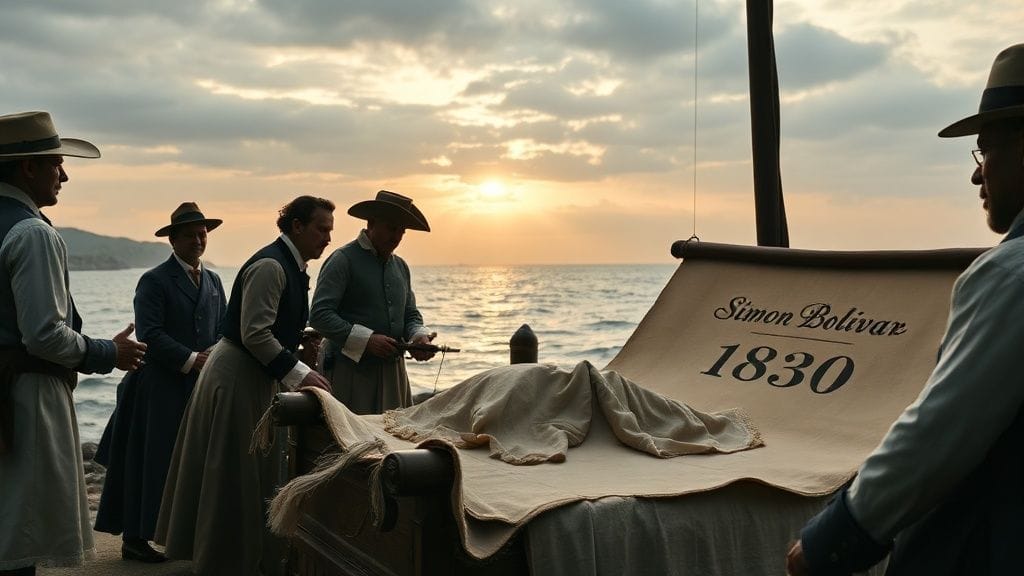
It was a grey morning on December 17, 1830, in the tropical port city of Santa Marta, Colombia. The Caribbean breeze carried a somber heaviness through the hospital room where Simón Bolívar, the towering figure behind the liberation of much of South America, drew his final breath. At 47 years old, his body, ravaged by illness and years of relentless struggle, could sustain no more. Outside, a restless city unaware, while inside, history was quietly closing a chapter that had reshaped continents.
Bolívar’s death was not just the passing of a man, but the fading of a revolutionary light on the dawn of Latin America’s new world — a martyr whose dreams of unity and freedom had both conquered and fractured vast lands. This moment, charged with emotion and fraught with political uncertainty, sounded the beginning of both mourning and mythmaking.
The Journey to Santa Marta: A Tired Hero’s Last Stand
The path to Santa Marta was long, grueling, and marked by defeat. After years of leading armies, uniting disparate republics, and envisioning a federated Gran Colombia, Bolívar found himself increasingly isolated. Political enemies, disillusioned allies, and the heavy burden of governance shattered his once indomitable spirit.
In early 1830, Bolívar’s health began to fail under the strain of tuberculosis and exhaustion, compounded by the stresses of a crumbling political landscape. Leaving the capital Bogotá, he headed toward the coast, aiming to escape the pressures and perhaps seek treatment in the warmer climate of the Caribbean. But this retreat symbolized more than health—it was the last exodus of a man whose revolutionary cause was unraveling.
His journey was marked by bitter quarrels and sobering realizations. The dream that had once sparked the independence of Venezuela, Colombia, Ecuador, and beyond was fraying. Friends turned foes, former comrades doubted, and entire regions pulled away into nascent national identities. Bolívar’s declining health echoed the political fracturing around him.
Political Turmoil in Gran Colombia: The Liberation Dream in Peril
Bolívar’s vision of a unified Gran Colombia—a vast federation encompassing modern-day Colombia, Venezuela, Ecuador, and Panama—was already under siege by 1830. Political factions wrestled for power; regional leaders sought autonomy; and the vision of a pan-American state seemed an increasingly distant aspiration amid deep ideological divisions.
His appointed successor, Domingo Caycedo, struggled to maintain control as centrifugal forces grew stronger. Bolívar’s opponents accused him of authoritarianism, citing his role as “Dictator of Gran Colombia,” appointed in an era of crisis but controversial in a republic yearning for democratic structures. Moreover, social divisions and economic tensions complicated governance, while external pressures from European powers and burgeoning U.S. interests loomed.
Bolívar’s deteriorating health only worsened his political influence; as his body weakened, so too did centralized control. By late 1830, the dream was near collapse, and Bolívar’s death threatened to finalize the disunion.
Bolívar’s Illness and Declining Strength: A Nation Watches
Tuberculosis — a disease that claimed countless lives in the 19th century — gnawed at Bolívar relentlessly. His once-vibrant body wasted away; persistent coughs rent his chest, fevers sapped his energy, and relentless pain shadowed his camp. Doctors equipped with limited knowledge could offer little relief.
Letters from friends and political allies reveal a man torn between hope and despair. “Our Liberator fights his greatest battle now,” wrote a correspondent, capturing the irony that the hero of armed revolutions was succumbing to an invisible enemy.
Throughout late 1830, Bolívar oscillated between moments of spirited clarity and debilitating weakness. His mind remained sharp, reflecting often on the fate of his nation and the sacrifices made. Yet, each day, his physical capacity diminished, signaling the nearing end.
The Arrival in Santa Marta: Seeking Solace on the Caribbean Coast
Santa Marta, a coastal city basking under the hot Caribbean sun, became Bolívar’s final refuge. Its tropical climate was believed to ease the symptoms of consumption, offering a balm to his ailing lungs. Yet, the city was far from the political center, and his presence there was a poignant exile in his final days.
Welcomed with a mixture of reverence and uncertainty, Bolívar was lodged in the Quinta de San Pedro Alejandrino, a hacienda owned by a local family. Though far from the battlefields and councils where he had wielded immense power, this quiet estate bore witness to his last moments.
In this slow retreat from history’s stage, Bolívar found moments of introspection and melancholy. Visitors came sparingly, aware of both his physical frailty and the sensitive political climate.
Memories of a Revolutionary Titan: Bolívar’s Reflections
In the solitude of Santa Marta, Bolívar’s thoughts often turned to the tumultuous route he had carved through history. From the battlefields of Boyacá and Carabobo to the independence assemblies, his life had been a relentless chase for freedom and unity.
He pondered the contradictions of power: how a liberator could become a dictator in the eyes of some; how loyalty shifted like desert sands; how the ideals of liberty could be betrayed by ambition and factionalism. In letters and conversations, he expressed a profound sense of both accomplishment and sorrow.
His reflections also revealed a deeper, human side—a man who had endured losses, betrayals, and the crushing loneliness that leadership often entails. One of his last contemporaneous quotes captures this: “If Nature has decreed my fate, it is because she has punished me for my faults, but I die contented.”
The Role of Bolívar’s Close Allies in His Final Moments
Despite the growing political divisions, some of Bolívar’s closest confidants remained with him during his dying days. Figures such as General Daniel Florencio O’Leary, a loyal companion and military man, provided support and cared for the Liberator with deep reverence.
Yet even these loyalists were faced with the inevitability of the moment. The shifting political scene meant that many others were hesitant to openly show allegiance, fearing repercussions from emerging factions. The atmosphere in Santa Marta was thick with a mixture of devotion, apprehension, and restrained public grief.
These allies preserved Bolívar’s wishes regarding his legacy and burial, embedding his final moments with an aura of solemnity and dignity. Their testimonies form the backbone of the historical record of Bolívar’s last hours.
The Death of Simón Bolívar: December 17, 1830
On the early morning of December 17, Bolívar’s final battle ended not with cannon fire but with the quiet stillness of death. At approximately 11 a.m., surrounded by attendants and close companions, his breath ceased, leaving a void that would echo throughout Latin America.
His body was thin, almost skeletal, a far cry from the imposing figure who had once dominated battlefields and parliaments. His eyes, still penetrating, seemed to suggest a man who had seen too much, borne too much.
News of his passing quickly spread, casting a shadow over the continent. For many, it triggered an outpouring of grief; for others, a recalibration of political realities. Bolívar was no longer invincible—he was human, mortal, yet immortalized in death.
Immediate Reactions Across the Americas: Mourning a Liberator
The death of Bolívar was met with shock, sorrow, and even disbelief across the newly independent nations. Crowds gathered, funerary ceremonies were improvised, and political leaders scrambled to respond.
In Venezuela, Colombia, and Ecuador, processions honored the man they called El Libertador. But amid mourning, fears bloomed: What would become of the fragile alliances? Who would carry the burden of independence forward?
Internationally, Bolívar’s death resonated far beyond South America. The United States, remembering earlier correspondence between its own founding fathers and Bolívar, sent diplomatic condolences. Meanwhile, European powers appraised the changing dynamics of a continent reshaped by one man’s vision and death.
Burial and the Enigmatic Journey of Bolívar’s Remains
The story of Bolívar’s body after death is itself a tale tangled in mystery, politics, and reverence. Initially interred in Santa Marta, the remains were moved to Caracas in 1842, a decade later, amid efforts to construct a national narrative around the liberator.
Controversies arose around the location and treatment of the remains, with some historians speculating about theft, desecration, or political manipulation. Bolívar’s tomb today in Caracas’s National Pantheon stands as a symbol not only of respect but also of the contestation surrounding memory and identity in Latin America.
The Collapse of Gran Colombia: Political Fallout after Bolívar’s Passing
With Bolívar’s death, Gran Colombia’s demise accelerated dramatically. His leadership, despite imperfections, had been a force holding diverse regions together. Now, centrifugal forces pushed the federation to dissolve by 1831, splitting into separate, sovereign republics.
New political leaders emerged, often competing factions that represented differing visions for the future of their countries. Centralized power gave way to regionalism; new constitutions replaced Bolívar’s political frameworks. The fragmentation was painful but, in some respects, inevitable.
The fall of Gran Colombia illustrated the limits of grand visions in the face of local realities and entrenched differences. Bolívar’s failure to bind the region under a lasting unified state became a cautionary tale.
Bolívar’s Death and the Shaping of New Nations
Ultimately, Bolívar’s passing did not end the project of Latin American independence but transformed it. Nations such as Venezuela, Colombia, and Ecuador forged individual paths, yet the ideal of liberty remained a guiding force.
Bolívar’s ideas influenced constitutions, leadership styles, and the broader political culture of the Americas. His name became a rallying cry for future generations seeking justice, sovereignty, and equality.
Thus, though his dream of political unity was unrealized, Bolívar’s death marked the birth of national identities that remain foundational in South America today.
Myth vs. Reality: The Death Narratives of the Liberator
Over the years, Bolívar’s death has been shrouded in myth and speculation. Some narratives emphasize martyrdom and heroism, others highlight political intrigue or question medical explanations.
Was his tuberculosis diagnosis complete? Did political enemies accelerate his decline through neglect? The historical record offers clues but no definitive answers. These ambiguities fuel the legend of Bolívar, blending human frailty with mythic grandeur.
Bolívar’s death, like his life, became a canvas for competing stories, each reflecting the hopes, fears, and identities of Latin America.
Bolívar in the Cultural Imagination: From Icon to Myth
More than a historical figure, Bolívar became a symbol — of freedom, anti-colonialism, and Latin American dignity. Artists, poets, and writers enshrined his image in literature and public memory, creating an icon that transcended the man.
Monuments sprang up, speeches celebrated his ideals, and Bolívar became a key reference point in debates about national destiny. His death catalyzed the process by which history transformed into myth, turning tragedy into inspiration.
The End of an Era: How 1830 Changed Latin America Forever
1830 was more than the year of Bolívar’s death; it was the turning point where revolutionary dreams met political realities. The dramatic changes set in motion that year redefined borders, governance, and identities.
New leaders faced the challenge of balancing freedom and order, unity and fragmentation. The ripple effects echoed through decades, influencing civil wars, foreign interventions, and nation-building processes.
Bolívar’s death marked the end of one era and the uncertain beginning of another, forever inscribed in the continent’s collective memory.
Bolívar’s Legacy in Modern South America: Political and Social Echoes
Today, Bolívar’s legacy continues to shape politics and society across Latin America. Politicians invoke his name to legitimize power; social movements appeal to his ideals of justice and inclusion.
Yet interpretations vary widely: some see him as a father of modern democracy, others as a complex figure whose authoritarianism complicates his legacy. The debates reveal how Bolívar’s image remains alive, dynamic, and contested.
The Global Impact of Bolívar’s Death: Revolution and Empire
Bolívar’s life and death resonated beyond Latin America. His revolutionary model inspired independence movements worldwide—from Europe to Africa to Asia—challenging empires and colonial structures.
His death also raised questions about postcolonial governance, state formation, and the challenges revolutionaries face once power is seized. The global history of empire, revolution, and nationhood is forever intertwined with the Liberator’s saga.
Commemorations and Memorials: Honoring the Liberator
From Caracas to Bogotá, statues, plazas, and institutions bear Bolívar’s name, celebrating his contributions. Annual commemorations on December 17 recall his death and legacy, blending solemnity and celebration.
These acts of remembrance reinforce the Liberator’s role not only as a historical figure but as a continuing presence in the cultural and political landscapes of Latin America.
The Debate over Bolívar’s Health: Tuberculosis or Politics?
Modern historians and medical experts have revisited Bolívar’s health, weighing the evidence of tuberculosis against alternative theories. Some argue that the political context—exhaustion, stress, deprivation—played a role equal to the disease.
This debate highlights the complexity of understanding historical figures’ deaths, especially in contexts of political upheaval and limited medical knowledge. Bolívar’s death thus remains a subject of medical, historical, and political inquiry.
Bolívar’s Final Words: Portals to His Inner World
Reportedly, Bolívar’s last utterances capture a poignant farewell to life and mission. Expressions of regret, hope, and reconciliation offer profound insight into the man behind the legend.
Whether through testament or rumor, these words invite us to see Bolívar not just as the Liberator but as a mortal soul confronting his destiny. They humanize one of history’s greatest figures, leaving a lasting emotional imprint.
Conclusion
The death of Simón Bolívar on December 17, 1830, was far more than the passing of one man—it was the end of an epoch and the beginning of a complex legacy that still shapes Latin America and the world. Bolívar’s life was marked by impossibly high ideals, immense sacrifices, and contradictions; his death underscored his vulnerability, his humanity. Yet, in losing their Liberator, the newly born nations gained a symbol—a guiding star in the stormy seas of independence and nation-building.
In Santa Marta’s quiet room, as Bolívar breathed his last, a whole continent held its breath. What came next was uncertain, tumultuous, but irrevocably changed. To remember Bolívar is to remember the power of dreams, the pain of fragmentation, and the enduring quest for freedom that defines human history.
His death invites us not only to mourn but to reflect, to understand that great revolutions are not won nor lost by single lives—but by the legacies they leave behind.
FAQs
Q1: What exactly caused Simón Bolívar’s death?
A1: Bolívar’s death is commonly attributed to tuberculosis, a widespread and deadly respiratory disease of the time. However, some historians suggest that the extreme physical and mental stress he endured may have worsened his condition, and political neglect could have played a role.
Q2: Why was Bolívar in Santa Marta rather than the capital cities?
A2: Bolívar retreated to Santa Marta seeking relief from his illness in the warmer Caribbean climate. It was also a political decision to distance himself from the chaos engulfing the capital, although this move isolated him further.
Q3: How did Bolívar’s death affect Gran Colombia?
A3: His death significantly accelerated the disintegration of Gran Colombia, which fragmented into independent republics shortly thereafter. Bolívar’s leadership had been a crucial factor holding the union together.
Q4: Who were Bolívar’s closest companions at the time of his death?
A4: Among those close to him were General Daniel Florencio O’Leary and other trusted aides who remained loyal and cared for him during his final days.
Q5: What is the significance of the Quinta de San Pedro Alejandrino?
A5: This hacienda in Santa Marta is where Bolívar died. It is now a museum and memorial site, symbolizing the end of his journey and the revolutionary era he sparked.
Q6: How is Bolívar commemorated today?
A6: Numerous monuments, plazas, and institutions across Latin America bear his name. December 17, the anniversary of his death, is commemorated with ceremonies and reflections on his legacy.
Q7: Did Bolívar foresee the collapse of the unity he fought for?
A7: Bolívar was deeply aware of the region’s divisions and expressed concerns about the fragmentation of Gran Colombia. His writings and speeches reflect a mix of hope and resignation.
Q8: How has Bolívar’s image evolved since his death?
A8: Bolívar has grown from a political leader into a mythic symbol embodying freedom and Latin American identity. His image is used variously by different political groups, showing the enduring complexity of his legacy.