Table of Contents
- An Ocean Liner in an Age of Illusions
- From Drawing Board to Atlantic Queen
- The Gathering Storm: Europe Slides into War
- Blockades, U‑Boats, and the New Lawless Sea
- Passenger Dreams: Life Aboard the Lusitania
- Warnings in Newsprint: Tickets to Danger
- Departure from New York: Hope and Foreboding
- The Hunter and the Hunted: U‑20 Takes Position
- The Last Morning: Calm Seas off Old Head of Kinsale
- Torpedo in the Afternoon: The Moment of Impact
- Eighteen Minutes to Eternity: Panic, Heroism, and Loss
- Rescue from a Drowning World: Kinsale and Queenstown Respond
- Shockwaves Across the Atlantic: Propaganda and Protest
- Secret Cargoes and Hidden Agendas
- From Outrage to Policy: The Long Road to American Entry
- Memory, Memorials, and the Silent Wreck
- Historians’ Debates and the Search for the Second Explosion
- The Sinking in Film, Literature, and Collective Imagination
- Echoes in Modern Maritime and International Law
- Conclusion
- FAQs
- External Resource
- Internal Link
Article Summary: This article explores the dramatic story of the sinking of the rms lusitania off the Old Head of Kinsale, Ireland, on 7 May 1915, and traces how a single torpedo reshaped global history. Moving from the ship’s luxurious birth in an era of imperial pride to its final desperate minutes in cold Atlantic waters, it blends eyewitness testimony, political intrigue, and maritime technology. The narrative examines how German U‑boat warfare collided with British blockade policy and civilian expectations that the sea was still a safe highway, not a battlefield. It investigates enduring controversies over secret munitions cargoes, naval decisions, and whether the disaster was preventable—or even, as some alleged, quietly welcomed by certain strategists. Through the voices of passengers, crew, rescuers from the Irish coast, and outraged diplomats, it shows how the tragedy shifted American opinion and paved a road toward U.S. entry into the First World War. Finally, the article considers how the sinking of the rms lusitania lives on in law, culture, and memory, as divers visit the corroding wreck and historians continue to debate what truly happened in those fateful eighteen minutes.
An Ocean Liner in an Age of Illusions
On the afternoon of 7 May 1915, as a light haze hung over the waters near the Old Head of Kinsale on Ireland’s southern coast, a sleek grey periscope broke the calm surface of the Atlantic. Beneath it, in the cramped steel tube of the German submarine U‑20, men whispered coordinates and calculations. Above them, bearing down the sea lane like a floating city, steamed the RMS Lusitania, the pride of the Cunard Line, a symbol of British engineering might and Edwardian grandeur. Within less than half an hour, that symbol would become a tilting, shrieking inferno of splintering wood, twisted steel, and human voices crying out for help that would not come in time. The sinking of the rms lusitania would not merely end 1,198 lives; it would shatter illusions about the safety of civilians at sea and drag neutral nations closer to the vortex of world war.
To understand why the loss of one ship reverberated so violently, one must step back into the years before the First World War, when ocean liners were as much weapons of prestige as they were vehicles of commerce. The Atlantic had become a highway of steel, where German and British firms competed for speed records and luxury, a contest watched by millions through newspaper headlines. The Lusitania was not just a ship; she was a statement: that Britain, mistress of the seas, would never be outdone on the waves. Yet behind the glittering saloons and polished brass, she also embodied another reality of the early twentieth century—an age in which industry and nationalism were creating ever more powerful tools of war, even as ordinary people boarded them believing themselves safe.
In that contradiction lies the heart of the story. The sinking of the rms lusitania was forewarned—by German advertisements, by naval intelligence reports, by the brutal logic of a total war that no longer cared where soldiers ended and civilians began. Yet thousands still walked up her gangways in New York Harbor, trusting in her speed, in her size, and above all in the unspoken belief that there were rules even in war. It is astonishing, isn’t it, how quickly such rules can vanish when fear, hunger, and strategic necessity take command.
From Drawing Board to Atlantic Queen
The Lusitania was conceived at a time when Britain felt its supremacy challenged not only on land but at sea. In the early 1900s, German shipbuilders backed by Kaiser Wilhelm II were launching ever-larger and faster liners. Vessels like the Kaiser Wilhelm der Grosse and the Deutschland seized the coveted Blue Riband for the fastest crossing of the Atlantic, and London newspapers fretted about a “German invasion” of the North Atlantic passenger trade. The British government, anxious about more than just pride, feared that control of the sea lanes—and the ability to move troops and material rapidly—might someday hinge on who possessed the fastest ships.
To counter this challenge, the British Admiralty quietly partnered with the venerable Cunard Line. With a mixture of subsidies and loan guarantees, the government encouraged the company to design two giants: Lusitania and her near-sister Mauretania. They were to be not mere commercial vessels but potential auxiliary cruisers in time of war, built with the speed to outrun any enemy ship afloat. Construction began at the John Brown & Company yard on the River Clyde in Scotland. Laid down in 1904 and launched in 1906, Lusitania stretched nearly 240 meters (787 feet) from bow to stern and displaced over 44,000 gross tons. Her quadruple screws were driven by steam turbines that could propel her at over 25 knots, making her one of the fastest ships in the world.
Inside, she was a palace. The first-class interiors were designed in an exuberant blend of Edwardian and neo-classical styles. Passengers could stroll through a two-deck-high dining saloon capped by a glass dome, sink into the rich carpets of the smoking room, or promenade beneath electric chandeliers that poured light on shining brass rails and polished mahogany. Even second and third class enjoyed levels of comfort unimaginable to emigrants of an earlier generation. When Lusitania entered service in 1907, newspapers on both sides of the Atlantic celebrated her maiden voyage, hailing her as the perfect fusion of speed, power, and luxury.
But woven into her very blueprints was a dual identity. Strengthened decks, extra magazine spaces, and the ability to mount guns meant that, should the Admiralty ever call, the ship could be converted into an armed merchant cruiser. She received an official designation on the British navy’s list. Though she would never actually be taken up for such service, that latent martial character would later become a central piece of the controversy surrounding her loss. Was she truly a civilian liner—or a vessel with one foot already in the camp of war?
The Gathering Storm: Europe Slides into War
In 1907, when Lusitania first cut through the Atlantic, Europe seemed at once fragile and stable. The great powers were bound by alliances and rivalries, yet few could imagine a conflict that would engulf entire societies. That illusion disintegrated in the summer of 1914, when an assassin’s bullets in Sarajevo set off a chain reaction among empires armed to the teeth.
As Austria-Hungary and Serbia clashed, Germany and Russia mobilized; France and Britain were drawn in; the Ottoman Empire soon followed. Within weeks, the world had changed. What had been political posturing now became a mechanized slaughter across front lines stretching from Flanders to the Dardanelles. The seas, too, turned hostile. Britain’s Royal Navy, still the largest and most powerful fleet in the world, moved to cut off Germany’s overseas trade. A distant, relentless blockade aimed not only at German warships but at its entire economy. Food, raw materials, nitrates for explosives—all were to be throttled.
Germany, lacking a surface fleet that could challenge the Royal Navy head-on, turned to a relatively new weapon: the submarine. The U‑boat, once viewed as a curiosity or a defensive tool, began to assume a deadly offensive role. At first, German commanders tried to adhere to “prize rules,” the traditional laws of naval warfare that required warships to warn merchant vessels, allow crews to abandon ship, and avoid targeting neutral or passenger vessels. But as the blockade tightened and Germany’s leaders contemplated starvation and industrial paralysis, these old rules seemed increasingly like luxuries they could not afford.
By early 1915, pressure was mounting in Berlin to use the U‑boats without restraint. Admirals and army commanders argued that only by choking Britain’s sea lifelines could Germany hope to force an early peace. Civilians sailing under the Union Jack, they claimed, did so at their own risk in a time of total war. The stage was thus set for a confrontation between military necessity, as Germany defined it, and the moral outrage that would follow the sinking of the rms lusitania.
Blockades, U‑Boats, and the New Lawless Sea
In February 1915, the German Admiralty issued a proclamation that stunned much of the neutral world. The waters around the British Isles, including the English Channel and parts of the Irish Sea, were declared a war zone. Enemy merchant ships in this zone, the statement said, would be destroyed—“without its always being possible to provide for the safety of the persons on board.” Even neutral ships were warned that they might be at risk, such was the uncertainty of war.
From Britain’s perspective, this was piracy. The Royal Navy insisted that it adhered, at least in principle, to traditional rules and that its blockade, though harsh, was a legitimate weapon of war. In Germany, however, voices pointed to Britain’s own disregard for earlier conventions, especially its widening definition of contraband, which now embraced even foodstuffs bound for German civilians. If Britain could starve a nation, why should Germany not strike at the merchant and passenger vessels that fed the British war machine?
In practice, the prize rules crumbled beneath the realities of submarine warfare. A surfaced U‑boat was vulnerable to ramming, gunfire, and decoy vessels known as Q‑ships, which concealed heavy guns beneath innocent-looking hulls. Submarines were small, with limited room for prisoners. If they lingered to offer aid, they risked their own destruction. More and more often, commanders opted to fire without warning.
The Atlantic thus became an arena of uncertainty and terror. Merchant captains altered routes, zigzagged through fog, and doused lights at night. Passengers read lurid accounts of sinkings while travel agencies quietly advised caution. Yet the big liners still seemed invincible. They were fast, tall, and carved through the sea at speeds many U‑boats could not match. Their owners advertised them as the safest way to cross the ocean—even in wartime. The idea that a single torpedo could bring down such a giant in minutes seemed grotesque, almost absurd. That, too, was an illusion soon to be destroyed by the sinking of the rms lusitania.
Passenger Dreams: Life Aboard the Lusitania
By the spring of 1915, Lusitania had already made dozens of voyages between New York and Liverpool. War had changed the atmosphere aboard her, but not entirely. When she left port, she carried a mixture of travelers: wealthy industrialists and socialites in first class, families and emigrants in steerage, businessmen, diplomats, nannies with children, and a scattering of writers and artists. Many were American; others were British, Canadian, or from across Europe. Some were hurrying home to join the war effort, while others hoped the ocean passage would offer a brief respite from the anxiety and shortages that had begun to grip the continent.
Life aboard remained comfortingly familiar. The ship’s crew of nearly 700 kept to their routines—officers on the bridge, engineers in the bowels of the vessel tending the roaring furnaces, stewards gliding through corridors with trays of food and drink. Passengers read books in the library, wrote letters in the writing rooms, and took meals under gleaming chandeliers in the grand dining saloon. There was music in the evenings, gossip about the war, card games, and the slow forming of friendships that long voyages tend to foster.
But behind the gracious rituals, nervous glances sometimes flickered. Some travelers had heard of previous sinkings, such as that of the British liner Arabic, and of merchant vessels torpedoed with little warning. Parents instructed their children, half in jest and half in earnest, on how to wear a lifebelt. Others brushed aside such fears, insisting that Lusitania’s speed and size made her an unassailable fortress of steel. “If she meets a submarine, it is the submarine that will be in danger,” one passenger reportedly remarked on an earlier voyage—a bravado that spoke less to technical accuracy than to a general faith in progress.
Most crew members, hardened by experience, recognized that there was risk but believed that they knew the sea. They trusted their captain, William Thomas Turner, a seasoned sailor with nearly four decades of maritime service. Turner was known as taciturn, even stern, but he had a reputation for competence. If any man could steer a liner safely through dangerous waters, many believed, it was he. That trust would soon be tested as Lusitania approached the narrowing lanes off the south coast of Ireland, where U‑boats were known to lurk.
Warnings in Newsprint: Tickets to Danger
Long before Lusitania sailed from New York on what would be her final voyage, the German government had sent an extraordinary warning. On 22 April 1915, just below advertisements for the ship’s departure, American newspapers carried a notice placed by the German embassy in Washington. It stated bluntly that “vessels flying the flag of Great Britain, or any of her allies, are liable to destruction in those waters” around the British Isles, and that “travelers sailing in the war zone on ships of Great Britain or her allies do so at their own risk.”
The warning, printed in the same pages that announced Lusitania’s sailing schedule, sparked discussion. Some readers dismissed it as propaganda, others as a real threat. The British and Cunard authorities reacted with a mixture of irritation and reassurance. The U.S. State Department, still representing a neutral power, made no move to forbid its citizens from traveling. After all, America was not at war; its flag and its people were thought to be respected under international law, even aboard belligerent ships.
At the Cunard office, clerks sold tickets with practiced efficiency. When questioned, some reportedly told would-be passengers that Lusitania was too fast to be caught and that the route was safe. The company had good reason to project confidence: cancelling voyages or conceding that the Atlantic was now fundamentally unsafe would have devastated its business and symbolically ceded control of the sea to Germany. Yet privately, shipping officials knew the risks were real. Admiralty instructions had been issued to captains on how to navigate the new dangers: dim lights, increased speed when in the “danger zone,” zigzagging courses.
Some passengers took out extra life insurance. Others canceled at the last minute, uneasy but unsure why. Among those who decided to sail anyway was a cross-section of the age: magnates like Alfred Vanderbilt, artists such as theatrical producer Charles Frohman, and ordinary men, women, and children whose names would scarcely be recorded in history. They boarded believing that the worst would not happen to them, that there were limits even to German audacity—that the sinking of the rms lusitania was not, could not, be part of their future.
Departure from New York: Hope and Foreboding
On 1 May 1915, Lusitania slipped her moorings at Pier 54 on New York’s Hudson River. The weather was fair, and the familiar rituals of departure unfolded: handkerchiefs waved from the quay, voices calling farewell, the slow churn of propellers as tugs eased the liner into the channel. For many, it felt like any other sailing, though newspaper photographers captured the scene with more than usual interest, aware of the war’s steady encroachment on the Atlantic.
On the bridge, Captain Turner carried sealed Admiralty instructions for the final leg of the voyage near the British Isles. He knew that U‑boats were operating off the Irish coast and that the Liverpool-bound lanes had become especially hazardous. Yet much about the voyage still seemed ordinary. The crew loaded not only passengers’ luggage but also commercial cargo—bales, crates, mailbags, and boxes that filled the holds. Official manifests later revealed “rifle cartridges,” “shell cases,” and “non-explosive fuses,” categorized as contraband but also as legitimate cargo under the rules Britain believed governed wartime trade.
Among the passengers, moods varied. Some felt uneasy, brooding over the German advertisement. Others shrugged it off, joking that the Kaiser would not dare sink a ship full of Americans. In smoking rooms and lounges, conversations turned back and forth between Wall Street, the situation on the Western Front, and the prospects of peace. For the first days out of New York, the sea was calm, the weather kind, and the steady vibration of the engines lulled many into a sense of security.
Yet behind this veneer, the Atlantic was being watched. In Berlin, naval staff tracked the expected movements of major liners, using schedules, wireless intercepts, and intelligence from agents abroad. In the chilly North Sea and around the British Isles, U‑boat commanders scanned horizons through periscopes, noting silhouettes, judging courses, and calculating attack angles. One of them, Kapitänleutnant Walther Schwieger of U‑20, would soon cross paths with Lusitania off the coast of Ireland and change history.
The Hunter and the Hunted: U‑20 Takes Position
U‑20 was not a large vessel by the standards of later submarines. Barely 65 meters long and crewed by around 35 men, she was crowded, smelly, and constantly damp. The air inside was heavy with oil, sweat, and the metallic tang of batteries and machinery. Yet to the German navy, she was a potent weapon. Armed with deck guns and torpedoes, able to cruise submerged for hours, she could slip past the great battle fleets and strike where the enemy least expected.
By early May 1915, U‑20 was patrolling the waters off Ireland, where British-bound shipping converged. Under Schwieger’s command, she had already sunk several ships. The days blurred into a tense routine: surface to recharge batteries, submerge when danger threatened, scan for targets, and occasionally attack. The crew, young and disciplined, lived with the constant awareness that one depth charge, one lucky shot, or one collision could end them all.
Schwieger was an able and determined officer, but not a fanatical one. Surviving pages from his war diary, or Kriegstagebuch, reveal a man attentive to weather, navigation, and the human cost of his actions. On 5 May, he wrote of poor visibility and missed targets. On the 6th, he torpedoed the steamer Candidian, noting lifeboats and survivors. The ocean was thick with ships, many of them British, and each sighting presented a choice: to attack, to observe, or to let pass.
When U‑20 approached the south coast of Ireland, the submarine entered what German naval command considered a fertile hunting ground. Here, shipping lanes narrowed as vessels funneled toward Liverpool and other ports. The Old Head of Kinsale, a distinctive promontory jutting into the Atlantic, served as a navigational marker for many captains. It also became, on that fateful afternoon of 7 May, the backdrop to the sinking of the rms lusitania, an event Schwieger would record with clinical brevity and which the world would soon interpret as a moral catastrophe.
The Last Morning: Calm Seas off Old Head of Kinsale
On the morning of 7 May 1915, Lusitania entered the approaches to the Irish Sea. The weather was clear; the sea, almost unnervingly smooth. Some passengers remarked on the beauty of the coastline as it slowly came into view, faint and blue on the horizon. The ship’s pace had been reduced from her top speed; coal shortages, Admiralty instructions, and navigational caution all played roles in this decision. Instead of racing at over 24 knots, she steamed at around 18.
In the previous days, the British Admiralty had received wireless reports of U‑boat activity in the area. At 7:50 a.m., a message went out from the Admiralty to ships, warning of submarines off the south coast of Ireland. Some of these messages reached Lusitania; others, due to wireless traffic and the complexities of naval coding, may have been delayed or misunderstood. Captain Turner had been instructed to steer a mid-channel course, keep a good lookout, and, when in potentially dangerous waters, zigzag—a maneuver designed to throw off the aim of torpedoes.
Historians have debated why Turner did not zigzag continuously that morning. Some point to the good visibility and the belief that a submarine could be spotted in time; others to conflicting signals, or to the difficulty of navigating near land. In any case, as Lusitania neared the Old Head of Kinsale shortly after lunchtime, she was proceeding on a fairly steady course, not at her maximum speed, and without constant evasive maneuvers.
On deck, passengers took advantage of the fine weather. Children played; adults leaned on railings, chatting or staring at the distant Irish coast, perhaps imagining their impending arrival in Liverpool and the onward journeys that awaited them. In the dining saloon, the last lunch aboard was being served—soups, meats, fish, the clatter of cutlery, the murmur of conversation. It was, in many ways, a quintessential ocean-liner scene: a self-contained world of routine, unaware that history was about to rupture it.
Torpedo in the Afternoon: The Moment of Impact
At approximately 2:10 p.m. local time, U‑20’s periscope caught sight of a large vessel approaching from the east-southeast. In his war diary, Schwieger later wrote that he recognized her as a “large passenger liner,” steaming at considerable speed but not zigzagging. He maneuvered to intercept, judging the course and distance with a practiced eye. At 2:10 p.m., he ordered a single torpedo fired from about 700–750 meters away—a short distance in naval terms, but one that left little time for the target to react.
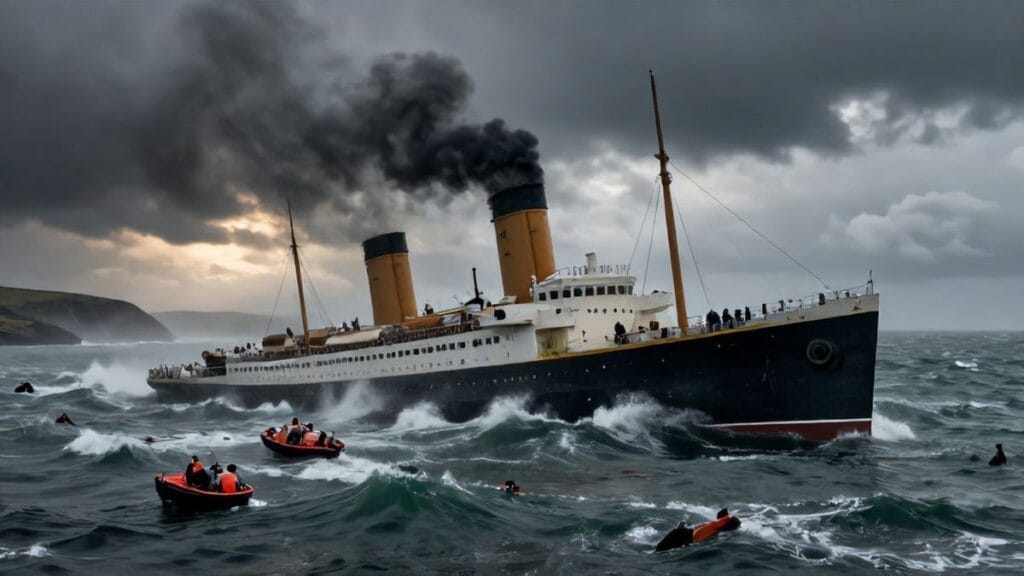
On Lusitania’s decks, some passengers saw a faint, pale streak moving through the water, like a line drawn beneath the surface. One later recalled thinking it was “a flock of sea birds” before realizing with horror what it really was. A moment later, the torpedo struck on the starboard side, near the bow, roughly between the second and third funnels. There was a sharp explosion, a powerful shudder that rippled through the ship. Crockery fell from tables; steam pipes trembled and burst; shocked conversations broke into panicked cries.
Within seconds, a second, even more violent internal explosion detonated somewhere within Lusitania’s hull. Witnesses later described it as if the vessel had been hit twice, or as if something deep within her had blown apart. The nature of this second blast would become one of the enduring controversies surrounding the sinking of the rms lusitania. Some argued it must have been detonating munitions; others maintained it was the catastrophic ignition of coal dust, ruptured boilers, or structural failure triggered by the torpedo hit. Whatever its cause, its effect was devastating.
The ship immediately began to list to starboard, sharply and ominously. In the control rooms and on the bridge, officers scrambled to assess damage and take emergency measures. Orders were given to close watertight doors, to send distress signals, to steer for the coast if possible. But it quickly became clear that the injury was mortal. Water flooded compartments at a terrifying rate. The ship, designed to stay afloat with several compartments breached, had suffered damage beyond the limits of her safety systems.
Passengers, many still in the dining saloon, were thrown against tables and bulkheads. Some rushed for the stairways; others were briefly paralyzed by shock. On open decks, people stared in disbelief as the liner’s majestic equilibrium vanished and the deck beneath their feet tilted ever more steeply toward the sea. “It was like the floor of a house giving way,” one survivor later recalled. Panic, confusion, and the first acts of bravery all erupted at once.
Eighteen Minutes to Eternity: Panic, Heroism, and Loss
From the moment the torpedo struck, Lusitania had roughly eighteen minutes left above the waves. That span of time, so brief and yet so agonizingly long, was filled with every kind of human response—courage, terror, self-sacrifice, bewilderment. The rapid list to starboard made launching lifeboats a nightmare. Boats on the high port side swung outward, suspended far above the water; those on the low starboard side were jammed against the ship’s flank or crushed as they were lowered.
Crew members tried to impose order, shouting instructions, cutting away boat covers, organizing passengers into lines. But many of them, too, were disoriented by the speed of events. Drills had been minimal; many passengers had not attended them. As the angle of the deck grew steeper, people slipped and slid across wet planks. Parents clutched children, sometimes tying lifebelts around them before thinking of their own survival. Some lifeboats were launched half-full; others spilled their terrified occupants into the sea.
In the chaos, acts of remarkable bravery stand out. Alfred Vanderbilt, heir to a great American fortune, reportedly helped women and children into lifeboats, giving away his own lifebelt and making no move to save himself. Theatrical producer Charles Frohman, who walked with difficulty due to transplant surgery, is said to have calmed those around him with the words, “Why fear death? It is the most beautiful adventure in life.” Whether his exact words are accurately remembered, their spirit captured the composure some tried to maintain as the ship groaned and slipped lower.
Inside the ship, water surged up stairwells. Electricity failed in some areas, plunging corridors into darkness. Stewards pounded on cabin doors, urging passengers out. In steerage, language barriers and the complexity of the layout made escape especially difficult. Many who survived later spoke of the cacophony: the hiss of steam, the roar of inrushing water, the groaning of metal, and above it all the cries of hundreds of human voices, some praying, some pleading.
At 2:14 p.m., wireless operator David McCormick sent out an SOS: “Come at once. Big list. Ten miles south of Old Head of Kinsale.” The signal was picked up by nearby ships and naval stations, but distance and time worked against them. The nearest significant port, Queenstown (now Cobh), was dozens of miles away. The sea, astonishingly calm for such a disaster, now became the stage for countless individual struggles as Lusitania lurched toward her end.
By 2:28 p.m., the ship’s bow was deeply submerged. Passengers and crew clustered toward the stern, clinging to railings and rigging. Some jumped, hoping to clear the suction they believed would follow the ship’s final plunge. Others clung to anything that might float—deck chairs, pieces of wreckage, overturned lifeboats. At last, with a final, sickening heave, Lusitania’s stern rose, her screws for a moment visible above the waterline, and then she slid beneath the surface. The sudden silence that followed was, survivors later said, even more terrible than the noise. Only the cries of those left in the water remained, thin and desperate across the wide, indifferent sea.
Rescue from a Drowning World: Kinsale and Queenstown Respond
When Lusitania disappeared beneath the waves, hundreds of people remained alive in the cold Atlantic. Many wore lifebelts but had no boat; others clung to rafts or pieces of wreckage. Some were injured; others were weakened by shock or swallowed seawater. Hypothermia set in quickly. The surface of the ocean near the Old Head of Kinsale was soon scattered with bodies, floating debris, and upturned lifeboats.
Along the Irish coast, fishermen and locals saw the distant plume of smoke and sensed something was terribly wrong. Reports reached Kinsale and Queenstown, prompting a rush to sea. Trawlers, small steamers, fishing boats, and any vessel that could be spared set out toward the coordinates of the disaster. Their crews, many of them civilians with little experience of mass rescue, found themselves entering an unimaginable scene.
One small ship after another pulled survivors from the water—shivering children, stunned adults, men and women weeping or eerily silent. Some had been there for more than an hour. Lifeboats that had launched successfully now served as floating islands where the living clustered around the dying. Here and there, passengers still searched for loved ones, calling names into the wind, hoping against hope for an answer.
Back on shore, the towns of Kinsale and Queenstown improvised as emergency hospitals and morgues. Schools, churches, and public buildings became temporary shelters. Doctors and nurses, alerted from their homes, tended to the rescued as best they could, stripping off wet clothes, wrapping them in blankets, administering stimulants, treating wounds. Bodies were laid out for identification. The grim task of cataloguing the dead began almost immediately, with lists of names hastily compiled and telegraphed to consulates, shipping offices, and newspapers.
The Irish communities responded with generosity and sorrow. Local families took in survivors, offering them food, dry clothing, and a bed. At the same time, the knowledge that this catastrophe had been wrought by human decision, not natural forces, cast a bitter tone over the rescue. The sinking of the rms lusitania was not an accident like the Titanic three years earlier; it was an act of war, deliberate and controversial from the moment the sea closed over the liner’s decks.
Shockwaves Across the Atlantic: Propaganda and Protest
News of the sinking traveled swiftly. Within hours, telegraph offices crackled with reports; by the next day, headlines screamed from front pages on both sides of the Atlantic. In London and New York, crowds read with disbelief that a great passenger liner had been sent to the bottom in mere minutes, and that among the dead were 128 citizens of the still-neutral United States.
The British government and press quickly framed the event as a moral outrage, a symbol of German barbarism. Photographs of drowned children, recovered lifebelts, and devastated survivors were reproduced widely. Editorials thundered against “piracy on the seas,” drawing a line between what was portrayed as Britain’s lawful blockade and Germany’s “murder of innocents.” The Lusitania disaster became a powerful tool in Allied propaganda, used to galvanize public opinion and to sway neutral nations.
In Germany, reactions were more complex. Many newspapers hailed the sinking as a legitimate blow against an enemy vessel carrying contraband and contributing to the British war effort. Official statements emphasized that the ship had been warned and that passengers chose to sail at their own risk. Yet even in Germany, some intellectuals and politicians worried about the diplomatic implications, especially for relations with the United States. Chancellor Theobald von Bethmann Hollweg is reported to have expressed concern that such incidents might “drive America into the war”—a fear that would, in time, prove prophetic.
In Washington, President Woodrow Wilson faced a dilemma. The United States cherished its neutrality but also its rights as a maritime nation. American citizens had died in a violent act that appeared to flout international norms. Public opinion, while not yet united behind war, was outraged. Wilson initially chose a path of firm diplomacy rather than immediate confrontation, sending notes to Berlin demanding assurances that such attacks would not be repeated and insisting on the rights of neutrals to travel safely. The sinking of the rms lusitania had not yet brought America into the conflict, but it had irrevocably altered the tone of U.S.–German relations.
Secret Cargoes and Hidden Agendas
Almost from the moment the first casualty lists appeared, questions surfaced about what exactly Lusitania had been carrying in her holds. Official manifests revealed items such as rifle ammunition, shell cases, and fuses—all classified as contraband by Germany but, under Britain’s interpretation of international law, legitimate cargo for a passenger liner. Critics, however, suspected more. Could there have been large quantities of hidden explosives? Had an enormous clandestine shipment of munitions to Britain turned the ship into a floating powder keg, explaining the second, more violent explosion after the torpedo hit?
The British government, mindful of international opinion and the delicate negotiations with the United States, denied that Lusitania had carried illegal or unusually dangerous cargo. The Admiralty asserted that any munitions aboard were properly declared and posed no risk. Nevertheless, rumors flourished. In America, some isolationist voices suggested that British recklessness—or even deliberate provocation—had put civilians in harm’s way in order to draw the United States closer to war. The suspicion that the tragedy might have been not only a crime but also a calculated gamble haunted debates for decades.
Later investigations, including dives to the wreck, revealed evidence of small-arms ammunition and other munitions, but nothing conclusively on the scale required to explain the massive second explosion as a detonating magazine. Many maritime experts instead pointed to structural effects: the torpedo’s blast may have ruptured boiler rooms, broken critical transverse bulkheads, or stirred up coal dust that itself could have ignited. Modern analyses of ship design and damage patterns often support the view that a combination of factors—torpedo impact, design vulnerabilities, possible internal secondary explosions of non-munitions sources—conspired to doom the liner.
Yet the controversy has never fully subsided. As historian Colin Simpson argued in a controversial 1972 study, the secrecy surrounding certain Admiralty documents and the reluctance to discuss military use of passenger liners fostered a climate in which conspiracy theories could thrive. Whether or not there was a hidden agenda, the perception that civilians had been used as shields for contraband fed the anger of those who felt the victims of the sinking of the rms lusitania were caught between two ruthless warring systems—Germany’s submarine campaign and Britain’s global blockade.
From Outrage to Policy: The Long Road to American Entry
In the short term, the United States did not go to war over Lusitania. President Wilson, facing a divided public and mindful of the immense costs that full involvement in the European conflict would entail, chose a course of diplomatic protest. In a series of notes to Berlin, he emphasized America’s right to sail the seas and demanded that Germany renounce attacks on passenger vessels without warning. Germany, anxious not to provoke the powerful neutral, issued partial concessions, promising to restrict its U‑boat campaign and to avoid similar incidents when American lives were at stake.
For a time, this uneasy modus vivendi held. Submarine warfare around the British Isles became more cautious. Yet the memory of Lusitania lingered like a smoldering ember in American politics. Interventionists invoked the dead as martyrs to German aggression; isolationists argued that the tragedy showed the perils of entanglement with European belligerents. Wilson himself, in perhaps his most famous phrase, insisted that America must remain “too proud to fight,” yet the tone of his language shifted over time. “There is such a thing as a man being too proud to fight,” he had said in 1915; by 1917, the rhetoric turned toward the defense of democratic principles and freedom of the seas.
Lusitania’s ghost resurfaced whenever new outrages occurred. Attacks on other ships carrying Americans, such as the Arabic and the Sussex, sparked further crises. Germany stepped back, then advanced again, like a gambler testing the limits of an opponent’s patience. In early 1917, facing blockade-induced shortages and stalemate on the Western Front, German leaders decided on a desperate gamble: unrestricted submarine warfare would be resumed in full force, whatever the cost. All ships, neutral or belligerent, in specified zones around the Allies would be targeted without warning.
That decision, combined with the inflammatory Zimmermann Telegram—Germany’s secret proposal of an alliance with Mexico against the United States—finally tipped the balance. When Wilson addressed Congress on 2 April 1917 to ask for a declaration of war, he spoke of “a war for democracy,” but he also invoked the long train of submarine outrages, of which Lusitania was the symbolic first great crime. The sinking of the rms lusitania had not directly caused American entry into the war, but it had marked a turn in moral perception, a point after which German actions at sea were viewed through the lens of civilian massacre and broken promises.
Memory, Memorials, and the Silent Wreck
Today, the wreck of the Lusitania lies on her starboard side in about 90 meters of water off the Old Head of Kinsale. Corroded by salt, colonized by marine life, and distorted by the pressures of depth and time, she is far removed from the gleaming liner that once graced New York’s harbor. Yet divers who visit the site speak of a powerful sense of presence—a cathedral-like quiet broken only by the sound of their own breathing and the faint clink of equipment against hull plates.
On land, memorials to the dead stand in Ireland, Britain, the United States, and elsewhere. In Cobh, the Lusitania Peace Memorial depicts a mother and child, watched over by the figure of the Angel of Peace. Plaques list the names of victims; some bear the simple notation “Unknown.” Over the decades, relatives of those who sailed on that final voyage have made pilgrimages to the Irish coast, casting wreaths upon the water, reading from letters and diaries, trying to bridge a century of time with acts of remembrance.
The disaster has entered the shared memory of the First World War alongside names like Ypres, Verdun, and the Somme. But whereas those battles symbolize the mass slaughter of soldiers, Lusitania stands for the vulnerability of civilians in modern, industrial war. It reminds us that the front lines can be everywhere—on sea lanes, in ports, in cities beneath the paths of bombers and missiles. The passengers who dressed for dinner on 7 May 1915, unaware that a periscope had already turned their way, were not combatants. Yet they died as surely as any soldier in the trenches.
In this sense, memorializing Lusitania carries a broader weight. It is not only about the individuals lost—though their stories, from the wealthy Vanderbilt to the unnamed infant in steerage, deserve to be remembered. It is also about recognizing how war, once imagined as a contest of armies and navies, had become a total conflagration in which entire societies were targets. Each wreath laid at Kinsale and Cobh is an acknowledgment that the sinking of the rms lusitania marked a step on that grim path.
Historians’ Debates and the Search for the Second Explosion
As with many pivotal historical events, Lusitania’s end has been the subject of ongoing scholarly debate. Central among the questions are: Why did the ship sink so quickly? What caused the notorious second explosion? Could the Admiralty have done more to protect her? And were political calculations at play in the decisions that left her vulnerable in known U‑boat hunting grounds?
In the decades following the disaster, official British inquiries, such as the one led by Lord Mersey, generally placed the blame squarely on Germany, finding that the sole cause of the catastrophe was the torpedo fired by U‑20. Mersey himself, however, reportedly confided doubts about the completeness of the evidence, later writing that he had been “asked to do what I could to help the Admiralty” and resigned rather than preside over another sensitive inquiry. Such hints of behind-the-scenes pressure fed suspicions that awkward facts—such as instructions to Turner, or the extent of contraband in the holds—had been downplayed.
Maritime engineers and historians have proposed multiple theories about the second explosion. One school argues that coal dust and ruptured boilers, perhaps combined with structural fatigue, created a cascade of damage that far exceeded what the original compartment design could withstand. Another insists that hidden munitions, possibly improperly stored, detonated. Underwater surveys, including expeditions in the late twentieth and early twenty-first centuries, have offered tantalizing but inconclusive clues. Some damaged sections of the hull might reflect an internal blast; others could be the result of salvage operations, corrosion, or the original torpedo impact.
Historians also debate the Admiralty’s role. Why was Lusitania not provided with a naval escort in waters known to be active with submarines? Why were some warnings not relayed clearly, and why was advice about zigzagging open to interpretation? Admiralty officials later insisted that the available destroyers were needed elsewhere and that escorting every large passenger liner was impossible. Critics suggest that a flagship like Lusitania, carrying hundreds of civilians and symbolizing British prestige, warranted special protection.
These debates are not merely technical; they touch on moral responsibility. As one historian noted, “The question is not simply who fired the torpedo, but who sent the ship into its path.” The consensus remains that Germany bears primary blame for choosing to attack a passenger liner without ensuring the safety of those on board—a violation of long-standing maritime norms. Yet the ambiguities in British decisions, from cargo choices to navigational orders, reveal a more complicated picture of how civilians became pawns in wartime strategy.
The Sinking in Film, Literature, and Collective Imagination
From the moment it occurred, the Lusitania disaster became a story as well as an event. Newspapers serialized survivor accounts, sometimes embellishing them. Posters depicting the sinking were produced to encourage enlistment and war bond purchases, showing desperate mothers clutching children as the great liner disappeared beneath crimson-streaked waves. The phrase “Remember the Lusitania” joined “Remember the Maine” and later “Remember Pearl Harbor” as a slogan of outrage in American and British discourse.
In literature and film, the sinking often served as a shorthand for the brutalities of war. Early silent films dramatized the attack, some with lurid exaggeration, others with attempts at documentary realism. Novelists used the catastrophe as a turning point in characters’ lives, a moment when innocence was lost and illusions about war were shattered. In some modern works, the liner appears as a haunting presence, a ghost ship symbolizing the fragility of civilization.
Within Germany, the portrayal was more ambivalent. For years, many Germans were taught that Lusitania had been a legitimate target carrying weapons, that the passengers had been warned, and that Allied propaganda had distorted the event. After the Second World War, as Germany reckoned with broader questions of wartime atrocity and responsibility, interpretations shifted. The sinking came to be viewed more widely as a tragic example of how militaristic logic can override humanitarian considerations.
Cultural memory also grapples with comparisons. People often ask how Lusitania relates to the Titanic, sunk three years earlier by an iceberg. Both were great liners, both went down with heavy loss of life, and both became subjects of myth. Yet their meanings differ. Titanic represents technological hubris and the indifference of nature; Lusitania, the deliberate choice to turn civilians into targets in pursuit of strategic advantage. This distinction has persisted in public imagination, ensuring that the sinking of the rms lusitania sits in a darker, more explicitly political corner of maritime memory.
Echoes in Modern Maritime and International Law
The legal and moral shock of Lusitania’s destruction helped accelerate changes in how the international community thought about warfare at sea and the protection of civilians. In the years after the First World War, various treaties and conventions sought to clarify the status of passenger ships, neutral vessels, and non-combatants. While the efforts were imperfect and often thwarted by the realities of later conflicts, the underlying principle—that civilians should not be attacked indiscriminately—drew renewed strength from memories of 1915.
In a sense, Lusitania anticipated later horrors. During the Second World War, submarine campaigns once again targeted merchant shipping, and civilian vessels like the German Wilhelm Gustloff and the Soviet hospital ship Armenia were sunk with enormous loss of life. Each new tragedy prompted fresh denunciations and legal arguments, many of which echoed the debates sparked by the sinking of the rms lusitania. After 1945, the Geneva Conventions and their protocols expanded protections for civilians and sought to limit indiscriminate attacks, though enforcement has remained uneven.
In more recent decades, as passenger airliners have become the principal means of intercontinental travel, Lusitania’s story has gained renewed relevance in discussions of incidents like the shooting down of Iran Air Flight 655 in 1988 or Malaysia Airlines Flight 17 in 2014. In each case, questions arise: Who bears responsibility when civilian carriers operate in or near war zones? What duty do states have to warn, to protect, or to restrain military actions that might endanger innocents?
Legal scholars often cite Lusitania as an early, vivid case where technological capability ran ahead of established norms. Submarines gave Germany the power to strike unseen at ships once considered off-limits. Today, long-range missiles, drones, and cyberweapons raise similar challenges. The lesson drawn by many is that law and ethics must adapt quickly when new weapons emerge—or risk being trampled in the rush of strategy and fear.
Conclusion
The sinking of the RMS Lusitania off the Old Head of Kinsale on 7 May 1915 was not merely a maritime disaster; it was a turning point in the moral and political history of modern warfare. In just eighteen minutes, a proud symbol of Edwardian luxury and technological prowess was transformed into a grave for nearly 1,200 people, including men, women, and children who believed that the ocean remained a safe highway even in time of war. Their deaths forced the world to confront a new reality: that in a conflict driven by industrial might and total mobilization, there were fewer and fewer boundaries between combatant and civilian, battlefield and home.
This tragedy cannot be reduced to a single narrative of villainy or innocence. Germany’s decision to unleash submarines against passenger ships, knowing civilians would die, was a grave violation of existing norms; yet it arose from a desperate sense of encirclement and the brutal logic of blockade and counter-blockade. Britain’s use of armed merchant vessels, its broad definition of contraband, and its willingness to allow passenger liners to sail through known danger zones with military cargo aboard blurred the lines between civilian and military targets. The passengers of Lusitania perished in the space between these hard calculations, their lives weighed lightly by distant strategists and commanders.
In the century since, the corroding hull resting on the seabed near Kinsale has become both a tomb and a warning. Divers who glide past its twisted plates see more than a wreck; they see the physical remnant of a moment when technology and nationalism combined to make the unthinkable possible. The memorials on the Irish coast, the plaques in churches and town squares, the faded family photographs on mantels in far-off homes—all testify that history is not an abstract sequence of events but a web of human lives, hopes, and losses.
The story of Lusitania continues to resonate because it raises questions that remain painfully current. How do we protect civilians when weapons can reach anywhere? What responsibilities do governments and companies bear when they send travelers through regions shadowed by war? And how do societies remember such tragedies—honestly, without forgetting the uncomfortable complexities that lie beneath the surface of slogans and propaganda? The sinking of the rms lusitania offers no easy answers, but it does insist that we keep asking. In the stillness above her resting place, the waves and wind carry a muted echo of those questions, urging each new generation to reckon with the costs of war—and the fragile line between safety and catastrophe on which ordinary lives so often balance.
FAQs
- Where and when did the Lusitania sink?
The RMS Lusitania was sunk on 7 May 1915 off the Old Head of Kinsale on the southern coast of Ireland. She went down in approximately 90 meters of water after being torpedoed by the German submarine U‑20. - How many people died in the sinking of the Lusitania?
Of the roughly 1,959 passengers and crew on board, about 1,198 lost their lives. This included 128 citizens of the United States, as well as British, Canadian, and other nationalities. - What caused the Lusitania to sink so quickly?
The ship was hit by a single torpedo that created severe structural damage, followed almost immediately by a powerful secondary internal explosion. Flooding across multiple compartments, combined with the design limits of her watertight bulkheads, led to a rapid list and sinking in about eighteen minutes. - Was the Lusitania carrying munitions?
Yes, the ship carried declared cargo that included rifle ammunition, shell cases, and related materials bound for Britain. However, there is ongoing debate over whether additional undeclared munitions were on board and whether any such cargo contributed to the secondary explosion. - Did the sinking of the Lusitania cause the United States to enter World War I?
No, the United States did not enter the war immediately after the disaster. However, the sinking dramatically shifted American public opinion against Germany and became a major factor in the deterioration of U.S.–German relations, contributing to the eventual U.S. declaration of war in April 1917. - Was it legal under international law to torpedo the Lusitania?
Most contemporary neutral observers and later legal scholars have concluded that attacking a passenger liner without ensuring the safety of those on board violated customary international law, including the so‑called “prize rules.” Germany argued that the ship was a legitimate target because it flew the British flag and carried contraband, but this justification was widely rejected outside the Central Powers. - Did the British Admiralty deliberately put the Lusitania in danger?
There is no definitive evidence that the Admiralty intentionally sacrificed the ship, though it certainly used the disaster for propaganda. However, questions remain about why a major liner was not escorted in known submarine-infested waters and why navigational and speed recommendations were not followed more rigorously. - Can the Lusitania wreck still be visited today?
Yes, but only by experienced technical divers, as the wreck lies at a depth of around 90 meters and is in a fragile, corroding state. It is legally recognized as a maritime grave, and there are ethical as well as legal considerations about disturbing the site. - How does the Lusitania compare to the Titanic disaster?
Both were large ocean liners that sank with heavy loss of life, but Titanic was lost to an iceberg in peacetime, symbolizing hubris and the power of nature. Lusitania was sunk by a deliberate act of war, making it a symbol of civilian vulnerability and the erosion of distinctions between combatants and non-combatants. - Why is the Lusitania still historically important?
The sinking of the rms lusitania is significant because it marked a major escalation in submarine warfare, influenced U.S. opinion and policy, and became a potent symbol of the dangers civilians face in total war. It also continues to inform debates about maritime law, the ethics of targeting, and the responsibilities of states toward passengers in conflict zones.
External Resource
Internal Link
Other Resources
- Encyclopaedia Britannica – general search for the exact subject
- Google Scholar – academic search for the exact subject
- Internet Archive – digital library search for the exact subject