Table of Contents
- A Summer Day in Stockholm Harbor: The Vasa Prepares to Sail
- Ambition on the Baltic: Sweden’s Great Power Dreams
- Designing a Floating Palace: The Birth of the Vasa
- Artisans, Laborers, and Prisoners: The Human Hands Behind the Hull
- A Warship of Symbolism: Power, Faith, and Royal Image
- Whispers in the Shipyard: Early Warnings and Overlooked Doubts
- The Fateful Morning of August 10, 1628
- The Moment of Disaster: When the Vasa Heeled and Water Rushed In
- Panic on Deck: Human Voices Amid the Sinking of the Vasa
- After the Silence: Shock, Grief, and Blame in Stockholm
- Investigating a Catastrophe: The Inquest That Found No One Guilty
- The Technical Truth: Stability, Ballast, and Deadly Ratios
- Echoes Through the Fleet: Political, Military, and Economic Consequences
- Forgotten in the Mud: The Long Sleep of the Vasa Beneath Stockholm
- Raised from the Deep: The 20th-Century Resurrection of a Warship
- A Time Capsule of Empire: What the Vasa Revealed to Historians
- Human Stories from the Wreck: Bones, Belongings, and Lost Lives
- From Failure to Icon: How the Vasa Became a National Symbol
- Lessons Written in Oak: Power, Hubris, and Maritime Engineering
- Conclusion
- FAQs
- External Resource
- Internal Link
Article Summary: This article tells the story of the sinking of the warship Vasa on August 10, 1628, in Stockholm Harbor, a disaster that unfolded within minutes of the ship’s first voyage. We move from the noise and excitement of the shipyard to the charged political atmosphere of Sweden under King Gustavus Adolphus, where ambition pushed design beyond safe limits. Through narrative and analysis, we explore how the Vasa, a lavishly decorated warship meant to intimidate enemies, instead became a monument to miscalculation and royal pressure. The sinking of the warship Vasa is reconstructed moment by moment, from the first gust of wind that caused her to heel dangerously to the cries of the crew as water poured through the gunports. We follow the subsequent investigation that absolved individuals but quietly acknowledged systemic failure. Centuries later, the rediscovery and raising of the Vasa unveiled a uniquely preserved time capsule of 17th-century life, warfare, and craftsmanship. The article also examines the cultural, social, and emotional legacy of the ship, tracing how it evolved from a humiliating failure into one of Sweden’s most cherished historical treasures. Above all, it reflects on what the sinking of the warship Vasa continues to teach about the perilous intersection of power, technology, and human judgment.
A Summer Day in Stockholm Harbor: The Vasa Prepares to Sail
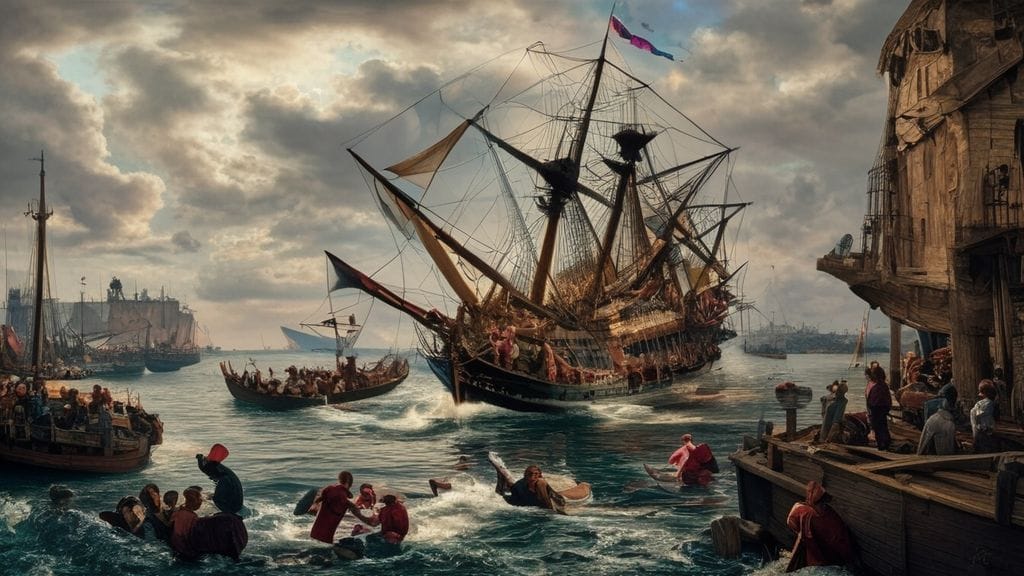
On the afternoon of August 10, 1628, Stockholm Harbor glittered under a mild Baltic sun. The air smelled of tar, salt water, and pine, a familiar blend in the Swedish capital, yet on this day the harbor felt different—charged, expectant, almost theatrical. Citizens pressed against the quays, their wooden clogs clacking on planks worn by years of trade and war. Children climbed onto barrels and crates, craning their necks for a better view. Above them, a forest of masts rose into the sky, but one hull towered over all the others: the brand-new royal warship Vasa.
She dominated the scene—a vivid blaze of ochre, red, blue, and gold. Her sculpted stern, high and ornate, was crowded with carved warriors, lions, cherubs, and ancient emperors. It was not enough for the Vasa to be a weapon; she had to be a message. To anyone who saw her, whether Swedish citizen or foreign envoy, she proclaimed Sweden’s intention to stand as a great power on the Baltic stage. The sinking of the warship Vasa had not yet entered the realm of possibility. On that warm August day, she embodied triumph, not tragedy.
Gulls wheeled, screaming over the harbor as sailors shouted orders across the decks. The harbor buzzed with the clank of chains, the scrape of ropes over pulleys, and the creak of timber shifting under strain. Men in coarse linen shirts and wool hose hurried up and down the gangplanks, carrying last-minute supplies and tools. Officers in finer dress, some with the stiff poise of court life, checked lists and conferred in tight knots along the quayside. Stockholm’s merchants and artisans, who had watched the ship grow plank by plank over the preceding years, now prepared to see her move under her own canvas.
Near the waterline, the Vasa’s gunports stared out like a row of square, waiting eyes. Behind each opening, a bronze cannon, polished and menacing, rested in readiness. Above them, two great decks of towering superstructure soared into the sky, giving the ship a top-heavy grandeur. To those who understood ships more by intuition than by geometry, something about her height seemed slightly unsettling, but the mood among the crowd was jubilant. It was a day to be proud. Sweden had built a warship fit for any king of Europe.
The captain, Hans Jonsson, known as Söfring Hansson, moved about the decks with an air of strained composure. He had command, but he did not truly own the ship; in the age of absolute monarchy, the Vasa belonged first and foremost to King Gustavus Adolphus. The king himself was absent that day, fighting far from Stockholm in the brutal theaters of the Thirty Years’ War. But his will, his expectations, seemed to hang over the vessel like an invisible standard. The crew knew this. The officers knew it even more keenly. This maiden voyage into Stockholm’s outer harbor would also be a test of their obedience, their competence, and their loyalty.
A priest moved among clusters of sailors, offering blessings and quiet words. Some of the men wore amulets or small crosses tucked under their shirts, combining Christian faith with older, more superstitious habits—a whispered charm, a piece of wood touched in passing. They would need luck, they believed, on the open sea, but almost none imagined they would need it in the calm waters just beyond the harbor. The sinking of the warship Vasa, if it crossed their minds at all, would have seemed a nightmare too distant to dwell upon.
Drums beat from the quayside. Families waved to brothers, sons, and husbands aboard the ship, shouting last-minute farewells. The harbor echoed with overlapping voices, some jubilant, some anxious, some already tinged with the faint regret that accompanies any parting. Then, as the wind shifted and tugged gently at the furled sails, the great hull stirred against her moorings. The Vasa was ready to move, to prove that all the years of labor, all the timber felled and bronze cast, had been worth the cost.
Ambition on the Baltic: Sweden’s Great Power Dreams
To understand why the Vasa was built the way she was, one must step back from that summer day and look out over the wider, troubled landscape of 17th-century Europe. The Baltic Sea was not merely a body of water; it was a theater of power, trade, and conflict. Around its shores, kingdoms and duchies maneuvered for advantage, for access to ports, for control of customs and tolls. Grain, copper, iron, tar, and timber—all flowed across these waters, feeding the economies of northern Europe. Whoever dominated the Baltic would wield influence far beyond its gray waves.
In the 1620s, Sweden was an upstart among great powers, but a rapidly rising one. King Gustavus Adolphus, young yet already hardened by warfare, had an audacious vision: Sweden would become the hegemon of the Baltic region. Instead of a peripheral northern kingdom, it would stand alongside Spain, France, and the Holy Roman Empire as a central actor in Europe’s vast and bloody drama. Such ambitions, however, demanded teeth—specifically, a powerful navy.
Sweden’s rivals were formidable. The Polish-Lithuanian Commonwealth, to the south, controlled key ports and had its own claims in the region. Denmark-Norway, to the west, sat astride crucial sea routes, collecting tolls from ships passing through the Øresund Strait. To counter these neighbors, Gustavus Adolphus needed ships that could not only carry men and arms but could also project an image of overwhelming power to intimidate his enemies and reassure his allies.
Naval warfare was undergoing a transformation. Cannon had long been mounted on ships, but their deployment in organized broadsides and concentrated fire was becoming central to naval tactics. Warships needed more guns, heavier guns, and the capacity to fire them rapidly and from stable platforms. Yet naval architecture lagged behind political desire. The calculus of length, beam, draft, and ballast was still as much art as science. Shipwrights relied on experience, proportion, and tradition rather than precise mathematical theory.
Into this world of evolving warfare and imperfect knowledge stepped the Vasa. Her design was an expression of royal ambition: more guns than usual, more decoration, more height, more everything. In letters, Gustavus Adolphus pressed his shipbuilders for power and spectacle. Historian R. C. Anderson once described the era’s royal warships as “palaces of power afloat,” and the Vasa was exactly that—palace and weapon, symbol and instrument fused into one hull.
Yet behind the king’s demands lay insecurities. Sweden’s territories were scattered, its population relatively small. Its ambitions in Germany, where the Thirty Years’ War ravaged the land, were costly and precarious. The king needed victories at sea to secure supply lines and to project his strength. The warship Vasa, armed with over sixty guns and crowned with elaborate carvings, was supposed to stand as a visible pledge that Sweden’s rise was not temporary, but permanent.
It is astonishing, isn’t it, how often empires express their dreams through ships? Floating on the boundary between land and sea, ordered world and wild nature, a warship gathers to itself not only wood and iron but also the hopes and anxieties of a nation. The sinking of the warship Vasa would come to symbolize a harsh truth: that dreams, when forced too quickly into reality, can founder under their own weight.
Designing a Floating Palace: The Birth of the Vasa
The Vasa was conceived in Stockholm’s bustling shipyards, where the smell of fresh-cut oak mingled with tar, coal smoke, and sweat. The king hired the Dutch master shipwright Henrik Hybertsson, a man with experience building modern, ocean-going vessels. Dutch shipbuilders were renowned in this period, their country at the forefront of maritime trade and naval power. If Sweden wanted a warship that could stand beside those of the Dutch or English, it made sense to draw on Dutch expertise.
Hybertsson received a royal contract in 1625 to build a series of ships, among them the vessel that would become the Vasa. The original plan likely called for a relatively large but conventionally proportioned warship, about 108 feet at the keel, carrying a substantial yet manageable armament. But as construction progressed, royal instructions changed. The king, perhaps influenced by reports of enemy fleets or by shifting strategic calculations, demanded more guns—especially heavy 24-pounders—and a taller superstructure, with two full gun decks.
This decision set in motion a series of compromises and adjustments. Warship design is a delicate balance between weight, height, and stability. With each gun added to the upper decks, the center of gravity crept higher. To compensate, the ship needed more ballast—stone and iron in her hold—to keep her steady. But there were limits: too much ballast could strain the hull or reduce cargo capacity, and the hull’s shape itself limited how low she could safely sit in the water.
Hybertsson and his team worked within these constraints, but they were also subject to relentless pressure from above. Gustavus Adolphus wrote from the battlefields of Prussia, urging greater firepower and faster completion. Time was short; the empire needed ships now, not in some ideal future. Then, in 1627, as the Vasa took shape on the stocks, Henrik Hybertsson fell ill. He died before seeing his masterpiece launched, leaving his assistant, Hein Jacobsson, to carry the project forward.
Jacobsson inherited not only a half-finished ship but also a tangle of expectations, orders, and design modifications. There is evidence that the ship’s dimensions were altered mid-construction, with the hull lengthened or its upper works extended, while the keel remained based on original proportions. Imagine trying to add an extra story onto a house whose foundations were never meant to bear the weight: the structure might stand, but hidden weaknesses would lurk inside its walls.
The Vasa’s lines, as later reconstructed by naval historians, reveal a ship somewhat narrower relative to her height than was ideal for stability. Her beam—the width that gives a vessel much of its steadiness—did not quite match the soaring height of her sterncastle and forecastle. To the admiralty and the king’s officials, however, she looked magnificent. Her gun decks promised devastating broadsides. Her towering stern, crowded with sculpture, gave her a presence that few ships in the Baltic could rival. On parchment, in reports, and in the imaginations of those who read them, the Vasa was a triumph already achieved.
Nobody yet knew that the most important calculations had gone fatally awry. The sinking of the warship Vasa would, in time, expose these misjudgments with merciless clarity, but in the late 1620s, the shipyard pressed on. Carpenters, caulkers, riggers, and painters converged upon the hull, transforming raw engineering into a floating work of art and intimidation.
Artisans, Laborers, and Prisoners: The Human Hands Behind the Hull
Behind the royal orders and the shipwright’s plans stood hundreds of anonymous hands. Shipbuilding in 17th-century Stockholm was a vast collaborative effort, and the Vasa’s creation wove together the lives of artisans, laborers, and even prisoners.
Oak logs arrived in the city by barge and sled, hauled from forests across Sweden and Finland—over a thousand trees felled for a single ship. Ship carpenters, with years of experience etched into the calluses of their palms, shaped these trunks into frames and planks. They read the grain of the wood almost instinctively, sensing where a timber would curve best to form the ship’s ribs. Their axes, adzes, and saws produced a constant rhythm that echoed across the yard: the heartbeat of a kingdom’s maritime ambitions.
Caulkers, often working in harsh weather, hammered tarred oakum—hemp fibers mixed with pitch—into the seams between planks, sealing the ship against the relentless press of water. Riggers climbed like acrobats among the masts and yards, threading a complex web of ropes and pulleys that would allow the crew to harness the wind. Blacksmiths forged nails, chainplates, and fittings. Rope makers labored in long, narrow sheds where fibers were twisted into the thick lines that would hold sails and anchors.
Alongside these skilled workers toiled the less willing: prisoners, conscripted laborers, and the urban poor, hired for heavy lifting and rough tasks. Some carried stones for ballast, back and shoulders aching as they moved the ship’s invisible counterweight into place deep in the hold. Others pushed and levered timbers into alignment or hauled cannons on wooden sledges across uneven planking. Their names seldom entered the official record, but without their effort the Vasa would never have left the stocks.
Then there were the carvers and painters, artists whose work transformed a wooden hull into a floating manifesto. Under the guidance of master sculptors, they produced hundreds of figures: Roman emperors, biblical heroes, lions symbolizing royal strength, and grotesque faces meant to frighten enemies and ward off evil. These carvings, later studied in exquisite detail when the ship was raised, were originally painted in vivid colors—reds, blues, greens, and gold leaf that shimmered in the sun. The Vasa was no bare, weathered war machine; she was a moving pageant of images declaring Sweden’s royal lineage, its alliances, and its power.
For the workers, pay came irregularly, sometimes in coin, sometimes in kind. They might have grumbled about delays or cursed the cold wind off the water in winter. Yet many would have felt a mixture of pride and apprehension as the ship neared completion. She was unlike anything Stockholm had seen. The same men who had crouched in dim, resinous holds driving caulking irons into seams could now stand back and see a towering silhouette against the sky. However, few of them could have guessed that their grand creation’s first voyage would last barely more than a kilometer.
A Warship of Symbolism: Power, Faith, and Royal Image
From bow to stern, the Vasa was designed not only to fight but also to speak. In an age when literacy was limited and images carried immense persuasive power, the ship’s carvings formed a visual argument about Sweden’s place in the world and the legitimacy of its king.
At the stern, dominating the entire rear façade, stood a towering composition of figures. There were lions, the enduring emblem of royal courage and rule. There were Roman emperors and heroes, evoking the classical world that early modern monarchs so often invoked to link their own power to that of ancient empires. Biblical scenes reminded viewers that the king’s rule was not only historical but divinely sanctioned. To enemies and allies alike, the message was clear: Gustavus Adolphus stood within a continuum of great rulers, chosen instruments in the unfolding of God’s will.
Below the surface glitz, the Vasa’s symbolic program had sharp political edges. Sweden’s rivalry with Poland-Lithuania, whose king Sigismund III Vasa was a Catholic and a deposed claimant to the Swedish throne, lurked in the background of many decisions. Gustavus Adolphus needed to demonstrate that his branch of the Vasa dynasty was the true guardian of Sweden’s destiny. A glorious, heavily armed flagship bearing the family name was a powerful statement of that claim.
Even the very act of commissioning such a ship was an assertion of confidence. Naval warfare was expensive, and a 64-gun warship represented a massive investment of treasury funds, labor, and material. Each cannon alone was a masterpiece of bronze casting, costing more than many ordinary citizens would see in a lifetime. To launch such a vessel signaled that Sweden was not merely struggling to survive but poised to shape the course of regional politics.
In this sense, the Vasa was as much a diplomatic instrument as a military one. Foreign envoys in Stockholm would have carried home reports not only of her specifications but of her visual impact. Rumors spread quickly along merchant routes and through diplomatic channels: Sweden had built a warship of extraordinary size and ornamentation. That the sinking of the warship Vasa would soon overturn this narrative in the most humiliating way possible could not yet be imagined.
There was also a religious dimension. The Thirty Years’ War, in which Gustavus Adolphus would later gain lasting renown, was fought along confessional as well as political lines. Protestant and Catholic powers struggled for dominance. A great Protestant king fielding a formidable navy, sailing under banners emblazoned with religious symbols, had both earthly and spiritual significance. The Vasa’s very name, echoing the royal house, folded identity, power, and faith into a single emblem.
Whispers in the Shipyard: Early Warnings and Overlooked Doubts
Despite the grandeur and confidence that surrounded the Vasa, not everyone felt at ease. Ships, unlike palaces, live and die in the shifting, unforgiving medium of water. There, a delicate equilibrium rules. Even without sophisticated theories of stability, experienced sailors and shipwrights could sense when a vessel felt “stiff” or “tender,” steady or unstable.
In the weeks before the maiden voyage, the Vasa underwent basic trials in Stockholm Harbor. One famous episode, recorded in the subsequent inquest, has become emblematic of the warnings that went unheeded. The admiralty ordered a simple stability test: thirty men were told to run from one side of the upper deck to the other, back and forth, while the ship lay at anchor. They managed the maneuver only a few times before the officer in charge, Admiral Klas Fleming, commanded them to stop. The ship, he observed, was heeling so dangerously under the shifting weight that he feared it might capsize right there in the harbor.
This informal test was crude, but its implications were grave. The Vasa appeared precariously sensitive to lateral movement, a sign that her center of gravity was too high and her ballast insufficient. Some officers voiced concern, though the surviving records suggest these doubts were expressed cautiously. Who wanted to be the one to say that the king’s magnificent new ship might be inherently unsafe?
Here we see a familiar and deeply human dynamic at work: deference to authority, fear of delaying a royal project, and the normalization of risk. The Vasa was needed, the war effort was pressing, and the king’s correspondence crackled with urgency. Admiral Fleming, according to later testimony, was heard saying that he wished the king were present to witness the test. But the king was away at war, and distance can dull the sharpness of warnings. Ships must sail, and the calendar of war rarely pauses for technical perfection.
In the shipyard and along the quays, quiet conversations likely turned around this unease. Some sailors may have muttered about the ship’s tall sides, her towering stern, her unfamiliar feel underfoot. Others reassured themselves that once underway, once properly ballasted and manned, she would prove herself. After all, many warships combined heavy guns with high castles and survived storms and battles. Why should the Vasa be any different?
Yet beneath these rationalizations, the seeds of catastrophe were already sown. The sinking of the warship Vasa would reveal not a single catastrophic error but the accumulation of many smaller ones: design changes piled atop one another, incomplete tests, intimidated subordinates, and a system that favored obedience and speed over doubt and delay. In hindsight, the warning signs seem luminous; at the time, they flickered at the margins of attention and were ultimately ignored.
The Fateful Morning of August 10, 1628
When dawn broke over Stockholm on August 10, the city stirred with anticipation. The Vasa would finally leave the safety of the shipyard and venture into the open stretches of the harbor. It was not a combat mission; her destination lay only a short distance away, to be towed and sailed to an anchorage where final adjustments could be made before a longer voyage. Yet the ceremony was important. This was a debut, a public unveiling of royal might.
On board, the crew busied themselves with preparations. Estimates vary, but around 130 people were likely aboard: sailors, officers, gunners, and a number of civilians—family members, guests, and contractors—taking advantage of the chance to sail on the grand new ship. Some brought their wives and children, an outing on a day that promised calm weather and light winds. Others, such as artisans who had worked on the ship, came along to observe how their handiwork fared at sea.
The rigging creaked as men loosened lines and prepared the sails. Below decks, in the gunrooms, cannons sat secured but ready. Powder and shot, carefully stored, would not yet be fired in anger, but the armament was real, heavy, and very much part of the ship’s living balance. The ballast stones, deep in the hold, lay where they had been placed, committed to their final role of anchoring the towering hull.
Shortly after mid-day, with a gentle wind from the south-west, the Vasa began to move. Small boats and capstans helped pull the ship away from the quay, guiding her through the bustle of the inner harbor. Sails unfurled in careful sequence, white canvas billowing as it caught the wind. From the shore, the movement must have appeared regal and almost effortless: the giant, freshly painted hull gliding forward, her banners fluttering, her carvings glinting in the sun.
Church bells rang faintly in the distance, mingling with the cries of dockworkers and the low rumble of the crowd. This was a day of spectacle, and many Stockholmers had interrupted their routines to witness it. Merchants left their stalls; apprentices slipped out of workshops; children tugged at their mothers’ sleeves. All eyes tracked the Vasa as she headed toward the slightly wider waters beyond the inner harbor, progressing toward the island of Beckholmen and the open stretch beyond.
Yet behind the celebrations, some officers remained tense. They knew of the truncated stability test, of the worries expressed in hushed tones. They watched closely as the ship responded to each gust of wind, each small shift in sail. For the moment, the Vasa answered well, her hull slicing cleanly through the water. The harbor was calm, the sky kindly, the wind modest. What could possibly go wrong?
The Moment of Disaster: When the Vasa Heeled and Water Rushed In
As the Vasa passed the island of Södermalm, the wind freshened somewhat from the south-west, pressing against the broad expanse of her sails. Orders rang out across the deck as sailors adjusted the rigging to keep her steady on course. The ship responded, heeling slightly to port—nothing unusual in itself. A living ship never sits perfectly upright; she moves with the wind and sea, her motion a kind of conversation with the elements.
But then, as another gust struck, the angle of heel increased. Witnesses later recalled how the great hull leaned farther than seemed comfortable. On deck, men instinctively shifted their stance, bracing themselves. Loose items slid, then rolled. Somewhere amidships, a bucket tipped, clattering across planking now inclined at an alarming angle. The Vasa’s tall upper works, heavy with guns and timber, amplified every breath of wind, turning gentle pressure into dangerous leverage.
Below, at the level of the lower gun deck, the open gunports hovered only a short distance above the waterline—far less than safety demanded. The guns themselves sat in their carriages, their muzzles pointing outward, the ports open so that the ship could fire a salute if required and to demonstrate that her weapons were aboard and ready. As the hull leaned, the edges of these square openings crept closer to the water’s surface.
Another gust. The ship heeled still further. And then it happened: the first of the lower gunports dipped below the waterline. The Baltic rushed in, not as a trickle but as a sudden, forceful intrusion. Water surged through the openings, slamming onto the gun deck, soaking wood, rope, and flesh. Men shouted in alarm as the cold, dark flood spread rapidly along the deck, dragging loose gear in its wake.
Once water penetrates a ship at the level of the gun deck, gravity becomes a merciless ally of destruction. The incoming flood shifted the ship’s weight dramatically, pulling the already-tilted hull farther toward the port side. More gunports went under; more water cascaded through. In moments, the Vasa’s fate was sealed. The sinking of the warship Vasa was no longer a remote possibility; it was an unfolding reality.
On deck, chaos broke out. Some crew members rushed to haul on lines, hoping to ease sails and reduce the pressure driving the ship over. Others ran toward the heeling side, trying by instinct to counterbalance the tilt with their own bodies—a futile gesture against hundreds of tons of misplaced mass. Voices overlapped in a rising roar of confusion: commands in Swedish, curses, prayers, screams.
From the shore, spectators watched, disbelieving, as the great warship leaned, paused for a heartbeat as if in decision, and then continued inexorably toward her death. Within a few terrifying minutes, the Vasa rolled further, took on more water, and began to sink into the murky harbor, her proud stern and gilded carvings disappearing beneath a churning froth of foam, debris, and human struggle.
Panic on Deck: Human Voices Amid the Sinking of the Vasa
Amid the technical analyses and later reconstructions, it is easy to forget that the sinking of the warship Vasa was first and foremost a human catastrophe. On that day, around thirty souls would never return to shore; some estimates suggest more. Their final minutes were a storm of confusion, fear, and desperate attempts at survival.
When the water surged through the lower gunports, the gundecks transformed instantly from orderly corridors of war to lethal traps. Men slipped on wet planks as loose cannonballs and equipment careened across the slanting deck. Heavy cannons, if not perfectly secured, could shift dangerously, crushing anyone in their path. The noise was overwhelming: the roar of water, the splintering of wood, the crash of metal, and the shouts of men trying to be heard over the din.
Some sailors below deck scrambled for the nearest ladders, clawing their way upward as the angle of the ship steepened. Others, trapped in compartments as doors jammed or debris fell, pounded on bulkheads that would soon be underwater. Darkness spread quickly as lanterns were extinguished by the invasive tide. For many, the last sight they saw was not the sunlit sky, but the rising, ice-cold blackness of harbor water flooding into their world.
On the upper deck, panic and instinct battled for control. Some officers tried to restore order, calling for sailors to cut loose rigging or throw heavy items overboard to lighten the ship, but there was no time. A few men hurled themselves toward the rail and into the water, preferring the uncertain mercy of the harbor to the certainty of being dragged down inside the hull. Others clung to anything that might float—planks, spars, barrels—as the ship rolled beneath them.
Civilians, including women and children, found themselves particularly vulnerable. Many could not swim; formal swimming instruction was rare in 17th-century Europe. Clothing, heavy and waterlogged, dragged bodies down. The harbor, though near the city and familiar, was unforgiving. Bubbles and splinters marked the point where the Vasa disappeared, her masts and rigging the last to vanish beneath the surface.
From the shore, the horror unfolded like a distant, slowed-down nightmare. People screamed, pointed, and some rushed to launch small boats in a desperate rescue effort. Oars bit into the water as quickly as able-bodied men could manage, but by the time they reached the site, much was already over. Survivors clung to wreckage or struggled weakly; others had already sunk beyond reach.
Later testimonies captured fragments of these final moments. One survivor reportedly recalled how swiftly the ship “capsized and sank, so that the tops of the masts were all that could be seen above the water.” Another spoke of comrades who disappeared within arm’s reach. Lives ended there, within sight of home, in a harbor that should have been safe. The warship that was meant to carry Swedish power across the Baltic barely made it past the city’s own islands.
After the Silence: Shock, Grief, and Blame in Stockholm
When the water calmed and the last cries faded, a heavy, almost unreal silence settled over Stockholm Harbor. Bits of wreckage and cargo bobbed on the surface: planks, broken spars, perhaps a chest forced open by the impact. Divers—using primitive means by modern standards, little more than holding their breath and descending by rope—soon began the grim work of recovering bodies. Families gathered anxiously along the quays, peering out toward the scene of the disaster, hoping to see loved ones rescued, dreading confirmation of their loss.
The psychological shock was immense. The Vasa had been a source of collective pride, a floating testament to Sweden’s ambitions. Now, in a matter of minutes, it lay on its side in the mud at the bottom of the harbor, a tomb for sailors and shipwrights’ dreams alike. Mourning mixed uneasily with disbelief. How could such a thing happen on a calm day, within sight of the royal castle, with the entire city as witness?
Blame, in such moments, seeks an anchor. Rumors began to circulate. Some whispered that the crew must have been incompetent, the officers negligent. Others muttered about drunkards at the helm or poorly secured cargo. Still others, mindful of the intricate hierarchy of responsibility, wondered if the problem lay deeper: with the Admiralty, with the shipwrights, even with the king’s own demands.
The crown, for its part, could not afford to leave the matter unresolved. War continued abroad, and the loss of such an expensive and symbolically important ship was not merely a technical failure but a political embarrassment. Quickly, an inquest was convened to investigate the causes of the sinking, to assign responsibility—or, perhaps more accurately, to diffuse it.
Families of the dead, meanwhile, buried their loved ones with whatever rites they could manage. For them, the Vasa’s story was not about royal prestige or naval engineering but about empty places at the table, widows’ tears, and children growing up without fathers. Yet even in their grief, they must have sensed that the disaster would echo beyond their private sorrow. The sight of the ship slipping beneath the surface, witnessed by hundreds if not thousands, was too public, too dramatic, to be quietly forgotten.
And so, even as Stockholm tried to resume its routines—merchants reopening stalls, ships coming and going, soldiers marching in distant campaigns—the memory of that day hovered like a shadow over the harbor. The sinking of the warship Vasa had become a story everyone in the city could tell, each in their own words, each from their own vantage point of loss, survival, or stunned observation.
Investigating a Catastrophe: The Inquest That Found No One Guilty
The royal inquest into the Vasa’s sinking began within weeks of the disaster. The process gathered officers, shipwrights, sailors, and officials, all summoned to explain how a brand-new flagship, constructed at enormous expense and under royal supervision, could capsize on its maiden voyage in fair weather. The questions were sharp, the atmosphere tense. Lives had been lost, money wasted, and the king’s prestige badly bruised.
Witnesses described what they had seen and done. The captain, Söfring Hansson, recounted the sequence of events—the wind, the heel, the flood through the gunports. Shipwright Hein Jacobsson spoke about the construction, the modifications, and his compliance with the Admiralty’s instructions. Officers detailed the short, aborted stability test. Ordinary sailors described the sensations on board as the ship leaned violently and then went under.
Central to the proceedings was a seemingly simple question: why had the ship been so unstable? Some suggested that she had been improperly loaded, that ballast was insufficient or incorrectly placed. Others pointed to the heavy upper works and tall masts. The testimonies painted a picture of a vessel burdened with too much high weight and too little counterbalancing mass below. Yet no one individual could be clearly identified as the ultimate decision-maker responsible for this fatal imbalance.
King Gustavus Adolphus, writing from abroad, wanted answers but was also keenly aware of the implications of those answers. If the fault lay with those who had carried out his orders to the letter, then the disaster reflected back on him. It was more palatable for the system to conclude that the ship had been “ill built” in some abstract sense, an unfortunate outcome of circumstance and misjudgment, rather than the direct result of royal pressure and overambitious specifications.
In the end, the inquest named no individual guilty of a crime. Records show Admiral Fleming asserting that the ship had been designed according to “the king’s measurements,” while shipwrights insisted they had followed the instructions given them. Responsibility dissolved into a haze of collective action and royal authority. As one historian has noted, the Vasa’s sinking revealed a structural problem: a decision-making chain in which deference upward discouraged critical feedback, and where technical concerns yielded under the weight of political urgency.
The proceedings, however, did not entirely ignore the technical lesson. There was a clear recognition that the ship had too little stability, that her hull and ballast were inadequate for the height of her superstructure and the weight of her artillery. In practical terms, this meant that future ships would be built differently—wider, lower, and more stable. The Vasa became a cautionary example, even as official rhetoric tried to soften the blow.
Still, for the families of the dead and the people of Stockholm, the conclusion of the inquest brought little solace. No one was punished; no one stood as the single, clear bearer of blame. The sinking of the warship Vasa thus entered Swedish memory not as a crime, but as a tragedy born of ambition, miscalculation, and the invisible workings of power.
The Technical Truth: Stability, Ballast, and Deadly Ratios
Modern naval architects, studying the Vasa’s recovered hull and contemporary documents, have been able to reconstruct in detail what early observers sensed only intuitively: the ship was dangerously unstable by design. The numbers tell a stark story.
At her launch, the Vasa carried two gun decks with a planned armament of 64 bronze guns, including a full complement of heavy 24-pounders. These cannons, mounted relatively high in the hull, added tremendous weight above the waterline. Above them rose high castles fore and aft, with additional structures, rigging, and masts piling yet more mass on top. All this formed what might be called the “top” of the ship’s balance equation.
Below, in the hold, lay the ballast—stone intended to counteract the upper weight and keep the ship upright under sail. In the Vasa’s case, only about 120 tons of ballast were loaded, a figure far too low for the amount of weight she carried higher up. Survivors of the period reported that more ballast could not simply be added, because the hull was already riding low enough in the water; too much additional stone would have reduced her freeboard (the height of the sides above the waterline) to unacceptable levels and risked flooding from waves.
This reveals a deeper structural flaw. The hull’s dimensions—the width and volume of its underwater portion—simply did not allow for enough ballast to counter the towering superstructure and heavy armament. Had the Vasa been built with a broader beam, more weight could have been placed low in the ship without submerging her. As it was, the ratio of high weight to low weight was dangerously skewed. A ship’s stability can be conceptualized in terms of its metacentric height, a measure that describes how readily it will right itself after heeling. The Vasa’s metacentric height, as reconstructed, was perilously small.
The truncated stability test with men running along the deck was, in its rough way, an attempt to probe this delicate balance. The ship’s rapid and alarming response to the shifting human weight foreshadowed what would later happen when the wind acted instead of men. It was as if the ship were telling her builders and officers, in the only language available to her, that she was not fit for the task assigned to her. But that message, while noticed, was not translated into decisive action.
One might ask: was this kind of failure common in the period? Ships did occasionally capsize or founder when new, but the Vasa’s case was extreme in both its cause and its visibility. As Jan Glete, a prominent scholar of early modern navies, has argued, the Vasa represented an overreach in the transition from traditional, empirically grounded shipbuilding to a more experimental, ambition-driven naval architecture. The desire for more guns and greater height ran ahead of the accumulated experience that would normally serve as a brake on excess.
The technical truth, then, is clear: the sinking of the warship Vasa resulted from a critical misalignment between the ship’s design and the physical laws governing stability. Political pressure, haste, and hierarchical decision-making formed the human context, but gravity and buoyancy provided the final, inescapable verdict.
Echoes Through the Fleet: Political, Military, and Economic Consequences
In the immediate aftermath, the loss of the Vasa was a severe blow to Sweden’s naval aspirations. The ship represented not only significant material investment but also months of labor and planning that could not be quickly replaced. Her guns, many of which were later salvaged by divers using primitive bell technology, could be recast or remounted, but the hull itself was gone, sunk in the shallow harbor mud.
Militarily, the Vasa’s absence limited Sweden’s ability to project overwhelming naval force in the Baltic in the early 1630s. Yet the kingdom adapted. Smaller, more reliable warships continued to be built and deployed, and Sweden still emerged as a formidable maritime power. In this sense, the Vasa’s sinking was a setback, not a fatal wound. The war went on, battles were fought, and Gustavus Adolphus won and lost campaigns across the German lands until his own death at the Battle of Lützen in 1632.
Economically, the disaster strained resources but did not break them. Sweden’s mines, forests, and tax system continued to feed the war machine. However, the Vasa episode contributed to a growing awareness among administrators that even a rich kingdom could not afford such costly mistakes. Future naval projects would be subject to more cautious oversight, with greater attention to the practical lessons drawn from the tragedy.
Politically and symbolically, the impact was more complex. The sinking of the warship Vasa undermined, at least temporarily, the image of infallible royal power. Here was a grand project commissioned in the king’s name, boasting his dynasty’s symbols, that had literally collapsed into the depths in front of his own capital. Yet early modern monarchies were adept at managing narratives. The official focus on technical misfortune rather than personal culpability allowed Gustavus Adolphus to preserve his reputation as a gifted and energetic ruler.
In a broader sense, the story of the Vasa became part of an internal culture of caution within Sweden’s navy. Designers and officers, knowing how publicly a single failure could scar the realm’s prestige, were more inclined to favor conservative, proven solutions over sudden leaps in scale or experimentation without proper testing. Although this cautiousness could at times slow innovation, it also helped to prevent a repeat of such an embarrassing catastrophe.
Over time, as other victories and losses accumulated, the Vasa slipped from the forefront of collective memory. The ship lay buried in the harbor mud, and the kingdom’s story marched on: wars, treaties, dynastic changes, and shifts in territorial holdings. Yet the wreck remained as a silent witness to an era when Sweden dared to dream beyond the limits of its experience—and paid dearly for it.
Forgotten in the Mud: The Long Sleep of the Vasa Beneath Stockholm
For more than three centuries after that August afternoon in 1628, the Vasa lay largely undisturbed at the bottom of Stockholm Harbor. Silt and mud slowly covered the hull, softening its outlines, muffling its presence. Above, the city grew and changed. New quays were built, buildings rose and fell, fashions and languages shifted. Yet beneath the brown-green water, the ship remained, her timbers darkening, her guns partly salvaged, her decorations eroded but not entirely erased.
The harbor environment, however, offered the Vasa an unusual gift: preservation. The cold, brackish waters of the Baltic, with their low salinity, do not support the same kinds of wood-boring organisms—such as the notorious shipworm Teredo navalis—that ravage wooden wrecks in warmer, saltier seas. As a result, much of the Vasa’s hull, along with thousands of artifacts inside, survived in a remarkable state. The mud that might have suffocated life instead shielded history, sealing away a complete early 17th-century warship like a time capsule.
Over the years, divers occasionally visited the wreck, particularly in the 17th and 18th centuries, attempting to recover valuable items like guns, anchors, or other metal fittings. They worked in dangerous conditions, using crude diving bells and weighted ropes. Some succeeded in their tasks, but as iron and bronze were removed, wood and cloth were left behind, seen as worthless remnants rather than precious historical material.
By the 19th century, the Vasa had passed into the realm of semi-forgotten legend. References to the ship survived in archives and Admiralty records, but few if any Stockholmers could point to her exact resting place. The city’s waterfront buzzed with steamships and industrial barges, while beneath their keels, the old warship slept on in the darkness, slowly absorbing the subtle changes in water chemistry produced by urban growth.
It wasn’t until the 20th century, an age of technological curiosity and scientific archaeology, that serious efforts were made to locate and possibly raise the wreck. In the 1950s, a Swedish engineer and amateur archaeologist, Anders Franzén, became intrigued by the idea that Sweden’s lost flagship might still exist, preserved by the peculiarities of the Baltic environment. Armed with archival research and a homemade coring device, he set out to find her.
Raised from the Deep: The 20th-Century Resurrection of a Warship
Anders Franzén’s search for the Vasa was driven by a combination of historical passion and technical ingenuity. He pored over old naval documents, maps, and inquest records, narrowing down the likely area of the harbor in which the ship had sunk. In 1956, using a coring device that could bring up samples from the seabed, he began probing the mud. One day, the core came up not with soft silt alone, but with fragments of old, waterlogged oak. Franzén suspected he had finally touched the Vasa.
Divers were dispatched to explore the site more thoroughly. Working in frigid, murky water with limited visibility, they groped along the bottom, their hands tracing the contours of something huge and man-made. Gradually, a picture emerged: an intact hull, largely upright on her port side, buried deep in the mud but recognizably a 17th-century warship. The discovery, once confirmed, made headlines in Sweden and soon beyond. The Vasa, long-lost symbol of royal ambition and folly, was still there, waiting.
The decision to raise her was audacious. No one had ever attempted to lift such a large, old, and fragile wooden ship from such a depth and in such condition. The Swedish Navy, engineers, divers, and archaeologists joined forces in a monumental salvage operation that would stretch over several years. The plan involved tunneling under the hull with water jets, passing heavy steel cables beneath, and then gradually lifting the ship using pontoons and controlled flooding.
In 1961, after years of preparation, the world watched as the Vasa rose slowly from the water. Black mud and silt poured from her gunports and seams as the hull emerged into the light of day for the first time in 333 years. Crowds lined the shore; television cameras recorded the event, broadcasting a scene that seemed almost mythical—a ghost of the 17th century hauled into the technological glare of the 20th.
It is easy to forget that this resurrection was itself a race against time. The moment waterlogged wood meets air, it begins to dry and shrink, risking cracking and collapse. Conservators rushed to stabilize the hull, spraying it continuously with water and later with polyethylene glycol (PEG), a waxy substance that would slowly replace the water in the wood’s cellular structure and keep it from disintegrating. This process would take decades of careful monitoring and application.
As the mud was cleared and the interior exposed, archaeologists stood before a nearly intact early modern warship, complete with rigging fragments, tools, clothing, gaming pieces, personal belongings, and even the remains of those who had died when she sank. The wreck was not just a ship; it was a frozen moment in time, a cross-section of Swedish society in 1628.
The Vasa’s raising marked a turning point in maritime archaeology. It demonstrated what could be achieved when historical curiosity, engineering prowess, and conservation science combined. It also transformed the sinking of the warship Vasa from a primarily Swedish story into an episode of global heritage, drawing scholars and visitors from around the world to witness and study this extraordinary survivor.
A Time Capsule of Empire: What the Vasa Revealed to Historians
Once the Vasa was safely housed in a temporary structure—later replaced by the striking modern Vasa Museum—systematic study began. Every plank, nail, and artifact told a story. For historians of naval warfare, the ship offered unprecedented insight into early 17th-century ship design and armament. For social historians, the contents of chests, barrels, and pockets revealed details of daily life that no chronicle could match.
The hull’s construction confirmed many suspicions about the ship’s instability. Measurements allowed scholars to reconstruct her original lines and compare them to contemporary treatises and other surviving vessels. Subtle asymmetries in the hull, variations in timber thickness, and evidence of mid-construction alterations all supported the view that the Vasa had been pushed beyond safe design limits under political pressure. As one researcher remarked, studying the Vasa was like “reading a textbook in three dimensions.”
The armament was equally enlightening. Many of the bronze guns, richly decorated and bearing royal insignia, still lay in or near their original positions. Their standardized calibers and uniform design spoke to Sweden’s efforts to modernize and rationalize its artillery, a key factor in Gustavus Adolphus’s later successes on land and sea. The arrangement of the guns along the decks illustrated the emerging doctrine of broadside fire, in which ships functioned as floating gun platforms rather than as boarding vessels alone.
Beyond the military hardware, everyday objects painted a vivid picture of 1620s Stockholm and Swedish society. Leather shoes, woolen clothing, combs, knives, religious tokens, clay pipes, and gaming pieces surfaced from the mud. Some items bore initials or makers’ marks, linking them to known artisans or workshops. Food remains—animal bones, seeds, and grain—testified to the diet of sailors and officers. Barrels and crates contained supplies: beer, meat, ship’s biscuit, tar, and saleable goods.
Human remains were treated with special care. Osteologists and forensic experts examined the skeletons of crew and passengers, drawing conclusions about age, health, injuries, and even geographic origins based on isotopic signatures in teeth and bones. Evidence of healed fractures, arthritis, and nutritional stress spoke to the hardships of life in 17th-century Sweden. Some individuals could be tentatively identified by the context of their remains and nearby artifacts.
In a broader cultural sense, the ship’s carvings, though weathered, opened a window into the iconography of power at the time. Researchers analyzed the themes, styles, and likely sources of inspiration for the sculptors. They noted classical and biblical references, heraldic motifs, and influences from Dutch and German art. One scholar, in a frequently cited article, described the Vasa’s stern as a “sermon in wood,” preaching to friend and foe alike about Sweden’s place in a divinely ordered cosmos.
Together, these strands of evidence turned the Vasa from a static museum piece into a dynamic research laboratory. The past, once buried under Stockholm’s harbor mud, now spoke through timber and iron, bone and cloth. The sinking of the warship Vasa, once a brief and tragic news event in 1628, thus became a cornerstone of our understanding of an entire era.
Human Stories from the Wreck: Bones, Belongings, and Lost Lives
Among the most poignant discoveries in and around the Vasa’s hull were the remains of those who had died when she went down. Forensic analysis identified at least fifteen individuals with reasonable certainty, though more may have perished. Their bones, some still articulated, lay where the water and shifting debris had left them in 1628.
Archaeologists assigned letters to these individuals—“Man A,” “Woman B,” and so forth—both to respect their anonymity and to facilitate study. Man A, for example, was found near the stern, around 35 to 40 years old at death, with evidence of healed injuries consistent with a life of hard physical labor. Woman B, perhaps a guest or family member of a crewman, had been around 25. Analysis of her teeth revealed childhood nutritional stress, a reminder that even in a rising power like Sweden, scarcity and hardship were common.
Beside and around these skeletons lay humble yet eloquent items: a comb carved from bone, a leather shoe patched and repatched, a small knife, a clay pipe bowl blackened from tobacco. One man had carried dice and a few coins in his pouch, tokens of both leisure and livelihood. Another had a simple wooden spoon, worn smooth by years of use. These objects, ordinary in their own time, now serve as intimate bridges across four centuries, hinting at personalities, habits, and small pleasures lost to the water.
Clothing fragments revealed distinctions of rank and role. Officers’ garments used finer cloth and more vivid colors; sailors’ clothes were rougher, darker, and often heavily patched. Some textiles bore traces of dyes and decorative stitching, indicating personal pride even among those of modest means. Leatherwork—belts, scabbards, and cases—showed both functional design and aesthetic touches: stamped patterns, careful stitching, and engraved initials.
For museum visitors today, seeing these belongings can be as affecting as beholding the ship herself. The Vasa’s towering hull speaks of kings and wars and grand strategies; a child’s shoe, recovered from the mud, whispers of one fragile life abruptly cut short. The sinking of the warship Vasa thus occupies two scales at once: the macro-scale of state power and technological ambition, and the micro-scale of individual fates and ordinary objects imbued with extraordinary pathos.
Citation in the work of maritime archaeologist Fred Hocker, for instance, emphasizes this duality: “The Vasa is both a monument to a political program and a mass grave for people whose names we will never know” (Hocker, Vasa I: The Archaeology of a Swedish Warship). In studying their bones and belongings, we engage not only with the grand narratives of history, but also with the quiet, stubborn dignity of everyday human existence.
From Failure to Icon: How the Vasa Became a National Symbol
When the Vasa emerged from Stockholm Harbor in 1961, dripping mud and harbor water, she did more than astonish engineers and historians. She captured the public imagination. Sweden, once embarrassed by the ship’s catastrophic debut, embraced her as a beloved national icon. The transformation from failure to treasure was swift and profound.
In the decades that followed, millions of visitors came to see the ship, first in her temporary housing and later in the purpose-built Vasa Museum, which opened in 1990. They came from within Sweden and from around the world, drawn by the promise of encountering the 17th century in tangible form. Schoolchildren learned the story of the Vasa as part of their national history, a narrative that combined technical curiosity, cautionary lessons, and a measure of affectionate irony.
The ship’s very imperfection made her accessible. Unlike a triumphant victory monument, the Vasa exemplified the fallibility that unites people across time. Here was a mighty project that had gone terribly wrong—and yet, because it was preserved, it could now serve as a source of learning, reflection, and even pride. For many Swedes, acknowledging the Vasa’s failure became a way of demonstrating maturity and openness in dealing with the past.
Internationally, the Vasa became a flagship of maritime heritage, often compared with England’s Mary Rose or the Dutch Batavia reconstruction. Scholars cited her as a prime example of how archaeology could illuminate not only shipbuilding but broader cultural and social structures. Tourism campaigns featured her looming hull and elaborately carved stern, symbols as recognizable in some contexts as any medieval castle or royal palace.
The ship’s iconography—those once-fragmented carvings painstakingly conserved and partially repainted in hypothetical original colors—also entered popular culture. Replicas appeared in books, documentaries, and even stamps. Academic articles and popular histories alike used the Vasa as a touchstone when discussing early modern state formation, naval warfare, or the relationship between art and power.
Thus, the sinking of the warship Vasa, once an acute humiliation for a young Baltic power, gradually became a cherished part of Sweden’s self-understanding. The ship no longer stood solely for miscalculation and loss; she now symbolized resilience, curiosity, and the willingness to confront uncomfortable truths. Her story bridged the divide between past and present, elite and popular history, technical analysis and emotional engagement.
Lessons Written in Oak: Power, Hubris, and Maritime Engineering
Looking back across nearly four centuries, the Vasa’s story resonates far beyond the specifics of 17th-century Sweden. The sinking of the warship Vasa encapsulates enduring themes: the dangers of unchecked ambition, the complexities of technological progress, and the human tendency to silence doubt in the face of authority and urgency.
From an engineering perspective, the Vasa is a textbook case of “requirements creep”—the phenomenon whereby initial, manageable specifications get overloaded by additional demands until the system becomes unstable. What began as a large but feasible warship evolved, under pressure, into a taller, more heavily armed vessel without a corresponding adjustment of foundational dimensions. The result was a hull that could not safely support the ambitions loaded upon it.
From a political viewpoint, the ship illustrates how power can distort decision-making. Subordinates, even skilled experts, may hesitate to challenge the wishes of a powerful ruler, particularly in a hierarchical society where such challenges risk not only career prospects but personal safety. In the Vasa’s case, repeated royal directives for more guns and greater grandeur discouraged the kind of candid feedback that might have prevented disaster.
At the same time, the Vasa reminds us that technological failure can be a potent teacher. The lessons drawn from the ship’s instability influenced Swedish naval design for decades. Wider hulls, lower centers of gravity, and more rigorous testing became standard. More broadly, historians see in the Vasa an early chapter in the slow, uneven emergence of modern engineering practices, in which empirical testing and quantitative analysis gradually take precedence over tradition and intuition.
On a human level, the ship invites empathy as well as analysis. The men and women who built, crewed, and sailed on the Vasa were not fools or villains; they were participants in a system that rewarded obedience, celebrated boldness, and underestimated risk. Their tragedy is recognizable in countless later episodes, from collapsed bridges to industrial accidents, where the voices of caution are sidelined or drowned out.
In a sense, the Vasa’s oak timbers bear two intertwined inscriptions. One is a warning: that power must listen to expertise, that complexity demands humility. The other is a testament: that even from failure, knowledge and meaning can be salvaged, preserved, and shared. The ship’s rebirth as a museum piece ensures that her hard-earned lessons are not confined to the archives of Sweden’s Admiralty, but live on in the minds of those who stand beneath her soaring hull and feel, perhaps, a chill as they imagine that calm August day in 1628.
Conclusion
The story of the Vasa begins with pride and ends in silence—but then begins again, centuries later, with mud-smeared timbers rising into the light. On that August afternoon in 1628, the warship was meant to embody Sweden’s aspirations: to dominate the Baltic, to stand as a great power, to fuse religious conviction and royal authority into a single, awe-inspiring symbol. Instead, within minutes of leaving the quay, she heeled, took water through her open gunports, and vanished beneath the surface, taking dozens of lives with her.
The sinking of the warship Vasa was born from a tangle of factors: a king’s overreaching demands, a shipwright’s death and succession, incomplete tests, and a culture of deference that blunted necessary criticism. Technically, the failure lay in an insufficiently stable hull, too much weight above the waterline, and too little ballast below. Humanly, it lay in the inability or unwillingness to say “no” in time. Politically, it was a humiliation quickly shrouded in official language that spread responsibility so thinly that no single person bore formal guilt.
Yet history did not abandon the Vasa to oblivion. Preserved by the cold, low-salinity waters of Stockholm Harbor, she survived as a wooden memory palace, saturated with the material traces of 1628. Her raising in 1961 turned a forgotten tragedy into a global event, and her subsequent conservation transformed her into one of the most extraordinary maritime museums in the world. Within her hull, scholars have found not only insights into naval architecture, warfare, and state formation, but also the everyday lives of sailors, artisans, and their families.
Today, visitors to the Vasa Museum stand in semi-darkness before the immense, looming hull, its decorations dimly illuminated, its scars and asymmetries visible upon close inspection. They learn of the failed stability test, of the panic on deck, of the divers who later tunneled beneath the wreck to raise it. Many leave with a sense of awe, but also with a subtle, lingering unease: how often, in our own time, do we build Vasa-like projects, overburdened by ambition and under-tested in reality?
In this way, the Vasa refuses to remain merely an artifact. She is a mirror held up to each era that contemplates her, reflecting our own relationship to technology, power, and risk. The oak that once cracked under the strain of wind and water now whispers to us across the centuries: be bold, but be honest; dream, but listen; build, but always remember that gravity and water, like history itself, are not easily defied.
FAQs
- Why did the warship Vasa sink on its maiden voyage?
The Vasa sank because it was fundamentally unstable. The ship carried too much weight high above the waterline—especially heavy cannons on two gun decks and tall superstructures—and too little ballast in the hold. As a result, even a moderate gust of wind caused it to heel so far that water entered through the open lower gunports, flooding the interior and capsizing the ship within minutes. - How many people died when the Vasa sank?
Contemporary records are incomplete, but historians estimate that around 30 people died in the sinking, though some suggest the number could be higher. About 130 people were likely on board, including sailors, soldiers, officers, civilians, and possibly family members. Many could not swim, and the rapid flooding left them little chance to escape from below decks. - Was anyone found guilty for the disaster?
No individual was officially found guilty. A royal inquest collected testimonies from officers, shipwrights, and crew, but responsibility was spread among many actors, including the king’s own demands for more guns and a taller ship. The inquiry concluded that the vessel was “ill built,” without assigning criminal blame to any one person, reflecting both political caution and the hierarchical nature of decision-making at the time. - How was the Vasa rediscovered and raised?
In the 1950s, Swedish engineer and amateur archaeologist Anders Franzén searched archival records and used a coring device to locate the wreck in Stockholm Harbor. Divers then confirmed the find. Between the late 1950s and 1961, a major salvage operation tunneled under the hull, threaded steel cables beneath it, and slowly lifted the ship using pontoons. On April 24, 1961, the Vasa broke the surface after 333 years underwater. - Why is the Vasa so well preserved?
The Baltic Sea’s cold, low-salinity waters do not support the wood-boring organisms that typically destroy wooden wrecks in saltier oceans. Additionally, the ship was buried in anaerobic mud that limited decay. This unique environment preserved much of the hull, as well as thousands of artifacts—clothing, tools, weapons, and personal items—offering an exceptionally complete snapshot of life aboard a 17th-century warship. - What can visitors see at the Vasa Museum today?
Visitors to the Vasa Museum in Stockholm can see the largely intact hull of the ship, conserved and displayed in a climate-controlled hall. Surrounding exhibits present original carvings, cannons, recovered artifacts, and detailed reconstructions of how the ship and its crew would have looked in 1628. Multimedia displays and models explain the construction, sinking, rediscovery, and conservation of the vessel. - What lessons does the Vasa offer modern engineers and leaders?
The Vasa illustrates the dangers of allowing political ambition to override technical constraints. It shows how design changes, added requirements, and hierarchical pressure can undermine safety if they are not matched by careful testing and honest feedback. For modern engineers, managers, and policymakers, the ship stands as a reminder that complex systems must be grounded in realistic assessments of risk and that dissenting expert opinions should be heard, not suppressed. - Is the Vasa unique among historical shipwrecks?
While other important wrecks have been discovered—such as England’s Mary Rose—the Vasa is uniquely complete for a large 17th-century warship. Its overall preservation, along with the sheer volume and diversity of artifacts, make it one of the most significant maritime archaeological finds in the world. It provides detailed evidence not only of naval design, but also of everyday life and social structure in early modern Sweden.
External Resource
Internal Link
Other Resources
- Encyclopaedia Britannica – general search for the exact subject
- Google Scholar – academic search for the exact subject
- Internet Archive – digital library search for the exact subject

