Table of Contents
- A Storm Brews in the Far East: Prelude to Conflict
- France and China: Ambitions Collide
- The Spark of War: Tonkin and the French Expansion
- The Battle Lines Drawn: Military Strategies and Forces
- The Siege of Tientsin: Holding the Gate to the North
- Diplomatic Manoeuvres Behind the Cannon Fire
- The Treaty of Tientsin: An Unequal Accord
- Key Provisions: Concessions, Sovereignty, and Influence
- Political Repercussions in Beijing and Paris
- The Human Toll: Soldiers, Civilians, and Cultural Shock
- The Role of International Powers: Britain, Russia, and Japan
- The War’s Impact on Sino-French Relations
- Economic Shifts: Trade, Ports, and Colonial Competition
- The Legacy of the Treaty: Seeds of Future Conflicts
- Reflections on the War’s Place in Global Imperialism
- Conclusion
- FAQs
- External Resource
- Internal Link
1. A Storm Brews in the Far East: Prelude to Conflict
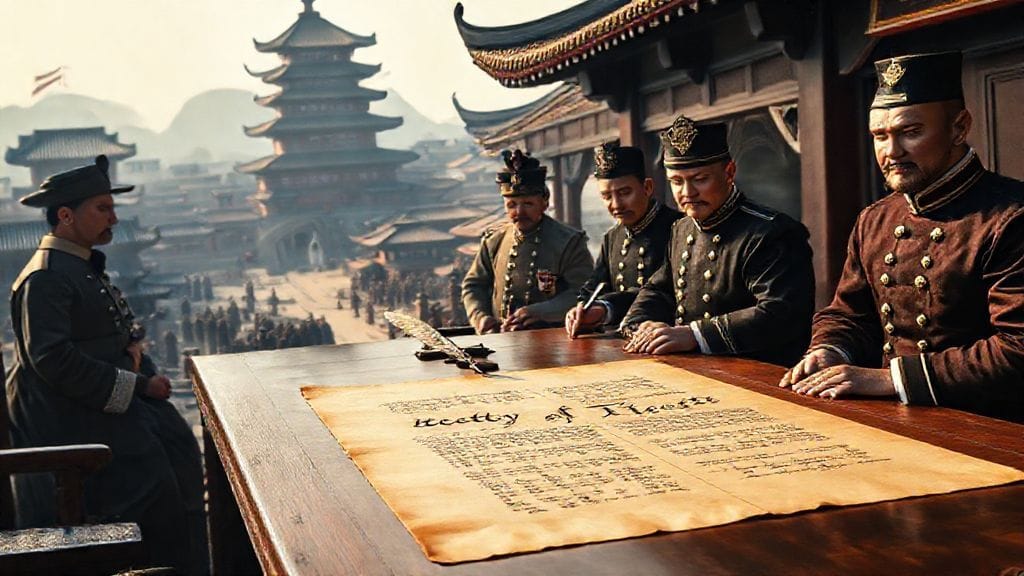
On a humid summer morning in June 1885, the city of Tientsin—now Tianjin—buzzed with anxious energy. Smoke from distant battles still clouded the skies, and the uneasy quiet that filled the streets belied the tectonic shifts underway in East Asia. The Treaty of Tientsin was about to be signed, concluding a bitter and costly conflict between two proud empires: France and Qing Dynasty China. But beneath the ink and parchment, this treaty represented far more than a diplomatic formality—it was a moment where colonial ambition, national pride, and regional balance converged with enduring consequences.
This historical juncture encapsulated the climax of the Sino-French War (1883-1885), a conflict fueled by imperial competition over Vietnam’s future, clashing visions of sovereignty, and a strategic rivalry with global reverberations. The Treaty of Tientsin, signed on June 9, 1885, would leave scars on the face of East Asia, define the limits of Qing power, and echo into the geopolitics of the twentieth century.
2. France and China: Ambitions Collide
The late 19th century was an era of imperial fervor. France, still smarting from the humiliations of the Franco-Prussian War (1870-71), sought to expand its colonial empire and restore national pride. Its eyes settled on Southeast Asia, where the ancient Qing dynasty’s grip appeared fragile and vulnerable amid internal decay and rising nationalist stirrings.
China, under the Qing, was grappling with the corrosive aftermath of the Opium Wars, internal rebellion, and a desperate need to reassert authority. Yet, its hold on vassal kingdoms such as Vietnam—historically part of its tributary system—was increasingly tenuous. France interpreted this as an opportunity, asserting control over Tonkin (northern Vietnam) and Cochinchina (southern Vietnam), triggering confrontation with Beijing.
Emperor Guangxu and the Qing court, wary of losing face and dominion, perceived French advances as a direct challenge. The clash was inevitable—a collision between European colonial determination and Asian imperial resilience.
3. The Spark of War: Tonkin and the French Expansion
The immediate causes of the war trace back to French attempts to consolidate control over Tonkin following treaties with Vietnamese authorities. France's declaration of Tonkin as a protectorate challenged the Qing’s suzerainty, provoking military responses.
French military expeditions repeatedly clashed with Chinese troops and local militias, escalating incidents into full-scale engagements. Battles such as Bac Ninh and Kep set the tone for a brutal confrontation marked by uneven terrain, logistical challenges, and fierce resistance.
The war became a theater demonstrating the limits of traditional Chinese military power and the growing might of modernized European armies equipped with superior artillery and naval capabilities.
4. The Battle Lines Drawn: Military Strategies and Forces
The Sino-French War was fought mainly in northern Vietnam and southern China. French forces, under generals like Louis Brière de l'Isle and Jules de Courcy, combined naval gunboats with ground troops skilled in colonial warfare.
China relied heavily on the regional armies, including the famed “Army of the Green Standard” based in Guangdong, but suffered from poor coordination and outdated tactics. The war saw siege warfare, ambushes, and a test of supply lines through rugged terrain.
Tientsin’s strategic importance lay in its position as the gateway to Beijing by land and sea, making it a critical prize for both sides.
5. The Siege of Tientsin: Holding the Gate to the North
Although the major battles occurred elsewhere, Tientsin became the symbolic focal point. Chinese forces attempted to either defend or reclaim the city to maintain a foothold in negotiations.
The French maintained a naval presence near the port, utilizing their ships to blockade and bombard supply routes. The city’s population endured the stresses of near-conflict, shortages, and the tension of political uncertainty.
This phase of the war highlighted how the confrontation extended beyond battlefields into urban centers, impacting civilians and upsetting traditional life.
6. Diplomatic Manoeuvres Behind the Cannon Fire
While armies clashed, diplomats in Paris, Beijing, and London engaged in a complex dance of negotiation, brinkmanship, and international observation.
The British Empire, closely watching the rising French influence in Southeast Asia, was cautious but eager to preserve its own colonial interests in nearby Hong Kong and Burma.
Russian diplomats, meanwhile, eyed the vacuum left by weakening Qing power, plotting to expand influence northward.
Negotiations were punctuated by ceasefires, ultimatums, and secret correspondence, painfully slow in resolving the tangled questions of sovereignty and trade.
7. The Treaty of Tientsin: An Unequal Accord
Signed on June 9, 1885, the Treaty of Tientsin effectively ended the Sino-French War but left deep wounds. The document forced China to recognize the French protectorate over Tonkin and Cambodia, effectively ceding control over Vietnam.
In return, France promised to respect China’s other territorial possessions and refrain from further aggression. However, the imbalance favored French interests and marked a significant diminution of Qing influence.
The treaty included provisions on trade rights, diplomatic representation, and indemnities, underscoring the unequal nature of the settlement.
8. Key Provisions: Concessions, Sovereignty, and Influence
Among the treaty's most consequential clauses were China’s formal acknowledgment of the French protectorate over Vietnam—a seismic shift in Southeast Asian geopolitics.
France secured trade privileges in Tianjin and other treaty ports, expanding access to lucrative markets.
China agreed to pay war indemnities, straining an already fragile treasury.
Furthermore, the treaty allowed for the establishment of French consular offices and missionaries in the region, deepening France’s cultural and political reach.
9. Political Repercussions in Beijing and Paris
In Beijing, the treaty triggered intense debates over Qing weaknesses and the failure to protect tributary states.
Empress Dowager Cixi, the dominant political figure, faced mounting pressure from reformists and conservatives alike.
In Paris, the treaty brought a measure of relief and pride, seen as restoration of France’s greatness, but critics warned of the long-term costs of colonial overstretch.
The war and treaty also spurred military modernization efforts and a rethinking of foreign policy on both sides.
10. The Human Toll: Soldiers, Civilians, and Cultural Shock
Beyond treaties and politics, the Sino-French War exacted a heavy human cost.
Thousands of soldiers, Chinese, French, and Vietnamese, perished amid combat, disease, and hardship.
Local populations suffered displacement, famine, and cultural upheaval as colonial forces asserted control.
Letters from French officers speak of harsh climates and unexpected bravery from Vietnamese guerrillas, while Chinese reports lamented corruption and inadequate support.
The war altered the social fabric of the region, leaving scars that would last generations.
11. The Role of International Powers: Britain, Russia, and Japan
Although primarily a conflict between France and China, other great powers watched closely.
Britain, wary of French expansion, sought to maintain balance through diplomacy and regional naval power.
Russia, engaged in its "Great Game" across Asia, eyed opportunities to press its claims in Manchuria.
Japan, freshly modernized and ambitious, observed the war with growing interest, seeing a weakening China as an opening for its own imperial designs.
Their indirect involvement would shape subsequent events in East Asia.
12. The War’s Impact on Sino-French Relations
The treaty ushered in decades of uneasy coexistence.
While direct hostilities ceased, diplomatic mistrust persisted.
France consolidated control over Indochina, but Chinese nationalism began fermenting resentment against foreign incursions.
Commercial and cultural exchanges expanded but remained tinged with suspicion.
The war left a legacy of competition and conflict that would resurface in the 20th century’s turbulent decades.
13. Economic Shifts: Trade, Ports, and Colonial Competition
With treaty provisions opening Chinese ports to French trade, economic dynamics transformed.
European goods flooded markets, challenging traditional Chinese artisans and merchants.
French investments in infrastructure—roads, railways, ports—altered patterns of commerce.
Meanwhile, Chinese exports faced new tariffs and restrictions.
The competition among imperial powers intensified, foreshadowing future conflicts over spheres of influence.
14. The Legacy of the Treaty: Seeds of Future Conflicts
The Treaty of Tientsin was more than a peace document; it was a blueprint for imperial relationships in East Asia.
By codifying colonial control over Vietnam and expanding foreign privileges in China, it undermined Qing sovereignty.
The humiliation deepened nationalist fervor and reformist zeal within China, contributing to movements leading to the 1911 Revolution.
The treaty also emboldened France’s colonial agenda but planted the roots for Vietnamese resistance and independence struggles.
15. Reflections on the War’s Place in Global Imperialism
The Sino-French War and its conclusion at Tientsin epitomize the age of high imperialism.
It reveals the clash between fading regional powers and aggressive Western empires.
The conflict was a microcosm of broader patterns: gunboat diplomacy, unequal treaties, and resistance amid subjugation.
Studying this moment invites reflection on the human costs of empire and the complexities of cultural encounters.
16. Conclusion
As the ink dried on the Treaty of Tientsin’s pages, the peoples of Asia faced an uncertain future. What seemed a diplomatic victory for France was a harbinger of shifting powers and impending revolutions. The Qing dynasty’s retreat from Southeast Asia marked a painful chapter of decline, while Vietnam entered a new era under colonial rule—a dual narrative of loss and resilience.
Yet, beneath the formalities of treaties and soldier’s reports, the story remained human: ambitions dashed and dreams forged anew, sacrifices uncounted, and a world just beginning to understand the profound interconnectedness shaped by conquest and diplomacy.
This moment in history reminds us how the distant echoes of a gunfire or a signature can ripple across continents and centuries, leaving indelible marks on the soul of nations.
Conclusion
The Treaty of Tientsin, borne from the fires of the Sino-French War, stands as a pivotal episode in the chronicles of imperial struggle. It encapsulates the collision of empires, the fragility of sovereignty, and the tensions inherent in the great game of nations. While it formalized French dominance in Indochina, it also exposed the Qing dynasty’s vulnerabilities and heralded the rise of new powers in Asia.
More than a historical footnote, the treaty invites us to contemplate the tangled legacies of colonialism and resistance—the human stories behind cold documents and battlefield reports. It teaches that history is never merely about agreements; it is about people, their conflicts, their ambitions, and the relentless passage of change.
In reflecting on this treaty, we gain insight into the forces that shaped modern Asia, and into the universal quest for dignity, identity, and sovereignty amid the tides of empire.
FAQs
1. What triggered the Sino-French War?
The war was primarily provoked by France’s expansion into northern Vietnam (Tonkin), challenging China’s tributary claims and provoking military confrontations.
2. Why was the Treaty of Tientsin significant?
It ended the war, forced China to recognize French control over Vietnam, and imposed unequal terms that weakened Qing sovereignty and expanded French colonial influence.
3. Who were the main figures involved in the conflict?
Key actors included French generals Louis Brière de l’Isle and Jules de Courcy, as well as Qing officials under the Empress Dowager Cixi who controlled China’s foreign policy.
4. How did the war impact civilians?
Many civilians suffered displacement, famine, and violence during military campaigns. The war disrupted traditional societies and economies in affected regions.
5. What role did other powers play?
Britain, Russia, and Japan observed the conflict carefully, with Britain especially concerned about balancing French influence; their indirect involvement shaped regional dynamics.
6. Did the treaty bring lasting peace?
While it ended active hostilities between France and China, underlying tensions and nationalist movements continued, leading to future conflicts in the region.
7. How did the treaty affect China’s position internationally?
It symbolized Qing weakness, eroding China’s standing and accelerating reformist and revolutionary energies within the empire.
8. What lessons can we draw from the Sino-French War today?
The war illustrates the costs of imperial rivalry, the complexities of diplomacy amid power shifts, and the enduring impact of colonialism on national identities.