Table of Contents
- The Final Winter of a Legend: January 17, 1468
- Skanderbeg: The Man Behind the Myth
- The Turbulent Balkans in the 15th Century
- The Rise of Gjergj Kastrioti — From Noble Prince to National Hero
- Forging a Resistance: The League of Lezhë
- The Iron Grip of the Ottoman Empire
- Skanderbeg's Military Genius: Battles That Defined an Era
- The Winter Months Leading Up to January 1468: Signs of Decline
- The Deathbed of a Warrior: Eyewitness Accounts and Chronicles
- How Skanderbeg’s Death Shifted the Balance of Power in Albania
- The Immediate Aftermath: Fractures and Fading Unity
- Venetian and Ottoman Reactions: The Geopolitical Chessboard
- The Legacy of Skanderbeg in Albanian National Identity
- Myth and Memory: Skanderbeg in Renaissance Europe
- Artistic and Literary Tributes Across Centuries
- Modern Albania’s Reverence: Symbolism and Statecraft
- Skanderbeg’s Ghost in Contemporary Balkan Politics
- The Rediscovery and Commemoration of His Tomb
- Lessons from a Life Cut Short: Heroism and Human Fragility
- Conclusion: Enduring Flame in a World of Shadows
- FAQs: Understanding Skanderbeg’s Death and Legacy
- External Resource
- Internal Link
The Final Winter of a Legend: January 17, 1468
It was a cold, bleak winter morning in the rugged hills surrounding Lezhë, a modest town perched in northwestern Albania. The biting wind cut through the scant stone walls of a modest chamber, where an ailing man, once the fierce flame of rebellion against an empire, lay motionless. His breaths came shallow and uneven, the weight of years battling invaders now pressing on his frail body. Outside, the world continued to swirl with conflict, but inside that dimly lit room, an era was about to end.
Gjergj Kastrioti, known to history as Skanderbeg, Albania’s indomitable prince and symbol of resistance against the Ottoman tide, breathed his last on January 17, 1468. His death was not merely the passing of a man; it was the severing of a unifying force, a blow that echoed far beyond the stone walls of Lezhë. If wars are often decided by arms and strategy, sometimes they pivot on the mortal limits of a single figure.
As the news spread across the Balkans and into the courts of Europe, a mixture of awe, sorrow, and foreboding swept through both allies and enemies alike. Who was this fierce warrior who stood against the vast Ottoman Empire when most European powers flinched? What made his death not simply a historical footnote but a profound turning point in the annals of South-Eastern Europe?
This narrative aims to trace the arc of Skanderbeg’s final days, unravel the complex web of political and military tension surrounding his life and death, and capture the enduring shadow he cast on history.
Skanderbeg: The Man Behind the Myth
Born as Gjergj Kastrioti around 1405 into a noble Albanian family, Skanderbeg embodies the paradox of history: a prince turned warrior, a man who wore both chainmail and diplomacy with the same resolute strength. From his earliest years, his life was shaped by the tides of conquest and loyalty. As a youth, he was taken hostage by the Ottomans—a common tactic intended to ensure the allegiance of subjugated families. Yet, instead of breaking him, this experience forged in him a martial prowess and political acumen that would later threaten the empire that once held him captive.
To call Skanderbeg merely a military commander misses the essence of his legacy. He was a symbol who carried the aspirations of fractured Albanian principalities yearning to assert their identity amidst encroaching foreign domination. His aptitude for uniting these often warring clans into a cohesive resistance was nothing short of extraordinary, a testament to his charisma and vision.
The Turbulent Balkans in the 15th Century
The 15th century Balkans were a crossroads of cultures, faiths, and ambitions. The Ottoman Empire was expanding relentlessly westward, toppling kingdoms, and reshaping the political landscape. Small Christian principalities and city-states found themselves trapped between the hammer of Ottoman conquest and the anvil of Venetian and Hungarian strategic games.
Albania, a land of craggy mountains and fiercely independent tribes, became a battleground where loyalties shifted and survival was a daily gamble. The Ottoman threat was not just military but existential: the imposition of Islam over largely Christian populations brought with it cultural and social upheavals. Feudal lords faced the stark choice of submission, collaboration, or resistance.
Skanderbeg’s rise amidst this chaos was a beacon for many disillusioned by the broader European powers’ reluctance to intervene meaningfully against Ottoman advances.
The Rise of Gjergj Kastrioti — From Noble Prince to National Hero
Gjergj Kastrioti’s early years, including his youth spent as a hostage in the Ottoman court, honed his skills in warfare and statecraft. He was trained in the Islamic military system yet never abandoned his Christian roots. The turning point came in 1443, during the Battle of Niš, when he deserted the Ottoman ranks and reclaimed his family lands with the support of local chieftains and European allies.
From that moment, Skanderbeg fashioned himself as the protector of Albania’s autonomy. His signature red flag, emblazoned with a black double-headed eagle, became a rallying symbol — one that still adorns the Albanian flag today.
Forging a Resistance: The League of Lezhë
In 1444, Skanderbeg orchestrated the League of Lezhë, a remarkable alliance of Albanian nobles who put aside their rivalries in the face of Ottoman expansion. This coalition marked one of the first united efforts of Albanian principalities to stand as one against a common enemy.
More than a military alliance, the League was a statement of emerging national consciousness. Its formation underlined Skanderbeg’s strategic genius—knowing well that fragmented resistance could only spell doom against the Ottomans' disciplined forces.
The Iron Grip of the Ottoman Empire
At the time, the Ottoman Empire was at its zenith, a well-oiled war machine that combined formidable infantry, cunning cavalry, and efficient logistics. Sultan Mehmed II, the conqueror of Constantinople, eyed the Balkans as vital to securing his empire’s European frontiers.
But Skanderbeg’s resistance pierced the seeming invincibility of the Ottomans. Between 1443 and 1468, the Albanian leader waged a guerilla war, ambushing Ottoman detachments, fortifying mountain passes, and exploiting local knowledge to frustrate his adversaries.
His victories were often outnumbered and against the odds, inspiring even distant European courts to lend moral and material support, though often limited and insufficient.
Skanderbeg’s Military Genius: Battles That Defined an Era
The Battle of Torvioll in 1444 marked the beginning of his string of tactical victories that would become legendary. Over the next two decades, Skanderbeg’s forces ambushed and repelled Ottoman campaigns repeatedly — from the fields near Krujë to deep within the Albanian highlands.
His unique style combined guerilla tactics with conventional siege warfare, and his ability to inspire loyalty among his clans was key. It is said that even Ottoman commanders respected his prowess, grudgingly admiring the tenacity of this rock in their expansionist current.
The Winter Months Leading Up to January 1468: Signs of Decline
By the winter of 1467-1468, the long years of campaigning had taken their toll. Chroniclers speak of Skanderbeg’s deteriorating health—perhaps aggravated by wounds, age, or disease—weakening his once indomitable spirit.
His enemies, ever vigilant, sensed an opportunity. The cohesion of the League of Lezhë had begun to fray under the pressure of constant warfare and scarce resources.
In the cold chambers of his last refuge in Lezhë, the once vibrant lion of Albania rested, knowing that the future was uncertain.
The Deathbed of a Warrior: Eyewitness Accounts and Chronicles
Primary accounts of Skanderbeg’s death come from various chroniclers — some Albanian, others Venetian and Ottoman. They concur on the poignancy of his final moments: surrounded by trusted lieutenants and clergy, receiving last rites, a man who knew he was leaving behind a cause still unfinished.
One Venetian observer wrote, “The day the eagle fell silent, the Balkans seemed dimmer—a sun had set on resistance.”
These testimonies humanize the warrior, showing a man who bore not only wounds of war but the weight of a people’s hopes.
How Skanderbeg’s Death Shifted the Balance of Power in Albania
With Skanderbeg’s passing, the delicate alliance he had forged began unraveling swiftly. Rival noble families returned to their feuds; some switched allegiances to the Ottomans or Venetians, seeking survival rather than honor.
The Ottomans exploited this fragmentation, renewing campaigns to subdue Albania fully. Without their unifying leader, the Albanian resistance lost momentum, and within a generation, many of the lands were under Ottoman control.
The Immediate Aftermath: Fractures and Fading Unity
Skanderbeg’s death exposed the fragile fabric of political unity in the region. Albanian principalities became vulnerable, and the League of Lezhë, which had held them together, steadily dissolved.
Venice, sensing strategic advantage, increased its influence along the coast while skirmishes erupted inland, painting a grim picture of decline for the once hopeful rebels.
Venetian and Ottoman Reactions: The Geopolitical Chessboard
European powers watched with calculated interest. Venice sought to contain Ottoman advances along the Adriatic, sometimes allying with Albanian leaders, other times pursuing its mercantile priorities.
Ottomans intensified their efforts under Sultan Mehmed II’s successors to finalize dominance in the region. Skanderbeg’s death marked a clear signal: the Albanian resistance could be broken — if fragmented enough.
The Legacy of Skanderbeg in Albanian National Identity
Despite political setbacks, Skanderbeg became an immortal symbol of defiance and national pride. Centuries later, Albanian nationalism would resurrect his image as the father of the nation, an archetype of courage and independence.
The double-headed eagle on Albania’s flag is inherited directly from Skanderbeg’s war banner — a vivid reminder that even the shadow of one man can cast a long light.
Myth and Memory: Skanderbeg in Renaissance Europe
Skanderbeg was not merely a Balkan hero; Renaissance Europe admired him as a bulwark against Ottoman expansion. Writers such as Marin Barleti chronicled his exploits, blending history and legend, inspiring poets and artists for generations.
His story crossed borders, shaping Western concepts of heroism, patriotism, and resistance against imperial oppression.
Artistic and Literary Tributes Across Centuries
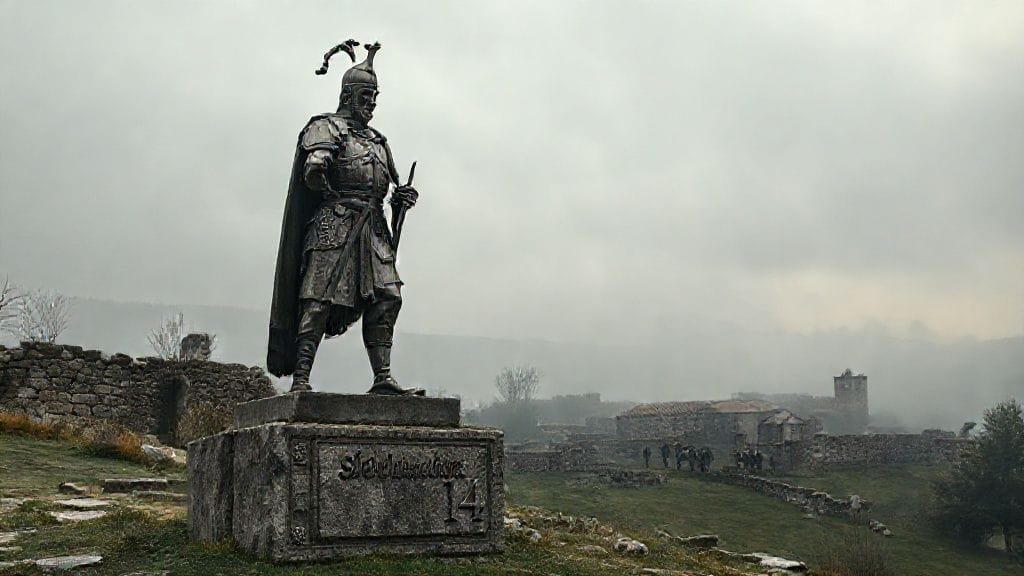
From Renaissance frescoes in Italy to 19th-century Albanian folk songs, Skanderbeg’s memory has been enshrined in diverse cultural expressions. His helmet, adorned with a goat’s head, became an iconic artifact reproduced in museums and literature.
Many historians argue it is through this myth-making that Skanderbeg has transcended the confines of his era.
Modern Albania’s Reverence: Symbolism and Statecraft
Today, Skanderbeg’s image dominates Albanian monuments, currency, and public spaces. He serves as a unifying emblem for a nation forged in hardship, inviting continuous reflection on sovereignty, resilience, and identity.
Political leaders invoke his legacy to rally citizens and strengthen national coherence in a complicated Balkan context.
Skanderbeg’s Ghost in Contemporary Balkan Politics
Even now, Skanderbeg’s memory features in the region’s complex identity debates. Different ethnic and religious groups claim various parts of his legacy, underscoring the enduring power of history in shaping present conflicts and reconciliations.
His figure remains a crucial reference point in discussions about national belonging and historical justice.
The Rediscovery and Commemoration of His Tomb
Skanderbeg’s exact burial site remained a subject of mystery for centuries. Recent archaeological efforts near Lezhë aimed to locate and honor the final resting place of the hero, reviving interest in tangible connections to the past.
Annual ceremonies and state commemorations continue to solidify his place as an eternal guardian of Albanian spirit.
Lessons from a Life Cut Short: Heroism and Human Fragility
Skanderbeg died not in a blaze of glorious final battle but in quiet exile from health and time—reminding us that even legends are human. His story offers poignant reflections on leadership, sacrifice, and the costs of resistance.
In the end, the lion who roared through the Ottoman storm found rest, but his echo remains.
Conclusion: Enduring Flame in a World of Shadows
Gjergj Kastrioti Skanderbeg’s death on January 17, 1468 was more than a historical event—it was a fulcrum that shaped Albania’s fate and the wider Balkan theatre. Though his life was finite, the ideals he embodied—freedom, unity, resilience—transcended centuries.
In a region scarred by division and conquest, Skanderbeg endures as a beacon of hope, a reminder that even against overwhelming odds, the human spirit can resist the erasure of identity. His story invites us to consider how history molds nationhood, how myth and reality intertwine, and how a single life, lived with conviction, can inspire countless hearts long after the final breath.
FAQs
Q1: What caused Skanderbeg’s death in 1468?
A1: Historical accounts suggest that Skanderbeg died of natural causes, likely related to illness compounded by years of warfare and perhaps injuries. Specific diagnoses remain uncertain, but chroniclers emphasize his declining health during the harsh winter months leading up to his death.
Q2: How did Skanderbeg’s death affect the Albanian resistance?
A2: His death precipitated the fracturing of the League of Lezhë and the loss of centralized leadership, making it difficult for Albanian forces to sustain their united resistance against the Ottomans. This led to the gradual Ottoman takeover of Albania.
Q3: Who were Skanderbeg’s key allies during his life?
A3: Skanderbeg allied mainly with various Albanian princes under the League of Lezhë, as well as receiving intermittent support from Venice, Hungary, and the Papacy, who saw him as a frontier bulwark against Ottoman expansion.
Q4: Why is Skanderbeg considered a national hero in Albania?
A4: Skanderbeg symbolizes Albanian unity, courage, and the struggle for independence. His leadership is seen as the foundational moment of Albanian national consciousness, making him a unifying figure transcending generations.
Q5: How did European powers view Skanderbeg during his lifetime?
A5: Renaissance Europe admired him as a defender of Christendom against the Ottomans. Writers and statesmen praised his military skill and determination, although political support was often limited by their own strategic interests.
Q6: Where is Skanderbeg buried?
A6: Skanderbeg is believed to have been buried in Lezhë. The exact location of his tomb remained unknown for centuries but has been the subject of archaeological investigation and national commemoration efforts.
Q7: What symbols associated with Skanderbeg remain important today?
A7: The double-headed black eagle on a red background, Skanderbeg’s war banner, is now the flag of Albania. Additionally, his helmet with the goat’s head emblem is an iconic artifact representing his legacy.
Q8: How is Skanderbeg remembered in modern culture?
A8: Beyond history books, Skanderbeg features in Albanian literature, music, festivals, and political discourse, serving as a perennial symbol of resistance and identity.