Table of Contents
- The Dawn of a New Era: June 25, 1991
- The Rise of Nationalism in Yugoslavia
- Seeds of Dissolution: Economic and Political Fractures
- The Role of the Communist Party and Tito's Legacy
- Slovenia and Croatia: Distinct Identities and Aspirations
- The Road to Declaration: Growing Tensions and Negotiations
- The Morning of Independence: Historic Declarations in Ljubljana and Zagreb
- Immediate Reactions: From Jubilation to Outrage
- The Yugoslav Federal Government Responds: Attempts at Containment
- The Ten-Day War in Slovenia: A Brief but Decisive Conflict
- Croatia’s Struggle for Sovereignty: The Escalating Conflict
- International Community’s Hesitation and Recognition
- Human Stories Amidst Political Upheaval
- The Role of Media and Propaganda in Shaping Narratives
- Breaking Apart: The Disintegration of Yugoslavia Accelerates
- The Aftermath: War, Displacement, and New Nations
- Economic Consequences of Independence
- Cultural Renaissance and Identity Reclamation
- Slovenia and Croatia in the Global Arena Post-1991
- Lessons from 1991: Sovereignty, Ethnicity, and Modern Nationalism
- Commemorations and Historical Memory Today
The Dawn of a New Era: June 25, 1991
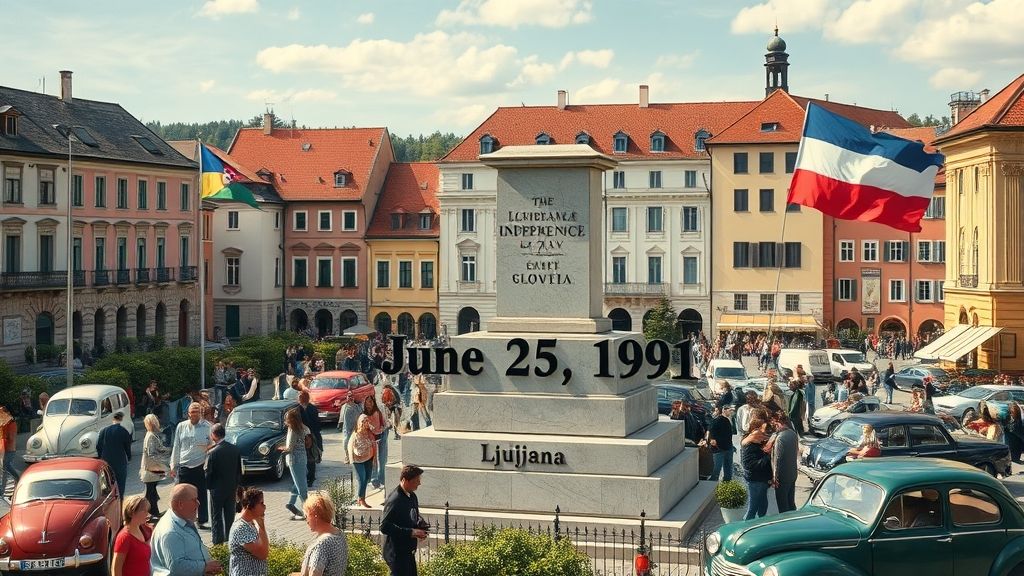
The summer sun bore down on the capitals of Ljubljana and Zagreb, casting long shadows over assemblies brimming with hope and apprehension. It was June 25, 1991, a day electrified with tension and colored by the stirring of dreams long suppressed. Crowds gathered outside the ornate government buildings, waving flags bright with new promises — the tricolor banners of independent Slovenia and Croatia. Inside, declarations were read in resonant voices that echoed through slippery corridors of history. For the people who had lived under the shadow of the Socialist Federal Republic of Yugoslavia, it was a moment of breathtaking emancipation and daunting uncertainty.
The proclamations did not merely announce the birth of two states; they heralded the collapse of a post-war order, one painstakingly built to unite disparate ethnicities under the banner of brotherhood and unity. But as the words settled over the cities, so too did the chilling realization: the path forward would be anything but peaceful.
The Rise of Nationalism in Yugoslavia
To understand why a summer day in 1991 became a pivotal rupture in Europe's twentieth-century mosaic, one must trace the slow, simmering rise of nationalism beneath Yugoslavia's surface. Formed in the aftermath of World War I and reimagined after World War II under the iron will of Josip Broz Tito, Yugoslavia was a patchwork of Serbs, Croats, Slovenes, Bosniaks, Macedonians, Montenegrins, and Albanians.
For decades, Tito’s rule suppressed nationalist fervor, balancing competing ethnic interests with a firm hand and the ideology of communist unity. However, beneath this carefully maintained calm, ethnic identities never waned; instead, they gathered strength in the shadows. The decline of communism across Eastern Europe in the late 1980s unleashed dormant resentments and aspirations. Old grievances concerning economic disparity, cultural recognition, and political representation resurfaced forcefully.
Seeds of Dissolution: Economic and Political Fractures
Yugoslavia in the 1980s was a cauldron of economic crises and growing political dissatisfaction. Hyperinflation, unemployment, and regional imbalances frayed the bonds that once seemed unbreakable. Slovenia, with its relatively advanced and stable economy, resented subsidizing the less developed southern republics. Croatia, a mosaic of ethnic Croats and Serbs, faced internal tensions aggravated by growing nationalist rhetoric.
President Tito's death in 1980 left a vacuum that no collective presidency could fill. The federal government descended into paralysis, unable to mediate rising disputes. Meanwhile, Serbia, with its dominant position in the federation and empowered by the charismatic yet divisive leader Slobodan Milošević, sought to recentralize authority — a reversal that alarmed other republics and inflamed ethnic nationalism.
The Role of the Communist Party and Tito's Legacy
Tito’s unique leadership style stemmed from his ability to forge a diverse federation into a relatively stable socialist state. His vision of "brotherhood and unity" masked deep ethnic rivalries but maintained political order. The League of Communists was the spine of this complex architecture, regulating and integrating the various republics.
By the late 1980s, however, the party's grip weakened under the pressure of reform movements sweeping across Eastern Europe. Slovenia and Croatia pioneered pushes for liberalization and autonomy within the party, foreshadowing their eventual break. This internal conflict within the communist apparatus was more than ideological — it was an existential struggle over the future shape of Yugoslavia.
Slovenia and Croatia: Distinct Identities and Aspirations
Slovenia and Croatia each nurtured a distinct national identity with unique cultural, linguistic, and historical traditions. Slovenia’s Alpine geography and closer ties to Central Europe contrasted with Croatia’s Mediterranean coast and complex ethnic makeup. Both republics felt suffocated under Belgrade’s rising authoritarianism and perceived Serbian hegemonism.
Croatia’s population included a substantial Serb minority, raising fears of internal conflict. Despite this, Croatian nationalism surged, galvanized by leaders like Franjo Tuđman. Meanwhile, Slovenia embraced a pragmatic nationalism that emphasized European integration and economic reform.
The Road to Declaration: Growing Tensions and Negotiations
The path toward independence was neither simple nor inevitable. Throughout 1990 and early 1991, Slovenia and Croatia navigated a landscape thick with diplomatic overtures, constitutional battles, and behind-the-scenes maneuvering. Nationalist parties pushed for secession, while federal authorities insisted on preserving Yugoslavia's territorial integrity.
Negotiations faltered as each side hardened positions. The Yugoslav Army moved troops into Slovenian territory under the guise of preserving the federation, setting the stage for direct confrontation. Meanwhile, popular assemblies in Ljubljana and Zagreb voted overwhelmingly for independence, fueling a growing sense of inevitability.
The Morning of Independence: Historic Declarations in Ljubljana and Zagreb
On a bright June morning, the two republics delivered historic statements. The Slovenian Parliament read a solemn and dignified declaration, emphasizing sovereignty, democratic governance, and respect for human rights. Not far away in Zagreb, Croatian representatives echoed this break from the federation, invoking self-determination and the right to freedom.
The streets erupted in celebrations; jubilation reverberated through cafes, markets, and homes. For many, it was the fulfillment of dreams deferred by decades of socialist rule and war. Yet, beneath the spectacle of hope, fear strummed a dark theme — especially among minorities and those wary of violent repercussions.
Immediate Reactions: From Jubilation to Outrage
The Yugoslav federal government and in particular the Serbian leadership viewed the twin declarations as an existential threat. Ivan Stambolić and Slobodan Milošević led campaigns to "preserve Yugoslavia" through military and political means. Federal institutions denounced the declarations as illegal and unilateral acts of secession.
Meanwhile, within Slovenia and Croatia, minority groups — especially ethnic Serbs in Croatia — expressed deep unease. Propaganda intensified, painting the new republics as nationalistic and aggressive, setting a volatile stage for the conflicts to come.
The Yugoslav Federal Government Responds: Attempts at Containment
The federal government’s response was swift and uncompromising. The Yugoslav People’s Army (JNA), nominally a pan-national institution, began mobilizing to prevent the breakup. In Slovenia, a seemingly precise and limited campaign was launched to regain control over border posts and strategic infrastructure.
Yet, the JNA was caught between conflicting loyalties and an unfamiliar terrain. Many Slovenian conscripts refused orders. The military’s intervention here was relatively brief but symbolic, embodying the fracture of Yugoslavia’s unity.
The Ten-Day War in Slovenia: A Brief but Decisive Conflict
From June 27 to July 7, 1991, the so-called Ten-Day War unfolded. Slovenian territorial defense units resisted the JNA’s limited incursion with guerrilla tactics and popular support. Despite some skirmishes and casualties, the conflict remained contained compared to the doom awaiting Croatia.
Internationally, the short war demonstrated Slovenia's resolve and exposed the federal army's vulnerabilities. It ended with the Brioni Agreement brokered by the European Community, giving Slovenia a de facto independence and a three-month moratorium.
Croatia’s Struggle for Sovereignty: The Escalating Conflict
Croatia's path was bloodier and more protracted. Ethnic tensions exploded as Serb-controlled areas within Croatia launched an insurrection, supported by the JNA. Cities like Vukovar and Dubrovnik became epicenters of brutal sieges.
The Croatian War of Independence would last until 1995, marked by ethnic cleansing, sieges, and war crimes. This conflict left deep wounds in the Croatian social fabric, with thousands dead and hundreds of thousands displaced.
International Community’s Hesitation and Recognition
The international response was cautious and often hesitant. Governments feared further destabilization in a region still haunted by the recent trauma of World War II. The European Community, under German pressure, eventually recognized Slovenia and Croatia in January 1992.
This recognition legitimized the new states but also polarized regional politics. Meanwhile, the United Nations and major powers scrambled to mediate a devastating conflict whose reverberations would continue for decades.
Human Stories Amidst Political Upheaval
Amid sweeping political shifts, individual lives intersected this historic moment in poignant ways. Teachers in Ljubljana exchanged emotional farewells, soldiers confronted the painful choice of loyalty, and families torn by ethnic divides were forced into exile or betrayal.
One particularly poignant anecdote follows Marija, a Croatian Serb nurse, who remained dedicated to saving lives regardless of nationality, embodying the harrowing human cost behind political lines.
The Role of Media and Propaganda in Shaping Narratives
The battle for hearts and minds was crucial. State media in Serbia emphasized threats from separatists, while Slovenian and Croatian outlets celebrated independence as liberation. The rapid spread of nationalist rhetoric fed fear and hatred, escalating tensions.
International media coverage brought the region’s turmoil to global attention, often simplified or polarized. This media environment shaped perceptions long after the guns fell silent.
Breaking Apart: The Disintegration of Yugoslavia Accelerates
The independence of Slovenia and Croatia ignited a domino effect. Bosnia and Herzegovina declared independence in 1992, plunging further into violence. Macedonia followed, and the federation’s collapse accelerated. Yugoslavia fractured into seven countries by mid-1990s, each forged through blood and diplomacy.
The dissolution of this federal state reshaped the geopolitical landscape of Southeastern Europe and tested international norms regarding sovereignty and self-determination.
The Aftermath: War, Displacement, and New Nations
The wars accompanying independence pleas left scars. Millions were displaced, ethnic cleansing campaigns wrought havoc, and war crimes challenged global justice systems. Croatia reconstructed its economy and institutions amidst recovery from devastation, while Slovenia integrated swiftly into European structures.
The human toll was incalculable, but so was the resilience. These new nations faced the daunting task of creating stable democracies amid traumatized societies.
Economic Consequences of Independence
Slovenia’s relatively robust industrial base allowed it to rebound and prosper, rapidly becoming a beacon of economic reform in the region. Croatia’s war-torn economy lagged but adapted through tourism and international aid.
The breakup shattered integrated markets, forced currency reforms, and shifted trade patterns radically. The road to recovery was intertwined with political stabilization and international support.
Cultural Renaissance and Identity Reclamation
Post-independence saw an explosion of cultural pride and revitalization. Languages were standardized, folklore celebrated, and history reexamined free from communist redaction. Museums, literature, and film grappled with the recent past while forging new national narratives.
This cultural reawakening fostered unity but sometimes risked exclusionary nationalism, revealing the delicate balance nations had to strike.
Slovenia and Croatia in the Global Arena Post-1991
Slovenia embraced European Union membership and NATO integration, positioning itself firmly within western institutions. Croatia’s journey was longer and more complex, culminating in EU accession in 2013.
Both countries used international diplomacy to assert sovereignty, promote economic development, and heal wartime divisions, while contributing to regional stability.
Lessons from 1991: Sovereignty, Ethnicity, and Modern Nationalism
The declarations of 1991 offer enduring lessons about the power and perils of nationalism, the fragility of multi-ethnic states, and the challenges of balancing self-determination with regional peace. They caution against the temptation of simplistic solutions to complex identity politics.
The Slovenian and Croatian bids for independence resonate today in discussions of secession worldwide, reminding us of the human dimension behind political decisions.
Commemorations and Historical Memory Today
Every June 25th, Slovenia and Croatia remember the moment that changed their destinies. Parades, speeches, and personal testimonies fill the day, mixing pride with somber reflection. Monuments and museums preserve the memory of sacrifice and resilience.
Historical debates continue, but a shared understanding has emerged: June 25, 1991, was not just a political act but a profound human event that shaped the lives of millions.
Conclusion
Slovenia and Croatia’s declarations of independence on June 25, 1991, stand as a watershed moment not only for these nations but for the turbulent trajectory of late 20th-century Europe. This was a moment defined by courage and complexity, when ancient identities met modern aspirations amid the collapse of an ideological order.
The journey from declaration to recognition was fraught with conflict and tragedy, revealing how deeply intertwined identity, politics, and violence can be. Yet, it also unveiled the enduring human spirit — a yearning for dignity and self-rule that would redefine borders and futures.
Today, as we look back on that fateful day, we carry forward lessons about the fragility of peace and the power of hope, aware that history is always a living conversation between past wounds and future dreams.
FAQs
1. Why did Slovenia and Croatia declare independence simultaneously?
Slovenia and Croatia shared similar grievances against the Yugoslav federal government, particularly Belgrade’s attempts to centralize power. Both republics felt their political and economic autonomy was under threat. Coordinating their declarations increased international impact and emphasized the widespread regional desire for sovereignty.
2. What role did ethnic tensions play in Croatia's independence?
Ethnic tensions were central in Croatia, where a significant Serbian minority opposed independence due to fears of marginalization. These tensions escalated into armed conflict and violence, particularly in Serb-inhabited regions, contributing to the brutal Croatian War of Independence.
3. How did Tito’s death influence the breakup of Yugoslavia?
Tito’s death in 1980 removed the central unifying figure who had maintained balance among Yugoslavia’s ethnicities through strong authoritarian rule. His absence allowed nationalist leaders to gain influence and ethnic divisions to deepen, setting the stage for dissolution.
4. What was the international community’s initial stance on Slovenia and Croatia’s declarations?
Initially cautious and reluctant, most international actors feared regional instability. Recognition came only months later, after attempted mediation and increased violence underscored the reality of dissolution.
5. How did the Ten-Day War affect Slovenia’s quest for independence?
The successful resistance against the Yugoslav Army in the Ten-Day War demonstrated Slovenia’s capacity to assert and defend its sovereignty. The swift resolution also gained Slovenia international sympathy and support for its independence.
6. What were the economic impacts of independence on Slovenia and Croatia?
Slovenia’s economy adjusted relatively smoothly due to its developed industrial sector. Croatia faced greater economic challenges due to active warfare and infrastructure destruction but recovered gradually, aided by tourism and reform.
7. How is June 25th commemorated today?
Both countries mark June 25th with national ceremonies, speeches, and cultural events. The day blends pride in national identity with remembrance of the conflicts and sacrifices that shaped their modern states.
8. What lessons does the 1991 breakup of Yugoslavia offer to modern geopolitics?
The events highlight the complexity of balancing ethnic identities within multinational states, the volatility of nationalist sentiments, and the role of international actors in conflict resolution and recognition of sovereignty.