Table of Contents
- The Final Hour in Athens: A City in Mourning
- Sophocles: The Man Behind the Myth
- Athens in 406 BCE: Turmoil and Transition
- The Twilight of a Dramatist: Life and Legacy
- The Last Days of Sophocles: Health, Influence, and Death
- Athens’ Cultural Scene Amidst War and Crisis
- The Peloponnesian War’s Shadow on Art and Society
- Sophocles’ Impact on Greek Tragedy and Its Evolution
- The Immediate Aftermath: Athens Grapples With Loss
- The Public Mourning and Commemoration of a Dramatic Genius
- Sophocles’ Posthumous Reception in Ancient Greece
- The Renaissance of Sophoclean Drama in Later Eras
- Societal and Political Ripples Following His Death
- The End of an Era: How Sophocles’ Death Symbolized Athens’ Changing Fortunes
- Remembering Sophocles Today: Legacy in Modern Culture
- Insights from Historical Sources and Ancient Testimonies
- The Intersection of Myth, History, and Sophocles’ Death
- Tragedy as a Mirror: Athens’ Fate Reflected in Sophocles’ Works
- Mythical Resonances in the Poet’s Passing
- Conclusion: The Eternal Voice of Sophocles in the Human Story
- FAQs: Sophocles, His Death, and Athens in 406 BCE
- External Resource: Wikipedia on Sophocles
- Internal Link: Visit History Sphere
1. The Final Hour in Athens: A City in Mourning
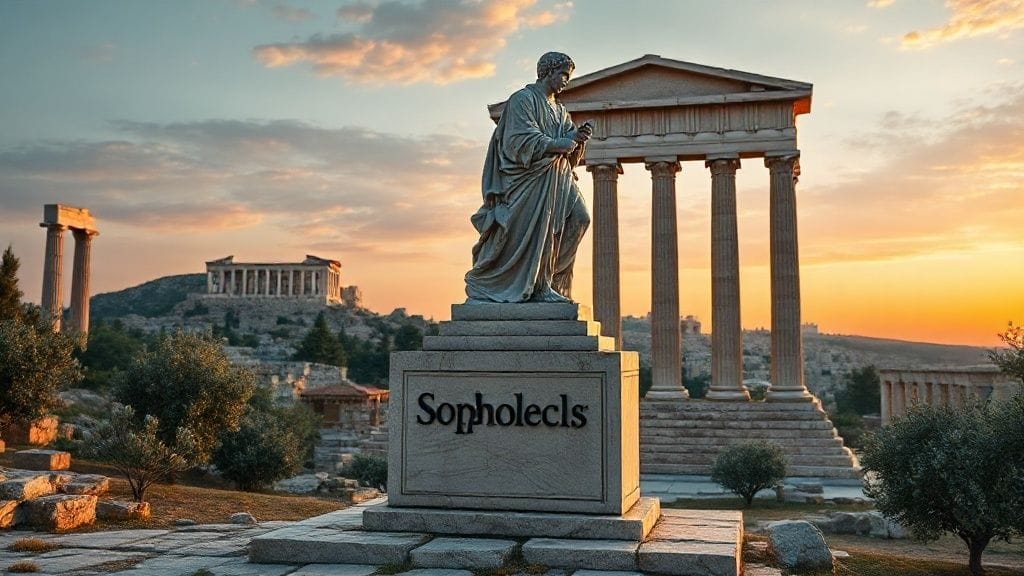
The sun set over the Acropolis in a crimson blaze, casting long shadows over the marbled temples as the city of Athens held its breath. The year was 406 BCE, a dark twilight not only of the Peloponnesian War’s devastation but of the tragic silencing of one of its greatest cultural pillars: Sophocles. The air was heavy with the grief of a city that had lost not just a playwright or a public figure, but a voice—a voice that had echoed through theaters, courts, and hearts for over half a century.
Athens was a city wounded by war and internal strife, yet it had long found solace and reflection in the brilliant tragedies of Sophocles. His death marked more than a personal loss; it was a symbolic end to an epoch of creative genius, a farewell whispered through the corridors of the Dionysian theater and the galleries of its citizens’ collective memory.
2. Sophocles: The Man Behind the Myth
Born around 497 BCE into a wealthy Athenian family, Sophocles was more than a dramatist. He was a statesman, soldier, and a man whose life imbued the rich complexity that his plays would later reveal. Approaching his nineties at the time of his death, he had witnessed Athens rise and fall through some of the most turbulent decades of classical Greece.
Unlike many of his contemporaries, Sophocles projected an optimism about human potential stifled only by fate’s relentless grip. His characters wrestled with moral ambiguities and the heavy weight of divine will—reflecting a mind deeply engaged with the questions of existence, power, and justice.
3. Athens in 406 BCE: Turmoil and Transition
To frame Sophocles’ death is to understand the anxious pulse of Athens itself in 406 BCE. The Peloponnesian War, a brutal and protracted conflict between Athens and Sparta, was in its devastating tenth year. Battles scarred the land, famine and plague had become familiar companions, and political factions splintered the polis.
Athens was reeling from setbacks: the loss of its fleet in the battle of Notium earlier that year and the growing disillusionment with the war effort. Yet the city also harbored grudging hopes—new commanders sought to revitalize Athenian fortunes. In such a climate, the death of a cultural icon like Sophocles hit like a dark omen, as if the gods themselves had turned their gaze away.
4. The Twilight of a Dramatist: Life and Legacy
Sophocles’ career spanned the golden age of Athens, beginning in the late 5th century BCE when tragedy was evolving from its dithyrambic origins into a more structured, psychologically profound art. At age 28, he burst onto the festival circuit by winning over the great Aeschylus. This victory heralded an era of dramatic innovation—most notably his introduction of the third actor, enhancing theatrical complexity and dialogue.
Between 468 and 406 BCE, he authored over 120 plays, though only seven have survived in their entirety. These works—“Oedipus Rex,” “Antigone,” “Electra,” among them—delve into human frailty and divine justice with unmatched insight. Even as Sophocles aged, his artistry seemed to grow richer, tempered by decades of political engagement and personal reflection.
5. The Last Days of Sophocles: Health, Influence, and Death
Reports from antiquity suggest that Sophocles lived to an advanced age despite the era’s rough conditions. Plutarch and other sources allude to his enduring presence in Athenian public life until shortly before his death. While no detailed medical records exist, the playwright’s final years were marked by sustained creative vigor; he was still producing plays and engaging in civic duties.
Yet, as the Peloponnesian War darkened Athens’ skies, Sophocles’ death in 406 BCE symbolized an extinguishing light. His passing was mourned formally, and his funeral procession underscored the public’s recognition of his stature—not simply as an artist, but as an embodiment of Athens’ intellectual and ethical spirit.
6. Athens’ Cultural Scene Amidst War and Crisis
It’s remarkable that amidst the chaos of war, Athens’ cultural machine did not cease. The city’s festivals, particularly the Dionysia, remained vital rituals, holding the community together through shared stories and collective catharsis. Sophocles’ presence loomed large here—not just as a veteran laureate but as a torchbearer of Athens’ artistic identity.
Drama was a mirror reflecting the city’s anxieties, hopes, and failures. Sophocles’ tragedies, with their fatalistic yet deeply humane tone, resonated with audiences wary of the real-world chaos unfolding around them. The playwright’s death thus left a void in a society in desperate need of reflection and meaning.
7. The Peloponnesian War’s Shadow on Art and Society
The war wasn’t just a backdrop—it permeated every aspect of Athenian life. Food shortages, political instabilities, and shifting alliances undermined the social fabric. The war’s psychological toll is echoed in the somber themes of Sophocles’ late plays, which increasingly contemplate fate’s cruelty and the fleeting nature of human power.
In fact, some contemporaries viewed tragic plays as propaganda or tools of morale, designed to prepare citizens for the brutal realities ahead. Sophocles, mastering narrative tension and moral complexity, helped articulate the collective trauma as much as individual sorrow.
8. Sophocles’ Impact on Greek Tragedy and Its Evolution
No study of Greek tragedy is complete without Sophocles. He revolutionized dramatic structure, character development, and thematic depth. His introduction of a third actor changed theater dynamics, allowing for richer narrative interplay and psychological subtlety.
His plays delved into the tension between human free will and divine law, probing ethical dilemmas with a layered complexity that influenced generations of playwrights. Sophocles gave tragedy a form and voice that were both profoundly personal and universally resonant, a legacy still felt today.
9. The Immediate Aftermath: Athens Grapples With Loss
News of Sophocles’ death traveled swiftly, eliciting public grief. His funeral was not a private affair but a communal event, uniting citizens across ideological divides through respect for a shared cultural treasure. Many lamented not merely the man but the ideas and values he symbolized.
The void left by his absence was palpable in the city’s artistic and political circles. New playwrights struggled to fill the gap, often measured against Sophoclean standards that seemed insurmountable. The elder statesman of tragedy had set a bar no one found easy to reach.
10. The Public Mourning and Commemoration of a Dramatic Genius
Ancient accounts describe Sophocles’ funeral as a moment of profound civic solidarity. Citizens gathered to honor the playwright who had shaped their collective consciousness. Scholars suggest that commemorations involved public recitals of his plays and speeches extolling his contributions.
His epitaph, some say, speaks of his dedication to Athens and the gods, linking his artistic achievements to the divine inspiration that sustained the city through adversity. This ritual mourning was both a farewell and an affirmation of the enduring power of art in human life.
11. Sophocles’ Posthumous Reception in Ancient Greece
Even in his own time, Sophocles’ works were preserved, performed, and revered. His plays became canonical texts within the dramatic festivals, with younger playwrights often paying homage or drawing inspiration from his approach. Over centuries, his style was studied and emulated, although later tastes sometimes favored Euripides’ more psychological realism.
Yet Sophocles remained the archetype of classical tragedy, embodying a profound balance of form, theme, and ethical inquiry. His death did not diminish his influence; if anything, it consecrated him as a timeless figure bridging myth and history.
12. The Renaissance of Sophoclean Drama in Later Eras
Centuries after his death, Sophocles’ tragedies resurfaced in Roman times, the Renaissance, and later, their echoes transformed modern theater, literature, and psychology. The timeless conflicts he portrayed—on fate, duty, and human suffering—resonate across cultures and epochs.
Modern dramatists, philosophers, and scholars find in his works a wellspring of insight, inspiring adaptations and reinterpretations that continue to captivate global audiences. The endurance of his art underscores a human quest for meaning amidst chaos.
13. Societal and Political Ripples Following His Death
Sophocles’ passing signaled a subtle shift in Athens’ cultural and political life. As the city’s fortunes declined during the war, its confidence in democratic ideals wavered. The fading of such a monumental artistic voice mirrored wider transformations—skepticism toward power, questions about divine justice, and the place of tradition in an uncertain world.
Some historians argue that the void left by figures like Sophocles contributed to a cultural identity crisis in Athens, where artistic innovation struggled against the backdrop of civic fragmentation.
14. The End of an Era: How Sophocles’ Death Symbolized Athens’ Changing Fortunes
Sophocles died at a moment when Athens stood at a crossroads, battered by war and internal strife. His death was emblematic of an era’s waning light, a farewell to the classical ideal of humanism and balance that his works epitomized.
The next decades saw Athens’ defeat and subjugation, underscoring the fragility of the city-state’s golden age. Yet through this loss, the memory of Sophocles remained an anchor, a reminder of a vision of humanity’s noblest aspirations.
15. Remembering Sophocles Today: Legacy in Modern Culture
More than two millennia later, Sophocles’ legacy persists. His tragedies are studied worldwide, performed on stages from Broadway to small theaters, inspiring philosophical debate and artistic creativity.
In education, his works serve as portals into ancient Greek culture, ethics, and the human condition. They continue to challenge audiences to confront their own notions of fate, responsibility, and resilience.
16. Insights from Historical Sources and Ancient Testimonies
Our understanding of Sophocles’ death and life comes from scattered fragments—Plutarch’s biographies, Aristophanes’ comedic references, and inscriptions. These sources, while limited, portray a revered elder whose impact transcended mere literary achievements.
Ancient playwrights and historians alike acknowledged Sophocles’ ability to capture the complexities of Athenian life, and his death became a symbolic moment recorded in chronicles and collective memory.
17. The Intersection of Myth, History, and Sophocles’ Death
Sophocles’ own plays blur the boundaries between myth and history—his death, too, acquires a mythical hue. In some accounts, his passing is woven into the tragic narrative of Athens itself—a city fated for greatness and destruction.
The dramatist who explored the inescapability of fate was himself subject to history’s inexorable currents, making his death both a personal loss and a communal allegory.
18. Tragedy as a Mirror: Athens’ Fate Reflected in Sophocles’ Works
Sophocles’ tragedies often portray the downfall of noble figures caught in the meshes of destiny. This mirrored Athens’ own trajectory—a city of enlightenment slipping toward ruin. His death in 406 BCE thus echoed this narrative arc, transforming historical reality into profound symbolic meaning.
The resonance between his art and Athens’ destiny continues to fascinate scholars, depicting how individual lives intertwine with collective history.
19. Mythical Resonances in the Poet’s Passing
The manner and timing of Sophocles’ death have themselves invited mythical interpretations. Some ancient commentators saw it as a fulfillment of the tragic patterns he dramatized; others viewed it as a final gift from the gods to the city.
Regardless, the death of Sophocles became enveloped in legend, magnifying his stature as a cultural titan whose life and death transcended ordinary human bounds.
20. Conclusion: The Eternal Voice of Sophocles in the Human Story
Sophocles’ death in 406 BCE stands as both an end and a beginning. The fall of a man who had shaped Athens’ soul took place amid the city’s darkest moments, marking a profound loss felt beyond his time and place.
Yet through his unparalleled artistry, Sophocles left an indelible imprint on humanity’s understanding of itself—its strengths, frailties, and tragic beauty. His voice, though silenced in life, continues to speak across the millennia, reminding us that in tragedy there is a mirror, a question, and ultimately, a shared humanity.
FAQs: Sophocles, His Death, and Athens in 406 BCE
Q1: What were the main causes of Sophocles’ death?
A1: While precise causes are unknown, it is generally accepted that Sophocles died of natural causes at an advanced age, likely from ailments related to old age. No historical record specifies illness or injury.
Q2: How did Sophocles’ death impact Athenian society at the time?
A2: His death was deeply mourned and symbolized the fading of an artistic and cultural golden age amid wartime hardships. It united Athenians in a public mourning that acknowledged his immense contribution.
Q3: Was Sophocles involved in political life, and did this relate to his death?
A3: Sophocles was active politically, serving as a statesman and military commander earlier in life, but there is no direct link between political events and his death; it coincided with turbulent times but was unrelated causally.
Q4: Did Sophocles continue writing plays until his death?
A4: Yes, historical accounts suggest Sophocles remained creatively active into his later years, with some plays produced in the years close to his death.
Q5: How did Sophocles’ contemporaries view his work posthumously?
A5: He was held in the highest esteem, regarded as a master of tragedy and a cultural icon, with his plays becoming a cornerstone of Athenian dramatic festivals.
Q6: What role did the Peloponnesian War play in shaping Sophocles’ later works and his death’s significance?
A6: The war’s hardships permeated Athens’ societal psyche and influenced the somber tones of his later tragedies; his death during this period made his passing emblematic of the city’s struggles.
Q7: How is Sophocles remembered today in literature and education?
A7: He is regarded as one of the greatest ancient playwrights; his works are studied worldwide for their artistic merit and insight into human nature, remaining essential in literature and theater curricula.
Q8: Are there monuments or relics commemorating Sophocles in Athens?
A8: While no known monuments from antiquity survive, ancient sources mention public honors, and modern Athens celebrates Sophocles through theater festivals and academic institutions.
External Resource: Wikipedia on Sophocles
https://en.wikipedia.org/wiki/Sophocles