Table of Contents
- Storms over the Western Seas: Setting the Stage for Submission
- Alfred’s England in Peril: Viking Fire and Saxon Resolve
- The Fractured Lands of the South Welsh Kingdoms
- Saints, Scholars, and Strongholds: Cultural Wales before 890
- Watching the Horizon: Viking Shadows over the Bristol Channel
- Alfred the Great’s Vision of a New Order
- Diplomacy on the Edge of a Sword: Why Southern Welsh Kings Submit
- Across the Borderlands: The Journey to Alfred’s Court
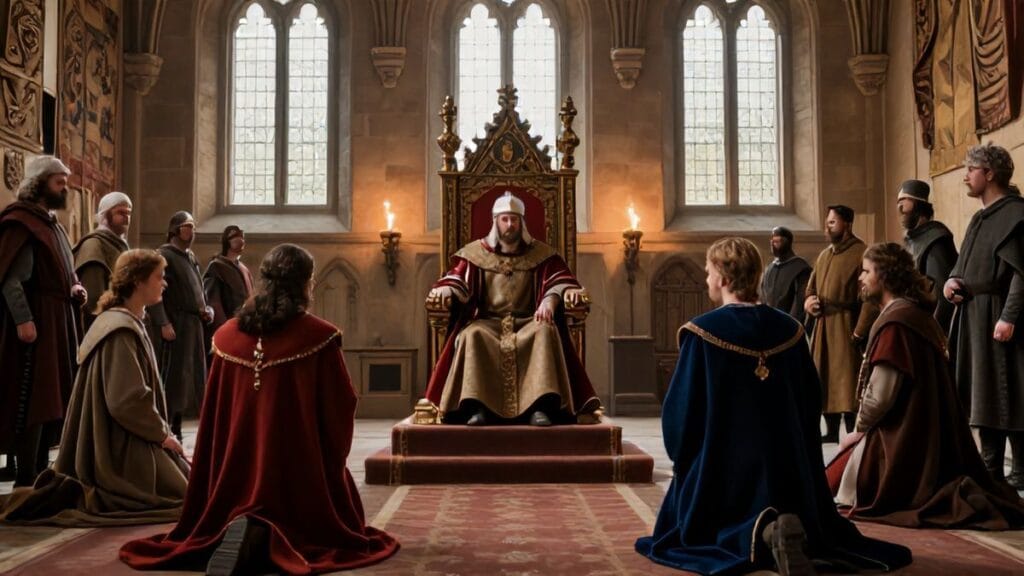
- An Audience in Wessex: Ceremony, Oath, and Symbolic Surrender
- Gold, Oaths, and Hostages: The Real Price of Protection
- Between Pride and Survival: Welsh Reactions to Submission
- Alfred’s Chronicle and the Politics of Memory
- Faith and Power: The Church’s Hand in a Quiet Conquest
- Border Wars Averted: Military Realities after 890
- From Alfred to Athelstan: The Long Arc of English Overlordship
- Myths, Poets, and Silence: Welsh Traditions on the 890 Submission
- A Turning Point for Britain: Why This Submission Still Matters
- Conclusion
- FAQs
- External Resource
- Internal Link
Article Summary: In the late ninth century, while Viking fleets prowled the coasts and kingdoms crumbled, a quiet but decisive shift took place when southern Welsh kings submit to Alfred the Great of Wessex. This article traces the path from a fragmented, embattled Wales and a harried but resilient Wessex to the moment in 890 when tribute, oaths, and overlordship reconfigured the map of power in Britain. Through narrative reconstruction, we follow rulers and envoys along windswept border paths into Alfred’s court, where ceremony masked hard political calculation. We examine how and why southern welsh kings submit in the face of external threat, weighing the pull of pride against the imperative of survival. The story also explores the role of the Church, the chroniclers, and later poets in shaping what this moment meant to both English and Welsh memory. By situating this episode within the broader arc from Alfred to Athelstan, we see how such submissions laid foundations for a future English “empire” in Britain. Ultimately, when southern welsh kings submit in 890, they do more than seek protection: they help create a new idea of kingship and hierarchy that would echo for centuries. Yet behind the dates and names, the article lingers on the human dimension—fear, negotiation, and the fragile hope that a signature or an oath could hold back the storm.
Storms over the Western Seas: Setting the Stage for Submission
The winter winds that swept across the Bristol Channel in the late ninth century carried more than salt and sleet. They carried rumors—rumors of longships sighted off the Severn, of burning churches in Ireland, of broken kings in the north of England. Far from being a quiet corner of Europe, western Britain was vibrating with danger. It is within this volatile landscape that we must understand why, in 890, southern Welsh kings submit to Alfred the Great, ruler of Wessex. Their choice was not a sudden act of weakness but the culmination of decades of pressure, opportunity, and fear, sharpened by Viking aggression and the slow rise of a new kind of English power.
Picture the western seaboard of Britain as a mosaic of small, proud realms clinging to their language and lineages against the roaring of the sea. To the north, the stronger Welsh power of Gwynedd cast its wary gaze eastward toward Mercia, itself battered but still formidable. To the south, a cluster of kingdoms—Dyfed, Brycheiniog, Glywysing, Gwent—nestled in valleys and along coasts, each ruled by dynasties tracing their bloodlines back to legendary founders. Their courts were small, their warriors few, but their traditions were deep. And yet, all around them, an older order was cracking. In the east, the Anglo-Saxon kingdoms had been ravaged by the so‑called Great Heathen Army. To the west, across the Irish Sea, Viking warlords carved out new lordships along coasts that once seemed untouchable.
When southern welsh kings submit, they are responding to more than one threat. They see, as any shrewd ruler would, that isolation is no longer tenable. The sea that once offered highway and protection has become a doorway for predators. The forests and hills that once sheltered them no longer hide their people from burning raids. It is astonishing, isn’t it, to understand how such remote-sounding events—fleet movements on the Irish coast, alliances in the Danelaw, reforms in distant Wessex—converge on the lives of a handful of Welsh princes? Yet that convergence would soon force them to bow, at least in form, to a king beyond Offa’s ancient dyke.
This moment in 890 is not simply about who commands whom. It is about a new configuration of power in Britain, where submission can be both confession of weakness and an act of calculated strength. The phrase “southern welsh kings submit” might suggest a simple narrative: conquered and conqueror, victor and vanquished. But the reality was a delicate and shifting bargain, one in which both sides believed they were winning something vital. Alfred sought security on his western flank and the prestige of overlordship. The Welsh rulers sought survival, some measure of autonomy, and a shield—however thin—against the next wave of invaders.
Alfred’s England in Peril: Viking Fire and Saxon Resolve
To understand why southern welsh kings submit to Alfred, we must first stand inside Alfred’s own world. The Alfred who received their homage around 890 was not born a triumphant “Great.” He had spent much of his life watching his father’s and brothers’ kingdoms lurch from crisis to crisis. The Anglo-Saxon Chronicle, that spare and sometimes laconic record of English affairs, speaks of burning towns, slain princes, and the grim advance of Viking armies across Northumbria and East Anglia. By the 870s, Wessex itself teetered on the edge of annihilation.
In 878, Alfred famously took refuge in the marshes of Athelney, a fugitive king in his own lands. From these reed-choked islands, he gathered loyal men, issued orders, and planned a comeback that would culminate in victory at the Battle of Edington. It was here that his legend as a savior king began. But even that victory did not restore the old England. Instead, it created a fragile balance: a Wessex still standing, but pressed against a vast Danelaw to the north and east. Alfred’s Wessex survived, yet it did so in a world where the concept of a single, dominant English overlord seemed more hope than reality.
In this climate, alliances mattered as much as swords. Alfred recognized that the Viking threat was not confined to one frontier. Fleets could appear in the Severn estuary as easily as at the mouth of the Thames. Raiding parties that harried Ireland and western Britain might be tempted to probe the soft underbelly of Wessex from the Welsh side. If a hostile or unstable Wales became a staging ground for enemies, Wessex’s hard‑won security might crumble in a single campaigning season. Thus, the submission of the Welsh was more than symbolic; it was part of a grand strategy of encirclement and defense.
Alfred’s reforms—the reorganization of the fyrd (militia), the foundation of fortified burhs, the promotion of learning and law—are often celebrated as steps toward a more centralized, resilient kingdom. But their success depended on predictable frontiers. An unpredictable Wales could not be tolerated. So when, a decade after Edington, southern welsh kings submit to Alfred, their act slots neatly into his broader project. Their homage helps secure his western flank and enhances his prestige as the kind of ruler before whom other kings bow.
The Fractured Lands of the South Welsh Kingdoms
Turn now from Wessex to the valleys, uplands, and coasts of southern Wales. This was not a single, unified kingdom but a set of small realms whose boundaries were as fluid as the loyalties of their nobles. Dyfed stretched along the western coast, its shores open to the Irish Sea. Gwent lay toward the east, closer to the Severn, while Glywysing and Brycheiniog filled in the patchwork of territory between sea and mountain. Each kingdom had its own royal line, its own court, its own arguments over inheritance and authority.
The kings of these realms were heirs to an older British tradition, claiming descent from Roman-British or early post‑Roman figures who had held the line against the first Anglo-Saxon intrusions. Their legitimacy rested on memory and myth as much as on any written charter. Yet by the late ninth century, these kings faced a dual squeeze: from the east, the growing might of Anglo-Saxon powers like Mercia and Wessex; from the west and north‑west, the unpredictable violence of Viking and Norse‑Irish raiders.
It is here that the decision of the southern welsh kings submit to Alfred reveals itself as both collective and deeply individual. Each ruler had his own calculations. A king of Dyfed, long vulnerable to Irish Sea raiders, might see the value in aligning with a strong land‑based neighbor who could deter land incursions and discourage Viking collaboration with local rivals. A ruler in Gwent or Glywysing, whose lands brushed against the Anglo-Saxon frontier, might be more concerned about Mercian encroachment and therefore see in Wessex a counterweight. Their internal rivalries and external fears dovetailed in a way that made joint submission plausible, even necessary.
We should not, however, imagine that these kings walked meekly into Alfred’s sphere. They were proud men, accustomed to being the highest authority in their small worlds. Their followers—warriors, household retainers, local chieftains—looked to them for leadership and protection. To admit another king’s overlordship risked appearing weak at home. The art of their politics, then, lay in framing submission not as humiliation but as prudent alliance. They could argue that by placing themselves under Alfred’s protection, they were preserving their people, their churches, and even their dynasties for another generation.
Saints, Scholars, and Strongholds: Cultural Wales before 890
Before the southern welsh kings submit, their courts were already deeply embedded in a world that blended war with worship, poetry with politics. The monasteries of southern Wales—places like St Davids in Dyfed—were not merely religious centers but hubs of literacy, diplomacy, and cultural prestige. They maintained contacts across the Irish Sea with Irish monasteries and across the land with English churches. Charters, when they were written, passed through the hands of clerics who also composed verse, copied saints’ lives, and managed estates.
In such settings, news of Alfred’s reforms and his patronage of learning would not have gone unnoticed. Alfred himself famously lamented the decline of learning in England and sponsored translations of key Latin works into Old English. While most of this intellectual program unfolded east of Offa’s Dyke, its reputation seeped into Welsh ecclesiastical circles. A king committed to both warfare and wisdom, to both defending Christendom and promoting literacy, would have appealed to some in the Welsh church who feared Viking attacks on their own holy sites.
Moreover, the church in Wales had long practiced the art of negotiating with secular power. Bishops and abbots knew that in times of war, holy relics and charters offered only so much protection. They needed strong kings as allies, even if those kings were foreign. When southern welsh kings submit, we can almost hear the quiet voices of churchmen behind the scenes, advising that Alfred’s overlordship might offer better prospects for the survival of monastic lands than the uncertain mercy of pagan raiders. As one historian has argued, “For the churchmen of the western seaboard, alliances with Christian kings were not capitulations, but strategies of preservation” (to paraphrase the consensus of several modern scholars).
Still, submission did not erase Welsh cultural identity. Bards continued to sing in Cymraeg, weaving genealogies and praise poems that honored their patrons as rightful rulers in their own lands. The tension between practical submission to Alfred and the internal assertion of native legitimacy would shape Welsh cultural memory for centuries. In poems and later chronicles, Alfred might be acknowledged as a powerful neighbor, but the dignity of the Welsh kings remained a stubborn and cherished theme.
Watching the Horizon: Viking Shadows over the Bristol Channel
Across the cold grey waters of the Bristol Channel, sails rose and vanished like omens. By the 880s, the peoples of southern Wales knew the Viking threat all too well. Raiders had struck along the coasts of Wales and Ireland, targeting monasteries and undefended settlements, using fast ships and surprise to devastating effect. Some Viking leaders settled, marrying into local elites, forging hybrid Norse‑Celtic communities along the Irish Sea littoral. Others remained itinerant predators, seeking silver, slaves, or land—whatever promise of gain the next raid held.
The very geography of southern Wales invited danger. Fjord‑like inlets and river mouths offered easy landing points. Once ashore, raiders could drive inland through broad valleys, seize cattle, burn churches, and be back to their ships before a full Welsh warband could assemble. In such conditions, a small kingdom could be crippled in a single season. The chroniclers of later centuries would remember these times as an age of fire from the sea, of bells ringing in panic rather than prayer.
When southern welsh kings submit to Alfred the Great, they are doing so in the shadow of these sails. They are reckoning with what has already happened in parts of Ireland and northern Britain, where Viking warlords transformed from raiders into rulers, seizing coastal territories and extracting tribute from the very kings who once resisted them. The Welsh rulers surely feared that their lands, too, could be carved into such petty Viking lordships if left unsupported.
Aligning with Alfred offered, at least in theory, a deterrent. A Viking captain contemplating a raid on Gwent or Dyfed might think twice if he knew that behind the Welsh warbands stood the armies of Wessex, with its fortified burhs and experienced commanders. Submission was thus not just about the south and east; it was about the west, about the sea, about the unquiet horizon. In choosing to accept Alfred’s overlordship, the Welsh kings were gambling that one powerful Christian king would be a better shield than their scattered resources alone.
Alfred the Great’s Vision of a New Order
Alfred emerged from his early trials with more than scars. He emerged with a vision. Wessex, in his mind, was not merely a kingdom fortunate enough to survive the Viking tempest. It was a chosen realm, a nucleus around which a more unified English polity could coalesce. His reforms in law, military organization, and education all fed into this larger ambition. A king, he believed, should be more than a war chief; he should be a shepherd of souls and a guardian of order.
One aspect of this vision was overlordship. Alfred looked back on earlier Anglo-Saxon history and saw precedents for powerful kings exercising hegemony over their neighbors. The so‑called “bretwaldas”—overkings recognized by Bede and other writers—had once dominated broad swathes of England. Alfred hoped not only to revive that tradition but to expand it. Submission by neighboring rulers, especially those who were not English, would underscore his status as more than a provincial warlord. It would suggest a pan‑British authority, or at least the beginnings of one.
Thus, when southern welsh kings submit, they are stepping into an ideological as well as political project. In accepting his overlordship, they bolster Alfred’s claim to be a king among kings, a Christian prince whose protective reach extends beyond the bounds of Wessex. The Anglo-Saxon Chronicle for the year 893 (one of the entries close in date to these events) notes, in its compact prose, that certain Welsh kings sought Alfred’s lordship—evidence, perhaps, that the royal scribes saw this as a notable achievement worth immortalizing.
For Alfred, the submission of the Welsh also had a moral dimension. He cast his struggle against the Vikings not simply as a war for survival, but as a defense of Christian peoples against heathen invaders. If southern Welsh kings submit to him, they are not only seeking protection; they are placing their Christian kingdoms under the spiritual as well as temporal wing of a pious ruler. It was a powerful narrative, one that helped to justify the burdens he placed on his own people in fortifying and defending the realm.
Diplomacy on the Edge of a Sword: Why Southern Welsh Kings Submit
By the time 890 approached, the logic was inescapable. Pressures from Vikings, fears of Mercian or English encroachment, economic strains, and churchly counsel all pushed in the same direction. In such a context, the decision that southern welsh kings submit to Alfred seems less like a sudden surrender and more like the inevitable conclusion of many quiet conversations. Yet behind those conversations lay hard realities. Tribute was costly. Oaths to a foreign lord might alienate local nobles. Failure to seek protection, on the other hand, might doom a kingdom to ruin.
We can imagine the councils where these decisions were hammered out: kings seated in timber halls, warriors standing in smoky shadows, bishops or abbots at their side. Maps were perhaps not spread on tables, but memories of raids, rumors of new fleets, and messengers’ reports served a similar function. Was Alfred trustworthy? Would he intervene if Viking armies descended on their coasts or valleys? Could he restrain Mercian ambitions? No one knew for sure. But the pattern of his behavior—his treaties with Viking leaders, his military reforms, his reputation as a law‑giver—suggested a ruler of unusual steadiness.
The act of having southern welsh kings submit also carried internal political advantages. A king who could claim the alliance of Alfred might outshine his local rivals. If Dyfed bowed to Wessex and Gwent did not, which kingdom would enjoy more security, more trade, more ecclesiastical favor? Such calculations might tip the balance. What appears in the Chronicle as a collective Welsh submission may in fact have been a patchwork of overlapping and competing decisions, each ruler hoping to gain more than his neighbor from the arrangement.
Diplomacy in this age, however, was rarely conducted from a position of equality. The Welsh rulers understood that Alfred would present their submission as confirmation of his superiority. They may have consoled themselves that overlordship was a flexible concept, one that could be reinterpreted or resisted if circumstances changed. But for the moment, survival outweighed the sting of pride. Thus, in the quiet language of charters and oaths, southern welsh kings submit, not in a single dramatic gesture, but through a series of meetings, tributes, and symbolic acts that collectively reshaped Britain’s political landscape.
Across the Borderlands: The Journey to Alfred’s Court
Before the ceremony came the journey. Envoys, and perhaps the kings themselves, had to cross the rough, contested borderlands between Wales and Wessex. Offa’s Dyke, that ancient earthwork running north‑south, still scarred the landscape, a reminder of Mercia’s older dominance over the Britons to the west. Now, as southern welsh kings submit to a different English lord, they would pass near or across these ditches and banks, feeling the weight of history under their horses’ hooves.
Imagine a small Welsh delegation: a king, his close counselors, perhaps a churchman, and a modest retinue of guards. They travel along muddy tracks, skirting thick forests and upland slopes, following river valleys that lead eastward. At the frontier, they are met by Alfred’s men—perhaps Mercian intermediaries loyal to him, perhaps West Saxon officials—who escort them the rest of the way. The air is tense. These are not equals meeting in a neutral space; these are small kings approaching a larger one, their security dependent on his goodwill.
Along the way, they see signs of Alfred’s new order: fortified burhs perched on hills, with timber palisades and deep ditches; garrisons of armed men drilling or repairing earthworks; market activity near the burh gates, where trade seems more organized, more secure, than in many Welsh settlements. Here, Alfred’s policies become visible in wood and earth and coin. For the Welsh travelers, it is a glimpse of the power behind the name. The realization that this is the force to which southern welsh kings submit must have been both sobering and reassuring. They were not placing their fates in the hands of a paper king.
The journey also allowed information to flow in both directions. Alfred’s officials would take the measure of their guests: their numbers, their attendants, their gifts. The Welsh would observe the protocols of Alfred’s court, learning who held influence, who whispered in the king’s ear. Much of diplomacy in this age rested on such impressions. A single ill-chosen word, a perceived slight at a banquet, or a gift judged too small could sour a relationship. Conversely, small acts of courtesy—a seat at the king’s table, a respectful greeting from a high-ranking ealdorman—could signal that Alfred sought not mere subjugation but cooperative order.
An Audience in Wessex: Ceremony, Oath, and Symbolic Surrender
At last, the travelers reached Alfred’s court—perhaps at Winchester, perhaps at one of his other royal estates. The hall they entered would have been larger than any in their home kingdoms: broad timber beams overhead, carved posts supporting a long roof, benches lining the walls, and a high seat at one end for the king. Torches flickered against shields and spears hung as both decoration and reminder of the sword’s authority. It is here, under watchful eyes, that the act by which southern welsh kings submit took formal shape.
We are not given a detailed script of the ceremony by our sources, but we can infer its outlines from other oaths and submissions of the time. The Welsh kings, or their envoys, would approach Alfred with gifts—perhaps rich cloaks, finely worked weapons, or even relics connected to Welsh saints. They would then swear oaths of loyalty, promising to be Alfred’s “men,” to aid him in war and counsel, to pay agreed tribute, and perhaps to provide hostages as guarantees of their fidelity. In return, Alfred would acknowledge their rulership in their own lands and promise his protection.
The language of such oaths mattered deeply. Words like “lord” and “man” (in the sense of retainer or vassal) carried social and legal weight. To proclaim before witnesses that southern welsh kings submit to Alfred was to anchor their relationship in a shared understanding of hierarchy. Yet the exact degree of that hierarchy remained negotiable in practice. Were the Welsh kings mere clients, or did they retain a clear sphere of autonomy? That ambiguity would persist, giving later generations room to interpret or contest the meaning of the submission.
Beyond the spoken oaths, there were gestures. Kneeling, placing one’s hands between the king’s, kissing a gospel book or relic—these visuals turned a political pact into something almost sacramental. The Welsh churchmen present would understand the gravity of swearing on holy objects. Breaking such an oath invited not only earthly retaliation but divine judgment. Alfred, ever conscious of his role as a Christian king, likely framed the agreement in terms of mutual obligation under God. Thus, the moment when southern welsh kings submit was not just an act of power politics; it was a liturgy of loyalty, staged in the theater of a royal hall.
Gold, Oaths, and Hostages: The Real Price of Protection
Submission had a cost, and it was measured in more than wounded pride. Tribute—whether in gold, silver, livestock, or other valuables—was central to the bargain. Alfred’s coffers needed filling to fund his military and administrative reforms. Paying him allowed the Welsh kings to convert the unpredictable devastation of Viking plunder into the predictable burden of annual tribute. Painful, yes, but survivable. Those who study this period often emphasize that in a world rife with coercion, regular tribute could be the lesser evil.
Yet tribute was only one thread in the web. Hostages were another. It was common for rulers to exchange prominent individuals—sometimes even close kin—to guarantee agreements. If southern welsh kings submit to Alfred, they may well have left sons, nephews, or key nobles in his custody. These hostages were not mere prisoners; they were symbolic embodiments of trust and control. Raised in Alfred’s courts, some would absorb Anglo-Saxon culture, language, and perhaps loyalties. In time, a hostage might return home more Elglish in habit than Welsh, subtly shifting the cultural balance.
Alongside these personal and economic costs came expectations of military support. When Alfred called for aid against Viking incursions, the Welsh could not easily refuse without admitting that their submission was hollow. We can imagine Welsh contingents marching eastward, banners snapping in the wind, their presence a living proof that southern welsh kings submit not only in word but in deed. Such cooperation, however, could also bring rewards: plunder from victorious campaigns, shared glory, and the chance to demonstrate loyalty in ways that might win Alfred’s favor and leniency.
Thus the “price” of protection was many-layered: treasure, hostages, service, and, above all, the acceptance of a new political order. Alfred’s overlordship did not erase Welsh kingship, but it encircled and constrained it. For some Welsh observers, this may have felt like a quiet conquest—a conquest not of armies sweeping through valleys, but of obligations tightening around courts and churches alike.
Between Pride and Survival: Welsh Reactions to Submission
How did the Welsh themselves feel when southern welsh kings submit to an English ruler? The sources are frustratingly sparse; most of what we have comes from later Welsh chronicles or from English accounts like the Anglo-Saxon Chronicle. Yet even in this silence, we can sense tension. No people easily accepts the idea that their kings bow to outsiders. Pride, especially in a culture rich with heroic poetry and ancestral lore, pushes against such acquiescence.
Within the royal halls, reactions likely varied. Some nobles and warriors may have viewed the submission as prudent statecraft. Better to accept overlordship and live to fight another day—perhaps even to throw off that overlordship when circumstances improved—than to gamble everything on resisting both Vikings and Wessex at once. Others, particularly those whose lands bore the heaviest tax burden, may have resented Alfred, seeing him as yet another distant king demanding their cattle and coin.
The church offered a more complex perspective. Many clerics probably welcomed the arrangement, optimistic that a strong Christian king would shield monasteries and churches from heathen attack. They might have preached sermons comparing Alfred to biblical kings who protected Israel, framing the submission as aligning with God’s chosen order. Yet even within the church, there could have been unease about the growing cultural and liturgical influence of the English church over Welsh dioceses.
Among common people—farmers, artisans, local freemen—the change may have been felt primarily in increased demands for tribute or mustering. Oaths sworn in a distant hall might seem abstract compared to a new levy of cattle or a summons to war. For them, the fact that southern welsh kings submit would matter only insofar as it altered their daily burdens or their safety from raids. Some may have judged the arrangement harshly; others might have whispered that at least the villages were not burning as often.
Alfred’s Chronicle and the Politics of Memory
The Anglo-Saxon Chronicle is one of the key texts that lets us glimpse the moment when southern welsh kings submit to Alfred. Compiled and continued at Alfred’s court and beyond, it is not a neutral logbook. It is a crafted narrative, emphasizing English victories, divine favor, and the growing authority of the West Saxon crown. When it mentions that various Welsh kings sought Alfred’s lordship, it does so to underscore his prestige and the righteousness of his cause.
Modern historians read these entries with both gratitude and caution. Gratitude, because without them we would know vastly less about ninth-century politics. Caution, because we know that such texts are as much about shaping memory as recording fact. By noting that southern welsh kings submit, the Chronicle quietly tells its readers: “See how distant peoples recognize our king’s greatness? See how the Christian order rallies around Wessex?” The Welsh are cast not as equals, but as supporting actors in Alfred’s drama.
Later English kings and chroniclers would build on this foundation. Athelstan, Alfred’s grandson, would later assert overlordship over not just Wales but also parts of Scotland and Northumbria, with some sources describing him as “king of the English and of all the nations round about.” The precedent that southern welsh kings submit to an English ruler thus became part of a broader story about the naturalness and inevitability of English hegemony in Britain.
Yet not all memories flowed in this direction. Welsh chronicles, compiled centuries later, tend to stress native resilience, victories, and saints rather than moments of submission. The 890 homage might appear as a brief note or be overshadowed by more flattering episodes. Memory, here, was selective. If the Anglo-Saxon Chronicle trumpeted the event, Welsh traditions often muffled it, reminding us that history is not just what happened, but what communities choose to remember or forget.
Faith and Power: The Church’s Hand in a Quiet Conquest
We have already glimpsed the church’s role in advising kings and shaping perspectives, but its influence in this episode runs deeper. Monasteries and bishops had much to gain or lose depending on which secular ruler they aligned with. When southern welsh kings submit to Alfred, churchmen likely viewed the agreement as a bulwark against chaos. A Viking raid could devastate a monastery in an afternoon; a stable overlordship, even if it demanded tribute, offered some predictability and a sense of order beloved by ecclesiastical minds.
Alfred himself cultivated a pious image. He sponsored the translation of religious texts, engaged in theological correspondence, and presented his legal reforms as grounded in Christian principles. Such gestures resonated across linguistic and political boundaries. A Welsh abbot facing the threat of heathen destruction could plausibly argue that bounden loyalty to a pious English king was preferable to standing alone. As one modern scholar notes, “Christian solidarity, even when unequal, seemed a lesser evil than Christian isolation in a pagan storm.”
The church also functioned as a medium through which the idea that southern welsh kings submit could be normalized. Charters might list Alfred as overlord alongside local Welsh rulers. Prayers might be offered for his success in war against the Vikings. Over time, such routine acknowledgments could make Alfred’s overlordship feel less like an intrusion and more like part of the natural order of Christendom in Britain.
But we should not mistake clerical pragmatism for blind submission. Welsh churchmen retained a strong sense of their own traditions and saints. They honored figures like St David, St Illtud, and others as patrons of a distinctively Welsh Christianity. Even as they accepted Alfred’s protective role, they continued to cultivate a spiritual identity that could endure political subordination. In this sense, the church helped manage the paradox that southern welsh kings submit politically while Welsh religious and cultural life remained stubbornly its own.
Border Wars Averted: Military Realities after 890
In the wake of the submission, what changed on the ground? One immediate effect was the reduction of the risk that Wessex and the southern Welsh kingdoms would find themselves on opposite sides in conflicts involving Vikings or Mercia. With southern welsh kings submit to Alfred, the frontier became less of a fault line and more of a seam—still visible, still potentially fragile, but no longer a site of open hostility.
Cooperation in military campaigns became more plausible. When Viking forces threatened the Severn or tried to exploit Welsh terrain to flank Wessex, Alfred could call on his Welsh allies for aid or at least for neutrality. This reduced the number of fronts he needed to defend, allowing him to concentrate resources where they were most needed. For the Welsh, such coordination offered a measure of security: they could count on Alfred’s forces to help repel large-scale invasions that might otherwise overwhelm their small warbands.
Yet the new arrangement did not eliminate all tensions. Local disputes over grazing rights, minor borderlands, or the behavior of some overzealous reeve or noble could still flare into skirmishes. The difference was that such incidents now occurred within a framework of overlordship, where Alfred or his successors might arbitrate or impose settlements. The submission of the Welsh, then, helped to convert potential wars of annihilation into disputes that, however bitter, could be managed.
From a longer-term perspective, the fact that southern welsh kings submit created a precedent: Welsh polities could exist in a subordinate relationship to an English king without being immediately annexed. This may have encouraged later rulers—on both sides of the border—to treat overlordship as a flexible tool rather than an all-or-nothing proposition. That flexibility, in turn, allowed the political map of Britain to evolve cautiously, with phases of integration and autonomy alternating over the centuries.
From Alfred to Athelstan: The Long Arc of English Overlordship
History did not stop in 890. The children and grandchildren of the men who watched southern welsh kings submit would witness even greater shifts. Alfred’s son Edward the Elder and his grandson Athelstan built on his foundations, extending West Saxon control over Mercia and asserting dominance beyond. By the 920s and 930s, English kings claimed overlordship—or more—over Welsh and Scottish rulers, summoning them to courts, demanding tribute, and expecting their presence in major political gatherings.
Athelstan in particular has been portrayed, in both medieval and modern accounts, as a kind of “first king of all Britain,” though such titles were more aspirational than descriptive. Nonetheless, earlier acts of submission—among them the decision that southern welsh kings submit to Alfred—smoothed his path. If Alfred could claim Welsh homage in the face of Viking threats, his descendants could argue that continued overlordship was only the natural continuation of an established order.
For the Welsh, this posed enduring challenges. Cooperation with one English king might forestall disaster in one generation but risk deeper entanglement in the next. Some Welsh rulers navigated this by playing English rivals against each other or by asserting greater independence when English power waned. Others leaned into the subordinate role, using English favor to consolidate their position at home. The precedent set in 890 thus became part of a repertoire of political strategies, invoked and contested as circumstances demanded.
Over time, English influence deepened. Legal practices, ecclesiastical connections, even marital alliances tied parts of Wales ever more closely to their powerful neighbor. Yet full conquest was slow in coming. The mountains and strong local identities of Wales ensured that, even centuries after southern welsh kings submit to Alfred, Welsh resistance and autonomy remained thorny realities that English kings had to reckon with.
Myths, Poets, and Silence: Welsh Traditions on the 890 Submission
If we look for stirring accounts of the moment when southern welsh kings submit in Welsh poetry or saga‑like tales, we are mostly met with silence. This silence is itself eloquent. Cultures often remember victories, heroic stands, and holy miracles. They are less eager to dwell on acts of submission, especially to foreign powers. As a result, the 890 event appears far more clearly in English sources than in Welsh ones.
Later Welsh literature, especially that associated with the so‑called “Mabinogion” cycle and heroic poetry, tends to celebrate local princes who fight the English and others, not those who bend the knee. Figures like Rhodri Mawr of Gwynedd, who resisted both Vikings and English, loom larger in memory than the more pragmatic rulers of the south who accepted Alfred’s overlordship. Myth and poetry thus served as a kind of correction—or consolation—for the hard pragmatism of political reality.
Nonetheless, traces of the underlying dynamic peek through. Some genealogical tracts and chronicles hint at alliances, marriages, and acknowledgments that reflect the practical necessity of dealing with powerful neighbors. The very fact that southern Welsh dynasties survived, in some form, into later centuries can be read as a quiet vindication of their choices. Poets might not sing about the day their kings submitted, but the continued existence of those royal lines suggests that they managed, more often than not, to keep their people and their traditions alive.
It is a reminder that history is not only made by the heroes who die on battlefields, but also by the cautious rulers who sign treaties instead of leading forlorn charges. When southern welsh kings submit to Alfred, they step into a role that generations of Welsh storytellers would rather gloss over—but one that historians, piecing together charters, chronicles, and context, can now bring back into view.
A Turning Point for Britain: Why This Submission Still Matters
Seen from the vast distance of more than a millennium, the decision that southern welsh kings submit to Alfred in 890 might seem like a minor footnote beside great battles and famous treaties. Yet its significance is larger than its brief mention in the sources. It marks a moment when the political gravity of Britain began to tilt decisively toward a single southern English pole—a moment when smaller realms recognized, however reluctantly, that survival required orbiting around a stronger center.
This had profound consequences. It encouraged the conception of a hierarchical order of kings, with the ruler of Wessex at its apex, at least in the south. It provided a model for later arrangements of overlordship that would shape the relationships between England, Wales, and Scotland. It also embodied the idea that protection and tribute could replace outright conquest as means of expansion. Instead of marching armies into every valley, Alfred could extend his influence across mountains through oaths and payments.
On a human level, the story of how southern welsh kings submit encapsulates the eternal tension between dignity and survival. The Welsh rulers of 890 had to weigh the honor of independence against the lives of their people. They chose survival, and in doing so helped shape a Britain where plurality of cultures and tongues endured alongside the rise of a powerful English monarchy. The alternative—a Wales shattered like some parts of Ireland into Viking-dominated enclaves—might have erased even more of their traditions.
As we reconstruct this episode from scattered entries and cautious analysis, we are reminded of the fragility of the sources that sustain our knowledge. A few lines in a chronicle, a faint echo in a charter, and the ghost of a ceremony in a royal hall: from such fragments we build our narratives. And within those narratives, the moment when southern welsh kings submit stands as a quiet but pivotal inflection point, where fear, faith, and political calculation converged to redraw the map of power in Britain.
Conclusion
In the late ninth century’s swirl of war, raids, and shifting allegiances, the decision that southern welsh kings submit to Alfred the Great was both an act of necessity and a stroke of political foresight. Cornered by Viking violence from the sea and pressured by the expanding power of Wessex from the east, the small kingdoms of southern Wales chose tribute and overlordship over isolation and probable ruin. That choice unfolded through precarious journeys across contested borderlands, through solemn ceremonies in Alfred’s halls, and through the quiet but potent language of oaths and hostages.
For Alfred, the submission of the Welsh consolidated his western frontier and burnished his image as a king whom other rulers sought out as protector. For the Welsh, it bought time—time for dynasties to persist, for churches to endure, for bards to continue singing in their own language. The imbalance of power was real, and the sting of dependence could not be wished away, but the arrangement allowed for a kind of constrained autonomy rather than immediate conquest.
Over the generations, the memory of this moment diverged. English chroniclers pointed to it as evidence of an emerging “empire” of Wessex, while Welsh traditions largely wrapped it in discretion and silence. Yet beneath those competing narratives lies the same historical core: a cluster of vulnerable kingdoms calculating that in a world on fire, survival sometimes meant bowing—temporarily or otherwise—to a stronger neighbor. The phrase “southern welsh kings submit” thus captures not just a political status, but a profound human dilemma about how small communities navigate the ambitions of great powers.
Looking back, we can see that the path from Alfred’s overlordship to later English dominance was neither straight nor inevitable. Resistance, rebellion, negotiation, and cultural resilience all shaped the centuries that followed. Still, the submission of 890 belongs among the key turning points that nudged Britain toward a landscape in which English kings would claim sovereignty far beyond their original homelands. It remains a quiet scene in the shadow of louder events, but one whose consequences still reverberate in the intertwined histories of England and Wales.
FAQs
- Which Welsh kingdoms are meant by “southern Welsh kings” in 890?
The phrase generally refers to the rulers of smaller kingdoms in south and south‑west Wales, notably Dyfed, Gwent, Glywysing, and Brycheiniog. These were distinct realms with their own dynasties, but they faced similar pressures from Viking raiders and from expanding Anglo-Saxon powers. It is these rulers, rather than the more northerly power of Gwynedd, who are usually associated with submitting to Alfred’s overlordship. - How do we know that southern Welsh kings submitted to Alfred the Great?
Our main evidence comes from the Anglo-Saxon Chronicle, a series of annals compiled at Alfred’s court and later continued. Entries for the late 880s and early 890s mention Welsh kings seeking Alfred’s “lordship” or protection. While the Chronicle is written from an English perspective and must be read critically, its testimony is supported by the broader pattern of Alfred’s diplomatic and military activity in this period, making the submission historically credible. - Did submission mean that Wales was conquered by Wessex?
No. Submission and overlordship did not equal outright annexation. The southern Welsh kings retained control of their own territories and internal affairs, but they acknowledged Alfred as an overlord, paid tribute, and likely provided hostages and military support. In modern terms, it was more akin to entering a subordinate alliance or becoming a client kingdom than being fully incorporated into Wessex. - Why did the Welsh choose Alfred rather than resist or ally with the Vikings?
The Welsh had already experienced the devastation of Viking raids and saw how, in parts of Ireland and northern Britain, Viking leaders turned from raiders into land‑holding rulers. Aligning with such forces risked losing their own kingship altogether. Alfred, by contrast, was a Christian ruler who had demonstrated both military strength and a willingness to protect allied territories. Submitting to him was a calculated attempt to secure protection and preserve native rule, even at the cost of tribute. - What role did the church play in this submission?
The church in southern Wales played a significant advisory and mediating role. Monasteries and bishops feared Viking attacks and saw strong Christian kings as potential protectors. They likely encouraged their rulers to seek Alfred’s overlordship, framing it as alignment within a Christian order against heathen invaders. Clerics also helped formalize agreements through charters and oaths, and they later shaped how these events were remembered or downplayed in local tradition. - How did this submission influence later English-Welsh relations?
The 890 submission set a precedent for English overlordship over Welsh polities. Alfred’s successors, especially Edward the Elder and Athelstan, built on this foundation to assert broader authority over Wales. While Welsh rulers continued to resist, negotiate, and sometimes break away, the idea that English kings had a legitimate claim to homage and tribute from Welsh princes became embedded in political practice and in English historical writing. - Are there detailed Welsh accounts of the submission to Alfred?
Not really. Later Welsh chronicles and literary traditions focus more on heroic resistance and internal affairs than on acts of submission to English kings. The event is more visible in English sources like the Anglo-Saxon Chronicle. This asymmetry reflects how communities prefer to remember moments of triumph rather than dependency, making the historian’s task one of piecing together a fuller picture from partial and sometimes biased records. - Did ordinary people in Wales feel the effects of the submission?
For commoners, the submission’s impact was indirect but real. They might experience increased tribute demands, new military obligations, or changes in trade patterns as their kings aligned with Wessex. However, their daily lives remained rooted in local agriculture, kin networks, and church communities. The political shift mattered most when it altered their exposure to raids or warfare—if Alfred’s protection reduced Viking attacks, many would have judged the arrangement worth its costs.
External Resource
Internal Link
Other Resources
- Encyclopaedia Britannica – general search for the exact subject
- Google Scholar – academic search for the exact subject
- Internet Archive – digital library search for the exact subject