Table of Contents
- A Treaty Signed at Dawn: The Soviet–Polish Treaty of Riga, March 18, 1921
- The Long Shadows of War: Eastern Europe After World War I
- The Polish-Soviet War: Clash of Ideologies and Nations
- From Revolution to Red Army: The Soviet Goal of Exporting Communism
- Poland’s Struggle for Independence and Borders
- The Battlefields that Shaped the Treaty: From Warsaw to the Niemen
- The Tired Negotiators Meet in Riga
- Behind Closed Doors: The Complex Diplomacy of March 1921
- The Terms of the Treaty: Dividing Nations, Drawing Lines
- The Fate of Belarus and Ukraine: Partition and Uncertainty
- The Treaty’s Immediate Impact on Europe’s Political Map
- Reaction within Poland: Jubilation and Reservations
- Soviet Perspective: Retreat or Strategic Pause?
- The Forgotten Voices: Civilians, Refugees, and Minorities
- The Treaty of Riga and the Interwar Period: Seeds of Future Conflict
- The International Context: Western Powers and the Treaty
- Soviet–Polish Relations After the Treaty: An Uneasy Peace
- Memory and Myth: How the Treaty was Remembered and Reinterpreted
- The Treaty’s Legacy in the Shadow of World War II
- Modern Echoes: Borders and Identities in Eastern Europe Today
- Conclusion: When Lines on a Map Became History
- FAQs
- External Resource
- Internal Link
1. A Treaty Signed at Dawn: The Soviet–Polish Treaty of Riga, March 18, 1921
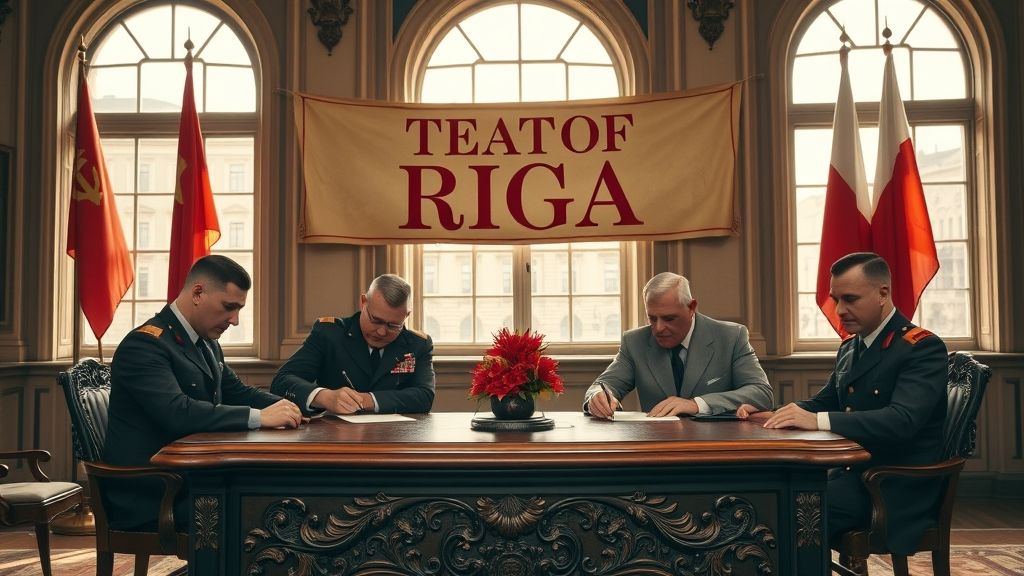
On a chilly spring morning in Riga, Latvia’s capital, two delegations sat down in a quiet building scarred by recent turmoil, ready to sign a document that would redraw the map of Eastern Europe. It was March 18, 1921—a date few outside bureaucratic circles might have anticipated would become a landmark. Yet this was the moment when the Soviet Union and the newly reborn Polish state inked a peace treaty that ended a brutal conflict carving up lands once ruled by empires now crumbled. The Soviet–Polish Treaty of Riga was more than just a peace accord; it was a testament to the messy aftermath of World War I, revolution, and nationalist fervor. It formalized borders, divided territories, and set the stage for decades of tension, uncertainty, and geopolitical maneuvering.
Imagine the faces around the table: exhausted negotiators, many having seen countless battles or survived revolutions, knowing their decisions would seal the fate of millions—soldiers wearied from combat, farmers caught between armies, families uprooted by war. The ink drying on fragile parchment was the final stroke on a grim chapter, but also a fragile beginning to a new and volatile era.
2. The Long Shadows of War: Eastern Europe After World War I
Europe’s east lay in ruins in 1921. The Great War had bled the continent dry, destroying old empires—the Russian, Austro-Hungarian, and German dynasties had collapsed or been overturned. In their wake rose fragile new nations, struggling to define themselves amid chaos. Poland, erased from maps for over a century, was reborn; the Soviet Union was newly birthed from revolution and civil war; Ukraine and Belarus hovered in political limbo, their fates uncertain. The region was a patchwork of conflicting claims, ethnic diversity, and ideological upheaval.
The Versailles Treaty had redressed some grievances, but the East remained a tinderbox. The Polish state, ambitious and uncertain, aimed to secure its eastern border—a line blurred by centuries of shifting control and mixed populations. Meanwhile, the Bolsheviks intended to spread revolutionary fire westward, seeing Poland as the bridge to Europe’s heart. The rivalry between these visions sparked a conflict that was as political as it was military.
3. The Polish-Soviet War: Clash of Ideologies and Nations
The war that raged between 1919 and 1921 was often dubbed Europe’s forgotten conflict, overshadowed by the Great War and later global crises. Yet it was a profound struggle combining nationalist ambitions and revolutionary zeal. On one side stood Józef Piłsudski’s Poland, eager to reclaim its sovereignty and push eastward to secure what it viewed as its rightful territory. On the other, the Soviets, guided by top commanders like Mikhail Tukhachevsky, sought to defend the revolution and expand the communist sphere.
This war was no mere territorial dispute; it was emblematic of the era’s contradictions and hopes. The Red Army advanced, painting itself as the liberator of the oppressed classes. The Polish military, hardened but under-resourced, fought fiercely to protect a nascent homeland. Battles ebbed and flowed unpredictably, with moments of dramatic victories and crushing losses.
4. From Revolution to Red Army: The Soviet Goal of Exporting Communism
The Soviet Union, born in 1922 but already effective as a power during the treaty years, was flush with revolutionary optimism. Lenin and his comrades believed the world revolution was imminent, with Poland envisioned as the first stepping-stone to Western Europe’s proletariat uprisings. The Red Army was both a defensive force and an offensive instrument designed to bring communist liberation to neighboring lands.
However, logistical challenges, civil war exhaustion, and the tenacity of Polish resistance frustrated these ambitions. The conflict around 1920, including the crucial Battle of Warsaw—dubbed the "Miracle on the Vistula"—marked a Soviet defeat that shattered hopes for rapid western advance. Yet the Soviets were pragmatic in peace talks, balancing ideology with the need to consolidate power internally.
5. Poland’s Struggle for Independence and Borders
For Poles, the years after 1918 were a feverish mix of jubilant independence and existential threats. Poland had reemerged after 123 years of partitions between Russia, Prussia, and Austria. Yet its future was fragile, its borders undefined, and its population diverse: Poles, Ukrainians, Belarusians, Jews, Lithuanians, and others inhabited contested regions.
Józef Piłsudski, Poland’s chief architect of independence, envisioned a federation—Międzymorze—stretching eastward with friendly nations aligned against Russian power. Achieving this required military success or diplomatic maneuvering, leading to the Polish-Soviet War and, ultimately, to the negotiations in Riga. For Poland, the treaty was both a triumph of survival and a political compromise.
6. The Battlefields that Shaped the Treaty: From Warsaw to the Niemen
The war’s turning points resound with drama and desperate heroism. In August 1920, the Battle of Warsaw saw Polish forces, under Piłsudski’s command, launch a counterattack that routed the advancing Red Army. This victory turned the tide, halting Soviet westward ambitions and forcing negotiations.
Fighting also seized other key areas: Belarus, Ukraine, and Lithuania found themselves caught between clashing armies. Control over major cities, railways, and resources fluctuated amidst scorched earth tactics and civilian suffering. The military stalemate by late 1920 made peace talks more necessary than ever.
7. The Tired Negotiators Meet in Riga
By late 1920, both sides were weary. With armies drained and domestic politics pressing, negotiators convened in Riga amidst war destruction and diplomatic uncertainty. The city itself, once part of the Russian Empire and now an independent Latvia, symbolized the fracturing landscape of Eastern Europe.
The talks were tense and lengthy. Soviet representatives sought to push borders westward to gain breathing room, while Polish diplomats demanded recognition of their eastern claims. Together, they entered a fragile negotiation space where military outcomes clashed with political realities.
8. Behind Closed Doors: The Complex Diplomacy of March 1921
The Treaty negotiations were laden with secrets and strategic maneuvers. While public statements echoed peace, backroom debates wrestled with contested histories, conflicting ethnic aspirations, and ideological mistrust. The Soviets aimed to protect Ukraine and Belarus as Soviet republics but were willing to cede some lands to Poland. For Poland, the priority was securing defensible, recognized borders.
At times, the negotiators’ personal rivalries influenced the talks as much as national policy. Documents reveal moments of frustration and rare concessions on both sides. The treaty was as much a diplomatic dance as a legal document.
9. The Terms of the Treaty: Dividing Nations, Drawing Lines
Signed on March 18, 1921, the Treaty of Riga established new boundaries that would remain for nearly two decades. Poland gained vast swathes of territory in western Belarus and Ukraine, roughly doubling its eastern expanse. The Soviet side formally recognized these borders, retreating from disputed regions.
The treaty included provisions for prisoner exchanges, trade agreements, and minority protections, although the enforcement of these terms would prove problematic. Importantly, the divisions ignored ethnic complexities, placing hundreds of thousands of Ukrainians, Belarusians, and others under Polish governance.
10. The Fate of Belarus and Ukraine: Partition and Uncertainty
Perhaps the treaty’s most complex legacy concerned the peoples of Belarus and Ukraine. Both lands were caught between two expanding powers. The Treaty of Riga essentially partitioned these peoples, some coming under Soviet rule, others under Polish administration.
This division bred discontent, setting the stage for future conflicts over national identity and autonomy. The treaty, while officially ending war, did not resolve the deeper question of allegiance and ethnic self-determination—questions that continued to resonate through the tumultuous interwar years.
11. The Treaty’s Immediate Impact on Europe’s Political Map
The treaty stabilized Eastern Europe briefly, defining borders that were recognized internationally. Poland became Europe’s eastern bulwark against Soviet expansionism, while the Soviet Union consolidated its western frontier. The fragile peace was a relief to war-weary populations and destabilized governments across the region.
However, the new map was a patchwork of concessions rather than solutions, and few believed it was permanent. The tension between these powers, fueled by nationalism and ideology, simmered beneath the surface.
12. Reaction within Poland: Jubilation and Reservations
In Poland, the treaty was greeted with a mixture of triumph and unease. Many celebrated it as a historic victory—validating years of bloodshed and sacrifice. Yet others, including some political factions and minority groups, questioned the costs and morality of ruling over diverse populations with different loyalties.
Piłsudski himself regarded the treaty as a necessary compromise, aware that the nation’s survival depended on diplomatic realism as much as military success.
13. Soviet Perspective: Retreat or Strategic Pause?
From the Soviet viewpoint, the treaty was a setback but also a strategic respite. Lenin and his successors framed it as a tactical retreat to consolidate internal power before launching future revolutionary efforts elsewhere. The loss of Western Ukraine and Belarus was painful but manageable.
This pragmatic stance allowed the Soviets to focus on domestic reconstruction and internal security, while ideological aims of spreading communism remained alive.
14. The Forgotten Voices: Civilians, Refugees, and Minorities
Amid conference tables and army camps, millions of civilians bore the war’s heaviest burdens. Ethnic minorities faced shifting rulers, discrimination, and sometimes violence. Refugees fled battle zones; families were split by the new borders. Poles, Ukrainians, Belarusians, Jews, and others found themselves pawns in great power politics.
Their stories—often overshadowed by grand treaties—remind us of the human cost behind maps and diplomacy. Some adapted; others suffered under new regimes; many emigrated, their hopes and fears imprinting the region’s memory.
15. The Treaty of Riga and the Interwar Period: Seeds of Future Conflict
The uneasy peace forged in Riga did not last. The interwar years saw simmering nationalism, border skirmishes, and unresolved tensions. Poland’s ambitious policies towards minorities sowed discord, while the Soviet Union’s rising power threatened to overturn the settlement.
The failure to address political and ethnic grievances laid the groundwork for renewed conflict, notably during World War II, when these borders would be violently contested once again.
16. The International Context: Western Powers and the Treaty
Western European powers watched the Soviet-Polish conflict with apprehension and hope. Allied nations, exhausted by war and wary of Bolshevism, tacitly supported Poland as a buffer state. However, no formal peace terms emerged from the Versailles framework for this region.
The Treaty of Riga, while largely bilateral, shaped wider Western policies towards the Soviet Union and Eastern Europe, influencing diplomatic alliances and fears of communist expansion.
17. Soviet–Polish Relations After the Treaty: An Uneasy Peace
The treaty formally ended active hostilities but did not erase mutual suspicion. Border tensions continued, espionage and propaganda campaigns escalated, and economic relations remained fraught. Poland and the Soviet Union eyed each other warily, a precarious calm masking deeper instability.
This uneasy peace would unravel under the pressures of rising totalitarianism and geopolitical upheaval in the 1930s.
18. Memory and Myth: How the Treaty was Remembered and Reinterpreted
In Polish memory, the Treaty of Riga became a symbol of national will and survival but also a contested legacy regarding minorities and eastern ambitions. In Soviet historiography, it was presented as a temporary setback en route to ultimate victory.
The treaty’s narrative evolved during the Cold War, shaping nationalist discourses and state propaganda differently in Poland, Russia, and Belarus.
19. The Treaty’s Legacy in the Shadow of World War II
The outbreak of World War II and the subsequent Soviet invasion of Poland in 1939 shattered the Riga treaty’s borders. The pact was effectively nullified, replaced by violence and redrawings of the map along new, brutal lines.
Yet the memory of the treaty persisted, influencing postwar border agreements and Soviet-Polish relations during the Communist era.
20. Modern Echoes: Borders and Identities in Eastern Europe Today
The Treaty of Riga's legacy lingers in contemporary debates over national identity, minority rights, and border legitimacy in Belarus, Ukraine, and Poland. Today’s geopolitical dynamics, including conflict and cooperation, reflect unresolved historical questions traceable to this moment in 1921.
In an era of renewed nationalism and regional tensions, the treaty serves as a reminder of the complexities—and human costs—embedded in lines drawn on maps.
21. Conclusion: When Lines on a Map Became History
The Soviet–Polish Treaty of Riga was more than a peace agreement; it was a fragile truce in a world remade by war and revolution. It codified the hopes and fears of two emerging powers, decided the fate of diverse peoples, and set the stage for the turbulent decades to come. Its story captures the human drama of negotiation, the brutality of conflict, and the enduring quest for stable identity and peace in Eastern Europe.
In the end, the treaty reminds us that history is often written in the language of compromise—never perfect, always provisional—but essential for survival.
Conclusion
The Treaty of Riga marks a defining moment when battered nations sought peace amid chaos, drawing borders that would impact millions. Yet it also embodies the limitations of agreements made under duress, with compromises that carried seeds of future wars. Its narrative intertwines heroism and suffering, political calculation and human drama. By examining this event closely, we glimpse the complexity of nation-building, the shifting nature of power, and the indelible stories of those living at the crossroads of history.
FAQs
Q1: What triggered the Polish-Soviet War leading to the Treaty of Riga?
The power vacuum post-World War I, competing national ambitions, and the Soviet desire to spread communism clashed with Poland’s efforts to secure its sovereignty and borders, triggering the 1919-1921 conflict.
Q2: Why was the Treaty of Riga signed in 1921 significant?
It ended the Polish-Soviet War by establishing borders between Poland and Soviet Russia, shaping Eastern Europe’s political map for nearly two decades.
Q3: How did the treaty affect Ukrainians and Belarusians?
It partitioned their homelands between Poland and the Soviet Union, causing ethnic tensions and uncertain futures for these populations.
Q4: What was Józef Piłsudski’s role in the treaty?
As Poland’s leader, Piłsudski directed military efforts and diplomacy, ultimately accepting the treaty as a practical compromise to secure Poland’s eastern borders.
Q5: How did Western powers view the treaty?
Western states saw Poland as a bulwark against communism and tacitly supported its position but did not formally participate in the treaty negotiations.
Q6: Did the Treaty of Riga ensure lasting peace?
No, the treaty’s compromises and unresolved ethnic and political issues led to continued tensions, contributing to conflicts before and during World War II.
Q7: How is the Treaty of Riga remembered today in Eastern Europe?
It remains a complex symbol—of national survival for Poland, a forced division for Ukrainians and Belarusians, and a temporary setback for the Soviet Union—shaping historical memory and national identities.
Q8: Can the treaty’s borders still be seen in today’s map?
While much changed after World War II, some modern borders and regional identities still reflect the divisions formalized by the Treaty of Riga.