Table of Contents
- The Dawn of a Frozen Conflict: December 24, 1979
- Afghanistan on the Brink: Political Turmoil and Ideological Fault Lines
- The Soviet Union’s Grand Design: Strategic Imperatives and Regional Aspirations
- The Afghan Communist Party in Crisis: Power, Paranoia, and Repression
- A People’s Resistance Awakens: Mujahideen Roots and Rural Unrest
- Operation Storm-333: The Night the Soviets Stormed Kabul
- Soviet Tanks on Afghan Soil: Early Days of Occupation and Shock
- The International Chessboard: Superpowers and Proxy Wars
- The Human Toll: Displacement, Destruction, and Daily Survival
- Afghan Voices: Stories from Kabul’s Streets and Mountain Villages
- The United States Joins the Fray: Covert Support to the Mujahideen
- Pakistan’s Role: The Frontline State in Cold War Contest
- The Soviet Military Campaigns: From Control to Counterinsurgency
- The Cold War Escalates: Ideology, Diplomacy, and Global Media
- Resistance and Resilience: Afghan Women, Fighters, and Families
- The Costs Mount: Soviet Struggles and Growing Dissent at Home
- The War’s Endgame: Withdrawal Plans and the Geneva Accords
- Aftermath: Afghanistan’s Long Shadow on Global Politics
- Memory and Myth: How the Invasion Shaped National and World History
- Lessons Learned: The Soviet Invasion’s Enduring Implications and Warnings
The Dawn of a Frozen Conflict: December 24, 1979
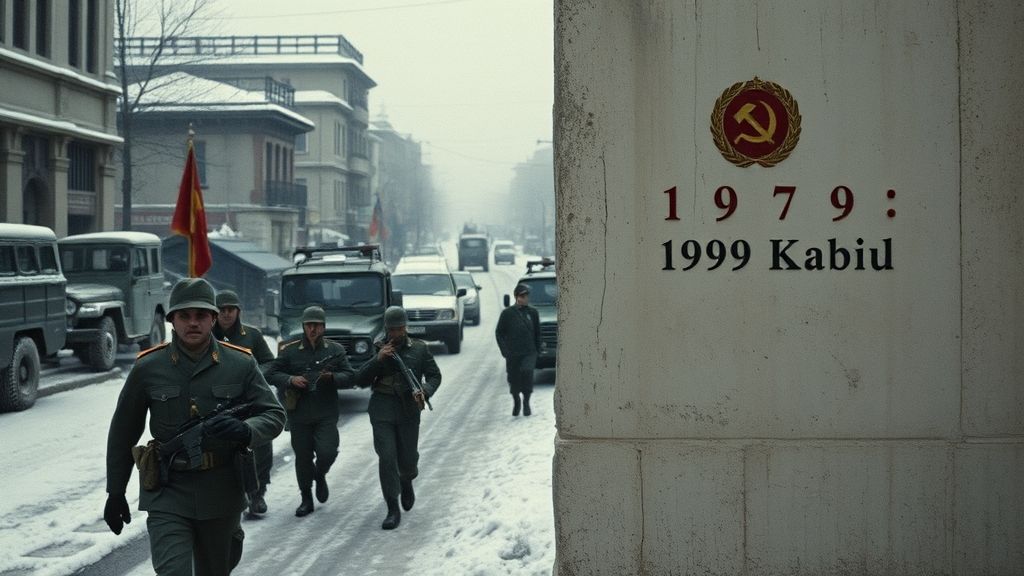
In the biting cold of a Kabul winter night, beneath a sky mercilessly shot through with cold stars sparkling like distant watchful eyes, Soviet troops crossed an invisible line—an act that would ignite a decade-long conflict blazing across Afghanistan’s rugged mountains and sprawling valleys. The first tanks rumbled through the city's streets, transforming a nation into a battlefield, and marking the commencement of one of the most tragic yet pivotal conflicts of the late twentieth century. December 24, 1979, was not merely a date etched on a calendar—it was the moment when the Soviet Union plunged headlong into Afghanistan’s tangled reality, sealing a destiny fraught with violence, defiance, and global consequences.
From that night on, the invaders and defenders would write a saga of war that would not only redefine Afghanistan’s future but also reshape the dynamics of the Cold War, alter superpower relations, and reverberate into the twenty-first century.
Afghanistan on the Brink: Political Turmoil and Ideological Fault Lines
To grasp the gravity of the Soviet entry into Afghanistan, one must first understand the storm roiling beneath its towering mountain peaks and ancient cities. Afghanistan in the late 1970s was a nation teetering on the edge of chaos. The monarchy had been overthrown in 1973, bringing to power the republican government of Mohammed Daoud Khan, yet instability persisted. His regime struggled to maintain control amid ethnic fragmentation, tribal loyalties, and ideological divides.
This fragile equilibrium shattered on April 27, 1978, when the People’s Democratic Party of Afghanistan (PDPA), an Afghan communist party deeply influenced by Marxist-Leninist ideology and strongly tied to Soviet interests, launched the Saur Revolution. Led by Nur Muhammad Taraki, they ousted Daoud Khan, promising modernization and reform. But the PDPA’s reforms—land redistribution, secular education, and women’s rights—were aggressively pushed and assailed traditional religious and tribal customs, inciting widespread rebellion.
Yet even within the PDPA, fissures emerged. Internal power struggles and purges created fear and chaos. Taraki’s successor, Hafizullah Amin, a charismatic and ruthless figure, intensified repression in an attempt to consolidate power. Violence spiraled, discontent grew, and the Afghan government teetered on the brink. The Soviets faced a stark dilemma: support Amin’s unpredictable regime or intervene more directly.
The Soviet Union’s Grand Design: Strategic Imperatives and Regional Aspirations
For the Soviet Union, Afghanistan was far more than a distant neighbor; it was a strategic gateway to South Asia and the Indian Ocean. The Kremlin feared the loss of a friendly socialist regime could spark the rise of Islamic fundamentalism spilling into its Central Asian republics or open the door to Western—and particularly American—intervention in what the Soviets considered their geopolitical backyard.
Brezhnev’s Politburo, wary of Amin’s erratic behavior and suspicious of his secret dealings with Washington, decided to exert firmer control. The Soviets believed that direct military intervention was necessary to stabilize Afghanistan and protect their southern flank from encroaching hostile forces.
The decision was monumental and fraught with peril. It meant risking international condemnation and embroiling the USSR in a complex internal conflict. But with Cold War stakes high, Khrushchev’s successor leadership reasoned that a firm hand was essential.
The Afghan Communist Party in Crisis: Power, Paranoia, and Repression
Inside Kabul, the PDPA was a house divided. Amin’s reign amplified rivalries, and paranoia poisoned the leadership. His brutal purges instilled fear but failed to secure power. Influenced by Soviet advisors and under constant surveillance, the Afghan communist elite became trapped in a cycle of betrayal and repression.
The PDPA’s aggressive reforms alienated much of Afghanistan’s rural majority. Islamic clerics, tribal elders, and ordinary villagers alike found themselves resisting not just political domination but the assault on their way of life. The regime’s brutality, including mass arrests and executions, fueled an insurgency that soon mushroomed beyond control.
This internal collapse gave the Soviets the pretext they sought. If the Afghan government could not hold together, they would intervene directly—deploying troops ostensibly to protect their allies but effectively to seize control.
A People’s Resistance Awakens: Mujahideen Roots and Rural Unrest
Afghanistan’s resistance was as multifaceted as its people. The conflagration ignited by Soviet intervention galvanized a diverse coalition of mujahideen fighters—religious warriors, tribal militias, students, and former royalists alike—whose unyielding determination defied the advanced weaponry and ruthless tactics of the newcomers.
These fighters, often armed with machine guns and small arms, leveraged knowledge of the harsh terrain to launch guerrilla attacks from mountain caves and remote villages. Their passion was rooted not only in religious fervor but in fierce independence and survival—the defense of their homeland, families, and sacred traditions.
Their courage and tenacity turned the war into a grinding quagmire with devastating cost but relentless resistance.
Operation Storm-333: The Night the Soviets Stormed Kabul
The precise and dramatic military operation that bore the Soviet invasion’s opening act was Operation Storm-333, carried out on the night of December 27, 1979. A specially trained KGB and Spetsnaz unit infiltrated the heavily fortified Tajbeg Palace, where Hafizullah Amin resided.
In a swift and brutal assault, the Soviet forces assassinated Amin and secured the palace. This surgical strike eliminated the unpredictable leader, allowing Moscow to install Babrak Karmal, a more compliant PDPA official, as puppet president. The operation sent a loud message: the Kremlin would not tolerate instability or Western interference.
But for Afghan citizens, the invasion was an unmistakable sign that war had come home.
Soviet Tanks on Afghan Soil: Early Days of Occupation and Shock
The arrival of Soviet troops was met with both confusion and horror. Kabul’s once bustling streets slowly filled with armored vehicles and soldiers clad in Soviet camouflage. Households shuttered their windows as gunfire echoed sporadically and curfews enforced a tense stillness.
Urban intellectuals and government officials were caught between hope for order and fear of foreign domination. Meanwhile, the countryside acknowledged the paradox of Soviet strength and Afghan resistance: occupiers with modern weapons versus defenders with hearts and faces shaped by millennia of mountain warfare.
The early occupation forced adjustments—alliances formed, betrayals happened, and the dynamic between Moscow and Kabul shifted daily.
The International Chessboard: Superpowers and Proxy Wars
Afghanistan’s war quickly transcended its borders, becoming one of the Cold War’s fiercest proxy battles. The United States, determined to counter Soviet expansion, ramped up clandestine support to the mujahideen through the CIA’s Operation Cyclone. Saudi Arabia and Pakistan funneled resources and fighters, transforming the conflict into a crucible for global jihad.
For the Soviets, every battle lost or won resonated on the world stage—testifying to the fragility of their superpower stature. The war was not merely military; it was ideological, a contest between communism and the Western-backed capitalist democracies, alongside regional powers pursuing their own interests.
The Human Toll: Displacement, Destruction, and Daily Survival
While strategies played out in Kremlin corridors and Washington’s shadowy agencies, Afghanistan’s people bore the brunt of suffering. Estimates suggest over a million Afghan civilians died during the ten-year conflict, with millions more uprooted into refugee camps in Pakistan and Iran.
Villages were razed, farmland scarred by landmines, and urban centers strangled by siege and air raids. Families faced famine, disease, and the trauma of constant loss. Children grew up knowing nothing but war; women became heads of households under the grim specter of social upheaval.
The conflict’s terrors rendered Afghanistan one of the twentieth century’s most tragic landscapes.
Afghan Voices: Stories from Kabul’s Streets and Mountain Villages
Amid statistics and strategies, the personal stories give color and depth to this harrowing chapter. One elder from Panjshir Valley recalled, “When the Soviet tanks came, we hid in the caves. My son took a rifle; he never came back.” A young woman scholar in Kabul wrote, “The schools closed, but the lessons of courage and loss were always with us.”
These voices reveal the resilience and humanity beneath the conflict’s violence, reminding us that history is lived by individuals, not just armies.
The United States Joins the Fray: Covert Support to the Mujahideen
The U.S. saw in Afghanistan a unique opportunity to challenge Soviet influence indirectly. Beginning in 1980, the CIA dramatically increased funding, training, and weapons supply to the mujahideen, opening a new front in the Cold War without direct confrontation.
Stinger missiles that shot down Soviet helicopters, communication equipment, and financial aid helped turn the tide of battle. This covert war became one of history’s most ambitious and prolonged secret operations, influencing Cold War dynamics for years.
Pakistan’s Role: The Frontline State in Cold War Contest
Pakistan emerged as the key logistical hub for mujahideen operations, acting as a conduit for foreign aid and fighters. Under General Zia-ul-Haq’s regime, Islamabad’s ISI (Inter-Services Intelligence) agency became a powerful player, shaping the conflict’s character and alliances.
Pakistan’s support was driven by geopolitical strategy—seeking a friendly regime in Kabul, countering India’s influence, and securing its western borders. But this involvement also seeded long-term instability for the region.
The Soviet Military Campaigns: From Control to Counterinsurgency
What began as a rapid, forceful occupation gradually transformed into a grueling counterinsurgency campaign. Soviet tactics—air strikes, search-and-destroy missions, and scorched-earth policies—aimed to dislodge elusive guerrillas but often alienated the population further.
Harsh winter weather, rugged terrain, and unfamiliar tribal dynamics bogged down Soviet troops. Casualties mounted; morale plummeted. The war revealed the limits of conventional military power against determined irregular fighters.
The Cold War Escalates: Ideology, Diplomacy, and Global Media
The Afghan conflict crystallized Cold War tensions. The United Nations debated condemnation, while Western media highlighted Soviet aggression. Moscow defended its “brotherly assistance,” accusing the West of arming “terrorists.”
The battle became symbolic—a narrative of freedom versus oppression, East versus West. It shaped public opinion worldwide and fed the ideological struggle that defined an era.
Resistance and Resilience: Afghan Women, Fighters, and Families
Despite war’s brutality, Afghan women played crucial, often overlooked roles—as fighters, supporters, and caretakers. Some joined mujahideen ranks; others organized aid networks or preserved education amid chaos.
Their stories illuminate a society’s resilience and the multifaceted costs of war beyond the battlefield.
The Costs Mount: Soviet Struggles and Growing Dissent at Home
Back in the USSR, the war became increasingly unpopular. Soviet citizens questioned the human and financial costs—over 15,000 soldiers killed, vast sums spent—with little hope for victory.
The war fed dissent, exposed systemic weaknesses, and became a factor in the eventual unraveling of Soviet authority.
The War’s Endgame: Withdrawal Plans and the Geneva Accords
By the late 1980s, Soviet leadership recognized the war’s futility. Mikhail Gorbachev, seeking reform, initiated withdrawal talks, culminating in the 1988 Geneva Accords which set the stage for troop removal.
The withdrawal, completed in 1989, was a tactical retreat tinged with defeat but also relief.
Aftermath: Afghanistan’s Long Shadow on Global Politics
The Soviet invasion’s legacy reached far beyond Afghanistan’s borders. The conflict destabilized the region, emboldened militant Islamism, and influenced later events—such as the rise of the Taliban and global terrorism.
It also contributed to the Cold War’s endgame, highlighting how overstretch and ideological rigidity could falter.
Memory and Myth: How the Invasion Shaped National and World History
In Afghanistan, the invasion is remembered as a national trauma and a symbol of resistance. Internationally, it became a cautionary tale about foreign intervention and the limits of military power.
The myths and narratives forged in this crucible continue to inform policy and historical memory.
Lessons Learned: The Soviet Invasion’s Enduring Implications and Warnings
Looking back, the Soviet intervention offers vital lessons on the complexities of foreign occupation, ideological hubris, and local dynamics. It shows how internal divisions and external machinations can spiral into protracted tragedy.
This history urges humility and nuance in international affairs—a message still relevant today.
Conclusion
The Soviet entry into Afghanistan on December 24, 1979, was a monumental turning point—an event that cascaded through the lives of millions and echoed in global politics for decades. This story is as much about ideology and geopolitics as it is about human courage, sacrifice, and endurance. The frozen nights of Kabul’s streets tell a tale of invasion and resistance, hope and despair. Understanding this history is vital not only to grasp Afghanistan’s past but to recognize the powerful forces—both destructive and redemptive—that shape nations and peoples.
FAQs
Q1: What motivated the Soviet Union to invade Afghanistan in 1979?
A1: The USSR sought to secure a friendly socialist government, prevent the spread of Islamic fundamentalism into Central Asia, and counter perceived Western influence near its southern borders.
Q2: Who was Hafizullah Amin, and why was he targeted?
A2: Amin was the Afghan communist leader whose unpredictability and alleged Western contacts alarmed the Soviets, prompting his assassination during the invasion operation.
Q3: How did the Afghan mujahideen manage to resist Soviet forces?
A3: Utilizing guerrilla tactics, knowledge of difficult terrain, strong local support, and foreign aid—including advanced weapons from the U.S.—the mujahideen sustained a protracted resistance.
Q4: What role did Pakistan play during the Soviet-Afghan War?
A4: Pakistan served as a key logistical base for mujahideen fighters and facilitated the flow of arms and support from the U.S. and allies into Afghanistan.
Q5: How did the Soviet invasion affect global Cold War dynamics?
A5: It intensified U.S.-Soviet rivalry, leading to covert proxy battles and increased ideological conflict, influencing diplomatic and military policies worldwide.
Q6: What were the long-term consequences for Afghanistan after the Soviet withdrawal?
A6: Afghanistan descended into civil war, leading to the rise of the Taliban and ongoing instability with global repercussions.
Q7: How is the Soviet invasion remembered in Afghanistan today?
A7: It is viewed as a tragic period of occupation and resistance, deeply impacting national identity and historical memory.
Q8: What lessons does the Soviet intervention offer to contemporary foreign policy?
A8: It warns of the dangers of ignoring local complexities, the limits of military intervention, and the unintended consequences of foreign involvement.