Table of Contents
- Winter in Moscow: The Day a New World Power Was Declared
- From Empire to Ruins: The World Before the Soviet Union
- Revolution, Civil War, and the Red Experiment
- Nationalities, Fractures, and the Search for a New Union
- Drafting a State: The Treaties and Debates of 1922
- The Kremlin Congress: December 30, 1922
- Lenin, Stalin, and the Struggle over the Shape of the Union
- Ordinary Lives on an Extraordinary Day
- Propaganda, Symbols, and the Birth of Soviet Identity
- From Moscow to the Provinces: How the Union Was Received
- Law, Constitution, and the Architecture of Power
- Economy, Industry, and the Promise of a Socialist Future
- Minorities, Republics, and the Paradox of Unity in Diversity
- A New Player on the World Stage
- The Human Cost Behind the Red Banner
- From Founding to Terror: The Union’s Darkening Trajectory
- Echoes of 1922 in the Second World War and After
- The Long Unraveling: How the Union’s Birth Foreshadowed Its Collapse
- Memory, Myth, and the Contested Legacy of the Soviet Founding
- Conclusion
- FAQs
- External Resource
- Internal Link
Article Summary: On a cold December day in 1922, in the heart of Moscow, delegates signed documents that declared a new kind of state into existence: the Union of Soviet Socialist Republics. This article follows the path by which the soviet union formed, from the collapse of the Russian Empire to the ideological battles inside the Bolshevik leadership. It weaves together high politics and the intimate experiences of workers, soldiers, and peasants who lived through revolution and reconstruction. Moving chronologically, it explores how the union promised equality among its republics while building a highly centralized, often ruthless system of power. The narrative shows how the birth of the Soviet Union reshaped law, economy, nationality policy, and global diplomacy. It also confronts the human cost of civil war, famine, repression, and social experiment that framed its founding. Step by step, the article traces how the moment when the soviet union formed contained both utopian dreams and seeds of future catastrophe. By the end, we see how that winter day in Moscow continues to echo in the politics, identities, and memories of the twenty‑first century.
Winter in Moscow: The Day a New World Power Was Declared
Snow fell in slow, heavy spirals over Moscow on December 30, 1922, softening the edges of a city still scarred by war and revolution. The streets were dim, the air brittle with frost, and coal smoke hung low over crooked roofs. Yet inside the red-brick fortifications of the Kremlin, under vaulted ceilings lit by electric bulbs and flickering candles, men in worn jackets and heavy boots gathered to do something astonishing: they were about to proclaim a new kind of state, a federation of socialist republics meant to outlast empires and overturn capitalism itself. It was here, on this day, that the soviet union formed not only as a legal entity on paper, but as a story people would tell themselves—about equality, about justice, about history finally aligning with ideology.
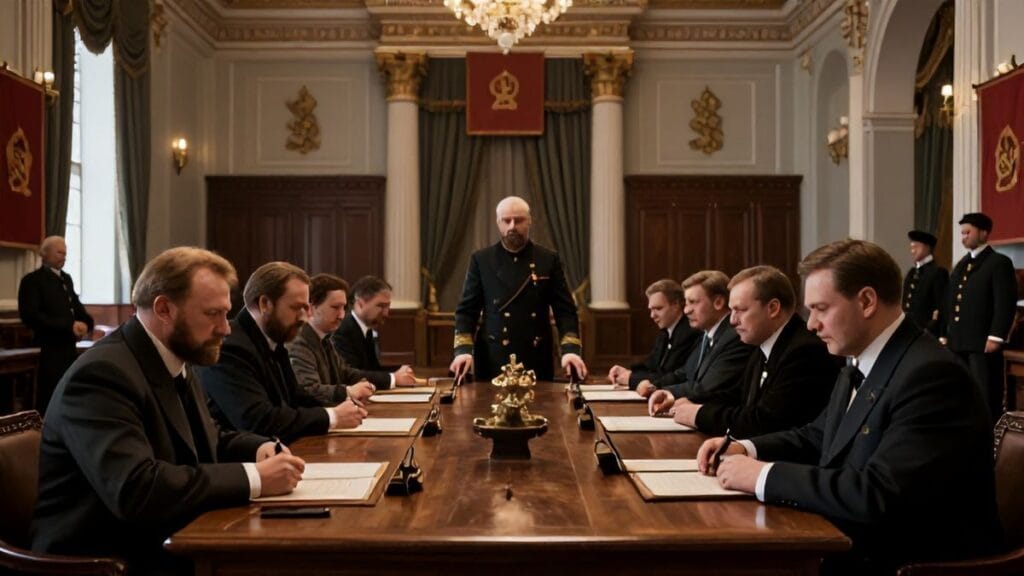
Delegates filed into the hall for the First Congress of Soviets of the USSR. Some were seasoned Bolshevik veterans, their faces lined by prison and exile, their lapels pinned with modest red star badges. Others were provincial activists from the Ukrainian steppe, the Caucasian mountains, and the cities of the Transcaucasus, still carrying the dust of long train rides. They spoke with different accents, sometimes in different languages, but shared an understanding: the old Russian Empire was dead, and they were here to give shape to what would come after. The air hummed with speeches, roll calls, and the rustle of paper—draft treaties, resolutions, and the new federation’s declaration.
On the table lay documents already discussed, amended, and argued over in party corridors and Politburo meetings. Their titles were dry, almost bureaucratic: “Treaty on the Formation of the Union of Soviet Socialist Republics,” “Declaration on the Formation of the USSR.” But behind the words stood an entire decade of upheaval. When the chair called for a vote, hands rose in near-unanimous assent. Applause crashed against the hall’s walls; someone began singing the Internationale. It felt, for a fleeting moment, like the culmination of a very long road. When we say the soviet union formed that winter’s day, we are naming this moment of collective affirmation—but also the world of hardship, violence, and ambition that had made it possible.
Outside, most Muscovites went about their lives, preoccupied with more immediate concerns: fuel rations, bread lines, the search for boots that did not leak snowmelt. Some barely noticed the news; others read it in the next day’s Pravda or heard of it second-hand in factories, barracks, and communal apartments. For them, the grand narrative—an international socialist republic rising from the ruins of the tsarist state—folded into the smaller narratives of survival, hope, and fatigue. Yet even those who felt no great thrill on December 30, 1922, were now subjects of a state unlike any that had come before, a state whose founding moment would mark the rest of the twentieth century.
In that sense, when the soviet union formed, it did not simply rearrange borders; it rearranged time itself, drawing a line between “before” and “after.” Before: empire, autocracy, landlords. After: workers’ councils, one-party rule, planned economy. The truth, as always, was messier. But in the winter quiet of Moscow in 1922, with snow muffling the city’s sounds and banners fluttering in the frosty air, it was possible to believe that history had turned a decisive page.
From Empire to Ruins: The World Before the Soviet Union
To understand why the creation of the USSR felt so momentous, one must see the debris field it emerged from. At the turn of the twentieth century, the Russian Empire sprawled across one-sixth of the world’s land surface. It was a patchwork of peoples: Russians, Ukrainians, Belarusians, Poles, Finns, Jews, Georgians, Armenians, Kazakhs, Uzbeks, Tatars, and dozens of smaller groups, bound together not by consent but by imperial conquest and autocratic rule. The tsar sat at its apex, draped in rituals and sacred myths, surrounded by courtiers and police spies who guarded a system already creaking under the pressures of industrialization and war.
The 1905 revolution had been the first great warning. Strikes, mutinies, and peasant uprisings forced Nicholas II to concede a parliament, the Duma, but he never truly accepted a constitutional order. Industrial workers crowded into new factories in Moscow, St. Petersburg, and the Donbass, nursing grievances over twelve-hour days and dangerous conditions. Peasants, who made up the overwhelming majority of the population, longed for land and resentfully eyed the sprawling estates of nobles and the church. National minorities felt their languages and cultures squeezed by Russification policies. So when the First World War erupted in 1914, the empire entered it already riddled with cracks.
The war deepened every existing fault line. Millions of men were conscripted and sent to the front with inadequate weapons, poor supplies, and often incompetent leadership. Casualties mounted: around 1.7 million Russian soldiers would die, many more wounded or captured. Cities strained under food shortages as transport systems faltered and the army swallowed up grain. Inflation eroded wages; women waited in queues for bread that arrived late or not at all. In this atmosphere, faith in the tsar’s government evaporated. Court scandals, including the influence of the mystic Rasputin, made the monarchy seem grotesque and distant at the moment people most needed competent rule.
By early 1917, the imperial order was only one crisis away from collapse. That crisis came in February (March, by the Western calendar), when demonstrations over bread in Petrograd escalated into mass strikes and mutinies. Soldiers refused to fire on crowds and instead joined them. Within days, the regime crumbled; Nicholas II abdicated, leaving a vacuum rapidly filled by competing authorities: the Provisional Government on one side, workers’ and soldiers’ soviets on the other. These soviets—councils elected in factories, barracks, and neighborhoods—embodied a radical democratic impulse that challenged traditional state structures.
Between February and October 1917, Russia existed in a kind of suspended animation. The Provisional Government tried to continue the war, alienating exhausted soldiers and workers, while failing to enact decisive land reform for peasants. The Bolsheviks, led by Vladimir Lenin, capitalized on this disillusionment with slogans like “Peace, Land, and Bread” and “All Power to the Soviets.” They promised not just a change of government but a new system altogether. When they seized power in Petrograd in October, and then gradually extended control to other major centers, they were not simply toppling a ministry—they were trying to rebuild the very idea of what a state could be. Yet out in the countryside and the empire’s peripheries, the story was very different. National movements in Ukraine, the Baltic states, the Caucasus, and Central Asia saw an opening to pursue autonomy or independence. The empire, long held together by force, began to fragment.
This is the world from which the soviet union formed: a collapsed monarchy, a ruined wartime economy, a society armed and polarized, and a territory where centrifugal forces seemed stronger than any centralizing power. The Bolsheviks could not simply announce a new union; they would have to fight for it, bargain for it, and, in some cases, impose it by force.
Revolution, Civil War, and the Red Experiment
The Bolshevik seizure of power in October 1917 was only the opening act in a long and brutal struggle. What followed was not a smooth transition to socialism but years of civil war, foreign intervention, and social experimentation under extreme pressure. The new Soviet government swiftly pulled Russia out of the First World War, signing the Treaty of Brest-Litovsk with Germany in March 1918. In exchange for peace, it ceded vast territories—Poland, the Baltic provinces, parts of Ukraine. To many Russians, even some on the left, the treaty felt like a betrayal, a humiliation. To Lenin and his allies, it was a necessary retreat: they needed “a breathing space” to consolidate power.
That consolidation, however, provoked furious resistance. Monarchists, liberal democrats, nationalists, and non-Bolshevik socialists coalesced into various “White” forces. Former imperial officers raised volunteer armies, while foreign powers—Britain, France, Japan, the United States—sent expeditionary forces and supplies, hoping to strangle the newborn Soviet state while it was still weak. The Russian Civil War erupted across a vast terrain: in Siberia, along the Volga, in the south near the Don and Kuban, in the Baltic and the north. The fighting was ferocious, chaotic, and, above all, deeply entangled with the social revolution in the villages and towns.
To feed the Red Army and the cities, the Bolsheviks implemented “War Communism”: grain requisitioning from peasants, nationalization of industry, centralized distribution of goods. Local officials, sometimes loyal revolutionaries, sometimes opportunists, sometimes barely more than armed thugs, arrived in villages with lists and rifles. They demanded grain at fixed prices or simply seized it. Peasants resisted, hiding harvests, ambushing detachments, or joining peasant uprisings that flared in Tambov, Siberia, and elsewhere. Famine followed. Between 1921 and 1922, a catastrophic famine in the Volga region and parts of Ukraine killed an estimated five million people. Corpses lay uncollected along dirt roads; entire villages emptied out. The American Relief Administration and other foreign organizations were invited in to provide aid—a bitter irony for a regime that prided itself on self-reliance.
At the same time, the Bolsheviks built new institutions of power: the Cheka, a political police force aimed at suppressing counterrevolution; the Red Army, forged under Leon Trotsky’s strict discipline; party committees that extended from Moscow into the smallest towns. The soviets, which had once been symbols of grassroots democracy, increasingly became transmission belts for centrally decided policies. The war’s logic—“he who is not with us is against us”—seeped into political life. Executions, hostage-taking, and concentration camps were used by both Reds and Whites, but the Reds, as eventual victors, would incorporate these methods into the state’s DNA.
Yet alongside this violence ran something else: a tremor of utopian hope. In cities like Moscow and Petrograd, workers discussed new ways of organizing labor, culture, and family life. Avant-garde artists experimented with radical forms, believing that a socialist society demanded a new visual language. Literacy campaigns pushed into the countryside. For many young people, joining the Bolshevik Party or the Komsomol (Communist youth league) meant not just gaining political power, but participating in a moral crusade to build a fairer world. The civil war years were a crucible in which terror and idealism fused into an alloy that would harden into the early Soviet state.
By late 1920 and early 1921, the Red Army had largely defeated the major White forces. Foreign troops withdrew. The Bolsheviks held most of the old imperial core, but at a terrible cost: the economy was shattered, cities were depopulating as people fled to the countryside in search of food, and unrest simmered even within the working class. The Kronstadt rebellion of March 1921—when sailors once loyal to the revolution rose up demanding “Soviets without Bolsheviks”—was a shock. The regime suppressed it ruthlessly, but the message was clear: something had to change. Lenin responded with the New Economic Policy (NEP), a partial retreat that reintroduced small-scale private trade and eased grain requisitions.
By the time the soviet union formed a year later, the Bolsheviks had survived existential threats but emerged deeply marked by civil war logic. They had become accustomed to ruling through a single party with little tolerance for dissent, relying on coercive instruments and emergency measures. The state they were now designing in 1922 was not being imagined on a blank slate; it was being built atop the trenches and ruins of a society brutalized by years of internal conflict.
Nationalities, Fractures, and the Search for a New Union
The Russian Empire had always rested on a fragile foundation of national diversity held together by force. With the empire’s collapse and the chaos of revolution, suppressed identities and aspirations roared to the surface. Ukraine declared various forms of autonomy and independence between 1917 and 1920, with multiple governments—Central Rada, Hetmanate, Directory—rising and falling amid war between Reds, Whites, nationalists, and foreign occupiers. In the Caucasus, Georgia briefly became an independent democratic republic; Armenia and Azerbaijan also experienced short-lived independent states. In Central Asia, Muslim reformers and traditional elites alike looked for ways to free themselves from Russian domination.
The Bolsheviks were acutely aware of this national question. Lenin, who had long studied and written about imperialism and national self-determination, understood that presenting the new regime as merely a rebranded Russian empire would doom it. Instead, he argued that oppressed nations must be granted the right to secede in principle, while in practice being drawn into a voluntary union that promised equality and protection from foreign capitalism. This was not simple altruism: he believed that without the resources and strategic depth of the former empire, the revolution would remain vulnerable.
The Bolsheviks therefore pursued a complex strategy. On one hand, Red Army units marched into Ukraine, the Caucasus, and Central Asia, defeating anti-Bolshevik and nationalist forces. Georgia, for instance, was forcibly Sovietized in 1921, its government pushed into exile. On the other hand, once power was established, the new authorities created “Soviet republics” with their own nominal governments, constitutions, and flags. In these republics—like the Russian Soviet Federative Socialist Republic (RSFSR), the Ukrainian SSR, the Belorussian SSR, and the Transcaucasian SFSR—they promised development of local languages, cultures, and elites under the banner of “proletarian internationalism.”
This policy, often called korenizatsiya (indigenization), aimed to cultivate local communist leadership and to convince non-Russian populations that the new state was not simply a Russian dominion. Schools in Uzbekistan began teaching in Uzbek; theater troupes in Georgia performed in Georgian with Soviet themes; party cadres were trained from among minority groups. Yet the center in Moscow retained control over key levers: the army, heavy industry, foreign affairs, and, crucially, the Communist Party’s upper echelons.
Still, the tension between centralization and autonomy simmered. Some local communists, especially in Georgia and Ukraine, pushed for genuine federalism. Russian communists, including Joseph Stalin—who, though Georgian by origin, became the party’s main expert on the nationalities question—favored a tightly bound union to prevent what they saw as dangerous centrifugal trends. It was in this contentious context that leaders began discussing a formal restructuring of the state: how should the different Soviet republics relate to each other and to Moscow? What would replace the loose, often improvised arrangements born of civil war exigencies?
These were not abstract matters. For the peasant in a Ukrainian village, it might determine whether his children learned in Ukrainian or Russian, whether his taxes went to a local administration or disappeared into distant Moscow ministries. For the budding Armenian or Kazakh communist, it shaped the horizon of political possibility: could one imagine becoming a national leader within a genuinely multinational state, or was the new order just Moscow’s empire in red clothing? Into this volatile mix of expectations and fears, the idea of a Union of Soviet Socialist Republics was introduced—a formula that claimed to balance unity with the right to difference.
Drafting a State: The Treaties and Debates of 1922
By 1922, with civil war largely over, the Bolshevik leadership recognized that their improvised arrangements with various Soviet republics could not continue indefinitely. There were practical reasons: managing a devastated economy, distributing scarce resources, coordinating military and foreign policy—all demanded a more coherent state structure. But there were also political reasons: the party needed to articulate a vision that could reconcile the promise of national self-determination with the reality of a centralized socialist project.
In the spring and summer of 1922, discussions intensified within the Politburo and among leading Bolsheviks. Stalin, then People’s Commissar for Nationalities, proposed a solution often referred to as “autonomization”: the non-Russian Soviet republics—Ukraine, Belarus, and the Transcaucasian federation—would be absorbed into the RSFSR as autonomous units. In this model, there would be one Soviet state, essentially Russian in its structure, within which other national entities existed in a subordinate, though culturally recognized, status. It promised administrative simplicity and strong central command.
Lenin, however, reacted sharply against this model when he fully grasped its implications. In notes and letters later known as his writings on the national question, he accused Stalin and his allies of “Great-Russian chauvinism,” that old imperial arrogance now dressed in Bolshevik uniforms. He insisted that unity had to be based on formal equality between republics, not their absorption into Russia. The solution he favored was different: a union in which Russia and the other republics entered as equal members, each retaining the theoretical right to secede, each with its own institutions, even if the Communist Party’s central committee would in practice coordinate everything.
The resulting compromise was the Treaty on the Formation of the Union of Soviet Socialist Republics and its accompanying Declaration. These documents set out that four republics—the RSFSR, the Ukrainian SSR, the Belorussian SSR, and the Transcaucasian SFSR (itself a federation of Georgia, Armenia, and Azerbaijan)—would unite into a single union state. This union would have a central government with authority over foreign policy, defense, trade, and certain economic and infrastructural matters. Each republic retained its own constitution and government, and, on paper, the right to withdraw from the union.
Drafting these texts involved committees of jurists, party officials, and national representatives. Reports were sent back and forth, phrases reworded to balance sensitivities. Was it “joining” a union or “entering” one? What precise powers would be reserved for the center versus the republics? The language of the declaration was soaring, promising a voluntary association of equal peoples, freed from the oppression of capital and empire. The treaty itself was more technical, but its legal architecture would shape the next seven decades. One historian later wrote that “the USSR was born simultaneously as a federation, an empire, and a party-state”—a hybrid whose contradictions were visible even in the founding documents.
It is in these debates and drafts that the soviet union formed in its conceptual sense, long before the official ratification. On paper, it was a union of socialist republics; in the minds of its architects, it was also a fortress against capitalism, a laboratory for reordering society, and a vehicle for projecting influence across Eurasia. The tension between these roles would never fully be resolved.
The Kremlin Congress: December 30, 1922
On the day itself, December 30, 1922, delegates to the First Congress of Soviets of the USSR gathered in the Grand Kremlin Palace, under chandeliers that once cast their light on tsars and courtiers. Now, the hall was filled with leather jackets, rough wool coats, and the red banners of proletarian revolution. The contrast was palpable: the architectural skeleton of empire housing the political theater of socialism.
Representatives from the four founding republics took their seats. They had been elected by congresses of soviets in their respective territories, though the degree of genuine contestation and debate varied widely. On the rostrum, leading Bolsheviks presided. Lenin, already weakened by strokes, could not attend; his physical absence was symbolic of a transition underway within the leadership. Stalin, Trotsky, and others occupied prominent positions, though not all played equal roles in the ceremony itself.
The session unfolded in a mix of ritual and real politics. The draft Treaty and Declaration were read aloud. Speeches were given hailing the victory of the working class, the end of centuries of oppression, the dawn of a new era in international relations. Delegates from Ukraine spoke of the importance of equality between nations; representatives from the Transcaucasus emphasized that small peoples, long manipulated by great powers, were now part of a “fraternal family” of Soviet republics. Applause punctuated these statements, a carefully stage-managed yet still emotionally charged affirmation of unity.
When the time came to vote, the outcome was never in doubt. Most delegates were committed communists, loyal to the party’s line and to the vision of a unified socialist state. The congress approved the Treaty on the Formation of the USSR and the Declaration overwhelmingly. In that moment, the soviet union formed in its formal, juridical sense. A new state—one of the largest and most ambitious ever conceived—was proclaimed to the world.
Outside the hall, the news rippled through official channels. Telegraphed announcements went out to party organizations and provincial soviets. Newspapers prepared special editions. In Moscow’s streets, there were no fireworks displays on the scale of later Soviet spectacles, but local meetings and gatherings marked the occasion. In some factories, workers were called together to hear readings of the declaration, followed by short speeches from party secretaries. In village soviets across the union, the news would arrive in the coming days and weeks, often as a short proclamation pinned to a notice board or read aloud at a peasant assembly.
Yet behind the formal unanimity, doubts lingered. Some national communists wondered how much real autonomy their republics would retain. Some Russian communists feared that excessive concessions would encourage separatism. Lenin, convalescing and increasingly alienated from Stalin’s methods, fretted in his notes that the union could become an “all-Russian prison of peoples” if great-power habits returned. Those tensions did not surface in the public choreography of December 30, but they were very much present—a reminder that the day the soviet union formed was a beginning, not an endpoint, in the struggle over what that union would be.
Lenin, Stalin, and the Struggle over the Shape of the Union
Even as delegates celebrated, a quieter drama unfolded in Lenin’s sickroom and in the inner corridors of the party. The formation of the USSR was inseparable from a power struggle at the top. Lenin, the revolution’s chief strategist, was incapacitated by strokes that limited his speech and movement. Stalin, appointed General Secretary of the Communist Party in 1922, was steadily consolidating influence through control of party appointments. Trotsky commanded great prestige as architect of Red Army victory, yet found himself increasingly isolated in the leadership’s factional maneuvers.
On the nationalities question, Lenin and Stalin clashed in ways that would reverberate through the new union. Lenin feared that old imperial habits would survive under red flags if Russian communists treated other peoples with condescension and coercion. In his last writings, sometimes called his “testament,” he criticized Stalin’s rough handling of Georgian communists who resisted being folded into the Transcaucasian federation under Moscow’s terms. He argued that in a union of nations, the formerly dominant nation had to be especially cautious and generous, otherwise equality was a sham.
Stalin, by contrast, viewed strong centralization as essential to survival. The civil war’s lessons were clear to him: fragmentation invited invasion, sabotage, and chaos. He distrusted local elites—whether nationalist or communist—who might put regional interests above the all-Union project. His initial autonomization plan reflected this instinct, and although modified under Lenin’s pressure, his underlying outlook did not change. Over the coming years, he would use the very framework that Lenin championed—a union of republics with the right of secession—to preside over one of the most centralized regimes in modern history.
The irony is sharp: when the soviet union formed, it embodied Lenin’s formal vision more than Stalin’s. Yet it would be Stalin who shaped how that union functioned on the ground. As historian Sheila Fitzpatrick notes, the USSR became “a highly centralized state cleverly disguised as a federation.” The disguise mattered: it provided language and structures through which non-Russian elites could be recruited, through which national cultures could be cultivated in Soviet form, and through which, decades later, those same republics would claim the right to leave.
Lenin died in January 1924, just over a year after the union’s founding. The personality cult that would later envelop Stalin began tentatively around Lenin first, with cities and institutions renamed in his honor and his body embalmed on Red Square. The Lenin-Stalin relationship over the union’s formation thus took on symbolic weight as well. Lenin could be remembered as the architect of a voluntary, fraternal union; Stalin as the man who “strengthened” and “defended” it, even as he turned its republics into administrative shells under tight central control.
The clash between their ideas on how the soviet union formed and should be organized was not merely theoretical. It foreshadowed the very real policies that would follow: forced collectivization, mass deportations of certain nationalities, purges of local elites, but also literacy campaigns and the elevation of local languages into written, standardized forms. The founding moment contained both possibilities, and the struggle between Lenin’s last concerns and Stalin’s rising power shaped which path was ultimately taken.
Ordinary Lives on an Extraordinary Day
Historians often focus on leaders and documents, but when the soviet union formed, its meaning was filtered through countless small, personal experiences. Imagine a metalworker in Moscow named Ivan, thirty-five years old, who had fought on the Red side in the civil war and returned to his factory in 1921. On December 30, 1922, he might have woken before dawn in his communal apartment, shuffled along a freezing corridor to the shared kitchen, boiled watery kasha for his family, then trudged through the snow to his workshop. At lunch, a party organizer might read aloud the news of the new union. Ivan would nod; perhaps he would clap politely. But his main concern was whether there would be enough fuel to keep the furnaces running and whether his children’s boots would last the winter.
Far to the south, in a Ukrainian village, a peasant woman named Hanna might have heard about the union days later. The village soviet’s secretary read a proclamation after Sunday church or at a meeting in the schoolhouse. The words—“Union of Soviet Socialist Republics,” “equality of nations,” “dictatorship of the proletariat”—floated above her like a distant storm cloud. She had lived through German occupation, battles between Reds and Whites, bandit raids, requisition squads demanding grain while her own children’s stomachs were empty. Would this new union mean fewer soldiers at her door? Or would it mean more?
In Tbilisi, the bustling capital of Georgia, a young poet scribbled verses by lamplight. He had seen the Menshevik-led Georgian republic crushed by Red Army troops in 1921, its leaders fleeing to Paris. Now, Georgia was part of the Transcaucasian SFSR, which in turn was one of the four founding republics of the USSR. Official newspapers proclaimed that Georgian culture would flourish under Soviet power, freed from both tsarist Russification and bourgeois nationalism. The poet felt torn. He despised the old landlords and admired certain Bolshevik promises; he also resented the heavy hand of Moscow. For him, the union’s birth was not an abstract geopolitical event but a question of whether his language and stories could survive within a new ideological frame.
In a Muslim village in Central Asia, an Uzbek teacher returned from a Koranic school now heard rumors that the Bolsheviks planned to open secular schools in Uzbek, using a new alphabet. Some elders were horrified; others were curious. The teacher wondered what this “union” would mean for their way of life. Would the Russians leave at last, or would this be a new form of intrusion? The term “USSR” might not yet have reached his ears, but the policies issued in its name soon would.
These imagined vignettes point to a broader truth: the day the soviet union formed was not a uniformly experienced turning point. For some urban workers and party activists, it was exhilarating. For many peasants, it was barely registered amid daily struggle. For national minorities, it was a moment of both hope and fear. Yet over time, even those who hardly noticed its birth would feel the union’s presence in concrete ways: in the language of school textbooks, the stamps in their passports, the uniforms of officials who came to their door, the slogans painted on factory walls.
The human dimension of that day also includes those who had lost everything in the upheavals since 1914: war orphans begging at train stations, widows with black headscarves, former noble families crammed into single rooms of their once-spacious apartments. For them, the proclamation of a new union might have felt like the closing of a door on the world they had known. The empire was gone, the Provisional Government a brief memory, the Whites defeated. There was no going back. The line that the soviet union formed marked, in their eyes, the final extinguishing of an old order—for better or worse.
Propaganda, Symbols, and the Birth of Soviet Identity
New states demand new symbols, and the USSR was no exception. Even before December 30, 1922, the hammer and sickle had emerged as an emblem of worker-peasant unity, the red star as a mark of revolutionary armed forces. With the union’s formation, these symbols were standardized and amplified. A new state flag was introduced: red field, golden hammer and sickle, red star above them. The initials “USSR” would soon appear on everything from letterheads to factory gates.
Propaganda posters celebrated the union as a triumphant union of equals. One could see images of muscular workers from different republics standing shoulder to shoulder, each in distinctive traditional attire yet all holding the same red banner. Ukrainian wheat, Caucasian oil, Russian coal, Central Asian cotton—all were depicted as flowing into a common reservoir, fueling a single socialist homeland. The imperial double-headed eagle had been replaced by a globe wrapped in wheat, bearing the slogan “Workers of the world, unite!” in multiple languages.
The creation of the USSR also reshaped time. New holidays were marked: the anniversary of the October Revolution, May Day, and, increasingly, the anniversary of the union’s founding itself. Old religious and imperial holidays were discouraged or openly attacked. Schoolchildren learned a new narrative of history: primitive communism, class society, feudalism, capitalism, the proletarian revolution, and finally socialist construction under the wise leadership of the Communist Party. The moment when the soviet union formed was written into this narrative as the necessary and logical next step after the victory of 1917.
The press, theater, cinema, and literature all took part in this identity-building project. Early Soviet films by directors like Dziga Vertov and, later, Sergei Eisenstein portrayed a dynamic, collective hero—the mass, the proletariat—replacing individual tsars and generals. Newsreels showed tractors rolling across fields, workers electrifying villages, women throwing off veils. In these moving images, the USSR appeared as a land marching confidently toward the future. The grim realities of NEP-era shortages, black markets, and bureaucratic corruption faded into the background.
Language itself changed. New terms entered everyday speech: tovarishch (comrade) as a universal form of address, kulak as a pejorative for allegedly rich peasants, “bourgeois” as an insult, “socialist construction” as a goal. To be “Soviet” was to belong to this new, ideologically charged community. For a child born in 1922, the year the soviet union formed, there would never be a living memory of tsars; by the 1930s, the very idea of an alternative political system would seem distant, almost fantastical.
And yet, beneath the official imagery, older identities persisted. Ukrainians, Armenians, Tatars, Jews, Russians—they all navigated a complex layering of loyalties. Some embraced the notion of being both Armenian and Soviet, for example, seeing the USSR as a protective shield in a hostile world. Others felt their local cultures squeezed into folkloric costumes for parades while real decisions were made far away. The birth of Soviet identity was thus not a simple replacement of one layer with another, but a constant negotiation between imposed narratives and lived experience.
From Moscow to the Provinces: How the Union Was Received
The creation of the USSR was proclaimed from Moscow, but its reception varied dramatically across the vast territory it sought to unify. In industrial centers like Petrograd, Kharkiv, and Baku, where Bolshevik organizations were relatively strong, the news of the union often sparked rallies, speeches, and carefully curated enthusiasm. Local party committees understood that they were expected to stage celebrations that demonstrated the masses’ support. Red banners were unfurled, choruses sang revolutionary songs, and resolutions were passed “greeting” the new union government.
In more remote areas, reactions were muted or confused. Some village soviets in Siberia received the news by telegraph weeks later; the announcement was read in dry, bureaucratic language at the end of a meeting about seed distribution or local taxes. For many peasants, the difference between being a subject of the Russian Republic and a citizen of the USSR was abstract at best. They cared about whether requisition quotas would rise or fall, whether the Cheka would come, whether their sons would be drafted again. The initials “USSR” might as well have been another distant acronym from the city.
National regions posed special challenges. In Ukraine, where competing governments and armies had risen and fallen with dizzying speed between 1917 and 1921, some communities doubted that any arrangement with Moscow would last. Ukrainian communists who had advocated for significant autonomy now had to persuade their constituents that membership in the union would protect Ukrainian culture rather than erase it. Schools began teaching in Ukrainian; newspapers and pamphlets appeared in the language, bearing Soviet symbols. This created genuine opportunities for Ukrainian cultural development, but also bound that development tightly to the fortunes of the Soviet project.
In the Caucasus, the memory of recent Sovietization was still raw. In Georgia, especially, parts of the population remembered the brief democratic republic of 1918–1921. The Red Army’s intervention, accompanied by arrests and émigré departures, left resentment that could not be erased by lofty talk of proletarian brotherhood. When Georgians heard that their republic would be part of a Transcaucasian federation, which in turn was part of the USSR, some viewed this as yet another erasure of their distinctiveness. Others, especially landless peasants and urban workers who had little stake in the old order, found hope in promises of land redistribution and industrial jobs.
Central Asia presented a different picture. Here, Soviet power advanced unevenly, often in alliance with or in opposition to local elites. The anti-Soviet Basmachi movement waged guerrilla war in parts of the region into the 1920s. For many inhabitants, the abstraction of the USSR mattered less than the concrete presence of Red Army units, local party committees, and policies that touched on religion, land, and nomadic life. The union’s formation was noted in official reports; in daily life, it blended into a stream of new decrees from distant Moscow.
Abroad, exiled Russians watched the development with a mixture of despair and fatalism. In Paris, Berlin, Harbin, and Constantinople, former officials, officers, and intellectuals gathered in shabby cafés to gossip and argue. The proclamation of the USSR confirmed what many had feared: the Bolshevik regime was not a temporary aberration. It was settling in, giving itself a constitution, anchors, symbols. Some émigrés began to accept that they would never return; others clung to fantasies of a future reversal. For them, the phrase “soviet union formed” carried a bitter finality.
Law, Constitution, and the Architecture of Power
With the treaty signed and the congress’s decisions proclaimed, the new state needed legal flesh on its institutional bones. Over 1923 and 1924, party and state officials drafted the first Constitution of the USSR, adopted in January 1924. This document formalized what the December 1922 treaty had set in motion, describing the organs of power, the relationship between union and republics, and the rights and duties of citizens.
The constitution outlined a system in which the Congress of Soviets of the USSR—composed of representatives from the republics—was nominally the highest authority. Between its sessions, the Central Executive Committee acted as the supreme legislative body. The Council of People’s Commissars (Sovnarkom) functioned as the government’s executive branch. Each republic had its own parallel structures. On paper, sovereignty flowed upward from local soviets through republican institutions to the all-Union organs, preserving a federal appearance.
In reality, however, the Communist Party towered above all these formal organs. Party committees controlled nominations, careers, policy lines, and discipline. Key decisions were made in the Politburo and the party’s Central Committee, then passed down through the state apparatus for implementation. There was no legal separation of powers: the judiciary, too, was subordinate to political directives. The constitution guaranteed certain civil rights—freedom of speech, assembly, and the press—but always “in accordance with the interests of the working people and for the purpose of strengthening the socialist system,” a clause that allowed virtually unlimited restriction.
The union’s legal architecture also encoded its multinational nature. The USSR was defined as a “union state of soviet socialist republics” built on the principle of socialist federalism. Each republic had the right to secede, at least in theory. National languages could be used in administration and education. Yet the central government retained exclusive competence over defense, foreign relations, foreign trade, and large-scale economic planning. It could also intervene in republics’ internal affairs via party channels whenever it deemed necessary.
This duality—federal in form, unitary in function—was not an accident. It was a deliberate attempt to reconcile Lenin’s insistence on formal equality with the leadership’s desire to avoid fragmentation. At the time the soviet union formed, no one could predict how consequential this duality would become. Decades later, as the USSR weakened in the late 1980s, republican elites would invoke constitutional rights and the very structure designed in the early 1920s to justify their bids for independence.
For ordinary citizens, the constitution was a distant, rarely consulted text. Yet its effects were tangible. Internal passports would classify people by nationality as well as residence. Educational systems were built along national lines within a common Soviet framework. Being “a citizen of the USSR” meant something specific at border crossings, in foreign diplomacy, and in one’s interactions with state institutions. The architecture of power conceived in these years ensured that the soviet union formed not only as a geographic and political entity, but as a legal and bureaucratic universe through which millions would navigate their lives.
Economy, Industry, and the Promise of a Socialist Future
Beyond constitutions and borders, the union’s founding carried a promise: that economic chaos would give way to planned development, that backwardness would be overcome, that the lives of workers and peasants would steadily improve. When the soviet union formed, the leadership faced a devastated economy: industrial output had shrunk to a fraction of pre-war levels, transport infrastructure was in disrepair, and currency had lost much of its value. NEP had stabilized some sectors by allowing small private trade and semi-market mechanisms, but strategic industries remained under state control.
The USSR’s creation provided a framework for coordinating reconstruction across former imperial borders. Coal from the Donbass, oil from Baku, grain from Ukraine, timber from Siberia, cotton from Central Asia—these resources could now be integrated into all-Union plans rather than competing in a fragmented post-imperial space. In principle, a central Gosplan (State Planning Committee) could rationally allocate investment and labor to where they were most needed, avoiding the “anarchy” of market capitalism.
During the 1920s, debates raged within the party about the pace and methods of industrialization. Should the USSR prioritize heavy industry or consumer goods? How quickly should agriculture be transformed? Could the state squeeze more grain from the countryside to finance industrial investment without provoking revolt? These questions, fierce and often technical, were the economic aftershocks of the political earthquake that had seen the soviet union formed.
For a worker, the rhetoric of socialist construction brought both hope and pressure. Factories organized “socialist competitions” to boost productivity: brigades pledged to exceed norms, slogans urged workers to “fulfill and overfulfill” plans. In some enterprises, living standards did improve modestly compared to the worst years of war and civil war. Workers gained access to clubhouses, reading rooms, and primitive but free medical care. Yet overcrowding, shortages, and bureaucratic arbitrariness remained constant companions.
Peasants had a more ambivalent relationship to the new economic order. NEP allowed them to sell surplus grain on the market, creating a class of relatively prosperous peasants that Bolshevik rhetoric labeled “kulaks.” Many villagers enjoyed a brief respite from the terror of War Communism, but they also sensed that the reprieve might not last. Party activists warned that NEP was a temporary concession, not a long-term model. They spoke of future collectivization, tractors replacing horses, and large collective farms replacing individual household plots. The fields where villagers labored were already being imagined by planners’ pencils as grids of collective enterprises.
Internationally, the USSR’s economic policy was watched with both anxiety and fascination. Could a planned economy, freed from private profit motives, actually deliver rapid development? Or would it collapse under its own bureaucracy? The founding of the union turned Russia’s revolution from a national to a multinational experiment, giving these questions global resonance. Over the next decade, as Stalin launched the first Five-Year Plans, the world would see the USSR transform from a largely agrarian society into an industrial powerhouse—at immense human cost.
Minorities, Republics, and the Paradox of Unity in Diversity
The treaty that defined how the soviet union formed promised something radical for its time: a state that not only tolerated but actively cultivated multiple national identities under a common socialist umbrella. In contrast to earlier empires that had often suppressed minority languages and cultures, the USSR declared that all nations had the right to develop. This policy was partly pragmatic—Moscow needed the loyalty of non-Russian populations—and partly ideological, rooted in Marxist theories about the progression from national to international solidarity.
In practice, the 1920s saw a flowering of national cultures within the Soviet framework. Alphabet reforms introduced written forms of languages that had previously relied mainly on oral tradition. Schools, newspapers, theaters, and publishing houses sprang up in dozens of languages: Uzbek, Kazakh, Georgian, Armenian, Azerbaijani, Tajik, and more. Local elites were promoted into administrative and party positions. A young Kazakh could imagine a career not only as a teacher or lawyer, but as a regional party leader, speaking both Russian and his native tongue.
At the same time, these national institutions were tightly bound to the Soviet project. Textbooks in Armenian or Uzbek taught Marxist history and praised Lenin. Local folklore was collected, but reframed to highlight class struggle and the progressive role of the party. Religious institutions—mosques, churches, synagogues—were attacked as relics of the old order. The state wanted national cultures without “bourgeois nationalism,” a delicate and often impossible balance.
Jews occupied a peculiar position. Lacking a contiguous territory that could easily be molded into a full union republic, they were designated a nationality with certain cultural rights. Yiddish schools, theaters, and newspapers appeared; later, in the 1930s, the Jewish Autonomous Region of Birobidzhan would be created in the Far East. Yet antisemitism did not disappear, and Jewish communists often found themselves squeezed between party demands for atheism and their communities’ religious traditions.
The paradox of unity in diversity became increasingly apparent. The very process of codifying national identities—drawing borders, standardizing languages, promoting certain elites—crystallized identities that might otherwise have remained more fluid. A peasant who once thought of himself primarily as a villager or a Muslim now carried internal passport entries specifying “Uzbek” or “Tajik.” The republics created when the soviet union formed were therefore not just administrative units; they were incubators of modern nations, even as the state insisted that the ultimate goal was a post-national, socialist humanity.
In the short term, the policy appeared successful. Many non-Russian citizens felt genuine pride in seeing their languages on signs, in newspapers, in books. The old Russian chauvinism of the empire seemed, at least superficially, to have been overcome. But beneath the surface, contradictions simmered. What would happen if a republic’s national consciousness grew too strong, if its elites began to think of their interests as diverging from Moscow’s? The 1920s did not yet provide a clear answer. The subsequent decades would.
A New Player on the World Stage
When the soviet union formed, it did so in a hostile international environment. The major Western powers had intervened against the Bolsheviks during the civil war and were reluctant to recognize the legitimacy of the new regime. Many hoped that economic breakdown or internal dissent would topple it. Yet by 1922, the situation was shifting. The Genoa Conference that year, attended by European powers to discuss postwar reconstruction, invited Soviet Russia; while the talks achieved little, they signaled grudging recognition that the Bolsheviks were there to stay.
The proclamation of the USSR in December 1922 strengthened this impression. Rather than a transient revolutionary government in Russia, there was now a formal union state claiming to unite multiple nations under socialism. For foreign diplomats, this complicated the picture. Were they dealing with Russia, or something larger and more ideologically committed? Could old imperial debts be claimed from this new entity? Could trade agreements be signed without strengthening a system they viewed as dangerous?
The Soviet leadership, for its part, pursued a dual-track foreign policy. On one track, it maintained the rhetoric of world revolution, supporting communist parties abroad and hosting the Communist International (Comintern) in Moscow. On the other track, it engaged in pragmatic diplomacy, signing trade agreements and, eventually, securing diplomatic recognition from many states. The formation of the USSR gave these efforts a stronger institutional base: embassies now spoke on behalf of a union of republics, not just Russia, and could present the USSR as a rising, if unconventional, great power.
Neighboring countries reacted with particular intensity. Poland, newly reconstituted as an independent state after more than a century of partition, eyed the USSR warily after the Polish-Soviet War of 1919–1921. The Baltic states—Estonia, Latvia, Lithuania—had fought fiercely to preserve their independence from both Germany and Soviet Russia. For them, the birth of the USSR was not an abstract event; it was the consolidation of a neighbor that had already tried to export revolution across their borders. In Eastern Europe and beyond, political elites began to think of their strategies less in terms of relations with “Russia” and more in terms of managing the presence of an ideologically driven union state.
In the colonial world, however, the picture looked different. To some anti-colonial activists in Asia, Africa, and the Middle East, the Soviet Union’s rhetoric of anti-imperialism and national self-determination held appeal. Here was a state that denounced Western colonialism and claimed to stand for the liberation of oppressed peoples. The fact that the soviet union formed from the carcass of an empire, yet proclaimed equality among its nations, seemed promising. Ho Chi Minh, Jawaharlal Nehru, and other future leaders would study or at least observe the Soviet model with interest, even if they adapted its lessons selectively.
The Human Cost Behind the Red Banner
None of the celebrations in Moscow in December 1922 could erase the human cost that had paved the way for the union’s founding. The revolution, civil war, famine, epidemics—these had killed millions. Entire regions bore physical and psychological scars. Refugees wandered rail lines; veterans with missing limbs begged in city streets. Children grew up with memories of hunger as their earliest recollections. The new state inherited not only territory and factories, but a traumatized population.
In the Volga region, survivors of the great famine of 1921–1922 remembered eating grass, bark, and, in the worst cases, human flesh. American and European relief workers who arrived to distribute food left haunting accounts of “villages of the dead.” One such observer wrote that “the silence was unearthly; it was the silence of people too weak to move.” These horrors unfolded largely in the same months when plans for the union’s formation were being drafted. The gap between the soaring language of socialist brotherhood and the desperate realities on the ground was vast.
Political repression had also taken its toll. The Cheka, and later its successor organizations, had carried out thousands of executions during the civil war. “Class enemies” were rounded up, imprisoned, or shot. The Red Terror, justified by Bolsheviks as a necessary response to White terror and foreign intervention, left a residue of fear and secrecy in society. Even those who supported the revolution learned to be careful about what they said and to whom.
The union’s birth did not mark an end to suffering. It was, instead, a pivot point: the violence of civil war transitioned into the institutionalized coercion of a one-party state. Future policies—forced collectivization, the Great Terror, wartime deportations—were not yet on the horizon, but some of the mechanisms that would enable them were already in place. When we say the soviet union formed in December 1922, we are speaking of a moment when both utopian aspiration and hardened brutality coexisted in the same institutions.
For many citizens, the hope that things would finally stabilize after years of chaos was powerful. They were willing to accept sacrifices, restrictions, and propaganda if these promised a life without constant war and hunger. The party capitalized on this willingness, framing every hardship as a temporary step toward socialism. Critics, dissidents, or even those simply exhausted by slogans found themselves isolated. In this atmosphere, the new union’s red banner flew over a society where joy and grief were tightly interwoven.
From Founding to Terror: The Union’s Darkening Trajectory
The distance from December 30, 1922, to the height of Stalin’s terror in the late 1930s seems, at first glance, immense. Yet threads connect them. The centralization of power, the belief in a single vanguard party, the willingness to use coercion for grand historical goals—all were present when the soviet union formed. Over the next decade and a half, these threads would be woven into a far more oppressive fabric.
By the late 1920s, Stalin had emerged as the dominant leader. Lenin was gone; Trotsky was sidelined and eventually exiled. The economic debates of the 1920s culminated in a radical decision: to launch rapid industrialization financed by the forced collectivization of agriculture. Beginning in 1929, millions of peasants were pushed into collective farms; those labeled “kulaks” were dispossessed, deported, or shot. Resistance flared across the countryside, often crushed with overwhelming force. Grain requisitions intensified, leading to famines, most devastatingly the Holodomor in Soviet Ukraine in 1932–1933, which killed millions.
These policies unfolded within the same union structure created in 1922. Republics were the theater in which all-Union directives played out. Ukrainian officials, for example, had some latitude in implementing collectivization, but when their actions deviated from Moscow’s will, they were punished. The Ukrainian SSR, once heralded as a proud and equal member of the union, became a site of catastrophic suffering imposed from above. The promise that the soviet union formed as a voluntary association of equal nations rang hollow against the reality of centrally orchestrated famine.
The Great Terror of 1936–1938 extended repression to the party itself, the military, and the intelligentsia. Show trials in Moscow presented confessions of supposed conspirators; in the republics, local elites were purged en masse. In many cases, national cadres promoted during the 1920s’ korenizatsiya were accused of “bourgeois nationalism” and eliminated. Entire ethnic groups—Chechens, Ingush, Crimean Tatars, Volga Germans, and others—would later be deported during and after the Second World War, accused of collective treason.
Yet even amid this darkness, the symbols and institutions created when the soviet union formed continued to function. Flags still flew, parades marched, schoolchildren studied in their national languages, at least officially. The USSR remained, in form, a union of republics, even as power was concentrated more ruthlessly than ever in the hands of a small group around Stalin. This disjunction between form and reality would become one of the defining features of Soviet life: doublethink, public conformity paired with private skepticism or fear.
Echoes of 1922 in the Second World War and After
The Second World War would test the union forged in 1922 like nothing before. When Nazi Germany invaded the USSR in June 1941, the conflict the Soviets called the Great Patriotic War demanded unprecedented mobilization. The multinational structure of the USSR now became both a strength and a challenge. Soldiers from all republics—Russians, Ukrainians, Belarusians, Kazakhs, Georgians, Armenians, and many others—fought and died together. Propaganda stressed a shared Soviet patriotism, but it also invoked older Russian symbols and heroes, blurring the lines between Soviet and Russian identities.
During the desperate defense of Moscow in the winter of 1941–1942, there was an eerie echo of the winter when the soviet union formed nineteen years earlier. Snow again covered the city; again, the regime’s survival hung in the balance. But now, the state born in 1922 commanded vast industrial resources in the Urals and Siberia, mobilized through centralized planning. The same mechanisms that had enabled coercion and terror also enabled rapid relocation of factories, coordination of logistics, and mass propaganda that sustained morale under horrifying conditions.
The war forged a powerful mythology of Soviet unity. The republics’ contributions were celebrated; monuments in Kyiv, Minsk, Tbilisi, and elsewhere memorialized shared sacrifice. Yet the war also intensified suspicions toward certain nationalities, leading to mass deportations. Chechens, Crimean Tatars, Volga Germans, and others were uprooted from their homelands and sent to Central Asia and Siberia. The union’s founding promise of equality among nations was further compromised, even as the victory of 1945 seemed to confirm the USSR’s status as a global superpower.
In the postwar decades, reconstruction and the Cold War further shaped the legacy of 1922. Under Khrushchev and Brezhnev, the USSR presented itself as a stable, modern socialist state, an alternative model to Western capitalism and decolonizing “Third World” nations. The fact that the soviet union formed from a mosaic of peoples was now an asset in propaganda: films and festivals showcased “the friendship of peoples,” colorful costumes, and national dances performing together under the red flag.
Yet by the 1970s and 1980s, cracks were reappearing. Economic stagnation, bureaucratic ossification, and growing cynicism among citizens eroded belief in the system. National movements, especially in the Baltic republics, the Caucasus, and parts of Central Asia, began to assert themselves more openly. They invoked not only cultural rights but also the formal constitutional status granted to the republics since 1922. The mechanisms and language that had made the soviet union formed as a union of republics now provided tools for challenging its cohesion.
The Long Unraveling: How the Union’s Birth Foreshadowed Its Collapse
The end of the USSR in 1991 often appears, in retrospect, as sudden: a failed coup in August, declarations of independence, the lowering of the red flag over the Kremlin in December. But the seeds of collapse were planted much earlier, even in the moment when the soviet union formed. The decision to structure the state as a federation of republics with the right to secede, even if purely theoretical in the 1920s, created a legal and institutional framework that would prove decisive.
Under Mikhail Gorbachev’s reforms in the mid-1980s—glasnost (openness) and perestroika (restructuring)—public discussion of previously taboo topics exploded. Histories of famine, deportations, and repression circulated. National grievances, long suppressed or carefully managed, came roaring into the open. In the Baltic states, activists pointed to the forced incorporation of their countries into the USSR in 1940 and demanded restoration of pre-Soviet independence. In Georgia, Armenia, and Azerbaijan, demonstrations and ethnic conflicts questioned Moscow’s authority.
Republican parliaments discovered that the constitutions written decades earlier gave them formal sovereignty. In 1990, the Russian Republic itself, under Boris Yeltsin, declared the primacy of its laws over those of the USSR, turning the core republic against the union center. What had once been a legal fiction—that each republic was a voluntary member—now became a political weapon. The structure crafted when the soviet union formed, meant to legitimize a centralized state, was being repurposed to dismantle it.
Elections in 1989–1990 brought new leaders to power in several republics, many of whom had nationalist leanings. They mobilized popular support by promising to reclaim local control over resources and culture. The failed August 1991 coup by hardline communists against Gorbachev further discredited the union’s central institutions. By December, leaders of Russia, Ukraine, and Belarus met in a forested dacha in Belovezhskaya Pushcha and declared that the USSR had ceased to exist, replacing it with a loose Commonwealth of Independent States.
It is striking that the same three republics that had been at the core of the process when the soviet union formed—Russia, Ukraine, and Belarus—now signed the document pronouncing its death. The legal arguments they used, the language of union and sovereignty, all traced back, in part, to the early 1920s. The USSR ended as it began: through treaties, declarations, and congresses, but now under conditions of deep economic crisis and political disillusionment rather than revolutionary hope.
Memory, Myth, and the Contested Legacy of the Soviet Founding
A century after the day the soviet union formed in Moscow, its legacy remains deeply contested across the lands it once governed. For some, especially older generations who recall postwar stability, mass education, and a sense of geopolitical pride, the USSR’s founding is remembered as the beginning of a grand, if flawed, experiment in social justice. They remember free higher education, guaranteed employment, subsidized vacations in Black Sea sanatoria, and the knowledge that their country was a superpower.
For others, the same founding moment marks the entombment of democratic possibilities and national aspirations. In the Baltic states, Georgia, Ukraine, and elsewhere, the Soviet period is often framed primarily as occupation and repression. Memorials to victims of famine, deportation, and terror stand where Lenin statues once did. School textbooks tell a different story from Soviet-era ones: one in which the treaty that created the USSR is seen less as a voluntary union and more as a cloak for continued empire.
In Russia itself, memory is fractured. Some nationalists celebrate the USSR as a period of Russian greatness, emphasizing victory in World War II and industrial achievements while downplaying terror and famine. Some liberals mourn the lost opportunities of the 1917–1922 period, imagining a path in which Russia might have become a democratic republic rather than a one-party state. Among leftists worldwide, the founding of the USSR still evokes debates: was it a heroic, if tragically flawed, attempt to escape capitalism, or an early warning about the dangers of concentrated power in the name of utopia?
Historians, too, wrestle with interpretation. Archival discoveries since the 1990s have shed new light on decision-making in the early 1920s. We now have access to internal party debates, secret police reports, and correspondence that reveal how contingent the process really was. As historian Terry Martin has argued, the USSR in its first decades can be seen as “an affirmative action empire,” promoting minorities in some contexts even as it crushed them in others. This duality challenges simple moral judgments.
What remains clear is that the day the soviet union formed cannot be understood in isolation. It was the product of war, revolution, famine, and ideological struggle; it was also the starting point for a century of political experiments, tragedies, and achievements that reshaped the globe. To walk today through Moscow’s streets, past the Kremlin where the treaty was approved, is to move through layers of time. The palaces of tsars, the offices of Soviet commissars, the glass towers of post-Soviet capitalism—all stand within sight of one another, testifying to the speed with which history can overturn what once seemed permanent.
Conclusion
On December 30, 1922, as snow drifted over Moscow and delegates raised their hands in the Grand Kremlin Palace, a line was drawn across modern history. The soviet union formed that day as a bold, contradictory project: a federation born from the rubble of empire, promising equality among nations while constructing one of the most centralized states the world had ever seen. Its creation cannot be separated from the decade of upheaval that preceded it—world war, revolution, civil war, famine—nor from the decades of industrialization, terror, war, and stagnation that followed.
Within that founding moment lived multiple, often conflicting, aspirations. For Bolshevik leaders, it was a step toward global socialism, a fortress against capitalist encirclement. For many workers and peasants, it was a fragile hope that chaos would finally yield to stability and fairness. For the empire’s former subject peoples, it was a chance—however constrained—for cultural revival and political participation, even as it threatened new forms of domination. The legal formulas and institutional designs of the early 1920s—republics, constitutions, the right to secede—would later become tools for dismantling the very union they had built.
To understand the twentieth century, one must return to that winter day in Moscow, to the hall where revolutionaries in worn coats sat beneath imperial chandeliers and imagined a new world. Their vision would inspire millions, terrify millions more, and leave an indelible mark on continents. The USSR’s flag no longer flies over the Kremlin; its anthem has been rewritten; its borders have fractured into independent states. Yet the questions posed when the soviet union formed—about power and equality, nation and empire, freedom and coercion in the pursuit of justice—remain urgently alive. The story of that day is, in the end, a story about the promises and perils of trying to remake the world from the top down.
FAQs
- When exactly was the Soviet Union formed?
The Soviet Union was formally created on December 30, 1922, when delegates at the First Congress of Soviets of the USSR in Moscow approved the Treaty and Declaration on the Formation of the Union of Soviet Socialist Republics. This act united the Russian SFSR, Ukrainian SSR, Belorussian SSR, and Transcaucasian SFSR into a single federal state. - Why did the Bolsheviks create a union of republics instead of a unitary Russian state?
The Bolsheviks faced a vast, ethnically diverse former empire in which many national movements had emerged after 1917. Lenin believed that only a formally voluntary union of equal republics could win the trust of non-Russian peoples and distinguish the new state from the old Russian Empire. While the structure emphasized equality on paper, in practice the Communist Party and central institutions in Moscow retained dominant power. - What role did Lenin and Stalin play in shaping the USSR’s structure?
Lenin insisted that the union be a federation of formally equal republics with the right to secede, opposing Stalin’s initial “autonomization” plan to fold non-Russian republics into the Russian republic as autonomous regions. Stalin, however, was responsible for drafting much of the early policy on nationalities and later used the federal framework to exercise tight central control. Their disagreements over the union’s shape foreshadowed later conflicts over centralization and national rights. - Which republics were the original members of the USSR?
The founding members in 1922 were the Russian Soviet Federative Socialist Republic (RSFSR), the Ukrainian Soviet Socialist Republic, the Belorussian Soviet Socialist Republic, and the Transcaucasian Soviet Federative Socialist Republic, which itself included Georgia, Armenia, and Azerbaijan. Over time, additional republics, such as Kazakhstan, Uzbekistan, and the Baltic republics, were incorporated, bringing the total to fifteen by the late Soviet period. - How did the creation of the USSR affect ordinary people at the time?
For most ordinary people, the immediate effects were less about the new name of the state and more about ongoing struggles with food shortages, reconstruction, and political control. Urban workers saw promises of improved conditions and expanded social services, while peasants faced uncertainty over land and grain policies. In national regions, people experienced a mix of cultural revival—schools and media in local languages—and increasing political oversight from Moscow. - Did the USSR’s founding contribute to its eventual collapse?
Yes, the way the soviet union formed shaped its end. By structuring the state as a union of republics with formal sovereignty and the right to secede, the founders created a framework that later republican elites could use to justify independence. Under conditions of economic crisis and political liberalization in the late 1980s, these constitutional provisions, largely symbolic in earlier decades, became powerful tools for dismantling the USSR. - How do historians today view the formation of the Soviet Union?
Historians see the USSR’s creation as a complex event combining revolutionary idealism, pragmatic state-building, and continuities with earlier imperial practices. Scholarship emphasizes both the genuine attempts to promote national cultures and social welfare, and the coercive, often violent methods used to maintain control. Many argue that understanding the contradictions built in when the soviet union formed is essential to explaining both its dramatic achievements and its ultimate failure.
External Resource
Internal Link
Other Resources
- Encyclopaedia Britannica – general search for the exact subject
- Google Scholar – academic search for the exact subject
- Internet Archive – digital library search for the exact subject