Table of Contents
- The Morning the Earth Roared: A Prelude to Disaster
- The Birth of the Deadliest Tsunami in Recent History
- Geological Mechanics: Understanding the Indian Ocean Earthquake
- Coastal Tranquility Shattered: Sri Lanka’s Sudden Ordeal
- The Relentless Surge: How the Tsunami Waves Unfolded
- Human Stories Amidst the Waves: Survivors and Tragedies
- Government and Local Response: Chaos and Compassion
- International Aid: A Global Wave of Solidarity
- Impact on Sri Lanka’s Fishing Communities and Economy
- The Role of Early Warning Systems: Missed Opportunities
- Environmental Devastation and Coastal Transformation
- Cultural Reverberations: Mourning and Memory in Sri Lankan Society
- Rebuilding Lives: Recovery Efforts in the Aftermath
- Political Consequences: Governance and Accountability
- Scientific Advancements Born from Catastrophe
- The Indian Ocean Tsunami: A Catalyst for Regional Cooperation
- Psychological Aftershocks: Trauma and Healing
- Lessons Learned: How 2004 Changed Disaster Preparedness
- The Global Tsunami Warning System: Birth of a New Era
- Revisiting the Coast: Memorials and Continuing Resilience
- The Tsunami's Place in Popular Memory and Media
- Why Sri Lanka? Geographic and Social Vulnerabilities Explored
- Legacy of Hope: NGOs and Community-led Initiatives Today
- Conclusion: From Tragedy to Tenacity
- FAQs about the Sri Lanka Coastal Tsunami
- External Resource
- Internal Link
The Morning the Earth Roared: A Prelude to Disaster
On the morning of December 26, 2004, the Indian Ocean basked quietly under the warm tropical sun. Fishermen in Sri Lanka’s southern coastal villages prepared their boats for the day’s haul; children teetered on the edges of sandy shorelines, their laughter mixing with the gentle lap of ocean waves. No one anticipated the silent, subterranean violence building miles beneath the sea floor – a monstrous upheaval that would change lives and landscapes forever.
At 7:58 a.m. local time, the Earth ruptured just off the coast of Sumatra—a massive magnitude 9.1-9.3 earthquake, one of the most powerful ever recorded, unleashed energy equivalent to hundreds of atomic bombs. The violent trembling of Earth’s crust birthed colossal waves, racing across the Indian Ocean at speeds of up to 800 kilometers per hour. For many coastal communities, especially in Sri Lanka, the time between the quake and the overwhelming tsunami’s arrival was agonizingly brief, measured in mere minutes.
The deadliest tsunami in modern history surged relentlessly, washing away villages, lives, and livelihoods with devastating finality. Over 35,000 people perished in Sri Lanka alone, families torn apart by the merciless sea. Yet amid the ruin were stories of extraordinary survival, of humanity’s resilience and resolve.
The Birth of the Deadliest Tsunami in Recent History
To comprehend the catastrophic force that struck Sri Lanka’s shores, we must travel beneath the ocean waves, into a violent underworld tectonic in scale. The December 2004 tsunami was triggered by the Sunda megathrust earthquake, where the Indo-Australian Plate forcefully slipped beneath the Eurasian Plate. This “subduction zone” is one of the planet’s most seismically volatile regions, stretching along the 5,000-km long Sunda Trench.
What made the 2004 earthquake particularly terrible was its sheer magnitude: with rupture extending over 1,300 kilometers, it released energy for minutes, an eternity in geological time. This colossal displacement of the seabed displaced billions of tons of ocean water, forming a series of waves radiating from the epicenter to strike distant coasts.
Geological Mechanics: Understanding the Indian Ocean Earthquake
Unlike the Pacific “Ring of Fire,” the Indian Ocean had lacked a comprehensive tsunami warning network. While seismologists worldwide tracked the earthquake’s magnitude with alarm, no established systems relayed urgent warnings to vulnerable coastal populations.
The concurrent vertical shift of the ocean floor generated immense water displacement. Unlike ordinary ocean waves driven by wind, these tsunami waves had extraordinary wavelengths — sometimes exceeding 100 kilometers — and traveled at jetliner speeds, their initial amplitudes scarcely visible in deep water.
Upon reaching shallower coastal waters near Sri Lanka — located some 1,700 kilometers from the earthquake’s epicenter — the waves slowed but grew monstrously in height, raw ocean power compressed into smoky walls of churning water. Coastal residents often had no warning, little time to flee.
Coastal Tranquility Shattered: Sri Lanka’s Sudden Ordeal
Sri Lanka’s southern and eastern coastlines were particularly vulnerable. Villages like Hikkaduwa, Batticaloa, and Trincomalee, dotted with fishing communities and dense mangroves, became direct targets of the towering waves.
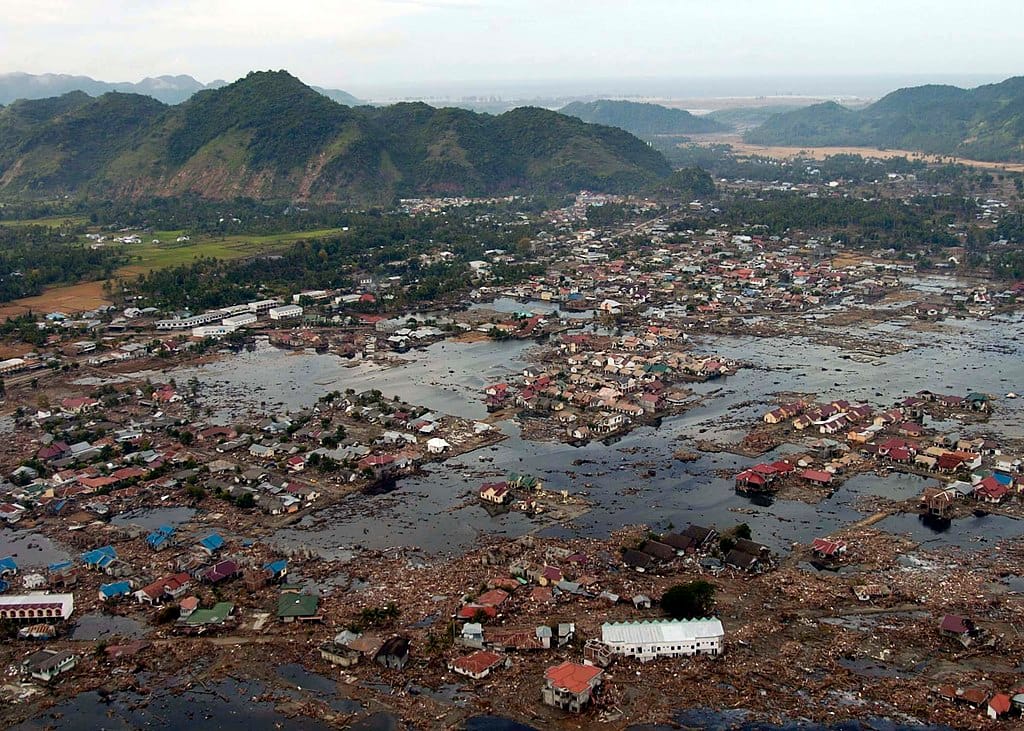
At around 9:15 a.m., the first wall of water struck – but it was only the beginning. Successive waves, some reaching heights beyond 10 meters, tore into homes, temples, and schools. The tsunami obliterated entire neighborhoods instantaneously. Many communities witnessed their built environment reduced to rubble within moments.
Witnesses recall a bone-deep silence preceding the waves—a haunting lull as the sea receded dramatically, drawing water far from shores in what was a natural but terrifying warning sign, often misunderstood or ignored.
The Relentless Surge: How the Tsunami Waves Unfolded
The tsunami’s destructive choreography followed a tragic pattern: receding waters, overwhelming surge, and then tidal backwash dragging debris and people back out to sea. Unlike waves caused by storms, these were disasters of slow-building tension, changing human perception of safety in an instant.
The multi-wave attack stretched for nearly two hours, invading inland areas up to two kilometers from the shoreline. Bridges collapsed, roads severed, and electricity lines fell, severing communication just as the humanitarian crisis unfolded.
Human Stories Amidst the Waves: Survivors and Tragedies
Amid the carnage, stories of human spirit emerged. A fisherman named Janaka, who spotted the sea’s eerie retreat and rushed inland with his family, survived against staggering odds. In contrast, the nearby community of Peraliya, where a crowded train was caught on the tracks by the tsunami, saw over 1,700 lives lost in what became known as one of the world’s worst rail disasters.
Children orphaned, families grieving their dead, and countless individuals driven to heroism or despair—these human accounts remain etched into Sri Lanka’s collective memory. They remind us that behind the staggering data points of death and destruction are real lives, hopes, and dreams swallowed by the water.
Government and Local Response: Chaos and Compassion
Initial government responses were hampered by fractured communications and the overwhelming scale of devastation. Sri Lanka’s military diverted efforts to rescue and relief, local officials coordinated shelter and care, but the sheer scale of damage exposed vulnerabilities in infrastructure and disaster readiness.
Yet the people of Sri Lanka, scarred but unbowed, mobilized swiftly—neighbors helping neighbors, communities forming makeshift shelters, Buddhist monks organizing aid and prayers. Local civil society’s resilience became vital in the immediate aftermath.
International Aid: A Global Wave of Solidarity
The tsunami’s scale and the graphic images broadcast worldwide sparked one of the largest humanitarian mobilizations in modern times. Countries from across the geopolitical spectrum sent medical aid, food, engineers, and financial support to Sri Lanka.
Organizations like the United Nations launched rapid response initiatives. Rescue teams from Australia, India, and the United States coordinated with local agencies to distribute relief, rebuild infrastructure, and restore basic services.
Impact on Sri Lanka’s Fishing Communities and Economy
The fishing industry along Sri Lanka’s coast absorbed a particularly brutal blow. Approximately 70,000 fishing boats were destroyed or damaged, leaving thousands without livelihood. Saltwater contamination ruined arable land, deepening food insecurity in the affected regions.
Tourism, a crucial pillar for Sri Lanka’s economy, temporarily collapsed in the wake of the disaster. The loss of life, infrastructure, and pristine beaches deterred visitors. Recovery of these sectors took years, with an emphasis on sustainable development and coastal management reforms.
The Role of Early Warning Systems: Missed Opportunities
One haunting question loomed large: could better warning have saved more lives? At the time, the Indian Ocean had no formal tsunami warning system. Japan, familiar with Pacific tsunamis, had limited reach here.
Following the disaster, intense international efforts focused on creating robust early warning capabilities. This included seismic networks, ocean buoys, and communication protocols designed to alert coastal populations within minutes.
Environmental Devastation and Coastal Transformation
Beyond human loss, Sri Lanka’s natural landscapes underwent dramatic alteration. Mangrove forests, coral reefs, and inland ecosystems suffered severe damage, their protective functions compromised.
Coastal erosion accelerated; saltwater intrusion affected freshwater aquifers. Scientists began studying how ecologically sensitive zones could be preserved to mitigate future tsunami impacts, highlighting the interdependence of environmental stewardship and disaster resilience.
Cultural Reverberations: Mourning and Memory in Sri Lankan Society
Buddhism’s emphasis on impermanence and compassion framed Sri Lanka’s collective mourning. Numerous rituals, ceremonies, and memorials arose, providing spiritual solace to survivors.
Poetry, music, and art emerged, capturing the tsunami’s emotional landscape. The disaster entered national discourse through public policy and education, embedding a shared narrative of loss and hope.
Rebuilding Lives: Recovery Efforts in the Aftermath
Rebuilding has been a Herculean task. Infrastructure reconstruction was accompanied by social programs focused on housing, education, and mental health.
International NGOs implemented projects emphasizing “build back better” philosophies—ensuring resilient construction and community engagement. Yet disparities persisted, especially for displaced and marginalized groups.
Political Consequences: Governance and Accountability
The tsunami exposed fissures in governance. Criticism arose over the speed and equity of aid distribution, inflaming ethnic and regional tensions in an already divided nation.
At the same time, the disaster spurred reforms — from enhanced disaster management agencies to community-based preparedness. For many politicians, the tsunami reshaped priorities and narratives around national unity.
Scientific Advancements Born from Catastrophe
Post-tsunami investigations yielded invaluable scientific insights. New understandings of megathrust earthquakes, wave propagation, and coastal impacts led to innovations in modeling and risk assessment.
Sri Lankan universities and research centers took active roles in disaster science, linking local knowledge with global expertise to fortify future preparedness.
The Indian Ocean Tsunami: A Catalyst for Regional Cooperation
Prior to 2004, the Indian Ocean region comprised diverse, often siloed nations. The tsunami galvanized unprecedented collaboration through forums like Indian Ocean Rim Association (IORA), sharing data and resources.
Regional early warning systems, including the Indian Ocean Tsunami Warning and Mitigation System (IOTWMS), became symbols of collective commitment to safeguarding millions.
Psychological Aftershocks: Trauma and Healing
Survivors faced not only physical loss but devastating psychological scars. Post-traumatic stress disorder affected many, manifesting in anxiety, depression, and social withdrawal.
Mental health services were integrated gradually into recovery programs, with traditional healing methods blending with modern counseling. Communities formed support groups, reaffirming the power of connection.
Lessons Learned: How 2004 Changed Disaster Preparedness
The tsunami served as a stark lesson in humility and urgency. Governments worldwide intensified focus on disaster risk reduction, investing in early warning, public education, and infrastructure adaptation.
For Sri Lanka, emboldened by resilience, the impetus shifted from reactive crisis management to proactive planning — a legacy that continues to evolve.
The Global Tsunami Warning System: Birth of a New Era
The United Nations and international agencies spearheaded a global tsunami warning initiative, linking oceans and continents through technology and policy.
By 2006, the Indian Ocean was equipped with seismic observatories and deep-ocean sensors capable of detecting tsunami events within minutes, a monumental step toward safeguarding vulnerable populations.
Revisiting the Coast: Memorials and Continuing Resilience
Today, Sri Lanka’s coastlines bear memorials—simple plaques, towering statues, and sacred sites honoring those lost. Annual remembrance ceremonies renew collective memory, inspiring adaptive measures.
Coastal communities have rebuilt homes elevated on stilts, mangrove replanting has restored natural buffers, and local advocacy groups champion sustainable coexistence with the sea.
The Tsunami's Place in Popular Memory and Media
Documentaries, films, and literature immortalize the 2004 tsunami’s impact. International attention shifted from statistics to stories, emphasizing individual experiences and cultural perspectives.
This narrative humanization fosters empathy and global solidarity, ensuring the disaster’s lessons endure beyond geography.
Why Sri Lanka? Geographic and Social Vulnerabilities Explored
Sri Lanka’s geographic position made it one of the first impacted by waves traveling westward from Sumatra. Its extensive coastline, chemical contamination of soils, and dependence on fishing intensified vulnerability.
Social inequalities, particularly affecting minority Tamil populations in the northeast, complicated relief efforts. Understanding these layers deepens appreciation of the tsunami’s complex legacy.
Legacy of Hope: NGOs and Community-led Initiatives Today
In the years since, a mosaic of grassroots organizations emerged to enhance disaster resilience and social welfare.
Projects focus on renewable energy, sustainable fisheries, and youth engagement, sowing seeds for a future where catastrophe is met with preparedness, solidarity, and hope.
Conclusion
The 2004 Sri Lanka coastal tsunami was an event of immense tragedy and profound transformation. It was a moment when nature’s fury met human vulnerability, yet also revealed our capacity for courage, compassion, and innovation.
The waves that tore through the coastline did not merely wash away homes and lives—they reshaped a nation’s consciousness and the world’s understanding of disaster. From sorrow was born a relentless drive toward resilience, a testament to the indomitable spirit woven into Sri Lanka’s social fabric.
Today, as ocean tides continue and lands bear the scars of that fateful morning, the story of the 2004 tsunami stands as a humbling reminder: that while we cannot always control the forces of nature, we can choose how to rise in their wake—together.
FAQs
Q1: What caused the 2004 Indian Ocean tsunami that struck Sri Lanka?
A1: The tsunami was triggered by a massive undersea earthquake along the Sunda megathrust fault near Sumatra, resulting from the Indo-Australian tectonic plate slipping beneath the Eurasian plate, displacing enormous volumes of seawater.
Q2: How many people died in Sri Lanka because of the tsunami?
A2: Approximately 35,000 people lost their lives in Sri Lanka, with tens of thousands more injured or displaced, making it one of the hardest-hit nations by human toll.
Q3: Why wasn’t there an early warning system for the tsunami in 2004?
A3: Unlike the Pacific Ocean, the Indian Ocean lacked a coordinated tsunami warning network at the time, primarily due to geopolitical fragmentation and limited investment in regional monitoring.
Q4: What were the immediate political repercussions in Sri Lanka after the disaster?
A4: The disaster exposed governance weaknesses and intensified ethnic tensions, but it also prompted reforms in disaster management policies and greater focus on equitable aid distribution.
Q5: How did the tsunami affect Sri Lanka’s economy, particularly the fishing industry?
A5: The destruction of thousands of fishing boats, coastal infrastructure, and contamination of land severely impacted the fishing industry and related economic activities.
Q6: What international efforts followed the disaster to help Sri Lanka?
A6: A massive international relief effort ensued, involving humanitarian aid from numerous countries, UN agencies, NGOs, and coordinated reconstruction projects.
Q7: How has Sri Lanka improved tsunami preparedness since 2004?
A7: Sri Lanka established early warning systems, improved community education on disaster risks, revitalized coastal ecosystems, and integrated disaster resilience into national planning.
Q8: How is the 2004 tsunami remembered culturally in Sri Lanka today?
A8: Through memorials, religious ceremonies, art, literature, and media, the tsunami’s memory remains a significant part of Sri Lanka’s cultural and historical narrative.