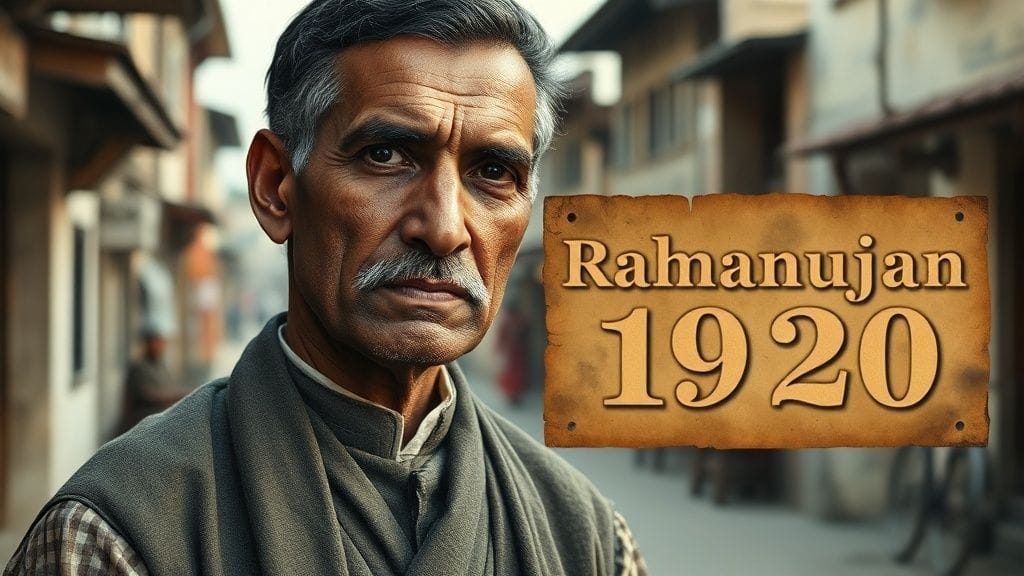
Table of Contents
- A Fateful Evening in Kumbakonam: The Last Days of Ramanujan
- The Enigma of Srinivasa Ramanujan: Genius Born in the South Indian Heartland
- Early Life Shadows: Poverty, Passion, and Mathematical Dreams
- The Silent Struggles: Illness and Isolation Amid Brilliance
- Ramanujan’s Journey to Cambridge: Crossing the Oceans of Skepticism
- Collaboration with G.H. Hardy: A Partnership Forged by Numbers
- Unveiling the Infinite: Ramanujan’s Groundbreaking Theorems
- The Return to India: Homecoming and Declining Health
- The Final Chapter: The Evening of April 26, 1920
- Medical Mysteries: Diagnosing Ramanujan’s Ailments
- The Cultural Landscape of Early 20th Century India: Context to a Tragic End
- Mourning a Mathematical Legend: India’s Grief and Reverence
- Legacy Beyond the Grave: Ramanujan’s Enduring Influence in Mathematics
- Personal Letters and Anecdotes: Glimpses into His Soul
- The Myth and Man: Separating Legend from Life
- The Global Reverberations: Ramanujan’s Work across Continents
- Ethos of Dedication: Lessons from Ramanujan’s Life and Death
- Remembering Ramanujan Today: Memorials, Celebrations, and Scholarship
- Conclusion: An Immortal Mind Lost Too Soon
- FAQs About Srinivasa Ramanujan’s Death and Legacy
- External Resource
- Internal Link
1. A Fateful Evening in Kumbakonam: The Last Days of Ramanujan
The humid air of Kumbakonam was thick with the scent of jasmine and impending rain as the sun slipped behind the temple spires on April 26, 1920. Inside a modest home on the outskirts of the town, Srinivasa Ramanujan, the prodigious mathematical genius, lay in fading silence. His breathing was shallow, each inhalation a fragile thread tethering him to life. Despite his youth — only 32 years old — his body was ravaged by malnourishment and illness. As dusk bled into night, the man who had once conjured infinite series and mystical formulas from thin air was succumbing to the relentless tide of disease. The final page of his extraordinary life was being written, quietly and with profound sorrow.
2. The Enigma of Srinivasa Ramanujan: Genius Born in the South Indian Heartland
The story of Srinivasa Ramanujan begins not in grand academic halls or bustling metropolises, but in the quiet town of Erode, Tamil Nadu. Born on December 22, 1887, Ramanujan's childhood was a paradox of simplicity and complexity. Raised in a deeply religious Brahmin family steeped in Tamil traditions, his genius was as much spiritual as it was mathematical. He saw numbers not just as symbols, but as mystical entities, believing that divine inspiration guided his insights. This cultural milieu — where the Vedas met the equations — set the stage for a mind that would challenge and expand the very foundations of mathematics.
3. Early Life Shadows: Poverty, Passion, and Mathematical Dreams
Ramanujan’s early years were marked by hardship. Despite his prodigious talent, formal recognition eluded him. Schooling was erratic; his obsession with mathematics often came at the cost of other subjects. By his late teens, he had produced independently a compendium of over 5,000 mathematical theorems and identities, many with little formal proof but brimming with originality. Yet, life’s harsh realities intervened: poverty, poor health, and familial pressure conspired to temper what should have been an uninterrupted ascent. For years, he remained in relative obscurity, his notebooks a treasure trove of secret marvels, waiting for the world to notice.
4. The Silent Struggles: Illness and Isolation Amid Brilliance
Behind the curtain of Ramanujan’s mathematical genius was a fragile human being. His physical health was precarious, worsened by malnutrition and relentless fatigue. His spiritual practices — rigorous and ascetic — seemed to co-exist uneasily with his bodily decline. His medical ailments were poorly understood by the standards of the day, compounded by the lack of adequate healthcare in colonial India. These health struggles isolated him. Most who encountered Ramanujan remarked on his intense focus and modest demeanor, unaware that beneath lay a warrior battling an invisible enemy.
5. Ramanujan’s Journey to Cambridge: Crossing the Oceans of Skepticism
At the behest of British mathematician G.H. Hardy, Ramanujan left India in 1914 for the University of Cambridge, a journey filled with personal sacrifice and cultural shock. The war had just erupted, and Europe was restless. Yet Ramanujan’s arrival marked a turning point: his theorems, once dismissed as eccentric, began receiving international attention. Hardy quickly recognized the genius in those apparently impenetrable formulas. The collaboration sparked a rare intellectual symbiosis. However, the cold English climate and wartime scarcity worsened his health and deepened his homesickness.
6. Collaboration with G.H. Hardy: A Partnership Forged by Numbers
The meeting between Hardy and Ramanujan remains one of the most celebrated in mathematical history. Hardy, the quintessential English rationalist, and Ramanujan, the mystic intuitive, combined rigor and inspiration in a partnership that produced revolutionary work on partitions, modular forms, and infinite series. Their correspondence reveals mutual respect and affection. Hardy once famously remarked that the odds of Ramanujan’s surviving a journey from home and the hardships of academia were slim, yet the man exceeded all expectations with his flair and undiminished creativity.
7. Unveiling the Infinite: Ramanujan’s Groundbreaking Theorems
Ramanujan’s work defied categorization. His theorems often lacked proof but were later validated, sometimes decades or even a century afterward. He contributed profoundly to number theory, continued fractions, hypergeometric series, and mock theta functions. Some of his results remain enigmatic to this day. The boundary between pure and applied mathematics blurred in his writings, inspiring later generations of mathematicians, physicists, and computer scientists. Yet these triumphant contributions concealed the cost of his lonely, war-shadowed years.
8. The Return to India: Homecoming and Declining Health
In 1919, after five arduous years in England, Ramanujan returned to India aboard the SS Dunera. His arrival was bittersweet. The care and lifestyle he needed to recuperate fully were hard to access. Though physically weak, his mind remained fertile. Unfortunately, his health steadily worsened — plagued by tuberculosis and perhaps hepatic amoebiasis — casting a dark shadow over the twilight of his life. Despite his ailments, Ramanujan continued contemplating mathematics, dictating theorems from his sickbed.
9. The Final Chapter: The Evening of April 26, 1920
On the evening of April 26, 1920, surrounded by family and friends, Ramanujan’s pulse faltered. His body, long betrayed by illness, finally gave way. The room was filled with quiet grief and spiritual solace. According to accounts, Ramanujan met death with an acceptance born of faith and intellectual detachment, whispering mathematical concepts even in his last moments. The light that had illuminated some of the most darkly mysterious corners of mathematics was extinguished far too soon, leaving the world to grapple with the magnitude of the loss.
10. Medical Mysteries: Diagnosing Ramanujan’s Ailments
The precise nature of Ramanujan’s illness has been debated for nearly a century. Contemporary doctors noted symptoms consistent with tuberculosis, but later scholarship suggests he may have suffered from hepatic amoebiasis, a parasitic liver disease endemic to Southern India. Medical resources at the time were inadequate, both in England and India, and cultural misunderstandings limited effective treatment. His malnutrition and overwork likely weakened his immune system. His death at such an early age underscores the fragility of genius captive to human vulnerability.
11. The Cultural Landscape of Early 20th Century India: Context to a Tragic End
Ramanujan’s death occurred amid a turbulent period in Indian history. The subcontinent was awakening under the stirrings of the independence movement, grappling with colonial subjugation, social hierarchies, and poverty. His trajectory as a Hindu Brahmin mathematician interacting with British scholars encapsulates the complex interplay of culture, race, and knowledge. Ramanujan’s life and death reflect broader colonial dilemmas: the promise of Indian intellect constrained by imperial structures and medical limitations.
12. Mourning a Mathematical Legend: India’s Grief and Reverence
News of Ramanujan’s death echoed through academic and popular circles. In Kumbakonam and beyond, tributes poured from students, academics, and admirers. Temples hosted prayers; newspapers commemorated his legacy. The Government of Madras created grants for mathematical studies in his name, while Cambridge mourned a prodigy lost. Yet, for many years, Ramanujan’s genius was a tale shared mostly within specialist communities, awaiting rediscovery by global audiences decades later.
13. Legacy Beyond the Grave: Ramanujan’s Enduring Influence in Mathematics
Ramanujan’s influence did not end with his death — quite the contrary. His notebooks, a lattice of unexplored theorems and computational patterns, continue to challenge and inspire. Fields as diverse as combinatorics, algebraic geometry, and mathematical physics have drawn upon his insights. The enigmatic mock theta functions he discovered only reached full recognition after being linked to modern string theory and quantum computations. Thus, Ramanujan’s mind lives on as a beacon in the ever-expanding universe of mathematics.
14. Personal Letters and Anecdotes: Glimpses into His Soul
Behind the mathematical marvel was a man of deep humility and faith. His letters to G.H. Hardy reveal a mixture of deference, playful wit, and frustration over his physical constraints. Friends recall his voracious appetite for knowledge paired with a simplicity of lifestyle. His strict adherence to vegetarianism and Hindu rituals added texture to his personality, framing him as both a scientist and a mystic. These humanizing fragments complicate any attempt to reduce him to a mere intellect.
15. The Myth and Man: Separating Legend from Life
The aura around Ramanujan is almost mythological — a poor boy touched by divine insight, a mathematical saint. While compelling, this narrative risks obscuring the hard work, perseverance, and complex personality behind the legend. By excavating historical documents, eyewitness accounts, and medical records, historians peel back the layers to reveal a figure shaped by his times, frailties, and an uncompromising devotion to his craft.
16. The Global Reverberations: Ramanujan’s Work across Continents
From Cambridge classrooms to American mathematical institutes and Japanese research centers, Ramanujan’s formulas transverse borders. His story contributed to a growing recognition of intellectual exchange in a colonial world, inspiring scholars in formerly colonized nations. As a symbol of native genius asserting itself under foreign dominance, Ramanujan’s legacy informs conversations on diversity, inclusion, and the decolonization of academic knowledge.
17. Ethos of Dedication: Lessons from Ramanujan’s Life and Death
Ramanujan's life embodies the tension between innate talent and external hardship. His relentless pursuit of knowledge despite poor health and material lack serves as a universal inspiration. Yet, his untimely death warns of the limits of human endurance and the necessity of support systems for nurturing genius. His story challenges educators, policymakers, and societies to create environments where brilliance can flourish sustainably.
18. Remembering Ramanujan Today: Memorials, Celebrations, and Scholarship
Today, cities like Kumbakonam and Chennai honor Ramanujan with statues, museums, and annual festivals. International conferences celebrate “Ramanujan’s Centenary Lectures,” and prestigious awards carry his name. Technological advancements allow digitization of his notebooks, providing newer generations access to his insights. The continued interest in his life and work reflects a profound respect for a mind that bridged worlds, culture, and centuries.
19. Conclusion: An Immortal Mind Lost Too Soon
As night fully enveloped Kumbakonam on that fateful April evening, a star dimmed in the vast firmament of human knowledge. Srinivasa Ramanujan’s death was not merely the loss of a brilliant mathematician — it was the silencing of a unique voice that harmonized numbers with the cosmos. Yet, like the infinite series he loved, his legacy continues to unfold, an immortal testament to the power of passion, faith, and intellect entwined. His story is a poignant reminder of the fragile beauty of genius and the enduring human quest to understand the universe.
FAQs
Q1: What illnesses led to Srinivasa Ramanujan’s death?
A1: Ramanujan suffered primarily from tuberculosis, a common and often fatal disease at the time. Recent studies also suggest hepatic amoebiasis (a parasitic liver infection) may have contributed. Malnutrition and general poor health compounded his condition.
Q2: How did Ramanujan’s cultural background influence his work?
A2: Raised in a Hindu Brahmin family deeply engaged with religious rituals and spiritual motifs, Ramanujan viewed mathematics as a divine revelation rather than pure logic alone, blending intuition with numerical rigor.
Q3: What was the significance of Ramanujan’s collaboration with G.H. Hardy?
A3: Hardy provided Ramanujan with formal mathematical frameworks, validation, and international exposure, while Ramanujan offered unique insights that expanded contemporary mathematics, making their partnership historically invaluable.
Q4: How was Ramanujan’s death perceived in India and abroad?
A4: In India, his passing evoked mourning and reverence, symbolizing a native genius struck down too soon. Globally, mathematicians remembered him as a prodigy lost in his prime, lamenting the unrealized potential.
Q5: Why is Ramanujan still relevant in today’s mathematical research?
A5: His theorems and discoveries remain sources of inspiration and practical applications in number theory, computer science, and theoretical physics, with ongoing research uncovering new depths in his work.
Q6: Are there memorials or institutions dedicated to Ramanujan?
A6: Yes, there are statues, museums, and academic institutes in India and internationally that honor Ramanujan. Annual lectures, scholarships, and awards celebrate his contribution to mathematics.
Q7: How do historians separate the myth from the man in Ramanujan’s story?
A7: By critically examining primary sources, correspondence, medical reports, and cultural contexts, historians strive to understand Ramanujan as a complex individual beyond the popular legend of divine genius.
Q8: What lessons does Ramanujan’s life offer for nurturing talent today?
A8: His life highlights the need for supporting gifted individuals holistically — balancing intellectual development with health, socio-economic aid, and emotional wellbeing — to sustain genius rather than lose it prematurely.

